




Abstract
We present a largescale, preregistered examination of factors that explain why citizens of certain nations might show higher levels of national narcissism than others. National narcissism is the belief that one’s nation is exceptional yet undervalued. It is related to several social ills, including conspiracy beliefs, intergroup aggression, extremism, and rejection of science. We theorized that national narcissism would be related to the nature of relations between countries. We expected it to be associated with higher levels of external conflict and lower levels of globalization. Using multilevel modeling across 56 countries (n = 50,757), we found that citizens of less globalized nations showed higher average national narcissism. However, external conflict was unrelated to national narcissism. We also tested whether citizens’ national narcissism was higher in countries led by populists but found no evidence for this effect. At the individual level, higher individual narcissism, self-esteem, and right-wing political orientation positively predicted higher national narcissism.
Collective narcissism is a belief that one’s social group is exceptional and entitled to special treatment but not appreciated enough by others (Golec de Zavala et al., 2009). It is typically studied in relation to one’s national group (e.g., Cai & Gries, 2013; Cichocka & Cislak, 2020; Golec de Zavala et al., 2019), in which case it is termed “national collective narcissism,” or more simply, “national narcissism.” National narcissism goes beyond the nationalistic conviction that one’s nation is superior (Bieber, 2018; Kosterman & Feshbach, 1989). This superiority needs to be recognized and respected by others (Golec de Zavala et al., 2009, 2019). National narcissistic rhetoric can be observed in populist political slogans such as Trump’s call to “Make America Great Again” or the Brexit rallying cry of “Take back control” (Fukuyama, 2018). The rise of such rhetoric has spurred a growing literature on the causes and consequences of national narcissism.
Studies conducted across a range of socio-political systems indicate that national narcissism is associated with important political outcomes. Those high in national narcissism see enemies both within and beyond their nation: they show higher levels of prejudice and intergroup hostility (Cichocka et al., 2022; Golec de Zavala et al., 2009, 2013; Marchlewska et al., 2020), are more likely to endorse and disseminate conspiracy theories (Cichocka, Marchlewska, Golec de Zavala, & Olechowski, 2016; Golec de Zavala & Federico, 2018; Sternisko et al., 2021), while also supporting antiscience (Bertin et al., 2021; Cislak, Marchlewska, et al., 2021) and antienvironmental policies (Cislak et al., 2018; Cislak, Cichocka, et al., 2021). Overall, national narcissism has been linked to lower respect for democratic principles (Gronfeldt et al., 2021; Marchlewska et al., 2022), lower social cohesion, and prioritizing group reputation over citizens’ well-being (Cichocka, 2016; Cichocka & Cislak, 2020; Cislak, Cichocka, et al., 2021; Gronfeldt et al., 2022).
To date, research on the roots of collective narcissism has focused primarily on the characteristics of individuals. Studies suggest that low self-esteem (Golec de Zavala et al., 2020) and low feelings of personal control (Cichocka et al., 2018) foster collective narcissism. A belief in one’s ingroup’s underappreciated greatness seems to be an attempt to compensate for one’s dissatisfaction with oneself (e.g., Adorno, 1963/1998; Cichocka, 2016; Fromm, 1973). However, little is known about country-level characteristics that might help explain why citizens of some countries display higher (or lower) levels of narcissistic national identity on average. Here, we address this question using a unique survey spanning 56 countries (van Bavel et al., 2022).
One’s social groups (e.g., nations) operate within broader intergroup hierarchies that determine how they relate to other groups (e.g., the international system of trade and alliances). These systems have differential effects on their constituent groups, creating contextual variation in group outcomes. There are reasons to believe that these contextual intergroup differences might be reflected in citizens’ levels of national narcissism. Specifically, citizens’ national narcissism might result from negative intergroup experiences (such as rejection or victimization) that nations have experienced. A belief in a great-yet-underappreciated nation might help compensate for any threat stemming from thinking a nation’s (mis)treatment is legitimate or justified (e.g., Marchlewska et al., 2018). Thus, we argue that citizens’ levels of national narcissism will differ systematically across nations, depending on these nations’ experiences in the international arena and their citizens’ perceptions of those experiences.
We focus on two key contextual factors that should be associated with citizens’ levels of national narcissism. 1 First, it has been theorized that national narcissism should go hand in hand with experiences of exclusion (Golec de Zavala et al., 2020). Feeling excluded or ostracized can take a psychological toll on the individual (e.g., Williams, 2007). Research suggests that people become especially distressed or defensive when feeling rejected by members of other groups—viewing such situations as unjust or discriminatory (Mendes et al., 2008). These feelings might be alleviated by a conviction that others simply do not recognize one’s group’s true worth. In this way, people can avoid placing blame for rejection on themselves or their group characteristics.
At the individual level, there is evidence that national narcissism increases following a game in which participants observe an ingroup member being ostracized (Golec de Zavala et al., 2020). National narcissism has also been linked to a belief that national achievements are being purposefully ignored or underappreciated internationally (Cichocka, Marchlewska, Golec de Zavala, & Olechowski, 2016; Golec de Zavala et al., 2016). Extending this pattern to the nation-level, nations in which people feel relatively more excluded from the international order may show a more narcissistic national identity on average. Thus, we predict that national narcissism will be higher among citizens of nations that are relatively less integrated in international networks of trade, culture, technology, and governance—that is, those that are less globalized (Gygli et al., 2019; Norris, 2020).
Second, collective narcissism has been theorized to be stronger in the context of intergroup conflicts, when people feel that their group is victimized, or disadvantaged (which is distinct from the feelings of exclusion discussed above; Golec de Zavala et al., 2009, 2019). National narcissism specifically has been linked to perceptions of collective victimhood (Skarżyńska & Przybyła, 2015) and more general beliefs that the ingroup is on the losing side in intergroup contexts (Cislak et al., 2020). A study in the United Kingdom found that national narcissism increased when participants were presented with a vignette describing their country as being long disadvantaged by the EU (compared with a neutral condition, Marchlewska et al., 2018). Perceptions of relative ingroup disadvantage have also been associated with national narcissism in Poland and the United States (Marchlewska et al., 2018; see also Sengupta et al., 2019).
Although it is difficult to gauge subjective indices of societal-level perceived disadvantage, we expect citizens of countries engaged in external conflicts to view their nation as relatively deprived. This is because groups involved in conflicts often experience a deep sense of victimhood, regardless of their role in the conflict (Bar-Tal et al., 2009; Noor et al., 2012). The development of a positive, even entitled, group image is also thought to facilitate engagement in morally questionable acts in conflicts (Bar-Tal, 1998)—national narcissism might then develop as a justification for going after the enemy. Thus, we generally predicted that engagement in external conflicts would be associated with higher citizens’ national narcissism.
Past research on national identities across countries provides some indication that country-level exclusion and disadvantage might be related to citizens’ national narcissism in the direction we predict. For example, national pride was higher in countries exposed to terror or suffering deaths from external conflicts (Ariely, 2017). National pride (but not nationalism, measured as feelings of national superiority) was also higher in less globalized countries (Ariely, 2012; see also Bekhuis et al., 2014; Norris & Inglehart, 2009). However, this work has not examined the defensive aspects of national identity captured by national narcissism. Because national narcissism assumes a positive evaluation of one’s group, it tends to be moderately associated with general measures of national identification, which could be defined as the “positive emotional valuation of the relationship between self and in group” (Postmes et al., 2013, p. 599). Therefore, in this work, we test the effects for national narcissism, accounting for its conceptual overlap with national identification.
Finally, we examine associations between national narcissism and populism. In 2020, there were three times as many populist leaders and parties in power than at the turn of the century (Kyle & Meyer, 2020). The rise of national populism seems to be accompanied by a rhetoric that demands greater recognition of the exceptionalism of one’s nation, and indeed past work has shown that national narcissism predicts support for populist leaders and politicians (Marchlewska et al., 2018). In the United States, it was associated with support for Donald Trump (Federico & Golec de Zavala, 2018), in Poland—with support for the ultraconservative Law and Justice Party (Marchlewska et al., 2018), and in Hungary—with support for the Fidesz party of Viktor Orbán (Lantos & Forgas, 2021). These effects are typically observed over and above factors such as partisanship and political ideology (Federico & Golec de Zavala, 2018; Marchlewska et al., 2018). We tested the hypothesis that citizens of countries governed by populists would score higher on national narcissism than citizens of countries where populists were not in power at the time of data collection.
Method
Participants and Procedure
To provide a systematic analysis of national narcissism across countries, we used data from the International Collaboration on Social and Moral Psychology: COVID-19 (Azevedo et al., 2022; van Bavel et al., 2022), which examined psychological factors related to the coronavirus pandemic in 67 countries (n = 51,089). In line with our preregistrations (https://aspredicted.org/e8hs2.pdf and https://aspredicted.org/pz6gd.pdf), we excluded data from countries with N<90. Our final sample thus consisted of 56 countries (n = 50,757, Mean age = 42.95, SD = 16.06; 51.8% women, 47.9% men). This ensured a sufficient level-two sample size for multilevel modeling (Maas & Hox, 2005). The study was approved by an ethics committee. Additional information about the dataset, data preparation, and preanalyses are presented in the Supplement.
Individual-Level Measures
Unless noted otherwise, participants responded to all items on a 0–10 slider scale from strongly disagree to strongly agree. All multi-item measures were reliable both within (αw) and between (αb) levels (calculated following the recommendations of Geldhof et al., 2014).
National Identity Measures
National narcissism was measured with the three-item, ultrashort version 2 of the Collective Narcissism Scale (Golec de Zavala et al., 2009) proposed by Ardag (2019), for example, “[My national group] deserves special treatment.,”αw =.83, αb = .98. National identification was measured with two items: “I identify as [nationality]” (Postmes et al., 2013) and “Being a [nationality] is an important reflection of who I am,”αw =.80, αb = .85.
Individual-Level Controls
We preregistered the inclusion of several covariates as robustness checks. Because Golec de Zavala and colleagues (2020) have linked national narcissism to low self-esteem, we planned to account for individual-level self-esteem measured with a single item (Robins et al., 2001): “I have high self-esteem.” Because past research has shown that collective narcissism tends to be weakly to moderately correlated with individual narcissism (e.g., Cichocka, Marchlewska, & Golec de Zavala, 2016; Golec de Zavala et al., 2009, 2019), we controlled for this trait measured with the Narcissistic Admiration and Rivalry Questionnaire (Back et al., 2013), which includes six items, such as “I deserve to be seen as a great personality” or “I want my rivals to fail,”αw =.76, αb = .89. Because we were interested in the effects of experiences of exclusion, we also decided to adjust for social belonging measured with the General Belongingness Scale (Malone et al., 2012), with items such as “I feel accepted by others” or “When I’m with other people, I feel included,”αw =.84, αb = .96. Finally, we adjusted for political ideology, measured on a scale from 0 (extremely liberal/left-leaning) to 10 (extremely conservative/right-leaning).
Demographics
Participants were asked to indicate their gender (male, female, other), age, marital status (single, in a relationship, married), and employment status (employed full-time, employed part-time, unemployed, student, retired, other). Gender, marital, and employment status were dummy coded with the first category used as a reference group.
Country-Level Indices
Key Country-Level Predictors
Data on country-level characteristics were collected from established databases.
Globalization
To measure globalization, in the confirmatory analyses, we used the overall KOF Globalization Index (Gygli et al., 2019). The index measures three dimensions of globalization: economic (long-distance flows of goods, capital, services, information and perceptions accompanying market exchanges), political (diffusion of government policies), and social (the spread of ideas, information, images, and people; Dreher et al., 2008; Gygli et al., 2019). We preregistered conducting exploratory analyses for each dimension of globalization.
External conflict was operationalized with three subindices of the 2020 Global Peace Index, which comprises 23 qualitative and quantitative indicators from various sources on safety and security, domestic or international conflict, and militarization (The Institute for Economics and Peace, 2020). 3 We preregistered to use the average of the “neighboring countries relations,”“external conflicts fought,” and “deaths from external conflict” indices. 4
Populism
To code whether countries were led by populists, we relied on the Populism in Power database (Kyle & Meyer, 2020). We updated the coding in the case of Slovakia, where the government changed to populist between the report publication and our data collection. The Populism in Power database distinguishes three types of populist leadership: antiestablishment (claiming that the establishment elites are the enemy of the people), socio-economic (claiming that true, hard-working citizens are exploited by big business), and cultural (claiming that native members of the nation are the true people threatened by outsiders). We preregistered exploratory analyses checking for the effects of each of these types.
Country-Level Controls
Because our main analyses focused on perceived exclusion and disadvantage, we wanted to control for objective indices of wealth and power. We operationalized these in two ways. We included GDP per capita as an indicator of the nation’s overall living standard (we used the most recent data available at https://data.worldbank.org as of June, World Bank, 2020). We also coded for nations’ power with the use of the 2020 Global Fire Power PwrIndx, which measures each nation’s potential war-making capabilities (Global Firepower, 2020). Higher scores indicate lower Firepower. Finally, given past research linking within-country inequality with higher levels of nationalism (but not identification, Staerklé et al., 2010), we controlled for economic inequality with the latest available World Bank (2021) Gini coefficient (data available at https://data.worldbank.org/ as of January 2021).
Results
Preliminary Analyses
Mean levels of national narcissism and other individual and country-level variables as well as correlations between these variables are presented in Table 1. Figure 1 illustrates mean levels of national narcissism in different samples (see Supplemental Table S1 in the Supplement for detailed descriptive statistics for each country).
Summary Statistics and Correlations for Continuous Measures.
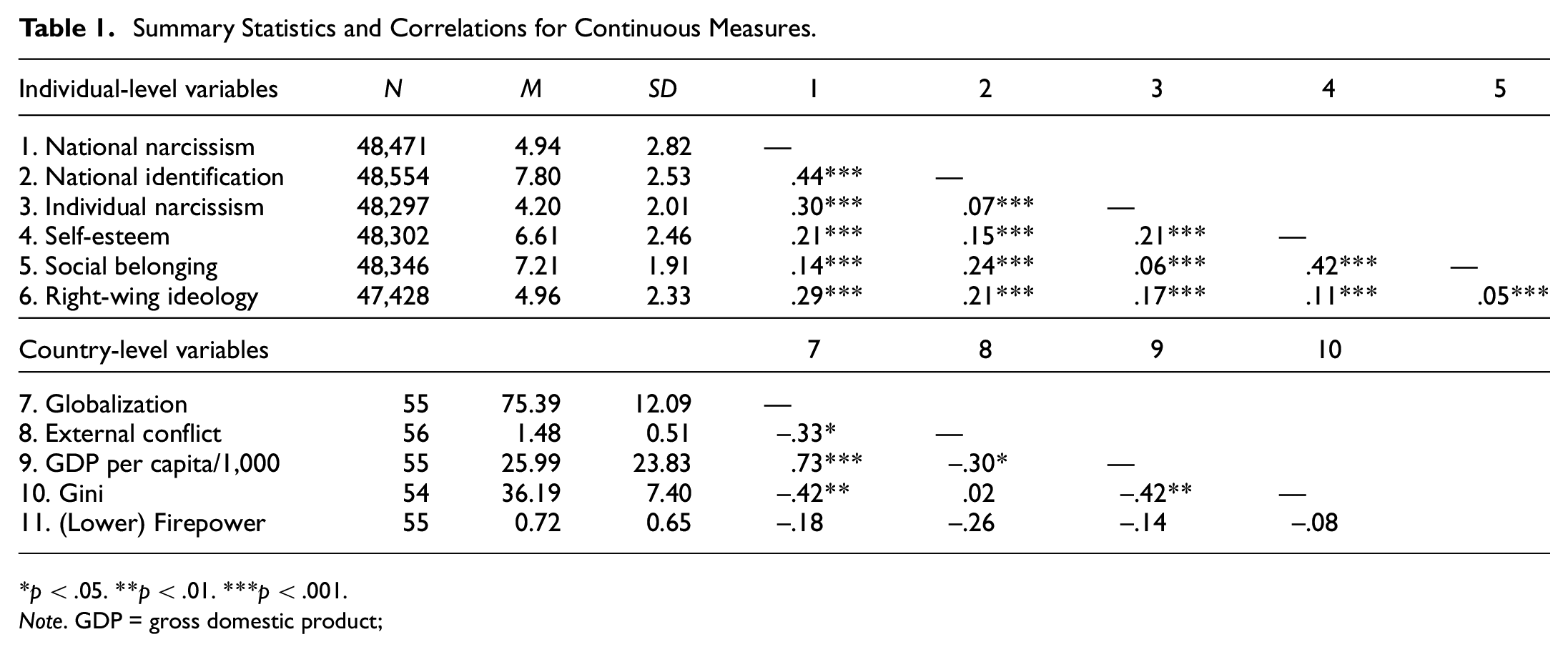
p < .05. **p < .01. ***p < .001.
Note. GDP = gross domestic product;
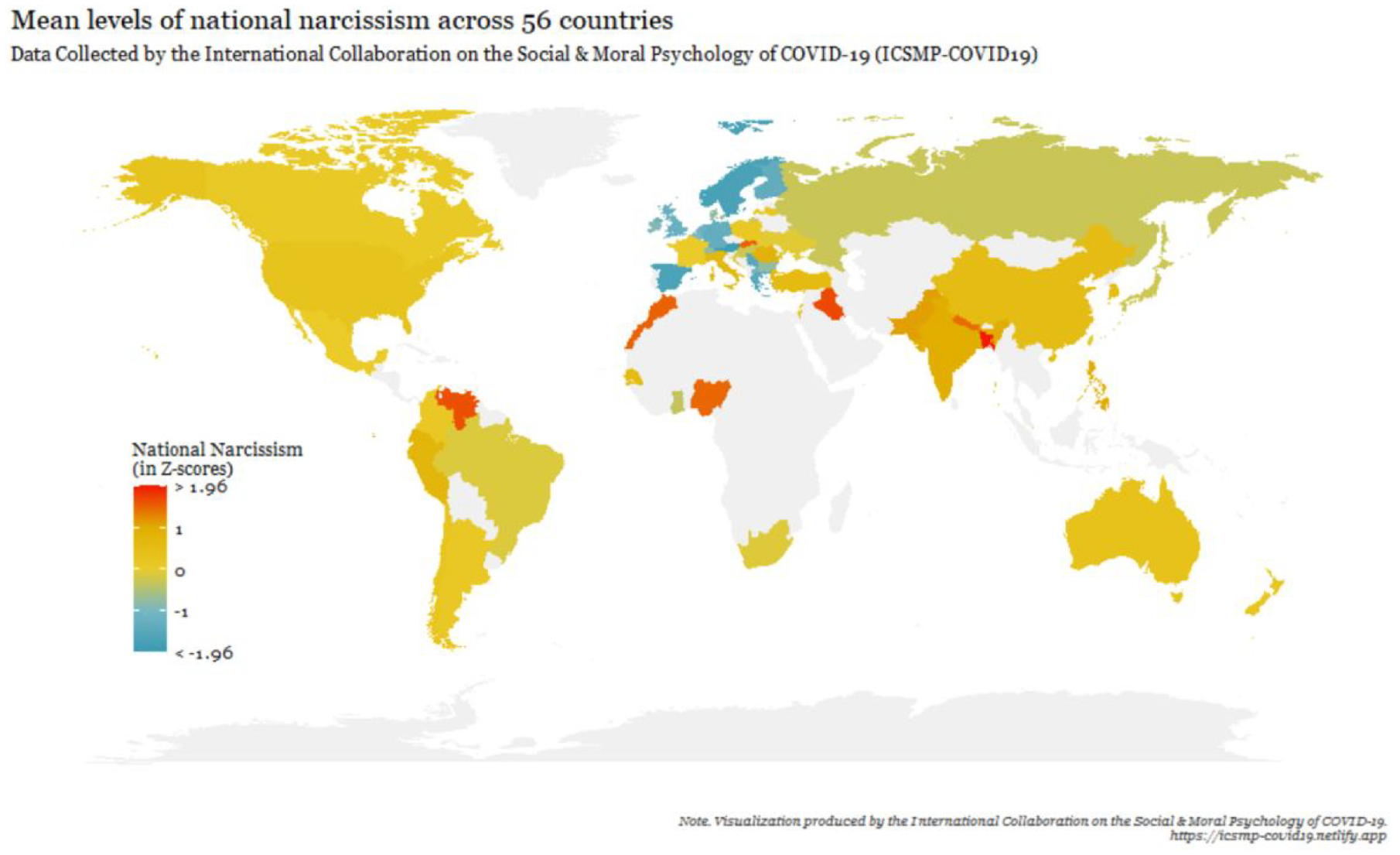
Mean Levels of National Narcissism Across 56 Countries.
Cross-National Analyses
Pre-Registered Confirmatory Analyses
We tested our hypotheses using multilevel regression models (which exclude countries with missing country-level indices). Data and code are available at: https://osf.io/4u7bs/. Using Mplus version 7, we first fit empty multilevel models that estimated the variance of national narcissism separately at the between level (i.e., how much it varies between countries) and the within level (i.e., how much it varies within countries, on average). The between-level residual variance estimate was significantly >0, variance = 2.033, SE = .311, p < .001, 95% CI = [1.43, 2.64], indicating that there were differences across countries in national narcissism. This showed that multilevel modeling of the predictors of national narcissism was justified. We, therefore, proceeded to estimate multilevel path models to test our preregistered hypotheses regarding the country-level predictors of national narcissism.
In line with our preregistration plan, we first estimated a model in which globalization and external conflict were entered as predictors of national narcissism at the between level. To account for the conceptual overlap between national identification and national narcissism, all predictors were simultaneously regressed on national identification, while adjusting for its residual covariance with national narcissism. Due to missing globalization data for Taiwan, this model included 55 countries, average cluster size = 874.38, intraclass correlation coefficient for outcome = .25, loglikelihood = −216,134.109, Akaike information criterion = 432,292.218, Bayesian information criterion = 432,397.588. Globalization showed a significant negative association with national narcissism, β = −.70, b = −0.08 [−0.10, −0.06], SE = 0.01, p < .001 (Figure 2). Thus, we found evidence in support of our hypothesis that national narcissism is lower in more globalized countries.
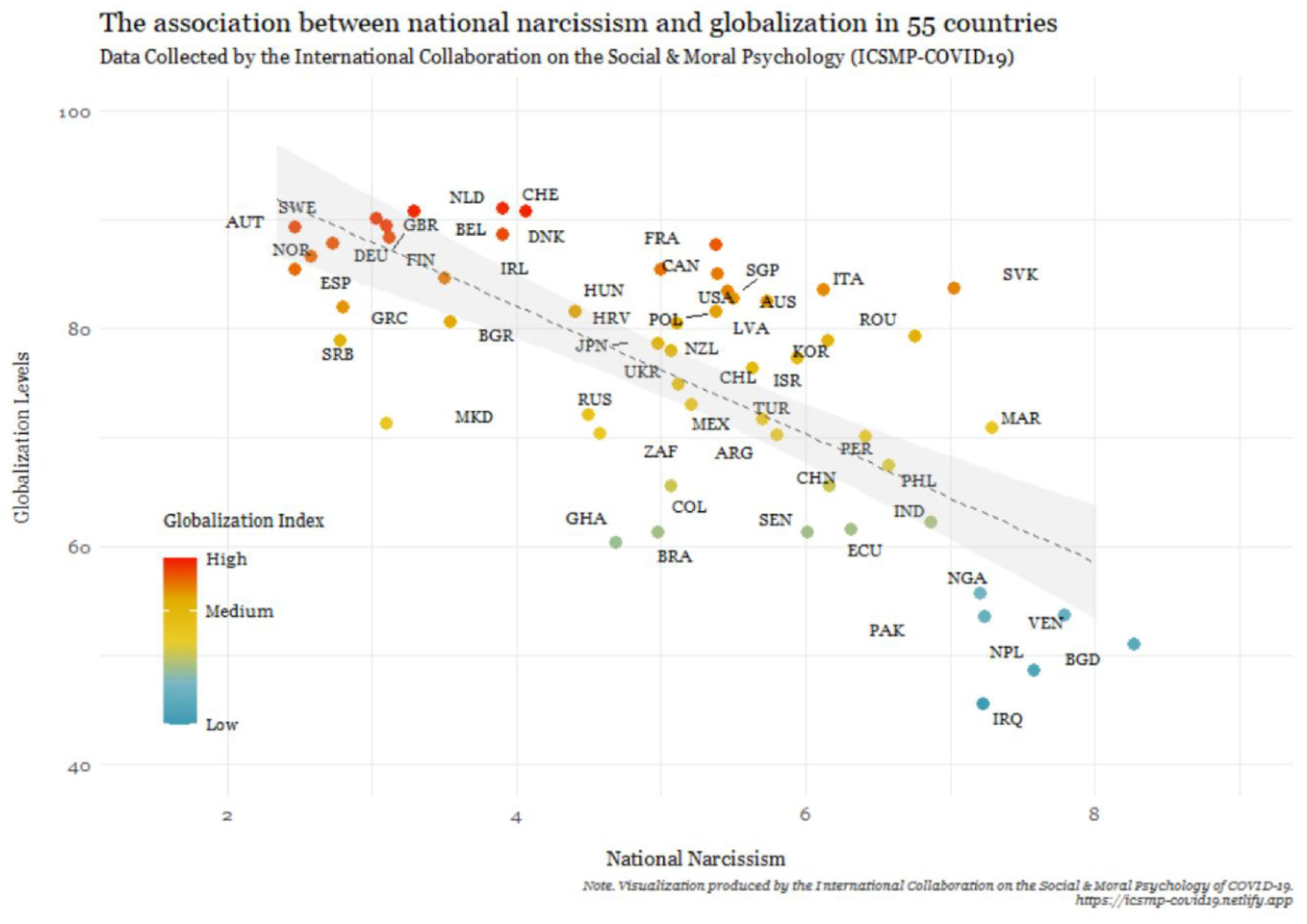
The Association Between National Narcissism and Globalization in 55 Countries.
However, we found that external conflict was unrelated to national narcissism, β = .03, b = 0.09 [−0.34, 0.51], SE = 0.22, p = .69. Thus, we found no support for our hypothesis that countries with more conflictual relations with other countries will show higher average levels of national narcissism.
Next, in line with our updated preregistration, we also added populist leadership as a predictor of national narcissism. Populism was unrelated to national narcissism, β =.16, b = 0.52 [−0.20, 1.23], SE =0.36, p = .16, while the other two effects remained very similar when it was accounted for: globalization showed a significant negative association, β = −.70, b = −0.08 [−0.10, −0.07], SE = 0.01, p < .001, while the effect for external conflict remained nonsignificant, β = −.003, b = −0.01 [−0.44, 0.42], SE = 0.22, p = .97. Thus, we found no evidence that countries with populist leaders would be higher on national narcissism.
Finally, we added preregistered within-level and between-level covariates to the model to test if our focal results held when adjusting for other theoretically relevant constructs, sample type as well as demographics. Accordingly, we added sample representativeness, GDP, the Gini coefficient, and the Global Firepower as predictors at the country level (see Table 2).
Multilevel Regression With National Narcissism as a Criterion.
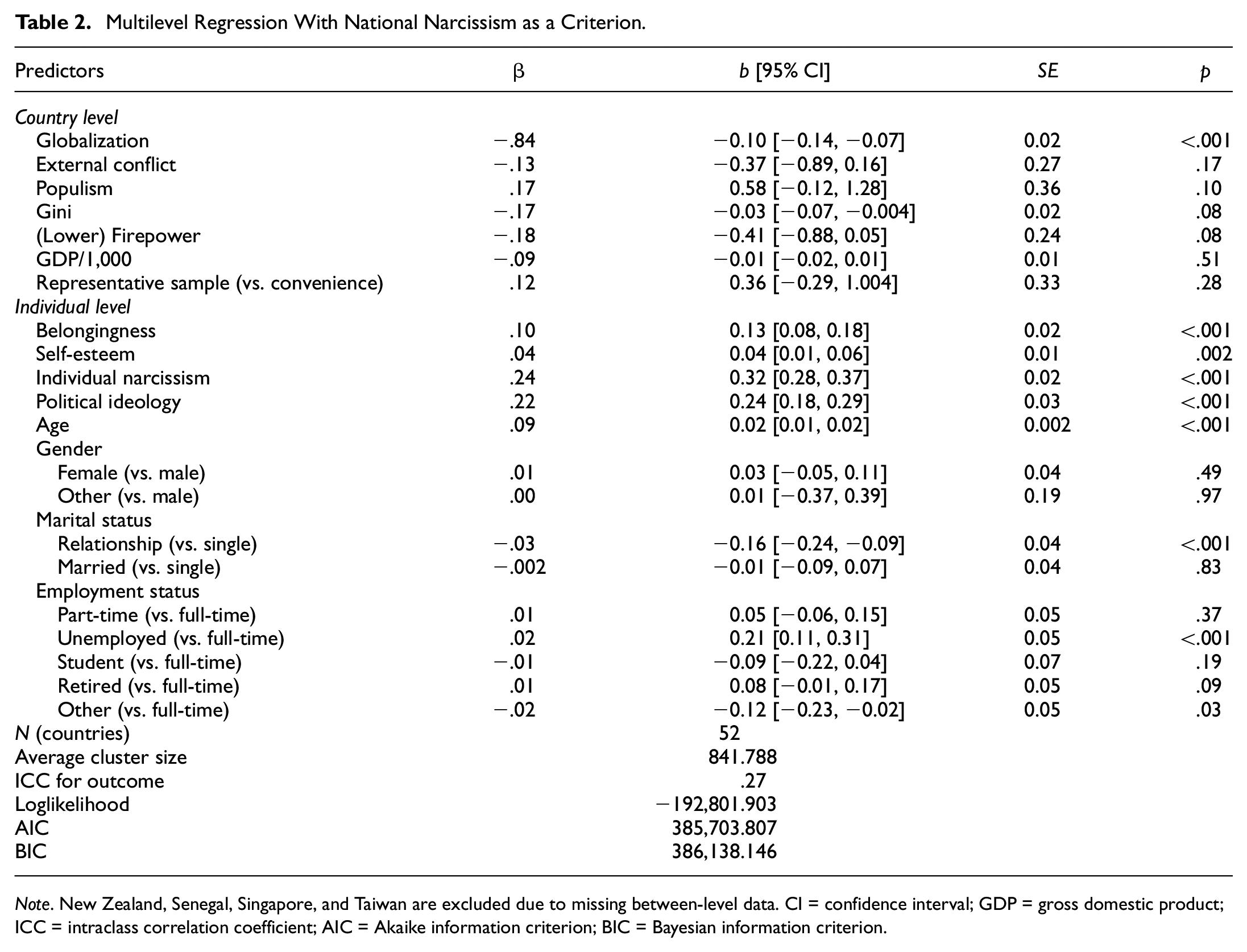
Note. New Zealand, Senegal, Singapore, and Taiwan are excluded due to missing between-level data. CI = confidence interval; GDP = gross domestic product; ICC = intraclass correlation coefficient; AIC = Akaike information criterion; BIC = Bayesian information criterion.
We also added age, gender, marital status, employment status, left-right political ideology, self-esteem, narcissism, and social belonging as predictors at the within-level. Notably, national narcissism was related to higher narcissism, self-esteem, right-wing political orientation, and higher social belonging (Table 2).
As shown in Table 2, including these covariates did not change the significance levels for the focal between-level predictors in the model (i.e., globalization, external conflict, and populism). In other words, the model including covariates did not find evidence for the effect of conflict relations or populism on national narcissism. However, the model supported our hypothesis that more globalized nations show lower national narcissism. Crucially, these associations held adjusting for the residual covariance with national identification, a more secure attachment to the nation.
The results for national identification as the second criterion variable showed that it was also significantly negatively associated with globalization, β = −.56, b = −0.04 [−0.06, −0.03], SE = 0.01, p < .001, but it was unrelated to external conflict, β = .08, b = 0.15 [−0.11, 0.40], SE = 0.13, p = .27 (in the first model), or populism, β = .14, b = 0.30 [−0.11, 0.70], SE = 0.21, p = .15 (added in the second model). Results for the model with covariates are reported in the Supplement.
Preregistered Exploratory Analyses 5
Analyses for Different Dimensions of Globalization
We included the three dimensions of globalization as predictors in Model 3 (i.e., including all covariates). We found that national narcissism was negatively predicted by the economic β = −.48, b = −0.04 [−0.07, −0.02], SE = 0.01, p = .002, and political β = −.35, b = −0.06 [−0.09, −0.03], SE = 0.02, p = .001, dimension, but not the social one, β = −.10, b = −0.01 [−0.04, 0.02], SE = 0.02, p =.51.
Analyses for Different Types of Populism
We included dummy coded indices of the three types of populism in Model 3 (with nonpopulist leadership as reference). None of these types of populist leadership was associated with national narcissism: antiestablishment β = .11, b = 0.86 [−0.78, 2.51], SE = 0.84, p = .30, socio-economic β = .05, b = 0.41 [−0.07, 0.89], SE = 0.24, p = .09, and cultural β = .05, b = 0.19 [−0.54, 0.92], SE = 0.37, p = .61.
Non-preregistered Analyses
Our main analyses control for the residual covariance between national narcissism and identification. However, researchers often co-vary out their shared variance as the two variables often suppress each other (Cichocka, Marchlewska, Golec de Zavala, & Olechowski, 2016; Golec de Zavala, Cichocka, & Bilewicz, 2013; Golec de Zavala et al., 2020). Therefore, we repeated our analyses, including national narcissism and identification as additional within and between-level predictors in Model 3. Results indicated that when controlling for identification in the model, the effect of globalization on national narcissism remained significant, β = −.43, b = −0.05 [−0.09, −0.02], SE = 0.02, p = .001. However, when controlling for national narcissism in the model, the effect of globalization on identification was no longer significant β = −.22, b = −0.02 [−0.04, 0.004], SE = 0.01, p = .11 (see the Supplement for more details).
Discussion
Leveraging a unique dataset with large samples from 56 countries, we sought to shed light on why citizens of some nations might have a more narcissistic identity than others. In line with our preregistered hypothesis, we found that higher levels of globalization were associated with lower citizens’ national narcissism. This effect remained strong and significant after accounting for the overlap between national narcissism and national identification. It was also unaffected by adjusting for other country-level factors, such as the GDP, Gini, military strength, or engagement in conflict, as well as for the person-level factor of social belonging. Exploratory analyses demonstrated that the effect may specifically be due to the economic and political dimensions of globalization. Overall, these findings highlight the importance of modeling contextual variation in national narcissism across countries and suggest that the nature of relations between countries might shape the nature of national identity within countries.
Our results are in line with past work showing that national pride is higher in less globalized countries (Ariely, 2012). However, our study suggests that this effect seems especially pronounced for narcissistic forms of national identity. Lower level of globalization, which implies that one’s nation is more isolated, might be accompanied by the need to boost the nation’s image by signaling that others do not recognize its greatness. In this way, people can explain why their nation is not being included in international processes. In contrast, higher globalization implies a greater degree of “interaction and integration among the peoples, companies, and governments of different nations” (Chiu et al., 2011, p. 644), which can lead to “deprovincialization” (i.e., an appreciation that a nation’s norms and customs are not necessarily superior to those of others; Pettigrew, 1998).
Importantly, less globalized countries are also less likely to profit from the economic benefits of globalization. However, we did not find similar effects for per capita GDP, which suggests that national narcissism might be linked to feelings of exclusion, rather than objective economic disadvantage. These results also highlight differences between individual and collective narcissism: while individual narcissism and sense of entitlement seem to be linked to personal wealth and status (Piff, 2014; Young & Pinsky, 2006), we found no evidence for country-level wealth or status being related to citizens’ national narcissism.
As we relied on cross-sectional data, our ability to make causal inferences is limited. Our causal interpretation is consistent with past work showing that national narcissism increased in response to individual experiences of ingroup exclusion (Golec de Zavala et al., 2020). However, it is also plausible that citizens’ national narcissism limits globalization: in past work, national narcissism predicted skepticism toward supranational organizations (Cislak et al., 2020; see also Gries et al., 2015; Marchlewska et al., 2018). Thus, our results might provide a snapshot of a reciprocal process that could be tested in future longitudinal research.
Contrary to our predictions, we did not find citizens’ national narcissism to be higher in less peaceful countries. Past research suggests that national narcissism might be related to higher perceptions of threat, even if this threat is not objectively present (Golec de Zavala et al., 2016, 2019). Although we assumed that citizens of societies engaged in conflicts would experience threat and disadvantage regardless of their role in the conflict (Bar-Tal et al., 2009), recent evidence suggests that state representatives can use victim claims in conflict selectively (Markiewicz & Sharvit, 2021). It is then plausible that national narcissism would be more closely associated with subjective perceptions of victimhood, strategically employed by leaders, than with conflict engagement.
Although it can be speculated that the rise of national populism has been associated with an increase in the use of rhetoric that calls for a greater recognition of the exceptionalism of one’s nation, we also did not find evidence for citizens’ national narcissism to be higher in countries governed by populist leaders, regardless of the specific flavor of populism. However, this does not contradict research showing that individual levels of national narcissism might predict populism support within each country (e.g., Lantos & Forgas, 2021; Marchlewska et al., 2018). Additional factors beyond average societal levels of national narcissism, such as the nature of the political system, will determine whether populists actually assume power (Kyle & Glutchin, 2018).
Our data also provided an opportunity to test person-level predictors of national narcissism within societies. In line with past research (e.g., Cichocka, Marchlewska, & Golec de Zavala, 2016; Golec de Zavala et al., 2009, 2019), national narcissism was associated with higher grandiose narcissism. Thus, it seems that the feelings of entitlement and self-importance associated with individual narcissism (Back et al., 2013; Krizan & Herlache, 2018) might extend to the group level (Bizumic & Duckitt, 2008). Unlike Golec de Zavala and colleagues (2020), we also observed that national narcissism was (weakly) positively associated with self-esteem.
This work is of course not free from limitations. As this study was part of a much larger cross-national survey project, we had to rely on relatively short measures of our key constructs (see e.g., Credé et al., 2012). However, this limitation should be interpreted in the context of the major strength of the current study—shorter questionnaires enable data collection on a much larger scale. Furthermore, our national narcissism scores were recorded during the COVID-19 pandemic. It would then be useful to replicate these findings in the future. Still, we believe that this work provides insights into how intergroup experiences can be reflected in citizens’ national sentiments that are potentially detrimental to relations both within and between groups. It also points to the importance of international cooperation as a buffer against narcissistic versions of national identity.
Supplemental Material
sj-docx-1-spp-10.1177_19485506221103326 – Supplemental material for Globalization Is Associated With Lower Levels of National Narcissism: Evidence From 56 Countries
Supplemental material, sj-docx-1-spp-10.1177_19485506221103326 for Globalization Is Associated With Lower Levels of National Narcissism: Evidence From 56 Countries by Aleksandra Cichocka, Nikhil Sengupta, Aleksandra Cislak, Bjarki Gronfeldt, Flavio Azevedo and Paulo S. Boggio in Social Psychological and Personality Science
Footnotes
Handling Editor: Peter J. Rentfrow
Declaration of Conflicting Interests
The author(s) declared no potential conflicts of interest with respect to the research, authorship, and/or publication of this article.
Funding
The author(s) disclosed receipt of the following financial support for the research, authorship, and/or publication of this article: This work was supported by NCN (grant no. 2018/29/B/HS6/02826). Paulo Boggio was supported by CNPq (grant no. 311641/20150-6) and CAPES-PRINT (grant no. 88887.310255/2018-00). We thank the University of Kent Political Psychology Lab for helpful comments.
Supplemental Material
The supplemental material is available in the online version of the article.
Notes
Author Biographies
 .
.
References
Supplementary Material
Please find the following supplemental material available below.
For Open Access articles published under a Creative Commons License, all supplemental material carries the same license as the article it is associated with.
For non-Open Access articles published, all supplemental material carries a non-exclusive license, and permission requests for re-use of supplemental material or any part of supplemental material shall be sent directly to the copyright owner as specified in the copyright notice associated with the article.
