



Abstract
Many conspiracy theories appeared along with the Zika outbreak. While the virus is still circulating, motives underlying Zika conspiracy beliefs remain underexplored. National narcissism has been shown to be a robust social motive predicting conspiracy beliefs about other public health crises. This relationship has been interpreted as conspiracy beliefs protecting one's idealistic national image from the crisis by externally attributing any potential threatening factors. We seek to provide an additional account by proposing that such external projection of grievances is rooted in the ethnocentric tendency to frame one's nation's suffering as central to the crisis. We argue that this inflated perception of victimhood, which we operationalized through exclusive victimhood, legitimizes national narcissists’ expression of their (conspiracy) view of the crisis, hence managing their identity. Based on a representative sample of the French population (N = 1,104), results confirmed that national narcissism was related to Zika conspiracy beliefs, and that this relationship was mediated by the belief that French people suffered uniquely and more than others from the Zika outbreak. These results held even when controlling for potential confounding variables. We discuss the possible functions of exclusive victimhood in times of global threats, and the defensive role played by conspiracy beliefs.
Keywords
Conspiracy theories are accusations of malevolent outgroups secretly plotting against the ingroup to achieve nefarious goals (Zonis & Joseph, 1994). During the 2015–16 Zika outbreak, a wave of conspiracy theories spread worldwide with potential detrimental consequences on health behaviors (Dredze et al., 2016; Mitchell, 2019). One of the most transmitted Zika conspiracy beliefs stated for example that the virus is transmitted through genetically modified mosquitoes or vaccines (Klofstad et al., 2019). While no vaccine is yet available, the Zika virus is still circulating and might in the future lead to a new outbreak situation (WHO, July 2019). Yet, little is known about the motives associated with Zika conspiracy beliefs. We aimed to fill this gap by investigating whether some key findings about COVID-19 conspiracy beliefs might apply to this different pathogen threat (Kashima et al., 2021). Specifically, we focus on social motives (Douglas et al., 2017) by replicating and extending findings about the relationship between national narcissism (i.e., the belief that one's national greatness is insufficiently recognized by others; Golec de Zavala et al., 2009) and conspiracy beliefs.
National narcissism has been extensively related to conspiracy beliefs in the context of the COVID-19 pandemic (Hughes & Machan, 2021; Rothmund et al., 2020; Sternisko et al., 2020b; Stoica & Umbreș, 2021). This relationship has been interpreted following an intergroup approach, according to which national narcissists manage identity threats posed by the pandemic by attributing threatening factors (e.g., poor crisis management, absence of medication) to the action of plotting outgroups (Sternisko et al., 2020b). We further draw on conspiracy beliefs as identity management strategies by arguing that along with national narcissists’ tendency to seek special recognition of their ingroup (Golec de Zavala et al., 2019), these defensive beliefs stem from a sense of exclusive victimhood resulting from the crisis (i.e., the “perceived uniqueness and distinctiveness of the ingroup's victimization compared to other groups’ suffering,” Vollhardt et al., 2021). We propose that framing a diffuse and contingent pathogen threat as a concrete and intentional intergroup threat (i.e., conspiracy beliefs) is the consequence of an ethnocentric perception of the crisis to which one's ingroup's suffering is central. Such victimized positioning then legitimizes expressions of conspiracy beliefs regarding the crisis in order to protect one's idealistic national image. Thus, we sought to investigate the association between national narcissism and conspiracy beliefs in the context of the Zika outbreak and predicted that this relationship would be mediated by exclusive victimhood. As this model was theorized in relation to social motives (Sternisko et al., 2020a; Van Prooijen & Van Lange, 2014), we predicted that it would hold even when controlling for variables previously associated with Zika conspiracy beliefs at the individual level.
National narcissism and conspiracy beliefs in time of outbreak
Societal crises are threatening contexts which provide fertile ground for conspiracy theories (Van Prooijen & Douglas, 2017), as observed during pathogen threats, such as those of the COVID-19 pandemic (Bertin et al., 2020; Heiss et al., 2021; Van Mulukom et al., 2020) and the 2015–16 Zika outbreak (Smallman, 2018). Motives underlying conspiracy theories about the former have received extensive attention (Douglas, 2021), while those regarding the latter remain understudied. The few studies targeting Zika conspiracy beliefs found associations with “classic” individual-level variables, such as concern about the outbreak (Connolly et al., 2020; Mitchell, 2019), conspiracy mentality (i.e., the general propensity to endorse conspiracy beliefs; Klofstad et al., 2019), and demographic factors, such as age (Pitch-Loeb et al., 2019). As far as we know, no study to date has investigated Zika conspiracy beliefs using the intergroup approach proposed by Van Prooijen and Van Lange (2014). Yet, this level of analysis might be relevant, particularly given the challenging nature of pathogen threats for one's national image, as observed in the context of the COVID-19 pandemic (Sternisko et al., 2020b).
Collective narcissism, a defensive form of ingroup identification (Cichocka, 2016), operationalized here at the national level, under the label “national narcissism” (Cai & Gries, 2013), has been shown to be a robust predictor of conspiracy beliefs about the COVID-19 pandemic (Hughes & Machan, 2021; Rothmund et al., 2020; Sternisko et al., 2020b; Stoica & Umbreș, 2021). Previous literature suggesting that national narcissists are prone to perceive threats against their ingroup (see Cichocka, 2016), and that conspiracy beliefs are triggered by perceived threat (see Van Prooijen, 2019), has reinforced these empirical observations. However, Sternisko et al. (2020b) provided a more contextualized and refined interpretation of this relationship by arguing that “conspiracy theories related to a public-health crisis may serve as a reinforcement of the idealistic image of one's nation that was threatened by the crisis” (p. 5). As such, national narcissists’ reactions to the image threat posed by public health crises might be compared with reactions to intergroup threats.
That is, national narcissists might defend their idealistic national image by attributing threatening factors to the alleged actions of malevolent outgroups. Similarly, Chen et al. (2021a) found that symbolic (but not realistic) threat perceptions mediated the relationship between national identity uncertainty and outgroup conspiracy beliefs regarding COVID-19. At the individual narcissism level, Mu (2020) reported relationships to nationalist conspiracy theory (i.e., “conspiracy theory that targets a rival out-group and stirs hostility among the believers to attain certain goals,” p. 340). Previous studies also found that heightened perceived threat toward the ingroup mediated the relationship between national narcissism and conspiracy beliefs (Bertin et al., 2021, Study 1; Cichocka et al., 2016, Study 2). We further draw on conspiracy beliefs as a reaction to threats by arguing that rather than being merely provoked by perceived threats, national narcissists’ conspiracy beliefs are rooted on an inflated and ethnocentric perception of threat. We therefore propose that conspiracy beliefs can serve as identity management strategies which stem from and are legitimized by positioning one's ingroup suffering as central to the crisis, operationalized in this study as exclusive victimhood.
The mediating role of exclusive victimhood
The status of being a victim has to be conceptualized as a subjective phenomenon (Christie, 1986). Despite this subjective reality, claiming victimhood can have concrete consequences. For example, it has been shown that, at the individual level, a high frequency of victimhood signaling is related to third-party support, such as material advantages (Ok et al., 2020). Interestingly, this tendency seems especially prevalent among individual narcissists (measured as part of dark triad traits; Ok et al., 2020). Furthermore, framing oneself as a victim has been reported as a moral positioning, which absolves oneself from blame, due to one's status as a moral patient (i.e., deprived of agency hence incapable of blameworthy actions). Thus, at the individual level, claiming victim status seems to be a moral positioning that legitimates expectation of external recognition.
At the collective level, a similar process has been theorized and captured through exclusive victimhood (comprising competitive victimhood, as proposed by Vollhardt et al., 2021). Exclusive victimhood is a form of comparative collective victimhood that has been mostly investigated in the context of human conflicts, classically taking the form of each conflicting group claiming superior victim status (for a review, see Young & Sullivan, 2016).
It has been proposed that this tendency of self-positioning the ingroup as being “uniquely” and “more” of a victim than others might be a defense mechanism attempting to reinforce the ingroup's position in the face of threats (Hirschberger & Ein-Dor, 2020). Indeed, recent empirical findings support the view that perceived identity threats are a driving factor in competitive victimhood (Demirdağ & Hasta, 2019; Mashuri et al., 2015; Pantazi et al., 2020). Hence, we propose that exclusive victimhood can occur in the context of an outbreak, this event being both threatening to national identities (Kachanoff et al., 2021) and involving several nations that might similarly claim victim status.
This distorted perception of ingroup victimhood might be especially prevalent among collective narcissists, given their biased view of their ingroup interests (Bocian et al., 2021) and their tendency to seek special recognition (for a review see Golec de Zavala et al., 2019). National narcissism has been previously associated with defense mechanisms similar to exclusive victimhood. For example, early work on national narcissism found it to be associated with siege mentality, “the beliefs that the national in-group is threatened by hostile intentions of other groups and stands alone against the world” (Golec de Zavala & Cichocka, 2012, p. 224). Hence, national narcissists might be prone to perceive their ingroup as deserving a “special victim” status in the context of outbreaks, reinforcing their ingroup positioning and legitimizing the expression of ingroup grievances.
This view is supported by Lerner (2020), who recently theorized that people who believe in national victimhood tend to legitimize the projection of national ingroup grievances onto third parties. Our proposition aims to offer a complementary empirical account to this prediction from a social psychology perspective. We propose that this ethnocentric positioning of ingroup suffering as central to the crisis legitimizes the expression of alternative versions of the event which attribute threatening factors externally, in the form of conspiracy beliefs.
Previous empirical findings support the mediating role of exclusive victimhood in the relationship between national identification and conspiracy beliefs. Indeed, competitive victimhood has been reported to mediate the relationship between national identification and conspiracy beliefs in Poland (Bilewicz & Stefaniak, 2013) and in Indonesia (Mashuri & Zaduqisti, 2014). While the causality between the mediator and the outcome variable cannot be statistically asserted (Lemmer & Gollwitzer, 2017), recent experimental evidence has suggested a causal relationship between historical collective victimhood and conspiracy beliefs among strong national identifiers (Pantazi et al., 2020). Hence, we might speculate that this causality can be applied in the context of exclusive victimhood regarding an outbreak. However, even though these previous studies emphasized the importance of national identification in predicting competitive victimhood and conspiracy beliefs, none of them accounted for national narcissism. Furthermore, as expressed by Armaly and Enders (2021), implications of group-level perceived victimhood remain to be investigated together with collective narcissism. Hence, we aimed to address this gap in the literature by investigating the association between national narcissism and conspiracy beliefs, and by testing the mediating role of exclusive victimhood in the context of the Zika outbreak. To explore the robustness of this model, we also sought to test it while controlling for variables previously associated with Zika conspiracy beliefs.
Overview of the present study
We tested this model on a representative sample in France. First, we hypothesize that French national narcissism (but not secure national identification) will be related to Zika conspiracy beliefs (H1). Second, we hypothesize that exclusive victimhood about the Zika outbreak will mediate the relationship between national narcissism and Zika conspiracy beliefs (H2). Finally, we posit that exclusive victimhood, as well as conspiracy beliefs about the Zika outbreak, might be influenced by a set of confounding variables previously associated with Zika conspiracy beliefs (knowledge and concern about the Zika outbreak, age, and conspiracy mentality; Klofstad et al., 2019; Piltch-Loeb et al., 2019). Thus, we hypothesize that the mediation model will be corroborated, even when controlling for these covariates (H3).
Method
Participants and procedure
We used Dynata services to conduct our survey, targeting a representative sample of the French metropolitan population according to quotas of age, gender, socio-professional category, and geographical location. Overall, 1,104 participants answered the survey (574 women, Mage = 47.1, SD = 16.4, max = 18, min = 85) in late October 2020.
Measures
Unless otherwise mentioned, a 5-point Likert scale ranging from 1 “totally disagree” to 5 “totally agree” was used. Mean, standard deviation, and internal reliability coefficients are displayed in Table 1. Full scales are displayed in the Open Science Framework repository for this project: 1 https://osf.io/vn98b/?view_only=514484a69bee458a917430e74d45d946.
Correlations, means and standard deviations for measured variables

Note: N = 1104. All variables were measured using a 5-point Likert scale except for CMQ (11 points). CMQ = Conspiracy Mentality Questionnaire.
*p < 0.05 **p < 0.01 ***p < 0.001.
National narcissism
We measured collective narcissism at the national level using the French version (Bertin et al., 2021b) of the 9-item Collective Narcissism Scale (Golec de Zavala et al., 2009, one reverse item, e.g., “France deserves special treatment,” α = 0.89).
Ingroup satisfaction
As in previous research (e.g., Dyduch-Hazar et al., 2019; Golec de Zavala, 2019), we operationalized secure national identification using the satisfaction subscale from Leach et al. (2008, e.g., “It is pleasant to be French,” α = 0.93), in its French version (Bertin et al., 2021a).
Zika conspiracy beliefs
We used items from Piltch-Loeb et al. (2019) and Klofstad et al. (2019) to create a 5-item scale measuring conspiracy beliefs about the Zika outbreak (e.g., “Zika was a form of population control,” α = 0.94).
Exclusive victimhood about the Zika outbreak
Like Vollhardt et al. (2021), we measured two kinds of closely related exclusive victimhood: competitive and exclusive victimhood. While competitive victimhood taps into how severe one's ingroup victimhood is compared with that of outgroups (quantitative comparison), exclusive victimhood taps into how distinct one's ingroup victimhood is compared with that of outgroups (qualitative victimhood). We adapted three items from Noor et al. (2008) to measure competitive victimhood in relation to the Zika outbreak (e.g., “French people suffered more from the Zika virus than other countries in the world,” α = 0.85). Similarly, we adapted three items from Vollhardt et al. (2016) to measure exclusive victimhood in relation to the Zika outbreak (e.g., “No other country has suffered as France from Zika virus,” α = 0.70). Ultimately, because these two scales were highly correlated (r = 0.79, p < 0.001) and due to their close theoretical interrelation (Szabó, 2020), we aggregated them under the label “exclusive victimhood about the Zika outbreak” (α = 0.88). This one-factor solution had an acceptable fit, χ2/df = 6.63, CFI = 0.99, RMSEA = 0.07 95% CI [0.05, 0.089], SRMR = 0.023.
Covariates
Following on from previous studies that investigated predictors of Zika conspiracy beliefs, we identified several potential confounding variables for which we controlled. First, we controlled for age, given that Pitch-Loeb et al. (2019) found Zika conspiracy beliefs to be prevalent among younger people. Second, we controlled for individuals’ predisposition to endorse conspiracy theories as measured by conspiracy mentality (Bruder et al., 2013), which has been reported to be a strong predictor of Zika conspiracy beliefs (Klofstad et al., 2019). To do so, we used a French version (Lantian et al., 2016) of the Conspiracy Mentality Questionnaire (Bruder et al., 2013, e.g., “I think that events which superficially seem to lack a connection are often the result of secret activities,” α = 0.89). This involved an 11-point scale ranging from 0% “Certainly not” to 100% “Certain.” Concern about the Zika outbreak has also been associated with Zika conspiracy beliefs (Connolly et al., 2020; Mitchell, 2019), which we measured using a single item (e.g., “When you think about the Zika epidemic, you feel,” from 1 “not concerned at all” to 5 “very much concerned”). Last, subjective knowledge about the Zika outbreak may play a role in predicting Zika conspiracy beliefs (Pitch-Loeb et al., 2019). We therefore measured this using a single item (e.g., “In your opinion, your knowledge about the Zika epidemic is,” from 1 “very low” to 5 “very high”).
Results
All analyses were run using Jamovi (The jamovi project, 2021). We first inspected the correlation matrix (Table 1), which revealed significant positive associations between national narcissism and Zika conspiracy beliefs, exclusive victimhood about the Zika outbreak, and covariate variables. By contrast, ingroup satisfaction was negatively associated with Zika conspiracy beliefs, exclusive victimhood about the Zika outbreak, and conspiracy mentality.
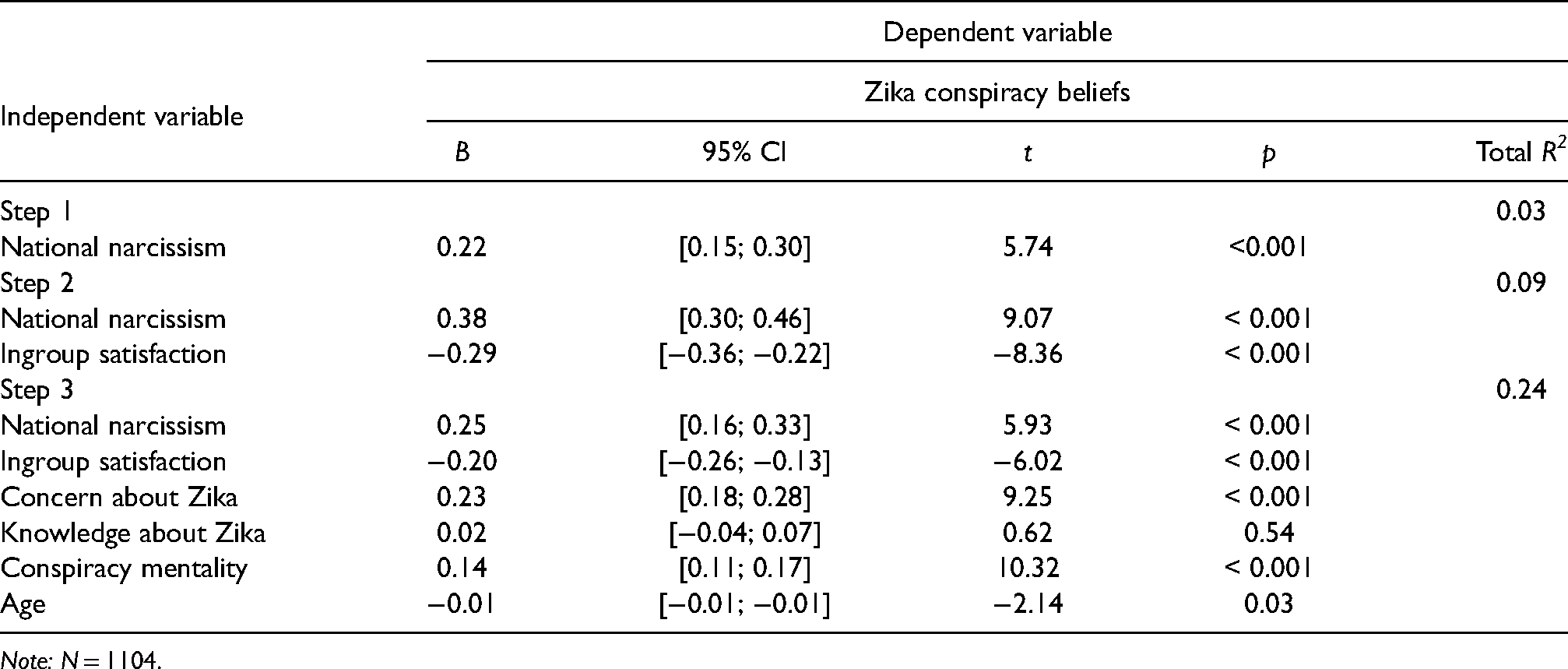
Then, we performed a linear regression to test for the relationship between types of ingroup identification and Zika conspiracy beliefs. Results revealed a positive association between national narcissism and Zika conspiracy beliefs, B = 0.38, 95% CI [0.30; 0.46], t = 9.07, p < 0.001 (controlling for ingroup satisfaction). In contrast, ingroup satisfaction was negatively related to Zika conspiracy beliefs, B = −0.29, 95% CI [−0.36; −0.22], t = −8.36, p < 0.001 (controlling for national narcissism), thus confirming H1. These relationships remained significant when controlling for covariate variables (see Table 2).
Hierarchical regressions on Zika conspiracy beliefs.
Note: N = 1104.
We then tested the indirect effect of exclusive victimhood using the JaMM module for Jamovi (Gallucci, 2020), with 1,000 bootstrapping of the indirect effect. Exclusive victimhood mediated the relationship between national narcissism and Zika conspiracy beliefs, IE = 0.24 (63% of the total effect), 95% CI [0.19; 0.29], z = 9.05, p < 0.001 (Figure 1, paths a), confirming H2. By contrast, ingroup satisfaction was negatively related to Zika conspiracy beliefs through exclusive victimhood, IE = −0.15 (51% of the total effect), 95% CI [−0.19; −0.10], z = −6.44, p < 0.001.

The mediating role of exclusive victimhood about the Zika outbreak in the relationship between types of ingroup identification and Zika conspiracy beliefs. Note: amediation model not controlling for covariates, bmediation model controlling for covariates. Coefficients presented are unstandardized coefficients. Coefficients placed within parentheses are total effects. Paths for covariates are not reported for clarity. **p < 0.01 ***p < 0.001.
This pattern of results held even when accounting for covariates (Figure 1, paths b). Exclusive victimhood about the Zika outbreak still mediated the relationship between national narcissism and Zika conspiracy beliefs, IE = 0.17 (70% of the total effect), 95% CI [0.12; 0.21], z = 7.26, p < 0.001, thus confirming H3. It is worth noting that when accounting for these confounding variables, the direct path between national narcissism and Zika conspiracy beliefs was no longer significant, B = 0.08, 95% CI [−0.01, 0.16], z = 1.77, p = 0.08. Ingroup satisfaction was still negatively related to Zika conspiracy beliefs through exclusive victimhood about the Zika outbreak, IE = 0.10 (50% of the total effect), 95% CI [−0.13; −0.06], z = 5.35, p < 0.001.
Exploratory analyses
Our measure of Zika conspiracy beliefs included three items about hidden plots potentially targeting the ingroup (e.g., “Zika was a form of population control”), but also two items about conspiracy beliefs rather targeting outgroups (e.g., “Zika was a form of biological weapon used against the South American population”). Hence, we differentiated conspiracy beliefs targeting the ingroup from those targeting outgroups, testing whether our pattern of results would remain when distinguishing these two kinds of conspiracy beliefs.
The table displaying the correlation matrix and descriptive of these new variables (Table S1), as well as the below mentioned figures, can be found in the supplementary analyses file. The pattern of results remains similar when separately accounting for Zika conspiracy beliefs targeting the ingroup and those targeting outgroups (see Figures S1 and S2). This is not surprising given the high correlation between these two factors (r = 0.89). We discuss this finding in the Discussion section with regard to the hypothesis of conspiracy beliefs organized in a belief system (Enders et al., 2021).
Discussion
Based on a representative sample of the population in France, we showed that national narcissism was positively related to Zika conspiracy beliefs. By contrast, secure national identification, captured through ingroup satisfaction, was negatively associated with Zika conspiracy beliefs (H1). We found that these relationships were significantly mediated by exclusive victimhood about the Zika outbreak (H2). Last, this mediation model held even when controlling for variables previously associated with Zika conspiracy beliefs (H3), and when differentiating conspiracy beliefs threatening to the ingroup from those targeting outgroups.
These results extend previous findings on predictors of conspiracy beliefs about the Zika outbreak (Klofstad et al., 2019; Pitch-Loeb et al., 2019) to group-level factors. Specifically, we replicated in the Zika outbreak context observations made in the context of the COVID-19 pandemic about the relevance of types of ingroup identification in predicting specific conspiracy beliefs (i.e., conspiracy beliefs about a given event, here pathogen threats). While national narcissism was related to conspiracy beliefs through exclusive victimhood, secure ingroup identification was negatively related to these variables. This pattern of relationships is in line with previous findings showing that when controlling for collective narcissism, secure identification is usually negatively or unrelated to conspiracy beliefs (e.g., Bertin et al., 2021b; Cichocka et al., 2016; Marchlewska et al., 2019). Importantly, our findings held even when accounting for a set of confounding individual-level variables previously associated with Zika conspiracy beliefs, that is knowledge and concern about the Zika outbreak, conspiracy mentality, and age (Klofstad et al., 2019; Pitch-Loeb et al., 2019). It is worth noting that conspiracy mentality and concern (i.e., threat perception) have been especially associated with specific conspiracy beliefs in previous research (Lewandowsky et al., 2013; Mashuri & Zaduqisti, 2015; Swami et al., 2018). Hence, the robustness of our model, when accounting for these variables, may suggest that when studied alongside national narcissism, specific conspiracy beliefs cannot be reduced to either threat perception or to an individual's general propensity to perceive conspiracy. This is in line with Sternisko et al.’s (2020a) theory that conspiracy theories might be primarily appealing at the social identity level when these narratives echo ingroup concerns. Our findings further suggested that specific conspiracy theories might be appealing at the group level, due to perceiving one's ingroup's suffering as central to the crisis.
Our mediation model held when distinguishing between conspiracy beliefs potentially targeting the ingroup from those targeting outgroups, which is in line with the view of conspiracy beliefs as being interrelated and in belief systems (Sutton & Douglas, 2014; see also Franks et al., 2017). A belief system can be defined as “a configuration of ideas and attitudes in which the elements are bound together by some form of constraint or functional interdependence” (Converse, 1964, p. 207; cited by Enders et al., 2021). In the context of the present study, if one believes that the Zika outbreak is a conspiracy threatening one's ingroup, one might congruently believe that this threat applies to other groups, since it is congruent and reinforces one's conspiracy view of the event. Following Sternisko et al. (2020a), we suggest that conspiracy beliefs motivated at the group level might be interrelated with other conspiracy beliefs as long as they share a common content explaining a threatening context (i.e., the Zika outbreak). Following this belief system perspective, conspiracy beliefs about a given event might help manage one's ingroup identification even when these conspiracy theories target outgroups, as long as their content refers to the event perceived as threatening for one's ingroup.
Our findings are in line with the theoretical proposition made in the area of international relations by Lerner (2020) that nationalist victimhood legitimizes the projection of ingroup grievances onto third parties. We observed that exclusive victimhood played a mediating role in the relationship between national identification and conspiracy beliefs, thereby replicating previous research (Bilewicz & Stefaniak, 2013; Mashuri & Zaduqisti, 2014). Moreover, the present study further contributes to this line of research by suggesting that only national narcissism (and not secure national identification) is positively related to conspiracy beliefs through exclusive victimhood. Perceiving the ingroup as being qualitatively and quantitatively “more” a victim of a given event, as compared with other groups, might legitimize the expression of alternative narratives of the event in order to favor one's ingroup and protect its idealistic national image in the face of threats. Replicating our findings in other contexts and in response to various global societal threats (i.e., “a natural or human-caused threat that can adversely affect a large portion of a human population,” Kashima et al., 2021, p. 223), such as climate change, would be useful in furthering research in this area.
Whereas conspiracy theories have been reported to have detrimental effects on one's health (e.g., increasing negative intentions regarding vaccinations; Jolley & Douglas, 2014), some scholars have suggested that from an intergroup perspective, these beliefs may be adaptative (e.g., Raihani & Bell, 2019). Indeed, another possible interpretation of our findings follows the adaptive approach to conspiracy beliefs which posits that anticipating intergroup threats is crucial for one's survival (van Prooijen & Van Vugt, 2018). That is, even though the Zika outbreak did not greatly impact France, victimizing the ingroup might be a way of maintaining one's alertness and vigilance towards future threats. The concept of collective conspiracy mentality might also be relevant here. This collective state has been conceptualized and fueled by historical victimhood, leading to a perpetual adaptative state of hypervigilance (Soral et al., 2018; see also Bilewicz & Liu, 2020). Even though we investigated contextual competitive victimhood, rather than historical victimhood, our findings could be interpreted as the expression of a national conspiracy mentality which still perceives the Zika outbreak as posing a potential threat years after its epidemic peak. Interestingly, the COVID-19 pandemic was still ongoing when we conducted our questionnaire and may have played the role of a traumatic event by fueling a national conspiracy mentality and increasing Zika conspiracy beliefs. Future research could explore whether a national conspiracy mentality plays a role in predicting conspiracy beliefs about ongoing public health crises, and whether these beliefs are interrelated with conspiracy beliefs about past crises.
As far as we know, the present contribution is the first empirical work documenting the relationship between national narcissism and exclusive victimhood. This relationship is somewhat unsurprising given that a core feature of narcissistic identifiers is their tendency to seek external recognition (Cichocka, 2016). Future research might further investigate how other comparative victim beliefs, such as inclusive victimhood (Vollhardt et al., 2021), might be related to each kind of ingroup identification. Indeed, inclusive victimhood can be universal—with a virtuous intergroup outcome—or selective and linked to competitive victimhood designed to strengthen one's ingroup position (Cohrs et al., 2015). A sense of selective inclusive victimhood might be especially related to conspiracy beliefs targeting outgroups, which future research might want to investigate. Narcissistic identifiers might also seek to get closer to some groups through inclusive victimhood in order to gain victim status and benefits, as has been observed previously, with individual-level narcissism being associated with victimhood, in an aim to gain material advantages (Ok et al., 2020). This would also be congruent with results showing that competitive victimhood can be used strategically to increase ingroup grievances (McNeill et al., 2017) and to gain outgroup support (Belavadi & Hogg, 2018).
This study has some limitations. First, several points underpinning our theoretical contribution are speculative. Future research is needed to test the proposition made by Sternisko et al. (2020b) that conspiracy beliefs expressed by narcissistic identifiers in the context of public health crises target the management of threats to their identity. It has also yet to be established that exclusive victimhood is indeed expressed as a biased perception of ingroup suffering by national narcissists in the context of public health crises. Further, even if our sample was representative of the French population, our study was cross-sectional, and causation cannot be asserted. Even though experimental findings by Pantazi et al. (2020) support the view of exclusive victimhood as causing conspiracy beliefs, reverse causation is theoretically possible. That is, endorsing a conspiracy theory during a societal crisis might increase one's sense of exclusive victimhood by making one feel especially threatened by alleged conspirators. Conspiracy beliefs would then fuel one's ingroup victimhood, be it merely perceptual or strategically motivated, in order to gain benefits over outgroups.
Another potential limitation of our work is the fact that France has not been severely impacted by the Zika outbreak, contrary to South American countries. Hence, it would be useful to test whether exclusive victimhood influences national narcissists’ conspiracy beliefs to a similar extent in countries where the outbreak took a more severe turn. Moreover, as previously stated, at the time of our data collection, the COVID-19 pandemic was unfolding. We cannot rule out the possibility that anxiety related to the COVID-19 pandemic context influenced our findings. From a measurement point of view, we operationalized secure national identification using the satisfaction subscale from Leach et al. (2008). While this operationalization has been used previously (e.g., Dyduch-Hazar et al., 2019; Golec de Zavala, 2019), secure national identification has also been measured using Leach et al.’s (2008) self-investment dimension (e.g., Marchlewska et al., 2020) or Cameron’s (2004) three-dimensional scale (e.g., Górska et al., 2020). Accordingly, future research might seek to measure secure national identification more accurately using multi-component constructs. Last, our measure of knowledge about the Zika outbreak tapped into subjective knowledge. Future research could improve this measurement by also controlling for objective knowledge about the Zika outbreak.
Conclusion
Based on a representative sample of the French population, we showed that national narcissism, but not secure national identification, was related to conspiracy beliefs about the Zika outbreak. We also observed that perceiving the national ingroup as being more and uniquely a victim of the outbreak mediated the relationship between types of national identification and conspiracy beliefs about the outbreak. These relationships held even when accounting for a set of confounding variables identified in the literature. We formulated the theoretical proposition that national narcissists’ ethnocentric perceptions that their ingroup victimhood is central to the crisis might legitimize their tendency to attribute threats to their idealistic national image to external factors. These results highlight the importance of social motivational factors in studying conspiracy beliefs about pathogen threats. As the Zika virus is still circulating and may resurge, health authorities must be prepared to encounter a parallel rise in Zika conspiracy beliefs, potentially among individuals and groups with defensive national identifications.
Supplemental Material
sj-docx-1-pac-10.1177_18344909211051800 - Supplemental material for Affected more than infected: The relationship between national narcissism and Zika conspiracy beliefs is mediated by exclusive victimhood about the Zika outbreak
Supplemental material, sj-docx-1-pac-10.1177_18344909211051800 for Affected more than infected: The relationship between national narcissism and Zika conspiracy beliefs is mediated by exclusive victimhood about the Zika outbreak by Paul Bertin and Sylvain Delouvée in Journal of Pacific Rim Psychology
Footnotes
We are thankful to Kathleen McColl and Kenzo Nera for their useful comments on the manuscript.
Author notes
P.B. conceptualized the project. P.B created the materials. P.B and S.D conducted the data collections. P.B conducted the analysis. P.B wrote the manuscript. P.B revised the manuscript. P.B. did the project administration and supervision.
Declaration of conflicting interests
The author(s) declared no potential conflicts of interest with respect to the research, authorship, and/or publication of this article.
Funding
The author(s) disclosed receipt of the following financial support for the research, authorship, and/or publication of this article: This work was supported by the H2020 European Research Council (grant number ZIKAlliance grant agreement No. 734548).
Ethical statement
The authors declare that there are no potential conflicts of interest with respect to the research, authorship, and/or publication of this article. This research has been approved by the ethical committee of the second author's university (number: 2020-003).
Open science statement

Supplemental material
Supplemental material for this article is available online.
Notes
References
Supplementary Material
Please find the following supplemental material available below.
For Open Access articles published under a Creative Commons License, all supplemental material carries the same license as the article it is associated with.
For non-Open Access articles published, all supplemental material carries a non-exclusive license, and permission requests for re-use of supplemental material or any part of supplemental material shall be sent directly to the copyright owner as specified in the copyright notice associated with the article.
