




Abstract
Zambia’s vision to attain middle-income status by 2030 and its strategic development plan are anchored on environmental sustainability. The main constraints to achieving these future goals are climate change and biodiversity loss. A missing aspect identified in the governance of biodiversity and climate is the limited participation of stakeholders in resource management. Engagement of multiple perspectives and plural values held by stakeholders and their relation to future management choices and sustainable outcomes through participatory future visioning processes is largely missing, particularly in biodiversity-rich mosaics such as the Barotse Cultural Landscape. This missing link has had powerful policy implications, as governance, in many instances, has produced, reproduced and upheld power structures that ignore locally and culturally relevant narratives necessary for transformative change. Using individual interviews and a participatory futures workshop with actors in the biodiversity and climate governance space in the Barotse Cultural Landscape, this study explores how futures methods can contribute to locally-led transformative change pathways. The Seeds of Good Anthropocenes approach is used to identify bottom-up biodiversity and climate initiatives in Zambia. They are used to develop alternative futures grounded in reality using the Nature Futures Framework nature value perspectives, i.e. Nature for Nature, Nature for Society and Nature as Culture, to gain an understanding of the local actors’ value perspectives. The study answers the question of what the pluralistic values and nature perspectives of the local actors in the Barotse Cultural Landscape are towards biodiversity and climate governance. This study contributes to the call to apply the Nature Futures Framework and operationalise its use.
Introduction
Developing equitable and climate resilient development pathways requires the reconciliation of diverse worldviews, values and interests (IPCC 2022; Pörtner et al. 2021). Understanding the pluralistic values of local and Indigenous communities beyond colonial perspectives can foster transformative change regarding biodiversity conservation, climate action, development and sustainable use of biodiversity (IPBES 2022b). This is particularly important in a social-ecological system (SES) context where people and nature are inextricably linked (Biggs et al. 2021; Folke 2007; Preiser et al. 2018). An SES is inherently uncertain. It is difficult to understand (analytical complexity), behaves unpredictably (ontological complexity), and societal groups attach different benefits, meaning and purposes to it (societal complexity) (Biggs et al. 2015; Hichert, Biggs, and de Vos 2021). Therefore, understanding it requires the use of methods, such as participatory scenario development with a variety of tools, that transcend disciplinary and methodological divides (Preiser et al. 2018; Tengö et al. 2014).
Futures studies methods and tools can explore multiple futures of SESs through various perspectives to question dominant assumptions and contribute to solving wicked problems (Hichert, Biggs, and de Vos 2021). Tools such as scenarios, back-casting, and forecasting have been used to respond to existing challenges (Boyd et al. 2015; Hebinck et al. 2018; Muiderman 2022). Conventional futures methods and tools have been criticised for failing to adequately integrate multiple perspectives in the development of futures scenarios, restricting the capacity to imagine (Moore and Milkoreit 2020; Oomen, Hoffman, and Hajer 2022). This has resulted in futures narratives that depict Western values as the gold standard of desirable futures, excluding diverse perspectives that are necessary to tackle complex global crises like climate change and biodiversity loss (Death 2022; Terry et al. 2024).
Scenario development is a futures studies method that has been identified as an appropriate way to study SESs. The dynamic and non-linear way in which SESs transform and their complex interactions with unpredictable consequences require these tools to develop imaginaries towards desired futures (Preiser et al. 2024). Scenario development is a method of choice because knowledge of how an SES functions is partial, and this understanding changes over time (Preiser et al. 2018). Creative visioning processes using scenario development in participatory workshops have been used to empower and inspire people to envision positive alternative narratives for nature futures (Hamann et al. 2020; Pereira, Hichert, et al., 2018; Raudsepp-Hearne et al. 2020).
Knowledge gaps on alternative visions of nature’s contributions to people, pluralistic values, narratives, and how they can be used to support sustainable transformative change, and their leverage potential on governance interventions are still prevalent on the African continent (Horcea-Milcu 2022; IPBES 2018, 2022b). Innovations in ecological restoration are prevalent in regions such as Africa, yet broader perspectives on historical land use, local cultural influences, and their links to ecosystem services are scarce (Toma and Buisson 2022). This gap is evident in cultural landscapes. Cultural landscapes are geographical areas that represent the combined work of humans and nature, and are a bridge to understanding the feedback processes that shape human culture and the natural environment (Aktürk and Dastgerdi 2021; Bridgewater and Rotherham 2019; Paracchini, Zingari, and Blasi 2018; UNESCO 2021). These landscapes have distinct values that vary widely across knowledge systems, geographical and environmental contexts, cultures and languages, and can facilitate two-way learning for sustainability and resilience planning that supports biodiversity conservation and protects cultural diversity to meet the dynamic needs of local communities (Balvanera et al. 2022; Crumley 2012; Dastgerdi and Kheyroddin 2022; Molnár and Berkes 2018).
The Nature Futures Framework (NFF) is a heuristic tool that fills the gap of developing nature-centric scenarios that show the plurality of human-nature relationships and values to inform place and context-specific policy options and acts as a boundary object in exploring these values (Figure 1) (IPBES 2022a; Kim et al. 2023). The three value perspectives of the NFF are summarised by Lunquist et al. (2021) as: Nature for Nature – emphasising the intrinsic value of nature; Nature for Society – highlighting the instrumental values of nature; and Nature as Culture – indicating the relational values of nature. The Nature as Culture value perspective is aligned with “one with nature”, in which biocultural landscapes are shaped by the intertwining of nature with cultures, faith, society and traditions (IPBES 2022b). The NFF can be used to develop narratives of desirable futures (D’Alessio et al. 2025). The Nature Futures Framework contribution to desirable futures for people, nature and Mother Earth. Source: (IPBES 2023).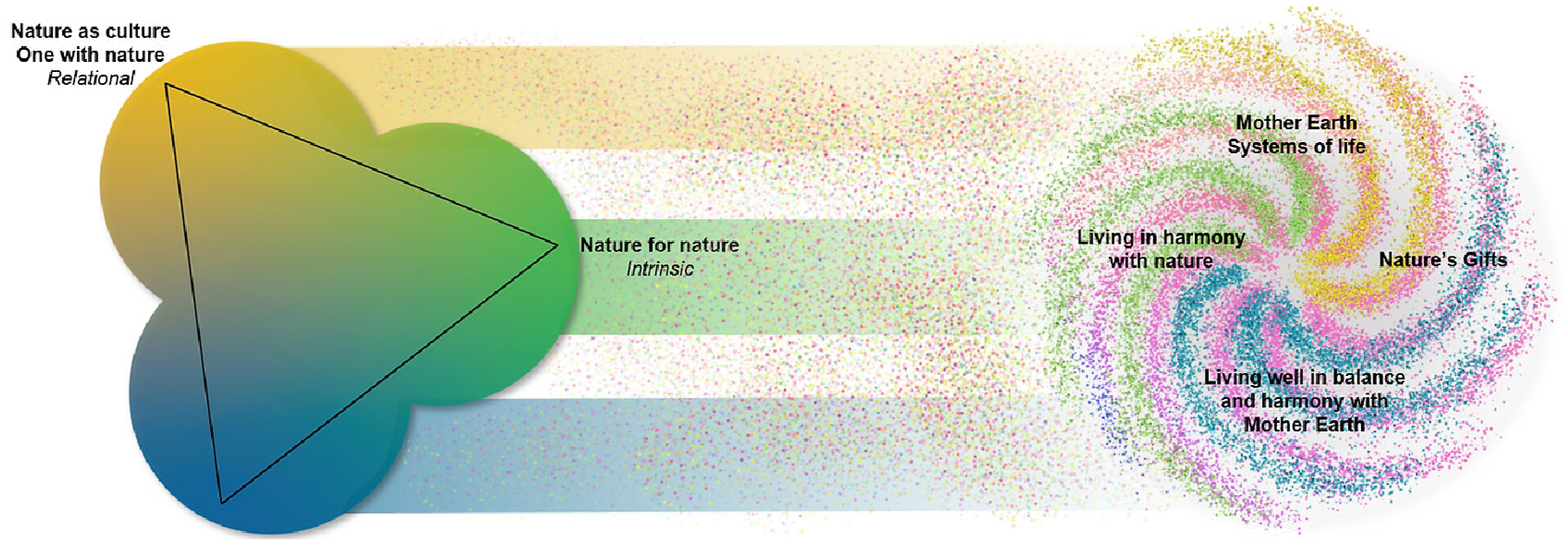
Narratives developed from scenario development processes that reflect diverse values can be drivers of transformation, opening up the imagination of desirable societies, inspiring personal agency for sustainable futures, and influencing system priorities that motivate action (Linnér and Wibeck 2021). Evidence suggests that powerful frames and compelling narratives of environmental futures influence positions on what is seen as desirable and legitimate in conserving biodiversity, and presenting alternative narratives can broaden policy approaches that are just and inclusive of plural values (Hutton, Adams, and Murombedzi 2005; Lliso et al. 2022; Louder and Wyborn 2020; Neil Adger et al. 2002; Pascual et al. 2021). Narratives can be powerful tools for transformative change through their ability to shift social and cultural norms and inspire agency that can enable people to act (Feukeu et al. 2021; Gosnell et al. 2024). Global assessments have shown what undesirable futures for climate and biodiversity are, with insufficient information on what desirable futures look like in different contexts, their plurality, and how to reach them (Bennett et al. 2016; PBL 2020; Pereira, Davies, et al., 2020; Rana et al. 2020; Veland et al. 2018).
The NFF utilises Indigenous and Local Knowledge to articulate many possible desirable futures for enhanced decision-making, policy design, and implementation (IPBES 2016; Kramer et al. 2023). The NFF can be used to create visions of desirable futures at whose core are the values people have towards nature, as opposed to these connections being viewed as outcomes (Durán et al. 2023). This can be attempted through a co-production process that uses it as a consistent framework for nature futures across multiple levels and scales, and accommodates plurality (Pereira, Frantzeskaki, et al. 2020). It is designed to support the development of qualitative scenarios and quantitative models (IPBES 2023). This support is dependent on three considerations (Kim et al. 2023). First, that people and society value nature in different ways. Second, that SESs have mutually reinforcing feedback systems that are important for people and nature, and third, that SES dynamics are complex, with indicators from various knowledge systems showing this change.
The NFF is not meant to be prescriptive but allows varied presentation of cultural and geographical preferences in scenarios and narratives, with values within the triangle showing desirable states for nature, and those outside the triangle showing undesirable states for nature (Durán et al. 2023). It is not able to capture all worldviews and knowledge systems, but the NFF tries to be as inclusive as possible and recognises that contributing to one value perspective may lead to trade-offs for the other perspectives (IPBES 2022b). It only takes into account nature value perspectives and not individual and social values (Alexander et al. 2023). The NFF has been used in exploring desirable futures for people and nature in various contexts (Kramer et al. 2023; Lembi et al. 2020; Mansur et al. 2022; Palacios-Abrantes et al. 2022; Quintero-Uribe et al. 2022; Rana et al. 2020). The NFF is applied in this case to answer the question of what the pluralistic values and nature perspectives of the local actors in the Barotse Cultural Landscape (BCL) of Zambia are for biodiversity and climate governance.
Zambia is well-positioned as a case study using the NFF because its institutional and regulatory frameworks on climate, biodiversity, and natural resource management are designed to include integrated and community-based participatory approaches (GRZ 2015; 2022a). The Eighth National Development Plan sets the country’s development agenda, and recognises that inclusive participation of vulnerable groups in resource management to inform policy decisions has been limited (GRZ 2022a). Participatory scenario studies have been done for agriculture, climate-compatible green growth and energy in Zambia (Broad et al. 2024; Hughes et al. 2024; Kwenye et al. 2022; Mapulanga et al. 2021). However, evidence of participatory scenario development using futures studies methods for biodiversity and climate governance remains limited.
This study is focused on the BCL, a vast wetland with a mosaic of ecosystems that sustain people and nature (Mapedza et al. 2022; WWF 2020). It is an SES. Scenarios research in the BCL has mainly focused on its economic potential, hydrology, agricultural production potential, traditional ecological knowledge, and ecosystem services (Banda et al. 2022a; Banda et al. 2022b; Cai et al., 2017; Mapedza et al., 2022; Mastracci and Edgar, 2020). Some work has developed narratives through a participatory process on social-ecological linkages in the Western Province, where the BCL is located (Suchá et al. 2022). However, policy questions on how pluralistic values and perspectives feed into biodiversity conservation and climate governance remain unanswered, with the use of futures studies methods largely missing. This is critical as governance decision tools can be robust and implementable if they acknowledge alternative desirable nature and climate futures (Pörtner et al. 2021).
Methods
Study area: The BCL has been occupied by the Lozi people for more than 400 years, with the traditions, culture, and management of the plains still based on the hydro-ecological regime of the Zambezi River (Silvius, Oneka, and Verhagen 2000; WWF 2020). Traditional authorities, the Barotse Royal Establishment (BRE), still retain influence on conservation efforts and natural resources and work alongside central governance structures (Suchá et al. 2022; Welsh et al. 2023). The inhabitants of the floodplain have mixed livelihood options from its rich ecosystem mosaic that include natural resource harvesting, fishing and agriculture (crops and livestock) (Chikozho and Mapedza 2017; van Steenbergen et al. 2015). It is a Ramsar site and a Key Biodiversity Area (Madzudzo et al. 2013; Ramsar 2022). Despite the endowment of natural resources, Western Province has one of the highest incidents of poverty, food insecurity and low agricultural productivity – and is vulnerable to the impacts of climate change (Estrada-Carmona et al. 2020; Hamududu and Ngoma 2020). Model projections suggest that the Western province will be one of the hardest hit by increased temperature and reduced rainfall, with far-reaching consequences on the already vulnerable ecosystem, biodiversity and human livelihoods (Ngoma et al. 2021).
Identifying Seed Initiatives
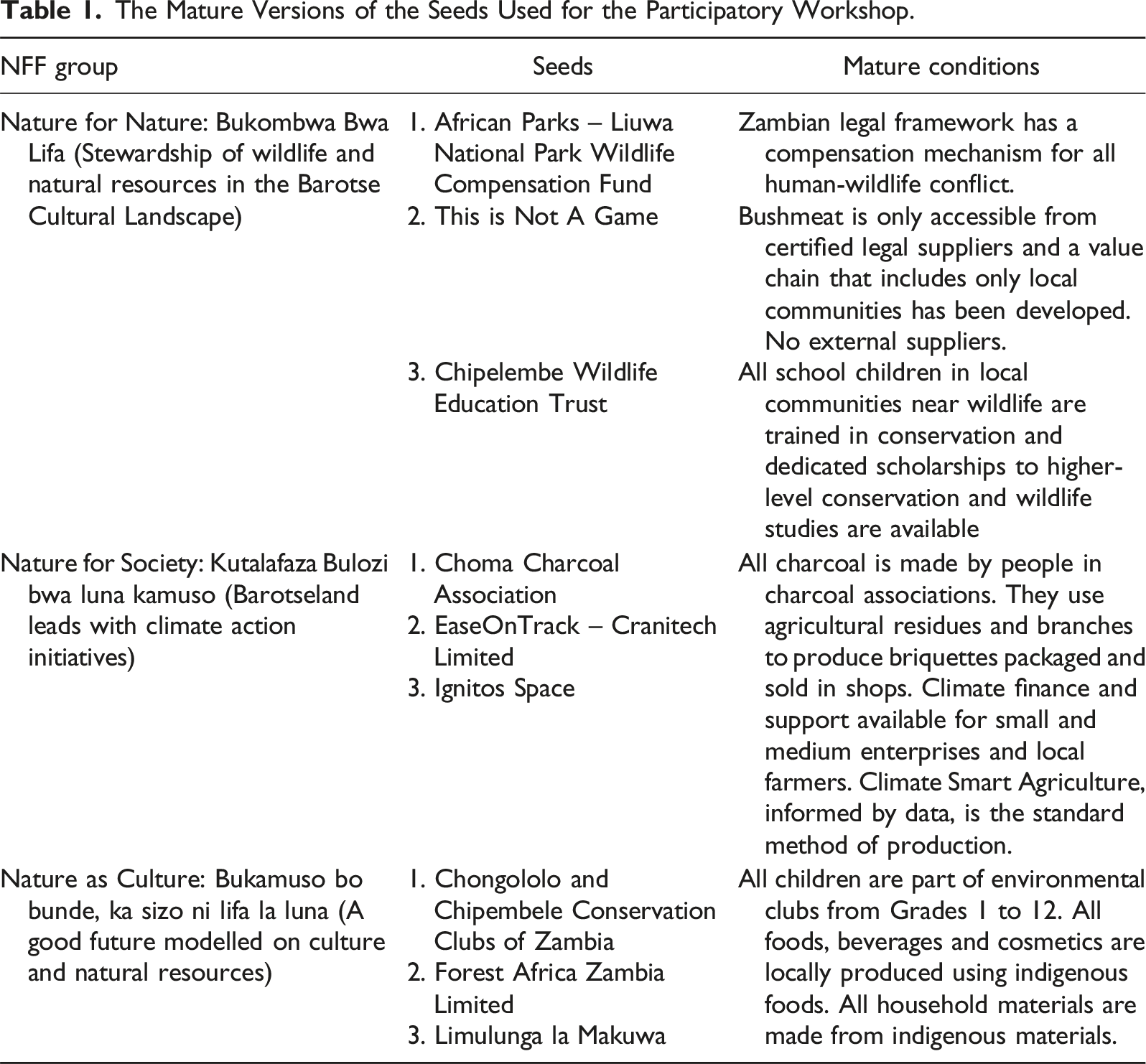
The development of the alternative futures was based on the Seeds of Good Anthropocenes (SOGA) framework. The SOGA is a global initiative that is documenting ecological, social and social-ecological initiatives with the potential to enable a more sustainable world (Tuckey et al. 2023). The framework uses the innovative ways of doing from bottom-up initiatives, seeds, to develop positive visions of nature futures (Bennett et al. 2016; Hamann et al. 2020). Seeds are currently existing initiatives that are not mainstream and represent diverse regions, values and worldviews on the different ways sustainability challenges can be tackled, and consider economic, social, social-ecological and technological ways of doing or thinking (Bennett et al., 2016). Seeds provide real-life knowledge in different contexts on solutions to environmental challenges (Gianelli et al. 2025). They can lead to positive outcomes and radical systems transformations for people and nature if conditions are right for their growth (Jiménez-Aceituno et al. 2019; van Velden et al. 2023).
These initiatives were identified in Zambia through a series of web searches on the social media sites Meta (Facebook), X (formerly known as Twitter) and LinkedIn. Web searches were also made on three websites showing innovation in the biodiversity and climate space. There were the United Nations Development Programme Zambia Acceleration Lab, the Biodiversity Finance Accelerator Lab for Malawi and Zambia, and the SEED promoting enterprise for sustainable development websites (Holz and Jaimes-Ramos nd; SEED nd; United Nations Development Programme nd). The selection was based on the seed being involved in innovative biodiversity conservation or climate action activities and based in Zambia.
Data Collection
One participatory scenario workshop was held between 25 and 28 June 2024, to explore preferable nature futures for biodiversity and climate governance in the BCL. The main objectives of the workshop were: (i) to understand the plural values and nature perspectives of local actors in the BCL and (ii) to understand the visions and pathways towards a preferred future for biodiversity and climate. Participant selection was based on twenty-three key informant interviews that mapped the main actors of biodiversity and climate governance in the BCL between December 2023 and February 2024 to achieve diversity in representation. This led to the identification of the main actors as those from the BRE, the Ministry of Agriculture, the Department of Forestry, the Disaster Management and Mitigation Unit, the National Heritage Conservation Commission, the Department of Culture and Traditional Affairs, the Department of National Parks and Wildlife, the Ministry of Fisheries and Livestock, the District Council and seed initiatives (biodiversity and climate seeds).
The two main criteria that guided who was invited to take part in the workshop were: (i) direct involvement in biodiversity or climate governance, and (ii) living in the Barotse floodplain districts of Kalabo, Mongu or Senanga. Extensive stakeholder engagement was done over a period of 6 months (January to June 2024) to establish rapport with the potential workshop participants and vetting representatives who would be suitable to engage in a creative co-production process. Some of the considerations of the vetting were whether the participant was senior in their position, as this could have an impact on their availability for a multi-day process and potential resistance by other participants to speak freely, their willingness to talk about positive futures during the engagement process, and how well they would fit in a group setting with diverse participants. Even though this vetting was subjective and based on the primary author’s experiences with participatory fieldwork processes, it was an essential part of creating a space that was “safe enough” for the visioning process (Pereira et al., 2018a, 2020a).
A total of 19 diverse participants took part in the workshop. There were four facilitators, ten state actors (academic institutions and government agencies), four seed initiative actors, two actors from the BRE, two artists and one writer. They were put into three groups based on the NFF value perspectives aligned with their line of activities/work. These three groups were Nature for Nature, Nature for Society and Nature as Culture. For example, a participant working for the Department of National Parks and Wildlife was placed in the Nature for Nature group, and another from the BRE was put in the Nature as Culture group.
Seeds of the Future
The Mature Versions of the Seeds Used for the Participatory Workshop.
The three NFF groups developed Futures Wheels (Glenn 2009), showcasing the primary, secondary and tertiary impacts of the seeds on each other in their mature conditions (Pereira, Karpouzoglou, et al., 2018). The groups went on to explore the interconnections among the Futures Wheels developed for each mature seed, looking at the synergies and/or conflicts of the impacts using influence mapping. Facilitator prompts were used to allow the participants to engage in the thought exercise and discuss the implications of the seed impacts among the three wheels (Figure 2). From the developed wheels, each of the three NFF groups made one creative presentation, provided a draft name of this future world, and a fictional newspaper headline and statistic. An example of a Futures Wheel developed for the Nature as Culture value perspective group, showing the interactions among the three seeds in their mature conditions.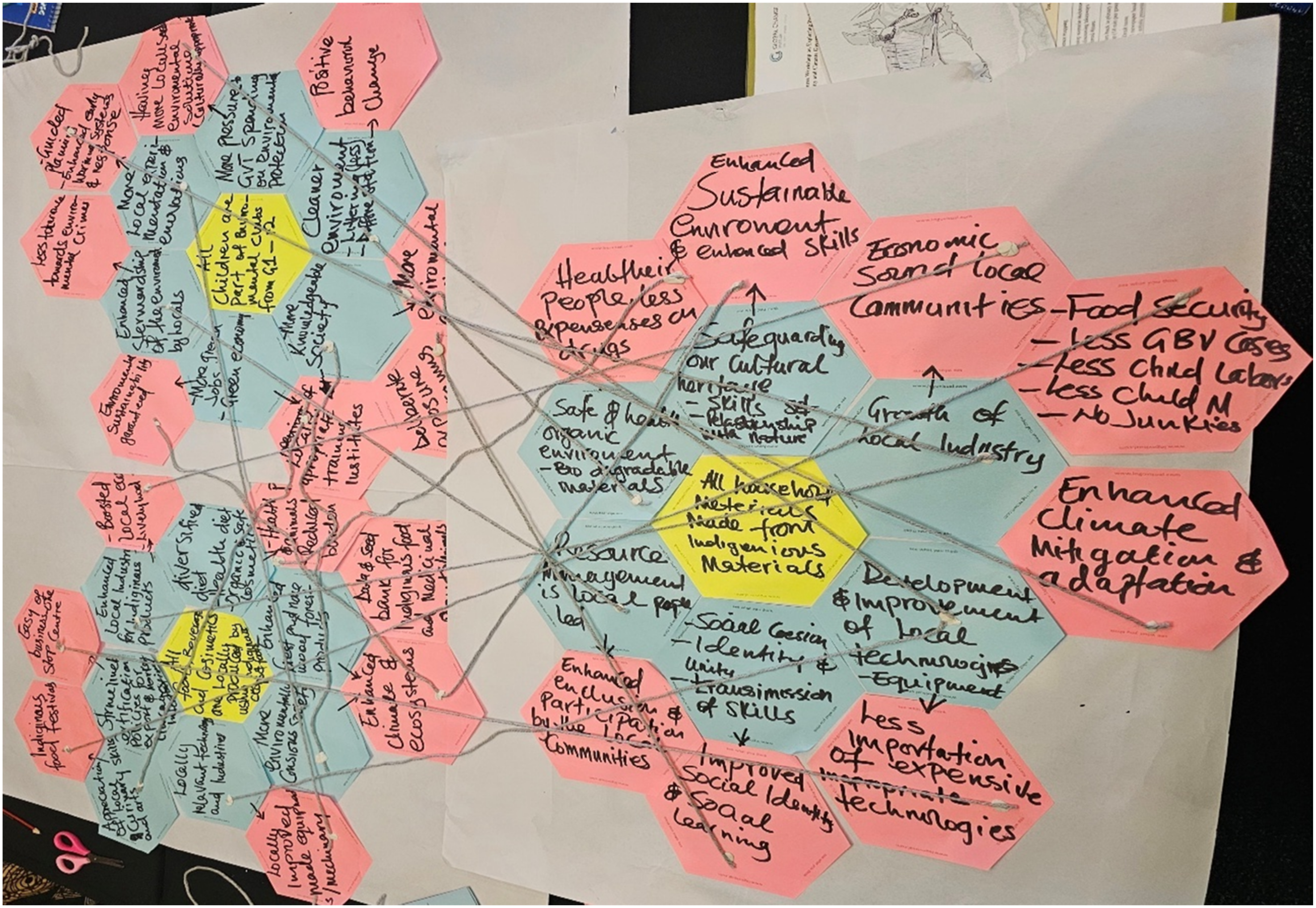
Narratives and Pathways
Time was allocated to the three NFF groups to develop scenario skeletons of these envisioned futures. Each group engaged in a visioning exercise that allowed each participant to close their eyes and envision what this future world looked like, as a way to expand the narratives. Facilitator prompts (Appendix 1) were used to help with this exercise. They included questions such as: what can you see about this future world? How do people relate to nature? Who are the main custodians of nature? What do people do for work? etc. All the groups creatively presented these scenarios in plenary through highly creative plays. An excursion to the Mosi-oa-Tunya Falls was organised to have the participants connect with nature. It was the site of the final reflection session, and each group member shared their learnings from the first two days of the workshop.
The second part of the workshop comprised a smaller group of 11 participants who fleshed out and refined the narratives of the envisioned futures using the scenario skeletons that were developed in the first part of the workshop. The smaller group was pre-organised before the inception of the main workshop for logistical reasons, i.e., the availability of participants for the entire workshop period. The participants maintained the initial groupings from the NFF value perspective groups in the first part of the workshop. Each group was represented and given creative freedom to refine these narratives.
Data Analysis
Keywords of the NFF Illustrative Narratives.
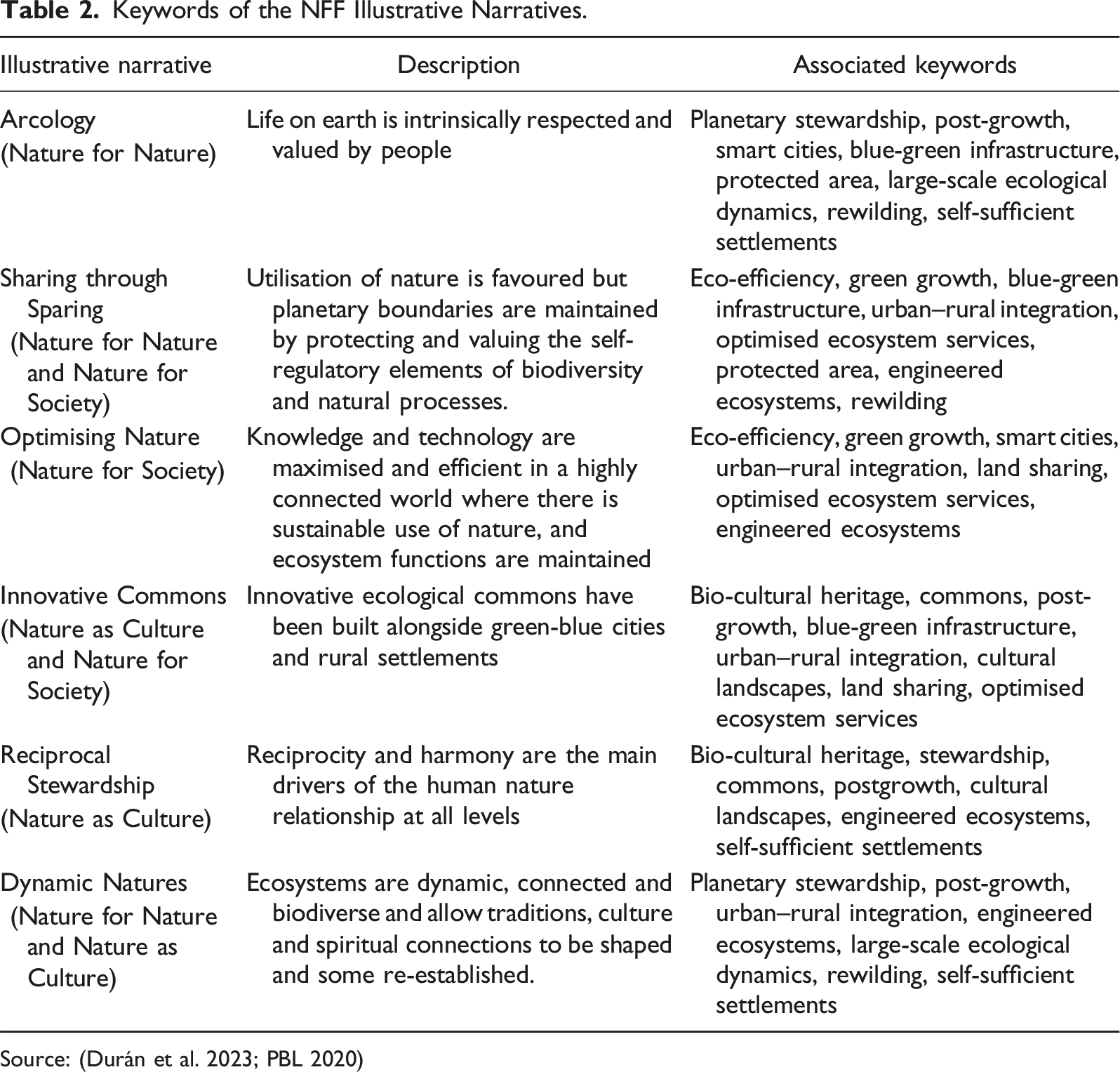
Source: (Durán et al. 2023; PBL 2020)
Results
We present the three visions developed from the participatory workshop in this section. We outline the detailed visions for each NFF value perspective group and the NFF Illustrative Narratives that each one is associated with.
The Three Visions for Biodiversity and Climate Governance in the Barotse Cultural Landscape Using the NFF
Nature for Nature Group Narrative: Bukombwa Bwa Lifa (Stewardship of Wildlife and Natural Resources in the Barotse Cultural Landscape
In this future, there is harmony between people and nature and a deep sense of mutual well-being. It is quiet, and there is an interconnectedness between traditional and conventional ways. Nature is restored to how it was in the past. Time is not linear but a circular flow where there is a re-routing of the “old” human-nature relationships or a rebirth of the human-nature nexus. Humans do not interfere with nature and there is a deep respect for it. There is trans-species communication and “you feel part of what is next to you” is the basis of human-nature relationships.
The school system teaches conservation as co-existence between people and nature. The curriculum integrates traditional and conventional knowledge. Conservation experts come from the local communities. This strong community stewardship creates a healthy and resilient environment for nature to flourish as there is no more human-wildlife conflict.
All development is inherently nature-forward and sustainable, and there exists informed wildlife decision-making, and improved wildlife habitat. Offices blend in with nature and all technology used is clean. Transport is carbon-free, electric and communal. People walk and cycle to work, and nature has the loudest voice (insects buzzing and birds singing). Technology is an important tool used by communities to rewild and conserve nature in this future. There is a genetic bank of local and indigenous species, and some species are bred to be drought and stress tolerant as climate changes in the future.
Future politicians come from these conservation-oriented communities and therefore this future is characterized by a strong political will for nature to be conserved, to flourish and be resilient in the face of climate change. There is a strong theme of a bottom-up approach in this future.
There are no genetically modified organisms and all food comes from a local farm. Communities come together for wild fruit festivals where fruits are blessed by traditional leaders. The focus is on inclusivity, care, and nurturing the human-nature relationship to provide a protective, healthy, and caring environment. There is a new relationship between people and nature that incorporates indigenous values with conventional ones, demonstrating the circular motion of time.
There is external support to obtain more protection for nature through a human-wildlife conflict compensation fund. This results in enhanced community livelihoods, sustainably managed natural resources and well-managed natural heritage sites. There is no deforestation, ecosystems are improved and no human-wildlife conflict. Communities sustainably harvest wildlife and have processing and testing centres located in each community. Because of this, there is no poaching, no species extinction and animal numbers increase significantly. The relationship between people and animals is healed.
Nature for Society group narrative: Kutalafaza Bulozi bwa luna kamuso (Barotseland leads with climate action initiatives)
This vision is set 100 years into the future (2124), where the main challenges of deforestation (driven by charcoal and agricultural land expansion), food insecurity, and unemployment have been tackled. The presence of people and nature-focused interventions leads to an end to these sustainability challenges.
There is good political will between central and local government in this future. This leads to sustainable livelihoods in Barotseland and the country as improved national policy frameworks that support research and development are effectively implemented, space for private funding is created and secondary stakeholders are integral in the change-making spaces.
A fund is created to provide agricultural equipment and support for farmers in Barotseland that also targets small and medium enterprises in the agricultural sector. Barotseland is the most food-secure region, producing food sustainably for other regions and engaging young people in profitable agricultural ventures. The charcoal-based market is no longer viable. The economic boom creates a second economy in the arts and education sector, due to increased market participation. More people are eating healthy locally produced indigenous agricultural produce.
There is a creation of a cultural knowledge hub because of increased funding for research and development. Young people and the elderly meet regularly to exchange inter-generational Indigenous knowledge. As a result of increased understanding and influence of Indigenous knowledge, there is access to and sustainable use of medicinal plants. This leads to an integrated health network in Barotseland with both conventional and local indigenous medicines available as treatment options. This leads to a 100 percent improvement in patient care.
Due to increased funding in research and development, the Ministry of General Education in collaboration with private funders, locate and construct Zambia’s first Climate Sciences and Technological University, King Lewanika University of Excellence. This is the best climate-focused institute in the world. It attracts the continent’s best climate scientists to Barotseland. The institution launches Naleli, the first climate change-focused satellite from the African continent - ushering in an age of continental information sovereignty regarding space technology and information. The university has the largest community-institution collaboration space in the country, allowing for more science engagements with local primary schools, high schools and community centres.
The increased collaborations between the transportation ministry and private funding leads to improved rail networks in Barotseland. This sees the first launch of an African high-speed rail system, in collaboration with the university. Because of the improved public transport system, the data from Naleli reports decreased private vehicle use in Barotseland. There is a tourism boom in Barotseland as a result of transportation access and affordable prices.
The local cultural hub, Queen Mbwanjikana Hub, takes in more young school learners through school tours, teaching them from an early age, the scientific, and indigenous names of plants, animals, and various natural formations. This helps yield improved local biodiversity conservation efforts, as more and more people grow up with an environmentally conscious worldview. The cultural hub also organises local clean-up trips with university students. This sees improved wildlife in the region.
The effective banning of the use of mosquito nets through the central government sees a tripling of fish stocks in the Zambezi floodplains and local streams. Due to the re-introduction of indigenous crops, localised fishponds and aquaponics are more commonplace, with very few people dependent on extensive fishing practices.
Nature as Culture Group Narrative: Bukamuso bo bunde, ka sizo ni lifa la luna (A Good Future Modelled on Culture and Natural Resources)
The built environment and infrastructure are made of natural indigenous and local organic materials. This includes construction materials, all household consumables and food. The people are active participants in how natural resources are used and how they contribute to their livelihoods. People are engaged in organic farming and climate-smart agriculture. People grow indigenous and local crop and livestock varieties and have extended reared livestock to domesticating wildebeest as part of conservation efforts and food. The main vocations are trade skills aligned with cultural production practices.
Barotseland is a tourism hub for learning about the inextricable link between people and nature. They showcase animal communication to help with conservation efforts and how to be better stewards of the land from the perspectives of both people and animals. This enhances efficient management and monitoring systems, as both people and animals are involved in conservation efforts. People use techniques from cosmic relationships and interpretation from Indigenous astronomers to understand weather elements and have more localised and appropriate climate change planning and disaster response.
The Barotse Royal Establishment Training Institute is established as the main custodian of Indigenous and Local Knowledge. This is a hub for culturally relevant innovation that includes teleportation training by Ng’akas (spiritual and traditional healers) to help with long-distance travel and the establishment of solar cable cars for mass transport within cities using biodegradable tigerfish scales as solar panels. This leads to zero carbon emissions travel in the region. Innovation hubs are embedded within the institute and merge Indigenous, local and mainstream knowledge. Consequently, traditional medicine is not seen as a fringe activity, and clinics and hospitals are established. People are not afraid to practise what was previously seen as “black magic”. This facilitates detailed documentation of these practices, enhances the conservation of plants and animals, formalises studies and holistic tackling of sustainability challenges.
African religion is the main mode of spirituality. Nyambe is the overall God and his wife Nasilele is also worshipped. Each family unit has responsibility towards a specific natural resource based on their family lineage. This guides the gods they worship and which resource they are responsible for. e.g. Rainmaking, providence (health using natural herbs – forest-based religion), indigenous astronomy (rain makers, sun worshippers etc.), and animal communicators (animal worship). Religion is based on earth stewardship. There is a symbiotic relationship between people and nature. It is based on familial links to the different elements of nature, but overall grounded in Nyambe and Nasilele’s laws around earth stewardship.
The school curriculum is climate-smart. The children learn about conservation and locally producing food. The parents, through family ties with the different elements of nature, are the first port of entry to understanding earth stewardship. Children are learning from a young age about the different plants and animal parts that are helpful medically and socially. Different stories about nature and its value are told about people and animals. No human-wildlife conflict through education and understanding the role that animals have in the world and how they relate to people. There is a Barotseland motto recited daily that is part of daily living that helps to reinforce cultural identity and pride, and earth stewardship and its associated obligations.
Local communities are the main custodians of biodiversity governance. Principle guidelines and not strict rules are available to cater to different scenarios on how to handle biodiversity. The BRE traditional management system, which includes “Misha ya bulozi” or the rules of bulozi, is the backbone of the functioning of this system. People learn historical lessons of natural resource management, and the BRE has reduced powers. They function as knowledge custodians, allowing collective responsibility over natural resources and people can see the benefits of co-existing with nature.
Illustrative Narratives of the Three Visions
Narrative Features of the Three Developed Narratives.
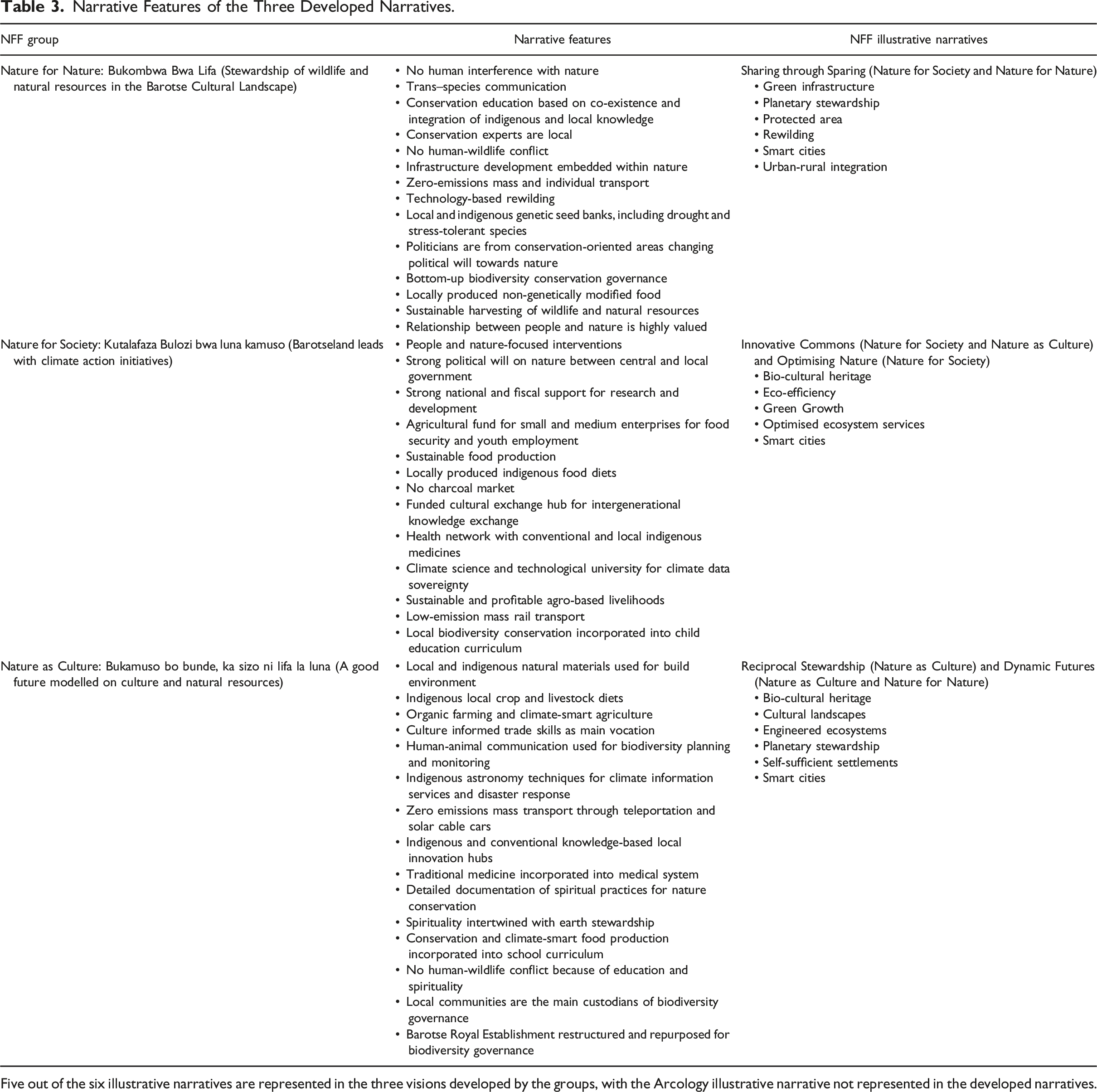
Five out of the six illustrative narratives are represented in the three visions developed by the groups, with the Arcology illustrative narrative not represented in the developed narratives.
Discussion
In this section, we discuss the narratives that were developed using the NFF value perspectives and provide some insights into what these visions tell us about the multiple ways in which nature is valued by biodiversity and climate governance stakeholders in the BCL.
Interconnections in the Narratives of Nature Futures
The developed narratives articulated multiple value perspectives in their storylines, even when the workshop groupings were designed along the three value perspectives. Instrumental values were expressed alongside intrinsic values in the Nature for Nature group, relational values were expressed with instrumental values in the Nature for Society group, and intrinsic values were expressed with relational values in the Nature as Culture group. This co-occurrence of value expressions in the developed narratives is an important outcome from the analysis using the lens of the NFF Illustrative Narratives. It reinforces the finding that values are not mutually exclusive, and these interconnections have important implications for interventions towards systems transformation (Durán et al. 2023; Kim et al. 2023). Intrinsic and instrumental value expressions are expected to be at odds, where interventions for people and nature are concerned (Schmitt et al. 2025). Yet, the Nature for Nature group expressed both of these values as shown through its alignment with the Sharing through Sparing Illustrative Narrative. This is relevant to conservation and climate change mitigation efforts in Zambia that prioritise protected areas and the exclusion of people from nature, with human-wildlife conflicts complicating efforts for participatory co-management (Kachali and Loos 2025).
Relational values were expressed in two of the developed narratives. The Nature for Society narrative had common features with the Innovative Commons Illustrative Narrative and the Nature as Culture narrative, with the Dynamic Futures and Reciprocal Stewardship Illustrative Narratives. This is unsurprising because people and nature are inextricably linked in cultural landscapes, and any interventions need to have this in mind (Monsarrat et al. 2022; Toma and Buisson 2022). Bio-cultural heritage was a common feature in both of these narratives, referring specifically to the co-conservation and co-management of the integrated agricultural and biodiversity systems. Actions for self-determination through bottom-up governance and strong political will were identified as important factors for governance.
These findings imply that for the Zambian context, efforts towards biodiversity and climate governance to attain these aspirational nature futures in the BCL need to express multiple values. This is because policy options that express multiple values have higher transformative potential (Kelemen et al. 2023). Providing a mix of value perspectives aligned with local values can provide pathways for sustainable transformations. Smart cities featured in all three narratives, and they could inform, for example, how urban infrastructure development can express all three value perspectives. For example, infrastructure can be developed with nature in mind by the use of indigenous and local materials that are developed through innovations informed by Indigenous and Local Knowledge, and built by tradespeople who have skills that are aligned with cultural heritage (e.g. carpentry, thatching, weaving). In this way, biodiversity can be conserved through sustainable use of the resources (intrinsic value), using skills that promote cultural heritage (relational value) and enabling innovation that supports livelihoods and diverse knowledge systems (instrumental value). In addition, co-management and co-conservation efforts aligned with local values are important for systems transformations.
Values and Priorities for Nature Futures in the BCL
Achieving desirable states for people and nature will require an alignment of values and priorities into the interventions aimed at meeting these aspirations (IPBES 2024; Nyirenda et al. 2024). The narratives articulated three main priorities on how biodiversity and climate should be governed.
Indigenous and Local Knowledge Integration
The concept of integrating Indigenous and Local Knowledge across various sectors, including agriculture, infrastructure development, health, education, climate action and biodiversity conservation, was clear across all three narratives. Indigenous and Local Knowledge plays an important role towards transformative change within SESs. It provides different knowledges that can facilitate inclusion and expand the scope of interventions to tackle the complex problems typical of SESs (Hakkarainen et al. 2022). This knowledge can guide the governance and management of biodiversity and climate by making it more just and resilient (Tengö et al. 2021; Yletyinen et al. 2022). In the context of the narratives, this knowledge includes the involvement of non-human entities, i.e. animals and weather elements, as a source of this information through spiritual practice and embedding this into mainstream conservation, climate information systems and health practice. It is a radical departure from the usual recommendations of who is involved in providing Indigenous and Local Knowledge. It can, however, contribute to ideas of recognitional justice that disrupt the tendency of people-centred interventions that disregard the perspectives and roles of non-human entities (Barrett et al. 2021). This can facilitate more meaningful incorporation of non-human perspectives and values into governance plans for more holistic outcomes for people and nature. This perspective was especially evident in the Nature as Culture narrative.
Bottom-up Governance
Bottom-up governance was a priority running across the three narratives. Biodiversity and climate governance in Zambia are state-centric, but are moving towards more participatory modes through community-based natural resource management (GRZ 2022a; 2023a, 2024). The Nature for Nature and Nature as Culture narratives provided interesting insights into how bottom-up governance could be actualised. The Nature for Nature narrative proposed that conservation leadership should prioritise locals who live and are involved in efforts in conservation areas. This is an important priority as having the right leadership can promote deep social changes that can enable transformations and manage power dynamics that can make efforts towards important actions, like climate change adaptation, difficult to implement (UNFCCC 2024). Also, leaders from local communities have a better understanding of the intricacies of management, and their guidance is likely to be more accepted as they are not viewed as outsiders with no connection to the resources they are trying to manage (Nyirenda et al. 2024). The Nature as Culture narrative proposed a restructuring of the BRE and have the local communities as the main actors in governance. The BRE has had the management structures and codes of conduct, Misha ya Bulozi, since the 1600s, guiding the management of land, forests, fisheries and water (Chikozho and Mapedza 2017; Mbikusita-Lewanika 2021, 2023). A rethink of the relationship and power hierarchies between traditional authorities and local communities is an important consideration to enable systems transformations. This is because leadership is crucial in enabling and influencing transformative change (Gupta et al. 2024). Decentralising power into a more horizontal structure can enable governance practices with more diverse values (Sánchez-García et al. 2025). What this new structure looks like has to be left to the local communities to decide. Futures studies tools like the NFF can help in the reimagination of how that can be actualised.
Sustainable Food Production
Climate Smart Agriculture, organic agriculture and the use of local and indigenous crop and livestock varieties emerged as important ways to adapt to climate change, support biodiversity in agricultural landscapes and support human well-being (livelihoods and food security). Agriculture is an important contributor to Zambia’s economy and is a driver of greenhouse gas emissions through land use change (GRZ 2023b; Mulenga, Kabisa, and Chapoto 2021; Ngoma et al. 2021). Climate Smart Agriculture is a priority climate change adaptation option for the Zambian government, and it is one of the programs under its Nationally Determined Contributions to secure human livelihoods and support biodiversity conservation (GRZ 2022b; 2023b). All three narrative pathways identified the importance of sustainable food protection as part of the range of activities towards preferred nature futures. Regenerative agriculture and related practices can enhance biodiversity conservation, and their inclusion in imaginaries can contribute to progress towards transformative change (Waddock 2024). Concepts of securing local and indigenous crop and livestock genetic resources, supporting research and development for sustainable food production and having these local and indigenous varieties as the mainstay of local diets were part of the storylines. This points to the importance of consumption behavioural change cognisant of social, cultural and economic needs (Siqueira-Gay et al. 2020). It also highlights the need for governance options that look at food production beyond a utilitarian lens, but that it can be linked to cultural identity and biodiversity conservation (by conserving wild relatives) (Schmitt et al. 2025; Subramanian and Nishi 2023). This view allows the expression of all three value perspectives in planned interventions.
Conclusion
In this paper, we demonstrated how the Nature Futures Framework can be used in a participatory futures workshop to develop narratives of preferred nature futures for biodiversity and climate governance. We found that actors in the BCL express multiple values, as evidenced by the three narratives of nature futures that were developed. Value co-occurrence in the developed narratives was an important feature in attaining these futures. Biodiversity and climate governance efforts need to include plural values that challenge the dominant ways of doing things to sustain system transformations. This must be complemented by the main priorities that were identified towards transformative change in the BCL, which were the integration of traditional and local knowledge, facilitating bottom-up governance and enabling sustainable practices for food production.
Our work contributes to the global efforts to develop diverse narratives of environmental futures that capture the diversity of what visions of a good future look like in different cultural and geographic contexts. The results of this paper only present the first step of the development of NFF-inspired visions. Data is being analysed on the suggested pathways to get to these futures, the associated outcomes and indicators, and what the policy implications are towards meeting national and global biodiversity and climate aspirations. This is an important aspect of understanding how conversations on “the future we want for people and nature” can open up the imagination to what can be leveraged to allow sustained transformative change for biodiversity and climate governance.
Footnotes
Declaration of Conflicting Interests
The authors declared no potential conflicts of interest with respect to the research, authorship, and/or publication of this article.
Funding
The authors disclosed receipt of the following financial support for the research, authorship, and/or publication of this article: This work was supported by the FEFA programme at Wits University in partnership with Oppenheimer Generations Research and Conservation, This document was produced with the financial support of the Prince Albert II of Monaco Foundation. The contents of this document are solely the liability of Mulako Kabisa and under no circumstances may be considered as a reflection of the position of the Prince Albert II of Monaco Foundation and/or the IPCC, The Swedish Research Council (FORMAS Project No 2020-00670).
