




Abstract
Over the last years, new media have emerged to share knowledge of and experiences with nature online. Most prominently, participatory digital platforms for observations of flora and fauna. Such platforms are citizen science endeavours, forming databases to be used for science and policy. However, these biodiversity databases are also cultural ventures that tell stories about our human relationships with more-than-humans. In this paper we take a narrative approach to study these relations, employing the narratological term characterization to study how humans and more-than-humans relate to each other in biodiversity databases. This narrative lens provides new insights on how humans and more-than-humans are represented and interact with each other in these databases. By applying this lens to the Dutch observation platform Waarneming.nl and its database of millions of observations, insights emerged around individualization, objectification, and isolation. Human characters are represented as individuals and select or restrict the information that is shared in the database, whereas more-than-human characters are represented as abstracted ‘objects’. Furthermore, more-than- humans are represented in isolation, unrelated to other species in shared images and sounds. This is in contrast with the relational nature of the database in which all observations, more-than-humans, and humans are connected to each other throughout space and time. With an eye to a future where humans and more-than-humans co-exist on more equal foot, we invite biodiversity databases to re-evaluate their representation of humans and more-than-humans by embracing more radical relationality. We propose using more active verbs as ‘encounter’ rather than ‘observation’, providing options to acknowledge both the individual, and make multispecies relationships more visible. By considering such changes, biodiversity databases would do more justice to the affective relations between humans and more-than-humans and advance mutual human-nature relationships.
Introduction
Since the rise of the internet, new ways have emerged to share knowledge of and experiences with nature. Most prominently, digital platforms where observations of flora and fauna are shared, such as eBird or iNaturalist. These platforms can be understood as participatory biodiversity databases, where people can create an account and share observations of flora and fauna with other users. This is an example of digital citizen science, where citizens contribute to knowledge production - in this case by gathering data that is made available to researchers, conservationists and policymakers to advance ecological knowledge (Dickinson and Bonney 2012). However, such databases are not only scientific endeavours. As literary scholar Ursula Heise (2016, 63) poses, biodiversity databases are also “cultural ventures”. Such databases are cultural productions – artefacts that play a role in our lives and like narratives tell us about more-than-humans 1 and our relations with them.
Biodiversity databases, where data about species such as their presence, behaviour, or status are collected, are particularly interesting to analyse from a cultural perspective in a time of environmental loss. Narrating the lives of more-than-humans, and our human relation to them, has been argued to be essential in coming to terms with and avoid (future) loss. As van Dooren (2016) reminds us, telling stories is an ethical act. Narratives about the lives of more-than-humans can make readers care and help connect to the more-than-human world: “at the same time as [stories] might offer an account of existing relationships, stories can also connect us to others in new ways” (10). He favours an approach of thick and lively narrating lives and losses of more-than-humans that we witness, rather than “reducing others to mere names and numbers” (9) or “populations and data” (10). Heise (2016) goes beyond this opposition between thick storying and data, rather proposing that biodiversity databases have in themselves a “certain kind of narrative structure…hardwired” into them (75). More particularly, a “narrative of decline” (72). Rather than data(bases) being in opposition to narratives, Heise inspires to analyse biodiversity databases through the lens of narratives.
Such biodiversity databases represent (and reproduce) how humans relate to the world around them. Especially in a time of environmental loss, it is crucial to better understand these relationships, to help envision better relationships with nature in the future. As we will suggest throughout this article, biodiversity databases can also challenge current hegemonic relationships and in this way contribute to imaging alternative futures where human-nature relationships are based on care and responsibility rather than instrumental and hierarchical relations (Cork et al. 2023). Although attention is paid to (disconnected) human-nature relationships in the field of socio-ecological interactions (e.g. Ives et al. 2018; Zylstra et al. 2014), it is less explored how these relationships are reproduced or challenged in cultural productions. In this study we are interested in the relations between humans and more-than-humans as represented in biodiversity databases. We refer to ‘representation’ as developed and popularized in cultural studies. Cultural productions, like literature, media, or visual art do not reflect reality as a mirror but rather produce meaning by presenting someone or something through selection, structuring, and shaping (Hall 1997). We study how information about humans, more-than-humans, and their relations is selected, structured, and shaped in biodiversity databases. In doing so, we take into consideration that different meanings can be derived from a representation, depending on its creator, its reader, as well as social and cultural values or ideologies (Hall 1997; Meijer 1996). Cultural productions and socio-ecological relations are in constant interaction, shaping each other. How socio-ecological relations take shape in society, influences how cultural productions represent these relations, either confirming or challenging them. In turn, these cultural productions influence socio-ecological relations. As Meijer (1996) formulates, representations are “reality-shaping forces” 2 (89). In a time when we are challenged to rethink our relationships with more-than-humans, we call attention to the ability of cultural productions to confirm or challenge existing values and ideologies. Through representation and by imagining more responsible futures, they also impact how socio-ecological relations are lived in reality.
In this analysis we combine cultural studies and socio-ecological theories with literary studies, focusing on one narratological dimension: character. As figures in narratives, characters give shape to stories and are actants in the information transmitted in it. The study of characters has gained renewed attention within literary studies. Characters are not just seen as textual structures in a story but as entities with relations to each other and to readers, and represent as well as induce feelings and thoughts (Anderson, Felski, and Moi 2020). By applying the lens of character(ization) to biodiversity databases, we explore what this narrative approach can tell about the relationships between humans and more-than-humans as represented in biodiversity databases.
To answer this question, we focus on Dutch participatory biodiversity platform Waarneming.nl. Launched in the early 2000s by birdwatchers to share their observations with other enthusiasts, today the platform has grown into a citizen science initiative where thousands of users contribute their observations of flora and fauna. This has resulted in a large database of biodiversity information accessible for scientists and policymakers. Our focus on this platform is explained by its national popularity, as well as its international success in gathering biodiversity information as exemplified by their large contribution of data to the Global Biodiversity Information Facility (GBIF). Furthermore, the platform is exemplary of a range of international platforms, that collect observations of more-than-humans, although they each have their own specificities. For example, platforms may differ in terms of species they focus on (e.g. eBird’s focus on birds). Some platforms are country specific (e.g. Artportalen for Sweden) whereas others are used internationally (e.g. iNaturalist). They also differ in what information they ask users to submit. For example, iNaturalist asks users to upload photographs, or a platform like Xeno-Canto focuses entirely on audio recordings. Platforms also differ in institutional imbedding, either organized by a community of enthusiasts/amateurs or by research institutes (or a combination of the two). Waarneming.nl emerged from within a community of users and covers all species groups - although certain species are more popular (for example birds are more popular than fish or reptiles). The platform is used in the Netherlands and has international sister-websites. They provide users with a wide variety of submission fields, including photographs and audio-recordings.
Before diving into this case study, we provide conceptual background on database and narrative, as well as character(ization). This is followed by our discussion on the relations between human and more-than-human characters, in terms of objectification, abstraction, and isolation. We end with a reflection on the future by putting biodiversity databases in the context of genre.
Conceptual Background
Database and Narrative
Since the emergence of the computer, literary scholars have debated how data(bases) and narratives are related. Before discussing the oppositional views on databases and narratives, we first conceptualise each, as there exist varying ideas about what either entail.
We conceptualise databases as computational systems that allow to organise and retrieve information, organised through a specific interface that facilitates interaction with users, represents data, and allows to add and delete information (Ramsay 2004). Functionalities on these interfaces such as submission fields and buttons, ‘afford’ certain usage. In design and media studies, the concept of affordances is used to understand how usage of (digital) technologies takes shape. As Hutchby (2001) explains: “affordances are functional relational aspects which frame, while not determining, the possibilities for agentic action in relation to an object.” (444). Moreover, the functionalities of an interface, may motivate or constrain certain ways of usage. How these functionalities are used and made meaningful is dependent on the interaction between the user and the technology.
Databases have become essential systems in the realm of biodiversity science (Turnhout and Boonman-Berson 2011). They are modern articulations of a historical tendency to categorize nature, in line with an imperial drive to catalogue the world (Bowker 2005). Database systems allow to structure vast amounts of data on flora and fauna which are used as a source for environmental research and protection. Examples of such digital databases are abundant, including popular participatory examples as eBird and iNaturalist, as well as initiatives where databases are integrated into larger databases such as the Global Biodiversity Information Facility (GBIF). As mentioned above, Waarneming.nl is an example of such a database.
Waarneming.nl is a relational database, which is today favoured over other types of databases such as hierarchical or network databases. In such relational databases, entities (e.g. observed species) are related to each other and to specific attributes (e.g. location observed, behaviour) and represented in a table (with entities as rows and attributes as columns) (Ramsay 2004). When registering observation, certain attributes are mandatory or optional to register. Based on these attributes, users can order and search information (e.g. all observations of a certain species at a certain data and/or location). For example, when registering a Blackbird in Amsterdam on the 21st of January 2023, this observation is related to all other Blackbird observations, all other observations in Amsterdam (or a broader area) and to all other observations that month, year, or day. Additionally, the observations are related to all other observations of that specific user.
In addition to conceptualising database, this study also draws on conceptualisations of narrative. For the purpose of this article we define narrative in its most basic form, as “a representation of a sequence of non-randomly connected events” (Rigney and White 1991, 591). We follow those who argue that narrative is not a binary concept but rather a matter of kind and degree. Different types of narratives may exist in varied media, that might hold more or less narrativity, referring to the extent to which a narrative can be understood as such, for example depending on the presence or absence of certain narrative structures (Prince 2004). In this study, we locate narrative within the database, whilst acknowledging the differences between narratives in traditional media (as print) or other digital media and their different levels of narrativity.
As noted before, the similarities and differences between narratives and databases have been source of discussion. Manovich (2001) argues that databases are a new cultural form, but one that inherently does not tell stories. He argues that databases do not have a beginning nor end and refuse to order the list of items it contains. A database rather is a “collection of individual items, where every item has the same significance as any other” (1). At the same time, Manovich also acknowledges that many hybrids of databases and narratives exist, where elements of both narrative and database are present. This can for example be recognised in projects where narrative and database structures overlap, for example in the digital memorial ‘What is Missing’ by artist Maya Lin, where users can contribute memories that are presented as datapoints on a map, creating a collaborative story about environmental loss (Ladino 2018). Another example may be literary works such as Juliana Spahrs’ poetry collection ‘Well Then There Now’. In the poem ‘Unnamed Dragonfly Species’, Spahrs interrupts a narrative about the impact of environmental change by listing names of species in alphabetical order, echoing the style of a database, in this way combining environmental information with affective experiences of the environmental crisis (Houser 2020).
Rather than considering narrative and database as hybrid, Hayles (2007) emphasises the symbiotic relationship between narratives and databases. She argues that these media are not in opposition or competition but rather have “mutually beneficial relation” (1603). According to Hayles, databases allow to collect information and create relations between this information, but do not hold interpretations of this information. Narrative is needed for this interpretation and explanation, making the information meaningful. To make sense of the datapoints on Waarneming.nl, users will connect these datapoints and weave them together into a narrative. Narratives are thus informed by databases, whilst narratives give meaning to what information is collected in the database.
Defining Character(ization)
Characters form a crucial element in any narrative. Here we follow Jannidis’ (2014) definition of character as: “a text- or media-based figure in a storyworld, usually human or human-like” (30). 3 Throughout a narrative, characters are characterized, which Eder and colleagues (2011) describe as “the process of connecting information with a figure in a text so as to provide a character (in a fictional world) with a certain property, or properties, concerning body, mind, behaviour, or relations to the (social) environment” (32). Such properties can be assigned through explicit textual ascription, by drawing inferences from textual clues, or can be based on information that is not included in the text, but that a reader associates with the character based on historical and cultural conventions (Jannidis 2014). For example, if a character is described as a female doctor and another character as a male cleaner, readers interpret these characteristics through their own societal lens – e.g. based on social standards, a doctor is likely understood as a more valued profession than a cleaner, and a doctor more likely to be perceived as male, whilst a cleaner is more likely to be perceived a female. In addition to the properties assigned to characters, characterization also takes place through the position of characters in a narrative, i.e. more attention is given to a protagonist than to minor characters (Smeets 2021; Woloch 2009).
As Jannidis poses, characters are often human or human-like. However, in this article we extend a focus on characters to also include more-than-humans. Here we follow Caracciolo (2018) in moving beyond an overtly anthropocentric study of characters. In addition, we move beyond the literary focus on fiction, as our study includes characters that are representations of individuals who also exist outside the story world. 4 Yet, just as in a fictional context, the characters in our database are representations of individuals with – implicitly or explicitly - assigned properties.
Throughout this article and our analysis, we use literary concepts such as ‘character’, ‘focalization’, and ‘genre’ to come to new insights on how humans and more-than-humans are represented and relate to each other in biodiversity databases. Rather than understanding humans and more-than-humans only as ‘actors’, the lens of character allows for a deeper understanding of how these beings have inner-life worlds and take (or are given) different perspectives and possibilities that impacts their relationship. As we will come to see, characters are actors, but the two concepts are not interchangeable. Furthermore, this is also an exercise in creatively bridging theories and insights from different disciplines. As authors from different fields, we have shared insights, theories, and language to come to new creative understandings that are especially needed to understand and tackle the challenges presented by the Anthropocene.
Characterization of Human and More-than-human Characters on Waarneming.nl
Following this conceptualisation of character, we can identify two types of characters on Waarneming.nl: human characters and more-than-human characters. Below we will discuss how these two types of characters are characterized.
Human Characters
When you register as a user on Waarneming.nl, a unique ID and page is assigned to you: waarneming.nl/user/uniqueID (see Figure 1). In addition, each user registers a name (as in real life or pseudonym) and can write an introduction about themselves (although many do not). Information is also provided on the date a user registered their account and what country they are based in. The page then covers a variety of statistics about the users’ observations, such as their total number of observations and a table and pie-chart with the number of observations and species registered. This page also links to a variety of subpages that show all the observations by the user on lists and maps, as well as photographs and audio recordings uploaded by them. Through this information, human users are characterized. Properties are assigned to them, related to nationality and preferred species or regions. For example, a user is a member since 2019, is based in the Netherlands, has 36 observations in total, of 27 different species. The option to view observations on maps also provides clues on the locations a user visits often, implicitly providing information on place-attachments. Example of user page Waarneming.nl (adapted for anonymity), Retrieved March 26, 2026, screenshot.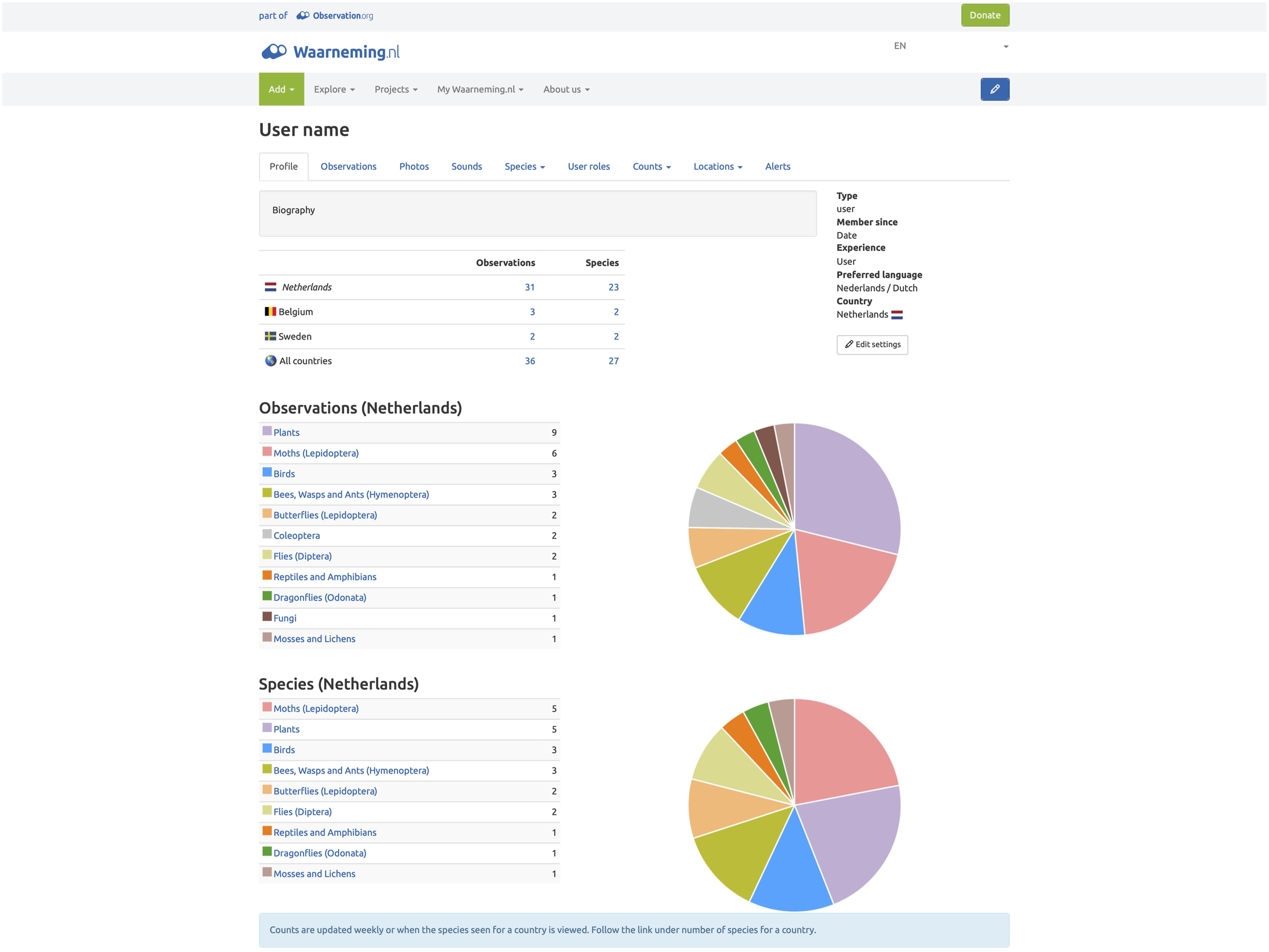
Through the lens of character, we are also confronted with the limited characterization of humans in the database, particularly in terms of their inner lives. Their characterization does not include inner properties like thoughts or feelings, nor other properties such as profession, social relations with other users, or photographs – although the database is filled with photographs, these do not show humans. This limited characterization is largely determined by the design of the database that leaves little room for other properties. The Waarneming.nl database has specific fields that information must fit into, limiting its affordances. As Hayles (2007) notes when describing the differences between database and narrative, unlike in narratives, databases can only include information that fits within “the logical categories that order and list the different elements” (1605). A database can only hold information that its categories allow for. If there are no categories in place on Waarneming.nl to gather information on the inner properties of its users, this information cannot be represented.
More-Than-Human Characters
In addition to human characters, more-than-human characters each have a ‘species’ page: waarneming.nl/species/uniqueID on which they are characterized (see Figure 2). This page includes the common name of the species, their Linnean name, and information on the taxonomic groups they are part of. This species page consists of multiple ‘sub-pages’: details, observations, maps, photos, sounds, statistics, on/in and names. The details page includes a text with general information on the species (e.g. information on their habitat, behaviour, or distribution). The (depth of) this content is pre-determined and cannot be changed by users, and differs per species (group), with long in-depth information for some species and a total lack of information for less popular species. External links to Wikipedia and at times (inter)national nature organisations are provided for more information. This sub-page additionally includes a data overview of the number of observations, photos, sounds, and total number of users who registered observations of this species. This also includes a top 5 of users who registered the most observations of this species. A range of photos is featured on this page as well as – when applicable – an audio recording of their sound. Finally, species are assigned specific traits: level of rarity (ranging from common to very rare) and origin (categorised as native or non-native). Example of species page Waarneming.nl (adapted for anonymity), Retrieved March 26, 2026, screenshot.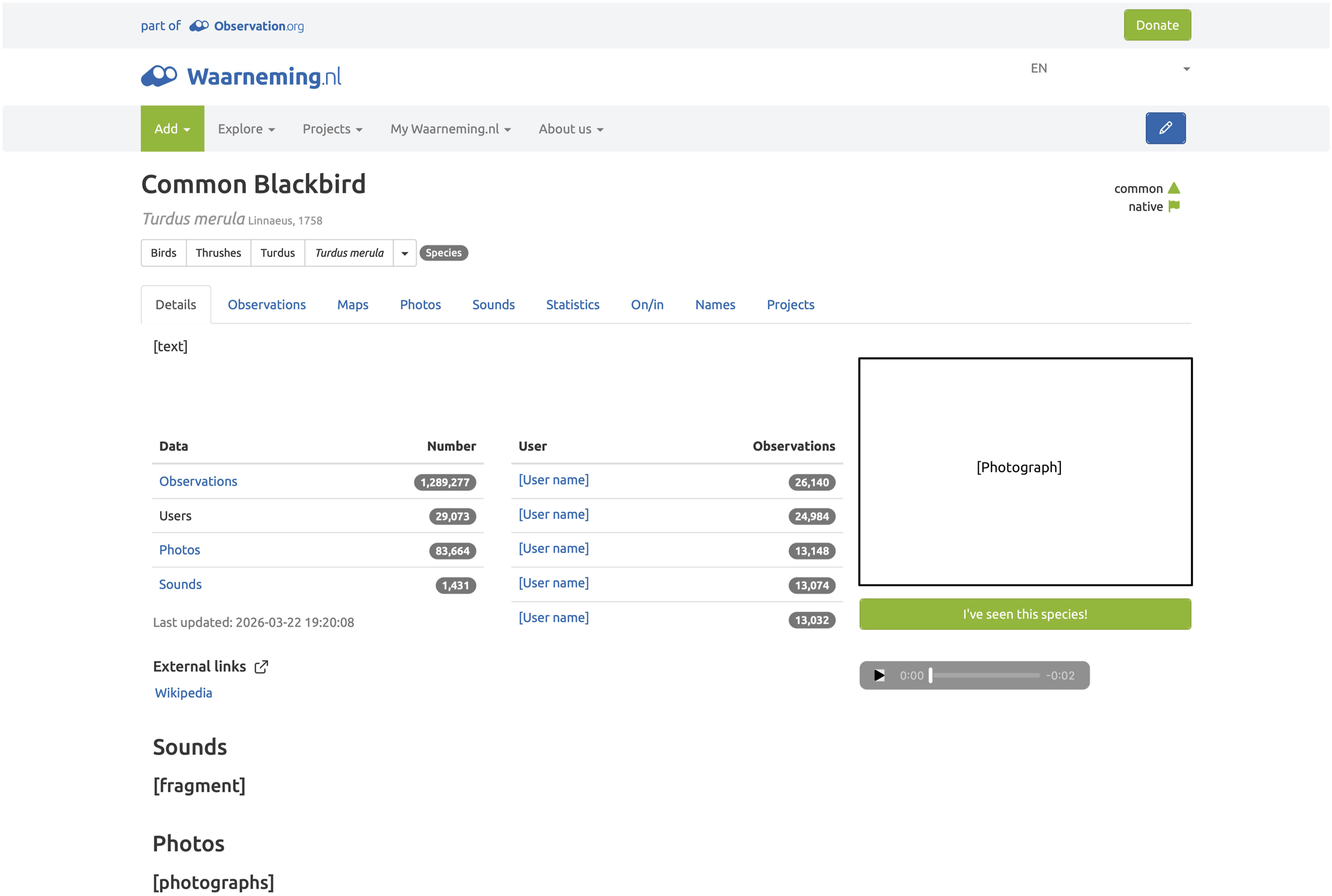
Analysis: Tensions in the Database
Now that we have established the two types of characters on Waarneming.nl and how they are characterized, we turn to the question how these characters relate to each other. We do so by diving into three tensions that can be recognized in the database between these characters: object vs. subject, individual vs. abstraction and isolation vs. relationality. For each we propose ways to move beyond these tensions in the future.
Object vs. Subject
Previously, scholars have noted how digital media tend to objectify and commodify more-than-humans (Altrudi 2020; Büscher 2013). The narrative dimension of ‘focalization’ helps to further study such objectification. Focalization refers to the selection of information in a narrative. The information that is or is not provided is dependent on the information accessible and deemed relevant by a narrator or characters in the story (Niederhoff 2014). For example, in Harry Potter, Harry himself is the main focalizer 5 , meaning that most information that is provided to us as readers is information that is accessible to Harry. We do not come to know about the events that Harry is not a part of, or the thoughts and intentions of other characters, unless the focalization would shift throughout the story.
In her theory of focalization, Bal (1997) distinguishes between a ‘focalizing subject’ (focalizer) and a ‘focalized object’ (focalized). The former refers to the character who is literally and figuratively doing the ‘observing’ (who determines what is in- and excluded from the narrative), whereas the latter is the object of this gaze. On Waarneming.nl, the human characters are focalizing subjects who are actively focalizing (observing); as a reader we get to know information they share. Reversely, the more-than-human characters are focalized objects; they do not select and share information - only information about them is narrated. Furthermore, on Waarneming.nl this focalization is limited to perceptible characteristics (actions, appearances, etc.), whereas imperceptible characteristics (thoughts, feelings, etc.) remain inaccessible. Strikingly, this also goes for the human characters themselves. Although they are focalizing subjects, their inner lives and imperceptible characteristics remain equally unnarrated.
On one level, focalization draws attention to a subject-object divide related to ‘agency’. Human characters are represented as active agents who literally perform the activity of looking and registering. More-than-human characters are merely passively registered. However, focalization not only draws attention to agency but also to how and what information is shared. Although Harry Potter is the main focalizing subject, this does not mean that Hermione or Ron – focalized objects - are derived of agency. However, we generally only come to know about Hermione or Ron what is known to Harry and what is deemed relevant for the story.
On Waarneming.nl, we only come to know about more-than-human characters what is known to the human characters and what they deem relevant to share. This relevance is determined by all sorts of values, biases, and ideologies. This links to what in cultural studies is described as the ‘gaze’ (Mulvey 1975). For example, many cultural productions throughout history depict a ‘male gaze’, featuring what is seen by and of interest to a man – which intentionally or not can result in sexualized representations of women – or a white ‘colonial’ gaze, which can result in overly exotic representations of non-Western communities. The gaze is thus not neutral but related to power. This gaze can be extended to the nonhuman world, where more-than-humans are the object of a human gaze (Malamud 2015). Here a database like Waarneming.nl runs the risk of reducing complex more-than-human lives to mere datapoints to be seen by other humans.
How can we get around this subject-object divide that reproduces the objectification of more-than-humans? After all, the human gaze is inherent to a database as Waarneming.nl. The human is literally ‘observing’ the more-than-human. Extending focalization beyond the human seems impossible in this context – in contrast to the fruitful ways fiction can achieve this. However, there are subtle ways to motivate subjectivity of more-than-human characters. For example, Caracciolo (2018) proposes, among other options, the use of reciprocal verbs. Using verbs as ‘encounter’ or ‘meeting’ rather than ‘observation’. Although this does not change the fact that human characters are the focalizing subjects, subtle changes in language challenge the objectification now built into the database by stressing mutual agency rather than a one-way gaze. It recognizes that the more-than-human other can also look back at the human observer and respond to their presence.
Individual vs. Abstraction
The more-than-human characters on Waarneming.nl are not only focalized objects but are also generalized into abstract entities. Unlike human characters, more-than-human characters are not represented as individuals. Although they are encountered as individuals in the field, in the database they are only characters on ‘species’ level. This is not limited to this database but in line with the historical and contemporary tendency to classify species into groups based on commonalities. Classification is not neutral but based on specific choices, determining what is deemed as relevant commonalities and differences. This has effects on how classified entities are understood in the world (Bowker and Star 2000). Databases are dependent on such categories, as Hayles (2007) reminds us. Categories are inherent to the structure of databases and limit what information can be shared. Although categories of species help us understand the natural world and helps us name the world around us, when it becomes impossible to go beyond these categories, the unique differences that exist within the abstract category of a species cannot be articulated. Representing more-than-humans only on an abstract ‘species’ level, reduces them to tokens of a larger group rather than individuals with their own unique ways of life. Such categorisations are also ethical. Carrithers and colleagues (2011) note that more-than-humans can be referred to either as (1) species, (2) group of individuals (population) or (3) as a particular individual. They find the latter to be most rare, whilst this option has the most ethical potential. By referring to someone as an individual rather than merely as a member of a group, one acknowledges their uniqueness and stimulates to treat this individual with respect.
Previous research suggests that Waarneming.nl users only acknowledge species as individuals for two main reasons; when it improves data quality or for protective reasons (Verploegen, Van den Born, and Aarts 2024). In the first case, users want to avoid registering the same individual twice, as this would suggest the presence of multiple individuals when only one was present. In the second case, species are acknowledged as individuals when they deserve protection, e.g. when an individual buzzard is building a nest. This is almost only the case for more rare or special species.
This raises the question what the consequences of such abstract representation are. We stress the difficulty of acknowledging species as individuals. Although relatively easy for species that do not move (e.g. trees), it is more complex for species that move around. These species can only be identified by coding individuals through e.g. bird ringing or GPS trackers. Although humans are represented as individuals more so than the more-than-humans on Waarneming.nl, as they have individual names and ID codes, we also come to know relatively little about their unique lives. As mentioned earlier, there are no functionalities in place that explicitly afford to narrate how these human characters experience their interactions with more-than-humans, what drives them, and interests them. Such imperceptible characteristics remain unknown. We would propose to integrate more functionalities that afford to share and learn about the inner lives of characters, either human or more-than-human. For example, functionalities that allow to describe the uniqueness of an observed species, for example a characteristic of an individual bird, plant, or other being, such as a specific mark. In addition, functionalities can be integrated that afford to share more about the unique experiences of the human characters, such as their interests and affects. Although there are some open text fields available where this could already be shared, such as the introduction field on users’ profile and the ‘notes’ field when registering an observation, these text fields are often not used, nor used for such purposes. This may lead to a lack of information that does not fit with explicit categories, attributes, or values present in the database (Hayles 2007).
Isolation vs. Relation
In addition to our analysis that more-than-humans on Waarneming.nl are objectified and abstracted, they are also relatively isolated. Each shared observation is of a single sighting of a species. It is not possible to register observations of multiple species at the same time. This isolation becomes particularly evident in the photos and sounds of species. These pictures and audio recordings focus on the specific species, often resulting in pictures that zoom in on the individual as closely as possible and audio recordings that isolate the sound of the species in question rather than a soundscape. This is motivated by the databases’ functionalities, that afford certain usage. For example, when registering an observation, a photo-recognition option is available. When using this option, users are asked “is the subject placed well and large in the centre? Crop where needed.” In this manner, relations with other species, the landscape, or the observer, are removed as much as possible.
However, focusing on the objectification and isolation of more-than-humans arguably does not do justice to the relationality of the database. As mentioned at the start of this article, the very structure of Waarneming.nl is relational, as all datapoints are linked to each other, meaning that all species (including humans) are connected to each other throughout space and time. In this sense Waarneming.nl is highly relational in its very nature and rejects isolation. The human and more-than-human characters cannot exist without the other. Every datapoint in the database includes both a (more-than-human) species and a (human) observer (Figure 3). Example of an observation list Waarneming.nl (adapted for anonymity), Retrieved March 26, 2026, screenshot.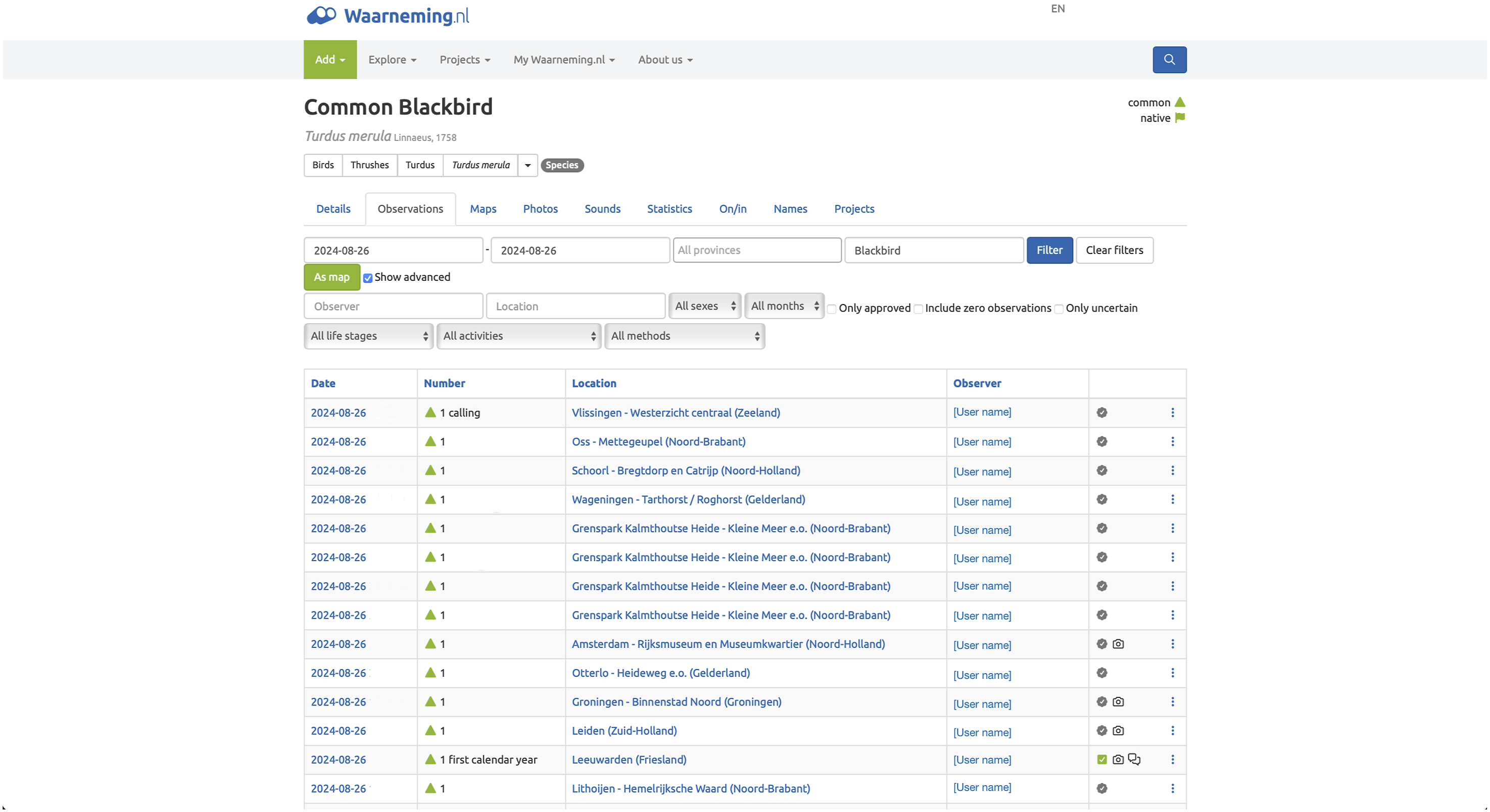
This is not only the case for relations between human and more-than-human characters, but the database includes multiple relations between human characters and more-than-human characters. Within the database, observers and observed species become related to each other when they are present at the same location and/or when they occur in a similar timeframe (i.e. range of day, time, or year). For example, as visualised in Figure 4, when you (human 1) observe a Blackbird in your neighbourhood, by registering this observation you relate yourself to the ‘Blackbird’. If someone else (human 2) register(s) a fox in this same neighbourhood or at a different place within the same timeframe, you also indirectly become related with the fox, as your observation of the Blackbird and the other user’s observation of the fox are linked in the database based on their shared attributes of location and timeframe. This also means that the blackbird and the fox become related to each other by their mutual presence at this location or time of observation. Similarly, the other human observer becomes linked to you. In this way the platform represents how humans and other species share their lives throughout space and time and are connected in intricate ways that are often overlooked in Western society. Lines represent how more-than-human and humans become connected to each other in the database, within a shared location and/or timeframe (dotted line).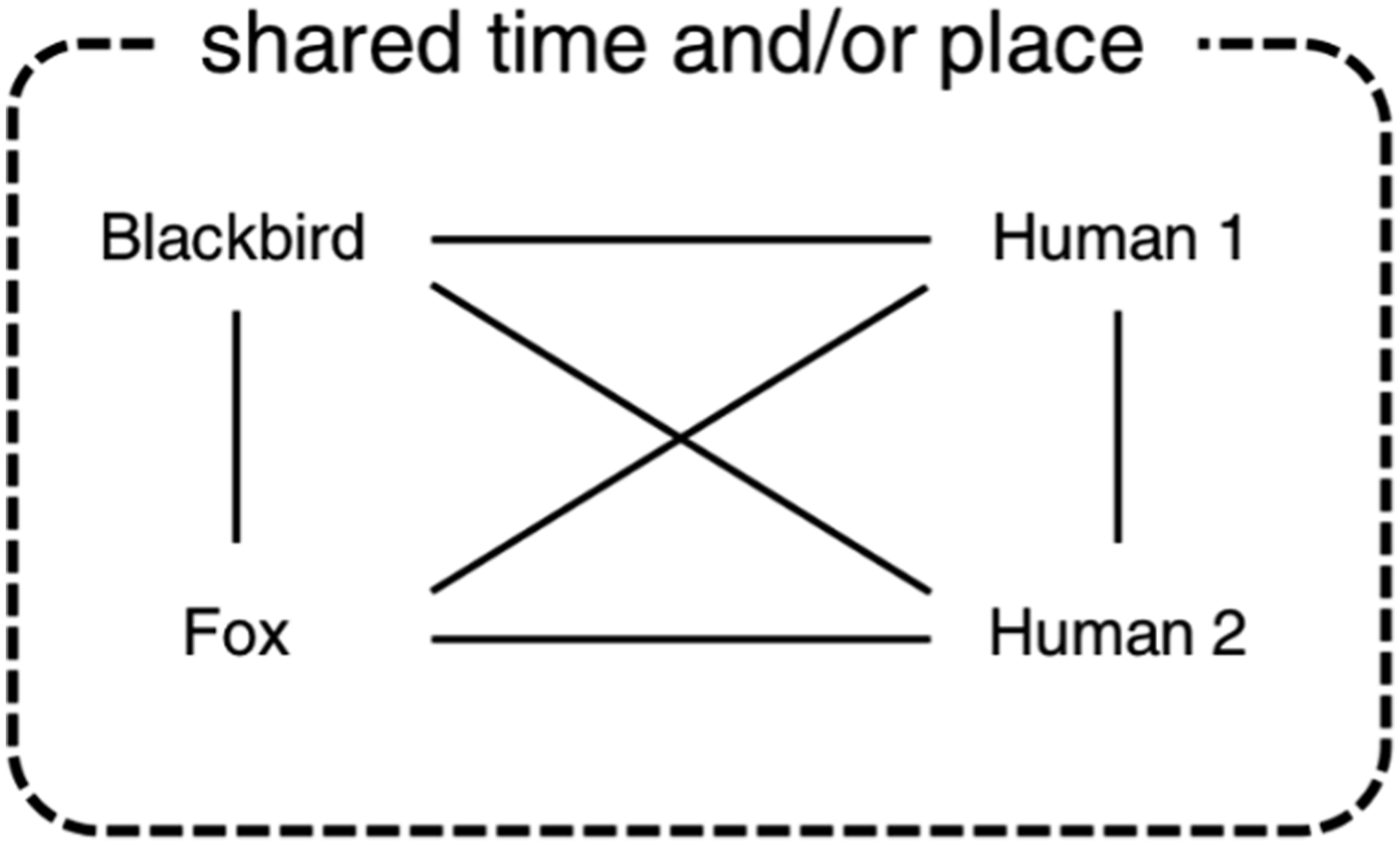
However, relationality has many forms. As studies on characterization remind us, relations between characters are not necessarily equal but often hierarchical, with some characters more central to the narrative and described in more detail and/or mentioned more often (Smeets 2021; Woloch 2009). Although all characters are related to each other in the Waarneming.nl database, such hierarchies are also evident. Environmental philosophers distinguish ‘images’ of how humans perceive their relationship with nature, with different levels of anthropocentrism: master (humans stand above nature); steward (humans stand above nature, but with responsibility to take care of nature); partner (human and nature are of equal value) and participant (humans are part of nature) (Zweers 1995). At first sight, Waarneming.nl seems to reaffirm a master relationship, in line with humans as active agents, objectifying and abstracting more-than-humans. However, this might be too quick a conclusion. Arguably, the efforts of the platform are more in line with a stewarding human-nature relationship. The collection and sharing of data on more-than-humans is also an act of care (van den Born et al. 2022; Verploegen, Van den Born, and Aarts 2024). The relation between humans and more-than-humans is in this case fed by care, fascination, and wonder and does not problematically reproduce a human-nature dichotomy that leads to less respectful relations.
Yet, these more affective and caring dimensions remain implicit in the database, as Waarneming.nl rather emphasizes certain ‘factual’ characteristics of species (their species names, location, behaviour). However, each observation in these databases also marks a moment of interaction between a human and more-than-human within a specific context. Especially those interactions and contexts are relevant to make space for in times of ecological crisis. As posed by the Intergovernmental Science-Policy Platform on Biodiversity and Ecosystem Services (IPBES), there is a need for a plural valuation of nature in society, research, and policy. This plural valuation includes (1) instrumental values of nature, where nature is valued for its benefits to humans, (2) intrinsic values of nature, referring to the value nature holds in and of itself independent of humans, and (3) relational values of nature, valuing the meaningful and reciprocal relationship between humans and nature (Chan et al. 2016). In databases such as Waarneming.nl, we see little explicit reference to instrumental values of nature, where species would be referred to for their benefit to humans. Yet, the collected data may be used in line with instrumental values, for example when used to study or improve ecological features such as drinking water quality. More so however, the database seems to engage with intrinsic values of nature, helping to map the occurrence of species and protect their presence, regardless of human benefit of this. Relational values are also not explicitly engaged with on the platform, in line with the lack of shared experiences and affects that implicitly underlie observations. Making explicit space for such experiential and affective dimensions could highlight the care that drives this data collection and provide more room for relational values. Recognising relational values shifts our focus to also acknowledge the qualities of the relationships themselves (Chan et al. 2016). Additionally, relational values have motivational power for nature conservation (Klain et al. 2017; Knippenberg et al. 2018; Mattijssen et al. 2020). In this way, the platform would engage with a more plural valuation of nature which IPBES stresses as essential for transformative change towards a more sustainable future (IPBES 2024).
Discussion: Looking to the Future - A Shift in Genre?
So far, we have used the narratological concept of character, as well as related concepts such as focalization, to gain a deeper understanding of how humans, more-than-humans, and their relations are represented in participatory biodiversity databases. When applying such a narratological lens to databases, another narratological concept that emerges is that of genre. In her pioneering analysis of biodiversity databases, Heise (2016) not only analyses biodiversity databases as cultural ventures but also highlights how these databases engage with elements and conventions of certain literary genres. Specifically, she argues that these databases engage with elements of elegy, a genre marked by the lamenting of the death or loss of a close one (Klarer 2013). Understanding these databases through the lens of genre gives additional depth to the overall stories these databases tell through certain techniques and conventions. Heise (2016) argues that databases, like the IUCN Red List, include elements of elegy by focusing on species decline, extending elegy’s traditional focus on the loss of an individual to global species loss. However, Waarneming.nl and similar participatory observation platforms favour a focus on presence, rather than absence. Elegy thus seems less appropriate of a genre to interpret such databases. Waarneming.nl does not explicitly engage with endangerment or loss. Loss is only made visible implicitly through statistics or maps on the platform where species can be seen to disappear over time. The only direct attention for loss is provided by the option to share observations of dead individuals, by registering their ‘behaviour’ as ‘dead’.
Furthermore, little of the melancholic, mournful styles of elegies are recognizable on Waarneming.nl. As analysed above, the database takes a rather impersonal, objective stance towards more-than-humans. Observations are registered meticulously but without elements of experience and affect. Rather than elegy, this reminds of the social realist tradition; a genre in literature and art with a focus on detailed descriptions and no explicit dives into the feelings, sensations or emotions of characters, “implicitly claim[ing] that reality can be represented objectively and divorced from subjective influence” (Munteán and Lange 2018: 344). Exactly through this more distanced, objective style, 19th Century social realist works aimed to address societal and political injustices, with a focus on marginalised communities. The attentiveness toward more-than-humans and their lifeworld that Waarneming.nl motivates, is arguably a political and ethical act (Verploegen, Van den Born, and Aarts 2024). Noticing the presence and needs of (certain) more-than-humans, has the potential to draw humans into more responsible relations with more-than-humans (Krzywoszynska 2019). Additionally, in a more instrumental manner, the data that is collected in the database contributes to nature protection and policy.
In conclusion to this article, we propose a genre shift that does more justice to mutual human-nature relationships rather than the current tendency of objectification, abstraction and isolation. Rather than understanding biodiversity databases like Waarneming.nl as elegy –focusing on melancholy and morning – or as social realism – focusing on factual description – we propose to follow a shift in contemporary literature towards post-postmodern genre conventions and its engagement with affect. Post-postmodernism can be understood as a corrective response to postmodernisms’ ‘cold’ tone and its emphasis on form over affective engagement, resulting from its focus on problematising storytelling’s inability to represent reality (Smith 2011). In response, post-postmodernism brings back elements of realism: “a renewed commitment to representing the emotional lives of real people” (424), whilst also continuing to engage with postmodern traditions (Smith 2011). The post-postmodern narratives that result from this, attempt to create warmer and more affectively laden stories that more explicitly engage with embodiment and subjectivity, as well as community and meaningfulness of life (Smith 2011; Van Dijk and Olnon 2015). To emphasize this move away from the individual to community, Van Dijk and Olnon (2015) identify how within this post-postmodern movement, narratives have emerged that “radically reposition the main character within the world around” (our translation), not so much by creating new or more relations, but rather by stressing how meaningful relations shape identity. As Demeyer and Vitse (2020) argue, contemporary literature engages with the alienation that is often felt in Western society between the self and the rest of the world, and a quest for connection in response to this. Narrating affects that come with both this alienation and connection, allows to reflect on, question, and imagine how to relate to each other – human and more-than-human – in better ways in the future. In this way, cultural productions can go beyond reproducing a human-nature divide but rather come to represent connections we want to aim for in the future.
This focus on relationality is not limited to post-postmodern literature but has a longer tradition, specifically within feminist and post-colonial literature, and other writing on non-binary worldviews (e.g. Margaret Atwood and Toni Morisson). The relations between humans and more-than-humans have likewise been subject of extensive theoretical reflection by scholars including Haraway (2007), Bennett (2010) and Tsing (2015). Platforms like Waarneming.nl can learn from such literary and scholarly endeavours to engage with environmental data in a way that motivate reflection on and engagement with the relationship between humans and nature. The relational structure of the database is a good basis for this and can be made more explicit in the visual and textual rhetoric of the platform. Within the context of citizen science there has already been some engagement with embracing relational and affective layers of environmental data. Gabrys and colleagues (2016), have proposed the development of ‘data stories’, presenting stories based on collected data to highlight the lived experience of citizen scientists in addition to the scientifically useful data they collected. In this way, the emotional labour they are involved in, and the worry, care, love, or passion related to the underlying topic they study is included more. Additionally, some examples already exist of more affective database structures that can be used as inspiration. The most prominent example of this is, ‘What is Missing’ by Maya Lin. This interactive digital memorial achieves such affective and relational database structures, where users can share explicitly affective stories about their memories of (lost) places and species they feel connected to. As Ladino (2018) writes, the memorial “combines data and narrative, suggesting we don’t need to choose between them. These stories are data. And the data is not just narrated, but affectively so.” (195), and as she continues, the multimedia on the website “encourage affective connections to nonhuman species and to specific environments” (197). As posed by Kolodziejski (2015), this is specifically achieved by disrupting the human gaze, which is also evidently present on Waarneming.nl, as well as by shifting between different human-nature relationships of hierarchy and harmony to make users more explicitly aware of the tensions in these relations and invite further reflection. Like on ‘What is Missing’, the tensions that Waarneming.nl currently induces between humans and more-than-humans, in terms of object-subject, individual-abstraction, and isolation-relation, can become invitations for further reflection on the relationship users have with more-than-humans.
Conclusion
This analysis has been an interdisciplinary endeavour, drawing on literary and cultural studies as well as socio-ecological theories. Based on our analysis, we invite biodiversity databases to join the genre shift already set in motion in contemporary literature and re-evaluate their representation of humans and more-than-humans, embracing more radical relationality to help imagine more caring and responsible human-nature relationships in the future. We propose using more active verbs as ‘encounter’ rather than ‘observation’, providing options to acknowledge the more-than-human individual as well as emphasising the care and other affects that underlie human-nature relations. Considering such changes, biodiversity databases would do more justice to the affective relations between humans and more-than-humans and help advance mutual human-nature relationships.
Footnotes

Funding
The authors received no financial support for the research, authorship, and/or publication of this article.
Declaration of Conflicting Interests
The authors declared no potential conflicts of interest with respect to the research, authorship, and/or publication of this article.