




Abstract
To build a sustainable future, people need new stories about how societies can engage with nature. Visions of the future are a powerful way to tell new stories, especially when they model value systems that are under-represented in dominant discourses about how the future might unfold or be guided. This paper outlines a participatory visioning process conducted in Mombera Kingdom, a traditional community located in northern Malawi. Using the Nature Futures Framework (NFF), a tool created by the IPBES task force on scenarios and models to help develop scenarios and models of desirable, sustainable futures for people and nature, we co-produced several desirable, value-diverse visions of the community’s future. To enable communication both within the community and a wider audience beyond academia, hopes and tensions embedded in these visions were captured by artworks and short speculative fiction stories that were widely disseminated to the public. We also applied semi-quantitative system mapping to integrate community insights with academic literature, and rearranged elements of the participatory visions into distinct future scenarios. These scenarios were designed to offer a local case study perspective that could feed into visioning at larger scales and thereby contribute to the ‘bottom-up’ scenario process advocated by the IPBES Task Force. This study’s approach specified multiple potential values for (and meanings of) the community’s landscape, offering an example of how research can navigate, support, and amplify value-plurality in post-colonial contexts.
Keywords
Introduction: Whispered Answers, Amplified
Answering a Crisis of Imagination
Across the planet, the Anthropocene’s crises are causing escalating impacts on the climate (IPCC 2023), the economy (World Economic Forum 2023), and the ecosystem functions that support nature and people (IPBES 2019). It is imperative that human societies transform away from the social, economic, and ecosystem management practices which have placed “planetary health … acutely under threat” and engendered “destabilisation of the global commons” (Gupta et al. 2024, e815). The failure of many dominant institutions to abandon these practices can be understood as a crisis of imagination (Bendor 2018; Haiven 2014; Moore and Milkoreit 2020). Imagination is a key component of how people and organizations understand (and act in) the world (Yusoff and Gabrys 2011). The Anthropocene demands that individuals and groups apply their imaginations to apprehend the “reality and severity of the risks” (Milkoreit 2017, 1), to understand the role of every-day practice in creating the risks (Yusoff and Gabrys 2011), and to imagine clear and coherent visions of sustainable alternatives (Bai et al. 2016; Wyborn et al. 2020).
To navigate alternative visions and possibilities for the world’s futures, individuals and organizations (including global institutions) often use scenarios (Cork et al. 2023; Kuiper et al. 2024). Scenarios are coherent, alternative descriptions of possible futures, such as the Shared Socio-economic Pathways (SSPs) used in the Intergovernmental Panel for Climate Change (IPCC) assessment reports (Riahi et al., 2017). While global-level narratives of the future like the SSPs are helpful for establishing shared problem frames and accepted bounds for plausibility (van Vuuren et al. 2012), they often present a narrow view of what is possible (Keys, Badia, and Warrier 2024). By building more diverse and inclusive global future scenarios, sustainability science can explore a broader range of solutions and increase buy-in among citizens and organizations at many scales (L. Pereira et al., 2021b; L. Pereira et al., 2019).
Diversifying global futures is a complex task. One complexity is that discussions about the future are often dominated by methods, institutions, and assumptions rooted in the Global North (Feukeu, Ajilore, and Bourgeois 2021; L. Pereira et al. 2021a; Lauer, Carpintero, and Castro 2025). By engaging with a diverse range of stakeholders, participatory scenario planning methods can promote a diverse range of worldviews (Lauer, Llases, and López-Muñoz 2025; Oteros-Rozas et al. 2015). A second complexity is that the worldviews expressed by stakeholders in these participatory processes may be structured and informed by the very assumptions we seek to diversify. This dynamic can be especially thorny in post-colonial contexts; many commonly held beliefs among governments and development practitioners regarding previously colonized ecosystems are inherited from misguided or incorrect colonial assertions (Leach and Mearns 1996). For example, many “common-sense” strategies for managing savannas and grasslands are rooted in the belief that these ecosystems are degraded forests (Stevens et al. 2022), which is reinforced by global classification systems such as the UN Food and Agricultural Organization’s definition of “forest” (Scogings 2023).
Decolonial Social-Ecological Imaginaries and African Futures
The collective imagination is dynamic, complex, and contested; thus, the framework of “imaginaries” is useful for navigating these dynamics in the context of sustainability. While social imaginaries structure the relationship between the individual and society (Taylor 2003), and socio-technical imaginaries examine the co-production of social and technical structures (Jasanoff and Kim 2015), both are fundamental to how we conceive of modern society. By framing scientific systems as socially embedded, these concepts facilitate analysis of the feedback loops between a society’s historically contingent imagination, its prioritized technologies, and its choices regarding how those technologies shape social life (C. A. Miller 2015).
Building on this, social-ecological imaginaries specifically address the relationship between society and nature. These imaginaries are the systems of ideas and images that shape how actors understand “nature,” interpret ecological conditions, and determine which relationships with their landscape are desirable (Beilin and Bohnet 2015). We utilize this concept to frame nature-futures visioning exercises, as it directs focus toward the co-evolution of perceived landscape conditions and the management practices that legitimate those perceptions. Social-ecological imaginaries thus clarify how communities structure and normalize their relationship with the natural world.
Social-ecological imaginaries are rarely monolithic. Local communities across the globe hold a wealth of cultural practices and traditions, offering a rich variety of alternative problem framings and solutions (L. Pereira et al. 2021). The emerging field of decolonial futures aims to intervene in the current crisis of imagination by mobilizing and amplifying these alternative imaginaries to bridge across knowledge systems (Tengö et al. 2017). This approach operates at multiple levels: locally, by mobilizing imaginaries within communities to redress past marginalization, and globally, by amplifying these alternatives to challenge dominant historical narratives (Feukeu, Ajilore, and Bourgeois 2021; Terry et al. 2024; Yusoff and Gabrys 2011).
We use the Nature Futures Framework (NFF) to navigate the contestation and interaction between these diverse ways of valuing nature. Developed by the IPBES task force on models and scenarios, the NFF is a heuristic for envisioning desirable futures for people and nature by articulating and connecting plural nature values (L. M. Pereira et al. 2020). It identifies three value perspectives: “Nature for Nature” (intrinsic value and biodiversity preservation), “Nature for Society” (instrumental benefits to people), and “Nature as Culture/One with Nature” (relational value linking nature to identity and community).
These three nature value perspectives can be viewed as defining a triangular state space, in which the area within the triangle represents plural nature values (Figure 1). As a heuristic that explicitly defines this state space that can hold infinite possibilities, the NFF has enabled a range of activities (Okayasu et al. 2025). For example, the framework can facilitate dialogue between divergent viewpoints (e.g. Nieto-Romero et al., 2016), aid the creation of desirable scenarios embedded in diverse values (e.g. Kuiper et al., 2022), and enable classification of potential interventions (e.g. Palacios-Abrantes et al., 2022). Ongoing research is also investigating how the framework might enable models that engage with nature’s complex impacts on human wellbeing, account for cross-scale interactions, and establish indicators that represent diverse benefits of nature (Kim et al. 2023). The NFF is designed to support bottom-up scenario approaches, enabling larger-scale futures to learn from diverse local-scale scenarios. The framework’s emphasis on the value of locally situated values may make it a useful tool for decolonial futuring. The Nature Futures Framework names three “value perspectives,” or ways that people value nature. These form the corners of a triangle, marking the boundaries (or extreme positions) of the diversity of values that might be represented by a stakeholder or a vision (modified from Pereira et al. 2020).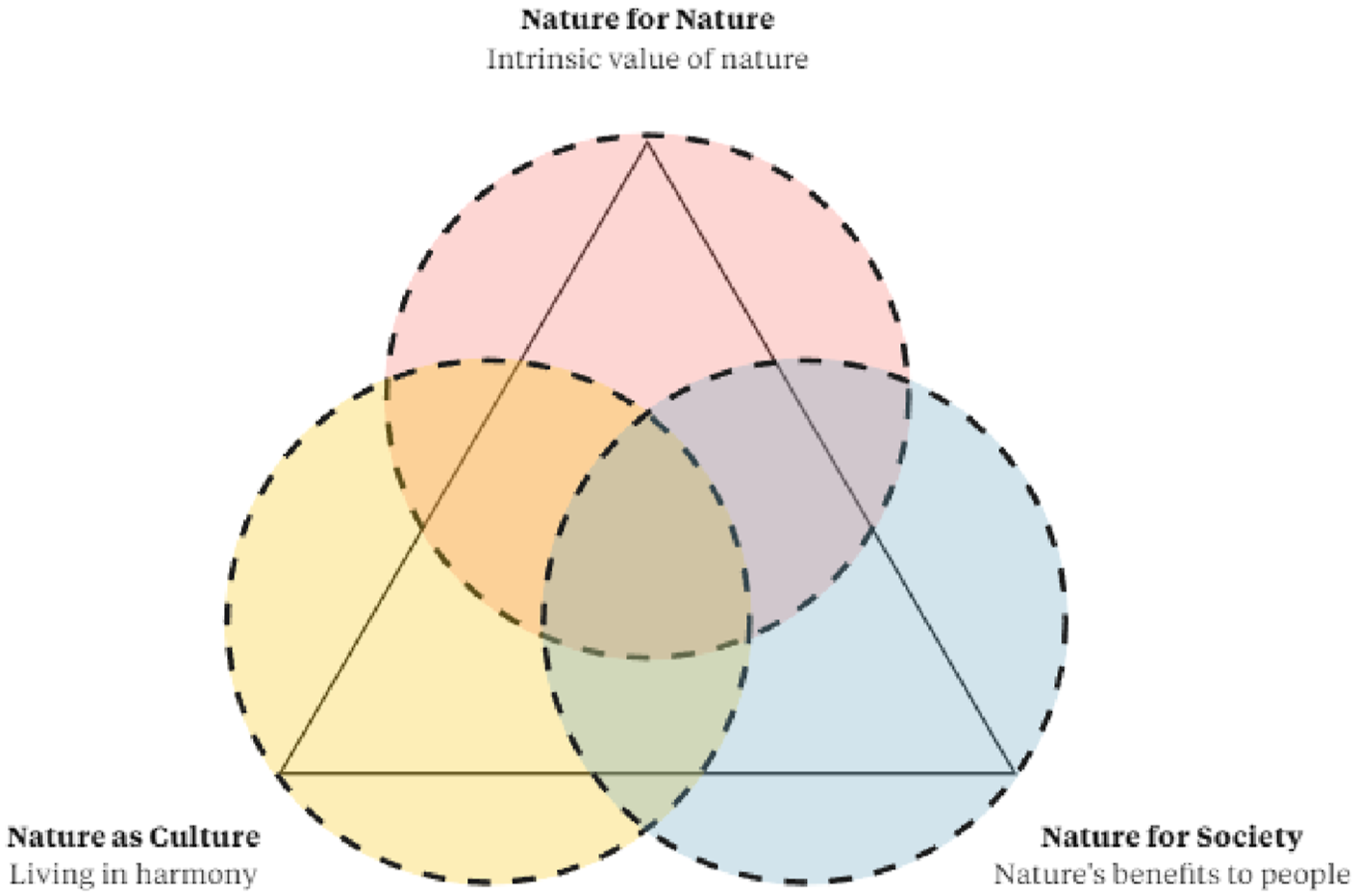
The AFRICAN FUTURES project aims to support more diverse and dynamic global scenarios by collaborating with local communities across Africa to assert new narratives about what is possible for the continent. The project team has convened community-scale participatory visioning workshops with royal households, traditional leaders, and citizens in Malawi, Zambia (Kabisa and Pereira 2025), and Benin (Tcheton et al. 2025). Globally, the project aims to amplify perspectives from partner communities in the prevailing academic discourse on possible futures, and operationalize semi-quantitative approaches to contextually-dependent nature values. Locally, the project aims to promote futures where people and nature thrive by supporting partner communities’ capacities to re-imagine their landscapes’ sustainability challenges and surface place-based solutions rooted in these imaginaries. This article reports on the results of the project’s engagement in Malawi with the traditional community of Mombera Kingdom, highlighting the integration of participatory approaches, artistic expressions and expert-driven analysis. The article concludes by articulating alternative framings of the community’s landscape, informed by the imaginaries surfaced by this project and emphasizing the value of articulating a set of social-ecological imaginaries for audiences across institutional and spatial scales.
Mombera Kingdom: Social and Ecological Context
Malawi is located in southeastern Africa, surrounded by Zambia, Tanzania, and Mozambique (Figure 2). Its present-day borders were drawn by a British colonial government in 1859, which positioned Malawi (then the Nyasaland Protectorate) as a source of valuable export crops (A. Conroy 2006). After the country achieved independence in 1964, the new government maintained an economic strategy based primarily on agricultural exports (Carr 2004), which has been reinforced in the 21st century by international development actors (Moyo and Moyo 2014). Because most farmland is managed by smallholders, the emphasis on cash crops incentivizes income generation over food security (Moyo and Moyo 2014) or ecosystem health (Ngwira and Watanabe 2019). Agricultural conversion is well-understood to be the primary driver of deforestation in Malawi, which most often means the loss of miombo woodland, a savanna ecotype that co-evolved with pre-colonial societies across much of southern Africa (Archibald et al., 2018) (Figure 3). Malawi (gray) in its regional context. Mzimba district is shown in orange. Insert shows Malawi’s position on the African continent. The map was created using QGIS software, with administrative boundaries from the Database of Global Administrative Areas (GADM 2025). Watercolor basemap from Stamen Design. Images of Mombera Kingdom. (a) The miombo woodland of Chimaliro forest reserve. (b) Cattle grazing along the road. (c) Mt. Hora, a sacred site in the district. (d) Traditional warriors and dancers performing a ceremonial greeting. Photos by the authors.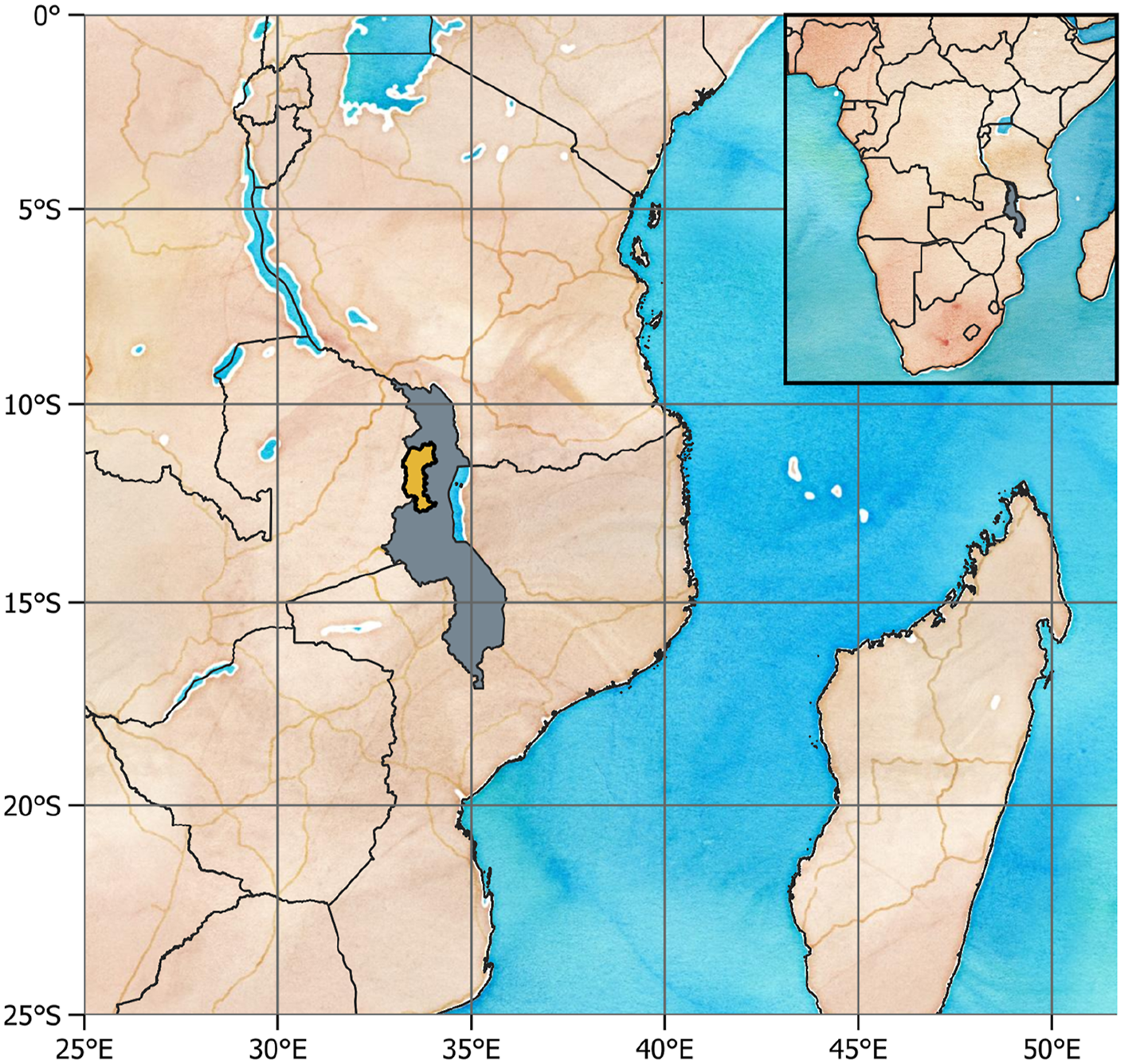
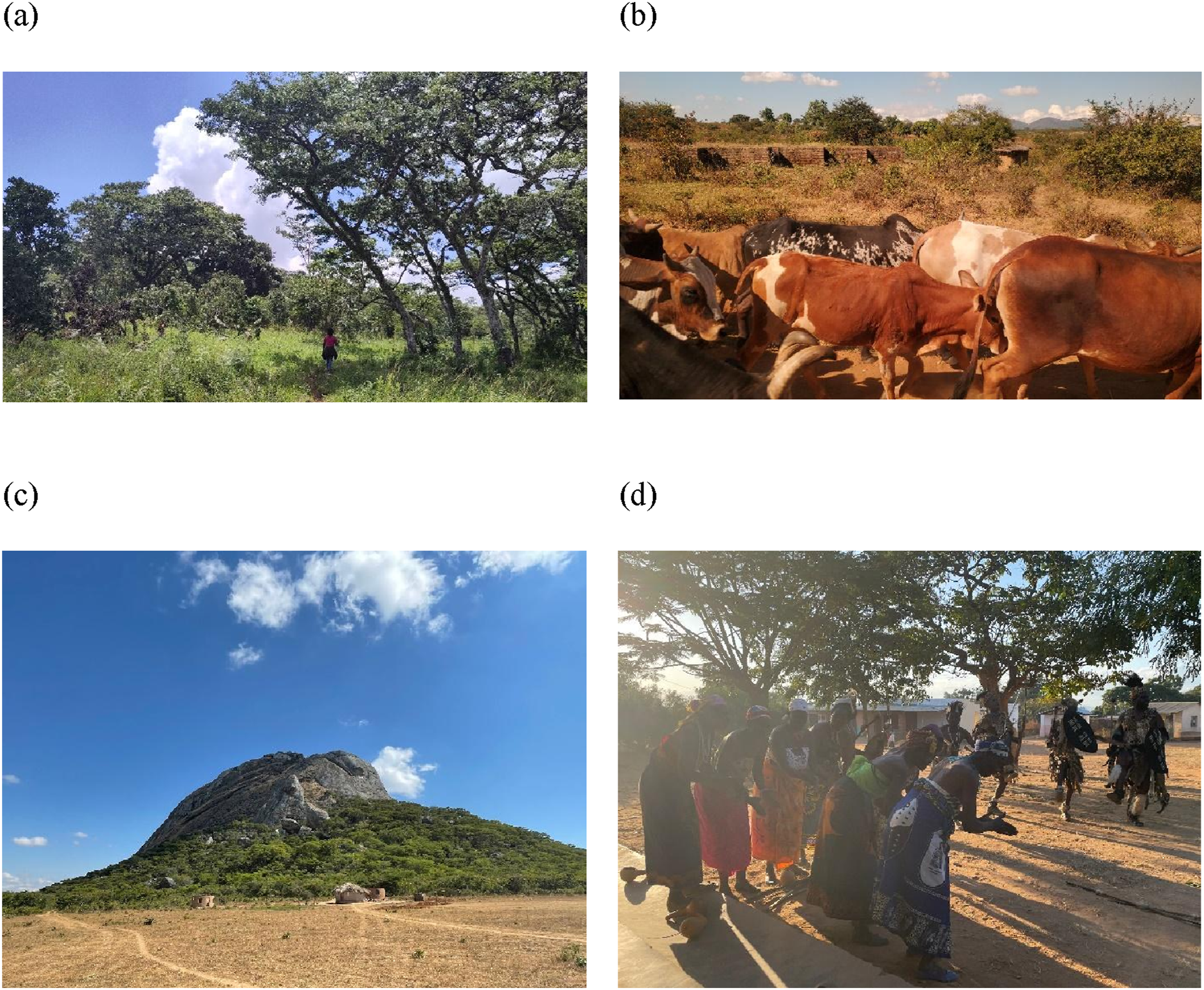
Mombera Kingdom is a traditional community situated in Mzimba, a district in northern Malawi (Figure 2, Figure 3). Mombera Kingdom was founded in the 1800s by Nguni settlers who migrated to Malawi during a series of conflicts in present-day KwaZulu Natal, South Africa. This group came to be called the M’mbelwa Ngoni. See (Tingokanyama 2023; Wright 2006) for a more thorough review of this history. The kingdom’s traditional governance structure is recognized in Malawian law as a Traditional Authority. While enforcement of national law in Mzimba is governed by a district council embedded in Malawi’s national government, cultural governance is administered by the M’mbelwa Chiefs Council, which is responsible for protecting vulnerable citizens, commanding traditional warriors, implementing certain development projects, and promoting customs, traditions, and peace. This traditional governance structure is headed by the Inkosi ya Makhosi (the king of kings) and nine Amakhosi (chiefs) who report to him, each governing a chiefdom within the kingdom. Traditionally, all Amakhosi are men. As in the rest of Malawi, agricultural livelihoods are dominant in Mzimba: in 2016, the average resident acquired the majority of their food and income through farming (Svesve 2016). Grazing is also an important cultural and economic activity in Mzimba which, like much of the kingdom’s economy and culture, is closely connected with its miombo woodland. The past 20 years have seen significant changes to Mzimba’s land cover, with significant conversion of savannas and woodlands to cropland and open grassland (Nazombe et al. 2024).
Methods
This project produced multiple products in parallel and across teams. The relationships between these products is mapped in Figure 4. More methodological details are available in the supplemental material. A visual outline of this project’s 3 parallel approaches. The visions’ participatory process informed the artistic products, while the visions themselves informed the expert-led scenarios. The stories informed the research team as they were building the scenarios.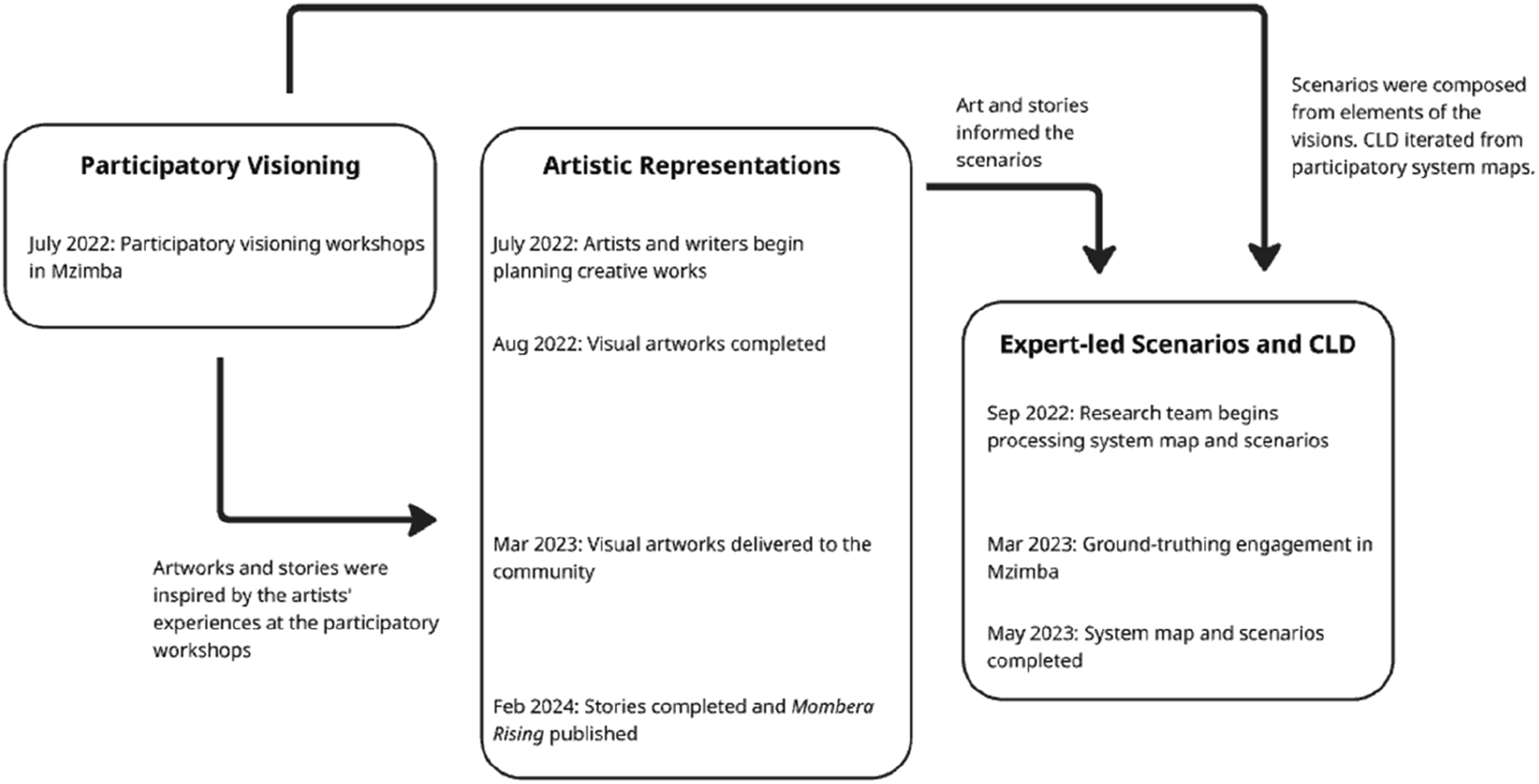
Participatory Visioning Workshops
Demographics of Participants at July 2022s Initial Visioning Workshops (Combined).
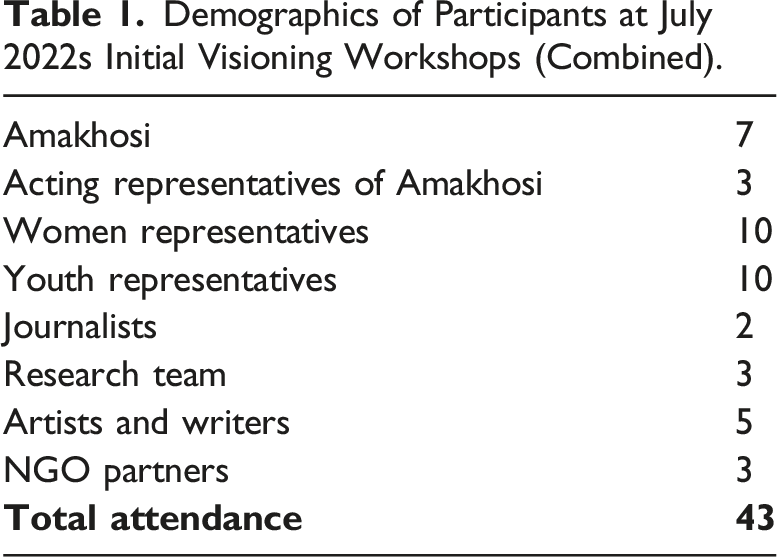
We conducted two participatory workshops. Each began with a participatory mapping exercise, which established a shared understanding of Mzimba’s present conditions and challenges. The visioning process in each workshop was guided by a different question. The first group was asked “What would a positive future for nature and people in Mzimba look like?” In order to guide the second workshop to emphasize different but complementary topics, the second group was asked, “What would the future look like in Mzimba if the Ngoni could have everything they want?”
Artistic Representations
Stories and art can create shared symbols that support shared imagination (Moore and Milkoreit 2020), frame invigorating aesthetic experiences that provoke audiences to see the world anew (van Lente and Peters 2022), and make sense of large-scale changes at a personal scale (Veland et al. 2018). Inspired by narrative and creative futuring approaches that have invigorated audiences across scales and sectors (e.g. Merrie et al. 2018; L. Pereira et al. 2021; Hamann et al. 2020), the research team commissioned Malawian artists and writers to capture the imaginaries that emerged in the workshop discussions. The artists created visual artworks that emphasize specific points of discussion and capture the emotional content of the visioning process. The writers created science-fiction stories that coherently (and compellingly) articulate the visions’ ideas and navigate potential points of incompatibility and conflict.
Causal Loop Diagrams
After the workshops, the research team used system mapping techniques to make sense of Mombera Kingdom’s social-ecological complexity. The Causal Loop Diagram (CLD) is a semi-quantitative approach that explores the structure of a complex system by describing causal relationships between key elements and tracing the feedback loops that drive system behaviour (Barbrook-Johnson and Penn 2022). We followed a systems thinking process to create a CLD of Mombera Kingdom’s present dynamics (Meadows 2008; Sterman 2000). We started with the participatory system maps co-produced during the visioning workshops, and adapted them iteratively based on feedback from experts and community partners. We also established one target variable for each NFF value perspective, enabling us to focus the map on how subsystems mentioned by experts and community partners impacted three broad concerns. See the supplemental material for more information about the target variables. This CLD was intended as more of an internal, analytical tool than as a core product for community partners - the goal was to help the research team clarify our evolving understanding of the system.
Expert-Led Scenarios
We converted the participatory visions into distinct, contrasting NFF scenarios, each emphasizing one value perspective. Further, we generated the scenarios by feeding disaggregated elements of the visions into an abbreviated version of the Manoa method, a futuring technique that generates complex, surprising futures from a handful of “emerging issues of change” (Schultz 2015, 5). These expert-driven scenarios are designed to enable comparison with other NFF case studies in the scientific literature, facilitating their inclusion in bottom-up scenario processes. By rearranging the components of the participatory visions into a new form, these scenarios were also designed to complement the participatory visions by offering new perspectives on the hopes, preferences, and imaginaries embedded in the visions.
Results
Participatory Visions
The participatory system mapping exercises revealed common concerns about deforestation among participants, which all groups agreed was a central problem with direct effects on the community’s wellbeing, as well as reinforcing effects on other problems (e.g. availability of clean water, soil erosion, and prevalence of traditional culture) (Figure 5). Images from the participatory visioning workshops in July 2022. (a) Workshop 2 – a group deliberates their vision (V5). (b) Workshop 2 – a vision, structured by the NFF (V4). (c) Workshop 1 - The women’s group brainstorms initial elements (V2). (d) Workshop 2 - group system mapping. Photographs by the authors.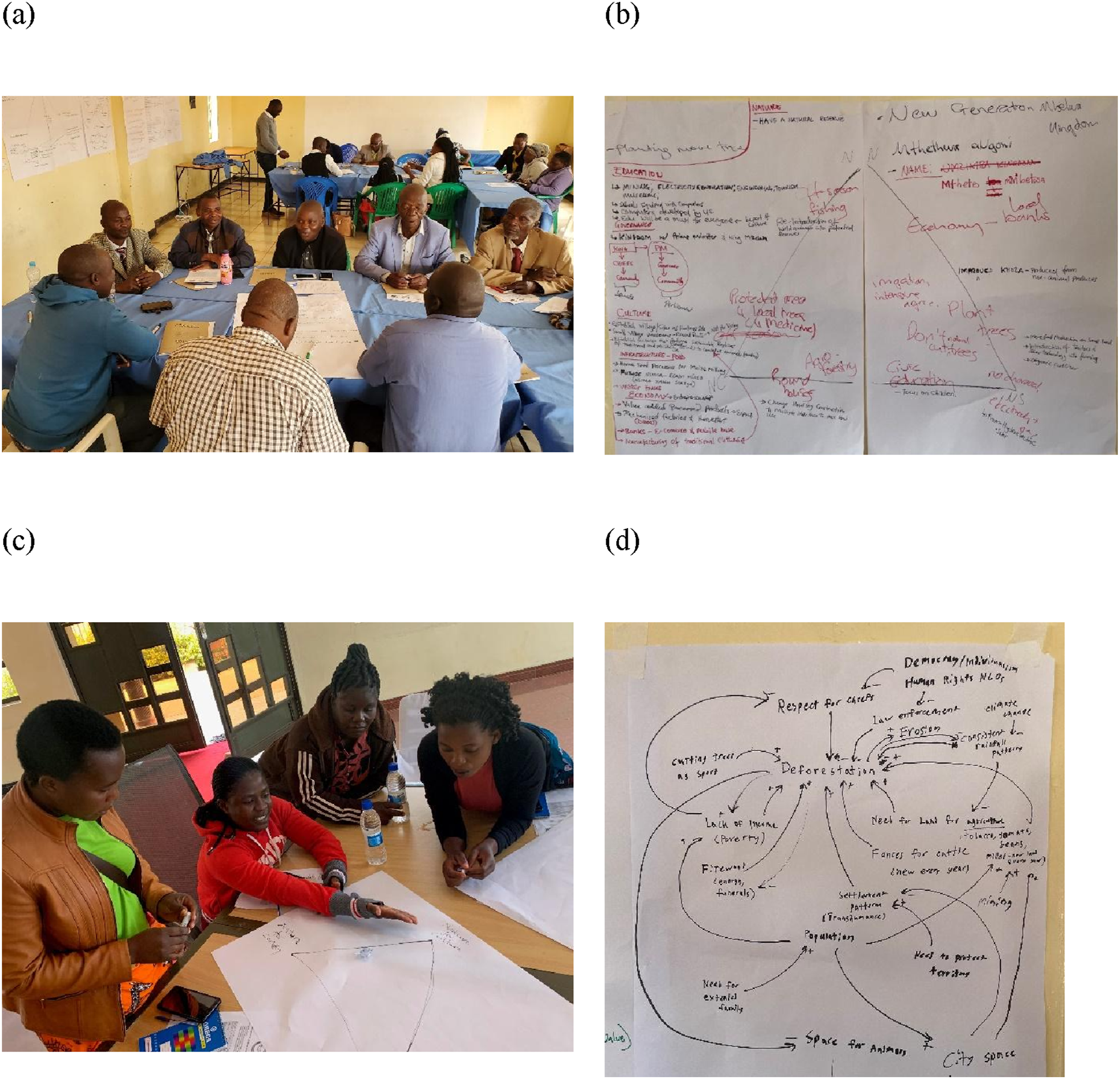
The focus of the visions changed between workshops, which suggests that the organizing questions may have offered different affordances. Participants in Workshop 1, who were asked to imagine positive futures for nature and people, tended to imagine recovery: of political autonomy, of ecosystem health, and of soil quality (V1, V2, V3). Probing of the participants revealed that for this group, imagining positive futures required recovering a pre-colonial starting point. In the first workshop, the participants were split into demographic groups, and the conditions of this recovery changed between groups. The women’s group envisioned a female Inkosi ya Makhosi, indicating greater gender equality in cultural governance (V2). The youth’s group emphasized market relations with other districts and other nations (V3).
Participants in Workshop 2, who were asked to imagine a future where the Ngoni community “could have what they want”, imagined economic and technological innovations that might embed traditional cultural practice (e.g. traditional round homes, grazing, or the production of millet beer) into daily life in the future. These visions (V4, V5) emphasized comprehensive changes to the local economy (eco-tourism, or local production of electronics), infrastructure (solar and hydropower, sophisticated e-commerce markets), and daily life (architectural overhauls, common use of agricultural drones). See the supplemental material for more details about the visions.
Visual Artworks and Stories
The visual artists created a trio of paintings, each representing one of the value perspectives as expressed and imagined in the visioning process (Figure 6). “Nature for Nature” offers a serene view of healthy miombo, with a calm river taking up much of the foreground, and zebra grazing among Brachystegia trees in the background. “Nature for Society” centres the interface between a dense cityscape and energetic nature, in which solar panels and a kraal (a pen for cattle hemmed in by traditional houses) mark the boundary. “Nature as Culture” splits its canvas in half: on the left end, overlapping lines build into a clamour of cultural symbols like shields and elephant tusks; on the right end, impressionistic brushstrokes suggest miombo trees and grasses. In the middle, these styles converge into the figure of an Impi, a traditional Ngoni warrior. Commissioned paintings inspired by the participatory visioning process. (a) Nature for Nature, Maputo Soko. (b) Nature as Culture, Jimmy Malinga Manda. (c) Nature for Society, James Tambula.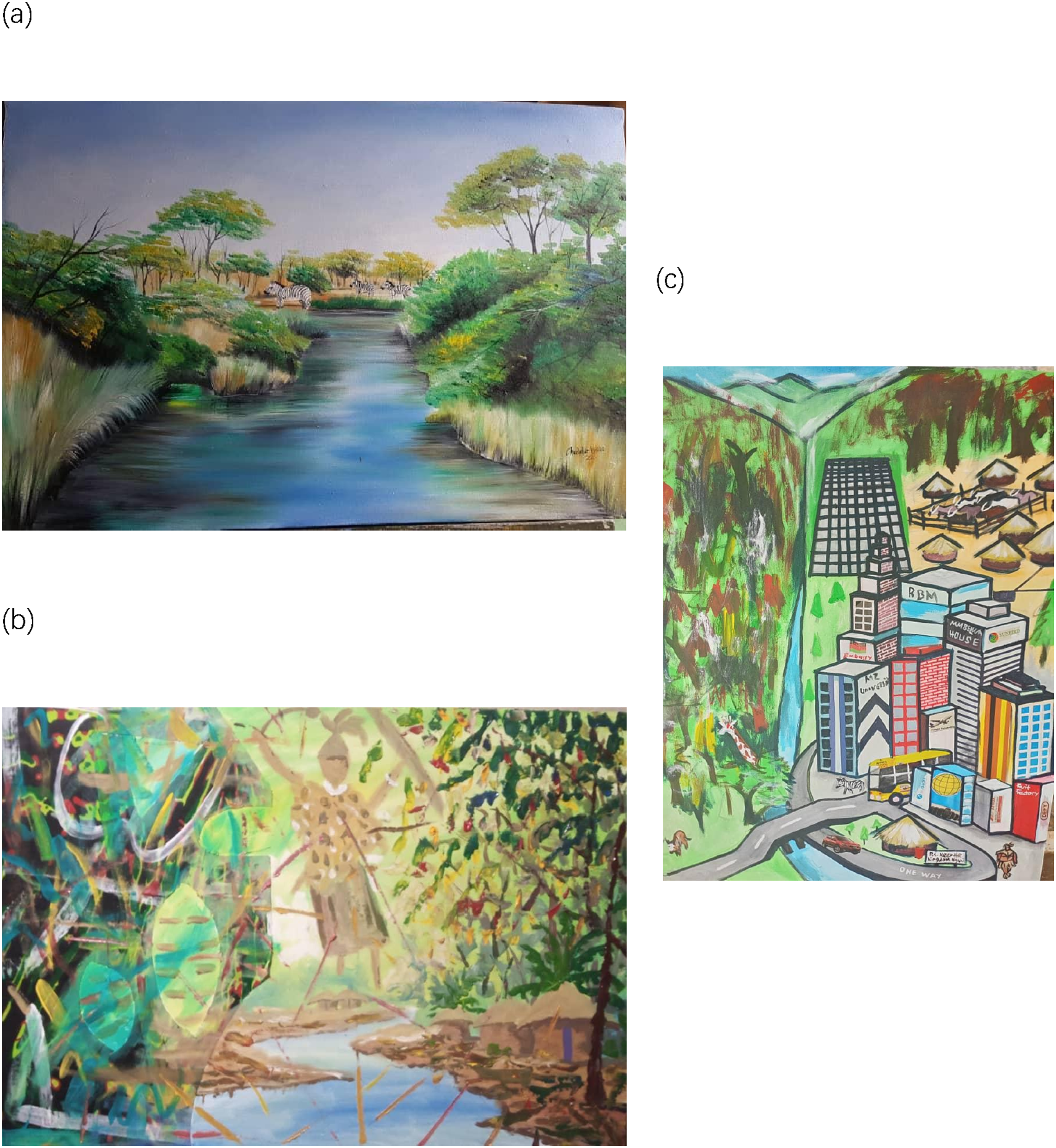
The writers created a cycle of three short science-fiction stories, which we collected and published as Mombera Rising (Mbvundula Chirombo and Nhlema 2024). “Khanyisile” introduces an Inkosi’s daughter who must navigate a potentially deadly conflict between two men she loves, each harbouring different hopes for the district’s recovered forests. “Hiraeth” follows an elder and a diplomat who has helped keep peace after a bitter civil war between Mzimba (now called Momberaland) and the rest of Malawi. This elder’s faith is challenged when his political leaders decide to abandon the creed of uMvelo, a nature-focused religion that has helped Momberaland’s ecosystems thrive as Malawi’s other landscapes have degraded. “Mombera Kingdom” follows a philanthropist from the UK who travels to the independent Mombera Kingdom after a climate event to distribute aid, and discovers that Mombera Kingdom, being resilient enough to offer aid themselves, receives him as a tourist rather than a saviour.
Causal Loop Diagram
Five subsystems (indicated by arrow colour in Figure 7) emerged as central to the system map’s structure. The charcoal production subsystem (grey) explored the conflict between unlicensed producers and communities affected by woodland degradation, suggesting that promotion of alternative livelihoods might be a better solution to the financial insecurity that motivates producers when compared to punitive approaches (Smith, Hudson, and Schreckenberg 2017). The agricultural conversion subsystem (tan) aimed to capture the mechanisms that drive land-use change, especially the promotion of cash crops (which link income to production) and conventional practices that degrade soil quality. This subsystem also captured the impacts of ongoing demographic changes: Sub-Saharan Africa is the region with the world’s fastest growing population, and Malawi’s growth has remained above average for the region since 2006 (UN 2024). The miombo conditions subsystem (pink) aimed to capture the woodland’s dynamic balance between grassy and wooded patches, which is maintained by complex social and ecological dynamics (Stevens et al. 2022). The wealth creation subsystem (blue) represents how material wealth may snowball as successful individuals support economic opportunities for local communities, which participants perceive as an alternative to dependence on international aid. The cultural wellbeing subsystem (orange) aims to capture citizens’ investments in and access to relational benefits of cultural practices. Causal loop diagram. Arrows represent relationships between system elements. Solid arrows indicate positive connections, in which increases in the origin element cause increases in the destination element. Dashed arrows indicate negative (or opposite) connections, in which increases cause decreases. The circular arrows mark reinforcing (R) or balancing (B) feedback loops. Connection colours indicate which subsystem the connection is part of: charcoal production, agricultural conversion, wealth creation and economic freedom, landscape integrity, or cultural reinforcement. Created using Kumu, a freemium system mapping platform.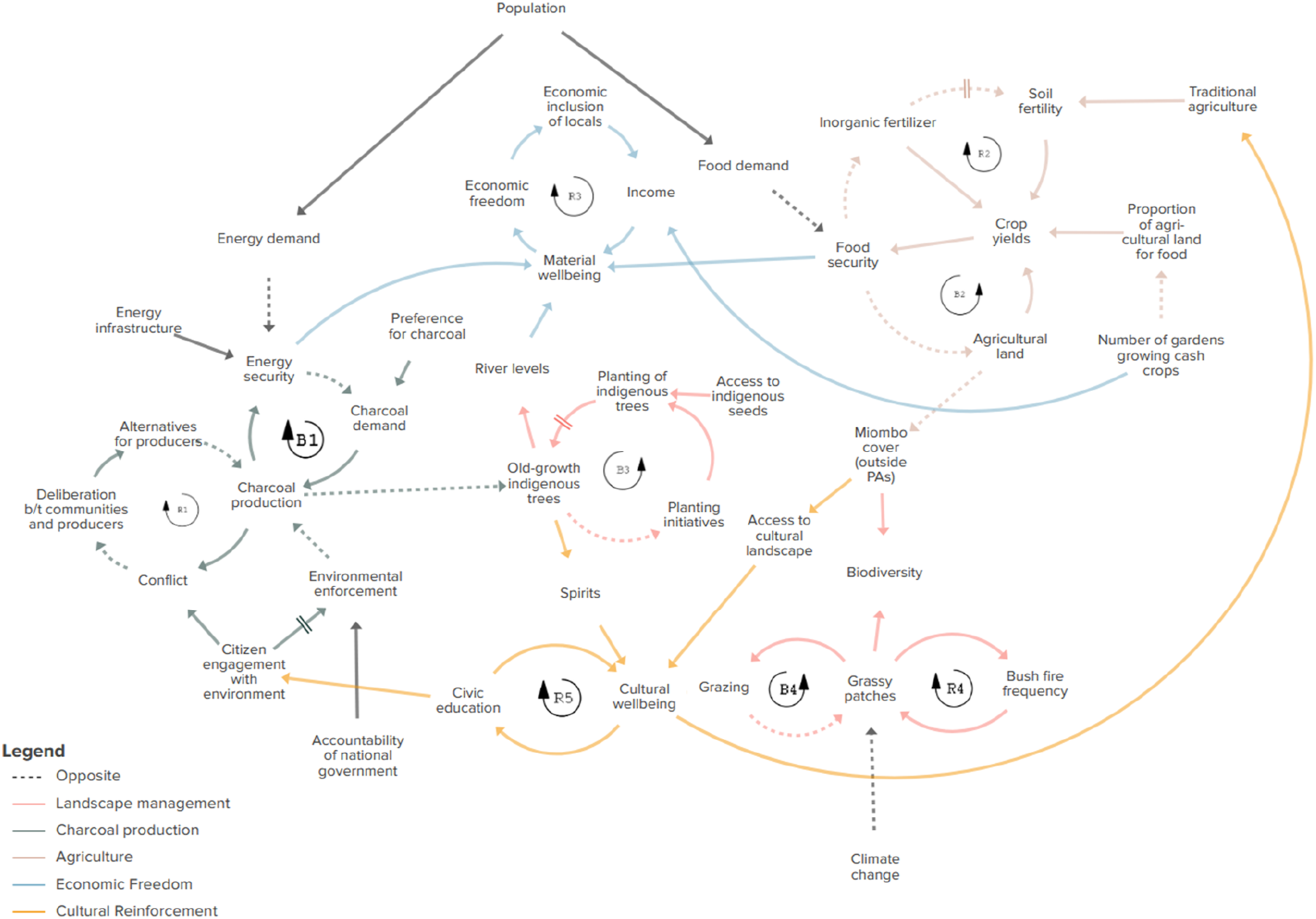
Scenario Summaries
This section presents short descriptions of the expert-led scenarios along with open-source images selected to evoke their atmosphere. The images and titles were selected by the project team. Longer narratives are available in the supplemental material.
Nature for Nature: Elephant Crossings – This scenario imagines that a majority of Mzimba’s landscape has been reserved for miombo, with people living in dense cities at each Inkhosi’s seat. The miombo is maintained by the woodland service, a prestigious organization that monitors plant and animal health, manages and controls fire, and protects the woodland from intruders. Thriving wildlife populations (after a series of successful reintroductions) also help maintain ecosystem health and bring in eco-tourists from across the globe. This tourism is a boon for Mzimba’s economy, along with new international schemes to pay for the carbon sequestration benefits of grasslands. However, with restrictions on when and how locals can visit the woodland, the connection between culture and the cultural landscape is strained (Figure 8). Nature for Nature (NN): Elephant Crossings. Icon is “Elephant” by Ed Harrison from Noun Project (CCBY3.0). Photograph is “Forest Reserve” by Ollivier Girard/CIFOR.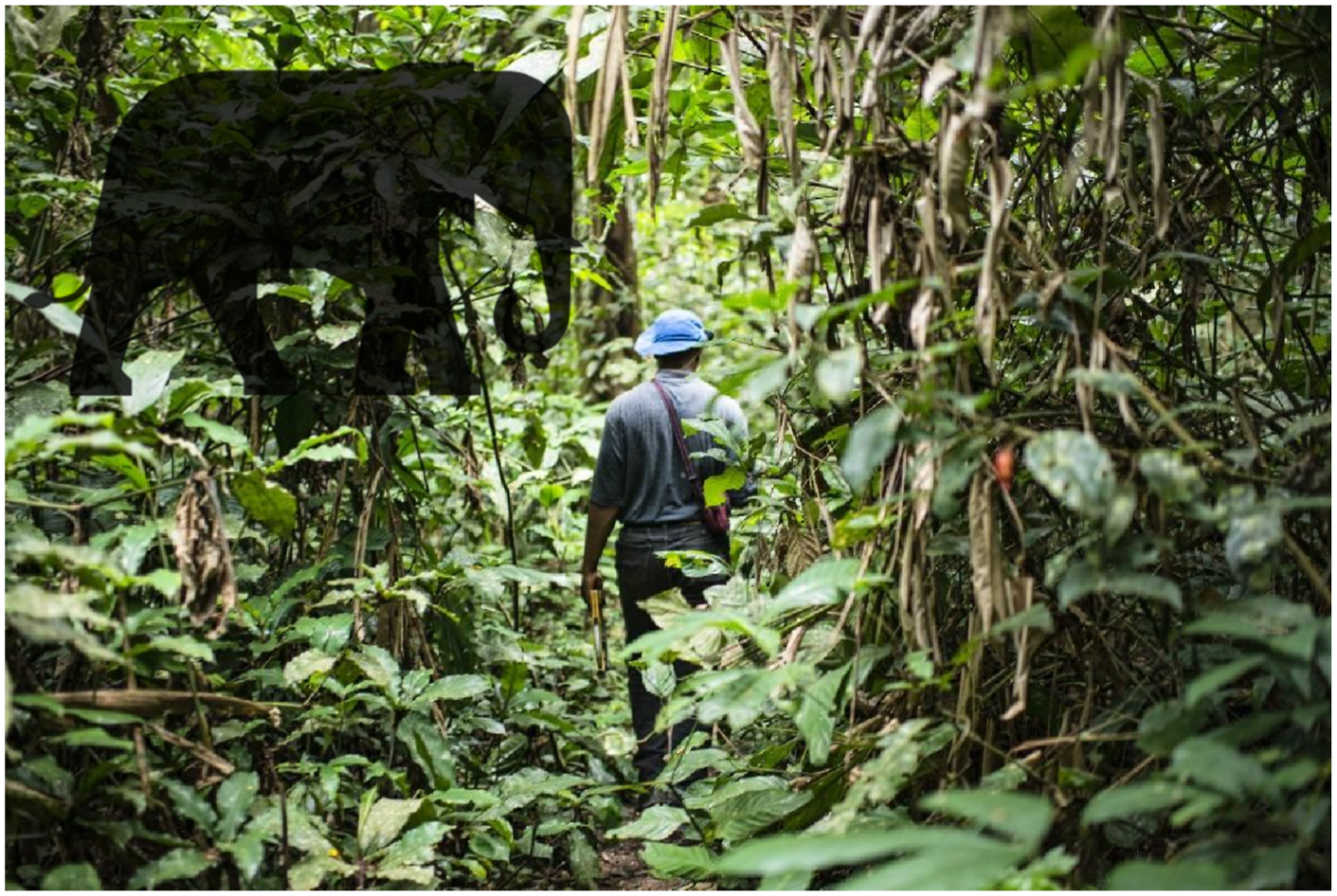
Nature for Society: home networks – Drones hover over groundnut fields, children build computers in their bedrooms, and every homestead has an electric car and an online business. Despite its enduring rural setting, Mzimba has seen the rise of a dynamic economy fuelled by innovation and grassroots entrepreneurship. Although people do not live close together, it is easy to stay in touch through high-speed internet or through the fleet of delivery drones buzzing across the landscape. Since the Southern African Development Community loosened its international borders, it has also been easier to travel and trade with people in neighbouring countries. There is very little miombo left outside of the protected areas, but much of it has been set aside to produce charcoal for outdoor heating and braai (Figure 9). Nature for Society (NS): Home Networks. Icon is “Acacia Tree” by Anisah Mahfudhah Billah from Noun Project (CCBY3.0). Photograph is public domain.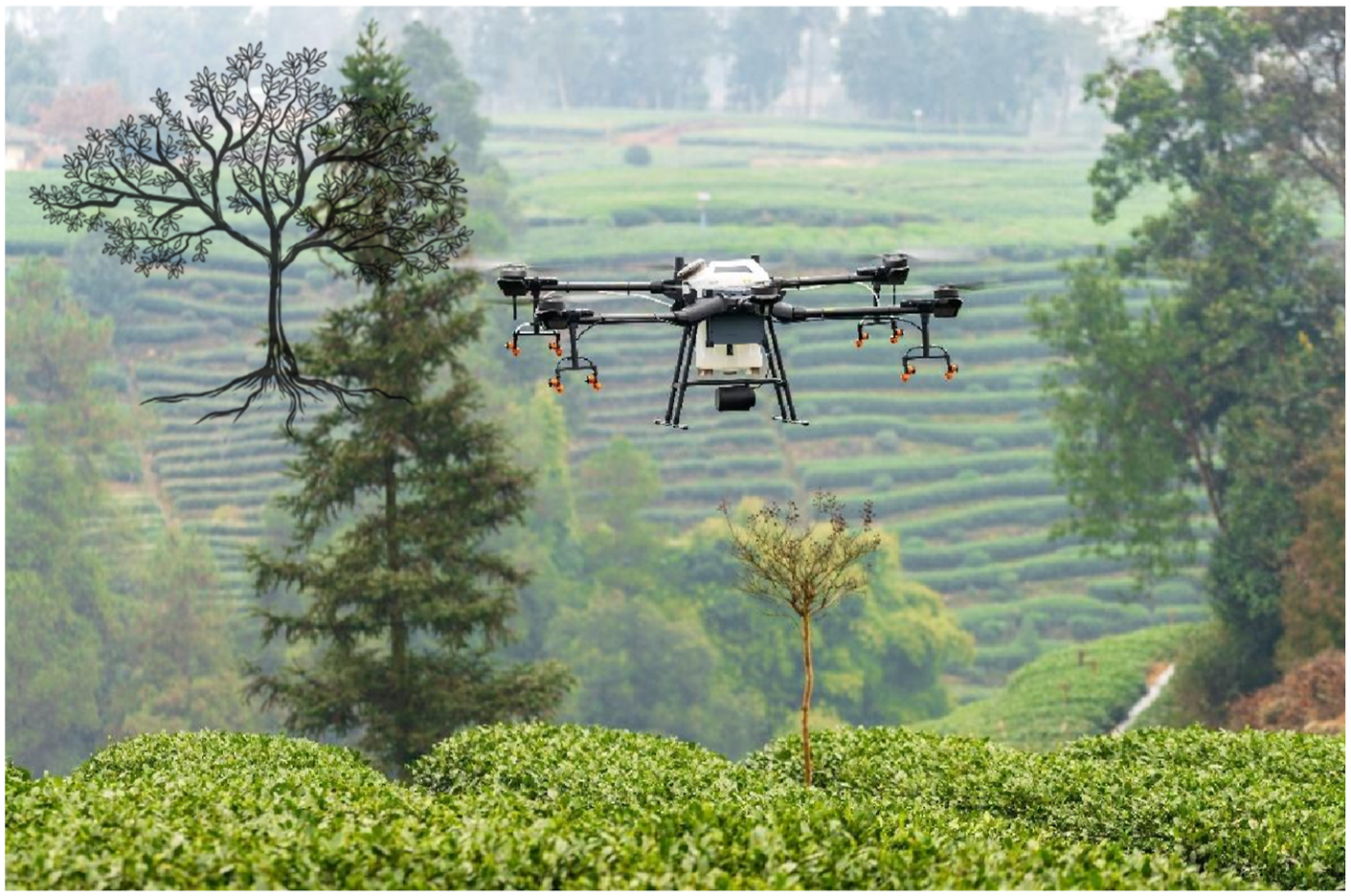
Nature as Culture: Old shield, new spear – Mzimba is a semi-autonomous kingdom within Malawi, governed by the Amakhosi. It is common to see workers loading export shipments on the train: Ngoni millet beer, electric nsima-makers, fashion inspired by traditional Ngoni garments. In the villages, one can find multi-story kraals: on the ground floor-courtyards, children lead in cattle and goats after a weekend-day out in the woodland; on the upper floors, adults stroll in gardens lit by sunbeams stabbing through the glass floors of the levels above. The villages are ringed by farmland, which is surrounded by miombo, which regulates the villages’ climate. All is layered with the sounds of music, animals, and the bells around the feet of marching Impi (Figure 10). Nature as Culture (NC): Old Shield, New Spear. Icon is “Zulu Shield” by Eucalyp from Noun Project (CCBY3.0). The Photograph is “Cattle Returning Home in Mozambique” by ILRI/Stevie Mann (CCBYNCSA3.0).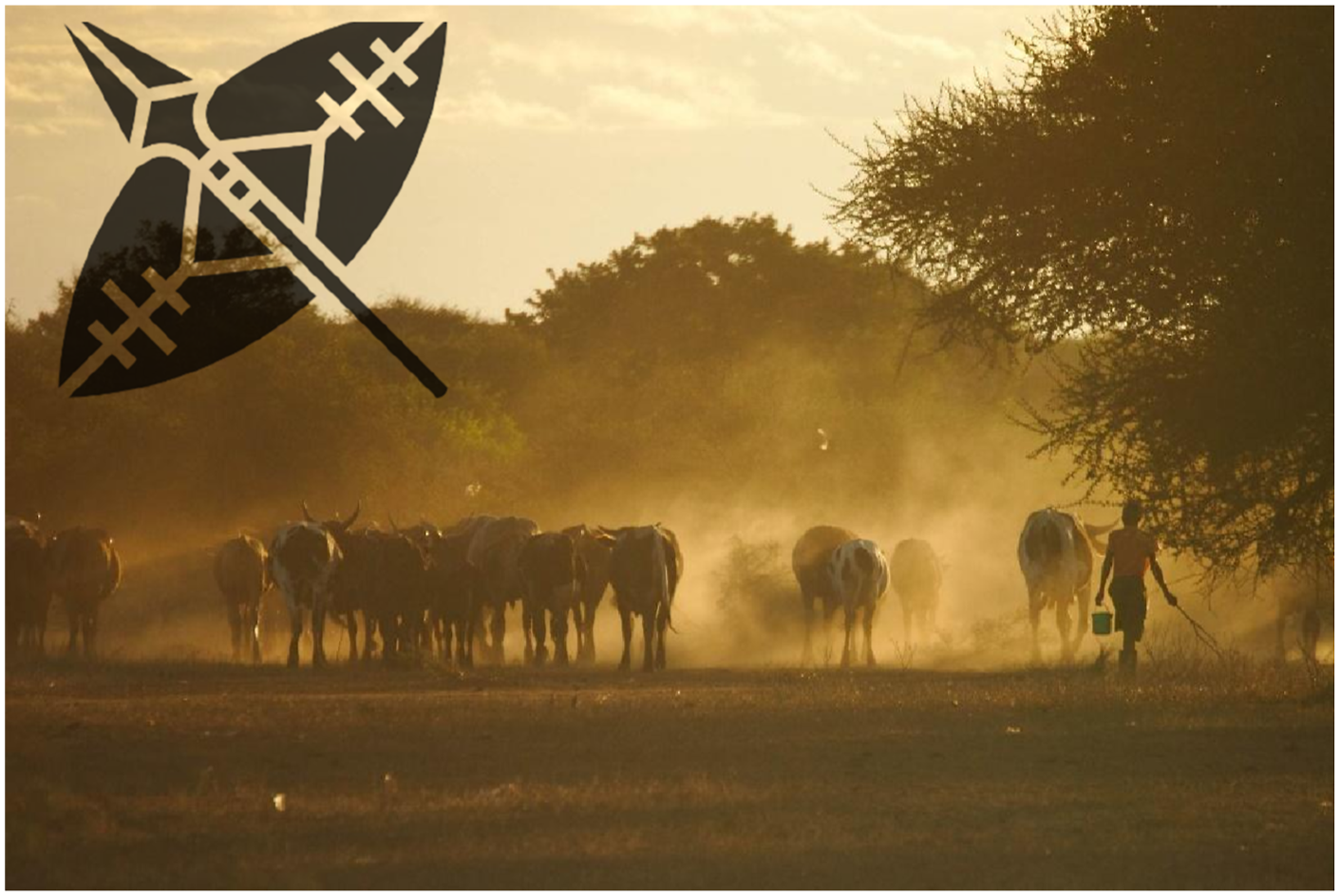
Discussion
The AFRICAN FUTURES project’s engagement with Mombera Kingdom produced participatory visions intended to facilitate new perspectives on the community’s social-ecological conditions, artistic products intended to bring the content of the visions to audiences in Malawi and abroad, and expert-driven alternative scenarios intended to package the community’s insights for inclusion in bottom-up scenario processes at larger scales. In this section, we discuss the value of these products in Malawi, for the Nature Futures Framework, and for diversifying the social-ecological imaginaries that structure assumptions about what makes a modern relationship with nature in global discourse.
Visioning to Braid Memory With Futures Literacy
The participatory visioning workshops aimed to support our partner community in surfacing those elements of the community’s collective imagination presently concealed by dominant narratives about nature. The process successfully facilitated positive images of possible futures rooted in the community’s cultural priorities and emphasizing a variety of nature values. We found that for some participants, imagining positive futures was predicated on reclaiming an imagined pre-colonial past- or that it was impossible for some participants to imagine a desirable future without cognitively ‘going back’ to a precolonial moment to build a future from there. This emphasis can be characterized as an intrusion of the “weight of history,” characterized in Inayatullah’s Six Pillars framework as those inherited structures in the present which constrain movement into desired futures (Inayatullah, 2008). Here, it appeared to be a sense of loss (rather than a material structure or institution) that constrained participants’ imaginations. However, given that the M’mbelwa Ngoni are understood to have arrived in present-day Malawi after 1835 (Tingokanyama 2023), and Malawi’s colonization began in 1889, questions remain about which landscape participants were recalling: were they remembering a landscape that the community’s ancestors lived for 1-2 generations before colonial disruption, or similar landscapes their ancestors left behind in present-day KwaZulu Natal? Engaging with the history of the community and landscape by mapping time and establishing a “shared history” (Inayatullah 2008, 7) may have established more clarity and is something for further exploration.
In the second workshop, participants “braided” elements of their remembered past with present conditions to “create something else entirely with the help of memory” (Moore and Milkoreit 2020, 4). This capacity can be characterized as a success of futures literacy, or the capacity to approach the future with different goals at different times (R. Miller 2018). Previous work has positioned futures literacy as an essential tool for decolonial scholarship and practice: if images of the future are dominated by powerful interests, that dominance will inform what people consider to be possible or proper in the present (Feukeu, Ajilore, and Bourgeois 2021). The elements of these visions which complicate dominant ideas are further explored in our discussion of the scenarios.
Although traditional authorities enjoy broad popular legitimacy across the continent (Logan 2013), certain aspects of Mombera Kingdom’s governance structures may read as non-progressive to Western audiences; this project’s decolonial aims directed us to centre the community’s values, even when they contradict current Western notions of progressive politics. We also recognize that centring the amakhosi and their chosen representatives in the participant selection likely informed these visions’ emphasis on the autonomy and authority of Mombera Kingdom’s present governance structure. However, the presence of a female Inkosi in V2 and the story “Mombera Kingdom” indicates that within the frame of envisioning ascendant cultural traditions, the community was actively negotiating traditional gendered power relations (Muriaas 2009). Still, power relations between cultural groups in the area went unrecognized during the workshops. We recognize that differently composed participant groups would very likely have produced quite different desired futures. The goal of this exercise was to diversify the imaginaries explicitly considered in the community’s discourses, not to favour any particular approach.
Art to Amplify Shared Symbols and Meanings
The artistic representations were intended to invigorate the community and communicate their insights to a national and international audience. Participants enthusiastically received the artistic products, which they said accurately and engagingly reflected their desires. The speculative fiction stories also resonated with broader audiences, with positive coverage in national newspapers (The Nation Online 2024), selection for best-of-year lists (Talabi 2025), and award recognition: “Hiraeth,” the collection’s second story, was longlisted for a British Science Fiction Award. This success may indicate both the artistic success of the products themselves and a resonance of the ideas embedded within the art. Previous scholarship has discussed how aesthetic experiences can push audiences to understand that other ways of being are possible (van Lente and Peters 2022). Not only does this mirror imaginative processes’ capacity to “break hegemonic views as the only possible reality” (Moore and Milkoreit 2020, 3), but it can also enable art and stories to carry the epistemic disruption of transformative imagination to their audience(s). Africanfuturism, or futures-art “rooted in African culture, history, mythology, and point-of-view” (Okorafor 2019), enables artists and audiences to reclaim agency regarding what future they want (Hartmann 2013), and reclaims the futurity of African images, practices, and symbols that dominant perspectives relegate to the past (Cleveland and Edoro 2024). Furthermore, the artistic products can invite global audiences into the shared imagination co-produced by this community’s participants (Moore and Milkoreit 2020), which is very helpful for the project’s goal of amplifying local imaginaries.
System Mapping to Clarify Insights
By focusing on the political (e.g. protected area enforcement), economic (e.g. alternative livelihoods for charcoal producers, prevalence of cash crops), and cultural (e.g. grazing, the presence of spirits in old-growth indigenous trees) structures that mediate the community’s relationship to its woodland landscape, our CLD reinforced the imaginative approach of our expert-led scenarios. Imagination includes the ability to detect and describe the structures in the present “that are continuously recreating and reinforcing our current environmental conditions” (Moore and Milkoreit 2020, 1); future visioning can support this capacity to (re-)imagine the present (R. Miller 2018). Because the CLD was designed in parallel with the scenario-planning process, the diagram captures the structures we were able to detect by imagining alternatives.
The CLD also clarifies insights into two key processes that the community perceived as drivers of woodland degradation and deforestation: charcoal production and agricultural expansion. We found that charcoal producers’ conflict with neighbouring communities may be a key barrier to both alternative livelihoods for producers and possibilities for a more sustainable charcoal sector. Although previous research has detailed how producers experience social isolation (Smith et al. 2015, 2017) and how misconceptions about charcoal’s impact inflect policy and development decisions (Kambewa et al. 2007; Mabele 2020; Mwampamba et al. 2013; Zulu 2010), our finding is a contribution in the Malawian context. By focusing on the importance of miombo woodland for cultural practice, we were also able to articulate the link well-known causes of agricultural expansion (Chinangwa, Gasparatos, and Saito 2017; Geist, Otañez, and Kapito 2008; Ngwira and Watanabe 2019) with our partner community’s access to their culturally-relevant landscape.
However, the CLD failed to resonate with community partners during the initial workshops, the iterative process, or follow-up meetings. One potential reason is that the CLD process began by iterating the participatory maps generated during the workshops; a stronger approach may have used the participatory maps to prioritize subsystems and dynamics before starting from zero, as indicated by more successful processes (e.g. Hanspach et al. 2014). This approach would have dovetailed with a stronger emphasis on historical analysis, as suggested in the discussion of the visions. Another potential shortcoming is that we used the CLD to synthesize insights from the workshops with the academic literature, but our academic process favoured academic insights. A more careful approach to integrating knowledge, e.g. Aguiar et al.’s (2025) iCLD approach, may have offered more balanced outcomes. Finally, we opted to establish vague variables (Biodiversity, Material Wellbeing, and Cultural Wellbeing), enabling the system map to remain relevant across value perspectives and subsystems. While more precise target variables may have narrowed the CLD’s scope of the system map, perhaps even necessitating multiple CLDs across value perspectives, they may also have enabled stronger contextual resonance. We would recommend that similar projects draw clear boundaries between system maps representing participant perspectives, maps representing researcher perspectives, and maps meant to represent a new understanding of the system reached together. Extending Sterman’s (2000) advice to use models and system maps to represent problems rather than entire systems, we would also encourage future NFF projects to use multiple system maps to explore the system from multiple value perspectives.
Alternative “Forests:” Value(s) of the Contrasting Scenarios
Many values of presenting multiple contrasting scenarios have been demonstrated. For example, suggesting the scope of critical uncertainties (e.g. Merrie et al. 2018; Peterson, Cumming, and Carpenter 2003), evaluating policy options (e.g. R. C. Lembi et al. 2020; Rodríguez-Izquierdo et al. 2019)
Although participants named deforestation as a primary concern during the participatory workshops, the concept of deforestation in Africa is deeply informed by the shadow of colonial management. Colonial governments misapprehended African savannas as degraded forests and implemented policies to promote woody growth (thereby increasing opportunities for extraction) (Brown 2003). In the present-day, this colonial-era misapprehension is reproduced by development initiatives that aim to afforest healthy grasslands (Stevens et al. 2022). Within that historical context, it is critical to excavate the social-ecological imaginaries embedded in the community’s imagined woodlands. This study offers three alternative landscapes, each of which resists colonial narratives.
In the Nature for Nature scenario, the woodland is a mirror of the pre-colonial landscape. In that future, the community’s efforts aim to hold the landscape in stasis, artificially recreating the conditions and dynamics that originally generated the woodland. These efforts, based on a dynamic and adaptive understanding of the landscape, shape a healthy landscape that stores carbon, refreshes water quality, and supports recovering wildlife populations. However, the community’s choice to protect the bulk of the land evokes fortress conservation, which has been widely criticized for excluding communities from their own landscapes (Lele et al., 2010; Singh and van Houtum 2002). As the story “Khanyisile” explores, there are social tensions and costs that might emerge from top-down restrictions on engagement with the woodland, even when those restrictions are handed down from cultural authorities.
In the Nature for Society scenario, the woodland represents all the trees and grasses that support human well-being. Although miombo still provides fuel, fruits, and limited cultural engagement, the community in this future has de-emphasized the miombo ecosystem’s specificities, e.g. by depending on the winter thorn tree for agroforestry benefits. This woodland supports a prosperity and resilience that does not require urbanization, resisting the common narrative that urbanization is rural communities’ best path to wealth (National Planning Commission 2020) and projections that neither detect nor acknowledge alternatives (OECD/SWAC 2020).
In the Nature as Culture scenario, the woodland represents whatever landscape conditions emerge from culturally guided management practices. In this scenario, the cultural displaces the economic as central organizing principle, as Hallberg (2021) imagined organizing around the aesthetic. Or, as Mombera Rising’s “Hiraeth” positions the relationship between the reader and WEH, a spiritual and social-ecological expression of communally inherited culture: “You are bound to WEH. Not WEH to you” (Mbvundula Chirombo and Nhlema 2024, 41). Our NC scenario imagines that embracing this “binding” positions the community to benefit more efficiently from the traditional ecological knowledge carried by institutions like the M’mbelwa Farming Institute and passed down through culturally important activities like grazing. Furthermore, the recovery of pre-colonial settlement patterns and architectures represent not only “pockets of the past” (Falardeau, Raudsepp-Hearne, and Bennett 2019), or traditional elements that the community wants to carry into the future, but also a reclamation of the essential futurity of those images, which has been occluded by the epistemic violence of the colonial encounter (Cleveland and Edoro 2024). By expanding the bounds of the community to include nature, the landscape becomes part of the architecture; landscape conditions are not understood to be enforced by people, instead being produced by people and nature together.
In this context, the concept of social-ecological imaginaries directs our attention not only to how landscapes and community desires change over time, but how the trajectory of institutional perspective informs how natural conditions are understood, and which social-ecological arrangements are understood to be modern and proper. In addition to presenting alternative visions of modernity, these scenarios are a reminder that landscape categories like forest or woodland mean entirely different things in different places and from different perspectives. They may also suggest approaches for using the NFF to navigate such diversity at multiple scales. At the local scale, we have found that contrasting scenarios can surface the diverse meanings and values moving underneath language that appears to be shared. At higher scales, as the NFF community works to establish value-diverse indicators and analyse the feedbacks by which nature’s conditions impact people, this study’s results might offer a reminder that a given ecosystem category might interact differently with its people in different scenarios, not only because what people seek from their nature will be informed by the scenarios’ value perspective, but also because the local conditions represented by the category name (e.g. forest) might be completely different.
In the Academic Context
In the context of participatory futures, this study demonstrates the value of creating multiple products for different audiences. Previous work has recommended that participatory futures studies produce different kinds of outputs to satisfy diverse stakeholders (Oteros-Rozas et al. 2015). This project extends that recommendation with an example of how those products might work together, and how the stakeholders and audiences they target might operate at different institutional scales.
In the context of African futures, this study represents an early exploration of value plurality. In their review of African scenario planning, Chibwe et al. (2024) found a notable lack of scenarios that exclusively investigate Nature for Nature and Nature as Culture values. By creating alternative scenarios that focus on individual value perspectives, this project has taken steps toward addressing that gap. Although some previous futures work in Malawi has recognized the importance of cultural values (van Velden et al. 2020), the bulk of visions and scenarios produced for Malawi prioritize Nature for Society (e.g. National Planning Commission 2020; Rivard and Reay 2012) or Nature for Nature (e.g. van Velden et al. 2020) values. This project represents an early attempt to clarify what Nature as Culture values might mean in desirable futures, both in Malawi and on the continent.
In the context of indigenous futures, this project represents an attempt to synthesize multiple frames of indigenous futures thinking (Cheok et al. 2025). The overarching goals of the project were rooted in Cheok et al.’s “Culturally grounded” frame: the research team and the local team aimed to ground the NFF’s meanings in Mombera Kingdom’s cultural context. With their aims to target products toward community audiences, the visioning exercise and artistic representations were embedded in the “Participatory” frame. These stages of the project applied participatory methods to support the community’s futures-thinking capacities and package the meanings that emerged from the process for reception by both the community and international audiences. On the other hand, the system mapping and expert-led scenario components straddled the “Participatory” and “Adaptation oriented” frames, applying insights from participatory tools toward questions about ecosystem vulnerabilities and capacities to the questions that drive the Adaptation frame. Other projects have used the Culturally grounded frame to integrate culturally-specific “constructs” into their academic approach (e.g. Falardeau, Raudsepp-Hearne, and Bennett 2019; Cheok et al. 2025, 9) or embed concepts of transformation in local (e.g. Fredström et al. 2023) and regional (e.g. Hamann et al. 2020) contexts. However, it is unusual for such projects to also structure products for interpretation and synthesis with larger-scale adaptation processes. Other projects have engaged the Adaptation oriented frame to support community action (e.g. Prado, Martins, and Christofoletti 2024; e.g. R. Lembi et al. 2025; e.g. Ruiz-Mallén et al. 2015) in post-colonial and contested contexts. However, it is unusual for those projects to enable deeper investigation of the meanings and boundaries of the categories in question.
While this project’s position between frames afforded unusual synergies between goals, our specific methods of frame-synthesis barred this project from the deeper benefits of either frame. Because our engagement with participants was limited to the data collection and ground-truthing stages, our project could not adapt its visioning methods in response to community needs and concerns (Cheok et al. 2025; Falardeau, Raudsepp-Hearne, and Bennett 2019). Without established categories for analysis or clear system boundaries, our project was unable to achieve materially actionable plans (e.g. R. Lembi et al. 2025; Ruiz-Mallén et al. 2015) or co-produce one clear consensus vision (e.g. Nieto-Romero et al. 2016; Prado, Martins, and Christofoletti 2024). There are certainly unavoidable trade-offs, but there is likely room for methodological innovation to improve outcomes for similar projects, as demonstrated by further AFRICAN FUTURES case studies (Kabisa and Pereira 2025; Tcheton et al. 2025).
Conclusion
As one component of the AFRICAN FUTURES project’s futuring engagements with communities across the African continent, we conducted a visioning process with Mombera Kingdom, a traditional community in Malawi. This process used the Nature Futures Framework to activate a diversity of nature values in participatory visions and to prepare the community’s vision for inclusion in larger-scale scenario processes that may be conducted by the research community, such as bottom-up scenario processes promoted by IPBES’ task force on scenarios and models.
This paper presented the participatory visions co-created during our initial visioning workshops, which indicated the complexity inherent in re-establishing community agency in the wake of colonialism. It also presented visual artworks and science fiction stories created to capture and communicate the substance of the participatory visions, which have been well received by Mombera Kingdom and other audiences in Malawi and beyond. Finally, we presented discrete scenarios formed from rearranged elements of the participatory visions. These expert-led scenarios indicate multiple meanings of “woodland” in this context, which raises questions that larger-scale NFF processes should consider when discussing landscape categories across scales, contexts, and value perspectives. The scenarios also demonstrate what the research community can learn from Mombera Kingdom’s values and imaginaries: that conserving the landscapes we’ve inherited will often require consistent human intervention, that economic prosperity may not require urbanization, and that the economic need not remain the organizing principle that structures our societies’ relationships with nature. These insights contravene the values and assumptions imposed on the past by colonial powers across the globe and maintained in the present by dominant narratives about the future. By inviting audiences to participate in novel forms of shared imagination, this project offers new perspectives on existing social-ecological structures, and new material with which to imagine what alternatives might be possible.
Supplemental Material
Supplemental Material - Mombera Rising: Using the Nature Futures Framework to Amplify Novel Imaginaries in Malawi
Supplemental Material for Mombera Rising: Using the Nature Futures Framework to Amplify Novel Imaginaries in Malawi by Liam Carpenter-Urquhart, Laura M. Pereira, Bwalya Chibwe, Maganizo Kruger Nyasulu, Aupson W. N. Thole, Jan J. Kuiper, Garry D. Peterson in World Futures Review.
Supplemental Material
Supplemental Material - Mombera Rising: Using the Nature Futures Framework to Amplify Novel Imaginaries in Malawi
Supplemental Material for Mombera Rising: Using the Nature Futures Framework to Amplify Novel Imaginaries in Malawi by Liam Carpenter-Urquhart, Laura M. Pereira, Bwalya Chibwe, Maganizo Kruger Nyasulu, Aupson W. N. Thole, Jan J. Kuiper, Garry D. Peterson in World Futures Review.
Supplemental Material
Supplemental Material - Mombera Rising: Using the Nature Futures Framework to Amplify Novel Imaginaries in Malawi
Supplemental Material for Mombera Rising: Using the Nature Futures Framework to Amplify Novel Imaginaries in Malawi by Liam Carpenter-Urquhart, Laura M. Pereira, Bwalya Chibwe, Maganizo Kruger Nyasulu, Aupson W. N. Thole, Jan J. Kuiper, Garry D. Peterson in World Futures Review.
Supplemental Material
Supplemental Material - Mombera Rising: Using the Nature Futures Framework to Amplify Novel Imaginaries in Malawi
Supplemental Material for Mombera Rising: Using the Nature Futures Framework to Amplify Novel Imaginaries in Malawi by Liam Carpenter-Urquhart, Laura M. Pereira, Bwalya Chibwe, Maganizo Kruger Nyasulu, Aupson W. N. Thole, Jan J. Kuiper, Garry D. Peterson in World Futures Review.
Supplemental Material
Supplemental Material - Mombera Rising: Using the Nature Futures Framework to Amplify Novel Imaginaries in Malawi
Supplemental Material for Mombera Rising: Using the Nature Futures Framework to Amplify Novel Imaginaries in Malawi by Liam Carpenter-Urquhart, Laura M. Pereira, Bwalya Chibwe, Maganizo Kruger Nyasulu, Aupson W. N. Thole, Jan J. Kuiper, Garry D. Peterson in World Futures Review.
Footnotes
Acknowledgements
The authors deeply appreciate support of the Mabilabo Social Support Organization, the Mzimba Heritage Association, and all participants that gathered to courageously imagine a better future. Thanks to Kingsley Jere, Keeper Gumbo, Dr Aupson Thole, and Michael Nhlema for organizing these gatherings. Thank you to Jimmy Malinga Manda, Maputo Soko, and James Tambula for your beautiful work on the paintings. Thank you to Ekari Mbvundula Chirombo and Muthi Nhlema for three thrilling and energizing stories. And, finally, thank you to His Majesty Inkosi ya Makhosi M’mbelwa V and the rest of the Amakhosi for permitting and engaging with this project.
Author Contributions
L.P. and B.C. conceived of the presented idea and designed the data collection process. L.P., B.C., L.C., and M.K. facilitated data collection. L.P., L.C., and M.K. guided commissioned artists. L.C. designed and conducted the remaining research, guided by L.P., A.T., and G.P. L.C. wrote the manuscript with contributions from L.P., B.C., M.K., A.T., J.K., and G.P. Research funding was acquired and managed by L.P.
Declaration of Conflicting Interests
The authors declared the following potential conflicts of interest with respect to the research, authorship, and/or publication of this article:
Funding
The authors disclosed receipt of the following financial support for the research, authorship, and/or publication of this article: This work was funded through the Swedish Research CouncilFORMAS [project number 2020_0670]. This work was also a component of the FEFA programme in partnership with Oppenheimer Generations Research and Conservation. LC’s and GP’s participation was enabled by funding from the Marianne and Marcus Wallenberg Foundation.
Ethical Considerations
The authors declared that this research was internally approved by the research ethics sub-committee at the Stockholm Resilience Centre.
Consent to Participate
The authors declared that informed, written consent was gathered from participants prior to all interviews and workshops.
Consent for Publication
The authors declared that written consent for reproduction and publication of their images was gathered from all participants.

Data Availability Statement
Data sharing not applicable to this article as no datasets were generated or analyzed during the current study.
Prior Publications
This work builds on the first author’s MSc thesis (Carpenter-Urquhart 2023a) as well as project reports (Carpenter-Urquhart et al., 2022; Carpenter-Urquhart 2023b).
Supplemental Material
Supplemental material for this article is available online.