




Abstract
Background
Subjective and objective evaluations of chronic rhinosinusitis with nasal polyps (CRSwNP) are often discordant.
Objective
This study aimed to investigate the feasibility of using a newly developed five-item Sino-Nasal Outcome Test (SNOT-5) to evaluate disease severity and to compare its results with objective assessments in patients with CRSwNP.
Methods
Adult patients with bilateral CRSwNP planning to undergo sinus surgery were prospectively enrolled. The nasal polyp score (NPS), Lund-Mackay (L-M) score, olfactory cleft opacification (OC) score, and the 22-item Sino-Nasal Outcome Test (SNOT-22) questionnaire were assessed. The SNOT-5 scores were retrospectively extracted from the SNOT-22 results. Three-month postoperative endoscopic modified Lund-Kennedy (MLK) scores and SNOT-22 data were collected when available.
Results
A total of 169 participants were enrolled. The SNOT-5 score rather than the SNOT-22 score, was significantly correlated with objective measurements of disease burden, including NPS, L-M, and OC scores. SNOT-5 score was significantly associated with younger age, comorbid asthma, NPS, L-M, and OC scores in the univariate regression analysis, and with age, L-M, and OC scores in the multivariate analysis. Additionally, the SNOT-5 score also significantly correlated with the MLK score at 3 months after surgery.
Conclusion
The SNOT-5, rather than the SNOT-22, correlated more closely with objective measures of disease burden, including the NPS and L-M scores, and postoperative MLK score in patients with CRSwNP. Utilizing the SNOT-5 in clinical practice may help clinicians more accurately assess disease severity and treatment response in patients with CRSwNP.
This is a visual representation of the abstract.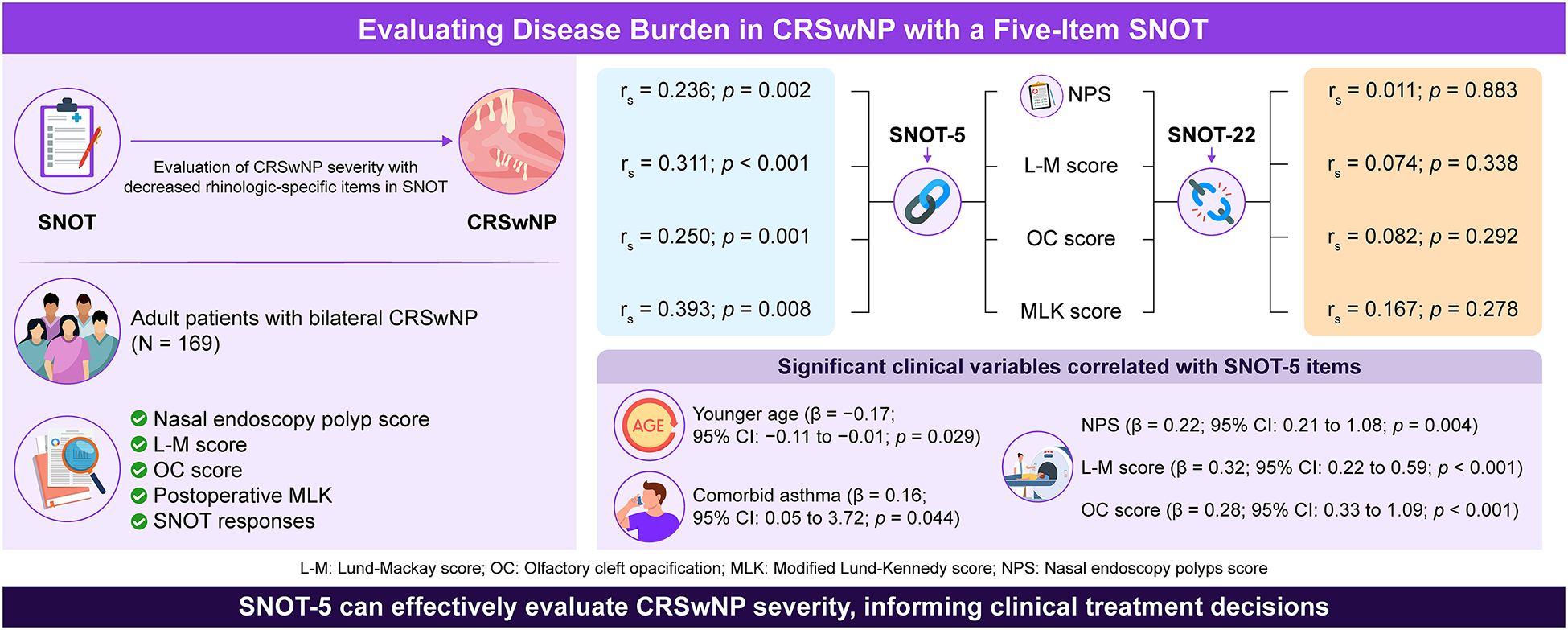
Keywords
Get full access to this article
View all access options for this article.
References
Supplementary Material
Please find the following supplemental material available below.
For Open Access articles published under a Creative Commons License, all supplemental material carries the same license as the article it is associated with.
For non-Open Access articles published, all supplemental material carries a non-exclusive license, and permission requests for re-use of supplemental material or any part of supplemental material shall be sent directly to the copyright owner as specified in the copyright notice associated with the article.
