



Abstract
Background
Endotype identification based on clinical characteristics is crucial for the selection and prediction of the efficacy of various therapeutic modalities in patients with chronic rhinosinusitis with nasal polyps (CRSwNP).
Objective
This study aimed to evaluate the clinical characteristics of patients with non-type 2 (non-T2) CRSwNP.
Methods
Clinical and laboratory data, as well as nasal tissues, were collected from adult patients who underwent endoscopic sinus surgery (ESS) for primary diffuse CRSwNP. Non-T2 CRSwNP was defined as a tissue eosinophil count <10/high power field. The levels of interleukin (IL)-5 and IL-13 in nasal polyps were measured using real-time polymerase chain reaction.
Results
A total of 199 patients with bilateral CRSwNP were recruited. Sixty-five (32.7%) exhibited non-T2 CRSwNP. Regression analysis revealed that male sex, absence of asthma, low ethmoid/maxillary (E/M) ratio, high blood neutrophil, low lymphocyte, and low eosinophil percentages were significantly associated with non-T2 inflammation in patients with CRSwNP. Age and nasal polyp score were significant predictors of postoperative residual sinus inflammation—defined as a modified Lund-Kennedy endoscopy score of ≥5 at 3 months after surgery—in patients with non-T2 CRSwNP.
Conclusion
Male sex, absence of asthma, E/M ratio, and the percentages of neutrophils, lymphocytes, and eosinophils were significantly associated with non-T2 CRSwNP. Age and polyp score were predictors of postoperative residual sinus inflammation in patients with non-T2 CRSwNP. These findings may help clinicians better evaluate patients with non-T2 CRSwNP and provide optimal therapeutic strategies.
This is a visual representation of the abstract.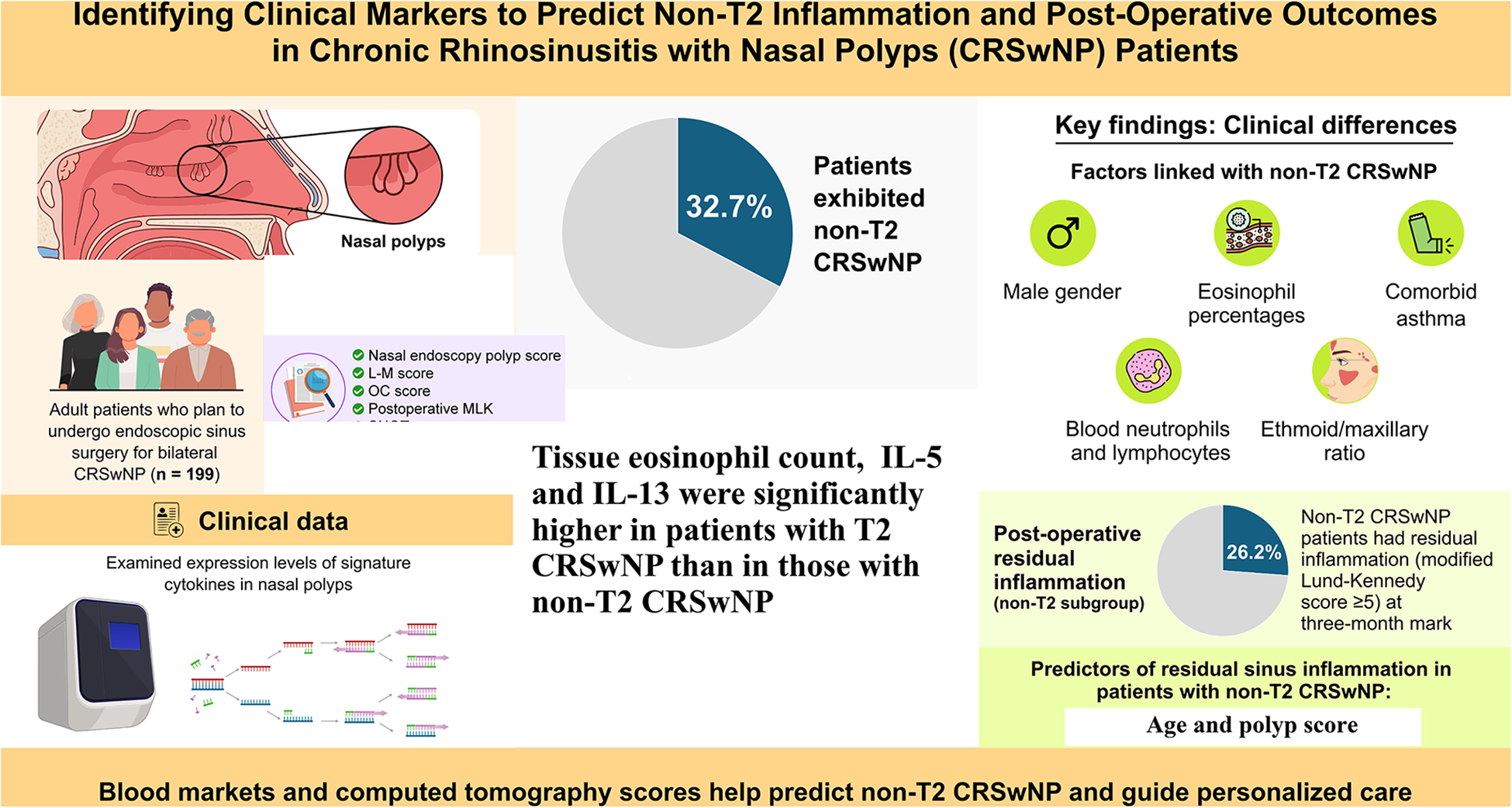
Keywords
Get full access to this article
View all access options for this article.
References
Supplementary Material
Please find the following supplemental material available below.
For Open Access articles published under a Creative Commons License, all supplemental material carries the same license as the article it is associated with.
For non-Open Access articles published, all supplemental material carries a non-exclusive license, and permission requests for re-use of supplemental material or any part of supplemental material shall be sent directly to the copyright owner as specified in the copyright notice associated with the article.
