



Abstract
Hydrogen is trending globally but is also contentious. Touted as the ‘fuel of the future’, it can help to decarbonise large swaths of the economy. Yet, hydrogen's speculative rush unfolds amid asymmetrical power geographies, prospects of green extractivism and socio-environmental injustices. These tendencies come vividly to the fore at the World Hydrogen Summit (WHS), the world's largest dedicated event for hydrogen energy, held annually in Rotterdam, the Netherlands. In this Contention article, I draw on my attendance and impressions at the 2025 WHS to critically reflect on how hydrogen futures are performed, staged and spectacularised. Considering the Summit's discursive and aesthetic structures, I interrogate the (geo)politics and spatial-material representations of hydrogen, the power relations at stake and equity and justice implications. I contend that the WHS epitomises and further reinforces the uneven power geographies of hydrogen, marked by inequitable global economic structures, spatial differentiation, exclusions and fossil capitalism's lock-ins. The article contributes to the burgeoning field of critical hydrogen studies.
Introduction
In May 2025, I attended my first World Hydrogen Summit (WHS) in Rotterdam, the world's ‘landmark event’ for hydrogen energy. As a South African-born Brazilian researcher based in the Netherlands, I have been critically following the global hydrogen rush, particularly through its implications for societies and territories in the Global South (Cezne, 2025; Cezne et al., 2025; Cezne and Otsuki, 2025). I decided to attend the WHS despite warnings by colleagues of it being ‘greenwashing as usual’ and an exclusive gathering ‘with all the fancy suits’ deliberating on complex technical and financial problem-solving. In other words, a place where social scientists like me would be out of place. Still, regardless of the plausible caveats, attending the WHS could provide powerful insights into the agendas, imaginaries and (dramatised) practices fuelling the ‘green fuel of the future’.
In this Contention article, I draw on my attendance and impressions at the 2025 WHS – held over 3 days between 20 and 22 May in Rotterdam, the Netherlands – to critically reflect on how hydrogen futures are performed, staged and spectacularised (see also Ariztía and Undurraga, 2025). Based on an event ethnography (Koch, 2023), I consider presentations and conversations held during panels, receptions and mingling moments (e.g., at coffee breaks or reception drinks), along with observations from touring the Summit's exhibition floor, where industry, investors and governments showcased their products, services and projects. Across these engagements, I paid particular attention to their discursive and aesthetic structures.
I build on these insights to think through the (geo)politics and spatial-material representations of hydrogen, the power relations at stake and issues of equity and justice. I argue that the WHS epitomises and further reinforces the uneven power geographies of hydrogen, offering a situated perspective into their inequitable geopolitical economic structures, spatial mechanisms of differentiation and exclusion and fossil capitalism's dispositions. These reflections contribute to discussions in the burgeoning field of critical hydrogen studies, attentive to the distributional (in)justices, power relations, coloniality, gender, socio-ecological costs and contested spatialities of hydrogen in decarbonised development (DeBoom, 2025a, 2025b; Dorn, 2024; Kalt et al., 2023; Kalt and Tunn, 2022; Monteith and Bäumer Escobar, 2025; Tunn et al., 2024, 2025a, 2025b). Drawing inspiration from Ariztía's and Undurraga's (2025) pioneering examination into how hydrogen futures are enacted through technology fairs, this article contributes to such understandings by centering on hitherto underexplored hydrogen summits as crucial sites in and through which (particular) hydrogen futures are produced, rationalised and diffused.
Rotterdam: The world capital of hydrogen
The annually held WHS in Rotterdam is the world's ‘largest’, ‘most influential’ dedicated event for hydrogen energy (WHS, 2025). It is consisted of two main parts: (a) a restricted, paid Summit area with keynotes, thematic panels, delegate networking platforms and amenities such as coffee breaks, lunches and dinners; and (b) an open, free of charge Exhibition section, a trade fair-like arrangement demonstrating latest products, technologies, services and projects. Policymakers, innovators, professionals and overall hydrogen enthusiasts travelled from all over the world to Rotterdam for exchanges and interactions on all things hydrogen, effectively making the Dutch city the world capital of hydrogen for some days. From a few hundred attendees at the inaugural edition in 2020, the WHS boasted a record high of over 15,000 participants from 130 countries in its sixth, latest edition in 2025 (WHS, 2025). Upon my arrival, parked right outside the Rotterdam Ahoy Convention Centre – the Summit's venue – were lines of sleek, black executive vehicles bringing and awaiting important government officials and CEOs, there to ‘build new alliances and sign bold agreements that will kickstart the next wave of hydrogen project developments’ (WHS, 2025) (Figure 1).
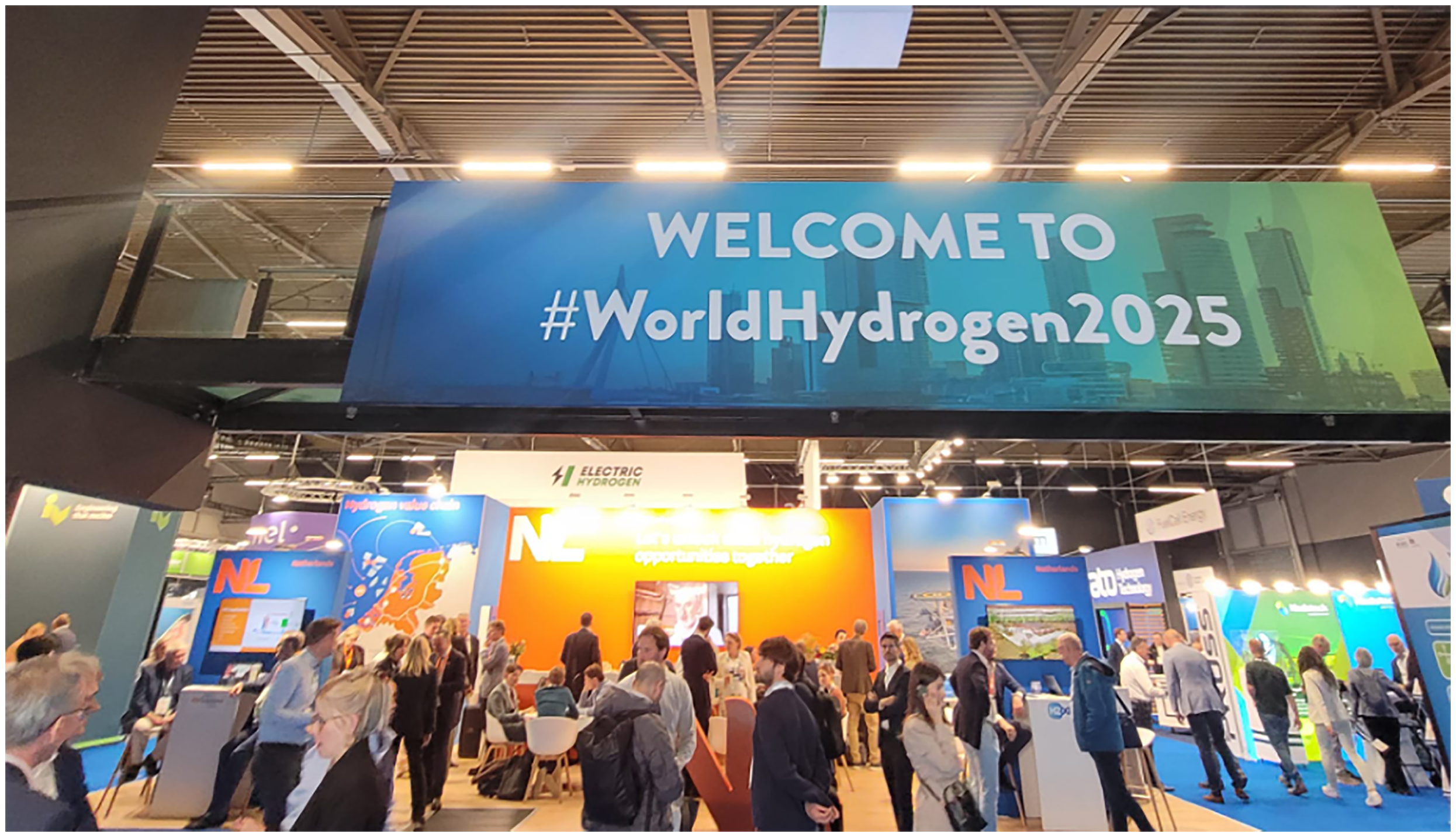
Entrance of the Exhibition Hall. Own image.
The growth and popularity of the WHS mirrors hydrogen's impressive boom in projects, finances and visibility in recent years. Long a niche field of a few specialised technocracies (i.e., chemistry and physics scientists, industrial engineers and highly specialised agencies), hydrogen is now embraced as a cornerstone of the global energy transition (IEA, 2024). Much of the appeal rests on clean hydrogen solutions like green hydrogen, produced by using electricity from renewable sources (e.g., wind, solar, hydropower) to split hydrogen from water. Widely circulated and normalised projections expect clean hydrogen to meet 12% of final global energy demand by 2050 (IRENA, 2022), up from virtually zero today, and to drive green transformations, particularly through the decarbonisation of hard-to-electrify industries (e.g., steelmaking, fertilizer, aviation) (Dejonghe and Van de Graaf, 2025). These ambitions – alongside intense corporate lobbying, state subsidies and geopolitical developments like the Russian invasion of Ukraine – have galvanised the hydrogen ecosystem, turning the WHS into an increasingly bustling scene.
As such, the WHS has been on my radar since 2022, when I started to research the role of hydrogen in decarbonised development more closely. But I was always held back by the hefty price tag, set at €2699 in 2025, for the Summit delegate pass. Until a contact from the industry tipped me off that the restricted Summit area did not have much added value – ‘nothing new there’ and ‘the usual discourses’, he said. 1 Counter-intuitively, it was on the exhibition floor, which was free of charge to access, where most networking took place. He also warned that, with the right connections, I could learn about relevant side-events and even potentially get invitations to drink receptions, where, according to him, most of the interesting conversations took place. I heeded his advice and, afforded with the privilege of being based in the Netherlands with ease of travel to Rotterdam and the right information (which included leads for attending side-events), I registered for the ‘free’, Exhibition part of the WHS.
Rotterdam's hosting of the WHS is not coincidental. Co-organised by the Dutch government, the province of South Holland, the municipality of Rotterdam, and the Port of Rotterdam, the WHS is at the heart of Dutch ambitions of becoming the European gateway for hydrogen and a global leading hub (Monteith and Bäumer Escobar, 2025). Correspondingly, across various global hydrogen trade maps displayed at the event, Rotterdam was the indispensable central node (see Figure 2). Hosting the WHS also provided Dutch public and private actors with important agenda-setting influences in hydrogen diplomacy and governance (Van de Graaf et al., 2020). In this sense, paradoxically, it was in Rotterdam itself where Dutch ‘extraterritorial agency’ – the ability of entities to act beyond their borders and influence hydrogen global production networks in accordance with their interests (Kalvelage and Walker, 2024) – came most vividly to light.
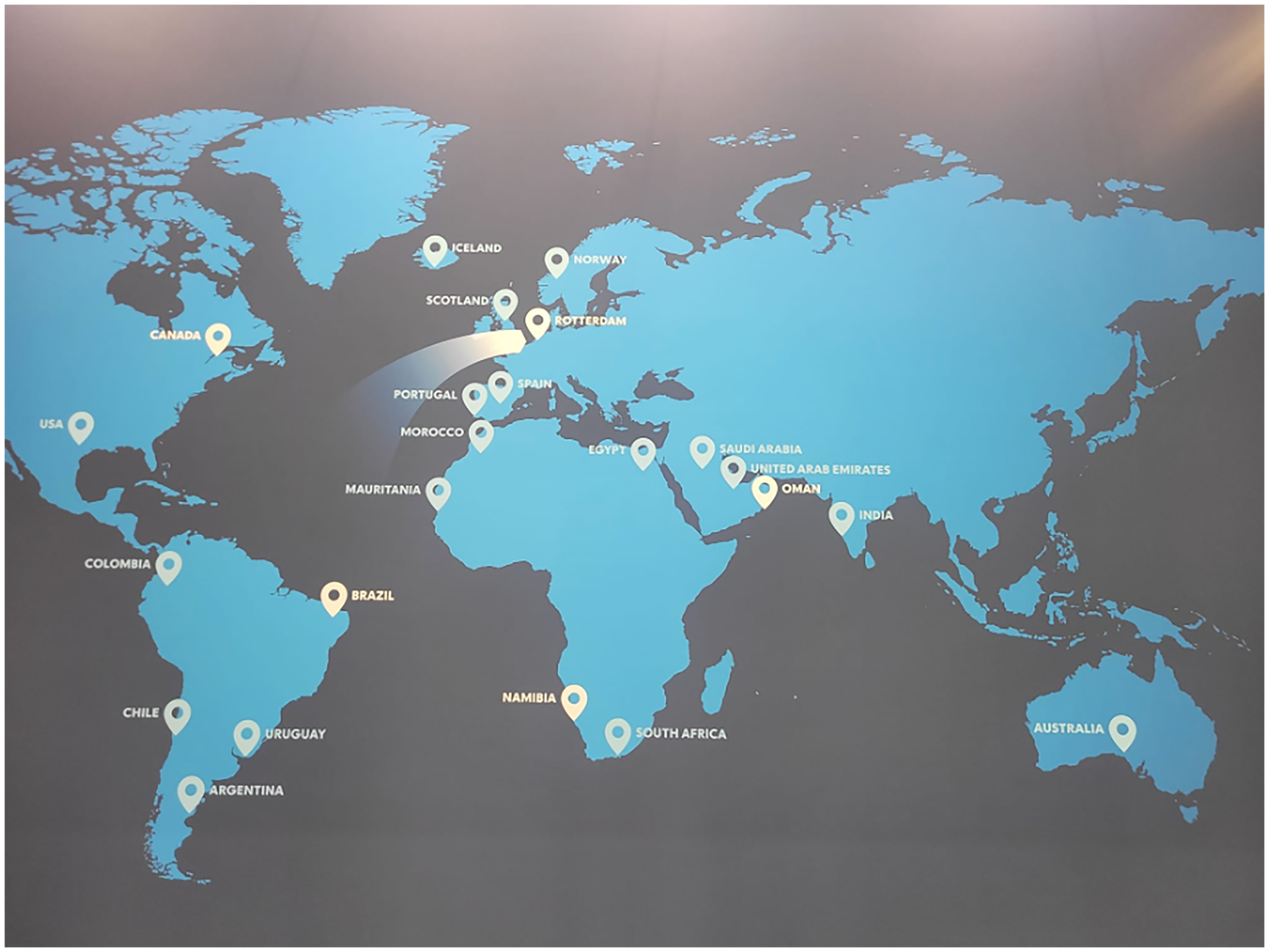
Poster at the Port of Rotterdam Authority's booth depicting flows of expected hydrogen imports into Rotterdam. Own image.
At the WHS, the Port of Rotterdam Authority (PoRA) was working hard to make sure it lived up to these ambitions. In a Linkedin communiqué about the highlights of the first day were meetings with partners in Brazil, where the PoRA is invested in the country's main green hydrogen hub at the Port of Pecém, and South Africa, with whom negotiations were underway to strengthen collaborations. The motivation: ‘Both Brazil and South Africa, with their abundant solar and wind energy, are positioned as potentially significant future exports of cost-effective green hydrogen derivatives’ (Port of Rotterdam, 2025). Coincidentally, the three countries central to my personal trajectories and connections were forging speculative connections of their own based on maritime corridors that would see countries in the Global South and other resource peripheries delivering the ‘fuel of the future’ to the Netherlands (see also Monteith and Bäumer Escobar, 2025). From Rotterdam, much of this hydrogen would flow onwards via a system of pipelines and inland shipping to the industrial heartland of Germany in the Rhine-Ruhr region, where much of the demand is expected to come from (Port of Rotterdam, 2024).
These economic and political geographies were also markedly manifested in the Exhibition's floorplan. At the forefront of the exhibition hall were the stands of the Port of Rotterdam and the Netherlands Pavilion – the first ones to be spotted upon entering. With seven dedicated booths, 535 m2 of floor space and 56 exhibitors, the German Pavilion was by far the dominating presence (German Pavilion, 2025). Despite notable exceptions (e.g., India), Global South countries and entities were typically confined to much smaller, less exclusive spaces at the back or the side margins of the hall, with their banners hardly visible from a distance and names barely legible on maps of the floorplan (see Figure 3). Emblematically, upon my visit to the Colombia Pavilion, with only 15 m2 of floor area and clumped together with other exhibitors behind the hall's cafeteria, their friendly representative was trying to explain to me the country's hydrogen vision and projects (see Dietz et al., 2025) while apologising that the tables and chairs at the booth were blocking the information posters.
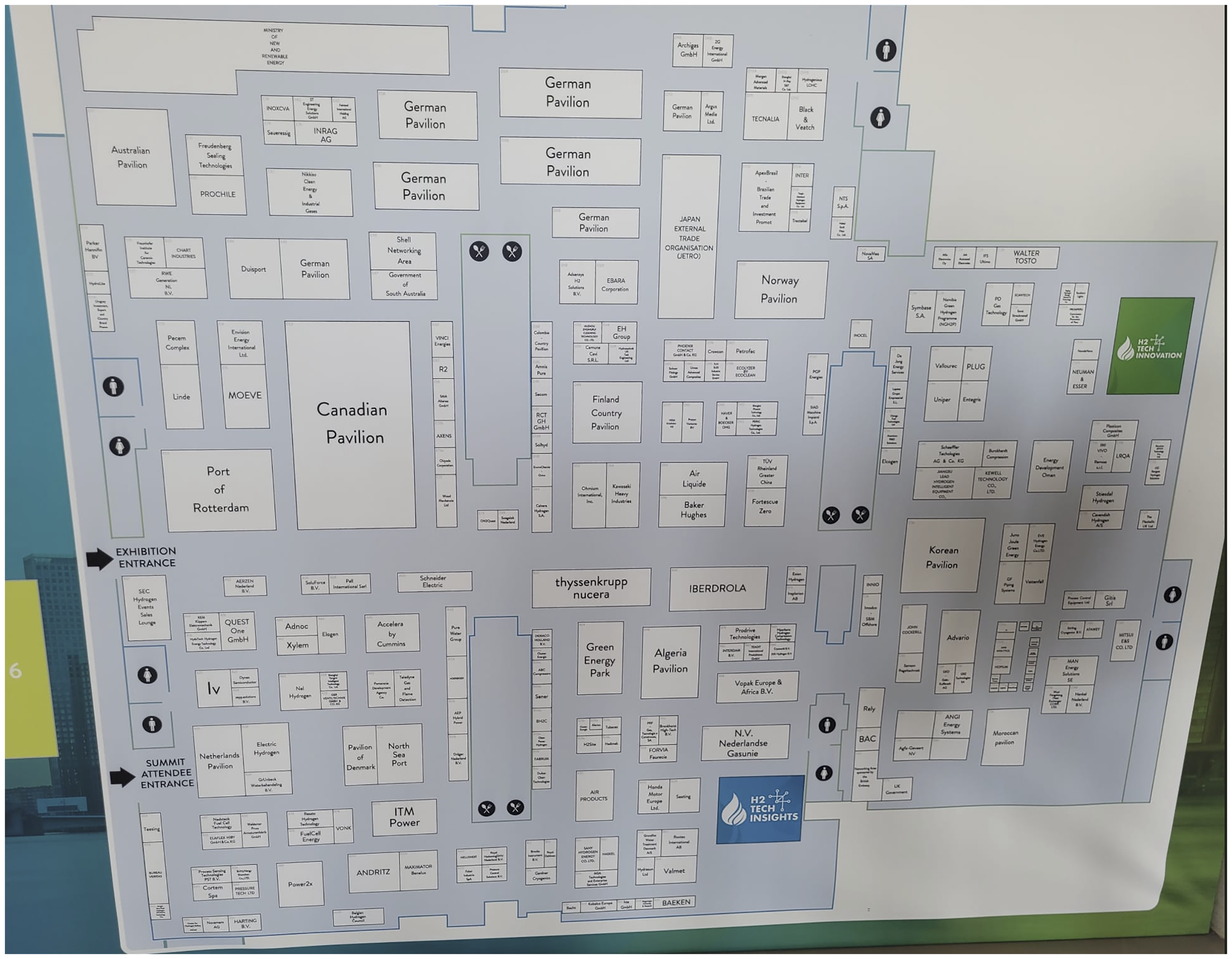
Poster with the exhibition's floorplan. Own image. For the online version, see: https://floorplanning-visualisation.rxweb-prd.com/ZEPG-25/exfx.html?zoomto=%20&units=M.
With Rotterdam and Europe positioned at the core of the hydrogen economy, the WHS made it possible for policymakers, businesses and investors to (re-)imagine resource peripheries – in the Global South and North alike – as exporting territories of ‘cost-effective’ and ‘abundant’ hydrogen. From the margins, and at times barely noticeable, the Colombian representative and his counterparts from other ‘wannabe’ hydrogen exporters were competing, in turn, for attention, technologies and investments from this core, justified under ‘green industrialization’, ‘green growth’, ‘green jobs’ and other similar mottos (see Dejonghe and Van de Graaf, 2025).
‘Building a sustainable future, together’?
The above-described impressions were not entirely surprising to me. I was well aware of the exclusive and excluding nature of the WHS. As I have written elsewhere (Cezne and Otsuki, 2025), since 2020, the Summit's yearly programmes highlighted not only the lack of civil society and grassroots representatives but also the lack of panels and sessions dedicated to addressing their concerns. In 2025, once again, the Summit's website did not leave doubt about what the priorities were and who mattered. Namely, the WHS was a ‘highly targeted environment’ for ‘governments, companies, and industry leaders’ to ‘unlock efficiencies and scale, further cementing the bankability of projects’ (WHS, 2025).
Yet, access barriers, established hierarchies and lack of inclusivity contrasted with the plethora of flashy posters that stressed the ‘togetherness’ of the hydrogen economy. ‘Building a sustainable future together’, was the overall slogan of the WHS. ‘Let's unlock clean hydrogen opportunities together’, was the message centrally illustrating the large orange wall at the Netherlands Pavilion (Figure 4, emphasis added). In some cases, the marginalising nature of such ‘togetherness’ was readily captured. Like at the ‘exclusive Members Breakfast… [with] 40+ CEOs and Senior Executives from Hydrogen Council member companies’, 2 where a key takeaway was that ‘we can stay on course and navigate the headwinds together’ (Hydrogen Council, 2025b, emphasis added).
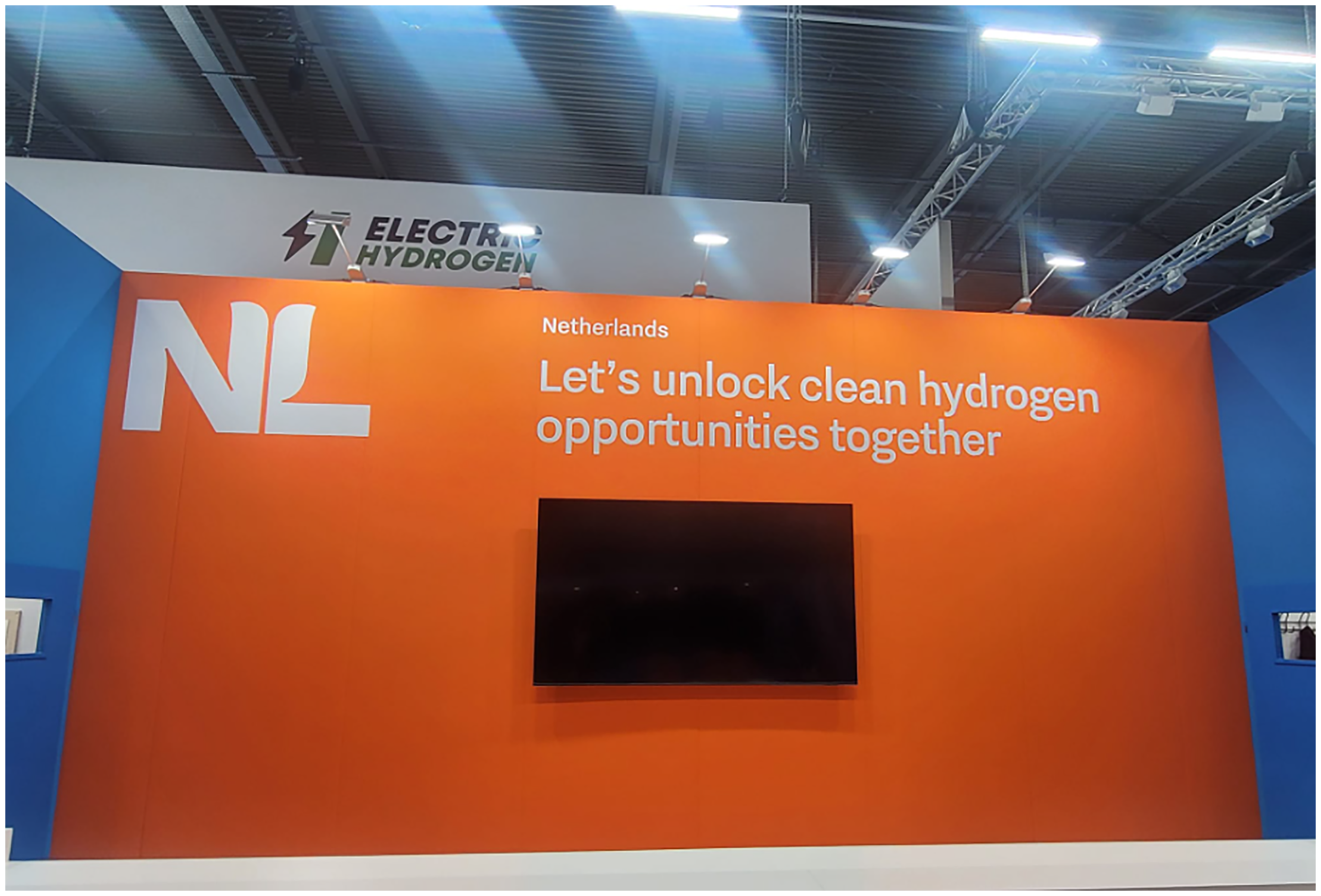
The Netherlands Pavilion. Own image.
But to the WHS's credit, despite the continued absence of themes and representatives ‘from below’ in the Summit's mainstream programme, this year's edition included a handful of side events dedicated to societal questions. I attended two of which: the ‘Environmental & social best practices in green hydrogen development’ and the ‘Feminine leadership in hydrogen business’ panels, both of which organised by the Netherlands Enterprise Agency (RVO).
At the first one, under the motto ‘great opportunities demand great responsibilities’, many of the risks of hydrogen projects to hosting societies and spaces (e.g., pressures on land, water, biodiversity and energy resources) were vocalised (see also Tunn et al., 2024). Most of the panellists stressed the need for rigorous Strategic Environmental Assessment (SEA), a framework devised to offer a more systematic, multi-tiered and participative approach to project planning and implementation (European Commission, n.d.). One speaker went as far as to describe SEA as the ‘Swiss Army Knife of complex socio-environmental problem-solving’ to the ‘Swiss Army Knife of the energy transition’ (as hydrogen is sometimes conventionally called due to its versatility), though long-held critiques associated with SEA's top-down impositions, misleading simplifications and exclusion of alternative worldviews were ignored (see Bina, 2007; Bernauer et al., 2025).
During the same panel, in a bold critical reflection, the representative of ActionAid, an NGO focusing on poverty and injustice issues, used the case of platinum mining in South Africa to underscore how green hydrogen – despite being hailed as a ‘roadmap for the future’ – is entangled and set to perpetuate familiar harms of the past. Cautiously measuring her words and apologising in advance for her remarks to an audience of political and corporate dignitaries, she noted how the drive for platinum (used in the production of hydrogen technologies like electrolyzers) and the deployment of hydrogen-powered trucks at mines, while serving green discourses and aesthetics, only exacerbated extractive operations and associated rights violations and environmental contamination – echoing what scholars and activists have problematised as ‘green extractivism’ (see also Corporate Europe Observatory, 2024; Dunlap et al., 2024; Kalt et al., 2023).
Namibia, home to the much-vaunted Hyphen project, one of Africa's most ambitious green hydrogen undertakings, was also covered in the panel. Toni Beukes, the Namibian-born and raised head of Environment, Social and Governance (ESG) at Hyphen, 3 outlined the range of measures adopted by the company to ensure socially responsible and just outcomes in otherwise ecologically sensitive and water-scarce desert geographies (see Tunn et al., 2025a). Among which were public consultations, local content stipulations, respect to cultural heritage sites, preservation of high biodiversity areas and use of desalinated water – ESG measures praised by the moderator from the Dutch-based Impact Hydrogen consultancy as pioneeringly ‘robust’ in green hydrogen. Recent civil society dialogues in Namibia have disputed, however, the inclusivity of such processes, alleging instances of exclusion and co-optation (Tjipura and Shingnege, 2024). Tunn et al. (2025b) have contended, moreover, how seemingly pioneering socio-economic empowerment initiatives largely stem from Namibia's hard-fought post-apartheid legislation and associated power struggles, rather than benign corporate proclivities.
Subsequently in the panel, the charismatic mayor of Lüderitz – a remote, coastal town at the centre of Namibia's green hydrogen industry – described hydrogen and Hyphen as catalyst events that finally put his town on the map (see DeBoom, 2025a). He then invited the audience to visit Lüderitz, which is open for business, and to taste its wonderful seafood. Yet, paradoxically, port expansion projects designed to serve Hyphen are threatening the area's fishing industry, Lüderitz's main economic activity today and by extension the very own livelihoods of fisher folks (DeBoom, 2025a) – groups who did not make it to the maps of the WHS. These concerns also extend to eco-tourism related livelihoods, as infrastructural development for Hyphen is planned for lands located in the Tsau Khaeb national park (Tunn et al., 2025a). Throughout the Namibia-related discussions, the panel's moderator pompously acknowledged the presence in the room of Namibia's Green Hydrogen Commissioner, James Mnyupe, the man who had brought hydrogen to Namibia (see DeBoom, 2025b), as if he was also the man to be convinced by the panellists.
By contrast, the side event on feminine leadership in hydrogen business sought to ‘offer diverse perspectives’ on what is a field heavily dominated by men. A lineup of five Dutch female executives – most of whom, as described by the moderator, made their careers ‘deep in the offshore world’ – went on to discuss the opportunities and challenges of female leadership in hydrogen. Yet, a missing perspective concerned how investments under their helm affected women and other marginalised groups in project localities they oversee; and whether their leadership was harnessed to foster more equitable, diverse outcomes. Later, while addressing a question about the role of mentorship in their careers, many of the executives referred to former male supervisors or colleagues, stressing how they appreciated men's ‘technical’, ‘problem-solving’ and ‘quick’ attitude. During the panel, I couldn’t help but think of the ambivalences of mentorship in feminine leadership and how the ‘togetherness’ of the hydrogen economy had strong masculine undertones, even in spaces meant to further more diverse perspectives (see, e.g., Walters, 2022).
Between clean and dirty
‘The oil and gas sector are a good example of what not to do. Hydrogen can be different’, declared a representative from the Dutch Entrepreneurial Development Bank (FMO) in the aforementioned environmental and social best practices panel. Yet, for a minimally attentive Summit-goer, it was hard to dismiss the multitude of explicit and implicit references to, precisely, the oil and gas sectors. Upon arrival, imprinted on the WHS's welcoming board were the logos of event sponsors like Shell, Repsol and Total-Energies (see WHS, 2025). On the exhibition floor, the networking area was proudly offered by Shell (see Figure 5). Many executives, like the women referred to above, made their careers in fossil fuel and mining companies.
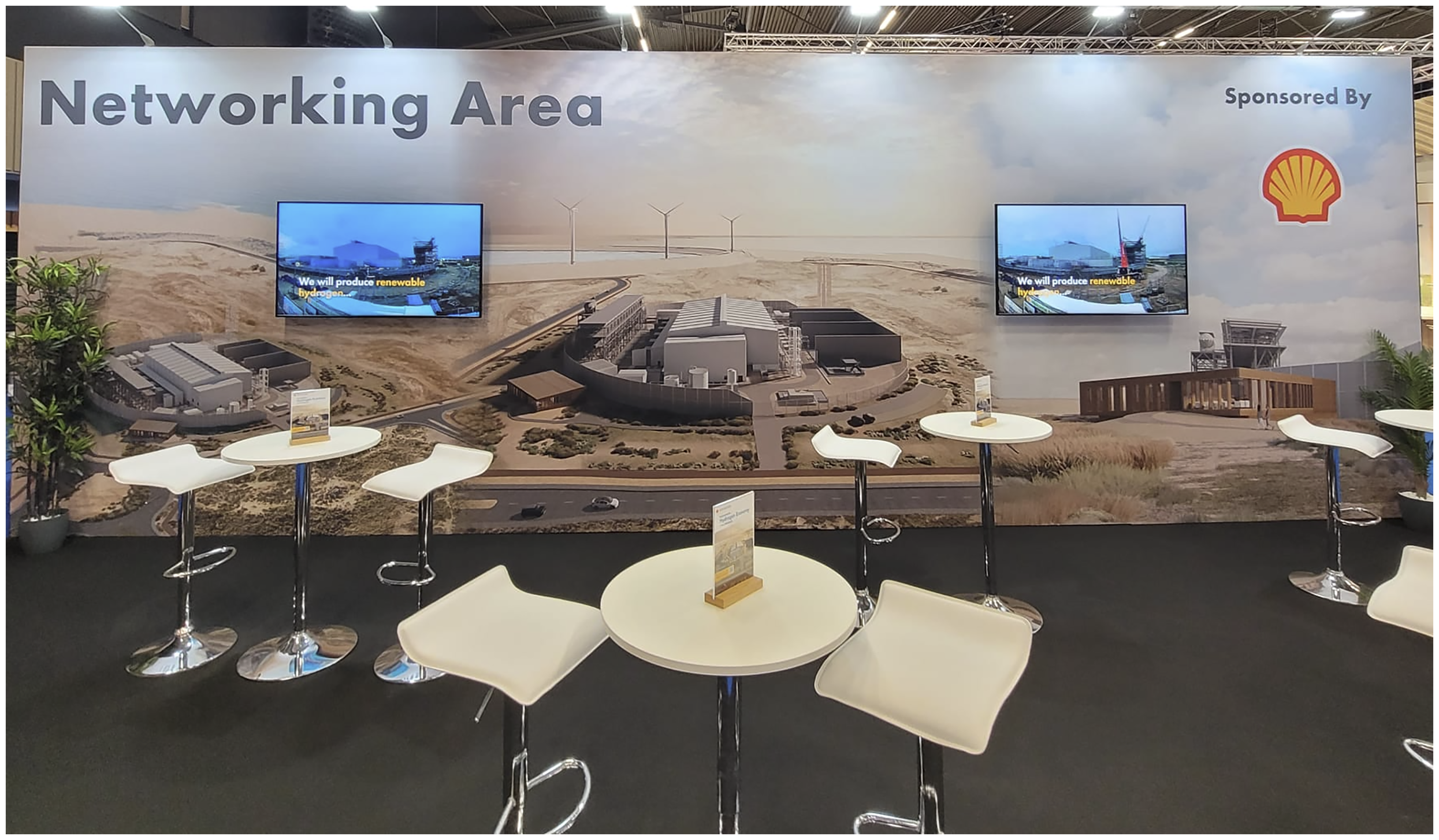
Networking area sponsored by shell. Own image.
Fossil and mining companies are spearheading, in turn, some of hydrogen's largest and most visible investments. Take, for instance, Shell's construction of Europe's largest electrolyzer at the Port of Rotterdam – where the produced green hydrogen will be employed in petroleum refining (!) (Port of Rotterdam, 2022). Or the pipelines exhibited by Dutch national gas operator Gasunie, which is set to repurpose and build more pipelines for the hydrogen economy. Or Australia's mining and metals group, Fortescue, one of the most active players in the field, with a global investment portfolio. In this vein, to partake with the apt conclusions raised by scholars like Vezzoni (2024), the hydrogen economy – predominantly controlled by the fossil and mining industries, from production to consumption – keenly represents a self-reinforcing inertia of old energy systems. An inertia or, to build on Verweijen and Dunlap (2021), a ‘fossil fuel+’ initiative masked as energy transition that was on full display at the WHS.
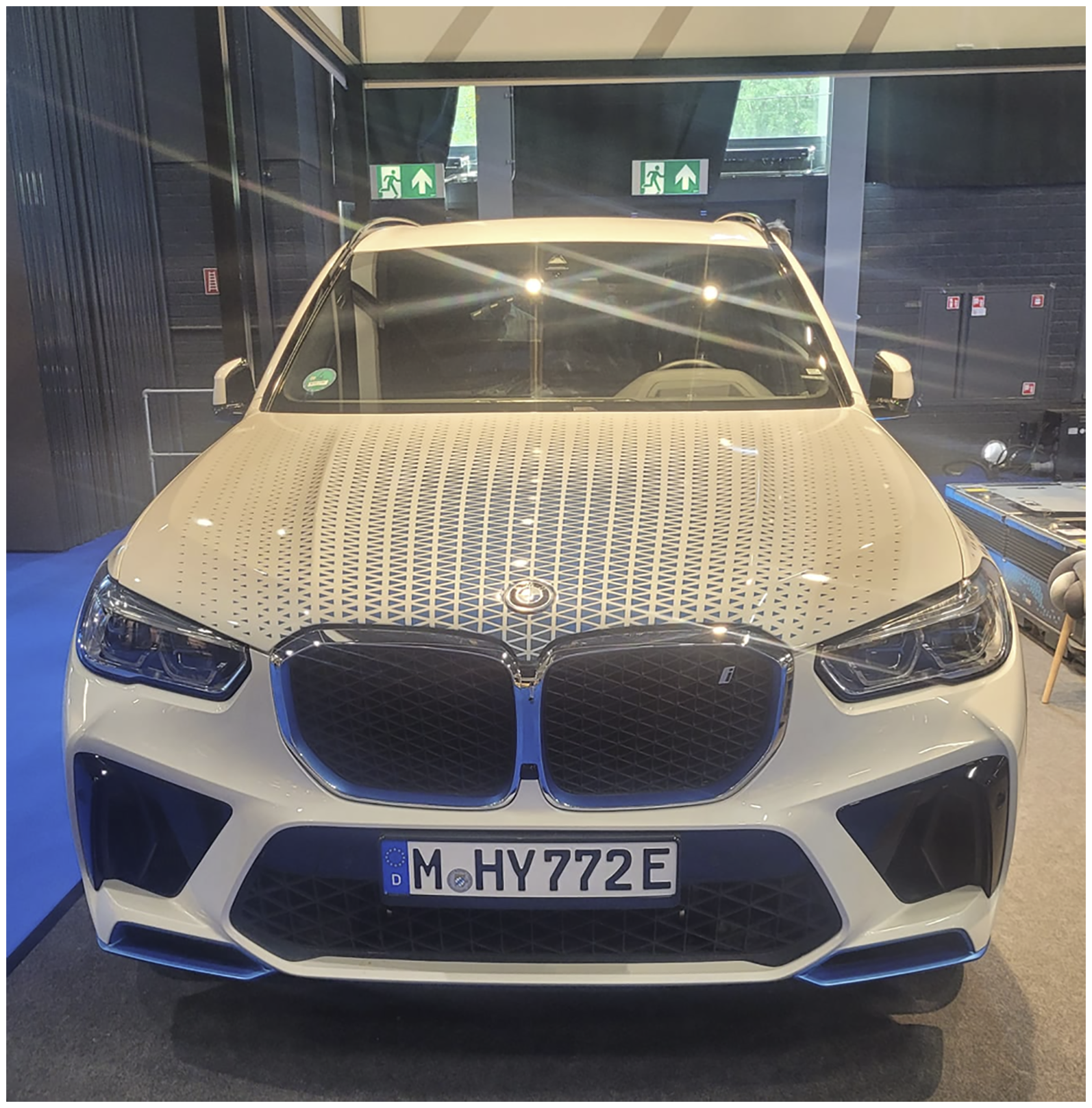
Prototype of BMW iX5 hydrogen fuel cell SUV on display at the German Pavilion. Own image.
A personal surprise was to see Brazil's mining giant Vale making a grand entrée into hydrogen at the Summit (Alencastro and Cezne, 2023; Cezne and Garcia, 2024). In partnership with Green Energy Park, an European investor and financed by the EU Global Gateway initiative, Vale unveiled a ‘mega-hub’ for the hydrogen-based production of hot briquetted iron (dubbed by the industry as ‘green iron’), a raw material used in steelmaking. The project connects Vale's iron ore mines in the Brazilian Amazon to the coastal state of Maranhão, where the mega-hub will be installed and the green iron exported to Europe for steelmaking (Vale, 2025). One of Brazil's most socio-environmentally disruptive companies, responsible for the country's deadliest labour tragedy in the Brumadinho tailings dam disaster (Rotta et al., 2020), was ‘where there is transformation’, to quote the headline of their booth.
Conclusion: ‘hydrogen is happening’, but… is it?
Trade fairs have long exposited imaginaries of techno-optimism, with material devices – be it computers, industrial machines, pharmaceuticals, or even weapons – encapsulating beliefs that technological innovations make the world a better place (Jasanoff and Kim, 2015). At the WHS, this was not different. In the official discourses, hydrogen was touted as an indispensable solution for the climate crisis, wrapped in promises of boundless energy abundance. Materially, products like the hydrogen fuel cell BMW car on display at the German Pavilion (Figure 6), the INERC promo hydrogen bike that was a popular hit for passers-by, or Fortescue's ammonia-powered Green Pioneer ship docked in Rotterdam rendered hydrogen – an otherwise invisible gas – palpable, visible, impressive, cool and investible. And more crucially, that the ‘fuel of the future’ is already a reality – ‘it's happening’, as depicted in presentation slides of the Port of Rotterdam (Figure 7).
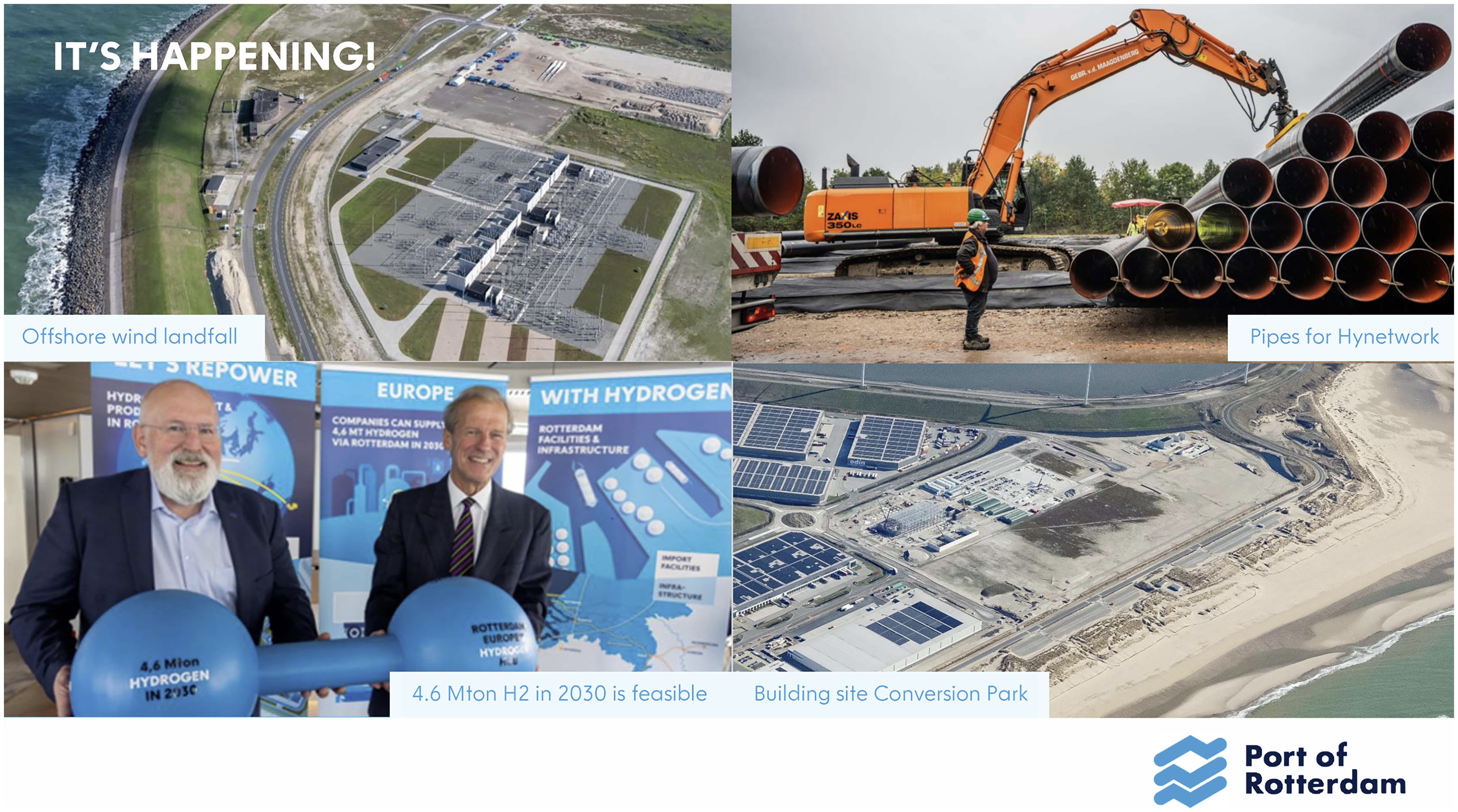
Slide in presentation about the hydrogen ecosystem at the Port of Rotterdam. Image courtesy of the Port of Rotterdam Authority.
Yet, slipping through the cracks in unscripted conversations during Q&As and mingling moments were occasional remarks that it is not all roses: ‘discussions at the moment are quite tough’, ‘the hydrogen economy is slowing down’ and ‘interesting times ahead’. 4 These stood as reminders of the host of cost, technical and policy obstacles hydrogen faces. Hydrogen remains expensive, subsidy-reliant and inefficient (see Johnson et al., 2025). Applications like the BMW car and INERC bike are among the least promising, as more cost-efficient alternatives exist via direct electrification. By the end of 2024, only 4% of all announced clean hydrogen production has reached final investment decision (IEA, 2024). Where progress or offtake exists, it is mainly in sectors which have traditionally deployed hydrogen such as – and ironically so – petroleum refining.
Still, at the WHS, such hurdles only seemed to intensify a sense of urgency to make hydrogen happen – otherwise, if we don’t act now, the planet's climate and lives are at stake. The assumed need to fast-track hydrogen, however, further reinforced beliefs that solving ‘serious’ technical and economic barriers should be the most urgent responsibilities, as evidenced by the dominance of buzzwords like ‘competitiveness’, ‘scaling up’ and ‘market activation’ in the Summit's programme and exhibitions. Ideas like ‘just transition’, ‘social responsibility’ and ‘tech ethics’, while increasingly part of the WHS's parlance, remained consequential afterthoughts; something to be acted on when things are supposedly up and running but ignoring that hydrogen's anticipatory processes are already creating (harmful) dynamics of their own. Tellingly, socio-environmental and gender discussions were literally sidelined to side events, typically as niche causes of ESG enthusiasts and women, respectively.
At the same time, entire countries and societies are asked to weather, together, the headwinds of the hydrogen economy – ‘Rome wasn’t built in one day’ (Hydrogen Council, 2025a), ‘you should be in it for the long run’, 5 were some of the ponderations raised. By fixating the future on hydrogen, the Summit's highly targeted and exclusive environment compelled everyone and (scarce) public resources toward an energy transition that is uncertain, of unproven viability, and championed by fossil capitalism. In other words, a (super)imposition of particular agendas disguised as pressing public concerns in face of a climate crisis. This stands, nevertheless, as a revelation of the uneven power geographies shaping and consolidating imaginations of hydrogen as the fuel of the future, while downplaying increasing doubts about the industry's viability and discarding alternative energy futures (see also Ariztía and Undurraga, 2025; Virens, 2024).
In this sense, this Contention article foregrounds the Summit's discursive and aesthetic dispositions as revealing lenses into the contentious nature (politically, economically, spatially, relationally, epistemologically) of hydrogen energy and, by extension, of current trends in decarbonised development more broadly. Meanwhile, the organisers are gearing up for the Summit's 2026 edition, with a call to ‘join us on our mission and together, let's make hydrogen happen’ (Sustainable Energy Council, 2025, emphasis added). Though, as discussed, the togetherness of the World Hydrogen Summit is yet to include much of the ‘world’ in the representation and production of hydrogen futures.
Footnotes
Acknowledgements
The author thanks two anonymous reviewers for their valuable comments and Alexander Dunlap, Thijs Van de Graaf and Noura Alkhalili for encouraging the publication of these insights and for their reading of earlier drafts.

Ethical considerations
No ethical approval was necessary.
Consent to participate
The research described in this paper draws on information and observations collected at an open and widely advertised public event, as well as from related open sources.
Funding
The research described in this article is part of the author’s Postdoctoral Fellowship withthe African Studies Centre, Leiden University, the Netherlands.
Declaration of conflicting interests
The author declared no potential conflicts of interest with respect to the research, authorship, and/or publication of this article.