




Abstract
Green hydrogen is often presented as a transformative solution to the dual challenges of decarbonization and economic development. This article applies the framework of climate necropolitics to interrogate the contested spatialities underlying such “win-win” narratives. It does so through an extended case study of Hyphen Hydrogen Energy, a $10 billion green hydrogen project planned for Lüderitz, Namibia. A remote town of 20,000 in a country with a $12 billion annual GDP, Lüderitz initially appears to be an unlikely host site for the “industrial fuel of the future.” To explain this outcome, I first illustrate how discordant socio-spatial projects—including European energy security, Namibian industrialization, and (sub)national developmentalism—have shaped both the emergence and legitimation of Hyphen and the construction of Lüderitz as an abstracted space for the realization of external ambitions. I then draw on interviews, focus groups, and ethnographic encounters with Lüderitz residents to place these socio-spatial projects in the specific context of Lüderitz. My analysis demonstrates how local interpretations of Hyphen are shaped not by abstract promises of energy abundance and decarbonized development, but instead by concrete experiences of extractive violence and displaced decarbonization. Analyzing these findings through the framework of climate necropolitics, I argue that Hyphen and similar energy mega-projects are enabled by varied and at times contradictory socio-spatial projects that serve to legitimize extractive violence and displace the costs of decarbonized development. This outcome is not inevitable though—energy transitions can be otherwise, and I draw on the perspectives of Lüderitz residents to consider how. I conclude by discussing the implications of this analysis for efforts to pursue more equitable, just, and place-based low-carbon futures.
Introduction
Green hydrogen is increasingly presented as a “win-win” solution to the twin challenges of decarbonization and development. Heavy industrial processes that are central to contemporary capitalist development, including the production of steel, cement, and chemicals, are difficult to decarbonize through electrification due to production requirements (e.g., the necessity of high heat for conversion processes). As a result, industry is likely to become the largest source of global carbon emissions by mid-century, surpassing electricity generation, transportation, and buildings combined (Larsen et al., 2023). The challenge of decarbonizing industrial development is particularly acute for the governments of lower-income countries across the Global South, which must balance the imperative of decarbonization with the demands of poverty alleviation, including the provision of electricity. Green hydrogen promises to resolve this dilemma by enabling the continuation or even expansion of industrial production while also reducing carbon emissions. Hydrogen is already a $150 billion global industry (The Economist, 2021), but its production currently relies on fossil fuels (IEA, 2023). As a result, global hydrogen production emits roughly the same amount of carbon dioxide each year as the country of Germany (Sherbourne, 2022). Green hydrogen, by contrast, would be produced through electrolysis, the splitting of H2O into hydrogen and oxygen via an electric current produced using low-carbon energy (e.g., wind and solar power). The European Union (EU), which has played a driving role in the global green hydrogen rush through its REPowerEU strategy, expects green hydrogen to meet approximately one quarter of global energy demand by 2050 (European Commission, 2024), compared with roughly zero in 2023. Much of that energy is expected to come from Africa, which boasts more planned green hydrogen projects than any other world region (IEA, 2023). These projects have received broad support from African governments, at least half of which have developed green hydrogen strategies.
The air, sunlight, and water on which green hydrogen production relies are not abstract resources. Their energy and molecules must be captured somewhere. Transforming air, sunlight, and water into hydrogen, converting that hydrogen into transportable forms, and distributing it to industrial centers around the world requires a complex network of infrastructures, including pipelines, desalination plants, electrolysers, compressors, transmission lines, and ports. Those infrastructures are prevalent in the industrial heartlands of the EU, China, and the US. Yet one of the world’s most ambitious green hydrogen projects—Hyphen Hydrogen Energy—is not happening in the EU, China, or the US. It is happening at the end of a 340-kilometer dead-end road through the Namib Desert in the southwestern African country of Namibia—a road so often obscured by sandstorms that local vehicle rental contracts include a sand damage clause (Figure 1). More specifically, it is happening on the outskirts of Lüderitz, a coastal town of just under 20,000 named for a German colonist and located on the ancestral lands of the Nama, descendants of some of the first human residents of southern Africa. Lüderitz boasts two consumer fuel stations, both of which close by 22:00, and an industrial sector dominated by a few fish-processing factories. Its connection to Namibia’s electrical grid relies on one lonely transmission line. The town receives less than a millimeter of rain each year and lacks local groundwater. Its water is supplied by a deteriorating pipeline from the Koichab aquifer, located 120 km away. It is, in other words, a seemingly unlikely host site for the “industrial fuel of the future.” A road sign on the B4 highway, which connects Lüderitz to the interior of Namibia via a 340-kilometer dead-end spur. Lüderitz is located just on the other side of the sand dune in the background (Photo: Author, 2015).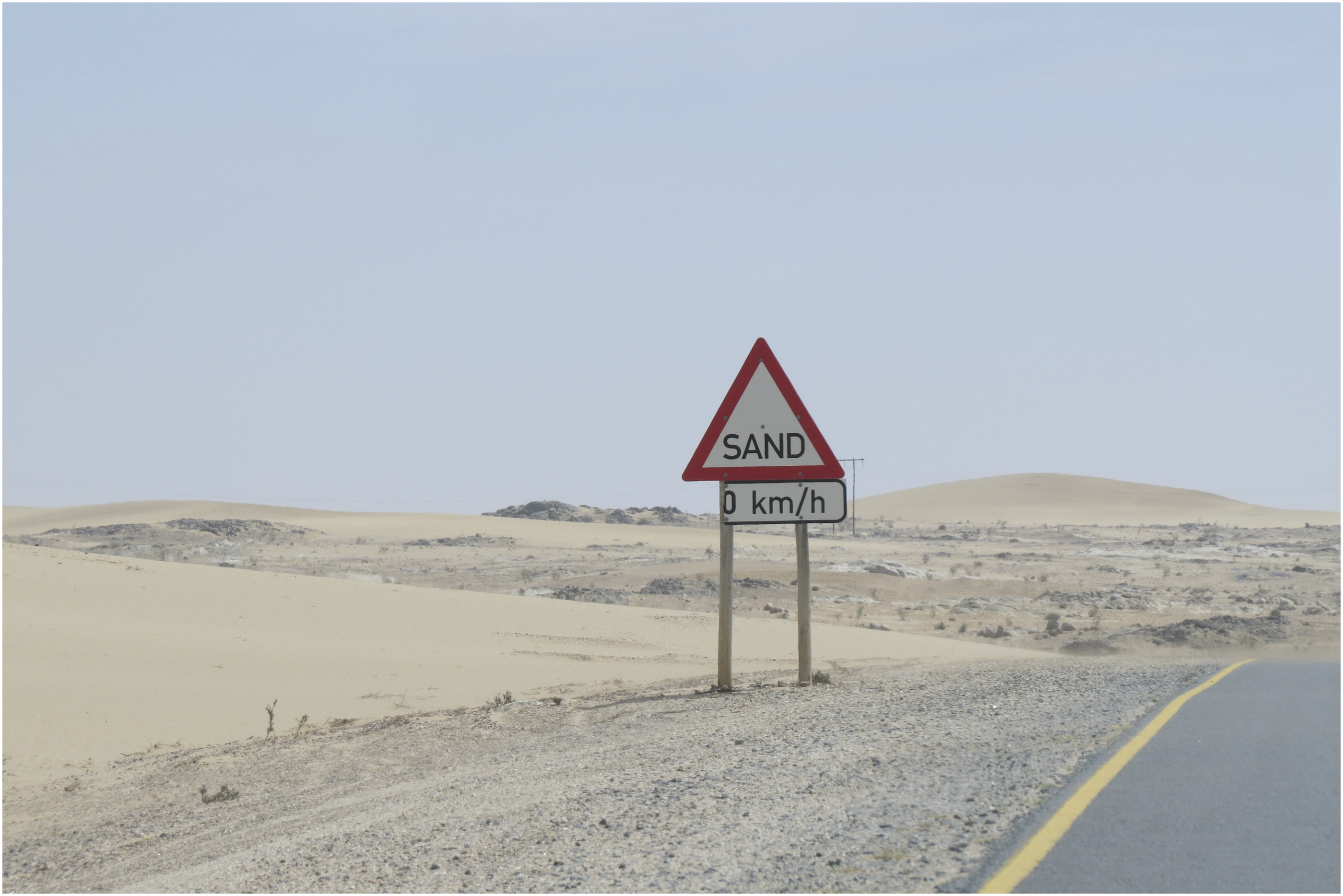
How did a $10 billion project to produce green hydrogen for European industry end up here, in a sand-swept town located over 5000 nautical miles from the Port of Rotterdam, at the territorial edge of a country whose entire GDP is roughly $12 billion? And what does its placement in Lüderitz reveal about the socio-spatial mechanisms of legitimation underlying low-carbon energy transitions—and how they might be transformed? This article uses the Hyphen project as an entry point to investigate the contested spatialities, geopolitical economic structures, and place-based politics that shape energy transitions. I begin by situating the research and its theoretical approach, climate necropolitics, in critical scholarship on energy transitions. After describing my methodology and providing a brief overview of green hydrogen, I address the above questions through three lines of analysis. First, I draw on interviews and participant observation to explain how Hyphen’s European funders have framed Namibia as a space of abundant emptiness for the pursuit of European geopolitical security and colonial capitalism. I then de-center this Euro-centric vision, drawing on extended research in Namibia to trace Hyphen’s more proximate roots in the developmental visions of Namibia’s ruling SWAPO political party, which is pursuing its own socio-spatial strategy for “green industrialization” through Hyphen. This strategy calls for a fundamental shift in the geopolitical economy of energy, which has long rendered African countries mere energy exporters rather than consumers in their own right. National plans, however, do not necessarily translate into local benefits. Drawing on interviews, focus groups, and ethnographic encounters with Lüderitz residents, I describe how local perspectives on Hyphen are shaped not by abstract promises of national development and global decarbonization, but instead by concrete experiences of extractive violence sedimented over centuries. Analyzing these findings through the framework of climate necropolitics, I argue that Hyphen and similar energy mega-projects are enabled by varied and at times contradictory spatial projects that serve to legitimize extractive violence and inequitable geopolitical economic structures. This outcome is not inevitable—energy transitions can be otherwise, and I build from the perspectives of Lüderitz residents to consider how. I conclude by considering the implications of this analysis for researchers, policymakers, and activists seeking to enable and enact more equitable, just, and place-based low-carbon futures.
Climate necropolitics: Distribution, legitimation, and the spatialities of energy transition
The need to mitigate climate change while simultaneously reducing the relative and absolute burdens borne by the world’s poorest and most marginalized people is one of the most pressing challenges facing humanity. Yet far from promoting just and equitable outcomes, critical research across a range of contexts and scales suggests that existing responses to climate change often benefit populations that are relatively well-positioned to deal with climate change while increasing the burdens borne by populations most likely to be harmed by—and typically least responsible for—climate change (Deberdt and Le Billon, 2024; DeBoom, 2021; Hecht, 2018; Kalt and Tunn, 2022; Sultana, 2022; Voskoboynik and Andreucci, 2022; Zografos and Robbins, 2020). If the uneven distributive geographies underlying this double burden (Leichenko and O’Brien, 2008) are not ameliorated, it is likely that increases in inequality, violence, and injustice over the coming decades will be driven not only by climate change itself, but also by responses to it.
The risk that climate change responses will deepen injustice and inequality is particularly acute in the realm of energy transitions. “Energy transition” is a contested umbrella term that refers to the intentional—though yet unrealized—shift from carbon-intensive energy production (e.g., coal and oil) to low-carbon energy production (e.g., wind and solar energy and hydropower). Critical research on the (geo)political economic and socio-environmental geographies of energy transitions has exploded over the past decade. At least two paradigmatic yet interlinked patterns in the spatialities of energy transition have emerged through this research. The first is “green extractivism,” which refers to the extraction of minerals and raw materials (e.g., lithium and copper), particularly from locations home to marginalized communities in and beyond the Global South, for use in decarbonization technologies, which are often produced and deployed in Global North contexts (Andreucci et al., 2023; Andreucci and Zografos, 2022; Bruna, 2022; Deberdt and Le Billon, 2024; DeBoom, 2021; Dunlap et al., 2024; Riofrancos, 2019; Sánchez Contreras et al., 2023). The second is “green grabbing,” which refers to the enclosure of land and displacement of populations for large-scale decarbonization projects, including the production of low-carbon energy and the establishment of carbon offsets (Benjaminsen and Bryceson, 2012; Fairhead et al., 2013; Núñez et al., 2022; Stock and Birkenholtz, 2021; Sullivan, 2013).
Socio-spatial and relational dynamics—including those associated with energy production and use (Huber, 2015), climate change response (DeBoom, 2021), and scalar governance projects (Hine et al., 2024)—play a significant role in enabling the violence of green extractivism and green grabbing. Although often approached as a technical challenge, energy transitions entail unevenly distributed political, economic, cultural, social, and ecological changes (Bridge and Gailing, 2020; Bridge et al., 2013; Broto and Baker, 2018). These complexities are often obscured by interpretations of energy transitions as “ruptures,” as equivalent to “just” transitions, or as otherwise necessarily transformative (Newell and Mulvaney, 2013; Rignall, 2016). Yet energy transitions do not emerge from the ether. They build on and intersect with broader geographies of socio-spatial violence and differentiation, including uneven development (Smith, 1984), ecologically unequal exchange (Hornborg, 1998), “othering” (Said, 1978), racial capitalism (Pulido, 2016; Robinson, 1983), extractivism (Acosta, 2013), and colonialism (Fanon, 1963), among others. Their spatialities are likewise shaped by relational geographies of contestation, refusal, and resistance, including efforts to pursue socio-environmental futures otherwise (Allan et al., 2022; DeBoom, 2022; Dunlap and Arce, 2022; Stock, 2023; Sultana, 2022).
The framework of climate necropolitics (DeBoom 2020, 2021, 2022) enables analytical connections across these varied but interlinked forms of socio-spatial and socio-environmental violence by foregrounding their underlying mechanisms of legitimation. Integrating Mbembe’s work on necropolitics (2003, 2019), a relational form of violence that imposes literal or symbolic death upon some in the name of life for others, with Fanon’s (1963) attention to the spatialities of violence, climate necropolitics calls attention to the processes, practices, discourses, and logics through which intensified climate change-related violence against particular people and places is rendered legitimate, including in the name of climate change response. Its analytical approach opens space for examining not only where and how the costs and benefits of climate change responses are distributed, but also how and why those distributions are rendered legitimate and through what underlying mechanisms. These mechanisms, which include hegemonic capitalist and colonialist logics as well as more contextualized dynamics, enable the lives of some to be rendered disposable, expendable, or otherwise less intrinsically valuable in the name of (continued) life for privileged others and/or the continued survival of the planet writ large. By identifying, denaturalizing, and challenging the socio-spatial mechanisms of legitimation underlying varied forms of climate change-related violence, the framework of climate necropolitics opens space for developing more just and equitable strategies for decarbonizing development.
The particular strength of climate necropolitics as a framework for energy transitions research lies in its attention to how legitimation operates through space, including through scalar politics, place-based identities, and spatial representations. Extractive endeavors have long been rendered legitimate in the name of imperialism, national security, or racial capitalism, among other rationales. Climate change mitigation projects, by contrast, are often justified in the name of universal, planetary salvation—including on behalf of the very populations they may harm (Andreucci and Zografos, 2022; Deberdt and Le Billon, 2024; DeBoom, 2021). These existential claims about what must be done to “save the planet” (Mann and Wainwright, 2018) can facilitate an at-all-costs mentality that enables violence against particular people and places to be deemed justifiable—and even necessary—in pursuit of broader, yet often ultimately exclusionary socio-spatial projects. Although often justified in seemingly inclusive terms (e.g., energy security, sustainable development), these projects often serve exclusionary ends (Andreucci and Zografos, 2022; DeBoom, 2022; Dunlap, 2023; Hughes et al., 2022; Schuetze, 2023). They also facilitate the creation of zones “where the violence of the state of exception is deemed to operate in the service of ‘civilization’ (Mbembe, 2003: 24),” a category in which we can include extractive “frontiers” (Acosta García and Fold, 2022; Klinger, 2017) and “sacrifice zones” (Brock et al., 2021; Scott and Smith, 2017; Zografos and Robbins, 2020). This article contributes to scholarship on the necropolitics of energy transitions (Deberdt and Le Billon, 2024; DeBoom, 2020, 2021; Dunlap and Laratte, 2022; Shokrgozar et al., 2024) and climate change-related violence more broadly by demonstrating how actors leverage spatial representations, imaginaries (Chateau et al., 2021; Jasanoff and Simmet, 2021), and subjectivities (Hecht, 2018; Köppel and Scoville-Simonds, 2024) to render intensified violence against marginalized populations legitimate—or, alternatively, to contest such violence.
Emergent geographies of green hydrogen
Hydrogen is often described as the most abundant element in the universe. On Earth, however, it occurs mainly in combination with other elements, such as in water. Although often framed in futuristic terms, hydrogen has long been an appealing industrial fuel and energy carrier. First, it is energy dense—2.6 times denser per kilo than natural gas (The Economist, 2021). Second, it does not require oil and can be produced via electrolysis or methane steam reforming using coal or natural gas. This characteristic appeals to oil-poor countries with high industrial energy demands, including Japan, Germany, and China. Third, it can be converted into ammonia, a fertilizer component for which global transportation and storage networks already exist. Finally, when combined with oxygen, hydrogen releases energy without producing greenhouse gases. This latter characteristic makes it particularly appealing in the context of decarbonization. Yet hydrogen also has significant downsides. Most notably, it is a highly reactive gas that needs to be pressurized, liquified, or converted into a derivative (e.g., ammonia) to be transported. These processes require significant energy and specialized infrastructures.
Due to the difficulty of transporting hydrogen, most hydrogen production currently occurs near industrial centers. The requirements of green hydrogen production present challenges for this spatial orientation. Due to limitations on sun, wind, and/or “affordable” or “available” land (defined according to colonial capitalist logics), investors view dense industrial hubs as poorly suited to large-scale production of low-carbon energy. Such large-scale production is considered essential to making green hydrogen production more cost effective vis-à-vis fossil fuels. As a result, investors and governments in wealthier, industrialized contexts, including the EU, have turned to a long-standing geopolitical economic strategy for reducing costs: sourcing fuel for their economies elsewhere. It is in this context that green hydrogen has emerged as a leading destination sector for investments by wealthy corporate and state actors in lower-income countries.
Although initial research on green hydrogen focused primarily on its technical and economic feasibility, subsequent research has foregrounded its distributive implications (Hanusch and Schad, 2021; Kalt and Tunn, 2022). A growing body of scholarship focuses specifically on the geopolitical economy and ecologies of green hydrogen projects across the Global South (Chigbu and Nweke-Eze, 2023; DeBoom, 2025; Fladvad, 2023; Hanusch and Schad, 2021; Kalt et al., 2023; Kalt and Tunn, 2022; Linder, 2023; Müller et al., 2022). This research has made valuable contributions to the critical literature on green hydrogen, including by evaluating Hyphen’s implications for the structural power of the Namibian state (Gabor and Sylla, 2023), assessing its territorialization through speculative processes (Monteith and Bäumer Escobar, 2025), and interrogating it through the lenses of green colonialism (Tunn et al., 2025) and future-making (Klagge et al., 2025). These studies—in Namibia and elsewhere—have thoughtfully considered the local implications of green hydrogen projects, but they have done so primarily through limited interviews with civil society or government leaders and/or the analysis of civil society, community, and media statements, rather than through situated research in communities at the “point of production” (Rignall, 2016: 541). This article complements the above research by providing a long-term, multi-scalar analysis of the Hyphen project with an eye toward situated histories. More specifically, it takes a place-based approach to assess how residents of Lüderitz interpret, experience, and engage with Hyphen vis-à-vis socio-spatial projects underway at national and global scales.
Methods
This analysis draws on long-term research in Namibia, including Lüderitz, since 2011. This long-term perspective enables me to situate the Hyphen project in a broader local and national context characterized by recurrent boom-bust commodity cycles. Most of the data presented here were collected as part of an ongoing project on the distributive geopolitics of green hydrogen and oil (see also DeBoom, 2025), which incorporates interviews, focus groups, participant observation, archival research, and textual analysis. The specific analysis that follows is informed by ethnographic engagements in Lüderitz as well as semi-structured individual and small-group interviews with 37 residents of Lüderitz and representatives of the Namibian government and the hydrogen industry. These interviews were complemented by five focus groups of 3–7 participants organized on the basis of shared identity (e.g., subsistence fisherman). Based on prior experience in Namibia, I used images or maps to prompt discussion in both interviews and focus groups. Analyzed texts included roughly 110 media, industry, civil society, and government documents related to green hydrogen and energy transition. I also conducted archival research in Lüderitz, Swakopmund, and Windhoek, with a focus on Germany’s genocide in Namibia. Finally, I completed repeated visits to proposed green hydrogen production sites (including the Hyphen site in Tsau ǁKhaeb National Park) and conducted event ethnography (Koch, 2023) at 20+ events (e.g., conferences, public outreach events, and workshops) focused on green hydrogen in Namibia, the US, South Africa, and Europe.
Hydrogen for whom, what, and where? The contested spatialities of the Hyphen project
The following analysis applies the framework of climate necropolitics to this article’s two opening questions: why is one of the world’s most ambitious green hydrogen projects being built in Lüderitz, and what does its placement reveal about the socio-spatial mechanisms of legitimation underlying energy transitions—and how they might be transformed? I first identify two distinct socio-spatial projects—European energy security/colonial capitalism and Namibian industrial development—that have emerged as legitimation mechanisms for the Hyphen project (hereafter, Hyphen) and evaluate how they have come to manifest in the specific context of Lüderitz. I then turn to the perspectives of Lüderitz residents themselves, focusing on how historical experiences and contextual factors shape their experiences and interpretations of Hyphen and its associated socio-spatial projects—as well as its alternatives. I begin, however, by providing a brief overview of Hyphen itself.
The Hyphen project
On May 25, 2023, then-Namibian President Hage Geingob announced that the Namibian government had approved a 40-year contract for Hyphen Hydrogen Energy to construct and operate a large-scale green hydrogen project near Lüderitz. With an estimated cost of $10 billion, Hyphen is the largest project in the Namibian government’s broader plan attract $20 billion in green hydrogen investments. Hyphen is a multinational joint venture with public and private investors. Its controlling shareholders are ENERTRAG SE, a German company with experience in low-carbon energy projects, and Nicholas Holdings Limited, a holding company registered in the British Virgin Islands. The EU and several of its member states have provided financial support to the project, including a €500 million loan from the European Investment Bank. Namibia’s government is also in the process of exercising its contractual option to purchase a 24% stake in Hyphen, which it intends to fund through European grants and loans, SDG Namibia One (a dedicated blended finance vehicle), and perhaps even revenues from Namibia’s emergent oil sector (DeBoom, 2025). Construction is expected to begin in 2025, with a completion target of 2027. At full production, Hyphen is expected to be the world’s fifth-largest hydrogen production site.
Importantly, Hyphen will not export green hydrogen, but instead green ammonia, a hydrogen derivative. Ammonia (NH3) has a higher energy density than hydrogen (H2) and, unlike hydrogen, can be liquified under ambient conditions. As a result, it is easier and safer to move via ship, and many of the transportation, storage, and distribution infrastructures necessary to do so already exist. Ammonia is also a versatile compound with a variety of decarbonization-related uses. Roughly 70% of global ammonia production is currently used to produce fertilizer, with the remainder used in a variety of industrial processes, including plastics production (IEA, 2021). Ammonia can also function as an energy carrier or be reconverted into hydrogen through a process known as “cracking” (IEA, 2021). It is less volatile than hydrogen, but its production and transportation are not risk-free. Although labeled “green” due to its production using low-carbon energy, green ammonia remains flammable, corrosive, and toxic (Crolius et al., 2021). At full production, Hyphen is expected to produce 300,000–500,000 tonnes of green ammonia for export annually.
Hyphen will consist of two primary sites. The first is an inland energy production and electrolysis site measuring 4000 square kilometers (approximately the size of the US state of Rhode Island) and located roughly 80 km south of Lüderitz in the Tsau ǁKhaeb National Park. There, 500–600 wind turbines and 40 square kilometers of solar panels will produce an estimated seven gigawatts (GW) of energy. That energy will power on-site electrolysis, the process of separating hydrogen and oxygen by passing an electric current through water. The resultant oxygen will be released into the air, and the green hydrogen will be pressurized for transport via pipeline. A corridor of roads, electricity transmission lines, and pipelines will connect this inland site to a second site on Lüderitz Peninsula, directly across the bay from Lüderitz. There, a new desalination plant will turn seawater into water suitable for electrolysis and two ammonia synthesis facilities will combine hydrogen transported via pipeline from the inland site with nitrogen extracted from the atmosphere to produce green ammonia. This ammonia will be stored in four large tanks before being transported via an undersea pipeline to a multi-buoy mooring system (used for loading ships) located 2 km offshore. Plans are also underway to construct a new deepwater port on the peninsula to accommodate tankers and increased commercial traffic.
“Abundant emptiness” and “excess capacity”: Namibia as an abstracted space for European energy security and colonial capitalism
The EU is seeking to achieve two transitional goals simultaneously through its investments in Hyphen and other green hydrogen projects: industrial decarbonization in the context of climate change mitigation and energy security in the context of geopolitical transition. Despite green hydrogen’s potential to enable large-scale decarbonization and the development of German and EU green hydrogen strategies in 2020, it was geopolitical turmoil and capitalist opportunity that ultimately catalyzed the Hyphen project. Russia supplied just over half the natural gas upon which European industry relied when it invaded Ukraine in 2022 (Kardaś, 2023). Shortly thereafter, the EU unveiled REPowerEU, a €300 billion plan to reduce its dependence on Russian gas through investments in alternative sources of oil/gas and low-carbon energy, with an emphasis on green hydrogen (European Commission, 2024). Investors took note, and the global green hydrogen rush was on (Tunn et al., 2025).
Energy security is not only a geopolitical economic challenge; it is also a psychological one. A general lack of knowledge about Namibia among European audiences 1 has enabled varied actors to cast Namibia as a “blank space” upon which European ambitions and imaginaries can be projected (Monteith and Bäumer Escobar, 2025; Tunn et al., 2025). Reflecting this dynamic, the question of “why Namibia?” was a recurring theme in think tank, government, finance, and industry events that I observed. One word repeatedly emerged as the answer: abundance. Given hydrogen’s status as the most abundant element on Earth, it is perhaps unsurprising that “abundance” featured prominently in discussions of Hyphen. Yet the abundance identified by European actors was located not in hydrogen as an energy source, but instead in Namibia itself as an abstracted space of energy potentiality. In interviews and public events, European actors consistently highlighted Namibia’s resource abundance, describing it as one of the “best locations in the world” for onshore wind and solar energy. These characterizations were often supported by comparative statistics designed to resonate with spatial imaginaries closer to home, including descriptions of the Namib as “windier than the North Sea” and “sunnier than southern Spain.” Industry representatives took particular pains to highlight the co-location of Namibia’s wind and solar resources—which reduces the likelihood of energy generation downtime, and thus production costs—near a suitable export harbor (i.e., Lüderitz). Namibia’s “trifecta of abundance” (co-located wind and solar plus a natural harbor), one representative of a European state investment entity noted, made it “an ideal setting in which to pursue our green hydrogen ambitions.” These visions of Namibia as a uniquely abundant space operated to mitigate audience concerns about the environmental, financial, logistical, and ethical implications of shipping ammonia over 5000 nautical miles (nearly 10,000 km) from Lüderitz to the Port of Rotterdam, its intended primary destination.
Yet wind and solar energy are not captured from thin air. Their production requires land—and lots of it. In addition to visions of abstract abundance, external imaginaries of Lüderitz and the Namib Desert drew on more specific spatial fantasies of the “desolate African outpost.” During interviews and events, government, think tank, and industry actors from Europe, the US, and South Africa described the Hyphen site using colonial tropes, including “virgin territory” and “the ends of the Earth.” Hyphen’s own presentations and web site characterized the project as “revolutionizing the African frontier.” As was the case for visions of abundance, speakers and interviewees often used comparative data to support these imaginaries. Namibia’s position as the second-least densely populated country in the world (“second only to Mongolia,” as one think tank representative enthusiastically noted) received particular attention. At times, this spatial-statistical representation was directly contrasted with descriptions of Namibia as the “world’s 35th largest country.” Together, these representations reinforced portrayals of the Namib Desert as a “vast, empty space” of “untapped” or “excess capacity.” 2 One industry representative went so far as to locate the project site’s appeal to investors in its “vast available land for copy/paste expansion”—well-suited, in other words, to the abstract spatialities of capitalist extractivism.
It is not only perceptions of Namibia as a land of “abundant emptiness” that have facilitated the Hyphen project's placement; it is the landlord. Hyphen will be constructed in partnership with Namibia's government on land currently owned by the Namibian state. From a neoliberal perspective that equates economic efficiency with privatization, this situation may seem to be a surprising selling point. Its appeal to investors reflects a shift in the geopolitical economy of development finance. Rather than attracting investment through privatization, Global South states like Namibia increasingly use state involvement to “de-risk” large-scale projects like Hyphen (Gabor and Sylla, 2023). One way to do this is for the host government to directly take on project risk, as the Namibian state has done through its land concessions and direct investments in the project. Importantly, these de-risking strategies are also socio-spatial re-distribution and displacement strategies. They transfer risks from private investors to governments, which spread them across citizens. One Hyphen representative explained Namibia’s appeal to investors at a public event as follows: “A lot of countries can show a pathway to one or two projects—working with private developer A and B—but you don’t have national planning scale. Namibia is one of the few countries where all the high quality resource is owned by the government, and it’s on government land, and that government is on board.” (emphasis added)
As a result, the Hyphen representative continued, Hyphen faces “few, if any, competing interests,” including “competing industries, infrastructure, or unsupportive private landlords.” This statement erases not only people and ecologies from Namibia as a space, but also the town of Lüderitz itself. By producing Namibia as an abstracted space of “abundant emptiness” and “excess capacity,” European governments and investors render legitimate the “externalization” (Tunn et al., 2025) of Hyphen’s costs and the concentration of its benefits in the electrical grids and financial accounts of external actors.
“The desert has become valuable”: Lüderitz as a sacrifice zone for national development
The Hyphen project, as described above, initially appears to be a straightforward continuation of colonial extractive patterns: a valuable resource is exported from Africa to fuel economic growth and energy security elsewhere. The Namibian government, however, is not a mere passive victim of European ambitions. Its leaders are pursuing their own socio-spatial project through Hyphen—one that both echoes and contradicts the Euro-centric project described above. In 2021, prior to Russia’s invasion of Ukraine, then-Namibian President Hage Geingob included green hydrogen in the second Harambee Prosperity Plan, his signature development initiative. Its rise to prominence was facilitated by Namibian Presidential Advisor and later Green Hydrogen Commissioner James Mnyupe, who identified green hydrogen as a pathway to achieve the industrialization-oriented development agenda of SWAPO, Namibia’s ruling party since its 1990 independence. In the EU’s geopolitical crisis, Mnyupe saw a developmental opportunity. He issued a request for bids for a large-scale green hydrogen project, initiated a blended finance fund to facilitate private and public investment, and secured grants and offtake agreements from around the world. The result is a $10 billion project in a country with a roughly $12 billion GDP. As one noted analyst of Namibian politics adroitly put it, “it’s like bolting on a second economy.”
Like their European counterparts, SWAPO officials with whom I spoke viewed Hyphen as an opportunity for energy security. Namibia faces significant challenges in providing sufficient electricity for its growing and urbanizing population. Half of Namibians lack electricity access, and that proportion is much higher in rural areas. A representative of NamPower, Namibia’s national electricity utility, indicated that Namibia imports over half of its electricity from the Southern African Power Pool, which is dominated by South Africa’s coal-reliant Eskom energy utility, at a cost that has increased approximately 24-fold in the last six years. The seven GW of electricity that Hyphen’s windmills and solar panels will generate dwarfs the 50 MW (0.05 GW) provided by Namibia’s aging coal power plant. In interviews and at public events, SWAPO representatives drew on these details to characterize Hyphen as an opportunity to turn Namibia into a regional energy powerhouse, capable of achieving its own energy security while also exporting electricity to its neighbors. Given southern Africa’s rising population and Eskom’s uncertain future (Cox, 2025), SWAPO officials described this prospect as appealing for both geopolitical and commercial reasons.
SWAPO leaders also expressed developmental visions for Hyphen that extended well beyond electricity. Despite Namibia’s classification as an upper-middle income country, 43% of Namibians live in multidimensional poverty (NPC, 2023). Namibia also has the world’s second highest level of income inequality and one of the world’s highest official unemployment rates (37%; NSA, 2024). These challenges have undermined SWAPO’s developmental legitimacy, with consequences for its electoral support. Several officials I interviewed characterized Hyphen as key to fulfilling SWAPO’s Vision 2030 promise to make Namibia a “prosperous, industrialized nation” by 2030 (NPC, 2004)—and, by extension, to reclaim SWAPO’s political dominance. Unlike uranium and diamonds, two commodities on which Namibia’s economy relies and for which downstream linkages are limited due to geopolitical economic dynamics, SWAPO representatives argued that green hydrogen will enable value-added production. They envisioned a range of “green” industries, including steelmaking and cement, fertilizer production, and the manufacture of electrolysers. These goals are detailed in a proliferating number of plans produced by the Namibia Green Hydrogen Programme. SWAPO officials also envisioned a more direct revenue stream. A government representative confirmed that, in return for the 40-year land concession it has granted Hyphen, Namibia’s government will receive €12 million in rent during Hyphen’s construction. That figure will increase to €26 million per year once the facility is operational. The government’s 24% ownership stake will also entitle it to a portion of any future Hyphen profits. Echoing the promise of its signature Harambee Prosperity Plan, SWAPO’s leaders argued that the green industrial future enabled by Hyphen will “leave no Namibian behind.”
Nowhere, in the eyes of several SWAPO officials with whom I spoke, better fit the definition of “left behind” than Lüderitz. Lüderitz is indeed a remote town. Although the offshore fishing and diamond mining industries that operate from its port are key to Namibia’s economy, the town’s residents are geographically isolated and socially marginalized. Surrounded by the Namib Desert on three sides and one of the most treacherous stretches of the Atlantic Ocean on the other, Lüderitz is located 834 highway kilometers from Namibia’s capital of Windhoek and at the opposite side of the country from SWAPO’s electoral base in northern Namibia. A local official estimated that 40% of Buchters, as most residents of Lüderitz call themselves, and upwards of 60% of Buchter youth are unemployed. Many multi-generational Lüderitz families identify as Nama or coloured, an identity claimed by southern Africans of multi-racial decent. Together, these groups constitute just over five percent of Namibia’s population (NSA, 2024) but a much higher proportion of Lüderitz’s (estimates varied among interviewees). Much to SWAPO’s frustration, the town has also become a fertile ground for political opposition movements, including the Landless People’s Movement.
Domestic imaginaries of Lüderitz share some similarities with the Euro-centric imaginaries of “abundant emptiness” and “excess capacity” described earlier. In my research in Namibia since 2011, I have often heard Namibians living elsewhere, particularly in Windhoek, characterize Lüderitz as an “odd” or “curious” place, lacking in opportunities but characterized by an unusually strong sense of identity, which is often ascribed to its remote location. In the eyes of some SWAPO officials, however, Lüderitz is not only remote; it is also “unproductive.” In interviews and at public events, SWAPO officials described Lüderitz as a “depressing” and “desolate” town and Buchters as “stubborn,” “proud,” or, in the words of one official working on green hydrogen, “ungrateful.” Hyphen, one official explained, will change all that, transforming Lüderitz from a “backwards village” into the “centerpiece” of an industrialized Namibia. Or, as Finance Minister Iipumbu Shiimi stated in an interview with the Wall Street Journal, “[n]ow all of a sudden, the desert has become valuable” (Wexler, 2021). As the following section demonstrates, this statement is a rather peculiar interpretation of Lüderitz’s geopolitical economic history.
“This is not for us”: Extractive violence and displaced decarbonization in Lüderitz
The importance of foregrounding necropolitics, place, and the spatialities of violence in analyzing energy transitions is nowhere clearer than in Lüderitz. The Hyphen project lies in what was formerly known as—and is still referred to by many Buchters as—the Sperrgebiet or “prohibited area.” The German colonial regime established it as a “forbidden area” of over 26,000 square kilometers (slightly smaller than Albania) in 1908 to facilitate a monopoly on alluvial diamond mining. Although the Sperrgebiet ostensibly became a national park in 2004, it remains off limits to the public without prior security clearance and an expensive permit. 3 A global biodiversity hotspot characterized by unique plant and animal life, its only human settlements consist of a few secured diamond mining outposts, Lüderitz (which the Sperrgebiet excludes but surrounds on all sides, including a portion of the coastline), and Oranjemund, a DeBeers company town that was only opened to the public in 2017. It was not always so “empty.”
In 1883, a German intermediary for tobacco baron Adolf Lüderitz purchased a portion of Nami≠nûs (“place embraced by the water”) in Tsau ǁKhaeb (“soft sand”), known today as Lüderitz Bay or Lüderitzbucht, on fraudulent terms from Kaptein Josef Frederiks, then-leader of the Bethanië Nama. Germany claimed what it called German South-West Africa the next year. Indigenous resistance quickly constrained Germany’s socio-spatial ambitions. Ovaherero and Nama leaders contested German land grabs and refused to facilitate German settlement and extraction (Erichsen and Olusoga, 2010). Germany responded with genocide. From 1904 through 1908, German colonial troops killed an estimated 70% of the Ovaherero and 40% of the Nama. Survivors of German attacks were forced into the waterless Kalahari Desert, where many died of thirst or from drinking water poisoned by German troops, or were forcibly displaced to concentration camps, where they were subjected to slave labor and deadly medical experiments (Steinmetz, 2007). Oral histories and remaining colonial-era records suggest that the deadliest concentration camp was at Shark Island—a rocky outcropping in Lüderitz Bay characterized by ferocious winds (Figure 2). Germany’s genocidal violence facilitated the subsequent enclosure and extraction of the Sperrgebiet’s resources, including diamonds. South Africa adopted Germany’s extractive approach after capturing Namibia in 1915 during World War I, and SWAPO adapted it for its own purposes after securing Namibia’s independence from apartheid South Africa in 1990. Until the decline of onshore diamond mining in the late 1990s, the Sperrgebiet operated as one of global history’s most profitable extractive endeavors. Through Hyphen, the Namibian government and European investors aim to make it profitable once more. Shark Island, as viewed from Lüderitz Bay. Namibia Wildlife Resorts, a state-owned entity, currently operates the site as a campground. Research by Forensic Architects (2024) indicates that the pictured lighthouse, which was recently renovated to appeal to tourists seeking overnight bookings, is located near where the concentration camp’s execution chamber once stood (Photo: Author, 2014).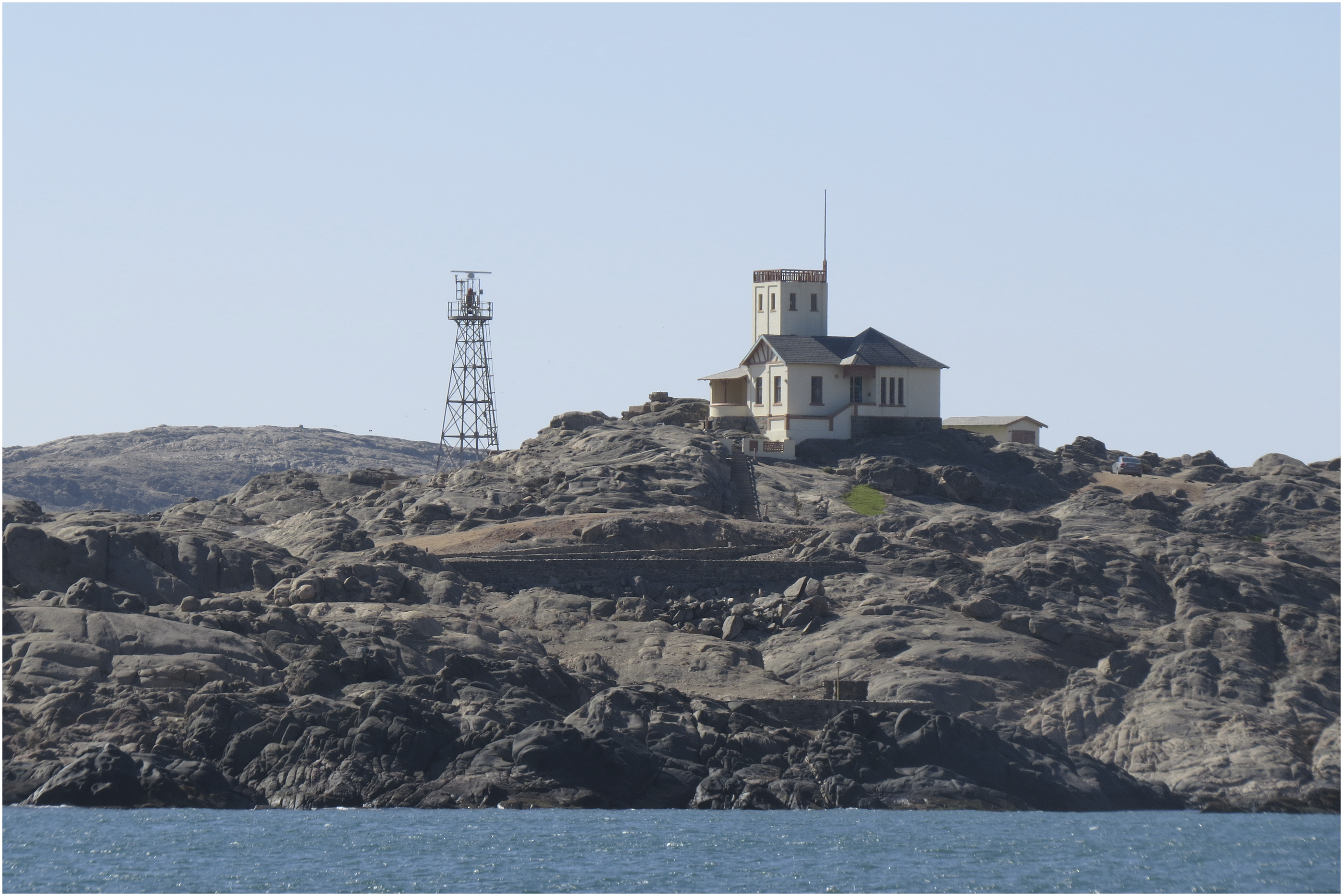
Despite Hyphen’s proximity to Lüderitz and the site’s violent history, most Buchters with whom I spoke expressed feeling inadequately consulted about the project. This outcome reflects Hyphen’s abstract, dis-placed, and state-centric spatial vision, which treats the Namibian state as the legitimate representative of all Namibians, including Buchters. At a public meeting held at a prestigious venue far from the informal settlements and townships where most Buchters live—an example of “symbolic intimidation” (Rignall, 2016: 550)—a Hyphen representative was asked about community input and involvement. “The government of Namibia is the partner in the project,” he responded, reinforcing the project's framing as a national endeavor. Hyphen’s dis-placed approach is reflected in its infrastructural plan, which was shared at several public events and in Hyphen’s Environmental and Social Screening Study (SLR, 2022: 4). As shown in the map presented in Figure 3, the project’s ammonia synthesis facilities, desalination plant, and deepwater port will be constructed directly across Lüderitz Bay from Shark Island. Archeological evidence suggests that the remains of genocide victims are located in the waters surrounding Shark Island, including Robert Harbor and Lüderitz Bay, and in unmarked graves nearby, including at Radford Bay south of Lüderitz (Forensic Architecture, 2024). These areas are slated for infrastructural development to support Hyphen, including the re-dredging and expansion of Robert Harbor to incorporate currently undeveloped land on Shark Island. According to Forensic Architecture (2024: 51), a research agency that has investigated local sites using ground penetrating radar in coordination with Nama and Ovaherero leaders, such activities entail a “serious risk of disturbing human remains and burial places.” Hyphen site plan for Lüderitz Peninsula (SLR, 2022: 4). The town of Lüderitz is at right. The concentration camp at Shark Island (not labeled here) was located on the northern half of the small peninsula directly north-northwest of Lüderitz (the former island was infilled to create the current port). Robert Harbor (not labeled) lies between Shark Island and the town. Hyphen’s proposed deepwater port, desalination plant, ammonia synthesis facilities, and pipeline and transmission corridor will be built at Angra Point on Lüderitz Peninsula (at left).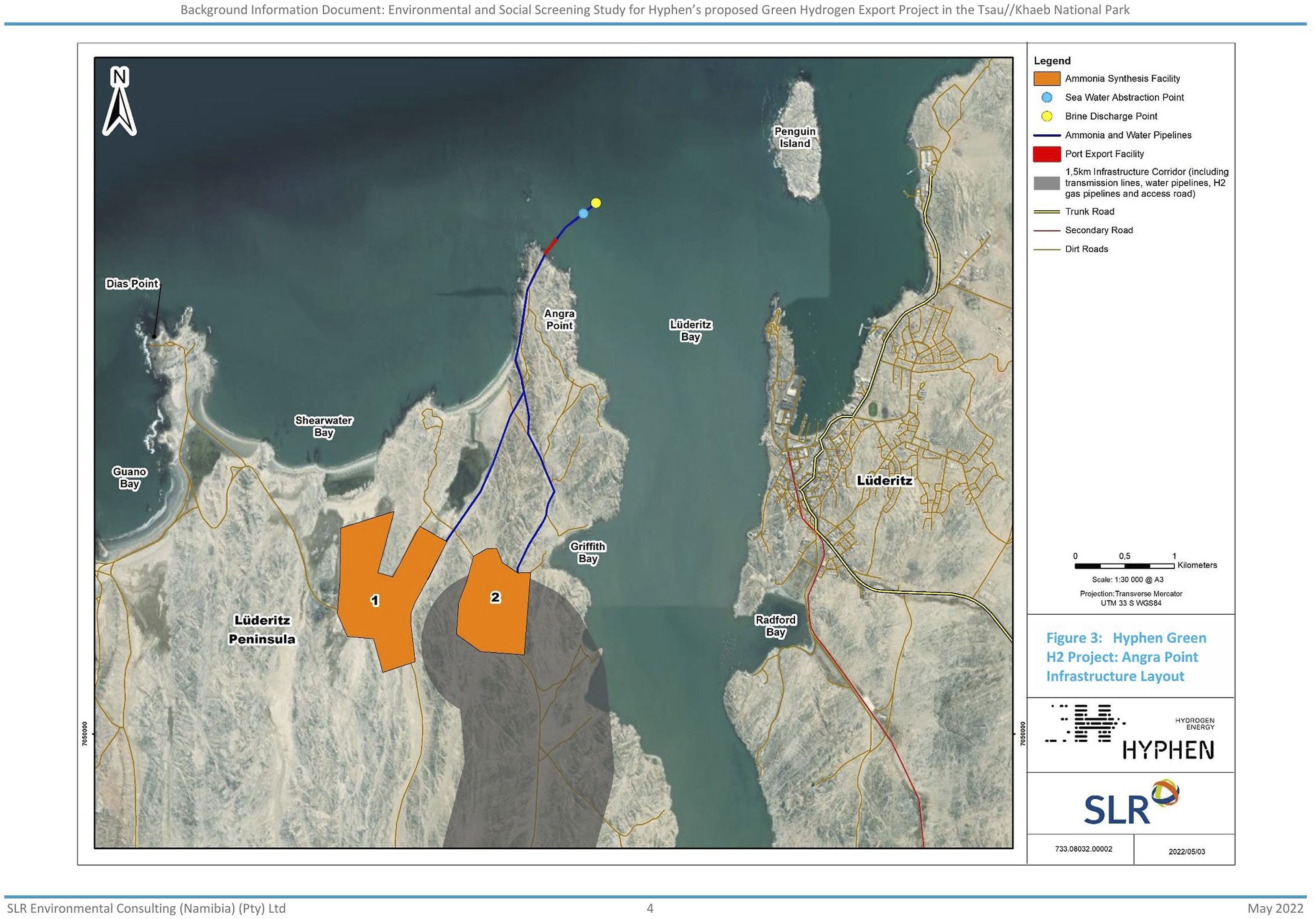
Buchters expressed varied opinions about Hyphen during interviews, focus groups, and at public events. Some were optimistic that Hyphen will provide employment opportunities. Few, however, interpreted Hyphen through the socio-spatial visions of transformative abundance espoused by European and Namibian officials and investors. Having experienced prior extractive violence and boom/bust cycles firsthand, most Buchters with whom I spoke were skeptical that Hyphen would “revitalize” their community. Instead, they focused on the project’s socio-environmental costs—and who will pay them. Several Buchters expressed fears that they will pay with their livelihoods. Most Buchters rely on the ocean for their economic survival, including through fishing, aquaculture, and tourism. At a public event, one fisherman noted that Hyphen’s desalination plant will release its salty brine near the mouth of Lüderitz Bay. He asked how that would affect the bay and its fish. Hyphen representatives dodged the question. An aquaculture employee expressed similar concerns during a focus group. “Making ammonia for fertilizer,” he said with a shake of his head, “that does not seem to me to be a path forward for us. Ammonia is a chemical, that does not sound green. What are the risks? It cannot be good for health.” A scientist echoed this concern in an interview, noting that an ammonia spill could put not only the health of the ocean, but also the health of Buchters at risk—particularly given the area’s high ambient humidity, which he worried could catalyze the formation of a toxic ammonium hydroxide cloud.
Other Buchters expressed concerns that they will lose access to the Lüderitz Peninsula altogether—and by extension, a key aspect of their identity. Almost all Buchters with whom I spoke identified the physical characteristics of Lüderitz, including the peninsula and ocean, as key to their sense of place and to collective Buchter identity. With the exception of Agate Beach, a small coastal area to the north of town, Lüderitz Peninsula provides the only undeveloped, public sea access in nearly 100 km. Buchters visit the peninsula to catch the area’s famous crayfish, fish for trade and subsistence, braai (barbeque) with their families, take wedding photos, exercise, and relax. Some also visit it to honor the memories of their ancestors, including those killed at Shark Island. Hyphen’s plan to use the peninsula for ammonia production starkly contrasts with these uses and with the socio-environmental values espoused by many Buchters, including living in harmony with one’s environment. During a walking visit to the peninsula, one multi-generational Buchter explained that, to Buchters, “Lüderitz is something extraordinary. Others don’t understand why we live here, but we would live nowhere else.” It is unclear how much access to Lüderitz Peninsula Buchters will retain once construction begins. The fact that these infrastructures, funded in part by Germany, will be built directly across the bay from Shark Island has not escaped the notice of Buchters, several of whom independently called my attention to this perverse spatiality.
Notably, few of the Buchters with whom I spoke expressed opposition to Hyphen based on its character as a low-carbon energy project or its associated goal of low-carbon development. Instead, they interpreted it as an example of what I conceptualize as “displaced decarbonization”: decarbonization initiatives that benefit external actors, located in places that do not require decarbonization. During a walk around town to discuss the Hyphen project, one Buchter pointed to three windmills on the ridge above town. “We already have green development, no?” he asked with a chuckle. Although described as an “eyesore” by some Buchters, that small wind farm, named Ombepo, enjoys broad local support. It is a partnership between InnoSun, a French-Namibian company, and the Lüderitz Town Council and supplies five MW of electricity to Lüderitz. Hyphen may likewise provide Buchters and Namibians with some low-carbon electricity. Company and government representatives have indicated that excess electricity not needed for hydrogen production will be put back into the Namibian grid. A similar promise has been made regarding water from Hyphen’s desalination plant. As more than one Buchter pointed out to me, however, the key to those promises lies in the word excess. “It is not that I am anti-green or anti-electricity or anti-any such thing,” one woman explained. “If it [the hydrogen] were for Namibians, even South Africans, Angolans, it is ok. But this,” she said, pointing to the Hyphen project map, “this is not for us.”
These perspectives from Buchters reveal all that is omitted in the visions of Hyphen’s European and Namibian supporters. The need for place-based abundance, development, and security, as defined by Buchters, is absent from the externally defined socio-spatial projects being pursued through Hyphen, as are the situated histories of dispossession, violence, and marginalization that have made the proposed Hyphen site “available” for such endeavors. This is not a simple case of anti-green NIMBYism; as the Ombepo wind farm example illustrates, many Buchters desire low-carbon development. Their visions of abundant green futures, however, differ from those of Hyphen’s backers. In place of de-risking for European capital, Buchters are calling on the Namibian government to attend to the risks faced by vulnerable Namibians. In lieu of large export-oriented projects, they are advocating for locally owned wind and solar to provide electricity to the nearly half of Namibians who lack it. These organizing efforts remain incipient. Like climate justice movements around the world, Namibian activists—and particularly Buchter activists—lack the resources of corporate and state actors. Yet their work, which builds on local lineages of opposition dating to the anti-colonial struggles of the Nama and Ovaherero, remains powerful. By challenging the socio-spatial assumptions underlying Hyphen and pursuing their own visions of low-carbon development, they are opening space for building energy transitions otherwise.
Conclusion
With construction yet to begin, the Hyphen project’s long-term effects remain a matter of speculation. A common joke in the hydrogen industry, often repeated at events I observed, is that “hydrogen is the fuel of the future—and it always will be.” Already, however, the contested spatialities and uneven implications revealed in the project’s planning phase tell us something significant about the socio-spatial mechanisms of legitimation that underlie low-carbon energy transitions—and how they can be transformed. At a global scale, Hyphen and similar projects could make substantial contributions to climate change mitigation. Those benefits extend to Namibia, where there have been recurrent, record-breaking droughts in recent years. Hyphen also has win-win elements from a state-centric, national view. For the EU, it promises to facilitate both energy security and industrial decarbonization. SWAPO officials in Namibia, meanwhile, are leveraging Hyphen to pursue green industrialization—a prospect they see as the final step in fulfilling the goals of Namibia’s liberation struggle. If they succeed, they may challenge the geopolitical economic structure of the global energy system, which has long rendered African countries mere energy exporters rather than consumers in their own right.
The framework of climate necropolitics, however, reveals that Hyphen's promises of “win-win” decarbonized development also disguise profound injustices. Despite their varied goals, Hyphen’s European and Namibian backers share a striking similarity: both use capitalist and (neo)colonial logics and imaginaries to justify Lüderitz’s creation as a multi-scalar sacrifice zone for displaced decarbonization. In doing so, they legitimize extracting climate solutions from a community that is highly vulnerable to—and almost entirely unresponsible for—climate change itself. The injustice of this situation is particularly clear in financing. To attract private investment and enable their socio-spatial agendas, Namibian and EU officials have “de-risked” Hyphen through long-term land concessions and state-backed financing. In doing so, they have effectively re-distributed and displaced the project’s risks from wealthy investors to citizens—and particularly to Buchters, whose own livelihoods the project may jeopardize. If Hyphen is successful, its associated risks could pay off for the governments of Namibia and the EU and for their respective citizenries—including, perhaps, Buchters, if the SWAPO-led government fulfills its promise to “leave no Namibian behind.” Green hydrogen is an untested industry though, with a product for which even transport is a work in progress. And even if Hyphen succeeds, it is Buchters who will pay its greatest costs.
These findings illustrate the practical and theoretical usefulness of climate necropolitics as a framework for work on energy transitions, with implications for researchers, policymakers, and activists. First, for policymakers, this analysis highlights the importance of recognizing energy systems as social systems. Though often conceptualized as a technical challenge, energy transition is also a distributional and socio-spatial one. Achieving a just transition means holding multiple socio-spatial goals in careful and constructive tension, including local energy access, national development, and global decarbonization. Second, it demonstrates the importance of a trans-scalar approach. Pursuing climate justice requires “holding the planet and a place on the planet on the same analytic plane” (Hecht, 2018: 112; emphasis in original). It also requires thinking beyond taken-for-granted structures, such as the territorial state system. Consider, for example, UN climate change negotiations, which, like the Hyphen representative quoted in the prior section, often treat state actors as the legitimate representatives of citizens. As a result, negotiations for climate justice prioritize resolutions at the scale of inter-state relations, such as between Namibia and Germany. That approach may mask considerable injustices at subnational scales. Finally, for climate activists, this research highlights the importance of attending to the socio-spatial mechanisms of legitimation that underlie climate change-related violence. Identifying how costs and benefits are distributed is essential, but it only gets us so far. As Táíwò (2022) adeptly argues, the point of attending to unjust distributions is to change them. Doing so, I argue, requires identifying and interrogating the mechanisms, including socio-spatial structures, narratives, and subjectivities, through which socio-environmental violence becomes the status quo. By revealing the underlying mechanisms through which intensified violence against marginalized groups is rendered legitimate in the name of climate change response, future applications of climate necropolitics can open space for building energy and social systems otherwise—systems capable not only of transition, but also transformation.
Footnotes
Acknowledgements
Thank you to the Buchters and Namibians who have shared their insights, perspectives, and experiences with me. Thanks also to the Special Issue editors, Thom Davies, and two anonymous reviewers, whose generous suggestions and thoughtful engagement strengthened the manuscript. Any remaining errors are my responsibility alone.
Declaration of conflicting interests
The author(s) declared no potential conflicts of interest with respect to the research, authorship, and/or publication of this article.
Funding
The author(s) disclosed receipt of the following financial support for the research, authorship, and/or publication of this article: This research was supported by an ASPIRE grant and McCausland Faculty Fellowship from the University of South Carolina.
