




Abstract
In this visual intervention, we show how a traditional community (Gujjars) associated with livestock and dairy business enables and sustains milk commons as an articulation of their devotion to Lahore's city saint Data Ganj Bakhsh. We argue that the flows of milk at the shrine (monthly/annually) operate not only as a special purpose vehicle of piety for centuries but also as a device for Gujjar identity formation. The commoning practices reveal that identity, spirituality, and rituals are key cultural drivers of the urban commons and associated metabolic circulations, therefore, establishing themselves as important markers and analytical categories within the broader urban-nature-society debates. We seek to foreground constituent elements of the local commoning and the socio-nature at the shrine—milk, community, identity, and rituals of piety. We call their interplay the “lactosocial” and show that it goes beyond the shrine, and its monthly/annual assemblies, and manifests itself throughout the year in other places, representations, and portrayals vis-à-vis Gujjar community. Through this work, we suggest that the lactosocial may be taken as a broader theoretical trope. It essentially moves our focus towards more-than-humans and the forms of power and social differentiation that cut across, inter alia, animal lifeworlds, traditional ecological knowledge, and neoliberal food policy domain.
Allah ke hukam se ye us waqat tak chalti rahey gi jab tak ye sooraj mashriq se nikal raha he na, ye Sabeel chalti rahey gi. Allah ke hukam se wali ke mazar pe ye divey bhi jaltey rahein ge aur ye Sabeel bhi lagatey rahein ge
By Allah's order, the Sabeel [the milk commons] will continue till the time sun rises from the east. By Allah's order, the lamps will continue to shine and the Sabeel will be established at the saint's shrine.
A member of the commons organizing team
This work illustrates how the Gujjar community articulates and exercises its devotion to Lahore's city saint—Ali bin Usman Hujwiri (1009–1072/77)—through the free milk distribution, in turn, enabling and sustaining a local food commons. Ali bin Usman Hujwiri is popularly known as Data Ganj Bakhsh (the bestower of treasures), or just Data Saheb (the master bestower). Gujjars are a traditional community mainly associated with livestock and dairy business in Pakistan. Although they establish milk commons monthly, our case presents the ritual of free milk distribution at the annual festival at Data Saheb's shrine on a larger scale. This photo essay stems from event ethnography conducted in September–October 2021 and September–October 2022 in connection with the three-day annual commemoration at the shrine (Figure 1). We situate this piece at the intersection of urban commons and urban metabolism. Debates on the urban commons—grassroots, collective, uncommodified, community-led, and organized city resources—emphasize the need to foreground context-specific, everyday commoning practices so that the (elusive) governing of these alternative imaginaries may be better understood (Anantharaman et al., 2023; Chatterton, 2016; Schwenkel, 2022; Williams, 2018). Similarly, scholars focusing on the (metabolic) flows of nature and materials in/out of the city spaces—food, water, energy, and waste—call for more situated analyses of the urban socio-natures in order to have grounded knowledge of the social-ecological exchanges and transformations (Bruns et al., 2022; Ibañez and Katsikis, 2014; Lawhon et al., 2014). Advancing the discussions in this direction, this work seeks to converge these two themes—urban commons, and metabolic circulations—at the pivot of public culture.
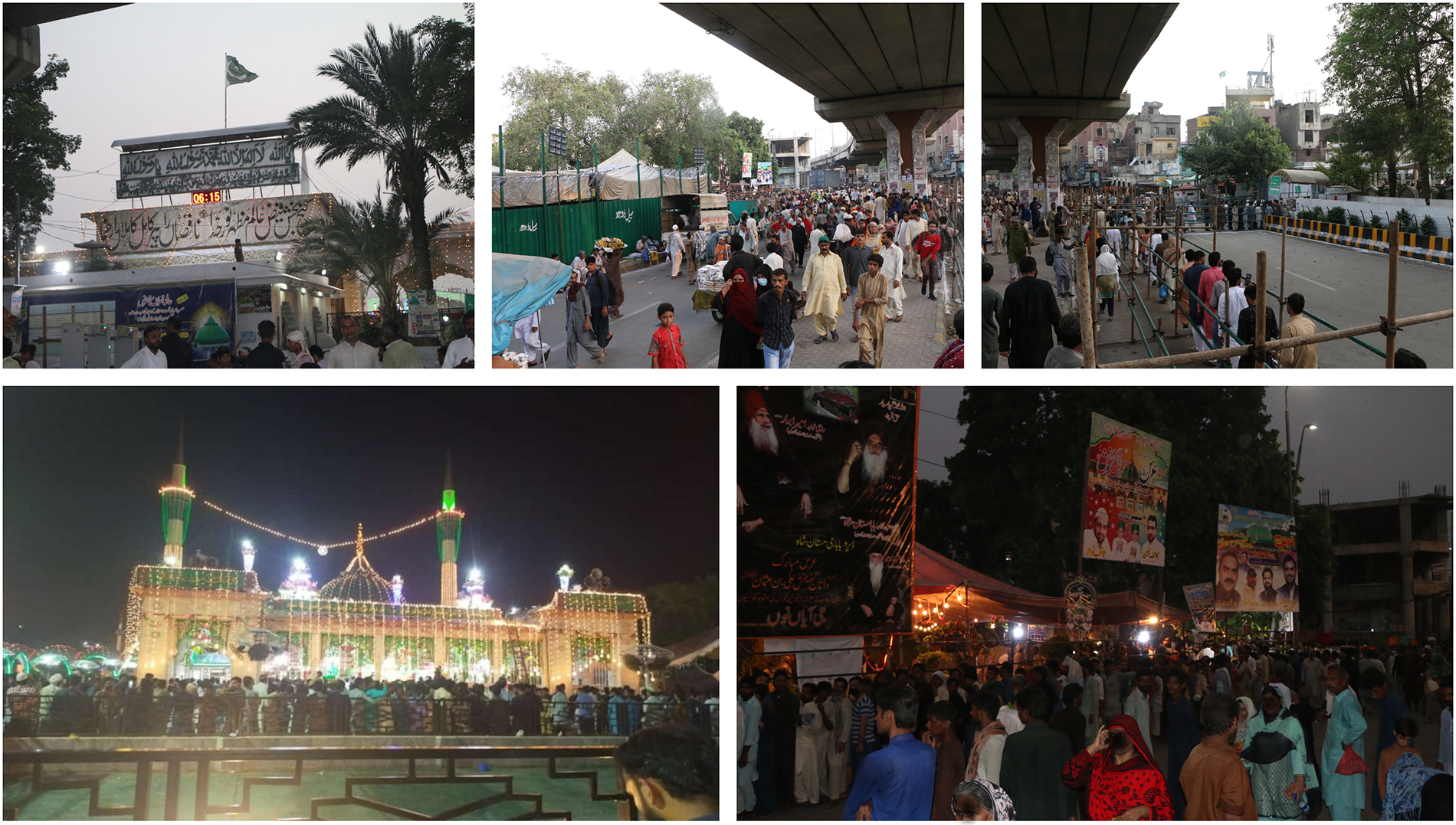
The devotees in and around the shrine of Data Ganj Bakhsh in Lahore (photos by Sajjad Hasnain ).
We argue that the free flows of milk at the shrine (monthly/annually) operate not only as a special purpose vehicle of devotion to Data Saheb for centuries but also as a device for Gujjar identity formation. The commoning practices at the shrine reveal that identity, spirituality, and rituals are key cultural drivers of the urban commons and associated metabolic circulations, therefore, manifesting themselves as important markers and analytical categories within the broader urban-nature-society debates. The ritualistic performance of free milk offering, on the one hand, stabilizes and preserves Gujjar’s identity. On the other hand, the set of rituals constitutes a performance of piety and devotion to the city saint. We seek to foreground constituent elements of the local milk commoning and the socio-nature at the shrine—milk, community, identity, and rituals of piety. We call their interplay the “lactosocial” (coined by Sajjad Hasnain) mirroring the widely studied concept of “hydrosocial”—the dynamics of human and water systems as hybrids (Boelens, 2014; Ross and Chang, 2020). As we further elaborate in this essay, the lactosocial goes beyond the shrine and its monthly/annual assemblies and manifests itself throughout the year in other places, representations, and portrayals vis-à-vis the Gujjar community. Similarly, building on this case, our aim is to foreground lactosocial as a broader theoretical trope that essentially moves our focus towards more-than-humans owing to their central position as resource producers in the social-ecological interactions within the urban-rural continuum. It offers an opportunity to critique human–nonhuman ecologies where various forms of power and differentiation are unearthed that cut across, inter alia, animal lifeworlds, traditional ecological knowledge, and neoliberal food policy domain.
As we move forward, we put Gujjar identity and the ritual of milk in the context. First, it may be noted that the Muslim Gujjars in the Indian subcontinent are known by different names. For example, they are known as “Dodhi Gujjars” (the milk sellers and owners of large stocks of buffalos); “Bakarwal Gujjars” (the goat herders); the pastoralist “Jammuwalah Gujjars”; the forest dweller “Bana” or “Van Gujjars”; and the “Muqami Gujjars”—who have settled in the plains and valleys permanently (Deol, 2018; Gooch, 1992). The focus of this note is on the Muqami Gujjars who are predominantly connected with the milk production business and are central to the lactosocial. While caste hierarchies are invisiblized in Pakistan to uphold a monolithic Muslim identity despite the prevalent caste-based social differentiation (Javid and Martin, 2020), Gujjars maintain their stand-alone social status like Jats and Rajpoots in modern-day Pakistan.
There is a widely known legend about how Gujjars associated themselves with Data Saheb and the ritual of milk offering. The legend has it that Rai Raju—the Kotwal/town magistrate of Lahore who was a magician also—would force local Gujjars to send a part of their produce (milk) to him as a tribute. In case of failure, with his magic, the cattle’s breasts would bleed instead of giving milk. One day, Data Saheb came to know about this and asked them not to follow Rai Raju's order. Furious at this, Rai Raju threatened Data Saheb with dire consequences. To show his superiority over Data Saheb, Rai Raju performed a trick and disappeared into the skies. In response, Data Saheb threw one of his shoes to bring him back beaten up. Impressed by Data Saheb's Karamat (a supernatural act of a saint), Rai Raju embraced Islam and became his disciple. The cattle also stopped bleeding. Rather, the quantity of their milk increased. In memory of the bounty bestowed by the saint, the Gujjars started sending milk to the shrine to express their gratitude (Acharya, 2017). The legend of Rai Raju gets a special mention on the invitation cards, advertisements for milk distribution, and the banners fixed on prominent places in the shrine area during the annual celebrations (Figure 2).
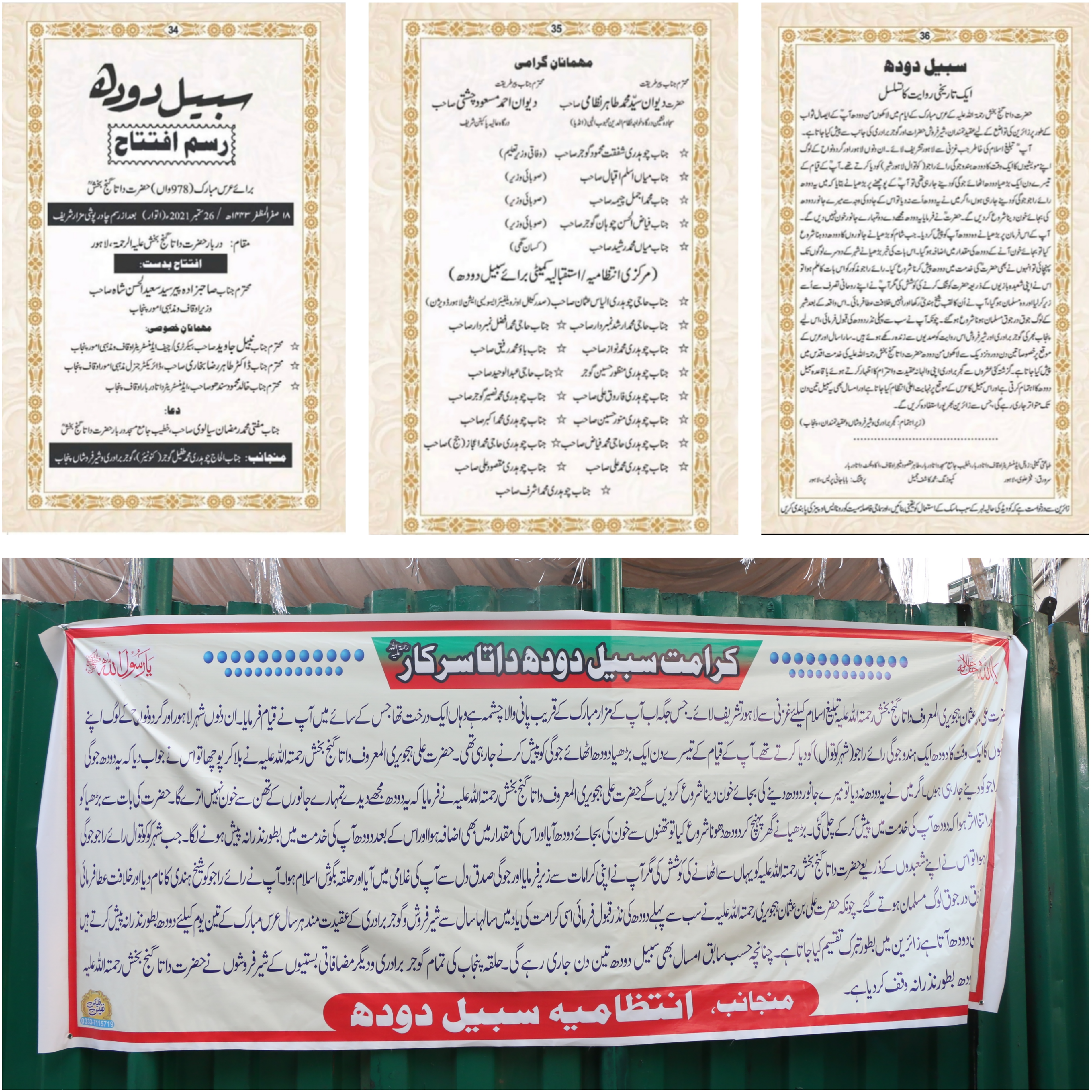
The legend of Rai Raju on the invitation card of the annual event and one of the banners in the shrine area (photos by Sajjad Hasnain ).
Second, the milk ritual of Gujjars is rooted in the religious-cultural practices being witnessed in various societies globally since time immemorial. Milk libations were performed for various deities in ancient Egypt as milk was considered a sacred substance (Ashby, 2019). In Zoroastrianism, milk is one of the common ingredients of libation (Boyce, 2001). In Far Eastern Mongolia, milk is sprinkled into the air for the sky deity, Tenger by the women/mothers praying for the protection of their families (Stephens, 2021). In South Asia, the use of milk in the ritual Abhisheka—the bathing and anointing of the idol—in Hindu temples in South India is common (Jain, 1997). Among the Muslims, devotees of a local saint Sheikh Salamat in Sindh province (Pakistan) perform ritual bathing of the domes of Sheikh's shrine with milk prior to the commencement of the annual festival (Khawaja, 2019). With Gujjars of Lahore, the milk offering at Data Saheb's shrine—known to have started with Rai Raju's incident—became a more formal communitarian act with the passage of time.
The place and/or process of free milk distribution is known as Sabeel, which means “pathway” in Arabic. In the Middle Eastern tradition, the word Sabeel is also used for a public source of water or a fountain (Mostafa, 1989). In the Pakistani socio-cultural context, any free distribution of drinks (sherbet, fruit punch, lemonade, and milk soda) is known as Sabeel. The publicness of Sabeel, the uncommodified collectiveness, establishes it as commons at Data Saheb's shrine and its continuity since centuries manifests the spirit of the “pathway.” We suggest that the continuity of the (milk) commoning practices enables Gujjar identity formation as their association with Data Saheb's central (religious-cultural) authority in Pakistan offers them the continued “group solidarity [which is not only a] form of existential security [but also the] reproduction of Gujjar practical knowledge [that is] given from one generation to the next: rearing buffaloes … [and] milk production” (Gooch, 2006: 112, 113).
To keep the tradition going, the Sabeel is advertised by the Sabeel committee weeks before the official start of the annual celebrations at the shrine. Gujjars work in teams and visit almost all the districts in Punjab. They meet milk producers and dairy owners and invite them to donate their share of milk. Every contributor knows the timeline of the annual event but the traveling from place to place and personal invitations constitute a pilgrimage for Gujjars. While Gujjars take the lead, milkmen from other communities also bring their milk on horse carts, three-wheelers, and trucks. After receiving the milk from all the sources regardless of the quantity, it is handled and processed carefully. Its quality (in its local standards) is supervised by the Sabeel committee (Figure 3). The designated team put together a decorated enclosure of Sabeel and the necessary infrastructures of supply and delivery—vehicles, containers, chillers, packaging machines, dispensers, and utensils. The Milk Commons is a generational affair. The community elders supervise; the young put it together; and the children learn by being there (Figure 4).
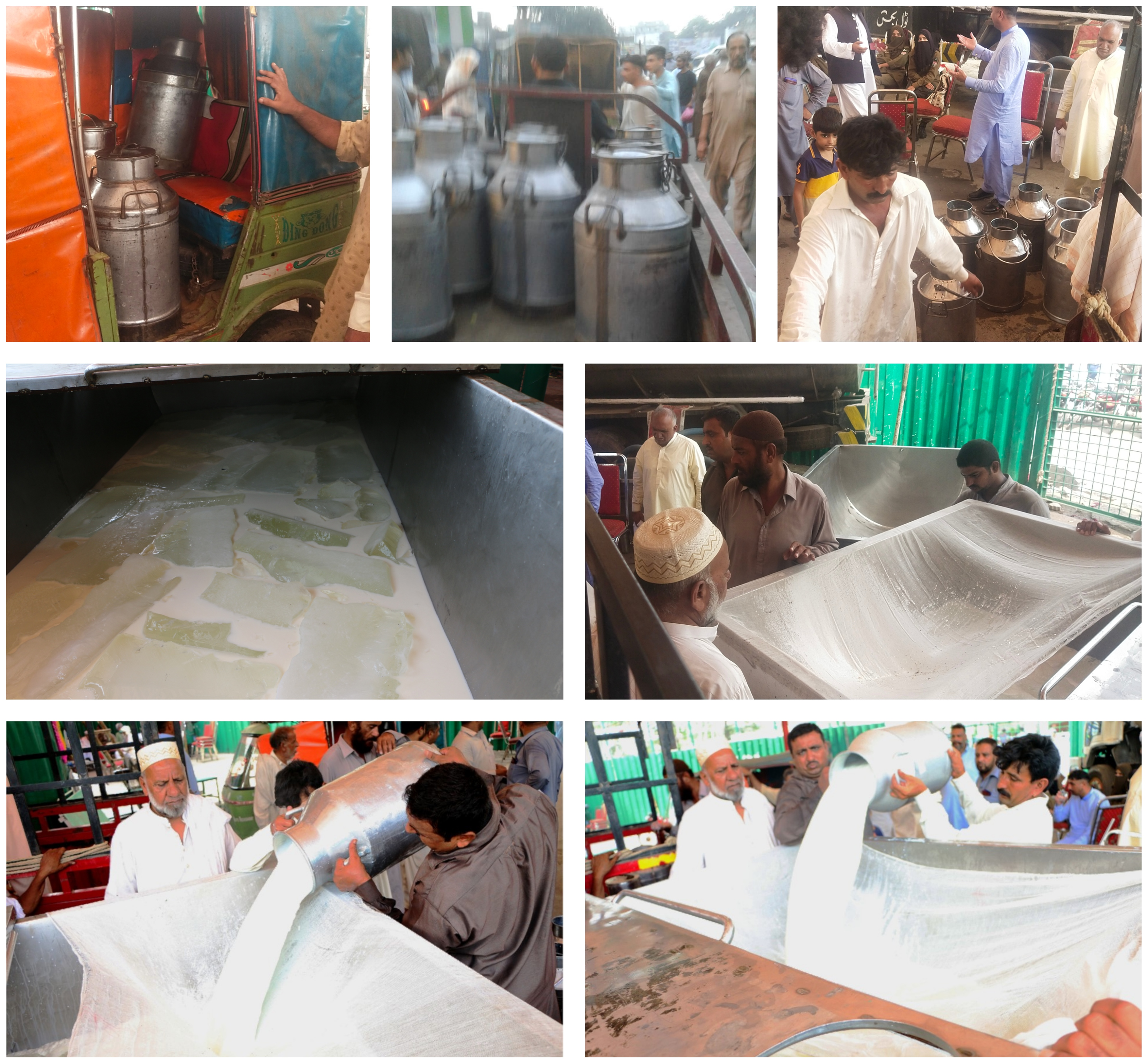
The milk is brought from all parts of Punjab—mostly Lahore and adjoining districts (photos by Sajjad Hasnain).
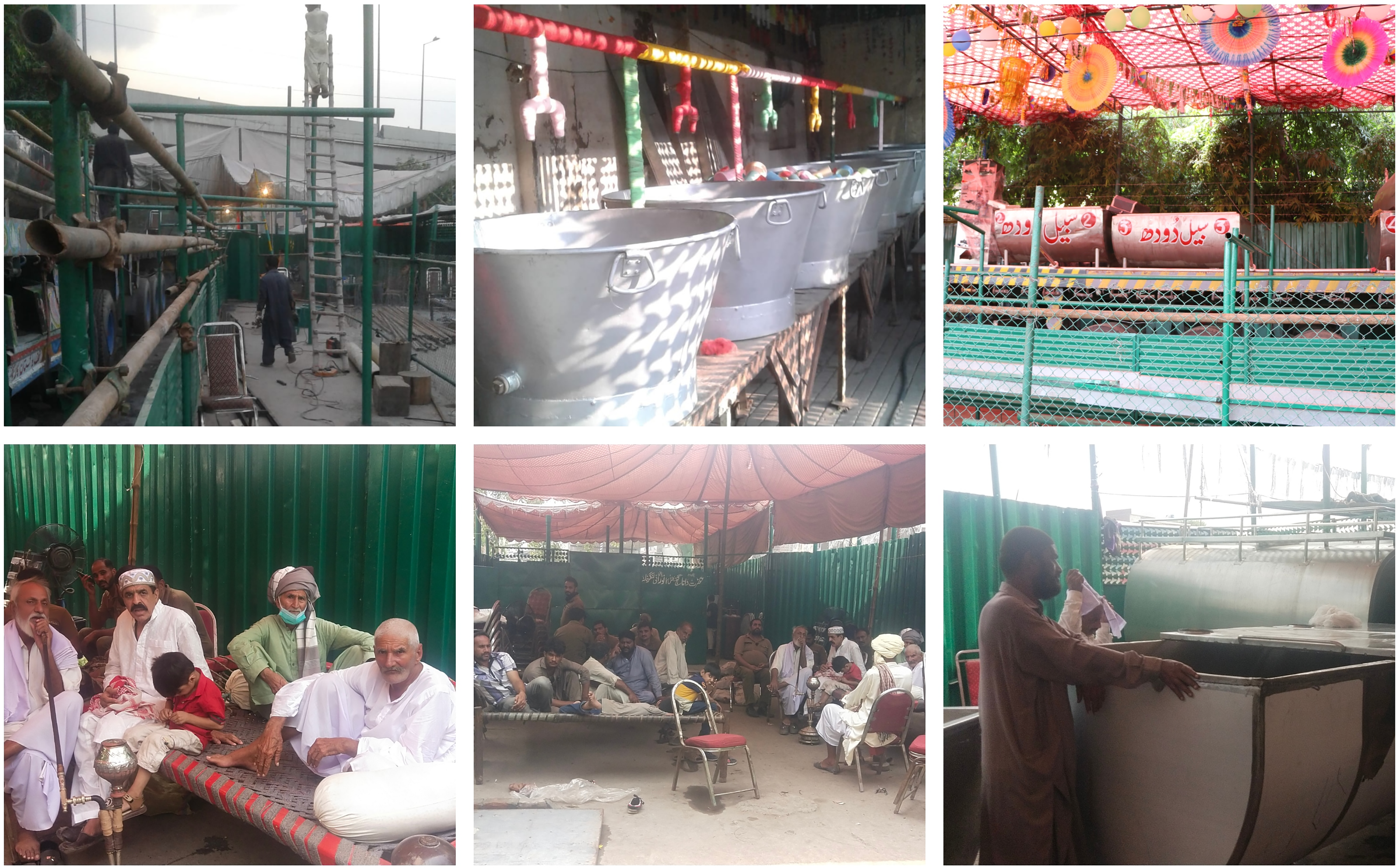
Setting-up the compound and containers of the milk commons (photos by Sajjad Hasnain).
In the enclosure, the devotees can drink as much milk as they want. They can also take away packed/bottled milk as a Tabarruk (a blessed gift) for those at home (Figure 5). The milk commons is not bounded in any way. It is open to all visitors regardless of their religious or sectarian background. One doesn’t have to be a devotee or a Gujjar by caste to drink or take away the milk from the Sabeel. No one asks any questions about the identity of the visitors. Likewise, the primacy of Gujjars in the milk commons vis-à-vis other communities is recognized, on the one hand, by their conventional position as pioneers in this ritual. Their community association with the saint is widely publicized through the promotion of Rai Raju's legend. On the other hand, as the state manages the affairs of the shrine, the milk commons under the Gujjar community is recognized by the state as a community-driven conventional project that has been an integral part of the rites of association for centuries. Likewise, this central position in the shrine ritual is complemented by the Gujjar community's influence in the milk and dairy business vis-à-vis other milk-producing communities. For instance, the incumbent President of Pakistan's Dairy and Cattle Farmers Association is a Gujjar who has been holding the office for the last 5 years.
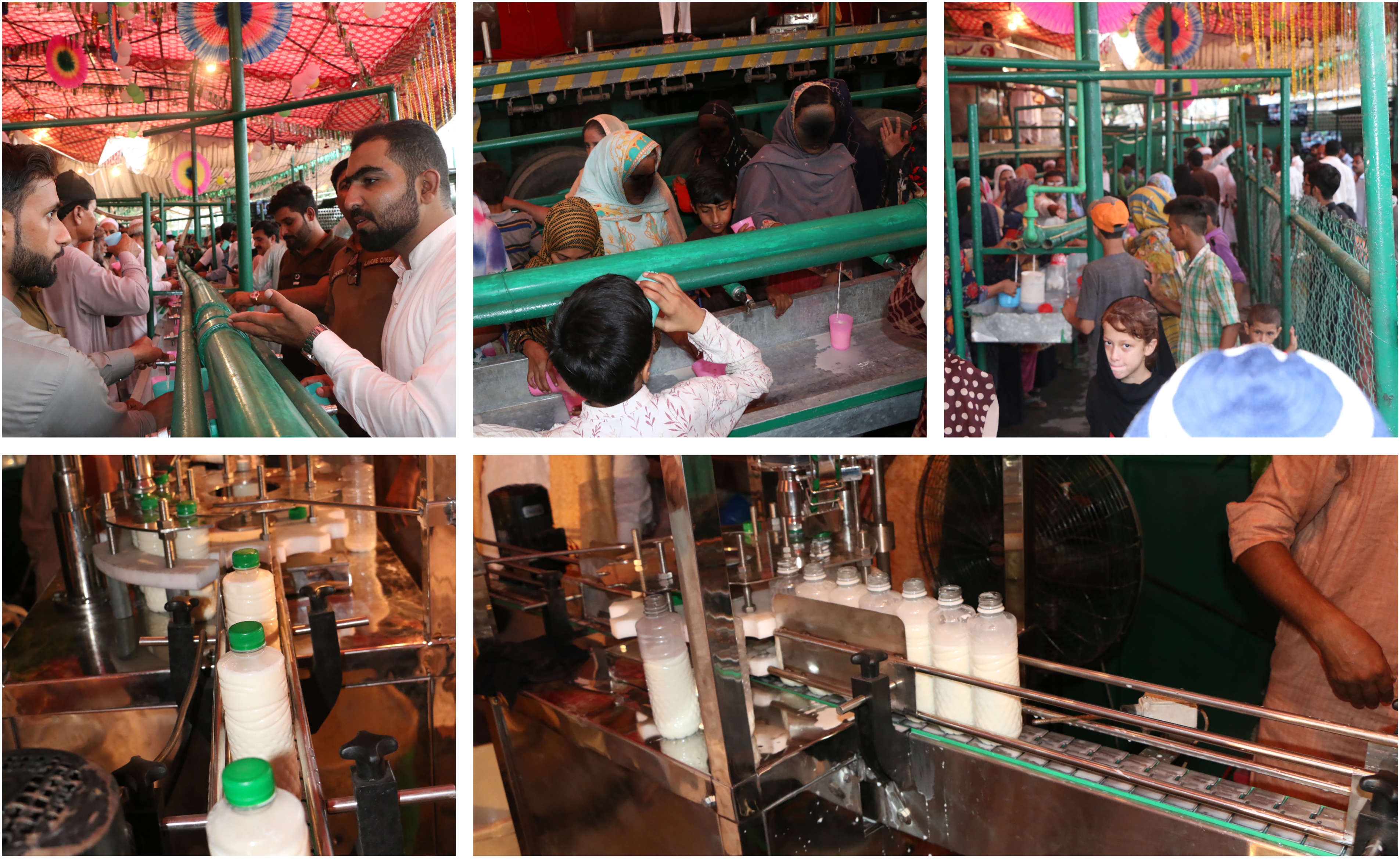
The commons in service of the visitors in the Sabeel enclosure (photos by Sajjad Hasnain).
We have also argued in this essay that the lactosocial is not confined to the monthly/annual gatherings at the shrine and it keeps manifesting itself in other places, representations and portrayals. For instance, the Gujjar community's devotion to Data Ganj Bakhsh is seen in the movies they produce. These films are mostly biopics and revolve around the Gujjar clan's pastoral culture, their gangsters, vendetta, masculinity, and gang wars in Punjab. It is noteworthy that the Gujjar production houses have been a significant pillar of the local Punjabi cinema of Lahore since the 1970s (Khan and Bin Rashid, 2012). A common thematic thread among these biopics is the portrayal of deep reverence for Data Saheb. The cinematic references come in multiple ways. For example, the movies would start with a frame of Data Saheb's shrine. Or, the storyline carries this refrain that whenever the protagonist (mostly a Gujjar) is in a difficult life situation, he visits the shrine to seek Data Saheb's blessings. In other frames, the masculine Gujjar hero declares subservience to Data Saheb in his dialogues as an enactment of his (only point of) humility. Besides cinema, the Gujjar social media users are seen propagating their association with Data Saheb with repeated reference to milk offerings. Similarly, as earlier mentioned, the milk and dairy business in Lahore (or Pakistan for that matter) is predominantly owned by the Gujjars. These businesses are mostly named after Data Saheb as an act of reverence and for seeking the blessings of the master bestower for the progress of the business—for example, Data Ali Hujwiri Milk Shop, Data Ali Hujwiri Dairy Farm, or Ali Hujwiri Milk Shop (Figure 6).
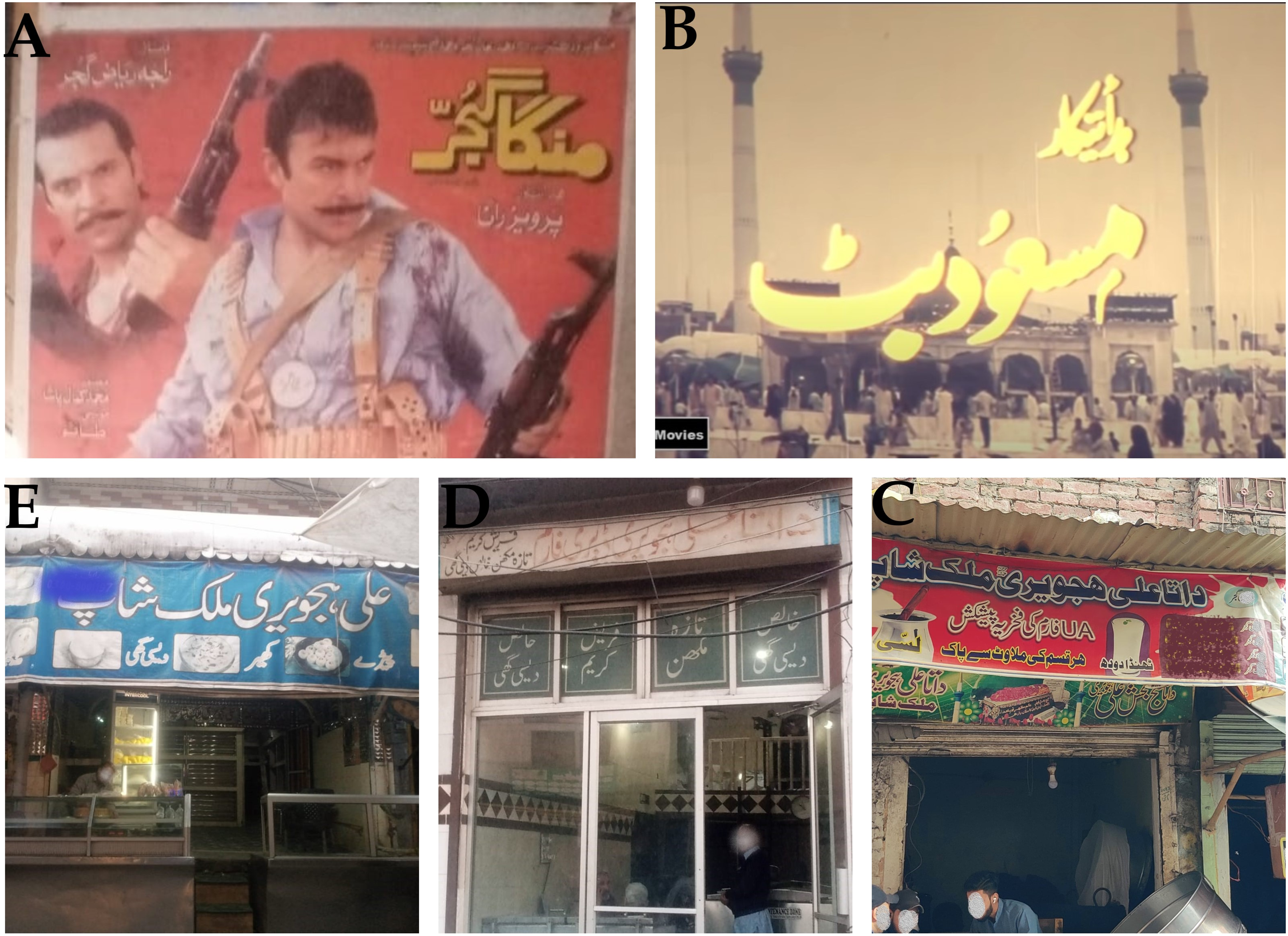
Clockwise: (A) poster of the movie “Manga Gujjar” produced by Raja Riaz Gujjar in 2007, (B) a still frame of the movie “Ibba Gujjar” (2006) showing its director’s name “Masood Butt” in Urdu language against the backdrop of Data Saheb’s shrine, (C) Data Ali Hujwiri milk shop, (D) Data Ali Hujwiri dairy farm, and (E) Ali Hujwiri milk shop (photos by Sajjad Hasnain).
While the milk commons is established by Gujjars monthly or annually, its social significance rests on the spirit of sharing resource(s) a community can offer to the wider public and sustaining it as a generational affair since time immemorial. In Holston's (2019: 136) words, in developing the commons “[w]hat matters is not the specifics of the activity but the active sense of a common project.” In showing Gujjars’ spirit of commoning and practices around free milk distribution, we have highlighted identity, spirituality, and rituals as key cultural drivers as well as analytical markers to be further probed within urban commons and urban metabolism discussions. Similarly, we have contended that the lactosocial may be taken as a wider theoretical perspective. We invite scholars to look into the questions of power and social differentiation within human-nonhuman social-ecological exchanges around flows of milk.
Footnotes
Declaration of conflicting interests
The author(s) declared no potential conflicts of interest with respect to the research, authorship, and/or publication of this article.
Funding
The author(s) received no financial support for the research, authorship, and/or publication of this article.
