



Abstract
In this visual essay, I curate and annotate nine photos of Palestinian prisoner graffiti, foregrounding a Palestinian politics of conviction. Prisoner graffiti is a prominent genre of Palestinian street art, countering Israel's system of colonial carcerality that attempts to dispossess and displace Palestinians. Israeli colonial carcerality functions not only through the “small prison” of Israeli detention, but through the “large prison” of Israeli colonial occupation and apartheid. The distinct forms that this incarceration takes across the fragments of Palestine—from the lands occupied in 1948, 1967, and the diaspora—all aim to crush a Palestinian will to resist. Israel works to construct its carceral systems as inescapable, suggesting to Palestinians that they have no choice but to submit to their colonisation. Against this colonial carcerality, we find in Palestinian prisoner graffiti what I term a politics of conviction. Persisting through their conviction and imprisonment under Israeli colonial law, Palestinians cultivate a conviction in liberation. Directly countering the apparent inevitability of incarceration and the reification of carceral systems, this politics of conviction asserts the inevitability of al-ḥurriya (freedom) from both the small prison and the large prison. This conviction in liberation is constituted by a range of feelings, including love for the prisoner and the dignity that they embody. I suggest that this politics of conviction might form the affective basis of a distinctly Palestinian abolitionism—working to abolish the colonial structures that uphold both the small and large prisons.
In this visual essay, I curate and annotate nine photos of Palestinian prisoner graffiti, foregrounding a Palestinian politics of conviction. Prisoner graffiti is a prominent genre of Palestinian street art. Not necessarily painted by prisoners themselves, this genre includes messages of support for prisoners who are inside, messages from prisoners to their communities, as well as messages from families and communities welcoming home freed prisoners. In suggesting that this graffiti articulates a politics of conviction, I theorise from, rather than about, Palestinian graffiti. That is, I take Palestinian prisoner graffiti to be a rich site of theorising, rather than attempting to describe or explain the Palestinian practice of graffiti itself, as several scholars have done before (e.g., Peteet, 1996; Larkin, 2014; Rolston, 2014; Arnoldi, 2015; Lehec, 2017). To understand the theorising carried out in prisoner graffiti, we first need to understand how Israel's system of colonial carcerality attempts to dispossess and displace Palestinians.
Incarceration has long been a pervasive tool of colonisation in Palestine. As Rana Barakat (2018) demonstrates, the British colonial mandate that ruled in Palestine between 1919 and 1948 set up a legal framework to criminalise Palestinian anticolonial resistance. Israel then adopted much of this legal framework after its founding as a state through the ethnic cleansing of Palestinians during the Nakba (Catastrophe) of 1948 (see Sa’di and Abu-Lughod, 2007). Israel continue to deploy this framework today to criminalise and suppress Palestinian resistance to ongoing Israeli settler colonialism (Barakat, 2018). Since their 1967 military occupation of the West Bank and Gaza—the areas of Palestine that Zionist forces had failed to colonise during the 1948 Nakba—Israel has imprisoned over one million Palestinians (Baker, 2022). Currently, approximately 4700 Palestinians are detained by Israel as political prisoners, including 190 children and 800 people as “administrative detainees” (held indefinitely without charge or trial) (Addameer, 2022). Attesting to the pervasiveness of this incarceration, Julie Peteet (2016: 339) notes that, “nearly all families have at least one member who has been through the prison system”.
As Palestinians recognise clearly (see, e.g., Giacaman and Johnson, 2013: 55), Israeli colonial carcerality functions not only through the “small prison” of Israeli detention, but through the “large prison” of Israeli colonial occupation and apartheid. Given the ongoing Israeli military siege on Gaza, the coastal enclave is often referred to as “the world's largest open-air prison”. In the West Bank, movement is heavily restricted through a range of Israeli colonial technologies including military checkpoints, the Apartheid Wall, and the debilitating Israeli permit system (see, e.g., Taraki, 2008; Hammami, 2015; Bishara, 2017). Meanwhile, Palestinians living as nominal citizens of Israel in the lands occupied in 1948 are incarcerated in the “citizenship prison” (The Manifesto of Dignity and Hope, 2021). Here, Palestinian communities are isolated from one another and from their land, as Israel attempts to erase their Palestinian identity to convert them into “Israel's Arabs” (Shihade, 2014: 452–454).
These distinct forms of incarceration all aim to crush a Palestinian will to resist. As Nahla Abdo (2014: 192–193) explains incisively, “Settler colonialism in general and its prison institution more specifically are designed to break the will of the subject populations in order to make them conform to the colonial order. Political detention aims at breaking the will of political detainees, at fracturing their determination and forcing them to submit to the authority's wishes” (see also Alazzeh, 2014: 108–109; Sheehi and Sheehi, 2022: 94–95). To achieve this, Israel works to construct these systems of incarceration as inescapable. That is, Israel suggests to Palestinians that they cannot liberate themselves from either the small prison or the large prison, and that they therefore have no choice but to submit to their colonisation.
Against this colonial carcerality, we find in Palestinian prisoner graffiti what I term a politics of conviction. Persisting through their conviction and imprisonment under Israeli colonial law, Palestinians cultivate a conviction in liberation. Directly countering the apparent inevitability of incarceration and the reification of carceral systems, this politics of conviction asserts the inevitability of al-ḥurriya (freedom) from both the small prison and the large prison. As demonstrated in the graffiti below, this conviction is embodied in particular by the hunger-striking prisoner and the prisoner who maintains ṣumūd (steadfastness) in the face of Israeli interrogation and torture (see Meari, 2014). Such conviction in liberation is constituted by a range of feelings, including love for the prisoner and the dignity that they embody.
All the photos presented in this visual essay, taken in 2019, are from cities and refugee camps in the West Bank—where colonial carcerality takes distinct forms, given the particular formation of military occupation that Israel enforces in this territory. In focussing on the West Bank, it is important to recognise that Israeli colonial carcerality functions in distinct but entangled ways across the fragments of Palestine, including lands occupied in both 1967 and 1948, as well as the diaspora. Indeed, part of the work performed by the politics of conviction expressed through these graffiti is stitching together these fragments of Palestine, clasping hands through the bars of the distinct cells in which Palestinians are isolated from one another. Figures 1 to 9.
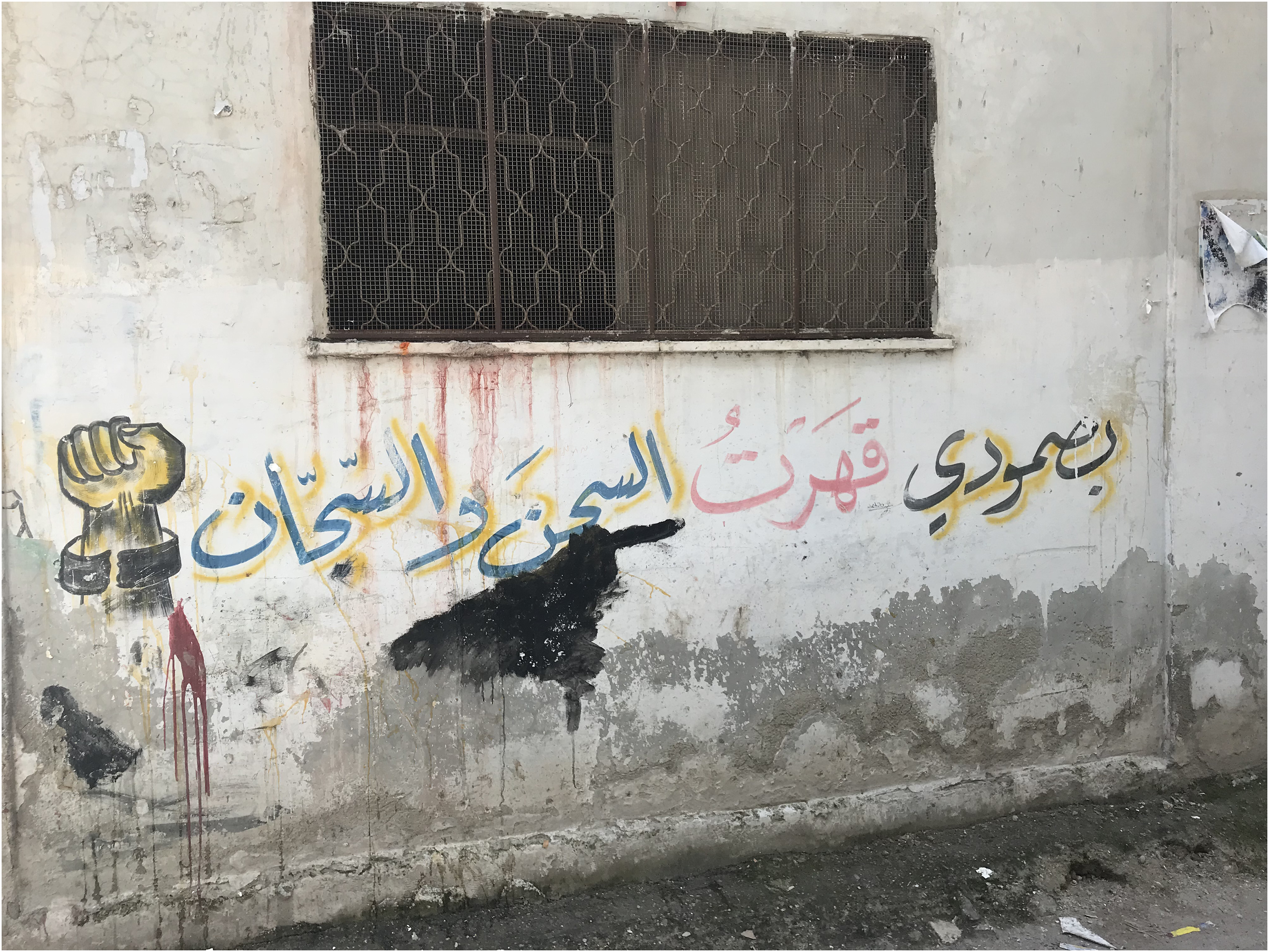
Balata camp, Palestine. “In my steadfastness I defeated the prisons and the imprisoners”. These words are accompanied by the painted image of a hand breaking free from its shackles, making a fist—a ubiquitous symbol of power.
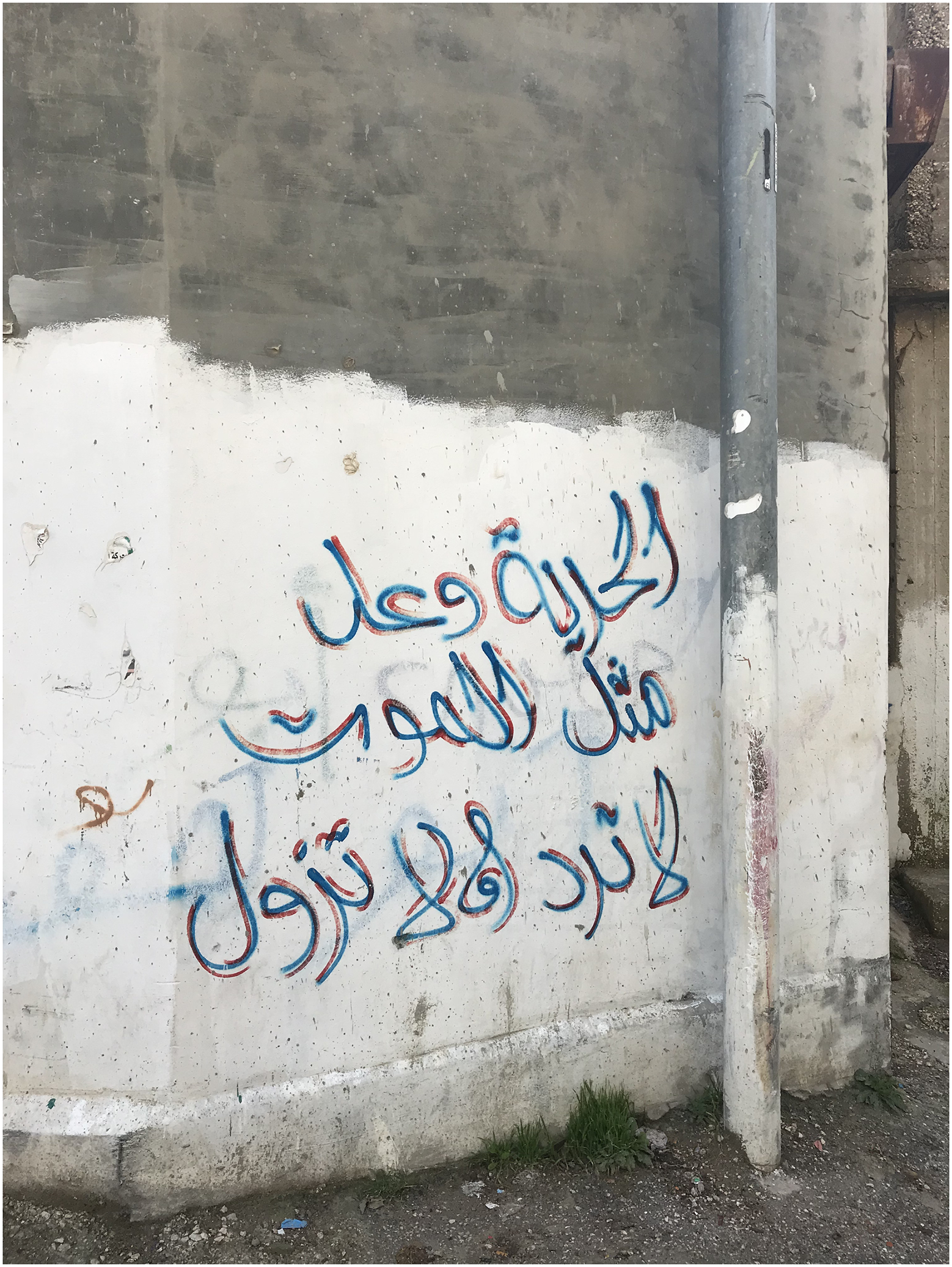
Qalandiya camp, Palestine. “Freedom is a promise like death, you can’t stop it and it won’t disappear”. Freedom for Palestinians simply cannot be stopped or erased. Like death, it is only a matter of time before it delivers on its promise.
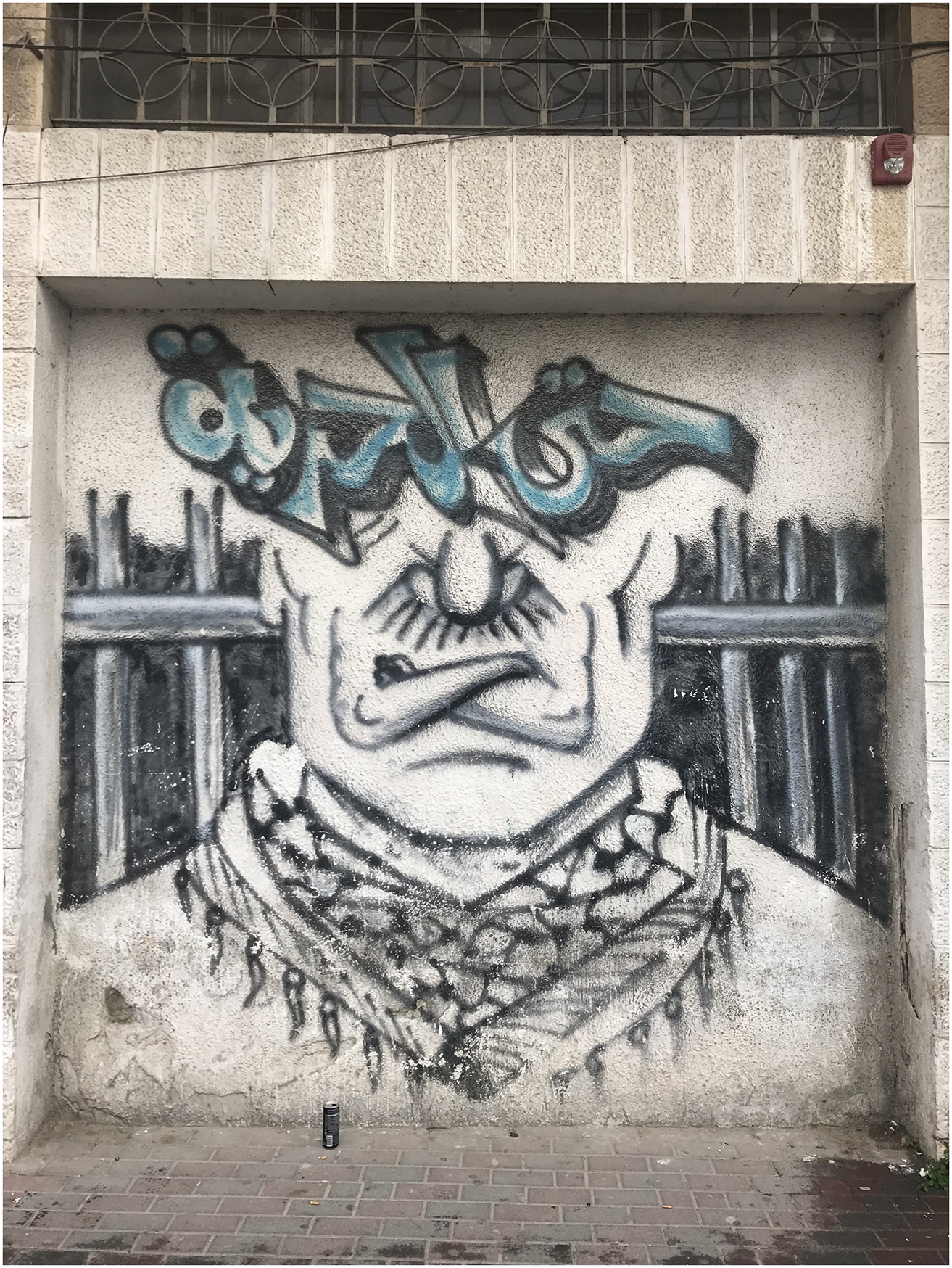
Hebron, Palestine. “Until freedom”. Set against the bars of his cell, a distinctly masculine prisoner dons a kuffiyya. Muscular arms are crossed over his mouth, representing his refusal to eat in hunger strike, until freedom is achieved. Hunger striking has long been a prominent tactic of Palestinian resistance in colonial prisons (Shwaikh, 2018; Ajour, 2021). The hunger striker chooses to resist their incarceration with the only means still available to them—their body.
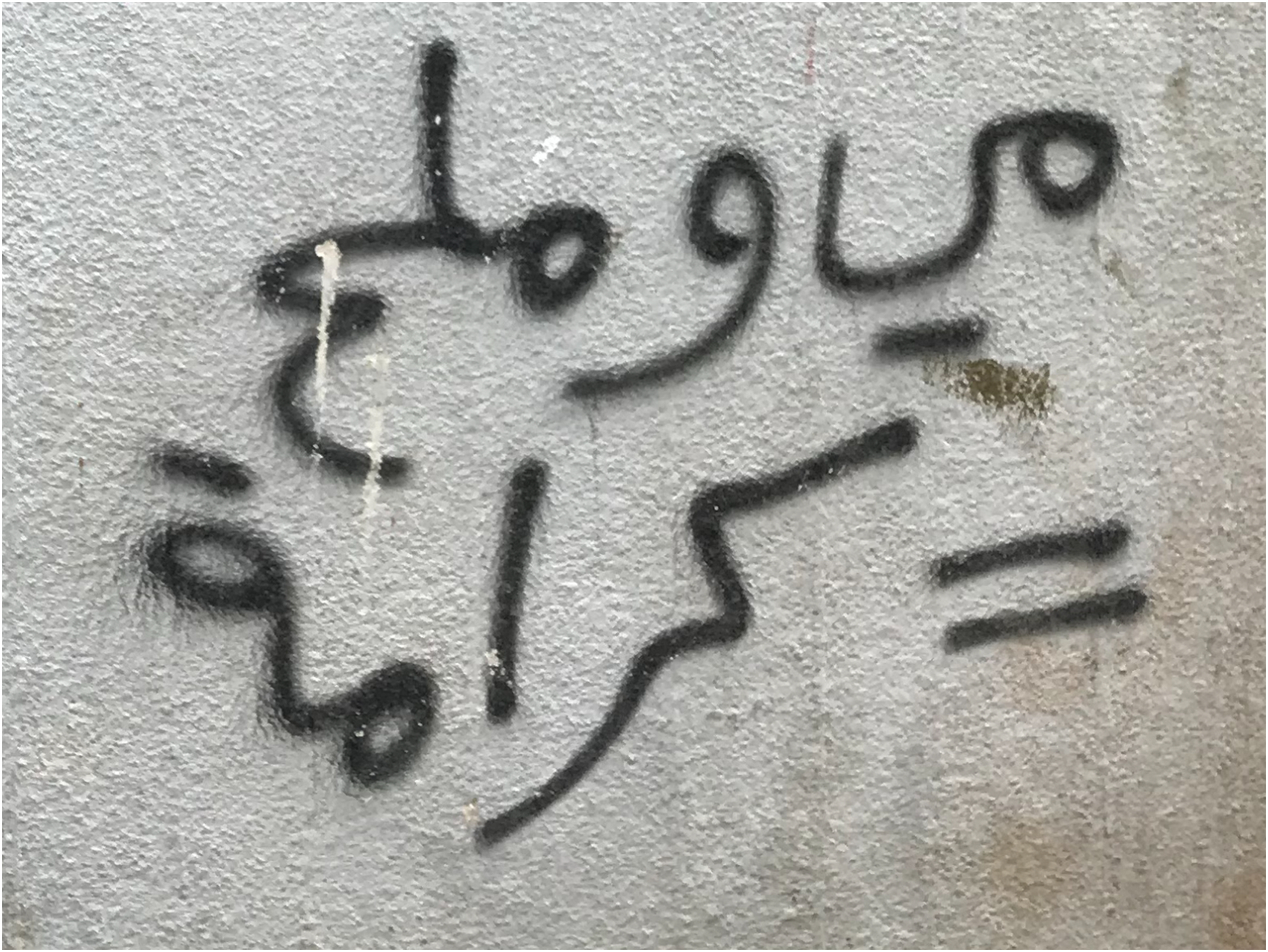
‘Aida camp, Palestine. “Water and salt = dignity”. Water and salt are the only things that hunger strikers consume, sometimes for weeks on end, to stay alive while abstaining from food. Refusing to sustain themselves on the produce of colonisation, for the hunger striker, water and salt is a recipe for dignity.
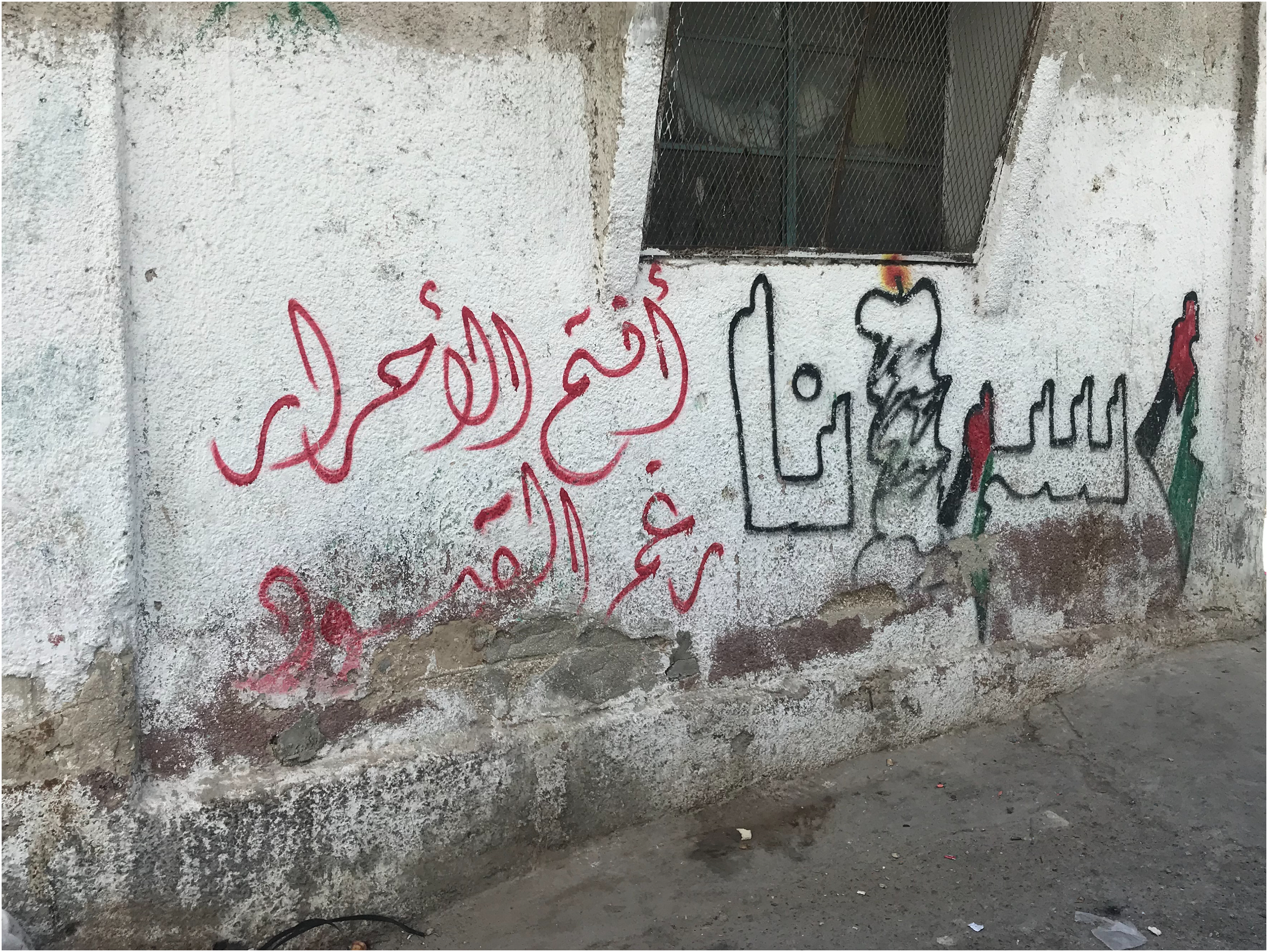
Balata camp, Palestine. “Our prisoners, you are the free in spite of the shackles”. The Arabic letters alif and ra of “asrānā” (our prisoners) are formed by maps of Palestine that are coloured in with the Palestinian flag. The second alif is a candle, which can signify both the steady conviction that burns in the prisoner and the memory of the prisoner that is kept alight in the community.
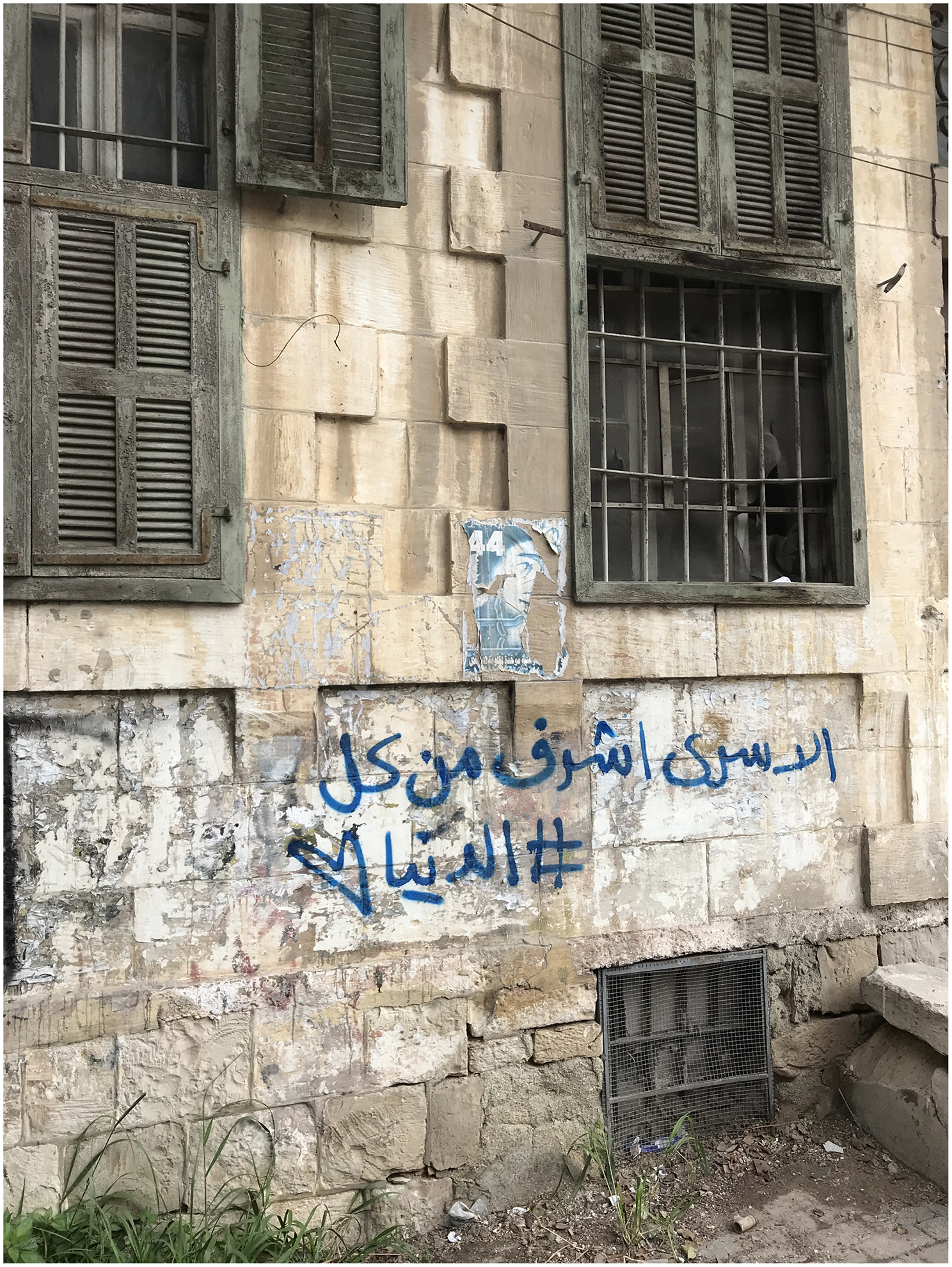
Nablus, Palestine. “The prisoners are more honourable than the whole world”. The words are punctuated with a love heart, expressing a communal love for the prisoners. This piece articulates both the insurmountable honour of prisoners, and the shame of “the whole world”, who allow the carceral colonisation of Palestine to continue.
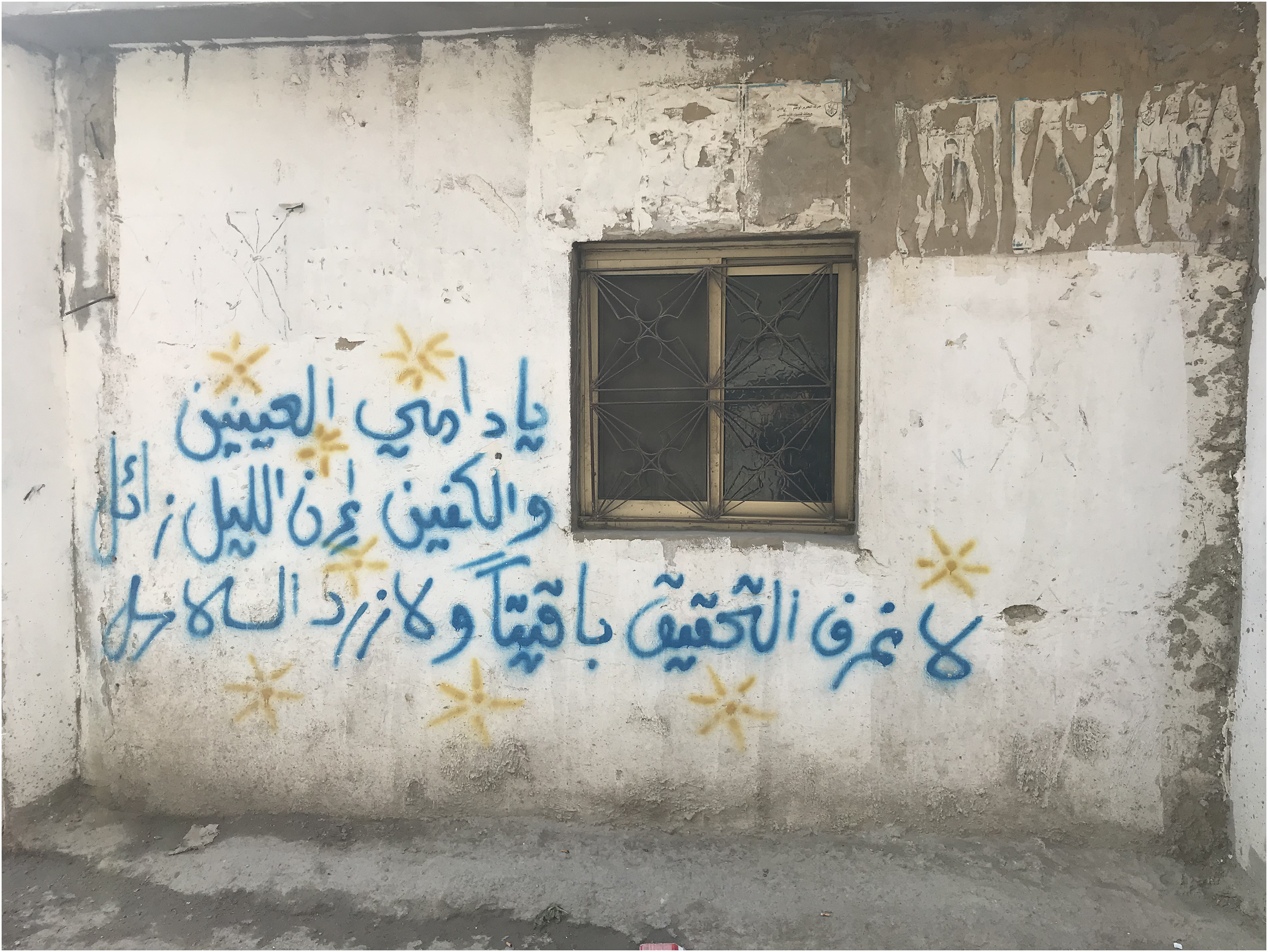
Qalandiya camp, Palestine. “You whose eyes and palms are bloodied, the night is fleeting, neither the interrogation room will remain, nor the tight grip of chains”. These are lines from the poem “On Man” by Palestinian poet Mahmoud Darwish. Expressing support for the prisoner who has undergone torture, the words are punctuated by sparks of light, shining through the darkness of prison.
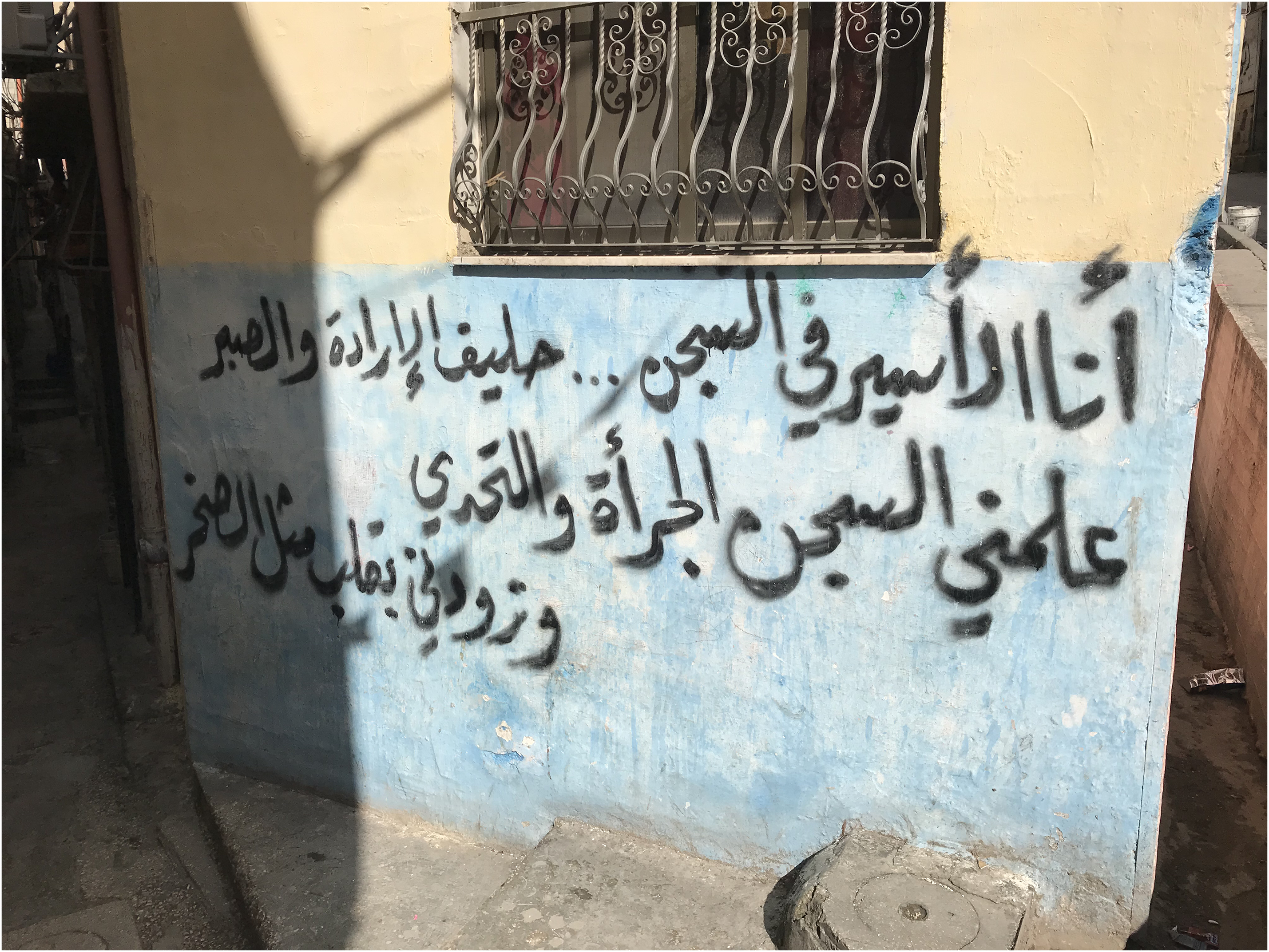
al-‘Ayn camp, Palestine. “I am the prisoner in prison … the friend of determination and patience, prison taught me bravery and defiance, and gave me a heart of stone”. While their physical body might be broken by torture, the prisoner's heart remains unscathed by turning to stone—forming part of the land for which this defiant bravery is expressed.
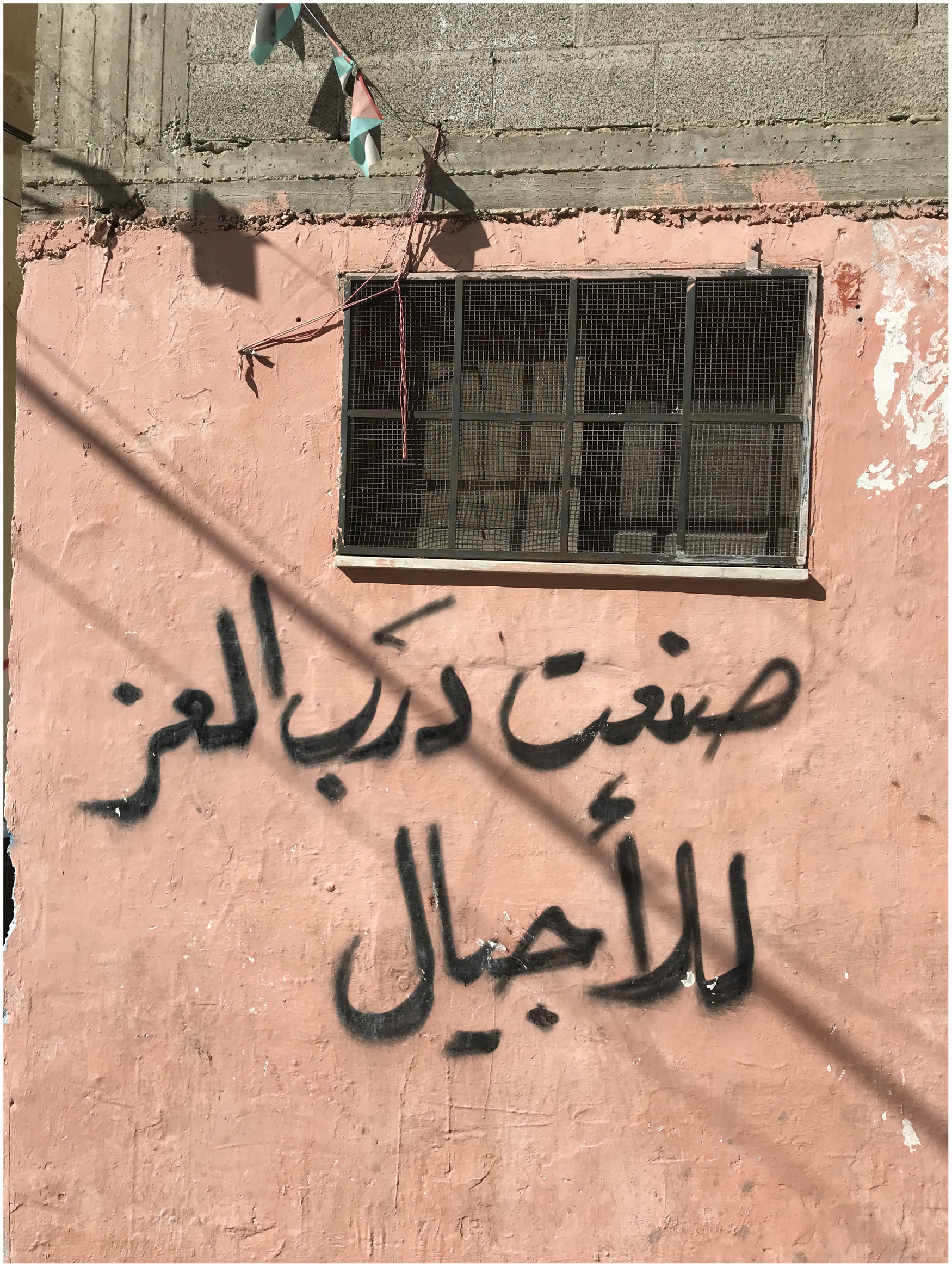
al-‘Ayn camp, Palestine. “I paved the way for the dignified life of the next generations”. “Al-‘izz”, which is translated as “dignified” here, has broader connotations of pride, honour, esteem, freedom, and prosperity. The sacrifice of the prisoner is made for al-‘izz of Palestinian generations to come.
***
Together, these graffiti assert the inevitability of Palestinian liberation, against an apparently inescapable incarceration. This conviction in freedom is constituted by a range of feelings, including a communal love for the prisoner and the dignity they personify. I suggest that this politics of conviction might form the affective basis of a distinctly Palestinian abolitionism—working to abolish the colonial structures that uphold both the small and large prisons. While “abolitionism” is not a term widely adopted in Palestine, as Tamar Ghabin (2022) suggests, much of the theorising and practice of Palestinian prisoners and their communities could be understood as abolitionist. After all, drawing on prominent abolitionist Ruth Wilson Gilmore, abolition is “the work that people are already doing” (Ghabin, 2022). Abolitionist theory and praxis has much to learn from the rich tradition of Palestinian prisoner struggles. Similarly, Palestinian struggles against incarceration can draw on abolitionism to bolster their challenges to Israeli settler colonial carcerality. Such conversations across contexts are necessary, as we resist together the global structure of carcerality, for the sake of al-‘izz of generations to come.
Footnotes
Declaration of conflicting interests
The author declared no potential conflicts of interest with respect to the research, authorship, and/or publication of this article.
Ethics
The broader research project from which this work is drawn (project number 2020/HE002954) was approved on 8 March 2021 by the University of Queensland Human Research Ethics Committee B.
Funding
The author disclosed receipt of the following financial support for the research, authorship, and/or publication of this article: This work was supported by the Institute of Human Geography,
