




Abstract
This article details methodological reflections and implications for future work from an innovative, participatory research project that started life during the UK’s first COVID-19 lockdown in early 2020. We reflect on the practice, ethical considerations, and challenges of this (necessarily) online participatory research program, which featured intensive, prolonged collaboration with parents/carers living on a low income within the UK. We discuss the ethical-epistemological foundations of the work, specifically a feminist ethics of care and reciprocity, and present our unique methodological approach, detailing how technology was used to collaborate with a diverse, nation-wide community of parents/carers. We discuss our own and participants’ reflections, including the distinctive complexities and advantages of conducting participatory research online, and also the challenges of upholding an ethics of care in an online, participatory space. We highlight the time intensive nature of this work and argue that, within the academy, more needs to be done both to recognize this and to find ways to create space within it for documenting and learning from innovations in the methodology pursued. We conclude with reflections on the new possibilities that emerge when translating participatory principles to online spaces—learnings with clear relevance for others interested in pursuing these approaches.
Turning Points in Participatory Research
As researchers of poverty, inequality, and social security, participatory methods working with rather than on those we sought to learn from had been essential to our work within the academy and beyond. Nevertheless, we had consistently struggled with the potential for exclusion and the limited reach of participatory approaches—it could be inaccessible to those who were unable to join in-person meetings, it was often very localized, and it could struggle to impact policy and debate at a national level.
In research, as in life, there are moments that constitute irreversible and often transformative “turning points,” after which things can never and should never be the same again. In many ways, the COVID-19 pandemic constituted just such a turning point, with the resultant lockdowns and shift to online working and living both restricting traditional research methods and opening up new possibilities for undertaking research in a radically different way (Howlett, 2022). Like many other researchers, in April 2020, we found ourselves in a situation in which it was impossible to continue our current approach to offline and in-person participatory research; we were forced, as it were, to rethink our methodology, confronting many challenges (see also Howlett, 2022) but also embracing the possibilities that may come with online participatory approaches.
The everyday realities of working at home, yet urgently needing to better understand how the pandemic was intersecting with wider inequalities, led the authors of this article to develop an ambitious and innovative online participatory research program, which found creative ways to forge connections and collaboration between parents and carers living on a low income from across the UK. The methods used in this research program were valuable—we use this article to argue—not only in the specific pandemic context, but more broadly in opening up new possibilities for participatory research, with clear relevance for future research practices. This article sets out the ethical and epistemological foundations of the research. It outlines its unique and innovative research design, including multiple forms of online engagement, which valued the varied knowledge that participants brought to the interaction, and protected agency over expression.
Rather than present our research findings (which we do elsewhere, see: Patrick, Power, et al., 2022), we discuss our own and participants’ reflections on the methodological approach adopted, including the unique challenges and advantages of conducting participatory research online, as well as reflections on upholding an ethics of care in the online participatory space. Significantly, we pull out methodological learnings that transcend the pandemic context and highlight the possibilities inherent within moving participatory research into an online space—possibilities that were not necessarily apparent to us before we began this work.
We highlight the time intensive nature of this work, which is one reason why it has taken us quite so long to write up our methodological approach. The reality of effective online participatory research is that it is incredibly demanding of time and resources; more needs to be done both to recognize this and to find ways to create space within that for documenting and learning from innovations in the methodology pursued. This article suggests some ways that this might happen and concludes with reflections on the new possibilities that open up when translating participatory principles to online spaces, learnings which constitute a valuable contribution in developing new understanding in this space.
Epistemological and Ethical Foundations of (Online) Participatory Approaches
Recent years have seen a rapid growth in the prevalence and popularity of participatory approaches to research (Bergold & Thomas, 2012; Boivin et al., 2014; Bussu et al., 2021; Flicker et al., 2007). With its origin in Lewin’s (1946) action research, participatory approaches entail doing research with rather than on participants (Bussu et al., 2021). Rejecting positivist assumptions about the relationship between the researcher and the researched (Batallan et al., 2017), participatory methodologies propose that social reality does not exist external to language and changes with time, requiring methodologies that are coherent with the ontology of the object under study (Giddens, 1982, 1995).
Participatory research can be viewed from a functionalist and a democratic perspective (see Bussu, Lalani, Pattison, & Marshall, 2021). From a functionalist perspective, participatory research can work with and utilize a wide range of expertise (see Herrington et al., 2020); it creates opportunities for the development of more relevant evidence through ongoing collaboration among professionals, academics, and community members involved in the research process, helping to bridge the gap between academia and the real world, fostering engagement with the findings, and increasing commitment to using evidence for policy change (Vindrola-Padros et al., 2020). By doing so, it can lead to research which is more robust and has greater potential for impact (Patrick, 2019). From a democratic perspective, the involvement of new voices and interests in framing problems and defining issues can challenge beliefs that might disadvantage some social groups (Banks et al., 2013). In the context of researching poverty with adults, this aspect of participatory research becomes particularly important. Poverty can be equated with misrecognition, the absence and silencing of voices; poverty, “to count for nothing” (Lister, 2015, p. 139), is a site of both redistributive and relational social injustice (Fraser, 2007). Involving people with experience of poverty in debates and consultations not only respects their rights and citizenship but can give them full status as social partners (Lister, 2004). It can be a vehicle by which people in poverty can get organized (Lister, 2020), and a means to present a counter to the dominant, often stigmatizing, narratives on poverty and benefit receipt (see Poverty2Solutions, 2021; Silver, 2018). Indeed, by mobilizing the expertise of experience of poverty, there is the scope to challenge the dominant machine of anti-welfare common-sense, and the ways in which popular narratives on welfare all too often misrepresent the lives of those in receipt of social security for all or most of their income (Patrick, 2019). What is more, the very act of participatory approaches represents a valuing and foregrounding of the expertise of those it involves; indeed “use of participatory methodologies that acknowledge and celebrate the presence of the people themselves have been hailed as another counter-narrative that challenges dominant processes of Othering” (Krumer-Nevo & Benjamin, 2010, p. 693, as cited in Lister, 2015, p. 140).
Nevertheless, participatory research poses multiple and interlocking ethical and practical challenges, which may conflict with paternalistic and bureaucratical ethical approaches, characteristic of university Research Ethics Committees (Bussu et al., 2021). Doing research with, rather than on, participants problematises traditional ethical requirements of informed consent, anonymity, and confidentiality, and requires a shift from “procedural ethics” to “ethics in practice” (see Bussu et al., 2021). Procedural ethics can be inappropriate, or even redundant, in contexts in which ethics need to be constantly re-negotiated between researcher and participant, and in research in which new ethical problems emerge from everyday practice, where decisions that might have profound ethical ramifications need to be made quickly (Guillemin & Gillam, 2004). A limited but growing body of literature argues that feminist critical theory (see Noddings, 1984), in particular a feminist ethics of care (see Gilligan, 1982; Holland et al., 2014; Tronto, 1994), can provide a more appropriate ethical framework for participatory research than ethics of principle (Bussu et al., 2021). Feminist ethics of care provide a powerful critique of rights-based frameworks in which independence and autonomy are paramount (Dewing, 2007). An ethics of care is premised upon the notion that humans are inherently relational (Noddings, 1984), stressing the importance of interdependence and connectedness through relationships (Lloyd, 2004); ethics is not an inflexible set of rules but a pragmatic attempt to democratically explore problematic social conditions and improve them (Dewey, 1984). In this way, an ethics of care is congruent with situations we experience as researchers on the ground, and certainly aligns with our own situated, research sensibilities, which prioritize the importance of connection, openness, and reciprocity.
Covid Realities: Online, Participatory Research with Parents and Carers
Covid Realities was a major two-year research program funded by the Nuffield Foundation. The program used online participatory methods to partner with and document the everyday experiences of families with children on a low income during the pandemic across the UK, through a collaboration including parents and carers with dependent children, researchers from the University of York and the University of Birmingham, and a national charity, Child Poverty Action Group. There was a focus within the project on families’ experiences of social security, but also on wider everyday life, including how families navigated the new and challenging world of COVID-19, and on the collective development of recommendations for change. Covid Realities was succeeded by Changing Realities, which continues online participatory research with parents and carers on a low income and which remains active as we write. In this article, we focus on the approach and methodological reflections from the first project, Covid Realities.
Ethical Approach
Our ethical approach sought to uphold a commitment to feminist research praxis, exploring the basis of our everyday knowledge as women, feminists, and social scientists (Stanley & Wise, 1993). It prioritized an ethics of care and reciprocity (Holland et al., 2014; Tronto, 1994), recognizing the interdependence of researchers and of researchers and participants, and prioritizing human relationships in all aspects of the research process. Nevertheless, our approach simultaneously also sought to incorporate robust “procedural ethics” alongside “ethics in practice” (see Bussu et al., 2021). Conscious of the potential vulnerability of participants and the likely challenges of the uncharted ethical terrain of online participatory research in a pandemic, we developed a robust (proactive) ethical framework for the research process involving informed consent and, within the confines of the participatory process, anonymity and confidentiality. We recognized that we would encounter “ethical speed bumps” during our research, and that this required both proactive and reactive situated ethical decision-making (Neale & Hanna, 2013; Treanor et al., 2021). Here, an ethics of care and reciprocity underpinned our decision-making, which was further supported by a robust process of engagement from a specialist sub-advisory group focused on the participatory aspects of the research.
This ethics of care and reciprocity was embedded throughout the participatory process. Informed by Oakley’s (1981, p. 67) approach—“the practice I followed was to answer all personal questions and questions about the research as fully as was required”—we adopted a policy of openness and transparency, answering any questions about the research in as much detail as needed, and sharing some personal information about ourselves in our interactions with participants (an element of our proactive ethical planning). This was, in part, facilitated by a weekly question asked by a member of the research team (and, as the project developed, participants and guests, too) using video software (see below), but it was also inescapable in the context of home working. In online (Zoom) group discussions, participants were able to see into our homes, often involving interruptions by children and pets. Over time, our ethics of care was maintained by prioritizing time for communication with participants, involving regular engagement and email contact, and maintaining the human touches so important to the offline participatory space. Participants were sent “welcome packs” on signing up to the project and for each online discussion group, participants were sent a “snack pack” in the post. In this privileging of small acts of kindness, we aimed to make tangible our ethics of care and reciprocity. We also sought to take learnings from our participatory research conducted face-to-face into the new online context; here, we knew the importance of investing time and energy into the small details, and prioritizing creating an informal, supportive and welcoming environment (Patrick, 2019). These principles apply equally online, and small acts such as the snack packs were a literal way of demonstrating that we had invested in and were prioritizing care and attention in these areas. Simultaneously, we prioritized care of the research team, holding regular team meetings and check-ins, and encouraging team members to take time away from the project when necessary for personal or work reasons.
While some participants remained entirely anonymous throughout the research process, using a pseudonym in all interactions with researchers, others chose to use their real names in some group meetings (see below) and in media engagement (see below). Pseudonyms were mainly used in published outputs, although there were occasions when participants chose to use their real name, and we responded to this flexibly and prioritized the preferences of individual participants. The negotiation of ethics was an ongoing, reactive process, both with the relevant institutional Research Ethics Committee (REC) and with participants. We submitted multiple amendments to our initial ethics submission to the REC to gain approval for any changes to the study, however, small. Further, we (re)-negotiated consent with participants throughout the participatory process; involvement in additional elements of the program, for instance online discussion groups, arts-based activities, and media work, required additional consent following information from and discussion with the research team.
Participatory Practices: Our Methods in Action
Participatory research is inherently a continuum (Aldridge, 2016) ranging from the involvement of participants limited to the data generation phase, to participants being involved in the full research process, from design to data collection to dissemination (see Mannay, 2016; Mannay et al., 2018; Staples et al., 2019). Our approach was necessarily constrained by the pandemic context, requiring social (physical) distancing and home working. As a research team, we had considerable expertise in participatory approaches (see: Power, 2019; Herrington et al., 2020), however, we had no experience of participatory research using online methodologies. There is a limited body of research on the use of audio-visual methodologies in ethnographic and/or participatory research. This literature details the progressive possibilities of such approaches, which provide agency to participants and facilitate the emergence of alternative narratives (see Battalan et al., 2017; Volpe, 2019), and outlines the methodological tools available. Of particular relevance here is the use of “digital diaries” (see Bellar, 2017; Staiano et al., 2012), “a document created by an individual who has maintained a regular, personal and contemporaneous record” (Alaszewski, 2006, p. 1) via the use of apps or other digital platforms (including photos and social media sites—see Volpe, 2019). There has also been innovative digital research conducted by Hale (2019) into chronic illness, including the formation of online focus groups, creating a discursive and inclusive space to share experiences and recommendations for change. We benefited from Hale’s insight as she sat on our specialist participatory research sub-advisory group.
Our participatory and data gathering approach employed a variety of methods and forms of intervention to allow participants to engage in different ways which suited their interests and expertise. Our methodological approach was developed via a participatory process involving feedback from, and collaboration with, participants; we worked with 15 low-income parents and carers to pilot digital diary methods and simple question-based activities. Extensive oral feedback from participants conveyed the value of dual methods (diary and question-based activities), the importance of facilitating digital access via financial support, as well as the appetite among low-income parents and carers for online research engagement. Following the pilot study, we collaborated with a website designer and four people with direct experience of poverty to co-develop an online research methodology and digital platform, working via an iterative process using feedback forms and online (Zoom) discussion groups. The online platform (see Figure 1), utilized as the basis for research and engagement, emerged from this process. Covid Realities online participant dashboard.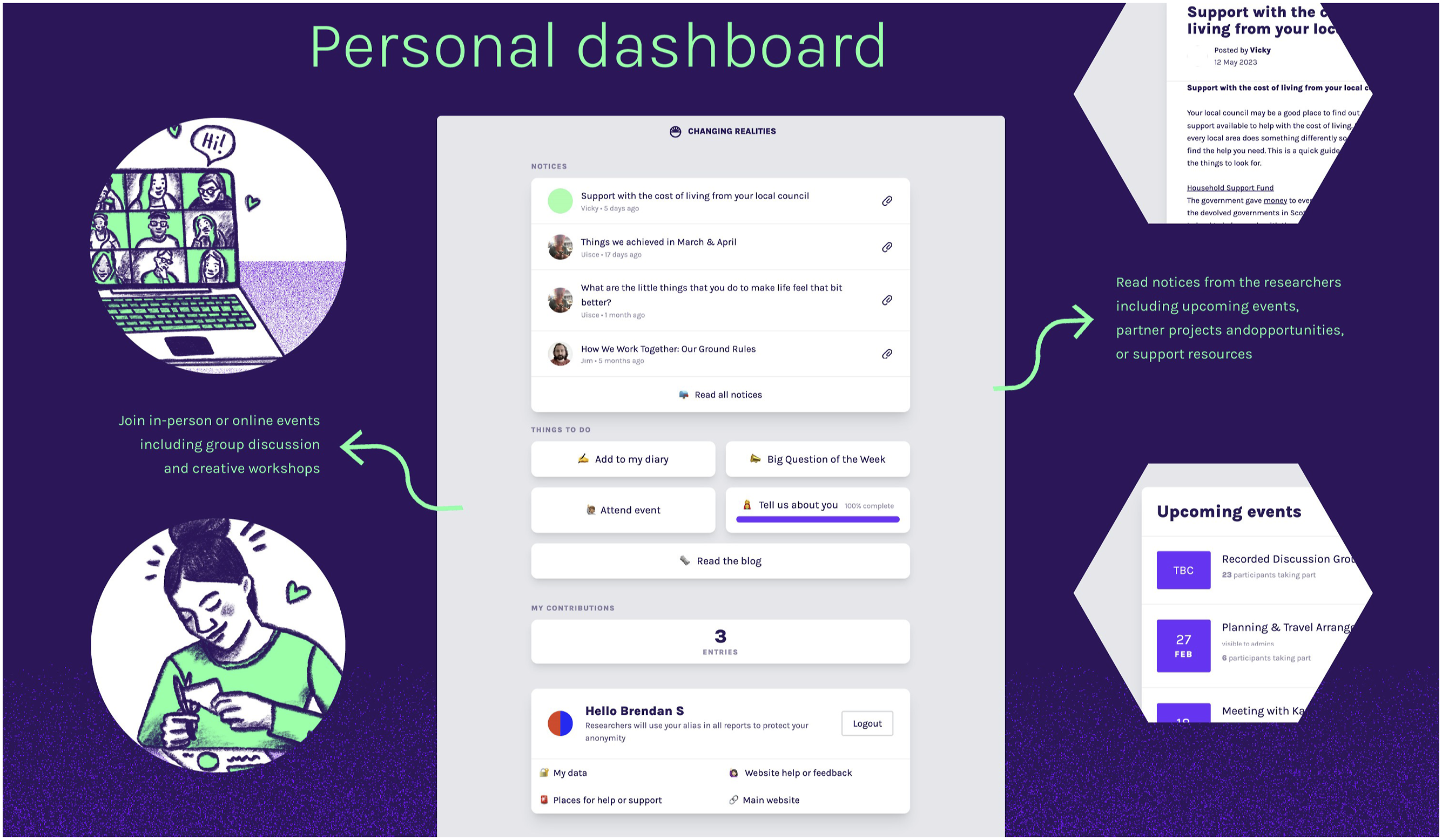
Our methodological approach encompassed multiple varied forms of online engagement: online diaries; responses to video questions; online discussion groups; and arts-based methods. Online “digital” diaries operated as a highly flexible form of data collection: participants could write (type) a diary directly into their online “dashboard,” upload photos or submit the diary via an uploaded video or audio recording and there was no required frequency for the diaries. This flexibility helped to overcome the inherent limitation of utilizing diaries for research in that they depend on the participant’s writing skills (Buchwald et al., 2009; as cited in Wilkinson & Wilkinson, 2018) and can require routine commitment from participants. The digital diaries were accompanied by a “Big Question of the Week,” a weekly question on topical issues recorded by a member of the research team, participants, and external partners using “Video Ask” software. Examples of weekly questions included: What does the weakening of (COVID-19) restrictions mean for you and your family? How has your children’s mental health been impacted by the pandemic? Is child benefit enough and what do you spend it on? The diaries and video asks were accompanied by monthly discussion Zoom groups. These were decision-making and policy development forums, with conversations feeding into the recommendations of published reports (see, Patrick, Power, et al., 2022; Patrick et al., 2021; Power et al., 2020), and guiding subsequent development of the participatory program (for instance, the use of arts-based methods—see: https://covidrealities.org/zines). Media engagement was (and continues to be) an essential part of the program which aims both to document lived experiences but importantly to share these experiences with a wide audience and to advocate for policy change. In line with the participatory ethos of the project most media appearances were fronted by participants, who were then well supported by the research team through both media training sessions and one-to-one support before and after any media appearance. The project received widespread coverage by the British print and broadcast media, including BBC and ITV news. These media interventions played a critical contribution in challenging dominant narratives about social security and poverty, and were a vital component of the project’s wider objective to support parents to voice their everyday experiences, and—vitally—their ideas for change.
Feedback and learning from participants was integral to every element of our work. Informally, regular communication with participants via email to check-in, communicate about new activities and opportunities (for instance media work or arts-based activities), and respond to participant enquiries, allowed for feedback on specific aspects of the program. Formally, the research team distributed feedback forms to all participants at multiple time points to solicit responses to various aspects of the program. This continuous loop of feedback and communication informed the development of new activities and underpinned improvement.
Thanking participants for their time is part of an ongoing ethics of reciprocity that we have adhered to throughout the research program. Participants were offered Love2Shop vouchers 1 (either paper or e-vouchers) as a way of thanking them for their participation. The decision not to offer cash was made in order to minimize pressure to take part and avoid affecting benefit entitlements. Participants were also supported with receiving mobile phone credit, as needed, in order to be able to take part in online activities such as the Zoom discussion groups. Throughout the project, we have made sure we always compensated people for their time, following submission—not just of their diary entries—but also when participating in virtual meetings, or taking time to speak to the media, participate in events, or write blogs. We have also sought to make this non-transactional—for example, by including notecards of thanks with the vouchers, and by refusing to ask for a formalized acknowledgement of receipt, as is sometimes required by institutions.
Living History: Lessons and Learnings from Covid Realities
The online participatory approach facilitated ways of working and forms of connection that would have been either impossible or highly expensive in the offline space. The cohort of participants included over 170 parents and carers from the four constituent nations of the UK and encompassed a considerable demographic range. It is highly unlikely that this diversity would have been possible had the work not been conducted online. It has long been an aspiration of some of the research team to forge and enable connections between people with lived experiences of poverty and social security from across the UK. Budgetary and practical constraints have meant this has not been possible. The pandemic suddenly opened up new ways of working that made these connections possible to establish and sustain, arguably something that should be continued even now that face-to-face meetings are possible again (see also Hale and Allam’s (2020) discussion of how the shift to digital engagement has impacted people with disabilities).
Participating via online platforms created an ease and informality that may not have been possible to recreate offline. It also allowed those with impairment/s or mobility issues to take part more readily than in a face-to-face setting, something which some participants explicitly acknowledged was made possible because of the online form of engagement (see also Miller & vanHeumen, 2021). Participants engaged with both the static “dashboard” and in the online Zoom group, as well as arts-based activities and any media engagement, from their own home. There was no need to arrange childcare or travel, and a unique form of intimacy could develop among participants and between participants and researchers, all of whom could gain an insight into the personal spaces of each other. The online system allowed for significant flexibility around engagement: participants could engage as and when they chose and via the medium which suited them. This diversity and flexibility facilitated rich evidence (see: Patrick, Power, et al., 2022) and gave rise to a varied community of participants. Participants voiced how the online space was perceived as less judgmental than the traditional research setting but also fostered community—participants could read about the experiences of others on the online living archive of experiences: When I first joined, I think I liked the fact I had a space I could vent my frustrations on a system that really gets to me on how it treats those less fortunate. I’ve discovered I like to come and say what I see and feel and won’t get judged. It's been like a safe space and has helped mentally a lot. It’s also been good to know there are others out there in similar situations and important that people’s journeys are recorded for historical reasons too. (Teddie)
Solidarity and Peer-Support in Participatory Research
Participatory research not only has the advantage of being able to mobilize the expertise of people in poverty, challenging dominant stigmatizing narratives (Patrick, 2019), but it can itself ferment solidarity and foster support between people living in poverty, being a source of hope in difficult times (see Goldstraw et al., 2021). Our research program demonstrated that these important features of participatory research can be retained when operating in an online space, and extended across geographical boundaries. It was common for participants to describe the sense of community, friendship and solidarity gained from the program: I’ve had my first Covid Realities Zoom meeting and I feel so lifted by it. To know I’m not the only one thinking the way I’m thinking and I’m not the only one feeling lost/forgotten/unheard. Thank you so much Covid Realities this is the most sane I’ve felt in a long while and I look forward to the next one. (Nellie) One of the great things about it Covid Realities is definitely the people who are involved and speaking with other people in the same position and seeing the positive work really that's going on around it has made me feel like I'll never, I'll never be alone again, and I won't be silent. (Lios)
For many participants, Covid Realities also provided the opportunity to “make their voice heard” and be part of collective change: To me, Covid Realities is like living history. I tell myself that in the future, students and possible future politicians will read these stories the way historians read diarists from the Victorian era and similar. I feel like I am a part of the history of this country, a small humble part perhaps (as I'd be shocked – but thrilled – if any of our current party leaders actually read and learnt from what we share here) but it feels huge to me. As someone who's always felt alone and ashamed of my situation in life, of being a single mum on benefits (something I never planned for or wanted for my children), I always felt voiceless, unimportant, and invalidated … Through Covid Realities I felt heard, I've felt my opinions and perspectives are listened to and respected (even when people disagree with me), mostly I feel like I am part of something bigger than me. (Victoria)
Significantly, the value and benefit of the participatory process itself is a reminder that this is an important research outcome to capture, and one which sits alongside more traditional research outcomes. While there has been a growing interest in extending impact—for example—to think about the role of creative outputs in disseminating findings in an engaging way to participants (see Sou & Hall, 2023), there has still been insufficient attention paid to the ways in which the very act of being involved in research can have immediate impacts on individuals, which should be tracked and better understood. We further explore this particular and important benefit of participatory research elsewhere (see: Patrick, Power, et al., 2022).
Challenges and Complexities to Online Participatory Research
As a research team, we were highly aware of the likelihood of digital exclusion resulting from an online-only participatory study. While it is impossible to know with any certainty, it is likely that potential participants were excluded because of the inherent program requirement of owning a smartphone, computer, or tablet to be able to participate. It is also worth highlighting that our research was likely experienced as inaccessible for those with limited English. We did have a considerable number of participants for whom English was a second language, some of whom attended Zoom discussion groups and many of whom shared diary entries. It was hard to ascertain the extent to which our methodology, including the absence of interpreters, excluded those for whom English was a second language. Going forward, we intend to work closely with existing participants to understand how and to what extent language may be a barrier to participation and cost in an adequate budget for interpreters, if this is considered by participants to be important.
Many participants did not engage in the online discussion groups or arts-based activities, opting to participate only via diaries or responses to video questions. There was some suggestion that participants could find the online discussion groups uncomfortable and would have preferred in-person groups: For me I struggle with speaking and being on camera so I find the Zoom meets awkward and not sure if taking part just using chat is acceptable? I suppose if I joined more I’d maybe get more confident. I’d like in the future to meet up in person as COVID allows. (Teddie)
The discussion groups, while broadly enjoyed by those who attended them (evidenced by positive feedback and continual high attendance, with around 25–30 participants attending monthly), could be highly challenging to facilitate. The groups included many vulnerable adults, some of whom had their cameras turned off and many of whom were simultaneously caring for young children; facilitating group discussion and comforting participants who became distressed required considerable empathy and mindfulness. Unlike in an offline setting, there was no ability to talk to or comfort a participant separately during or following the group. In cases where a participant became distressed, we would follow up immediately after the group via email, however, this was an inadequate substitute for a face-to-face conversation. This also raised issues over our own self-care as researchers, and we were mindful of checking in with one another following online groups to debrief and offload.
Ethical Complexities: Incorporating an Ethics of Care into the Online Space
Navigating traditional ethical practices (informed consent, participant contact, and privacy options) online could be challenging. Securing informed consent from participants, both as part of the initial sign up and throughout the research process, was deemed integral to the credibility and ethical validity of the research program. The initial sign-up and consent process was completed by the participant alone via an online system; there was no possibility of discussing the study with participants nor of ensuring that the participant was aware of the nature of their involvement and of the meaning of consent in this instance. Similarly, participants could choose one of two privacy options for their diary entries and responses to video questions: “public” and “for researchers.” Posts which were categorized as “public” were posted onto the live archive of experiences (see: https://covidrealities.org/learnings); posts which were categorized as “for researchers” were not posted on the archive but were used in published reports. This information was included in the initial sign-up and consent process, however, without direct communication it was unclear whether all participants fully understood the distinction between “public” and “for researchers.” Participants were contacted by post, email, and occasionally by WhatsApp/SMS. The unique circumstances of home working during the pandemic (often around caring responsibilities) threatened to undermine the necessary boundaries between researchers and participants. While the research team attempted to erect boundaries, such as using work phones only for participant contact, the nature of online engagement led to considerable contact with participants outside of work hours, blurring work/life balance.
There were significant challenges to negotiating ethics at speed in an ever-changing and fast-moving context. The program was designed, and ethical approval attained, in an incredibly short time period in order to begin the study and capture experiences in the early stage of the pandemic. This required quick judgements and decisions in an often highly stressful environment and concerning a methodology—online primary research—in which we were inexperienced. Navigating and negotiating “ethics in practice” required quick and measured judgements often on unfamiliar terrain. In particular, questions surrounding where, as researchers, we should intervene and provide support to participants. Diary entries often showed stress, depression, and anxiety among some participants. On a small number of occasions, a member of the research team intervened, following up the diary post to check on the participant’s wellbeing and, where relevant, signpost to the appropriate services. Was it our role to intervene in this way and what would happen when the project ended and we could not provide such support? These were situated and difficult questions for which there was no “right” answer. In each instance, we acted in line with our ethical practice, and took time to reflect together on the ramifications from our decision-making. Nevertheless, this support, as well as everyday communication with participants and the thank you cards and parcels sent out via post, were highly valued by participants: Covid Realities has been a rock and you have all been amazing I really do feel heard by all of you and you are the kindest people – the little surprises that you send out are so thoughtful and very caring. Mental health has been a big issue for myself and for everyone else around me and in this study, and the kind words and the thoughtful gifts and emails checking in make me smile so much and come at times when I need to be reassured there are kind people like the amazing people on your team. (Georgie)
Reflecting on their own experience of conducting participatory research, Bussu et al. (2021, p. 11) write, “the participatory approach entails being open to co-decisions with participants, but trust-building is an ongoing process and it was not always easy to ensure there was no perceived hierarchy between the researchers and the participants”; in our study, trust-building developed throughout the 18-month research program, facilitated not only by regular communication and transparency but by consultation with participants about the research itself, as well as about policy recommendations and broader ideas for change. In line with an ethics of care, the participatory research underscored the importance of interdependence, achieving a level of connectedness between participants and researchers through relationships (Lloyd, 2004). Nevertheless, like Bussu et al. (2021), it was not always easy to ensure there was no perceived hierarchy between the researchers and participants. As researchers, we set the time and terms of the online discussion groups, facilitated connections between participants in these groups and via the static data archive, and decided the nature of the project outputs and the form of their communication. Due to data privacy rules, participants were unable to connect outside the confines of the project and separate from researcher-facilitated interaction. Despite involving participants in the design and continued delivery of the research program a degree of paternalism remained.
Here, there is a need for further methodological reflection on the ethical duties researchers owe to participants who take part in participatory projects like Covid Realities, gaining new skills, experiences, and appetite for participatory activity in the process. At the very least, there is then an ethical obligation to signpost participants onto other programs where they continue these forms of engagement, but, perhaps more than that, there is a need to go further, and commit to devoting time and resources to seeking to extend and build on the legacy of the project.
Discussion: Power, Participation, and the Promise of Hope
On 31st July 2021, we closed the Covid Realities online diary to new entries. At this point, we anticipated the closure of the project and had to communicate this sensitively to participants (note that—as detailed above—we did, in fact, get more funding for a continued round of work in 2022, 2023, and 2024). The diaries had been open for over a year and had been a place where participants could document and share experiences, and ask and respond to the “Big Questions of the Week.” In the final diary entry, Aurora reflected on what her engagement in Covid Realities had meant to her: Covid Realities has meant a lot over the pandemic. Our voices have been heard where we’ve felt previously ignored. We will have hoped [to] make a valuable contribution to effect changes for the future of our children. To not feel so alone in what are and were challenging times. It is important we are heard. We are not alone and we must speak up about the unfairness in society. Thank you for supporting us through this time. (Aurora)
Aurora’s diary entry summarizes the key reasons why participants engaged with, and then stayed engaged with the project—participants were motivated by an aspiration to effect social changes, and also found solidarity and reciprocity in their interactions (most importantly) with other participants, but also with the wider research team. These drivers create ethical imperatives to act, both in working together to attempt to instigate change, but also in being cautious about the ending of projects, and in how these disrupt and potentially dismantle new solidarities and relationships. Here, there is a need to return to foundational ethical principles of care and reciprocity, and—we would argue—to challenge institutional processes where these work against these objectives.
Bell and Pahl (2018) draw on the work of Levitas (2013) and her call for more utopianism within the academy to situate participatory approaches as a utopian method, which attends to and works against dominant inequalities. Research that adopts participatory approaches can force change in how we analyze and confront inequality within both the academy and society more broadly, as well as how we work to address it. Participatory research provides an opportunity to de-center academic knowledge and challenge established ways of doing things; to collectively share caring labor; and to work against the hierarchical and stigmatizing tendencies of the academy and of society more broadly (Bell & Pahl, 2018). As Covid Realities has argued, qualitative research into poverty that fails to take a participatory approach, risks reinforcing the misrecognition and mis-respect routinely faced by individuals experiencing poverty. Instead, working with people experiencing poverty can be a small, partial corrective to the relational social injustice people face, and so working against and subverting dominant inequalities, as also set out by Bell and Pahl (2018).
Significantly, and inevitably, though, processes of participation rub up against, and sadly often into conflict with, dominant academic practices and funding requirements—for example, to publish in peer-reviewed journals, and to set out research questions and methodological approaches clearly at the outset of a funding bid, rather than leaving time and space for these to develop iteratively and in partnership with all those involved in a project (see Bell & Pahl, 2018). Engaging in participatory research requires us to sit “within, against and beyond current configurations of power in academia and society more broadly” (Bell & Pahl, 2018, p. 105). While this is a seat of discomfort and often of challenge, it is heartening to see how funders are at least starting to acknowledge and work with the approach that participatory research demands. In the case of Covid Realities, our funder, the Nuffield Foundation, was content to allow us to iterate our participatory research design as it developed, creating the vital space for collaboration and connection with the participants with whom we were working.
The participatory methodological approach we adopted in Covid Realities saw us translate the core features of our face-to-face participatory practice into a new online space, a process of methodological sharing and translation that worked incredibly (and for us sometimes surprisingly) effectively. Hale and Allam (2020) of the Chronic Illness Inclusion Project detail how the pandemic has created, or worsened, the problem of digital exclusion for some groups of disabled people and yet, for others, “the remote access revolution unleashed by the lockdown brought us a new form of inclusion. We found our horizons broadened and our participation enabled as never before” (Hale & Allam, 2020, p. 4). Our own experience underscores the progressive possibilities of online participatory approaches and suggests more scope for both methodological sharing and learning, and the adaption of methodological approaches from one context into another. In our own work, we have sought to document and draw out the learnings from our participatory research practice in the hope this will encourage others—both in academia and beyond—to engage with participatory approaches and do more to involve the expertise that comes with lived experiences across policy, research and campaigning activities (see Power & Patrick, 2023). We would therefore encourage others to consider and engage with what is increasingly possible with online participatory research.
In concluding, though, we want to emphasize that it has been incredibly difficult to find the time and space to actually write and reflect on the innovations in the methodological approach that we adopted. This is a result of the very time intensive nature of participatory research—done properly—which leaves little time or energy for reflection, and even less for reading and, indeed, writing. We recognize that it is beholden on research teams to try and find ways to create this time and space, but also would note that a competitive, and routinely demanding, external context and funding climate can make this incredibly difficult to realize (see McKeown, 2022). Moreover, there is an ethical logic to privilege direct contact with participants and collaborate on efforts to influence fast-changing policy contexts, especially when the outcomes of political decisions directly affect the lives of millions of citizens. At the same time, though, we do recognize how valuable properly documenting and reflecting on methodological innovations is and can be, and would encourage more open conversation about how this can be made possible. We have experimented here with whole team writing retreats, which have proved effective. Other measures might include writing methodological reflection into future bids, though of course this requires a receptive funder. This project benefited from supportive funders who showed a sensitive understanding and appreciation of the ethical challenges and intensive work required to do this work. Going forward, we would hope to see greater appreciation from a wider range of funders of the time and resources necessary for good quality participatory research, which will become increasingly important as participatory approaches become ever more common in qualitative research.
What we hope the reflections we have shared in this article demonstrate, are the ways and extent to which our innovative online participatory research program illustrated the possibilities for retaining the unique advantages of participatory research in the online space. Ongoing collaboration with low-income parents and carers from June 2020 provided opportunities for the creation of timely evidence and policy recommendations relating to the experience of low-income families during the pandemic, and underpinned considerable impact—findings were communicated widely by participants on high profile media sites, as well as with policy-makers and parliamentarians. The development of a sense of trust between researchers and participants, and of solidarity among participants, was fundamental in challenging myths and stigmatizing narratives around poverty and receipt of social security. Nevertheless, our experience suggests that, while an ethics of care can be maintained in online-only participatory research, this is not without its challenges and requires pragmatism, creativity, and empathy on the part of researchers to respond in new ways to the needs of, sometimes vulnerable, participants.
As we set out earlier in this article, our participatory approach was underpinned by a feminist praxis which motivated the research from the outset, and which guided and informed our decision making across the program. Cahill et al (2010, p. 407) argue that participatory research can draw on, and itself constitute, a feminist praxis of critical hope, “where what could be is sought, where what has been is critiqued and where what was is troubled.” Thinking of participatory approaches as constituting practices of critical hope, and drawing on what Bell and Pahl (2018, p. 105) describe as a “utopian method” has great value in reminding us of the importance that these approaches look forward and look upstream to develop proposals and practices of change. We would argue that the practice of participation is itself radical and hopeful, unsettling dominant inequalities and often tired (but popular) forms of engagement between researchers and participants (see also, Patrick, 2019). The utopian and hopeful bent of participatory work fuels the activity for all involved, but it also comes with risks, given the challenging political context in which change is sought. Covid Realities has sought to navigate this context, pushing for change in different places and with various actors, but without much—if any—notable success. But where it has been more successful has been in its hopeful, utopian practice, a practice which we would encourage others to experiment with and apply to their own research approaches. As Lexie put it in her last diary entry for Covid Realities: Covid Realities has meant the world to me during what has been an incredibly difficult year. Covid Realities has helped my mental health in an insurmountable way and at times literally kept me sane, it has given me a place to express my worries and woes but it has also given me a place to share my little victories and has given me a purpose. I have become part of something for the better. I have become a voice in the fight for justice, fairness, and food equality.
Footnotes
Declaration of Conflicting Interests
The author(s) declared no potential conflicts of interest with respect to the research, authorship, and/or publication of this article.
Funding
The author(s) disclosed receipt of the following financial support for the research, authorship, and/or publication of this article: This work was supported by the Nuffield Foundation.
