




Abstract
In the transition to a less protectionist research ethics paradigm—in which vulnerable groups are no longer excluded from participating in research—academic researchers need to think differently about vulnerability. By means of a collective autoethnographic investigation of professional and co-researcher’s experiences in a community-based participatory research (CBPR) project, this article explores how vulnerability is experienced and perceived in the work process and how to respond to vulnerability. It finds that vulnerability manifests in two main ways—that of feeling “emotional hurt” and “epistemic self-doubt”—and that it comes from two main layers: the lived life and from working within CBPR. The main argument in the article is that vulnerability is inevitable in qualitative research like CBPR, when involving persons in vulnerable life situations. We propose four key recommendations for future research: (a) accept vulnerability as an inevitable part of CBPR, (b) balance protection with participant autonomy in situ and together as a team, (c) use a processual approach because ethical risks in the research context might alter over time, and (d) accept that placing co-researchers at the center of interpretative authority can increase professional researcher’s vulnerability. The article expands existing understandings of ethical issues and risk in inclusive research through a combined and innovative focus on both professional and co-researcher’s lived experiences.
Keywords
Introduction
Conceptions of vulnerability in research ethics codes like the Helsinki Declaration (World Medical Association, 1964) are typically centered on particular features of groups—e.g., children—that can jeopardize their capacity for giving consent and thus render them vulnerable in research. Over the course of time, scholars have argued that vulnerable groups should be given more access to research and that vulnerability should not simply be defined in terms of group features (i.e., “the metaphor of labels” [Luna, 2009, p. 124]) but that it should be seen as context dependent and situational (Levine et al., 2004). Such arguments entail focusing on the wider life situation in which participants find themselves, as well as the research process itself. In particular, inherent power inequalities should be addressed, requiring “more robust and, perhaps even innovative decision making processes to guide the conduct of research” (Eckenwiler et al., 2008, p. 765).
Inclusive and collaborative forms of research like community-based participatory research (CBPR) or participatory action research (PAR) are proposed as a “way to reduce vulnerability” (Justo, 2004, p. 67). Because of these approaches’ sensitivity to power dynamics and a high degree of participant influence on the decision-making process, they take steps toward ensuring inclusion and democratic knowledge production to affect social change (Hacker, 2013). In this article, we agree that the PAR and CBPR approaches mark a strong advance in including persons in vulnerable life situations in research. However, we also highlight how the CBPR approach itself can increase vulnerability in the work process. This article aims to strengthen future participatory and inclusive research approaches by (a) exploring how vulnerability is experienced and perceived in the work process and (b) suggesting ways to respond to vulnerability. We argue that vulnerability is inevitable in the CBPR knowledge production process when involving persons in vulnerable life situations, proposing four key recommendations for future research.
We use collective autoethnography (CAE) to investigate the professional researcher’s (first author) and co-researchers’ (second and third authors) experiences with vulnerability in a CBPR project on the disability family. By “disability family,” short for “disability experienced family,” we mean a family in which one member or several members have a physical or mental impairment: here, limited to families who care for a child with congenital deafblindness (CDB). CDB entails the combined sensory loss of hearing and sight from birth onward.
In this article, we reflect on our experiences as a research team in this CBPR project. We are all mothers of a child with CDB and active members of a Norwegian parent peer group: the community within which the research is based. We share an insider–outsider position conducting “home” research on our community (Abu-Lughod, 1998; Subedi, 2006). Yet we bring different skills and background experiences to the project. Both co-researchers (Camilla and Grete) work as special education teachers and hold bachelor’s degrees. The professional researcher (Rosemarie) is a full-time academic in comparative political science with experience in ethnography, but new to CBPR. Camilla and Grete both have a child with CDB in their 30s, and they bring several decades of lived experiences to the research team. Rosemarie is a parent of a child with CDB who passed away at the age of four years old, and she is relatively new to the parent peer community, compared to Camilla and Grete. The fourth author is a professor in disability studies at VID Specialized University in Oslo and leader of the research center in which the CBPR project was situated. Though not part of our research team, she contributed to the CBPR project’s design and the article writing process, providing analysis and reflections on the research ethics dimensions of our findings.
Our article joins the growing international scholarship highlighting ethical challenges involved with CBPR and PAR approaches (Banks et al., 2013; Chabot et al., 2012; Tee & Lathlean, 2004). In this literature, researchers typically reflect on ethical issues that arise for vulnerable populations: reflections about the research participants rather than by participants (Centre for Social Justice and Community Action, 2012). Furthermore, the focus is often on participants, rather than on the professional researchers (exceptions being Campbell-Page & Shaw-Ridley, 2013; Muhammad et al., 2015; Wilson et al., 2018). In this article, we contribute by exploring not only the co-researchers’ sense of vulnerability but also that of the professional researcher, equalizing the power dynamics in our research team.
The equal sharing and interpretation of experiences occurred naturally in our discussions about the research process. More challenging was the choice with what voice to represent those conversations in the text (Muhammad et al., 2015). Initial versions of the manuscript utilized the “I” perspective, but this confused, since it was the professional researcher who wrote most of the text. We have chosen to narrate the article’s story through the roles of both co- and professional researchers, foregrounding these roles in explaining some of the vulnerabilities we felt. Where suitable, we use personal names and “we”.
The article commences with a background on understandings of vulnerability in CBPR approaches and research ethics and a sketch of the broader postdoctoral project and our approach to working on this article. Part II investigates how vulnerability emerged in the project, analyzing and describing findings that resulted from our collective reflections. Part III discusses findings in light of the wider literature; and in part IV, we present the potentially opposing commitments that CBPR can entail in terms of ethical protection in research, before concluding with Part V.
Part I. Understanding Vulnerability in Community-Based Participatory Research and Research Ethics
“CBPR” covers collaborative research approaches that promote equal partnership and co-learning and are committed to concrete action for the community involved (Israel et al., 2012). It encompasses participatory research (PAR), feminist PAR, and action research (AR). Although PAR and AR approaches do not necessarily involve a civic community, they often do create participative research communities, because, similar to CBPR, they actively engage participants in research. In these approaches, the question of vulnerability is commonly raised in discussions around ethical challenges (Brown et al., 2010; Hammersley, 2009), as these approaches involve partnership between academic researchers and communities and different degrees of sharing control (Minkler & Wallerstein, 2008). The challenges as identified in the literature by the Centre for Social Justice and Community Action (2012) are those of partnership and collaboration; community rights and representation; ownership and dissemination of data; anonymity and confidentiality; institutional ethical review issues; and blurred boundaries between researcher and community. In their study of professional researcher experiences with CBPR, Wilson et al. (2018) identified challenges with (a) balancing participant protection and autonomy; (b) partnership tensions between research and community objectives, and (c) insecurity regarding the professional researcher’s role.
In the Norwegian context of this research, research institutions and researchers are required to “act with caution to ensure that all research is conducted in agreement with recognized research ethics norms” (Forskningsetikkloven, 2017, §4). “Vulnerability,” as a term is mentioned by the National Research Ethics Committees’ (NESH) guidelines, and understood only in terms of persons and groups that are vulnerable (NESH, 2021).
Within the international literature on research ethics, there are more explicit attempts at conceptualizing vulnerability. One basic distinction is vulnerability as inherent versus situation dependent (Mackenzie et al., 2014). The first view stresses vulnerability as the inherent susceptibility to suffering of all human beings and as “a universal, inevitable, enduring aspect of the human condition” (Fineman, 2008, p. 8). In the research ethics context, this view lacks the precision to identify individuals or populations requiring extra protection (Levine et al., 2004; Luna, 2009). The second view sees vulnerability as situational and context specific, stressing persons’ or groups’ contingent susceptibility to harm (Mackenzie et al., 2014). However, by identifying the context-specific needs of particular groups and labeling these populations as vulnerable, this view risks stereotyping and paternalization (Dodds, 2008; Luna, 2009).
Luna proposes that “the metaphor of labels” approach be replaced with an approach that considers “layers of vulnerability.” Instead of listing entire groups as vulnerable, Luna recommends thinking about vulnerability as involving layers that can impinge on an individual’s situation: “Another way of understanding this proposal is not by thinking that some-one is vulnerable, but by considering a particular situation that makes or renders someone vulnerable” (Luna, 2009, p. 129, italics in the original). Luna’s perspective is helpful for our purposes, as it requires researchers to ask, on a case-by-case basis, if and how individuals in the research are vulnerable and what they need protection from, rather than presuming vulnerability. Luna’s notion of layers can suggest a potential overlap between different criteria for being vulnerable in the life situation, as they might affect the research situation.
Broader Postdoctoral Project
Personal lived experiences are the starting point for the postdoctoral project on disability families. The concept of “the disability family” emerged from the professional researcher’s own lived experiences in caring for her child, and her corresponding aim to analytically capture the social position one attains when one has a child with extensive care needs. The term resembles that of the “disabled family” (Ingstad & Sommerchild, 1984; McLaughlin, 2019), but differs in that it seeks to capture a wide range of experiences.
The project investigates how parents and siblings experience the structural care relationship with professionals, including the recognition or lack thereof of their knowledge. This investigation serves to foster greater self-understanding within the community. The project is informed by a critical paradigm that presumes a social reality structured by unequal power relations. This paradigm aims not only to understand reality but also to change it, and one of its “primary tools” is collective meaning making with participants toward a shared goal (Daly, 2007, p. 35).
We ground the project in an epistemological presupposition that lived experiences should be important to building knowledge and understanding (Dodson et al., 2007; Lykes & Coquillon, 2006; Maguire, 1987). We therefore also use autobiographical experiences as a vantage point to understand sociocultural phenomena, presuming an ontology of the family as “a diverse set and changing set of everyday practices” (Daly, 2007, p. 71). Inductively creating an understanding of such practices “is a collaborative process where the aim is to work intersubjectively with participants” to present multiple, complex, and conflicting perspectives on their lived experience (Daly, 2007, p. 50).
Methodological principles that guided our CBPR process were (a) a commitment to equitable partnership in all phases of research, involving an empowering and power-sharing process and (b) “conscientization,” increasing social awareness through reflection and action (Freire, 1970). We also draw on interdisciplinary disability research and feminist theories, exploring family experiences in light of epistemic injustice (Fricker, 2007): “a wrong done to someone in their capacity as a knower” (p. 1). One of its key instances is that of ‘testimonial injustice’: “when prejudice causes a hearer to give a deflated level of credibility to a speaker’s word” (p. 1). Fricker’s concepts help identify mechanisms of oppression in the communication between family members and professionals—and where someone “with a persistent background experience of testimonial injustice might lose confidence in her general intellectual abilities” (p. 47).
The methods and data involved autoethnography and researchers’ personal experiences, 8 semi-structured individual family interviews, 1 focus group interview with the parent collective (with 21 families represented), 5 reference group meetings, and 9 co-research meetings.
Approach to Working on the Article
For this article, we worked with collective autoethnography (CAE), “a qualitative method in which researchers work in community to collect their autobiographical materials and to analyze and interpret the data collectively to gain a meaning-full understanding of sociocultural phenomena” (Chang et al., 2016b, pp. 23, 24). There is a close affinity between CAE and CBPR; however, while CAE involves collective work among academic researchers, CBPR involves collaboration between professional and lay researchers and does not necessarily draw on a professional researcher’s autoethnographic experiences. What both CBPR and CAE share is the idea that proximity to the research topic is beneficial to research and that the researcher’s positionality is fundamental to the way the knowledge is produced (Haraway, 1988). In our case, using autobiographical experiences, a blending of roles occurs: Professional and co-researchers become both participant and researcher (Chang et al., 2016b).
Research Team Roles in the Project and Article
The relationship between Rosemarie, Camilla, and Grete was established two years prior to the start of the project and was one of friendly acquaintance (Chalachanová et al., 2020). The Norwegian parent organization’s board acted as a reference group from the project’s start, representing the parent group’s interests, including, for example, decisions on archive accessibility. The reference group had furthermore an advisory function. Formal agreements over responsibilities between co-researchers and the reference group were established in Meeting 1, but both parties were acquainted through previous peer meetings.
Rosemarie trained the reference group and co-researchers in research ethics, CBPR, and qualitative methods, offering perspectives on epistemic injustice as the project developed. In the article writing process, she made the co-researchers’ experiences and interpretations central in the knowledge production, while simultaneously participating as a participant. Grete and Camilla, in the overall project, assisted with planning and executing research. They helped formulate research questions and interview guides, led the group interview, and analyzed data. In the article writing, they contributed with their lived experiences, collective reflections, and decided on quote interpretation and inclusion.
Data Collection
Data for this article were derived from four co-research meetings (Meetings 5, 6, 8, and 9 in green, below, Figure 1). In Meeting 5, all reflected collectively on their role as researchers and on experiences with vulnerability as they arose in the work process. Transcriptions of Meeting 5 were used as the basis for the discussion in Meeting 6. Collective reflections in Meeting 6 were then transcribed and used as data for the article manuscript. Co-Research Meetings and Process (2020–2023).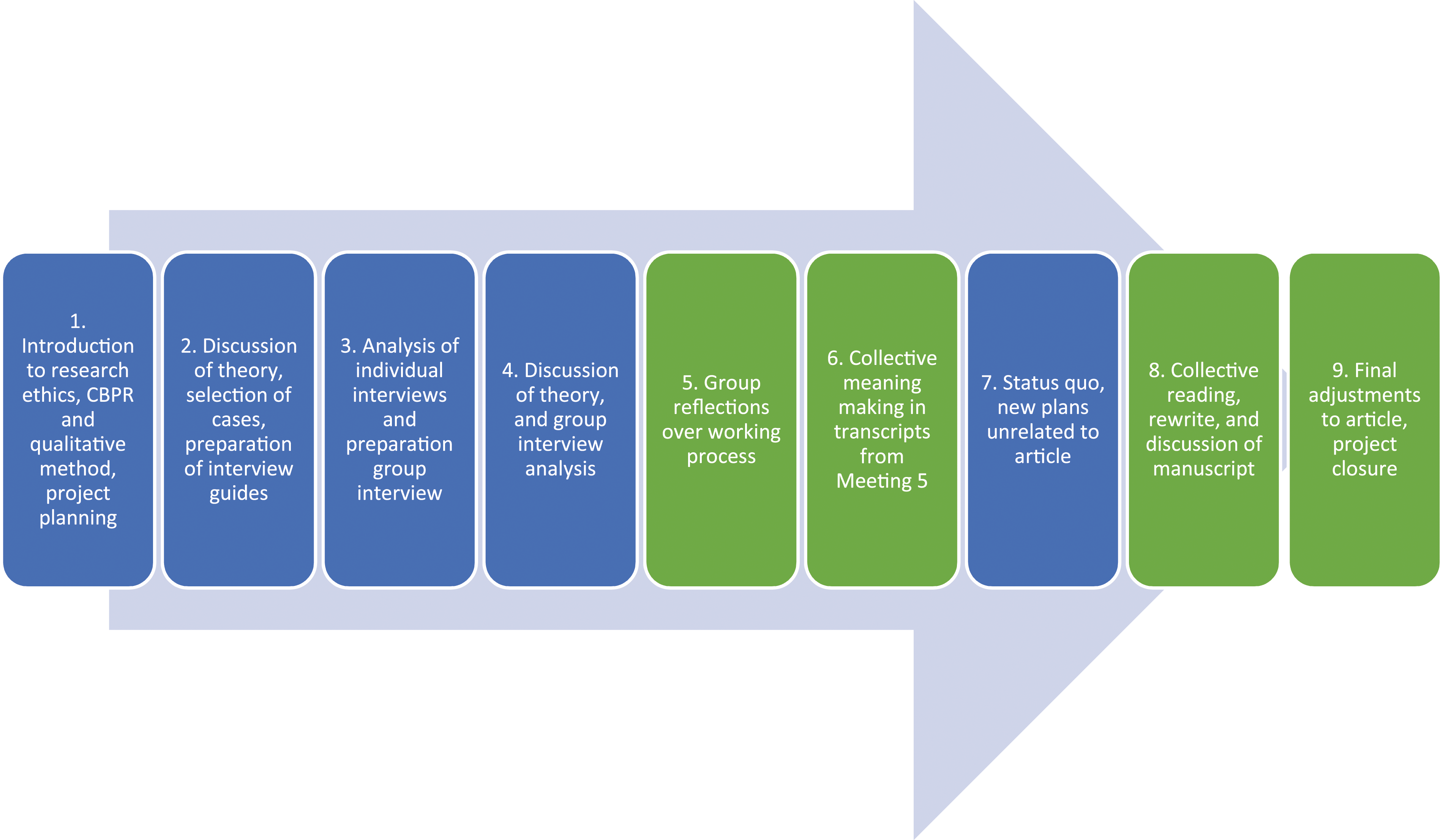
Data Description and Analysis
Rosemarie performed a preliminary coding of the textual data from Meeting 5, opening up for a collective discussion in Meeting 6. Combining the transcripts from Meetings 5 and 6, she applied thematic analysis (Chang et al., 2016a) to the total data set; her analysis was then reviewed and approved by all. This coding resulted in 58 units of meanings and 9 categories (concerning experiences of, or observations about, vulnerability), further systematized into two themes. This process allowed ideas to come to the surface that were fundamental to understanding experienced vulnerabilities in our work process, with the aim of arriving at a thematic summary (Thorne, 2016).
Part II. Understanding Vulnerability in the Community-Based Participatory Research Work Process: Describing Findings
In describing and analyzing the data from our collaborative reflections, we wanted to understand how vulnerability is experienced in CAE and CBPR, offering suggestions on how to respond to such vulnerability for future research. We identified two main themes: (a) manifestations of vulnerability in the form of feeling emotional unsettlement and self-doubt; and (b) sources/layers of vulnerability arising from the disability family situation and the CBPR approach itself.
Example I: (Meeting 6) Self-Doubt in the Role of Researcher.

Self-doubt arose because the work process involved delving into one’s inner personal life. Moreover, it was expressed as coming from the co-research role itself; It was not always clear to Camilla and Grete how that role differed from that of an informant or a representative of the parent group. For Rosemarie, self-doubt arose because being a professional researcher, parent, and community member made it challenging to determine on whose behalf she was speaking and to know to what extent she could influence the collective meaning-making process with her contributions. Rosemarie: I spend a lot of time doubting—“Here I come with my concepts, articles, and saying something about a life of which I have only a little bit firsthand knowledge.” I know that I have only had a short life with my son. I have only had a small glimpse of what it is like.
Example II: (Meeting 5) Grief Over the Life That Did Not Happen.

Example III: (Meeting 6) Self-Doubt About One’s Knowledge Status.

Example IV: (Meeting 6) Fear of Damaging Credibility in the Eyes of Professional Caregivers.

In Example III, Camilla and Grete discuss whether they want to be included as co-authors. At that point in the work process, Camilla was hesitant. In the example, the co-researchers point out how Camilla’s personal feelings of not being worthy of being a co-author might be a sign of a collective experience; They remark how Camilla’s personal reaction, in which she had not considered herself viable for the role of co-author might go “straight to the heart of the matter.” As a result of having felt devalued in the parent–professional care relationship over many years, Camilla has internalized a sense of low self-confidence—or so Camilla and Grete suggest.
This quote illustrates how these previous lived experiences of not being considered knowledgeable—a potential salient feature of their group’s situation—provide the interpretive lens through which they make sense of each other’s narratives and thereby produce knowledge about the work process. In other words, these group risks can become constitutive for meaning making.
Sources or Layers and Manifestations of Vulnerability.

Turning to how Camilla and Grete thought one should respond to such vulnerabilities, a feeling of mutual trust was emphasized as necessary. Camilla: It presupposes that we have, that we know each other quite well, and that I feel that what comes up I can share here. In this group, that works, but had I not known you and Grete so well, then it would have been much more difficult. Then I would not have dared.
Offers of professional help or having a neutral person joining our conversations were firmly dismissed. More important to Camilla and Grete was that what they said would be taken seriously. Camilla: Now I can only speak for myself but what is important (rather than receiving professional help) is that when that vulnerability is put on the table … , that it is taken seriously. Having a neutral person join the conversation would have destroyed the whole thing.
Specific to this working process, the power among the research team members was partially diffused: Personal stories were collectively examined, and there was a shared lived context of being a disability family. However, we did not feel equally vulnerable regarding all aspects. Camilla: What makes me more vulnerable in the work process than you, Rosemarie, is that I do not have the academic knowledge that you have. So I do not have the academic tools to distance me when necessary … . For me, it has been an emotional turmoil that I simply have to put into words. On the other hand, I have lived longer with a child with deafblindness than you. Yes.
Ultimately, Camilla and Grete did not want to be anonymous. Grete: The difference between being a co-researcher or an informant—here, we are something more. … We have a different status, … we are part of an end product. … That is more respectful than being made anonymous, than being researched on.
Part III. Contextualizing the Findings
The aim of our previous discussion was to describe and analyze how the co-researchers and professional researcher experienced vulnerability in the work process and to capture some of their thoughts on how to respond to vulnerability. Participants interpreted being vulnerable as feelings of risk, discomfort, and insecurity in the work process. Such interpretations are vernacular understandings of what it means to be vulnerable that future researchers should take note of. However, feelings of hurt or epistemic discomfort may not amount to actual harm in a research ethics sense. This might be a matter of degree. While some degree of insecurity or discomfort regarding one’s epistemic status is unfortunate but acceptable in a research process, feeling fundamentally disregarded and epistemically harmed is not. A distinction between “acceptable hurt/self-doubt” and “undue hurt/self-doubt” or “harm” in the research process can help us think through the research ethical implications for professional researchers.
In the following, we discuss the findings within the broader literature, relating back to the content and discursive headings of the cells in Table 5. We contextualize the observed risks from the lived life that were perceived as affecting the work process (i.e., low epistemic self-confidence, institutional precariousness, and emotional hurt) and the vulnerabilities that CAE and CBPR can entail (i.e., conscientization and role ambiguity).
Vulnerability Arising From the Lived Life
Our study identified several risks that can be contextualized in terms of possible features that come with being a disability family. We do not suggest that these are essential features of individual family members. However, as Kittay (2009) and Fineman (2013) thematize, unjust distributions of caring labor can render caregivers themselves vulnerable. Like any other human beings, disability family members are inherently disposed to vulnerability: for example, to the risk of falling ill. Moreover, they are situationally vulnerable as lifelong caregivers, which increases the risk that this inherent universal human disposition to falling ill (for example) becomes reality (Mackenzie et al., 2014).
The role of a disability family can entail increased risk of health problems (Brehaut et al., 2009; Reichman et al., 2008): Indeed, “their heavier-than-average caregiving burden has been associated with poorer physical and psychological health in many caregivers” (Hauge et al., 2013, p. 359). It can take the form of a significant economic burden (DeRigne, 2012); a negative effect on the mother’s labor market participation, working hours, and income (Wondemu et al., 2022); and the risk of encountering prejudice and stigmatization (Green, 2003; Green et al., 2005; Turner et al., 2007).
Being vulnerable to various risks (e.g., health problems) in an everyday sense does not necessarily imply that the co-researchers are at risk in a research context. However, three layers—or sets—of risks from the lived life were perceived as affecting our work process: The first involves a risk of epistemic misrecognition and low self-confidence (Example III). Family members with children with multiple disabilities do not necessarily collectively suffer from low epistemic self-confidence. What can be hypothesized, however, is that families structurally placed at the receiving end of many healthcare services and in a lifelong dependency relationship with a welfare system are prone to experiences of misrecognition and ultimately harm in their capacity as knowers (Fricker, 2007).
Findings in the postdoctoral project indicated that both a lack of sufficient knowledge regarding CDB and a lack of sufficient understanding of family knowledge in the professional hermeneutic resources exacerbated prejudices toward family members of children with CDB as “emotional” or “difficult” (Breemer, 2022, 2024). These prejudices had a negative impact on their credibility when they tried to communicate their opinions about their child’s care. The literature also lends support for the observation of the phenomenon that disability family members often experience not being heard or taken seriously (Case, 2000; Fylling & Sandvin, 1999; Kervick, 2017; Lundeby & Tøssebro, 2008; Mitchell & Sloper, 2001; Reed, 2000) and that repeatedly not being believed, or heard, can lead to low self-confidence and self-silencing (Dotson, 2011; Lee, 2021).
The second risk that affected our work process was the fear of damaging one’s credibility in the eyes of institutional caregivers and losing support; what Turner (2006) termed “institutional precariousness.” Families’ strong dependency on institutional care structures, as a result of their caregiver role, increases their risk of being treated unfairly. As Turner argues, human rights legislation is a response to inherent human vulnerability, where strong states and institutions must protect families like those discussed here. Simultaneously, institutional structures and care relationship can be precarious and lead to abuse, given the enormous power invested in them. Such precariousness affected our work process, in the removal of certain passages from the transcripts and the (potential) refusal of co-researchers to share certain experiences because of the real-life costs involved (Example IV).
Vulnerability Arising From Community-Based Participatory Research and Collective Autoethnography
A third risk from the lived life, that of (reliving) emotional hurt, was also identified as one that could result from CBPR and CAE. Recalling Examples I and II, emotional hurt arose because, as Camilla stated, “participating in this project has set things in motion.” We might link such feelings to a process of conscientization, which is important in CBPR and CAE and can involve emotional labor. Hooks (2010) argues that becoming aware of oppressive structures requires individuals to navigate complex power dynamics, which can be emotionally taxing. The theme of emotional labor in researching sensitive topics, and for research teams, is explored in a range of qualitative studies (Dickson-Swift et al., 2008, 2009; Holmes, 2010; Malacrida, 2008). Klocker (2015) points to the emotional consequences for co- but also professional researchers: “Those attempting PAR need to be prepared for the emotional pitfalls of research endeavors that seek to tangibly intervene in traumatized people’s lives” (p. 37).
A second reason for feeling vulnerable was identified as self-doubt resulting from role ambiguity in CBPR and CAE. For co-researchers, negotiating the roles at the core of CAE and CBPR was challenging. How to be fully immersed as a mother and community member in the research and be “neutral” as a researcher? Insider–outsider research positions are known to cause some discomfort for the researcher (Hamdan, 2009; Subedi, 2006). In our case, Camilla and Grete were well aware that self-reflexivity and transparency were important, rather than being neutral in their role as researcher; Nevertheless, vernacular understandings of what it means to “do” science coexisted for them, resulting in feelings of self-doubt.
The professional research role was also felt as challenging because of ambiguity regarding different commitments. Wilson et al. (2018) emphasize “conflict between scientific rigor and CBPR principles” for professional researchers (p. 11). Our study can add an observation about the potential tradeoff between reducing co-researchers’ vulnerability, yet increasing feelings of vulnerability for the professional researcher. Specifically, as we see in Example III, the co-researchers interpret Camilla’s personal feelings of not being worthy of being a co-author as the result of a collective experience. They recognize in the micro politics of the work process features of their own oppression: namely, those of internalized self-doubt and low self-confidence. While this is a plausible interpretation, Camilla’s self-doubt might also be interpreted as an inherent (and healthy, yet uncomfortable) part of the role as researcher.
This example thus brings out a tension for the professional researcher between the objectives of participatory research (validating co-researchers’ interpretations) and more standard concerns around internal validity: How do we know that we as researchers do not simply find what we are “looking for” (Yin, 2014, p. 46)? By introducing Fricker’s concept of epistemic injustice, had Rosemarie not informed the co-researchers’ interpretation too much? There are no easy answers. One could also argue that Fricker’s (2007) concepts led to greater self-understanding, allowing Grete and Camilla to make sense of experiences of oppression that had been challenging to articulate; so that the project, in line with its emancipatory ambition has proven to secure “validity as relevance/advocacy,” stressing “the utility and empowerment of research to benefit and uplift those groups often studied” (Altheide & Johnson, 1994, p. 488).
What is clear is that CBPR solutions to reduce co-researchers’ vulnerability in the research process can entail a tradeoff. Placing co-researchers at the center of analytic authority (Dodson et al., 2007) to give them more interpretative power can affect a professional researcher’s sense of vulnerability: Relinquishing epistemic authority is uncomfortable. This discomfort can also be seen to arise from Rosemarie’s positionality as a comparative political scientist, who has acquired through previous training more traditional “sensibilities” (or tacit understandings) of what it means to do qualitative research. Working with a CBPR approach, she is forced to engage in a “reflexivity of discomfort” (Pillow, 2003), negotiating different ideas about validity and research integrity (Kraemer Diaz et al., 2013), exploring “the limits of existing notions and understandings of what is acceptable research practice” (Pillow, 2003, p. 188). Increased feelings of vulnerability arise furthermore as “one of the repercussions of doing autoethnography” (Daly, 2007, p. 93). Indeed, as Allen and Piercy (2005, p. 156) write, “telling a story on ourselves, we risk exposure to our peers, subject ourselves to scrutiny” (p. 156).
Part IV. Implications Regarding Research Ethics Protection: Potentially Opposing Commitments
In light of previous experiences, what kind of protection, if any, do these vulnerabilities demand for and from the professional researcher? How should feelings of epistemic self-doubt and emotional hurt be attended to for the co-researchers? Here, we discuss the negotiation between potentially opposing commitments that CBPR can entail, delineated below in discursive headings.
Commitment 1: Validate Co-Researchers’ Experiences, and Also Secure Internal Validity
Recapping the discussion above, we can answer the first question: Professional researchers should receive protection in the form of good institutional support from their academic peers, but otherwise simply deal with the inevitable discomfort of opposing commitments at the core of the approach. Professional researchers have an ethical responsibility to support and validate their co-researchers in their observations, as well as to maintain research integrity. Altheide and Johnson (2011, p. 584) note that PAR researchers often “struggl[e] with issue of truthfulness and validity” (p. 584).
As for the second question, protection against epistemic self-doubt is not an explicit concern in research ethics codes. Challenges with self-doubt and low self-confidence are mentioned in relation to the process of obtaining informed consent, “when the research population is people with disabilities” (Durham et al., 2014, p. 2038). Yet, in our work process, self-doubt did not affect the capacity for informed consent, but was instead a matter of felt disadvantage in the work process. We do not think there is a right to be protected against epistemic self-doubt as such; Participating as a respondent, or co-researcher, poses an implicit imperative for some form of public self-analysis (Poland & Pederson, 1998). Nevertheless, professional researchers must be attentive to the risk of epistemic harm (“undue doubt”) and of not being sufficiently valued in one’s status as a knower in CBPR research.
Preventing emotional hurt is a more common concern in research ethics codes, covered by protectionist principles (or procedures) for “do no harm,” “free and informed consent,” “confidentiality,” and “anonymity.” However, as the discussion below shows, these principles can stand in tension with some of the co-researchers’ own wishes and with CBPR’s commitment to respecting participant autonomy and conscientization.
Protection by means of a “do no harm” principle is formulated in the Norwegian context by the national committees on research ethic (NESH, 2021, par. 28); the NESH guidelines state that “[r]esearch should not inflict harm on participants or expose them to unreasonable physical or mental disadvantages, such as re-traumatization.” Participants can consent to “less serious or reasonable disadvantages,” if the research is useful for society and has value for the participants. Yet, in such cases, “researchers and research institutions must ensure that participants are offered relevant and professional help or treatment for possible injuries and disadvantages resulting from their participation in the project.”
Striking a balance between “reasonable” or “unreasonable disadvantages”—or what we attempted to delineate by distinguishing between “acceptable hurt” and “undue hurt/harm”—proved challenging in a work process that constantly altered. Camilla and Grete were highly capable of drawing their own boundaries as to what they wished to share. But it was also clear that the work process took them by surprise and that it is impossible to know the long-term consequences of choosing to be a (non-anonymized) co-author, for example.
Commitment 2: Offer Professional Help, but Respect Wishes When It Is Not Desired
As seen earlier, offering professional help—as the NESH guidelines suggest—was in tension with the co-researchers’ own wishes. Their emphasis on being taken seriously and the need for mutual trust was emphasized as more important. This relevance of trust is confirmed by earlier studies (Banks et al., 2013; Israel et al., 2012; Tee & Lathlean, 2004). In our project, such trust emerged in part from the fact that there was a sense of shared vulnerability as disability families and because we all opened up to one another in the working process. This observation aligns with other CAE studies, where teams comprised of professors and graduate students became more equal in their relationship because of sharing personal experiences (Chang et al., 2016b; Chapman & Sork, 2001).
Commitment 3: Understand Free and Informed Consent, but as an Ongoing and Interactive Process
Free and informed consent was secured through an introduction to research ethics in Meeting 1, and written agreements about a division of labor between all parties. However, given the unexpected character of the work process, are co-researchers truly aware of what they are consenting to? One may also ask: Is withdrawing from participation in the project so easy, given that we have community connections beyond the research project? We had no good solution, yet our reference group agreed to function as a buffer between the professional researcher, co-researchers, and parent group if conflicts arose. The reference group and co-researchers had regular contact through parent peer meetings.
Commitment 4: Secure Confidentiality, but Understand That Risk of the Lived Life Remains
A standard measure to reduce vulnerability in all forms of research is of course to ensure full confidentiality. Dodson et al. (2007) secure such confidentiality by allowing research participants to do most of the interpretative work and interpret others’ narratives rather than their own. Given our CAE approach, we could not follow this second strategy, yet similar to Dodson’s interpretative focus groups, the co-researchers were very important in the interpretative process. Giving them the lead role proved a successful way to remove the greatest risks (recall, in Example IV, the demand for a rewrite). However, two caveats are in place. First, as Dodson et al. (2007) point out, “promises of confidentiality cannot undo a lifetime of managing punitive authorities” (p. 827). Second, as argued, placing co-researchers at the center of the interpretative process had consequences for the professional researcher’s sense of security.
Commitment 5: Offer Anonymity, but Respect Wish to be Known by Name
Finally, providing full anonymity would have undoubtedly been the best way to protect co-researchers from potential present and future harm. However, anonymity was in direct conflict with the co-researchers’ wish to be included as co-authors. Whereas previous protectionist paradigms and strict rule following would demand full confidentiality and anonymity, we aimed for collective decision making. Such decision-making involves a careful balancing act when it is no longer solely the academic researcher or research institution that decides on the risks and benefits of the study (see Banks et al., 2013; Wilson et al., 2018). Here, we can observe most clearly the new tension that marks debates concerning ethically responsible research with vulnerable groups and allowing research participants to influence the decision-making process in CBPR.
Part V. Conclusion
Against the backdrop of what can be seen as a shift in research ethics, from thinking about vulnerability as centered around a set of group features to a more case-by-case, situational understanding of vulnerability, this article has investigated how vulnerability is experienced and should be responded to in a CBPR work process for both co- and professional researchers. We found that vulnerability manifested in experiences of “emotional hurt” and “epistemic self-doubt.” And we identified these as coming from two main layers: the lived life and working from within CBPR. In the transition to a less protectionist research ethics paradigm—in which vulnerable groups are no longer excluded from participating in research—researchers need to rethink vulnerability. Our experience-based approach suggests the need for an understanding of vulnerability as inevitable for the CBPR knowledge-production process, when including persons in vulnerable life situations. This involves a qualified inevitability; It is the combination of the approach and potentially vulnerable subjects that together result in experiences of vulnerability in the work process. Such experiences cannot be reduced to either the lived life or the methodology.
With this qualifier in place, we found that feelings of vulnerability are inevitable, because working with the approach brings risks and epistemic insecurity through conscientization and role ambiguity—as do features of the lived life. Vulnerability from the lived life can also enter the working process in more subtle ways: Even if professional researchers provide emotional support and confidentiality to minimize vulnerability in the work process, co-researchers interpret and omit data with certain risks in mind. Previous lived experiences of not being taken seriously provided the interpretative frame for the co-researchers’ meaning making in the work process.
What kind of protection, if any, do these feelings of vulnerabilities demand for professional- and co-researchers? We distinguished between feelings of hurt, on the one hand, and harm (undue hurt, or undue doubt) in a research ethics sense, on the other. Co-researchers should be protected from undue epistemic self-doubt, undue emotional hurt (re-traumatization), and losing professional support as a result of the institutional precariousness with which they live. We do not think that there is a right to be protected against epistemic self-doubt as such; A certain degree of self-doubt should be considered part of normal research praxis, as long as it does not amount to—or exacerbate—existing epistemic harms.
Our investigation revealed discomforts arising from conflicting epistemological presumptions and sensibilities of what it means to do good qualitative research (e.g., “neutrality” vs. “reflexivity” for co-researchers, or “internal validity” vs. “validity as advocacy” for the professional researcher). Such discomfort can point to the need for a longer socialization process for all involved in their role as CBPR researchers. Redressing emotional hurt and epistemic self-doubt for co-researchers requires “listening, interaction, sharing and translating” (Dodson et al., 2007, p. 825) and offering sincere and equal cooperation. Standard protective measures through adherence to research ethics principles like “inflict no harm,” “secure anonymity,” and “ensure confidentiality” still matter. Yet a few features of CBPR make the application of such protective norms challenging: CBPR’s commitment to respect participant autonomy and conscientization, as well as its unpredictable work process.
A commitment to “doing no harm” must be weighed against a commitment to participant autonomy, where co-researchers themselves should decide on protective measures. “Doing no harm” must be weighed against “conscientization,” as becoming aware can hurt. A commitment to “securing anonymity” must be weighed against not wanting to be anonymous and co-researchers’ potential desire to have a public voice. Obtaining “free and informed consent” should be approached as a process, in light of a constantly changing assessment of risk. Last, professional researchers should receive good institutional support. We suggest four key recommendations: 1. Vulnerability should be accepted as an inevitable part of CBPR research with individuals in vulnerable life situations. 2. Participant protection and participant autonomy should be balanced both in situ and together as a team. 3. Professional researchers need a processual approach to vulnerability and to build trust. 4. Be aware that placing co-researchers at the center of interpretative authority can increase professional researchers’ vulnerability.
Including persons in vulnerable life situations in collaborative research, we conclude, is not easy and requires caution (Lid & Rugseth, 2019). Yet, such inclusion can provide a much-needed public voice for persons historically excluded from research and democratic knowledge production (Walmsley et al., 2018).
Footnotes
Declaration of Conflicting Interests
The author(s) declared no potential conflicts of interest with respect to the research, authorship, and/or publication of this article.
Funding
The author(s) disclosed receipt of the following financial support for the research, authorship, and/or publication of this article: This work was funded by The Citizens Project (CitPro): Everyday Citizenship for Persons in Vulnerable Situations, VID Specialized University, as well as the Department of Law, Philosophy and International Studies, Inland Norway University of Applied Sciences, Norway.
