



Abstract
China is a major trading partner of the European Union (EU), and the debate over China’s economic influence has gained prominence on both the political and media agendas in EU countries. Through time-series analysis, this study investigates reciprocal relationships between the European Parliament’s (EP) political agenda and the national media agenda regarding EU–China trade relations (2001–2020). The analysis is based on a sample of 538 speeches from the EP Plenary Debates and a total of 867 newspaper articles from the Netherlands and the United Kingdom (UK). Combined with a manual quantitative content analysis, this study also examines the salience of sub-issues in EU–China trade relations. Monthly-level vector autoregressive analyses yielded four major findings. First, a positive reciprocal relationship was observed between the EP’s political agenda and the national media agenda on EU–China trade relations, with mutual influences showing similar effect sizes. Second, it was especially the speeches by Far-Right Members of the European Parliament (MEPs) from the Netherlands and the UK that elicited more national media attention, and vice versa. Third, we found positive mutual influences not only between the national media agenda and the political agenda set by MEPs but also between the national media agenda and the political agenda set by EU representatives. Fourth, the geographical and social proximity of sub-issues in EU–China trade relations appears to moderate the politics-media dynamics. The findings contribute to existing scholarship by examining the function of multilevel structures (i.e., supranational vs. national) in agenda-setting research.
Keywords
Introduction
“Who follows whom” has become a staple in agenda-setting research (Walgrave and Van Aelst 2006). Over the years, scholars have demonstrated the effect of media coverage on issue salience in both the public and political realms, known as agenda-setting (e.g., Iyengar and Simon 1993; McCombs and Valenzuela 2021). Although politics and media often interact through mutual influences (Zoizner et al. 2017), only a few studies have focused on the reverse relationship as well—so-called agenda-building—where the political agenda influences the media agenda (e.g., Sciarini et al. 2020; Van Noije et al. 2008). Moreover, previous research has largely investigated the relationship between the political agenda of national parliaments and the national media agenda at the country level (e.g., Walgrave et al. 2008; Wouters et al. 2021). Very little is known about the interaction between the supranational political agenda of the European Parliament (EP) and the national media agenda. Investigating this dynamic enhances our understanding of the accountability of European Union (EU) institutions and advances our knowledge of the EU’s multilevel governance (George 2004). This involves examining how supranational issues are filtered and framed through national lenses on the one hand, and how domestic concerns, amplified by the national media, gain traction at the European level on the other hand.
Furthermore, existing studies have found the moderation effects of both country-level characteristics and party-level characteristics on the interaction between parliament and press (e.g., Van der Pas et al. 2017; Vliegenthart and Walgrave 2011). Nevertheless, how these characteristics function as potential moderators in multilevel structures (i.e., the supranational political agenda vs. the national media agenda) has yet to be examined. Understanding these moderation effects in multilevel structures allows us to move beyond general findings and reveal the specific conditions and mechanisms through which the EP’s political agenda and the national media agenda interact. In addition, prior research has investigated the politics-media dynamic in various contexts, such as economic crises in European countries (e.g., Vliegenthart and Damstra 2019), while little attention has been paid to foreign trade policy at the supranational level. As a crucial aspect of international politics, foreign trade policy serves as a key link between the EP and member states by negotiating the balance between broader EU objectives and national interests (Keukeleire and Delreux 2022; Martin 2015).
With the rise of emerging economies and the outbreak of the European Debt Crisis, international trade relations have become increasingly contested and politicized (Van den Putte et al. 2015). Consequently, the European Parliament and the European Commission now hold even more prominent roles in shaping and implementing EU trade policy. Against this backdrop of evolving EU trade governance, proposed US tariff measures for 2025 have placed the global economy at a precarious juncture, marking a period of heightened trade tensions (United Nations 2025). Both the EU and China, in particular, confront significant uncertainties regarding future trade policy (Alcidi et al. 2025). Therefore, studying EU–China trade relations provides a compelling and timely case for bridging theoretical gaps in agenda-setting research, while also carrying broader societal relevance.
Furthermore, EU–China trade relations offer particular insights into the function of multilevel structures, especially the interaction between the EP’s political agenda and the national media agenda. This is because important policy decisions are made at the European level, while the topic itself is widely debated in national media arenas (e.g., Zhao et al. 2023). Moreover, the multifaceted nature of EU–China trade relations allows for examining how a wide range of sub-issues are prioritized differently by the EP’s political agenda and the national media agenda. Taken as a whole, we aim to answer the overarching research question whether and how the EP’s political agenda and the national media agenda reciprocally influence each other in the context of EU–China trade relations?
Through a combination of time-series analysis and quantitative content analysis, this study investigates the interaction between speeches in EP Plenary Debates addressing EU–China trade relations (n = 538) and newspaper articles (n = 867) covering the same topic in the Netherlands and the United Kingdom (UK) from 2001 to 2020. As attention is a scarce resource and a precondition for policy change (Jones and Baumgartner 2005), this study also examines the salience of sub-issues in EU–China trade relations, as well as the transfer of attention from the EP’s political agenda to the national media agenda, and vice versa. An in-depth analysis of sub-issues (e.g., the EU’s exports to China, the EU’s imports from China) provides a deeper understanding of key priorities (e.g., reciprocity) in EU–China trade relations.
This study further explores how various factors moderate the reciprocal relationship between politics and media (see Figure 1). At the country level, the Netherlands and the United Kingdom are compared for two main reasons. First, given their economic significance as major logistics and trade centers in Europe, they are well positioned to illuminate broader trends that influence the EU’s trade policy toward China (Nefs et al. 2023; Summers 2017). Second, there are considerable differences between the two countries in their political and media systems, which enable the validation of existing findings in agenda-setting research (e.g., De Ruiter and Vliegenthart 2018). At the supranational level, differences among EP political groups are tested based on their left-right ideological divide on economic and trade policy (Milner and Judkins 2004; Stec and Chimits 2024). Furthermore, this study compares (a) Members of the European Parliament (MEPs) from the Netherlands and the United Kingdom, and (b) the representatives of the European Commission and the Council of the European Union, given their respective legislative and executive roles as well as potential conflicts of interest in trade policy toward China (European Parliament 2015). Investigating various moderators through a comparative lens helps to validate existing findings in different contexts and to understand how different conditions influence the politics-media dynamics of EU–China trade relations.
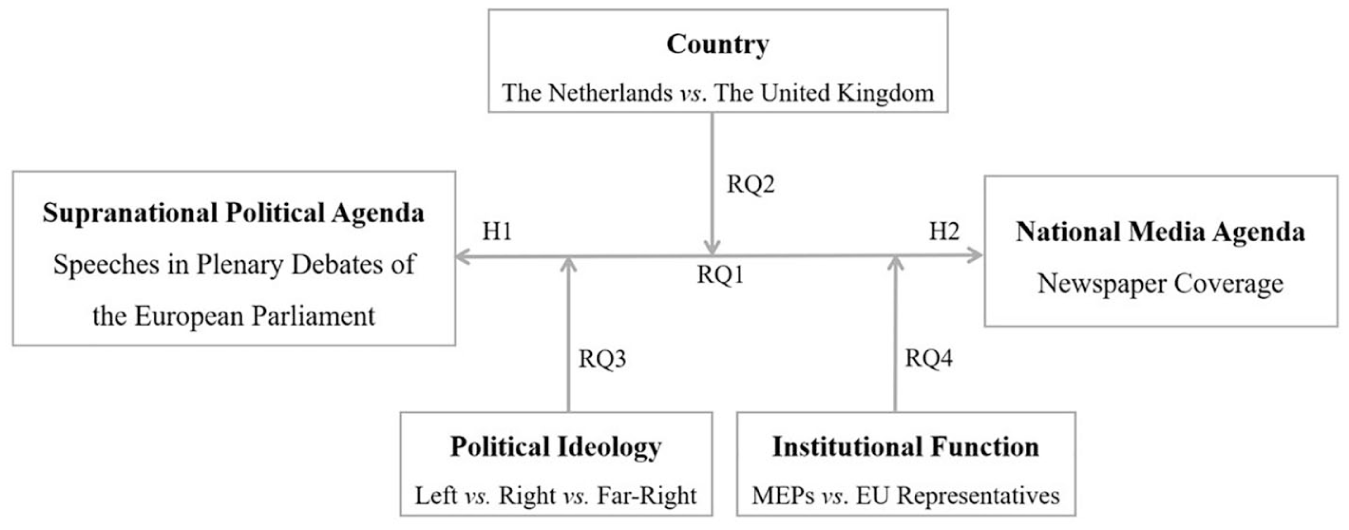
Conceptual framework of the reciprocal relationship between supranational political agenda and national media agenda on EU–China trade relations. MEPs = Members of the European Parliament, EU = European Union.
Media Agenda-Setting and Political Agenda-Building
Existing research has demonstrated that the national media can, in many cases, affect the national parliamentary agenda (e.g., Vliegenthart et al. 2016; Walgrave and Van Aelst 2006). In terms of the national-supranational dynamics, national media play a vital role in increasing the EU’s legitimacy and accountability by translating complex European policies into national public discourse and facilitating public debates (Trenz 2004). This role is especially important, as widespread European media are largely absent or unknown to the general public (Mourlon-Druol et al. 2022; Trenz 2008).
On the one hand, national news media act as watchdogs, scrutinizing EU representatives, while also providing a forum for deliberating on EU affairs and informing the public about the EU policy process (Gattermann and Vasilopoulou 2015; Koopmans 2007). On the other hand, the EP addresses the absence of a unified EU media agenda by devoting considerable attention to national media coverage on EU affairs, particularly in light of information subsidies tailored to national contexts (Laursen and Valentini 2015). In the context of EU–China trade relations, national media coverage not only provides access to information beyond geographical and cultural boundaries (Orbetsova and Men 2016), but it also elevates the issue salience to the European level. This elevated salience can serve as an electoral incentive for MEPs to actively engage in related legislative activities because responsiveness to nationally prominent issues increases MEPs’ chances of being noticed and rewarded by voters (Sorace 2021). Hence, we propose the first hypothesis:
According to the Indexing Hypothesis (Bennett 1990), news content on political issues directly reflects the political agenda set by elites—a dynamic largely explained by journalists’ heavy reliance on powerful institutional sources when shaping news content (Bennett 2016). For instance, national newspaper coverage of the European Commission and the European Parliament tended to report more often about institutions than individual politicians (Gattermann 2022). Moreover, the national media agenda on the EU’s socio-economic strategy was also found to be driven by European institutions and EU-level actors (De la Porte and Van Dalen 2016). In the Netherlands, the national political agenda has been demonstrated to impact the national media agenda on a range of issues, such as economic policy or economic crisis (Kleinnijenhuis and Rietberg 1995; Vliegenthart and Mena Montes 2014). In the United Kingdom, economic reporting has reflected a stronger political dimension, where partisanship is likely to be found in mainstream newspapers, even spilling over into the business pages (Doyle 2006). Chiru (2024) also highlighted that media coverage of MEPs’ legislative outputs has increased, as these outputs readily provide newsworthy stories for national media. From this perspective, when the EP prioritizes EU–China trade relations on its political agenda, the national media are likely to use these outputs of legislative activities to inform their audiences about the EP’s stance. Through such reporting, national media can then hold MEPs accountable for their roles in shaping the political agenda at the European level. Thus, we propose the second hypothesis:
In terms of the reciprocal relationship, existing research has found that the influence of the national media agenda on the national parliamentary agenda is stronger than the opposite effect, which could be ascribed to a shared public sphere and direct electoral accountability (e.g., Sciarini et al. 2020; Van Aelst and Vliegenthart 2014). Nevertheless, the dynamics between the EP’s supranational political agenda and the national media agenda are, arguably, more complex. Given the absence of a truly European public sphere (Adam 2016), EU-related issues are often covered through a national lens, focusing on how EU legislation affects the home country rather than the broader European perspective (De Wilde 2019). Therefore, the framing by national media can dilute or distort the European dimension and further influence the EP’s political agenda in diverse ways (Michailidou et al. 2014). In short, it remains unclear whether conclusions drawn from national-national contexts hold true in national-supranational settings, particularly with regard to different research topics. Therefore, we propose a research question to address “who takes the lead?”:
The Moderating Role of Political and Media Systems
Previous research has shown that the politics-media interaction is contingent upon a country’s political and media systems (e.g., Vliegenthart et al. 2016). In terms of political systems, the Netherlands has a multiparty government in which political parties share responsibility, resulting in a lower concentration of executive power but a higher level of proportionality (Vliegenthart and Mena Montes 2014). The United Kingdom, in contrast, has a two-party-dominated government in which political power is institutionally concentrated within either the Labour Party or the Conservative Party (Lijphart 2012). The disparity in political power could lead to differences in political control over journalistic work (Kelly et al. 2004).
In terms of media systems, the Dutch media landscape is deeply rooted in a public service tradition and a consensus democracy (Brants and De Haan 2010), while the UK media landscape is more often driven by market forces (Boumans et al. 2013). Furthermore, different levels of Euroscepticism could influence the national media agenda (Barbieri and Campus 2015). Specifically, the United Kingdom has traditionally been perceived as more skeptical of the EU than the Netherlands (Bijsmans 2017; Kandyla and De Vreese 2011). Thus, the UK media may devote less attention to the EP’s political agenda than the Dutch media. However, EU–China trade relations have also had a major impact on the UK’s national interest (e.g., the steel industry; see Hutton 2021). In this regard, the United Kingdom may pay more attention to the EP’s political agenda. This ambiguity complicates the prediction of how the interaction will unfold. Thus, we propose the research question:
The Moderating Role of Political Ideology
EP Plenary Debates are one of the most important venues for MEPs to raise questions, express criticism, and take policy positions (Greene and Cross 2017). MEPs sit in political groups, organized by political affiliations rather than by nationalities (European Parliament 2024a). Previous research has revealed latent ideological conflicts among MEPs and demonstrated that the left-right dimension matters more for economic issues than for non-economic issues in the European Parliament (Otjes and Van Der Veer 2016; Slapin and Proksch 2010).
In terms of the left-right divide on positions of trade policy, a cross-national empirical study suggested that the left typically advocates for more trade protection while the right favors more free trade (Milner and Judkins 2004). In this study, we categorize the EP political groups along the left-right spectrum, distinguishing between Left, Right, and Far-Right. The right side of the spectrum—comprising both the Right and Far-Right—remains deeply divided, particularly on foreign policy issues (Becker and Von Ondarza 2024). When examining EU–China trade relations, the EP political groups exhibit varying degrees of attention toward China, which may result in different priorities for bilateral trade relations on their agendas (Stec and Chimits 2024). For instance, the European People’s Party and the Alliance of Liberals and Democrats for Europe stand out for having the most robust and defined perspectives on China, which include protecting the EU’s economic competitiveness and reducing dependence on China by following the EU’s “de-risking” strategy.
However, little is known about whether the variation among political groups is consistent across previous parliamentary terms. Since different political affiliations could result in diverse policy positions (e.g., Ahrens and Kantola 2022), MEPs from various EP political groups may adopt divergent or even dissenting positions on EU–China trade relations. These differences, accordingly, could influence the national media agenda in different ways. Given the difficulty in predicting how this translates into different effect sizes and dynamics, we put forward the research question:
The Moderating Role of Institutional Function
The European Commission, as the main executive body, speaks for the EU’s common interests, whereas the MEPs represent the interests of constituencies within their respective EU member states (Greenwood 2017). Specifically, MEPs participate in the EU’s decision-making and express their standpoint vis-à-vis the European Commission and the Council of the European Union in the EP’s plenary sitting (European Parliament 2024b).
As the EU’s foreign trade policy is driven by competing factors (i.e., economic interests vs. political values), some EU member states do not always recognize that the EU’s collective foreign policy serves their national interests (Farnell and Irwin Crookes 2016). For example, at the end of 2015, the Netherlands and the United Kingdom argued for China to be granted market economy status since both countries have outsourced production to China and would benefit economically if the EU recognized China’s market economy status (Costello 2016). However, a majority in the EP opposed this resolution to protect the EU’s common interests (European Parliament 2015). Hence, one might expect Dutch and UK MEPs to lay out different agendas on EU–China trade relations compared to the representatives of the European Commission and the Council of the European Union in EP Plenary Debates.
Previous research has shown the impact of the conflict between the European Parliament and the Council of the European Union on the national media attention to negotiations on EU legislative acts in both the Netherlands and the United Kingdom (De Ruiter and Vliegenthart 2018). Therefore, we anticipate the conflict of interests between these two EU institutions to play a role in the context of EU–China trade relations. This leads to the following research question:
Key Issues in EU–China Trade Relations
As trade policy is an exclusive EU competence, the EU holds a strong position in global trade, legislating on trade issues with non-EU countries and establishing international trade agreements with a unified voice (European Council 2024a). Existing research has typically examined the average attention given to “foreign trade” on the national parliamentary agenda and the national media agenda (e.g., Sciarini and Tresch 2019; Vliegenthart et al. 2016). For instance, Kristensen et al. (2023) used sub-issues (e.g., import and export) as indicators to identify “foreign trade.” However, there remains a paucity of empirical evidence on the transfer of attention to sub-issues of “foreign trade” from the national media agenda to the EP’s political agenda at the supranational level; little is known about whether and how specific trade issues contribute to the power of politics-media dynamics.
Foreign trade, as a broad umbrella term, actually encompasses a wide range of sub-issues warranting further investigation. This is particularly relevant for EU–China trade relations, because trade forms both the cornerstone and the driving force of EU–China relations (Men 2016). The 2019 EU Strategic Outlook advocates for reciprocal market access to ensure a level playing field and to eliminate unfair practices in the EU’s trade engagement with China (European Commission 2019). Furthermore, the EU’s recent legislative initiatives emphasize that fair and equitable trade relies on effective regulation in key areas, including foreign direct investment and anti-dumping measures (European Council 2024b). This study therefore expands the focus on reciprocity (e.g., examine foreign direct investment through “the EU’s investment in China” and “China’s investment in the EU”) and investigates the transfer of attention to sub-issues between the EP’s political agenda and the national media agenda. Given the absence of clear expectations regarding specific trade issues, we propose the following research question:
Method
A systematic quantitative content analysis was conducted on speeches from EP Plenary Debates and newspaper articles covering EU–China trade relations. The sampling period extended from January 1, 2001 to December, 31 2020, commencing with the year of China’s accession to the World Trade Organization and concluding with the UK’s exit from the EU single market and customs union (Walker 2021). Time-series analyses of monthly aggregated data were used to address all research questions and test the hypotheses.
Data Collection
Media Agenda: Newspaper Articles
Verified search strings were developed to collect news articles about EU–China trade relations (see Supplemental File, Appendix A). Dutch newspaper articles were retrieved from the Nexis Uni Database; UK newspaper articles were retrieved from the Dow Jones Factiva Database. We examined the entire corpus, including six Dutch and eight UK newspapers (see Supplemental File, Appendix B). After excluding news briefs, letters, book reviews, and long lists of reported economic figures and indicators (see Soroka et al. 2015), 867 articles remained for the final analysis.
Political Agenda: Speeches in EP Plenary Debates
All plenary speeches about EU–China trade relations were collected from the EP’s official website. 1 As the search engine did not support extensive strings with Boolean operators, we adopted a two-step approach for data collection. First, we searched for each of the following keywords separately in the “In title” or “In text” fields: “China”, “Chinese”, “Chinees”, “Beijing”, or “Peking”. Second, we applied the keywords used for collecting news articles and manually screened all collected speeches to filter out those not pertinent to the topic of EU–China trade relations (e.g., climate change, gender equality). After excluding duplicates and irrelevant items, this study analyzed 538 speeches from EU representatives (n = 254) and MEPs from the Netherlands (n = 79) and the UK (n = 205).
Operationalization
Media attention was measured by the number of newspaper articles about EU–China trade relations published monthly within each country. Parliamentary attention was operationalized as the number of speeches in EP Plenary Debates that addressed EU–China trade relations each month. The monthly level of aggregation was considered appropriate because it not only smooths out the impact of short-term noise and random fluctuations (i.e., temporary peaks of attention due to special events) but also provides more accurate predictions of long-term trends. Using each speech as the unit of analysis allowed for comparisons between MEPs and representatives of EU institutions (i.e., the European Commission and the Council of the European Union) at the supranational level.
Issue salience was detected by manually coding the presence of sub-issues in EU–China trade relations. All sub-issues were adapted from the Comparative Agendas Project Codebook (Bevan 2022) to capture the complexity of EU–China trade relations: (1) the EU’s investment in China, (2) China’s investment in the EU, (3) the EU’s exports to China, (4) the EU’s imports from China, (5) EU–China trade agreements, (6) economic systems, and (7) exchange rates (presence = 1; non-presence = 0). The codebook provided detailed coding instructions and examples (see Supplemental File, Appendix C).
All three moderators were manifest variables, each manually coded. Country was measured by dummy variables (the Netherlands = 0; the UK = 1). Political ideology was captured by the political affiliations of MEPs who delivered speeches on EU–China trade relations and operationalized into three groups: Left Group, Right Group, and Far-Right Group (see Supplemental File, Appendix D). The categorization was guided by the EP’s seat projection maps and existing literature (e.g., Ahrens et al. 2022). Institutional function was defined by whether the speeches on EU–China trade relations were made by MEPs or EU representatives. The former referred to the MEPs from the Netherlands and the United Kingdom; the latter referred to the representatives of the European Commission and the Council of the European Union (MEPs = 0; EU representatives = 1).
Coding Procedure
The manual coding was performed by six coders with diverse academic, cultural, and linguistic backgrounds. After three rounds of coder training, an intercoder reliability test was performed using EP plenary speeches by MEPs from other EU countries and articles from the Reuters newswire (i.e., 10% of the final sample size as the threshold). Krippendorff’s alpha scores for all tested variables ranged from 0.89 to 1.00 for EP plenary speeches and from 0.88 to 1.00 for newspaper articles (see Supplemental File, Appendix E, for full results), indicating high levels of agreement among the coders.
Time-Series Analyses
Vector autoregression (VAR) was adopted to test multidirectional relationships with uncertainty about causal ordering (Vliegenthart 2014). Each variable in the VAR model was assumed to be endogenous, meaning it could be affected by its own past values and the past values of all other endogenous variables. A key advantage of the VAR model for prediction is that it estimates equations using ordinary least squares (OLS), a method that remains valid even when zeros are present in the data, as OLS does not inherently assume a data distribution that would be fundamentally violated by their presence (Borckardt et al. 2013).
Step 1: Test for Stationarity
The assumption of stationarity implies that the variation of the series should not change over time (i.e., no random walk in the series). The augmented Dickey–Fuller tests yielded significant results (see Supplemental File, Appendix F, Table F1), indicating that both the political series and the media series were stationary.
Step 2: Model Specification
The goal of model specification was to establish the number of lags for various variables to include in the equations. The number of lags had to be equal for each endogenous variable. Given that the study had 240 data points (months), the number of lags was constrained to avoid using too many degrees of freedom. Following Vliegenthart (2014), the best model was selected using fit statistics such as the Akaike Information Criterion, Bayesian Information Criterion, Final Prediction Error, and Hannan–Quinn Information Criterion. Therefore, a maximum of two lags was allowed for the selection-order criteria, implying that mutual effects were expected to occur within two months.
Step 3: Interpretation of Results
Granger-causality tests were performed to determine whether one time series (i.e., European parliamentary attention) can predict the future values of another time series (i.e., national media attention), and vice versa. Although the results of VAR analyses may resemble those of a set of OLS regressions, individual coefficients should be interpreted with caution due to potential multicollinearity, particularly due to high correlation between lags of the same variable. Thus, several additional indicators were considered to evaluate the results (see Vliegenthart and Damstra 2019). Specifically, the Cumulative Impulse Response Function (CIRF) was calculated to report the cumulative change in one endogenous variable due to a one-standard-deviation impulse in another endogenous variable. In this way, we obtained a clear visualization of the direction and size of the dynamic effects of one series on the other series, which could enhance the understanding of dynamic interaction between the EP’s political agenda and the national media agenda. Decomposition of Forecast Error Variance (FEVD) tests were also employed to attribute the percentage contribution of the variance of each variable due to the changes in other variables over the long run (see Supplemental File, Appendix F, Figures F1 and F2, for CIRF and FEVD visualization).
Results
General Trend
The national media agenda reached two peaks of attention in November 2007 and in March 2019 (see Figure 2). The former reflected the EU’s concern about its trade deficit with China, whereas the latter mirrored the debate over Italy’s decision to join the Belt and Road Initiative and its impact on EU–China trade relations. In contrast, the peaks were less pronounced on the EP’s political agenda. Yet, a heated debate occurred in September 2005 regarding the prospects of EU–China trade relations, as well as China’s market economy status in May 2016.
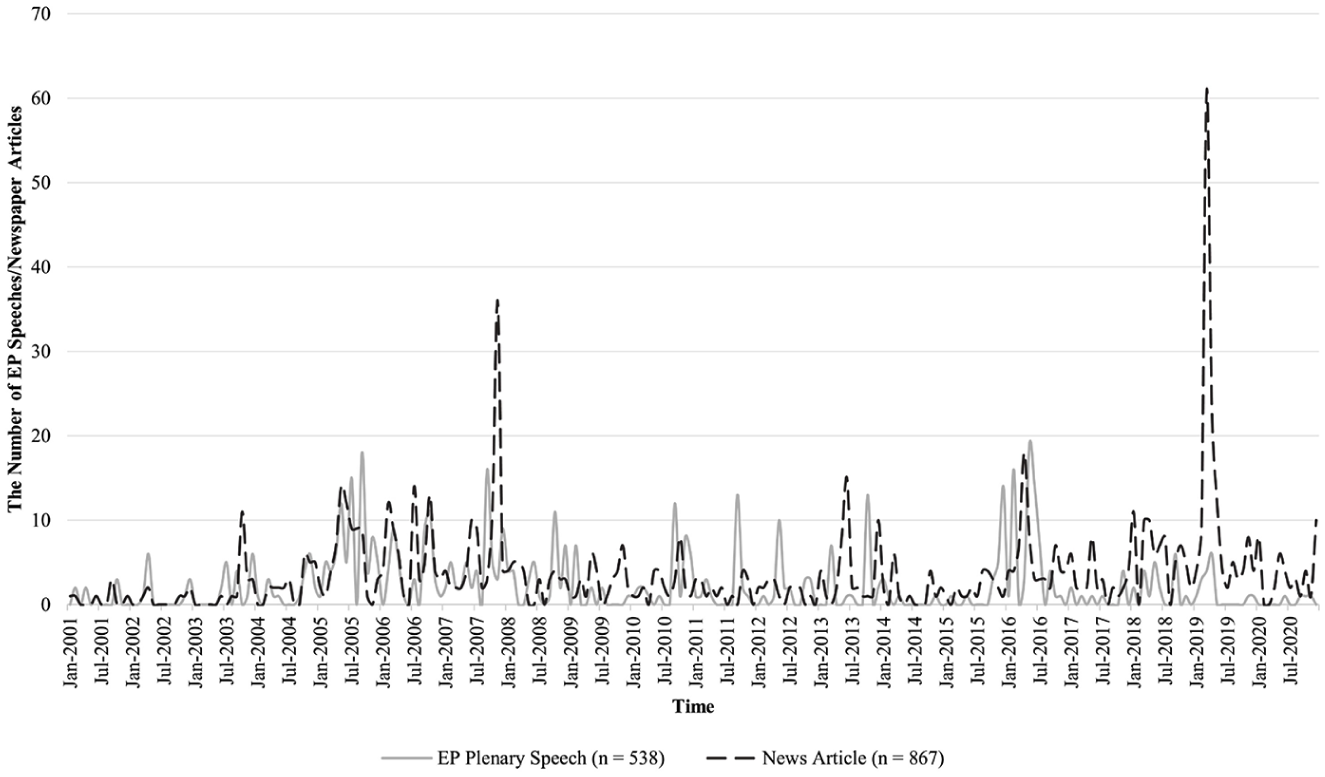
Time-series of supranational political agenda and national media agenda on EU–China trade relations (2001–2020).
The time series demonstrated that both the EP’s political agenda and the national media agenda had different amounts of attention at many points. In line with this observation, we identified a weak but significant positive correlation between the EP’s political agenda and the national media agenda on EU–China trade relations in the Netherlands and the United Kingdom (r = .18, p = .005). Additionally, strong correlations were observed within both the political series and the media series in the Netherlands and the United Kingdom: monthly attention for EU–China trade relations correlated strongly between Dutch MEPs and UK MEPs (r = .62, p < .001), and similarly between the Dutch media and the UK media (r = .66, p < .001).
Main Effects
Granger-causality tests revealed a significant reciprocal relationship between EP plenary speeches and national news coverage on EU–China trade relations (2001–2020), with the effect of media agenda on political agenda (χ2 = 8.69, p = .013) and the effect of political agenda on media agenda (χ2 = 8.24, p = .016) both being significant. Coefficients in Table 1 indicate positive effects. Therefore, both H1 and H2 were confirmed, indicating that national media coverage of EU–China trade relations leads to more political attention to this topic by the EP, and vice versa. 2
Vector Autoregression Model (VAR) Estimates.
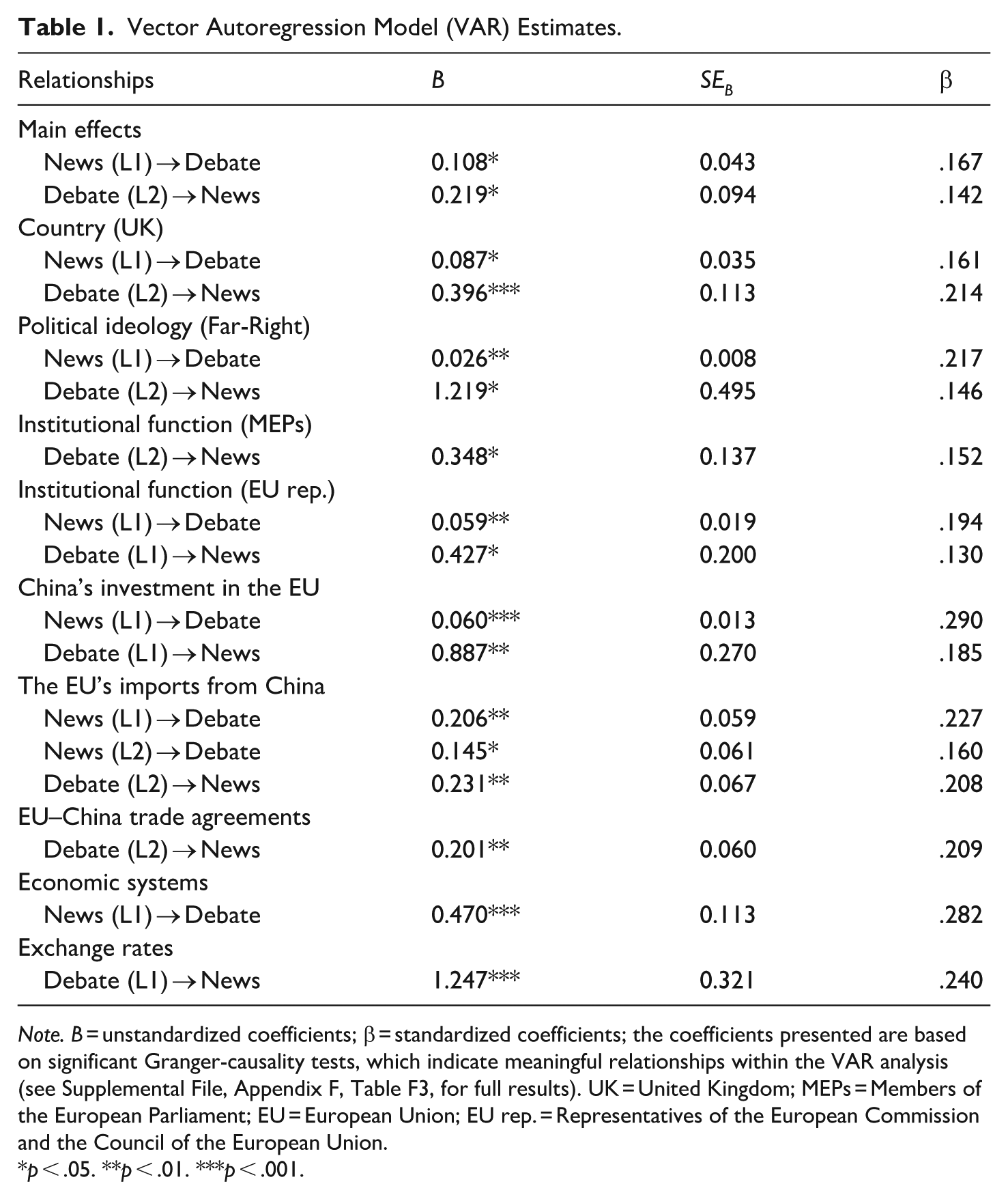
Note. B = unstandardized coefficients; β = standardized coefficients; the coefficients presented are based on significant Granger-causality tests, which indicate meaningful relationships within the VAR analysis (see Supplemental File, Appendix F, Table F3, for full results). UK = United Kingdom; MEPs = Members of the European Parliament; EU = European Union; EU rep. = Representatives of the European Commission and the Council of the European Union.
p < .05. **p < .01. ***p < .001.
In terms of RQ1, the CIRF suggested that after eight months, each mention of EU–China trade relations in national newspaper articles resulted in a 0.49 standardized change in EP plenary speeches over time, whereas each mention of EU–China trade relations in EP plenary speeches resulted in a 0.53 standardized change in national newspaper articles (see Figure 3). Given these small differences, we conclude that the mutual influences are of similar size, which implies a balanced power relationship between supranational political agenda-building and national media agenda-setting in the context of EU–China trade relations.
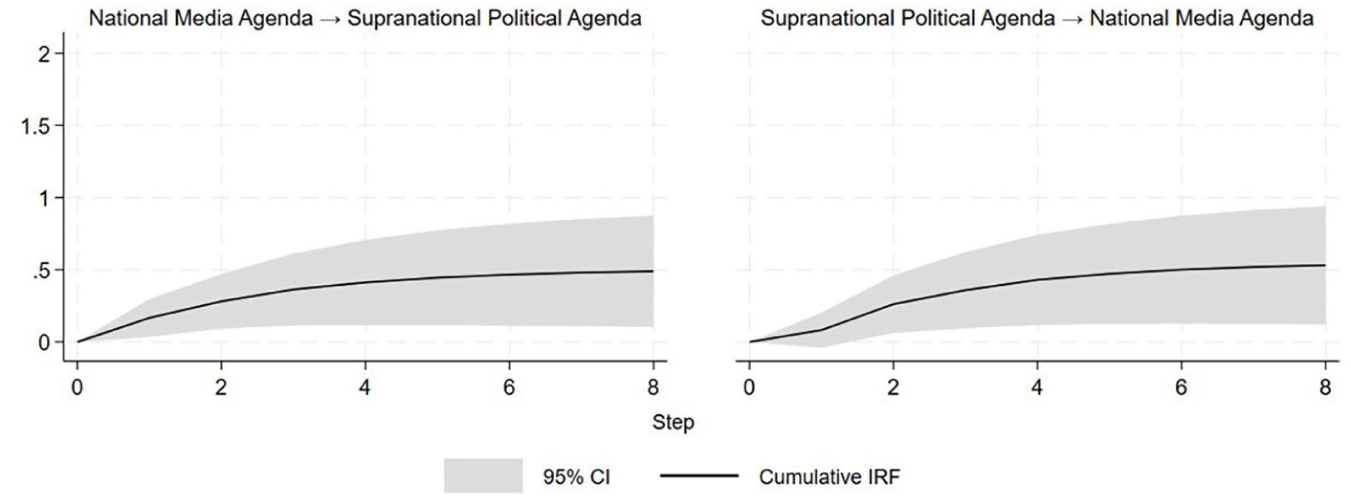
Cumulative impulse response function tests of main effects.
Moderation Effects
By Country
In terms of RQ2, we did not find a reciprocal relationship between speeches by Dutch MEPs and Dutch newspaper coverage. By contrast, we identified a significant reciprocal relationship between speeches by UK MEPs and UK newspaper coverage through Granger-causality tests, where the effect of media agenda on political agenda was significant (χ2 = 12.12, p = .002), as was the effect of political agenda on media agenda (χ2 = 14.22, p = .001). The CIRF suggested almost equal size of the mutual influences (P → M: 0.53 vs. M → P: 0.52) between UK MEP’s political agenda and the UK media agenda.
By Political Ideology
In terms of RQ3, there was no reciprocal relationship between national media coverage and speeches delivered by MEPs affiliated with the Left or Right Groups, respectively. However, we detected a significant reciprocal relationship between national newspaper coverage and EP plenary speeches by MEPs affiliated with Far-Right Groups. For Far-Right Groups, the Granger-causality tests demonstrated that the effect of media agenda on political agenda was significant (χ2 = 15.18, p = .001), as was the effect of political agenda on media agenda (χ2 = 8.43, p = .015). The CIRF suggested that the national media agenda had a slightly stronger long-term impact on Far-Right MEPs’ political agenda than vice versa (P → M: 0.47 vs. M → P: 0.56).
By Institutional Function
In terms of RQ4, a significant reciprocal relationship between national newspaper coverage and speeches by MEPs was identified through Granger-causality tests, with the effect of media agenda on political agenda (χ2 = 6.36, p = .042) and the effect of political agenda on media agenda (χ2 = 7.39, p = .025) both being significant. We also found a significant reciprocal relationship between national newspaper coverage and speeches by EU representatives, with the effect of media agenda on political agenda (χ2 = 9.41, p = .002) and the effect of political agenda on media agenda (χ2 = 4.54, p = .033) both being significant. The CIRF suggested that the mutual influences between MEPs’ political agenda and the national media agenda are of similar size (P → M: 0.45 vs. M → P: 0.44). By contrast, the national media agenda had a somewhat stronger long-term impact on EU representatives’ political agenda than vice versa (P → M: 0.27 vs. M → P: 0.40).
Issue Presence
In the full dataset, 57.6% of EP plenary speeches and 55.5% of news articles presented the EU’s imports from China. This featured as the most prominent issue on the EP’s political agenda and the national media agenda (see Table 2). RQ5 was answered using Granger-causality tests (see Supplemental File, Appendix F, Table F2, for detailed statistics). We identified a significant reciprocal relationship between the EP’s political agenda and the national media agenda on China’s investment in the EU and the EU’s imports from China. With regard to EU–China trade agreements and exchange rates, we found a significant effect of the EP’s political agenda on the national media agenda. In terms of economic systems, we identified a significant effect of the national media agenda on the EP’s political agenda. However, no reciprocal relationship was detected between the EP’s political agenda and the national media agenda on the EU’s investment in China and the EU’s exports to China.
Presence of Sub-Issues of EU–China Trade Relations on Supranational Political Agenda and National Media Agenda.
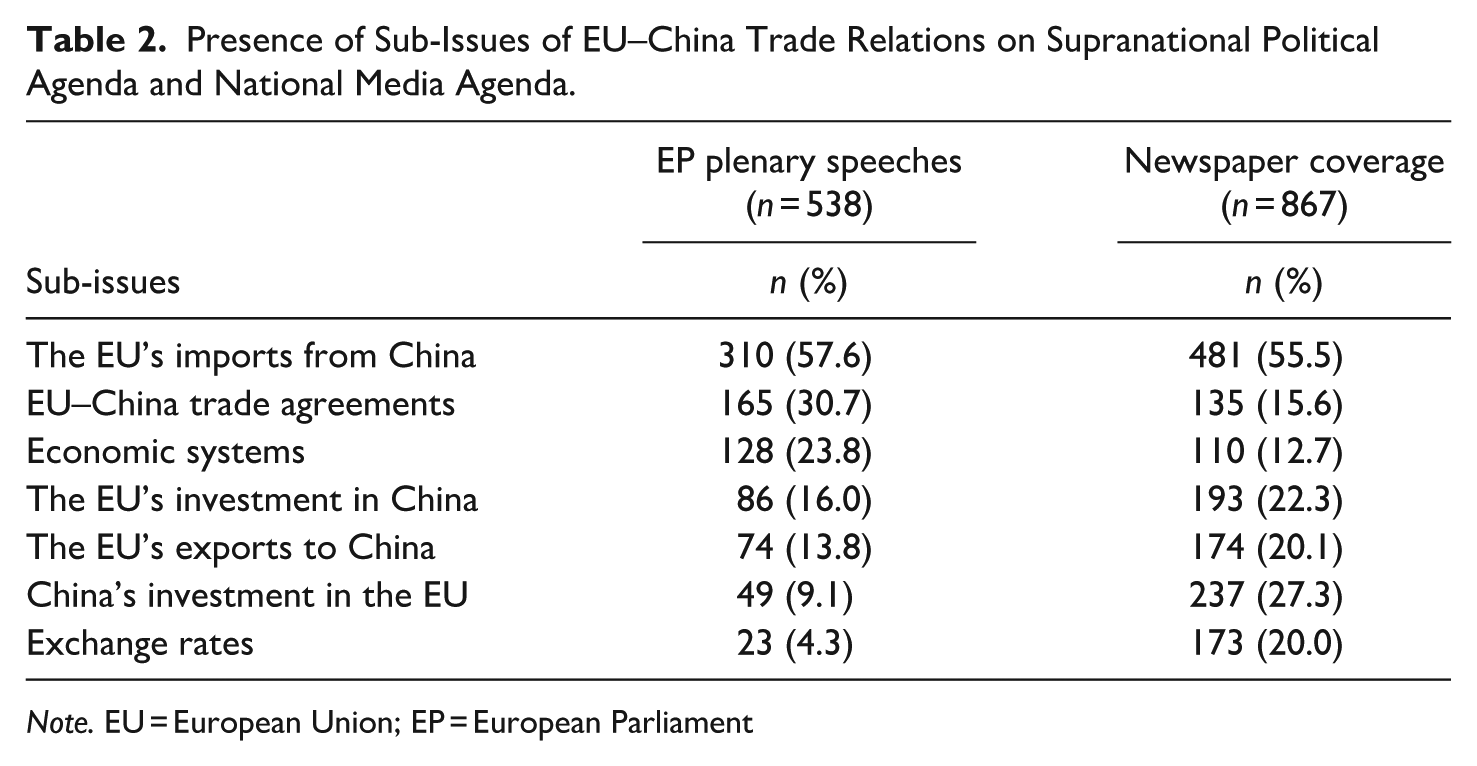
Note. EU = European Union; EP = European Parliament
Discussion
This study investigated reciprocal relationships between the EP’s political agenda and the national media agenda on EU–China trade relations in the Netherlands and the United Kingdom from 2001 to 2020. Four major findings were yielded. First, there has been a positive reciprocal relationship between the EP’s political agenda and the national media agenda on EU–China trade relations over the past two decades. This not only replicates the patterns observed in agenda-setting research but also extends their applicability to the context of international trade relations.
Notably, the EP’s political agenda-building power was nearly equal to the national media agenda-setting power in the context of EU–China trade relations. This finding, however, diverges from previous research, which suggested that the national media agenda on the EU’s socio-economic strategy was primarily driven by European institutions and EU-level actors (De la Porte and Van Dalen 2016). This divergence could be attributed to news values. Specifically, the EU’s socio-economic strategy is broad-scoped and process-oriented; its high visibility on the national media agenda largely arises from major policy changes at the European level. By contrast, EU–China trade relations are inherently conflict- and impact-driven. Thus, media agenda-setting power is likely driven by issues that inherently possess higher news values. Moreover, the balanced power in politics-media dynamics was confirmed specifically for the United Kingdom, but not for the Netherlands. The finding could be explained by MEPs’ divergent policy priorities and their stances toward the EU in the two countries. With a long-standing skeptical attitude toward the EU (Barbieri and Campus 2015), UK MEPs prioritized national interests, for instance, by raising concerns about the impact of EU trade policy on the UK steel industry. By contrast, Dutch MEPs largely shared and emphasized broader EU-level concerns, such as leveraging human rights issues in the context of EU trade policy. Therefore, issue-specific newsworthiness and country-specific contexts appear to foster a reciprocal relationship between the EP’s political agenda and the national media agenda.
Second, MEPs affiliated with Far-Right Groups demonstrated a reciprocal influence on the media attention given to EU–China trade relations, and vice versa. In contrast, such an effect was not found among Left and Right Groups. This finding further confirms that certain parties have different agenda-building capacities to elevate their issues onto the media agenda (Sciarini et al. 2020), thereby expanding the generalizability of previous research from the national level to the supranational level. Research has shown that the impact of Far-Right parties depends on their internal cohesion and the level of conflict in EP plenary sessions (Brack and Marié 2024). An issue like EU–China trade relations could, therefore, become more prominent if Far-Right MEPs frame it in line with their core tenets, such as prioritizing national interests and reducing dependence on global trade. If this framing taps into existing national concerns, the political agenda of Far-Right MEPs is more likely to be amplified and reciprocated by the national media. From the perspective of “issue ownership”, Far-Right parties often strategically “own” certain issues and position themselves as the primary voice for particular concerns (McDonnell and Werner 2019). Due to the perceived negative impact of EU–China trade relations on national interests, Far-Right MEPs, by establishing themselves as leading critics, are likely to receive more national media attention. This occurs as media also use “negativity” to increase newsworthiness and attract audiences (Boukes and Vliegenthart 2020). The increased media attention, therefore, reinforces their position as an important source on EU–China trade relations and establishes a reciprocal relationship between media and politics.
Third, positive mutual influences were identified between the national media agenda and MEPs’ political agenda, as well as between the national media agenda and EU representatives’ political agenda. This finding corroborates the moderating role of institutional functions at the supranational level. Specifically, it highlights the impact of the conflict between the European Parliament and the Council of the European Union on the national media attention to EU-related issues; it also generalizes previous findings from the EU internal issue of “EU legislative acts” to the EU external issue of “EU–China trade relations” (De Ruiter and Vliegenthart 2018). Compared to EU representatives, MEPs play a crucial role in representing the interests of their constituencies in their respective EU member states; this aligns with the normative role performed by journalists affiliated with national media in directing public attention to domestic concerns (Hanitzsch and Vos 2018). The stronger impact of the national media agenda on EU representatives’ political agenda also corroborates the reliance on national news media by EU policymakers and confirms the vital role of national news media in informing the EU policy process (Gattermann and Vasilopoulou 2015).
Fourth, the considerable attention to the EU’s imports from China on both the EP’s political agenda and the national media agenda not only implies the major dispute in EU–China trade relations (European Council 2024b) but also validates previous research that used “import-export” as indicators to measure “foreign trade” in agenda-setting research (Kristensen et al. 2023). Interestingly, mutual influences between the EP’s political agenda and the national media agenda were observed only when discussing the EU’s imports from China and China’s investment in the EU, but not in relation to the EU’s exports to China or the EU’s investment in China. Thus, it can be inferred that proximity—defined as whether the issue has a geographical and social impact on the location where the agenda is set up—could play a moderating role in the politics-media dynamics (see Boydstun 2013).
This study is the first attempt in the field to employ time-series analyses to investigate reciprocal relationships between the EP’s political agenda and the national media agenda on EU–China trade relations in the European context. Theoretically, these findings not only provide innovative insights into the function of multilevel structures (i.e., supranational vs. national) in the interaction between the political and media agendas in the context of international trade relations, but they also expand the generalizability of empirical evidence to broader contexts and advance existing knowledge in agenda-setting research. Methodologically, this study builds on the Comparative Agendas Project Codebook (Bevan 2022) by developing detailed systematic coding schemes for specific trade issues in the context of international trade relations, which can be applied to examine trade relations between the EU and other countries.
Future research could extend this work in several directions. First, incorporating a wider range of countries would be crucial to validate the generalizability and robustness of our findings across different political and media systems, both within the EU and globally. Second, investigating diverse policy issues beyond the current scope would allow for a more nuanced understanding of how agenda-setting and agenda-building dynamics vary depending on issue salience. Third, it would be particularly insightful to delve into the long-term impact of contextual factors, such as major geopolitical shifts (e.g., Brexit) or trade negotiations (e.g., the Comprehensive Agreement on Investment), on the longitudinal evolution of the reciprocal relationship between the national media agenda and the supranational political agenda.
Supplemental Material
sj-docx-1-hij-10.1177_19401612251368278 – Supplemental material for Who Takes the Lead? Reciprocal Relationships Between the European Parliament’s Political Agenda and National Media Agenda on EU–China Trade Relations in the Netherlands and the United Kingdom (2001–2020)
Supplemental material, sj-docx-1-hij-10.1177_19401612251368278 for Who Takes the Lead? Reciprocal Relationships Between the European Parliament’s Political Agenda and National Media Agenda on EU–China Trade Relations in the Netherlands and the United Kingdom (2001–2020) by Xiaoyang Zhao, Rens Vliegenthart, Knut De Swert and Mark Boukes in The International Journal of Press/Politics
Footnotes
Acknowledgements
We thank the editors and reviewers for their constructive feedback. We also thank the coding team for their diligent assistance with manual coding. Earlier stages of this research were presented at the 73rd Annual International Communication Association Pre-Conference, the European Consortium for Political Research General Conference 2023, the 15th Annual Conference of the Comparative Agendas Project, and the 25th Etmaal Communication Science Conference. Discussants at these conferences provided helpful comments.

Ethical Considerations
The research was conducted in compliance with the ethical regulations of the Department of Communication Science at the University of Amsterdam (FMG-10751_2024).
Funding
The authors disclosed receipt of the following financial support for the research, authorship, and/or publication of this article: The work was supported by the UvA–CSC Joint Scholarship and the ACES Thematic Research Grant (2024).
Declaration of Conflicting Interests
The authors declared no potential conflicts of interest with respect to the research, authorship, and/or publication of this article.
Data Availability Statement
The dataset supporting the findings of this study are available from the corresponding author upon reasonable request.
Supplemental Material
Supplemental material for this article is available online.
Notes
Author Biographies
References
Supplementary Material
Please find the following supplemental material available below.
For Open Access articles published under a Creative Commons License, all supplemental material carries the same license as the article it is associated with.
For non-Open Access articles published, all supplemental material carries a non-exclusive license, and permission requests for re-use of supplemental material or any part of supplemental material shall be sent directly to the copyright owner as specified in the copyright notice associated with the article.
