



Abstract
Contemporary media systems are in transition. The constellation of organizations, groups, and individuals contributing information to national and international news flows has changed as a result of the digital transformation. The “hybrid media system” has proven to be one of the most instructive concepts addressing this change. Its focus on the mutually dependent interconnections between various types of media organizations, actors, and publics has inspired prolific research. Yet the concept can tempt researchers to sidestep systematic analyses of information flows and actors’ differing degrees of influence by treating media systems as a black box. To enable large-scale, empirical comparative studies aimed at identifying interdependencies and power relationships in contemporary media systems, we propose the concept of discursive power. This describes the ability of contributors to communication spaces to introduce, amplify, and maintain topics, frames, and speakers, thus shaping public discourses and controversies that unfold in interconnected communication spaces. We also provide a theoretical framework of how structural features of organizations and media systems contribute to the emergence of discursive power for different types of actors in various contexts. This adds to the theoretical toolkit available to researchers interested in the empirical analysis of contemporary media systems.
Keywords
Why Talk about Power in Contemporary Media Systems?
Contemporary media systems are in transition (Williams and Carpini 2011). The constellation of organizations, groups, and individuals contributing information to national and international news flows has changed significantly as a result of the digital transformation. Traditional news organizations that once produced news in specific distribution formats—such as newspapers, television, and radio—have transformed into producers of multi-media news content with a strong focus on digital distribution channels (Sehl et al. 2018). All the while, new “digital born” (Nicholls et al. 2016) news organizations have emerged that are motivated to produce a wide variety of content, from in-depth investigative journalism to eyeball-catching clickbait and even explicitly partisan news coverage aimed at contesting and countering that of more established news organizations. In addition, digital technology has provided new forms of audience measurements, offering editors and journalists fine-grained statistics on audience behavior that allows them to infer drivers of audience attention and interests—insights they use to adjust their news coverage accordingly (Cherubini and Nielsen 2016; Webster 2014). Moreover, online spaces where political talk unfolds—such as Twitter, Facebook, YouTube, and Reddit—open a window into the interests and concerns of publics and even can provide quotes and scoops that may end up inspiring or shifting news coverage (Anstead and O’Loughlin 2015). What emerges has been described as a “hybrid media system” in which both “older” and “newer” actors freely use “older” and “newer” logics in the production, distribution, and consumption of news and political information (Chadwick 2017). This transition raises the question of whether the power once attributed to traditional news organizations still holds.
In the past, the news media was credited with the power to set the agenda of topics people thought about (McCombs 2014), recognize frames contributing to public discourse, and provide speakers in that discourse with access to the general public (Entman 2004; Gitlin 1980), and even act as arbiters of political competition by providing commentary and judgment on actors competing publicly for political power (Ferree et al. 2002). These gatekeeping powers of traditional news organizations (Shoemaker and Vos 2009) are now contested as alternative news organizations that have emerged online and people interested in getting their voices heard in politics are able to take freely to spaces of political talk online and communicate with publics (Barzilai-Nahon 2008; Vos and Heinderyckx 2015). This has led some to expect a fundamental shift in power away from hierarchically organized, internationally present commercial media organizations toward small, decentralized, networked outlets and individuals (Castells 2013) or to individuals and groups skilled in controlling the flow of information in interconnected communication spaces (Chadwick 2017). Others emphasize the continued importance of structural features of organizations, the behavior of publics, and the structure of national media systems. They point to the continued influence of traditional news organizations on newer contenders and spaces for political talk online (Hindman 2018; Schroeder 2018; Webster 2014).
Current methodological innovations in computational social science promise empirical insights into the dynamics of contemporary media systems (Lazer et al. 2009). However, for these methods to gain traction, we need to begin with a conceptualization of power in contemporary media systems that lends itself to operationalization for measurement and analysis (Jungherr 2018).
In this article, we present a theoretical framework that allows for both the large-scale empirical measurement of different actors’ varying levels of power in contemporary media systems and the identification of structural features of organizations, publics, and media systems that potentially shape the distribution of power between different contributor types. We first introduce the concept of “discursive power” as the ability of contributors to political communication spaces to introduce, amplify, and maintain topics, frames, and speakers that come to dominate political discourse. 1 This can take the form of episodic discursive power, when contributors are able to shape topics, frames, and speakers in isolated discursive episodes, or consistent discursive power, when contributors are able to do so repeatedly over time. We proceed by introducing a series of structural features of organizations and media systems that can be expected to shape systematically the composition and power-balance of information flows in contemporary media systems. In combination, we, thus, provide a theoretical framework that is both context-aware and allows for reliable measurement. This offers a promising basis for large-scale, comparative empirical research into contemporary media systems.
Contemporary Media Systems
Contemporary media systems constitute a set of deeply interconnected news organizations and spaces of political talk online that break, cover, comment on, and distribute political news and information (Chadwick 2017; Schroeder 2018). These actors and spaces are subject to national and international regulations governing their interactions and institutional setups (Hallin and Mancini 2004). Digital media have affected media systems strongly. These changes have arguably weakened the gatekeeping power of traditional media organizations, increased the interdependence of traditional and alternative news organizations, and led to the increased linkage between audience behavior as perceived on digital platforms and content produced by news outlets. In combination, these developments could lead to a shift in the availability of political information and subsequently a heightened influence for actors outside the conventional political spectrum.
Digital media have reduced the costs of producing and distributing information, thereby significantly increasing the number of readily available information sources (Bimber 2003). Rather quickly, established news providers have found themselves competing with digital-born news outlets that did not necessarily share the norms and practices of journalistic work. This has meant a weakening of the gatekeeping power of traditional news organizations. When news editors could choose to ignore stories and voices within the broad political spectrum, as in the past, the effect was that they were actually deciding which of all the available viewpoints and issues made it in front of their audiences. That made them arbiters of the political agenda and political discourse. Today, the decision of even the most influential news editor will not kill a story or suppress a voice (Vos and Heinderyckx 2015). The variety of available news outlets is too large and the competition for attention among them so strong that stories and voices inevitably find their way in front of an audience—even if ignored by traditional news organizations (Schroeder 2018). Add to this the ability of journalists, politicians, consultants, celebrities, and members of the public to contribute to political discourse by tweeting, blogging, or posting public video statements, unfiltered by the editorial decisions of others, and the breadth of opportunities to contribute information and opinion becomes staggering (Chadwick 2017).
Contemporary media systems are shaped by a variety of contributors. We find established media brands, alternative media such as digital-born news outlets and partisan news outlets, political parties, interest groups, companies, interested individuals such as politicians, consultants, and pundits, and members of the public. All are contributing content to the political communication space, be it in the form of original coverage, commentary, or online political talk (Thorson and Wells 2016). The contributions are not independent of each other; rather, contributors are reacting in varying degrees to content provided by others to the political communication space.
While there are many important differences in the institutional setup, journalistic practices, and norms between traditional media organizations and digital-born media, they share the need for attention to be paid to their outlets. In the highly competitive marketplace for news, this leads to a high degree of interdependence (Boczkowski 2010). As long as it generates clicks, a story broken on a partisan news platform, thus, has the potential to make its way into the content of traditional news organizations. By attracting public attention, such as by inciting controversy or breaking norms of democratic discourse, partisan actors have the opportunity to capture the agenda not only on alternative or partisan sites but also in content provided by traditional news organizations, which in the past might have enforced stronger editorial control (Schroeder 2018). This leads to an increasingly strong interdependence with regard to the topics covered by traditional and alternative or partisan news outlets. Editorial decisions can, thus, be expected to affect the tone and angle of coverage, but increasingly less the topic once it has been established as attracting attention in the political communication space.
It is not only media organizations that are interlinked in their coverage. There is also an increasing connection between the topics covered by traditional and digital-born media and the behavior of audiences. Media organizations are watching their prospective and actual audiences through the analysis of public attention on social media platforms or viewership and interaction metrics on their own platforms (Cherubini and Nielsen 2016; Webster 2014). These metrics show the topics people are currently interested in and with which they are interacting. This information can then serve as the basis for an editorial decision to post a quick take on said topic as a way to capture some of the eyeballs currently attracted by the topic. Similarly, analysis of audience behavior on their own sites allows news organizations to adjust their coverage according to the interests of their online audiences manifested in user behavior. This increased mutual “tethering” (Schroeder 2018) of news producers and news consumers is becoming an increasingly important element in decisions about which news to cover and how to present it.
To capture the defining characteristics of contemporary media systems, Andrew Chadwick introduced the term hybrid media system (Chadwick 2017). With it, he emphasizes the interconnection between traditional news media, digitally born news media, and spaces for political talk online: The hybrid media system is built upon interactions among older and newer media logics—where logics are defined as technologies, genres, norms, behaviors, and organizational forms—in the reflexively connected fields of media and politics. Actors in this system are articulated by complex and ever-evolving relationships based upon adaptation and interdependence and simultaneous concentrations and diffusions of power. (Chadwick 2017: 4)
This concept has served as a very helpful framework for understanding the importance of controlling the flow of information in interconnected communication spaces for politicians, activists, and celebrities: Power in the hybrid media system is exercised by those who are successfully able to create, tap, or steer information flows in ways that suit their goals and in ways that modify, enable, or disable the agency of others, across and between a range of older and newer media settings. (Chadwick 2017: 285)
Chadwick’s definition of power emphasizes the skill of individuals in controlling information flows in contemporary media systems to achieve their strategic goals over those of others. This has added a meaningful variable into the discussion of contemporary politics. Yet, from the vantage point of large-scale, comparative, empirical work, this definition comes with two important limitations. First, how we should translate Chadwick’s power to “create, tap, or steer information flows” (Chadwick 2017: 285) in quantifiable empirical measures remains unclear. Second, by emphazing individual actors’ freedom to choose “older” or “newer” logics to achieve their goals, this conceptualization has shifted the focus away from a systems-view aimed at identifying regular patterns, power dynamics, and their determinants (Schroeder 2018: 30f.).
The theoretical framework presented by us addresses both challenges. First, we propose the concept of “discursive power” as an opportunity to measure reliably the influence of different types of contributors to communication spaces. Second, we introduce relevant structural features of organizations, publics, and media systems that can be expected to affect the distribution of discursive power among different types of actors in different contexts. This conceptual extension of the analytical toolkit allows for large-scale, comparative, empirical work on contemporary media systems.
Discursive Power in Contemporary Media Systems
The question of power shifts has been at center stage in studies on the societal effects of digital technology. So, the question of power in contemporary media systems arises naturally. Contemporary conceptualizations of power include the way it manifests in discourse: Discursive power refers to the degree to which the categories of thought, symbolizations and linguistic conventions, and meaningful models of and for the world determine the ability of some actors to control the actions of others, or to obtain new capacities. (Reed 2013: 203)
Following this reading, the ability to shape normative discourses, those arising from political competition, and issue-specific debates is an important element of power (Lukes 2005). While this process often remains “imprecise, ambiguous, or referentially vague” (Reed 2013: 200), we argue that instances of contributors to the political space having “discursive power” over others can be identified each time they successfully introduce, amplify, and maintain topics, frames, and speakers that other contributors pick up in their coverage.
By selecting which topics to cover, frames to feature, and speakers to recognize, contributors to the political communication space are exercising discursive power. In their decisions about which elements of politics to cover, they also decide about the elements and actors in political discourse of which the general public becomes aware. Only by being aware of issues of contention, competing ways of looking at issues, and opposing factions in society can publics be expected to make informed political choices. This influence on society has featured strongly in the normative discussion about how media should cover politics (Christians et al. 2009). Shaping this process means the exercise of discursive power. By focusing on the introduction and spread of specific entities in discourse, we can identify patterns of discursive power and their determinants.
Conceptualizing “discursive power” as instances in which contributors to the political space adopt topics, frames, and speakers from the coverage of others allows for the empirical identification of meaningful moments in which one contributor to the political communication space exercises power over another. In turn, aggregating these moments over a wide variety of contributors, episodes, and contexts promises a comprehensive account of power relationships in contemporary media systems. This can serve as the basis for large-scale projects comparing dynamics in media systems over time or across countries or cultures.
Older approaches prove ill-suited to this task. Take a closely related concept such as intermedia agenda setting (Danielian and Reese 1989). The approach focuses on the transfer of salient entities in the coverage of one type of contributor to another (McCombs 2014). While this approach has proven instructive in the past (Conway et al. 2015; Meraz 2011), its reliance on aggregated entities and actor types depends on there being a media environment with little variance in coverage dynamics of specific topics and among actors of the same type. For example, by analyzing the power of social media in general to influence the salience of specific items in the coverage of established news aggregated across media organizations, one assumes little variance in the link between the two actor types across the political spectrum. The focus on aggregated lists of entities across aggregated groups of actors does not fit well an environment in which we find a lot of variance in the relationship between different actors of the same type—such as “new” or “old” media—as we currently do in the contemporary media system (Benkler et al. 2018). By identifying distinct acts of discursive power between individual actors over time, we can map the influence of specific actors or group of actors over time. This modular approach allows for identifying potentially shifting patterns in the relationships between actors and the identification of new unexpected groupings.
Discursive power is also better suited than established concepts for capturing the richness of influence in discourse across media. For example, where intermedia agenda setting sees power between media organizations or types as the transfer of salience of entities, we see this as only one possibility of shaping discourse.
Other patterns of influence are just as powerful, such as the introduction of entities into discourse or their maintenance over time. Neither pattern necessarily translates into a transfer of salience. For example, were a political blog to introduce a new aspect in an ongoing political debate, and that aspect was picked up by established media organizations, our reading would take this as an exercise of discursive power. Yet, for intermedia agenda setting to recognize that instance, the blog would have to feature the debate with high salience among its other contributions and, in picking up the story, established media would have to do so with a similar degree of relative salience. This, from our perspective, is only a very distinct and probably limited subset of influence between media that can be captured through this concept.
The concept also helps reduce the risk of misattributing power. For example, were a blog to break a story that is later picked up by a wide variety of media organizations and the public, we could attribute to said blog discursive power over others. Yet it would not necessarily mean that the blog directly influenced that later host of media organizations and the public. Rather, a closer look might reveal that the blog, to achieve its vast impact, first depended on a leading traditional news organization to pick up and feature its story. In other words, the blog exercised discursive power that was mediated through the reach of a major news outlet. This difference matters. In the first reading, we would speak of a shift of power from traditional media to new outlets, as apparently the blog was successful in breaking a story and distributing it widely through the communication space. In the second reading, our claim for a power shift would be more moderate. In that case, the blog was successful in breaking a story but its reach to other contributors to the political communication space and a wide public depended on a major news outlet featuring its story. The blog exercised discursive power, but perhaps that power was not as far reaching as the first reading would suggest.
By mapping the flow of entities through a communication space and identifying instances of discursive power in which contributors followed others in their adoption of entities, we can identify whether specific sets of actors exercise discursive power episodically or routinely.
Topics
Our first indicator of discursive power is the ability of contributors to political communication spaces to introduce, amplify, and maintain topics in political discourse. By influencing the topics people perceive as important in politics, news organizations, political elites, interested parties, and participants in online debates contribute to the shaping of political discourse. In this reading, topics not on the agenda are not part of people’s considerations in making political decisions. Influencing which topics make it on to the agenda is an important element of discursive power (Bachrach and Baratz 1962; Boydstun 2013; McCombs 2014).
Examining the relative discursive power of participants in political communication spaces entails determining their role in introducing topics and their tendency to follow topics introduced by others. Here, innovations in computational methods of large-scale continuous data collection and automated text analysis promise insights not previously possible. By collecting contributions to political communication spaces by a wide variety of actors over time, computational methods allow the continuous monitoring of political communication spaces. By identifying topics mentioned in contributions by different types of actors, we can then establish temporal dynamics in the introduction and distribution of these topics over time (Jungherr 2014; Neuman et al. 2014).
Frames
The introduction, amplification, and maintenance of frames is another expression of discursive power. Political competition in public discourse concerns not only the topics on the agenda, but also the interpretation of related topics and political problems. This is the competition for dominant frames linked to topics and controversies.
Definitions of frames vary, but tend to share a common core. Reese (2001) defines frames as “organizing principles that are socially shared and persistent over time, that work symbolically to meaningfully structure the social world” (emphasis in original). In a reading focusing more specifically on political discourse, frames—or frame packages—may indicate the way in which a topic represents a problem, its origins, and potential solutions (Entman 2004). Frames are thus relevant aspects of discursive power, as public contestation is largely about which frames apply to specific issues or episodes (Kosicki 1993). In featuring specific frames in their coverage of specific issues, media outlets, consciously or unconsciously, take positions in public contestation by featuring specific takes on the same issue. Through their contributions, participants in the political communication space shape the relative prominence of frames in discourse. They can refer to frames presented by political elites or interested parties or can introduce frames themselves. By doing so, they influence the public’s perspectives on the origins, relevance, and potential solutions of certain topics on the agenda.
This role has featured strongly in what D’Angelo (2002) has called the critical and constructionist paradigms of framing research. Research following the critical paradigm focuses on how frames in news coverage emerge from journalistic routines and from elites shaping the news-production process (e.g., Entman and Rojecki 1993; Gitlin 1980; Martin and Oshagan 1997; Reese and Buckalew 1995), while the constructionist paradigm sees frames as interpretative packages and rhetorical devices used by participants in the political communication space, journalists, and publics to understand and communicate about the world (Gamson and Modigliani 1989; Pan and Kosicki 1993). 2
In principle, computational methods promise the (semi-)automated identification of entities in text corpora corresponding with underlying frames. Other than topic detection, frame detection is at present an unsolved problem in automated text analysis. There are a number of promising approaches, such as model-based keyword selection (Monroe et al. 2008) or Supervised Hierarchical Latent Dirichlet allocation (SHLDA) (Nguyen 2015). That being said, it is as yet unclear whether these approaches can be used to identify entities such as frames that depend so strongly on interpretation. In a first step, manual coding can identify portions of text corresponding with underlying frames that then can serve as input for supervised computational methods identifying the frames over large corpora and time spans. This, in turn, would allow for the identification of temporal dynamics in the introduction and distribution of frames, which then would allow for determining whether specific contributor types tend to be successful in introducing, amplifying, or maintaining frames in public discourse.
Speakers
The third expression of discursive power in contemporary media systems is the recognition of speakers with regard to specific topics in discourse by featuring them in contributions to political communication spaces. Political discourse is the competition between speakers representing competing factions, organizations, and viewpoints to be recognized in communication spaces (Bennett et al. 2004; Entman and Rojecki 2000; Ferree et al. 2002).
Examples include a traditional news organization featuring quotes by politicians of two opposing parties in its coverage of, say, a proposed tax plan, or a partisan news organization featuring quotes by pundits and representatives of think tanks supporting a position favored by the outlet. Other actors might then feature these same speakers in contributions to political communication spaces.
Computational entity recognition in large text corpora offers a promising identification strategy for different speakers in content provided by various contributors to political communication spaces. We can analyze this element of discursive power by identifying the temporal patterns of speakers’ first appearances in contributions to political communication spaces and their subsequent appearances in other content.
Structural Determinants of Discursive Power
As we have seen, it is possible to characterize contributors to the political communication space based on their relative ability to introduce, amplify, and maintain topics, frames, and speakers that come to dominate political discourse in contemporary media systems. Building on media systems research, we should expect discursive power to be determined not only by individual features of contributors to the political communication space but also by organization- and system-level variables (Hallin and Mancini 2004; Reese and Shoemaker 2016; Shoemaker and Reese 2014). If we want to understand power dynamics in contemporary media systems, it helps to consider organizational features of contributors, system-level variations in the regulatory and cultural setup of contemporary media systems, and features influencing attention shifts in publics and their likely influence on variations in the manifestation of discursive power for different types of actors.
Organizational Features of Contributors in Contemporary Media Systems
We can group contributors to contemporary media systems by a set of organizational features they share that should influence their exercise of discursive power. In other words, what are the characteristics that make them more likely to introduce, amplify, and maintain topics, frames, and speakers successfully, or make them more likely to adopt those topics, frames, and speakers introduced by others?
In the past, we would have looked at different technological distribution channels and categorized contributors accordingly. Such categorization has become rather meaningless today when traditional news organizations rely as heavily on their online distribution channels as on original distribution channels, and digital-born news organizations dabble in physical distribution on paper (Chadwick 2017; Jenkins 2006). Still, groupings by organizational characteristics are likely to be meaningful in explaining systematic variations in the successful exercise of discursive power. In particular, the following variables should be considered when analyzing the conduct of different actors and its impact on the system:
the extent of their direct reach,
their norms of news production, and
their business models.
Extent of direct reach
The first precondition of discursive power is the ability to reach people. Here, contributors to contemporary media systems differ. For one, established news brands such as prominent newspapers or flagship news programs on television still routinely reach very large audiences. While they certainly have lost some reach through their traditional distribution channels, their audience share is still quite significant. To this must be added the number of people news organizations reach through digital distribution channels (Newman et al. 2018; Webster 2014). With regard to discursive power, this maintains established news brands in a prominent position in contemporary media systems, as their news coverage reliably reaches large audiences, other media organizations, political elites, and other contributors to the political communication space.
The reach of alternative media, such as digital-born news outlets or openly partisan news outlets, is much smaller and less reliable in comparison. Increasingly, alternative media also have loyal audiences, but these reliable audiences are much lower than those of established media brands (Newman et al. 2018). Yet, this does not necessarily mean that alternative media have little discursive power. They may, in fact, be highly influential, as their readership appears to be politically active (Farrell and Drezner 2007). This gives alternative media discursive power. Also, through controversial or news-breaking coverage, alternative media often manage to influence the coverage by established media brands (Green 2015; Karpf 2010), thus extending their reach indirectly toward the latter’s large audiences. Yet this potential discursive power is likely to be episodic and not as stable as the discursive power of established media brands.
Similarly, individual actors—such as politicians, political professionals, individual journalists, and members of the public—are also contributors to political communication spaces. In various communication spaces online—such as social networking platforms, individually maintained blogs, video platforms, or comment sections on news sites—people can post information, challenge news coverage, or break news themselves. While these individual contributions may not necessarily travel far on their own, they are often incorporated into the news coverage by established media brands or alternative media and thereby have the potential to reach considerably larger audiences indirectly (Chadwick 2011; Hamby 2013). For any one contributor, this might translate into isolated or episodic instances of discursive power. As a group, individual actors are very likely to be empowered in contemporary media systems.
We can also think of the platforms individual actors take to as they contribute to the political communication space as building blocks of contemporary media systems. By offering spaces to the public for political expression, platforms such as Facebook, Twitter, and YouTube can also be seen as constitutive contributors to contemporary media systems. This makes their internal structures and algorithms of obvious interest in the analysis of contemporary media systems (Pasquale 2015), as are their institutional interactions with news organizations (Nielsen and Ganter 2018) and political actors (Kreiss and McGregor 2018).
Norms of news production
News organizations follow a set of implicit or explicit norms that underlie their coverage (Shoemaker and Reese 2014: 158–61). Some follow norms of objective and balanced news reporting depending on their perceived relevance for audiences and society. In their selection and coverage of political news, these organizations will strive to represent a spectrum of topics, viewpoints, and voices that roughly mirrors their relative prominence in society. Other news organizations follow norms of partisan reporting. These organizations explicitly support a given political viewpoint or actor and adjust their reporting accordingly. Topics, viewpoints, and voices represented in their coverage do not necessarily mirror their relative prominence in society but rather their accordance with the organization’s partisan leaning. We also have news organizations that openly follow a market-driven approach. Here, the goal is to give readers what they want—for example, by entertaining or shocking audiences. In selecting topics, viewpoints, and voices for their coverage, controversy and surprise will be dominant selection criteria. As with any categorization scheme, the lines drawn here are harsher than those found in reality. Any media organization will, at times, follow a mixture of these orientations. So, it is probably best not to understand them as either-or distinctions but rather as distinctions of degree or tendency.
The degree to which media organizations adhere to these different norms will likely influence their probability of taking up topics or perspectives in their coverage of politics from other media or political talk online. Organizations striving for balance and fairness in their coverage will analyze the relative prominence of topics and share of political voices in political talk online and political coverage of alternative media and potentially include it in their coverage. Organizations following a partisan logic will include perspectives and voices only if they serve their purpose of partisan reporting. Moreover, organizations following a market-driven approach will incorporate only viewpoints and voices that either shock, amuse, or surprise their readers. In all three cases, we can, thus, expect the norms underlying the production of news coverage in a media organization to influence the conditions and degrees under which different media organizations are likely to react to political coverage in other media, to political talk online, and to their interaction metrics.
Business models
A news organization’s business model likely also influences its discursive power, especially with respect to its openness to information presented in alternative media and prominently featured in the contributions of publics. Publicly funded news organizations do not necessarily have to consider audience numbers in their decisions regarding what and how to cover news. Their editorial and selection decisions, thus, likely follow the norms under which these organizations were established (Shoemaker and Cohen 2006). Decisions to react to topics, frames, or speakers featured in alternative media or political talk online will, thus, likely be driven by the perception of their actual relevance in political discourse.
In contrast, commercially oriented news media must remain more conscious of drawing audiences to their coverage. This leads their editorial and selection decisions to diverge from those of publicly funded news media (Beam 2003). Commercial organizations are likely to be more receptive to news coverage in alternative media and political talk online if that coverage contains elements likely to attract an audience, such as scandals or controversy. This makes commercial news organizations a likely target of partisan media and individual actors who seek to gain representation for their voices and perspectives by producing sensationalized, unconventional, possibly even outrageous content targeted at attracting the coverage of attention-dependent commercial news organizations (Boydstun and Aelst 2018; Wells et al. 2016).
Beyond publicly funded news organizations, other organizations are increasingly receiving some funding from donations, whether by a small set of major funders or from large numbers of people making small individual contributions (Jian and Usher 2014; Nisbet et al. 2018; Wright et al. 2019). Both models, the “benevolent billionaire” (Benson and Pickard 2017) and crowdfunding, are also connected to discursive power. Funding through foundations or wealthy individuals may help news organizations cover news they consider as relevant even when public attention shifts from particular topics. While this increases their independence from the dynamics of their audiences’ attention, it potentially exposes them to the influence of their benefactors (Pickard 2016). Similarly, crowdfunding ties the financial success of news organization to the interests and attention shifts of their backers. This is likely to make them more responsive to political coverage in other media, attention dynamics in online publics identified through user metrics on platforms, and internal usage metrics.
Sets of structural features
These features do not appear in isolation but rather in combination. These combinations can offset or strengthen the relationship between isolated features and the exercise of discursive power. For example, publicly funded media organizations are likely to share norms of objective and balanced news reporting while being established media brands. In such cases, we can expect these organizations to hold high discursive power with a low tendency to react to topics, frames, or speakers presented in alternative media or communication spaces online except in cases where those represent legitimately underrepresented perspectives in political discourse. Conversely, commercially oriented established media brands committed to norms of objective and balanced news reporting might be more responsive to the coverage of politics in alternative media and political talk in online spaces, given its likelihood to drive audience numbers. Alternative media and political talk online may, thus, have more discursive power in environments where the big established news brands are predominantly commercially financed than in environments where they happen to be publicly funded. To get a better sense of this, we now turn to the regulatory and political boundary conditions of news organizations.
System-Level Variations in Contemporary Media Systems
Thus far, we have focused on the structural features of media organizations and their influence on discursive power. Beyond these organization-level influences, there are also system-level variations between countries that influence the distribution of discursive power among contributors to contemporary media systems (Reese and Shoemaker 2016). Media scholars have long established the influence of historical, political, and regulatory contexts on the organizational setup of media organizations, their coverage decisions, and even knowledge about politics by the public (Hallin and Mancini 2004; Shoemaker and Reese 2014). Some of these factors are also likely to have an effect on discursive power.
Chadwick focused on two countries, the United Kingdom and the United States (Chadwick 2017). Both countries share some key characteristics that make it likely for similar patterns to emerge in their media systems. For Chadwick’s purposes, the choice of these two countries makes sense because it allows him to examine the “hybrid media system” under the most likely conditions. But if we are interested in the distribution of discursive power in media systems of various countries, we have to account for system-level variations of likely relevance.
Two system-level conditions appear of obvious interest for the distribution of discursive power in contemporary media systems:
the relationship between media organizations and political institutions (political parallelism), and
the regulatory environment in which contributors to the political communication space operate.
Political parallelism
Hallin and Mancini (2004) identify “political parallelism” between media organizations and politics as an important feature of media systems. This includes historical links between print media and political factions or societal groups and mechanisms that ensure stable influence on media by governments, political, and social groups (Hallin and Mancini 2004: 26–33). These conditions have been shown to influence the degree of political pluralism expressed in news media, either externally across a media system or internally within the coverage of specific organizations (Hallin and Mancini 2004: 29f.).
These system-level variables also likely influence the structural composition of national media systems. Direct influence on the governance of news organizations exerted by governments, political, and social groups affects the structure of contemporary media systems. In systems where the government has a close hold on established news organizations, their receptivity toward prominent contributions to the political communication space by alternative media and publics is likely to be low once it challenges the authority of the government. In these systems, we are likely to find alternative media filling the void of political voices not present in the coverage of government-controlled media and, thus, developing discursive power within alternative media and publics even while remaining comparatively powerless to influence coverage by established news organizations.
In systems with input by political and social groups in the governance of large news organizations, we can also expect limited reactions of these media to content in alternative media and political talk online. Here, receptivity is likely if it means taking up topics, frames, and speakers of accepted political and social groups and minorities. Voices of publicly ostracized groups, such as political or religious extremists, might find representation in alternative media and political talk online, but probably will not find their way into news organizations in which a variety of established political and social actors share input in their governance.
Finally, in systems with little or no governance, influence by governments, or established political and social groups, established news brands can be expected to show no such inhibitions. Here, receptivity to prominent content emerging in contemporary media systems depends on the norms of news production of each organization without the mediating influence of governance by governments or political and social actors.
Regulatory environment
An even stronger shaping of the media system comes in the form of the regulatory environment to which contributors to the political communication space must adapt. The most obvious is the division between publicly funded news media and a predominantly commercial news media (Hallin and Mancini 2004: 41–44). Media systems with strong publicly funded news organizations relegate commercial news media to weaker positions. Discursive power is, thus, highly likely to rest with publicly funded media. Conversely, commercial news media can be expected to be much more prominent in systems without publicly funded news organizations.
Media systems also matter with regard to relevant laws regulating the conduct of media organizations. Relevant legislation includes, but is not limited to, laws establishing and governing free speech, defamation, or privacy (Hallin and Mancini 2004: 43f.). The specifics of these laws will also affect power dynamics in contemporary media systems with more restrictive legislation, leading to a less responsive media system because media organizations will be risk averse. Here, we can also expect restrictive legislation to reduce the likelihood that contributions by publics in online spaces challenge the status quo. Media systems with weak legislation will have more responsive media organizations, as there are fewer risks in featuring risqué or contested content from online sources. Accordingly, we can also expect online publics to challenge the status quo more openly and news organizations to respond to such challenges more directly.
The Persistent Influence of Structures
This discussion has shown that specific organization- and system-level constellations in national media systems are likely to continue to influence power dynamics. It is, thus, probably best not to speak of a global and universal “hybrid media system” but instead of interlinked national media systems. Power dynamics between sets of actors are likely to vary depending on the political and regulatory contextual conditions. This might even extend to specific types of actors emerging only in specific countries.
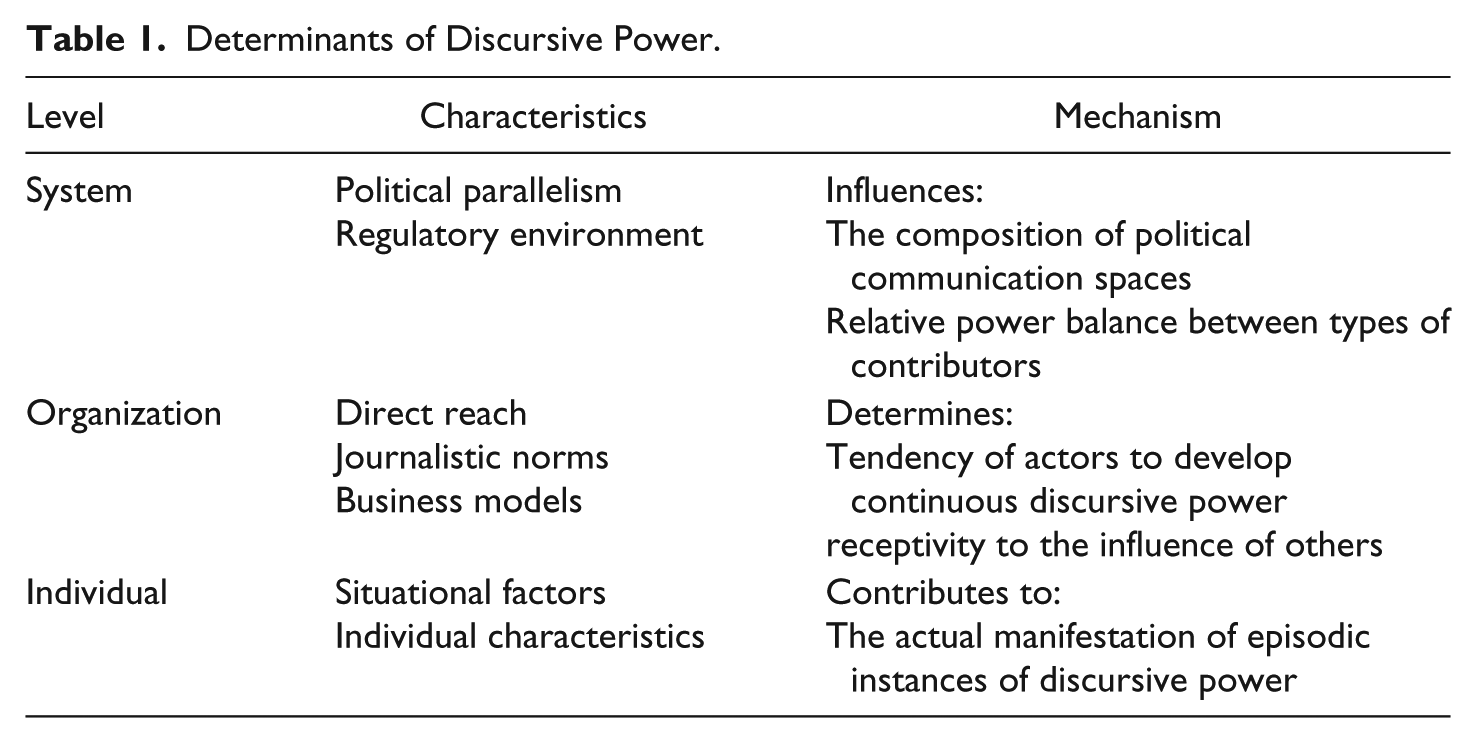
Our framework describes structural determinants of discursive power, as Table 1 shows. Characteristics of national media systems are shaping the composition of political communication spaces by affecting the presence of and relative power balance between types of contributors. Following these constitutive influences, the organizational characteristics of contributors to the political communication space determine the tendency of types of contributors to develop discursive power and their receptivity to influences by others. Finally, at the individual level, there are situational factors and individual characteristics of actors that contribute to the actual manifestation of discursive power in episodic instances.
Determinants of Discursive Power.
This theoretical framework lends itself to empirical testing. By selecting cases based on degrees and types of political parallelism and state intervention in the media system, researchers will be able to identify the influence of these variables on variations in the setup and power dynamics of contemporary media systems. Going further, by accounting for the structural features of contributors to contemporary media systems in empirical analyses, researchers will be able to identify their contribution to discursive power by types of contributors. Finally, we provide an operationalization of discursive power as the ability to introduce, amplify, and maintain topics, frames, and speakers in political discourse that come to dominate not only the coverage of a respective episode by one contributor to contemporary media systems but also the coverage of others. This translates the abstract concept of discursive power into an identifiable measure that in turn allows for the identification of the relative discursive power of contributors to contemporary media systems and the comparison of these power dynamics across actor-types and media systems.
Conclusion: Studying Power Dynamics in Contemporary Media Systems
We have presented a theoretical framework that allows for the systematic conceptualization and empirical analysis of power dynamics in contemporary media systems. In doing so, we build on the “hybrid media system” (Chadwick 2017) concept that emphasizes the mutual interconnections between various types of contributors to contemporary communication spaces. The concept does away with a technologically focused differentiation between “old” or “new” media and instead recognizes that contemporary news organizations share analog and digital operational logics and distribution channels. Their activities, thus, cannot simply be characterized by a single logic of news production. Instead, they may follow multiple logics, depending on the channel they happen to produce for at a given moment or the topic they cover.
Furthermore, the concept allows for the inclusion of various relevant contributors to the political communication space. Information flows are not only started, shaped, or governed by established news brands, alternative news organizations, or political elites; rather, digital media afford members of the public a very active role in the political communication space. In this, the “hybrid media system” captures very important elements of contemporary media systems.
We build on these fundamental insights by introducing the concept of discursive power, by which we mean the proven ability of contributors to the political communication space to introduce, amplify, and maintain topics, frames, and speakers that come to dominate attention in ongoing political discourse. This is a specification of the general competition for dominance of the limited attention space for politics by contributors to contemporary political communication spaces diagnosed by Schroeder (2018). In principle, discursive power allows us to measure empirically the relative power of many different actors in contemporary media systems.
We also build on insights from earlier media systems research (Hallin and Mancini 2004; Shoemaker and Reese 2014) and introduce a series of organization- and system-level features likely to shape the composition and power balance of information flows in contemporary media systems. These contextual variables help in structuring the analysis of contemporary media systems, making it possible to theorize and analyze their underlying characteristics and dynamics more closely.
While we have discussed discursive power and its likely determinants with respect to the flow of entities between contributors to the political communication space, the concept could also be applied to other relationships in the communication space. For example, journalism research has shown that relationships between media organizations and sources vary systematically (Reese 1991). Reexamining these relationships in the context of contemporary media systems is highly promising. Also, we have only hinted at the role of publics and audiences in the flow of information in political communication spaces (Bennett et al. 2018; Entman and Usher 2018). This is another area that would merit the conceptual application of information flows and discursive power.
While this once would have been an impossible task, methodological innovations in computational social science are very promising (Lazer et al. 2009). Through large-scale collection of contributions to contemporary media systems provided by various types of news organizations, individuals, and publics, researchers can map contemporary media systems comprehensively. By identifying topics, frames, and speakers across sources and platforms, researchers can establish temporal patterns in the mutual influence of various actors. Early studies already point to the potential of identifying cross-channel influences (Bennett et al. 2018; Jungherr 2014; Neuman et al. 2014; Posegga and Jungherr 2019; Wells et al. 2016). Using these techniques in combination with the framework proposed here to analyze topics, frames, and speakers systematically promises to establish a more comprehensive understanding of the structures and dynamics of contemporary media systems.
Footnotes
Acknowledgements
We thank Scott Cooper, Valeska Gerstung, Ralph Schroeder, Yannis Theocharis, and three anonymous reviewers for their valuable feedback.
Declaration of Conflicting Interests
The authors declared no potential conflicts of interest with respect to the research, authorship, and/or publication of this article.
Funding
The authors disclosed receipt of the following financial support for the research, authorship, and/or publication of this article: The research underlying this paper has been generously supported by the VolkswagenStiftung.
