




Abstract
According to selective exposure theory, people tend to select news media that are perceived to provide attitude-consonant information and avoid those that are perceived to provide dissonant information. Despite this, research on selective exposure seldom takes people’s perceptions of media bias into account, while research on perceptions of media bias seldom links such perceptions to subsequent media use. To address this, the purpose of this study is to investigate perceptions of mainstream media bias and whether such perceptions mediate the effect of using political alternative media on subsequent mainstream media use. Empirically, the study utilizes a three-wave panel survey during the 2022 Swedish parliamentary election campaign to investigate perceptions of public service media bias and subsequent use of public service media. Among other things, the results show that the use of right-wing political alternative media influences perceptions of leftist public service bias, which in turn mediates the effect of using right-wing alternative media on subsequent public service media use.
Introduction
According to the theoretical framework of selective exposure, people tend to select news media that are perceived to provide attitude-consonant information and avoid those that are perceived to provide dissonant information (Hart et al. 2009; Knobloch-Westerwick 2014; Smith et al. 2008). This occurs due to both interpersonal and intrapersonal motivations, including a desire to avoid cognitive dissonance and protect one’s political identity, among others (Dvir-Gvirsman 2019; Knobloch-Westerwick 2014; Sude and Knobloch-Westerwick 2022). Although not exclusive to political topics, politically motivated selective exposure is well-documented in both experimental and survey research (Garrett and Stroud 2014; Garrett et al. 2013; Iyengar and Hahn 2009; Stroud 2011).
Despite the key argument within the framework of selective exposure being that people tend to choose news that they perceive as attitude-congruent, studies analyzing people’s perceptions of news media’s political leanings, and which link those perceptions to subsequent media use, are scarce. Instead, most studies that investigate perceptions of news media’s political leaning focus on perceived media bias without linking that to media use, while most research on selective exposure assess different news media’s political leanings by making a priori assumptions, using the average leaning among users of different media, or making assumptions about participants’ perceptions of different media’s political leanings (for a critical overview, see Clay et al. 2013).
The result is a disconnect not only between research on perceived media bias and selective exposure, but also between theoretical assumptions in selective exposure theory—that people tend to choose news media that they perceive as in line with their attitudes and beliefs and avoid those they perceive as attitude-incongruent—and the empirical research. Yet, it is likely that perceptions of bias play an important role in selective exposure and avoidance. More specifically, it may be an important mechanism explaining why some individuals—in particular individuals using nontraditional information sources—may turn away from mainstream news media.
Important in that context are political alternative—or (hyper)partisan—media. As shown by the previous research, they typically position themselves as a “corrective” of mainstream news media (Cushion 2024; Heft et al. 2020; Holt et al. 2019; Newman et al. 2018). Consequently, they often oppose mainstream news media and accuse them of not telling the truth and being biased, and seek to appeal to those who do not trust mainstream news media (Andersen et al. 2023; Schulze 2020) (for recent reviews of research on media trust, see Fawzi et al. 2021; Strömbäck et al. 2020). This seems to hold in particular for right-wing political alternative media (Figenschou and Ihlebaek 2021; Holt 2020; Nygaard 2019), where research also suggests a negative linkage with mainstream media trust (Andersen et al. 2023; Tsfati et al. 2024). Because of this, the use of political alternative media is likely to lead to perceptions of mainstream news media bias, which in turn may lead to decreased use of mainstream news.
However, whether this is actually the case remains uncertain. To remedy this, the purpose of this study is to investigate whether perceptions of mainstream media bias mediate the effect of using political alternative media on subsequent mainstream media use. Empirically, we will use a three-wave panel study fielded during the 2022 Swedish election campaign. This case was chosen because systematic content analyses repeatedly have shown that none of the mainstream news media in Sweden exhibit any systematic political biases in their election news coverage (Asp 2006; Asp and Bjerling 2014; Johansson and Strömbäck 2019, 2023; Nord and Strömbäck 2018), but accusations of political bias—in particular left-wing bias—are nevertheless recurring (Ekman and Widholm 2023; Liminga and Strömbäck 2023; Strömbäck and Åkerlund 2025).
The Blind Spot in Selective Exposure Research
Following Knobloch-Westerwick (2014: 3), in a general sense, selective exposure denotes “any systematic bias in selected messages that diverges from the composition of accessible messages” (see also Sears and Freedman 1967). More common is, however, to conceptualize selective exposure as “the motivated selection of messages matching one’s beliefs” (Stroud 2018: 531) or other preferences—such as political interest—more broadly (Prior 2007; Skovsgaard et al. 2016). Based on this, there are several types of selective exposure depending on what the underlying preference is (Arceneaux and Johnson 2013; Prior 2007; Skovsgaard et al. 2016; Stroud 2018).
The most widely discussed type of selective exposure is partisan or politically motivated selective exposure. This type of selective exposure refers to when people seek out information or information sources that they perceive will provide them with like-minded or attitude-consonant information and avoid those that are perceived to provide dissonant information (Garrett 2009; Hart et al. 2009; Knobloch-Westerwick 2014; Smith et al. 2008; Stroud 2011). Selective exposure and avoidance are thus inextricably linked, although not necessarily equally strong (Garrett 2009; Garrett et al. 2013). The underlying reasons may be, among other things, to avoid cognitive dissonance, save cognitive energy, find arguments in support of a certain viewpoint, feel a sense of belonging, credibility assessments, and affirm one’s political identity (Festinger 1957; Knobloch-Westerwick 2014; Kunda 1990; Lodge and Taber 2013; Nickerson 1998; Young 2023). In either case, the politically motivated selective exposure argument rests on the assumption that people have expectations that different information sources will—or are likely to—provide information that is attitude consonant or attitude dissonant. This, in turn, presumes that people have perceptions of where different information sources stand in some political terms.
Despite this, there is only scant research within the selective exposure literature that seeks to establish the political leaning of different news media by asking people about their perceptions thereof (but see Goldman and Mutz 2011; Tryggvason and Andersson 2022). In experimentally based research, the political leaning or slant is typically established by manipulating the information sources or the messages to have certain political slants (Iyengar and Hahn 2009; Knobloch-Westerwick et al. 2020; Mothes and Ohme 2019). In survey-based research, the political leaning or slant is typically determined by one of the three strategies: (1) by assigning a political leaning a priori or by using secondary or indirect data such as endorsements of political candidates or the political leaning of the editorial pages (Dahlgren et al. 2019; Stroud 2011), (2) by using “audience-based measures,” which refers to using the average political leaning of different media’s users as a proxy for the political slant or leaning of the media themselves (Flaxman et al. 2016; Fletcher et al. 2021; Gentzkow and Shapiro 2011; Shehata et al. 2022), or (3) by using some kind of expert survey (Tóth et al. 2023; Zoizner et al. 2022).
While these strategies have some pros as well as cons, they do not take people’s actual perceptions and hence expectations fully into account. This is a blind spot in selective exposure research, which is problematic both theoretically and considering that people’s perceptions may have a major impact on their attitudes as well as their behaviors. As Lippman (1922) famously noted, “The way in which the world is imagined determines at any particular moment what men will do.”
Taking Media Perceptions Seriously
While selective exposure research seldom takes people’s media perceptions into account, there is more extensive research on people’s media perceptions within research where bias perceptions are the main dependent variables. In an early study, Watts et al. (1999), for example, sought to explain perceptions of media bias by asking respondents whether media coverage is fair or unfair toward a particular candidate or biased against a particular ideology. In another study, Stroud et al. (2014) investigated whether partisans evaluate media sources similar to how they evaluate in-group and out-group members. As a part of that, respondents were instructed to indicate their perceptions of media bias about multiple media sources. In a more recent study, Eberl (2019) analyzed perceptions of media bias related both to news media in general and different media outlets. With respect to the outlet level, that study asked whether respondents thought the news coverage was biased in favor of any parties or their policies and, if yes, which party was favored.
As another example, Soontjens and Van Erkel (2022) investigated the hostile media phenomenon, according to which people tend to perceive the news media as being biased against their own side and in favor of the other side in a political conflict (Hansen and Kim 2011; Perloff 2015; Vallone and Ross 1985). While there is ample empirical support for this theory, most studies have been based on experiments. In contrast, Soontjens and Van Erkel (2022) used a survey to investigate the extent to which people thought that the news outlet that they rely on the most favors each of the parties in the Flemish parliament.
A common finding in these and other studies is that perceptions that different news media are biased politically or ideologically are quite widespread but, importantly, far from universal (Eberl 2019; Goldman and Mutz 2011; Tryggvason and Andersson 2022; Watts et al. 1999). The same holds for hostile media perceptions (Hansen and Kim 2011; Perloff 2015). Studies that investigate perceptions of the news media’s political leaning at the level of individual media outlets also find that the share of the people who perceive different news media as biased politically varies across different news media outlets (Eberl 2019; Soontjens and Van Erkel 2022; Tryggvason and Andersson 2022). However, it is largely unclear to what extent mainstream news media in Sweden are perceived as biased (but see Tryggvason and Andersson 2022). Our baseline research question is thus:
RQ1: To what extent are Swedish mainstream news media perceived as ideologically biased?
Theoretically, mainstream media can, of course, be ideologically biased to both the left and the right, and criticism of media bias has historically come from both sides of the ideological spectrum. Over the last decades, however, the most dominant and vocal forms of bias accusations have come from the political right, which accuses mainstream news media of liberal or leftist bias (Lichter 2014; Schulz et al. 2020; Watts et al. 1999). This holds true for criticism coming from political elites as well as from political alternative media and online users more broadly (Carlson et al. 2021; Domke et al. 1999; Egelhofer et al. 2021; Figenschou and Ihlebaek 2021; Liminga and Strömbäck 2023; Strömbäck and Åkerlund 2025), which Trump and right-wing alternative media such as Breitbart exemplifies. The same pattern has also been found in the case of our study, Sweden, with accusations of leftist bias in mainstream media in general and public service in particular being particularly common (Ekman and Widholm 2022, 2023; Liminga and Strömbäck 2023; Strömbäck and Åkerlund 2025). Hence, our first hypothesis is:
H1: Perceptions that mainstream media are ideologically biased to the left are more common than perceptions that mainstream news media are ideologically biased to the right.
Bias Perceptions as a Mechanism Explaining Selective Exposure and Avoidance
Despite that previous research has not taken individuals’ bias perceptions into account, it is likely to be an important mechanism explaining why some individuals opt out from using mainstream news. More specifically, it is likely to be a key mechanism explaining why individuals who use political alternative media opt out of using mainstream news media or use them less than they otherwise would.
Although there are different definitions of political alternative—or partisan—media (Bauer et al. 2022; Steppat et al. 2023; Tóth et al. 2023), a distinguishing factor is that such media typically are guided by political goals and values and consider themselves as “correctives” of mainstream news media (Benkler et al. 2018; Holt et al. 2019; Strömbäck 2023). Not surprisingly, they also often accuse mainstream news media—not least public service media—of being biased, lying, or withholding the truth (Cushion et al. 2021; Figenschou and Ihlebaek 2021; Holt 2020; Nygaard 2019), and seek to appeal to people who do not trust mainstream news media (Andersen et al. 2023; Fawzi and Krämer 2021; Schulze 2020). This may hold in particular for right-wing political alternative media, which have become increasingly prominent across Western democracies (Benkler et al. 2018; Heft et al. 2020; Holt et al. 2019; von Nordheim et al. 2023; Waisbord 2022). This includes Sweden (Heft et al. 2020; Holt 2020; Ihlebæk and Nygaard 2021; Newman et al. 2023). Findings also suggest that those who use right-wing political alternative media are typically hostile to mainstream news media and that use of them leads to declining trust in mainstream news media (Andersen et al. 2023; Ihlebaek and Holter 2021; Noppari et al. 2019; Schwarzenegger 2023; Tsfati et al. 2024).
With respect to left-wing alternative media, theoretically, they also tend to position themselves as correctives to mainstream news media. At the same time, research suggests that the degree of alternativeness differs, and that left-wing political alternative media are less hostile toward and more similar to mainstream news media than right-wing alternative media (Benkler et al. 2018). However, findings seem to differ across countries (see Cushion et al. 2021). In the Swedish case, previous research suggests that the effects of using left-wing alternative media often run in the opposite direction to the effects of using right-wing alternative media, and that they are less pronounced (Shehata and Strömbäck 2022; Theorin 2019; Tsfati et al. 2024). Even so, the underlying mechanisms should be the same as for right-wing alternative media. Usage of both right-wing and left-wing political alternative media can thus be expected to influence perceptions that mainstream news media are biased.
The key question is, however, the consequences of perceptions that mainstream news media are ideologically biased, and more specifically, how that influences subsequent media use. Based on extensive theory and research on selective exposure and avoidance, people tend to prefer and select news media they expect to provide attitude-congruent information and avoid those they expect to provide attitude-discrepant information (Knobloch-Westerwick 2014; Stroud 2011; Sude and Knobloch-Westerwick 2022). Even though the tendency to select attitude-congruent information in general is stronger than the tendency to avoid attitude-discrepant information (Garrett 2009; Garrett et al. 2013), this suggests that those who perceive mainstream news media to be biased (to the left or right) should be less likely to continue using those. Thereby they can counter the perceived “hostile media” (Hansen and Kim 2011; Perloff 2015; Schmitt et al. 2004), perhaps seeking out perceived more friendly media instead (Goldman and Mutz 2011). In essence, then, perceptions of media bias can be expected to mediate the relationship between the use of political alternative media and subsequent use of mainstream news media. Based on this, we hypothesize that:
H2: Perceptions of mainstream media bias will mediate the relationship between political alternative media use and subsequent use of mainstream media, so that increased perceptions of bias (right or left) decrease the usage of mainstream news media.
Method and Data
To answer the research question and test the hypotheses, a three-wave panel survey conducted during the 2022 Swedish election campaign was used. We chose to focus on an election campaign both because previous research shows that none of the Swedish mainstream news media are politically biased in their coverage of election campaigns (Asp 2006; Asp and Bjerling 2014; Johansson 2022; Johansson and Strömbäck 2019, 2023; Nord and Strömbäck 2018), and because of the availability of data. The survey was facilitated by the SOM-institute, a research infrastructure at the University of Gothenburg. The data stems from a probability sample stratified by age, sex, and education. Compared to the population in general, the sample is slightly skewed toward older people, males, and individuals with higher education. The election was held on September 11, 2022. The first panel wave was conducted before the election campaign began, between June 16 and August 8, 2022. The net sample size was 3,924, of which 2,327 participants completed the survey. This corresponds to a gross participant rate of 58 percent (AAPOR RR6). The second wave was fielded during the election campaign, between August 16 and September 9. The net sample size was 3,832, and 2,079 participants completed the survey, corresponding to a gross participant rate of 53 percent (AAPOR RR6). Finally, the third wave was fielded after the election, between September 12 and October 13. The net sample size was 3,779, of which 1,975 completed the survey. This corresponds to a gross participant rate of 51 percent (AAPOR RR6). To be able to investigate changes at the individual level, only respondents who participated in all three panel waves were included in the analyses (N = 1,654).
Measurements
The independent variables, consumption of alternative media (right and left), was measured in wave 1. Respondents were asked, “During a typical week, how often do you use the following types of media (regardless of format)?” For right-wing alternative media, the outlets were Samhällsnytt, Nyheter Idag, Fria Tider, and Nya Tider. For left-wing alternative media, the outlets used were ETC, Flamman, Arbetaren, and Aktuellt Fokus. These are the largest and most commonly read online news alternative media outlets on either side of the political spectrum (Vliegenthart et al. 2024). The response options were (1) seven times a week, (2) six times a week, (3) five times a week, (4) four times a week, (5) three times a week, (6) two times a week, (7) one time a week, and (8) less often. The items were reversed, and two additive indices were created (alternative right media use w1: M = 4.797; SD = 3.108; alternative left media use M = 4.412; SD = 1.688). As evident based on the mean value, both the left and right alternative media indices have a significant positive skew.
The mediator, perceptions of ideological leaning of mainstream news media, was measured in wave 2. Specifically, respondents were asked to place a number of different national news media on a 5-point scale ranging from clearly to the left (1) to clearly to the right (5). The center of the scale (response option 3) represented “Neither to the left or the right.” When operationalizing mainstream news media, we chose to focus on public service. The reason is twofold. First, public service represents the epitome of mainstream news media (Djerf-Pierre and Weibull 2001; Shehata and Strömbäck 2022). Second, public service is most often the target of attacks that mainstream news media are politically biased (Ekman and Widholm 2023; Liminga and Strömbäck 2023; Sehl et al. 2022; Strömbäck and Åkerlund 2025; Widholm and Mårtenson 2018). Specifically, items include Rapport/Aktuellt i SVT (public service broadcasting news) and Ekonyheterna i Sveriges Radio (public service radio). These items were made into two additive indices of perceptions of mainstream news media’s ideological leaning; one where high values represent perceptions of left bias (w2: M = 6.975; SD = 1.468) and one where high values represent perceptions of right bias (w2: M = 5.025; SD = 1.468). Prior to this, principal component analyses were performed with the media items (full results can be found in Supplemental Appendix Tables A1–A3), demonstrating an explained variance of 64 percent (alpha = 0.83). While this alpha might seem low, it follows from the fact that people who use public service TV do not necessarily also use public service radio, and vice versa.
The dependent variable, mainstream media use again operationalized as public service media use, was measured in wave 3. Participants were asked how often during a typical week they use an array of different mainstream outlets (similar to alternative media use). Response options ranged from (1) 7 days per week over (2) 6 days per week, (3) 5 days per week, (4) 4 days per week, (5) 3 days per week, (6) 2 days per week (7) 1 day per week, to (8) less often. The same outlets for the measurement of bias perceptions were used (Rapport/Aktuellt i SVT and Ekonyheterna i Sveriges Radio [SR]). The items were reversed, and an additive index was created (w3: M = 9.421; SD = 4.564).
Control Variables
Age, education, gender, and ideology were included as control variables. Gender was measured through a categorical variable with two levels: female and male. It was recoded into a dummy variable with two levels: “female” and “male.” Age was measured by asking participants which year they were born in and then recoded into a dummy variable: young (under 30–39), middle (40–59), and older age (60–over 70). Respondents’ educational level was measured on a scale ranging from 1 (did not complete elementary school) to 9 (PhD degree) and recoded into dummies corresponding to low (elementary school or less), middle (high school and postsecondary education), and high education (undergraduate and graduate studies). A breakdown of all dummies can be found in Supplemental Appendix Tables A1–A3. Since ideology is a fundamental concept and can be expected to influence both the use of political alternative media and perceptions of mainstream media bias (Dahlgren et al. 2019; Jost et al. 2009; Soontjens and Van Erkel 2022; Suiter and Fletcher 2020), we also controlled for ideological self-placement. This was measured by asking participants to answer the question: “It is sometimes said that political opinions can be placed on a left-right scale. Where would you place yourself on such a scale?.” The response options were clearly to the left, somewhat to the left, neither to the left nor to the right, somewhat to the right, and clearly to the right (M = 3.011; SD = 1.293). This item is thus virtually identical to the question asked about the media’s political leaning.
Analytical Strategy
To analyze to what extent public service news media are perceived as ideologically biased (RQ1) and whether perceptions of ideological bias to the left are more common than perceptions of Swedish public service media as ideologically biased to the right (H1), descriptive statistics were used. More specifically, data from all three panel waves were used to analyze the percentage of individuals perceiving public service media as ideologically biased throughout the election campaign and whether perceptions of leftist bias were more common in all waves. To test H2 regarding the mediating effect of perceptions of public service media’s ideological bias, two longitudinal mediation models were run utilizing lavaan (R) via structural equation modeling (SEM). As a powerful multivariate technique, SEM is particularly suitable for capturing mediating effects given that standard regressions are “ill-suited for modeling such a relationship because of its a priori assignment of each variable as either a cause or an effect” (Gunzler et al. 2013: 391). Thus, SEM provides a more “appropriate inference framework for mediation analyses and for other types of causal analyses” (Gunzler et al. 2013: 391). The longitudinal nature of the data enables us to model a causal chain of mediation where right-/left-wing media use measured in wave 1 impacts public service media bias perceptions in wave 2 (as the mediator), which in return influences public service media use in wave 3, with a potential indirect effect of right/left media use via the mediator. 1
The first model investigates a potential mediation between right-wing alternative media (w1) use on public service media bias perceptions (w2) (perceiving media to be biased to the left) and public service media use (w3). The second model tests the potential mediation between left-wing alternative media use (w1), public service media bias perceptions (w2) (perceiving media to be biased to the right), and public service media use (w3). In both models, ideology as well as dummies for age, education, and sex are included as covariates.
Full information maximum likelihood (FIML) was employed to handle missing data. FIML estimates a likelihood function for each individual based on the variables that are present, ensuring that all the available data are used. It has been shown to produce unbiased parameter estimates (Enders and Bandalos 2001). To investigate statistical inference and mitigate type 1 error, percentile bootstrap confidence intervals were calculated for both the mediation models (see Hayes 2017).
Due to the skewness of the alternative media variables, longitudinal mediation models using maximum likelihood with robust standard errors estimation (as opposed to the default maximum likelihood estimation) for both alternative media use variables were computed as robustness tests. FIML was (again) applied to handle missing data.
Results
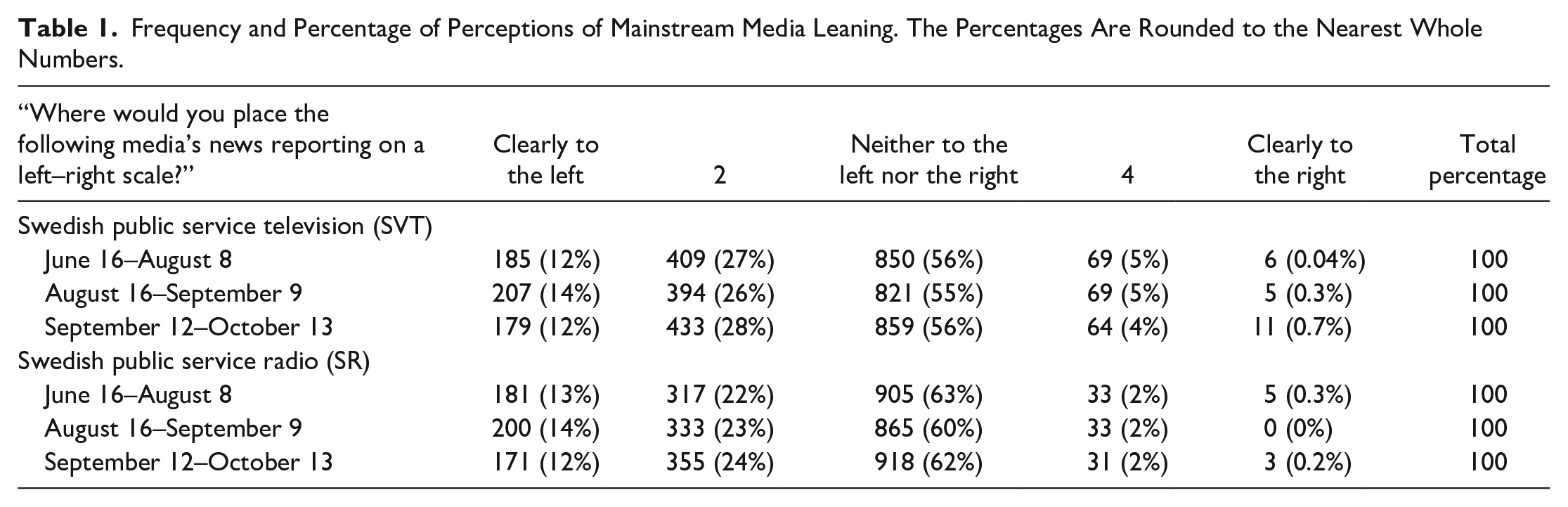
Turning to the results, the first research question concerns to what extent Swedish public service news media is perceived as ideologically biased (RQ1), while the first hypothesis states that perceptions of Swedish public service news media as ideologically biased to the left are more common than perceptions that public service media is ideologically biased to the right (H1). The results are shown in Table 1. First, it should be noted that more than half of the participants responded that they perceive public service media as “Neither left nor right” leaning. Throughout all three waves, 50 percent or more responded that they did not perceive public service media as ideologically biased. That said, a large proportion of respondents (39%–45%) answered that they perceive public service television (SVT) to be biased in some direction, with 39 to 40 percent perceiving it as somewhat or clearly left leaning and around 5 percent perceiving it as somewhat or clearly right leaning (with most respondents answering somewhat to the left). Between 35 to 39 percent answered that they perceive Swedish public service radio (SR) as ideologically biased, with around 35 to 37 percent perceiving it as somewhat or clearly left-leaning and around 2 percent perceiving it as somewhat or clearly right-leaning (with most respondents answering somewhat to the left). Thus, H1 is confirmed: perceiving public service media as ideologically biased to the left is more common than perceptions of public service news media as ideologically biased to the right. Finally, it should be noted that the respondents’ perceptions of both right and left bias remain relatively stable throughout all three waves.
Frequency and Percentage of Perceptions of Mainstream Media Leaning. The Percentages Are Rounded to the Nearest Whole Numbers.
Turning to the potential mediating role of perceptions of public service media bias and addressing H2, Figure 1 shows the results of the longitudinal mediation analysis for model 1: right-wing alternative media use (xi), perceptions of public service media bias (zi), and usage of public service media (yi). For the full model, see Supplemental Appendix Table A4.
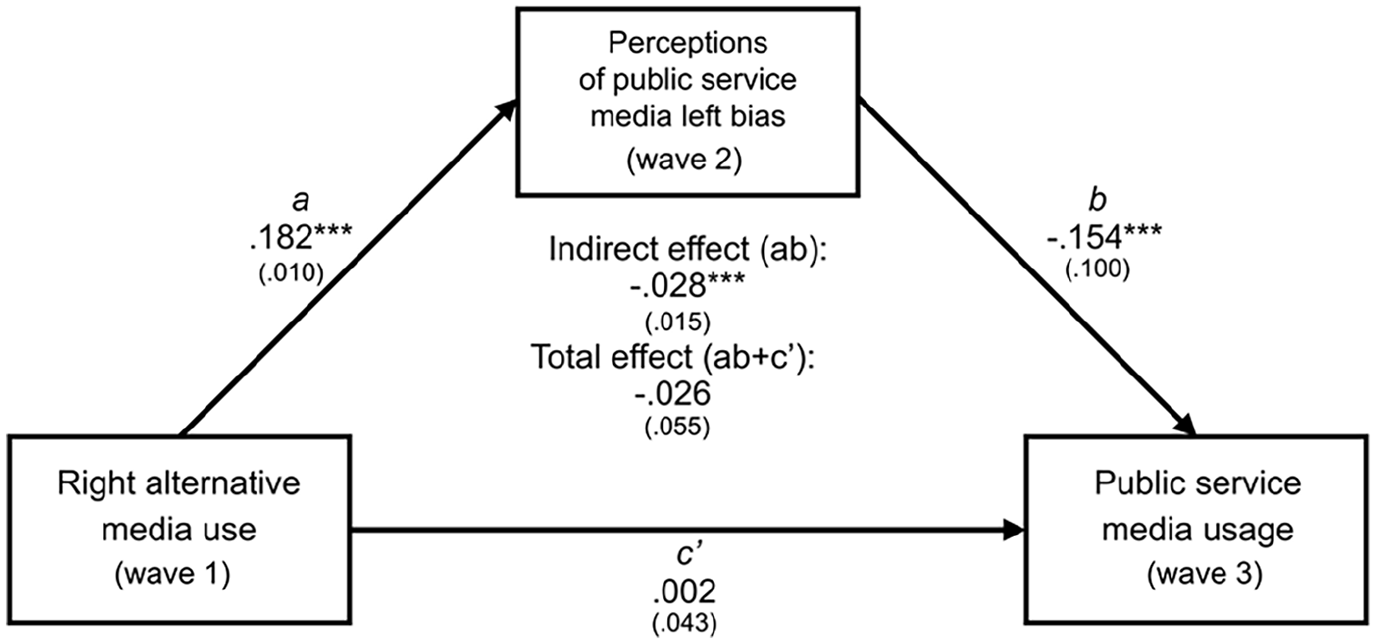
Longitudinal mediation between alternative right-wing media use, media bias perceptions, and public service media use.
The results show that the indirect effect was significant (bab = −0.028, SE = 0.010, p < .001), providing evidence for a mediation (see Supplemental Appendix Table A4). Percentile bootstrap confidence intervals with 10,000 samples did not contain zero, 95% CI [−0.042, −0.015]. As indicated in Supplemental Appendix Table A4, using right-wing alternative media is significantly related to perceiving public service media as biased to the left (ba = 0.182, SE = 0.010, p < .001) which, in turn, is significantly related to decreased use of public service media (bb = −0.154, SE = 0.100, p < .001). For every ba = 0.182 increase in the association between right-wing alternative media use and perception of public service media bias, there was a bab = −0.028 (SE = 0.010, p < .001) decrease in public service media use. Right-wing alternative media use was, however, not associated with public service media use (bc = 0.002, SE = 0.043, 95% CI [−0.055, 0.061]), indicating an absence of a direct relationship. The model thus shows support for an indirect effect of right-wing alternative media use through public service bias perceptions on public service media use, in the absence of a total effect. The robustness test demonstrates very similar results and reasserts the findings (see Supplemental Appendix Table A5).
Turning to the effect of using left-wing alternative media, Figure 2 shows the results for the mediation analysis for model 2: left-wing alternative media use (xi), perceptions of public service media bias (zi), and usage of public service media (yi). For the full model, see Supplemental Appendix Table A6.
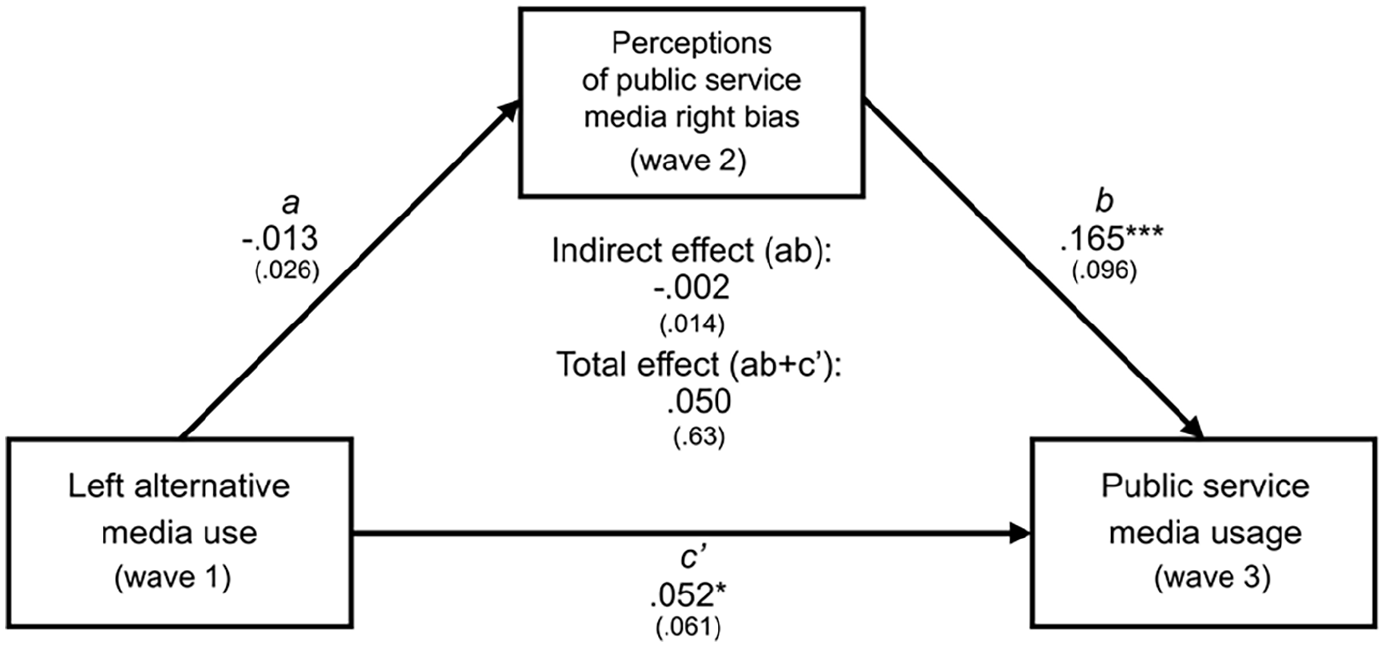
Longitudinal mediation between left-wing media use, media bias perceptions, and public service media use.
The indirect effect was not significant (bab = −0.002, SE = 0.014, p > .05), providing no evidence for a mediation. Percentile bootstrap confidence intervals with 10,000 samples contained zero, 95% CI [−0.004, 0.087]. As indicated in Figure 2, using left-wing alternative media is not significantly related to perceiving public service media as biased to the right (ba = −0.013, SE = 0.026, p > .05). However, media perceptions are still significantly related to public service media use (bb = 0.165, SE = 0.096, p < .001), meaning that perceptions that public service media are biased to the right increase the usage of public service media. Left-wing alternative media use also shows a direct association with public service media use (bc = 0.052, SE = 0.061, 95% CI [0.000, 0.087]), meaning that higher usage of left-wing alternative media is significantly related to higher use of public service media. In substantial terms, the effect is, however, small. Again, the results are very similar to the robustness test, conveying a direct effect of left-wing alternative media use on public service media use in the absence of an indirect effect (see Supplemental Appendix Table A7).
Conclusions
The purpose of this paper has been to address an apparent disconnect between selective exposure theory and research. A key argument in selective exposure theory is that people tend to consume news that they perceive as attitude congruent and avoid news media that they perceive as attitude discrepant. Despite this, empirical research has not sufficiently linked people’s perceptions of media bias with their media use. This is unfortunate since perceptions of bias might be an important mechanism through which some individuals turn away from mainstream news media. To address this, this study investigated the effects of using political alternative media on subsequent use of mainstream news media and the mediating effect of perceptions of mainstream news media bias. In both cases, mainstream news media were operationalized as public service news media.
To begin with, the results show that a substantial proportion of respondents, albeit not a majority, perceived Swedish public service media as ideologically biased in some direction. The fact that most respondents do not perceive public service media as ideologically biased is affirming, given that systematic content analyses have shown that Swedish public service media do not display any systematic political biases (Asp 2006; Johansson 2023; Johansson and Strömbäck 2019, 2023; Nord and Strömbäck 2018).
That said, the results show that perceptions of left-wing bias are more common than perceptions of right-wing bias. This reaffirms prior research that accusations of mainstream media’s political bias primarily come from the right wing of the political spectrum (Ekman and Widholm 2023; Figenschou and Ihlebaek 2021; Holt 2020; Liminga and Strömbäck 2023; Strömbäck and Åkerlund 2025) and that such accusations might be effective in influencing people’s attitudes toward and trust in mainstream news media (Egelhofer et al. 2022; Tsfati et al. 2024).
Turning to the mediation analyses, we find that using right-wing alternative media increases perceptions of leftist bias in the public service media, which aligns with previous research that those media are critical and hostile toward mainstream media (Cushion et al. 2021; Figenschou and Ihlebaek 2021; Holt 2020; Nygaard 2019). These perceptions, in turn, decrease the subsequent use of public service media. Thus, the findings suggest that bias perceptions are an important mechanism through which alternative right-wing media might suppress public service media use. In extension, this suggests that lower usage of and trust in public service media among those who lean further to the right ideologically can be conceived of as an outcome of successful opinion formation.
The findings regarding left-wing alternative media use are, however, different. More specifically, the use of alternative left-wing media does not seem to impact perceptions of public service media bias and subsequent usage of those. Although these results might seem somewhat unintuitive, they align with previous studies that have found quite different effects of right-wing alternative media use compared to left-wing alternative media use (for the Swedish case, see, e.g., Shehata and Strömbäck 2022; Theorin et al. 2023; Tsfati et al. 2024). This difference may be explained by the fact that left-wing alternative media tend to be less hostile toward and more similar to mainstream media (Benkler et al. 2018; Holt 2018). As such, the findings support the claims made by previous scholars that alternative media—while sharing some defining traits, most notably in their positioning as being corrective toward mainstream media (Holt et al. 2019)—should be considered as a rather heterogeneous category, acting out their opposition to mainstream media in varying ways, hence resulting in different outcomes (Brems 2023; Holt 2018; Staender et al. 2024). Although using left-wing media does not lead to perceptions of right bias, perceptions of rightist media bias is however positively linked to public service media consumption. While this result is rather counterintuitive, it could be a result of the timing of the panel survey, conducted during an election with high salience of issues typically regarded as right-wing (Johansson & Strömbäck 2023; Martinsson 2021), potentially generating increased perceptions of rightist bias among individuals who are still likely to continue to rely on public service for news.
An additional factor to consider is the wider environment in which political alternative media operates. The fact that we only find a mediated relationship between right-wing alternative media and public service media use through its effect on perceived bias could be seen as an effect of the long-term rhetoric from both right-wing politicians and right-wing political alternative media accusing public service media of being leftist (Carlson et al. 2021; Domke et al. 1999; Egelhofer et al. 2022; Figenschou and Ihlebaek 2021; Liminga and Strömbäck 2023; Strömbäck and Åkerlund 2025) or due to the fact that right-wing alternative media has enjoyed a greater dissemination among the broader public compared to left-wing alternative media (Newman et al. 2023). Most probably, it is a combination of both. These factors might foster a more closed right-wing media environment, contributing to a potential reinforcing spiral dynamic (Slater 2015; Slater et al. 2020).
The findings could be considered somewhat concerning. On the one hand, a majority still considers Swedish public service media to be politically unbiased. This is important, and especially noteworthy given that the data were collected during an election period, when it can be suspected that the hostile media effect would be especially pronounced (Hansen and Kim 2011; Vallone and Ross 1985). On the other hand, the fact that a substantial number of Swedes consider public service media to be ideologically biased to the left is problematic. Especially since our study shows that these perceptions of bias are influenced by right-wing alternative news use and are linked to a decrease in public service media use. Such dynamics might lead to increased political polarization and distrust of established journalistic institutions, thereby counteracting a shared understanding of reality and a common arena for public debate (Andersson and Oscarsson 2020; Rekker 2021; Strömbäck et al. 2022; Van Dalen 2021). Either way, a key theoretical contribution of this study is that perceptions of media bias matter for people’s media use. Hence, future research on selective exposure should account for people’s perceptions of the political leanings of different media and not just rely on indirect measures of where different media stand politically.
While this study highlights some important theoretical takeaways, it is important to acknowledge its limitations. First, there were very few respondents who reported using left-wing alternative media and perceptions of right-wing political bias in public service media, contributing to more uncertain model estimates for these measures. Second, as with all panel data, the timing of the survey waves can impact the result. Elections are highly visible events which contribute to both increased media usage as well as the salience of individuals’ political identity (e.g., Hansen and Kosiara-Pedersen 2017; Hansen and Pedersen 2014; Strömbäck 2017). Thus, the timing of the panel waves—measuring the effect of perceptions of media bias before the election (wave 2) on public service media use after the election (wave 3)—may have impacted the findings. Future research is therefore encouraged to investigate the relationship between political alternative media use, perceptions of mainstream media bias, and how these affect subsequent mainstream media use in other contexts and with different time lags.
These limitations notwithstanding, this study provides new insights into the selective exposure and avoidance literature by highlighting the relationship between perceptions of media bias and media use. Doing this, we have shown that fostering perceptions of bias is an important mechanism through which alternative right-wing media might pull people away from more established news sources. But much remains to be done. A particularly important question is the nature of the criticism aimed at mainstream media present in right-wing compared to left-wing alternative media, and how these accusations of media bias are fed into the public discourse and utilized by elite figures, such as politicians. This may potentially make individuals more inclined to turn away from mainstream and public media and use alternative outlets instead.
Supplemental Material
sj-docx-1-hij-10.1177_19401612251337814 – Supplemental material for Addressing a Blind Spot in Selective Exposure Research: Perceptions of Media Bias and Their Effects on Mainstream Media Use. A Mediation Analysis
Supplemental material, sj-docx-1-hij-10.1177_19401612251337814 for Addressing a Blind Spot in Selective Exposure Research: Perceptions of Media Bias and Their Effects on Mainstream Media Use. A Mediation Analysis by Jesper Strömbäck, Sofia Johansson, Elena Broda, Erik Espeland and Hugo Ekström in The International Journal of Press/Politics
Footnotes
Data Availability
The data underlying this article will be shared on reasonable request to the corresponding author.
Declaration of Conflicting Interests
The author(s) declared no potential conflicts of interest with respect to the research, authorship, and/or publication of this article.
Funding
The author(s) disclosed receipt of the following financial support for the research, authorship, and/or publication of this article: This work was supported by the Riksbankens Jubileumsfond (grant number M18-0310:1).

Supplemental Material
Supplemental material for this article is available online.
Notes
Author Biographies
References
Supplementary Material
Please find the following supplemental material available below.
For Open Access articles published under a Creative Commons License, all supplemental material carries the same license as the article it is associated with.
For non-Open Access articles published, all supplemental material carries a non-exclusive license, and permission requests for re-use of supplemental material or any part of supplemental material shall be sent directly to the copyright owner as specified in the copyright notice associated with the article.
