



Abstract
New political cleavages are reshaping the political landscape in established democracies. The classic left-right ideological dimension that has structured politics for decades is increasingly challenged by a sociocultural value dimension. At the same time, growing opportunities for media choice open for new forms of selective news exposure along political lines. We argue that previous research has too narrowly focused on traditional ideological cleavages, neglecting the increasingly important sociocultural value dimension of politics. Using four waves of panel survey data collected in Sweden during 2020 and 2021, this study analyses ideological selective exposure, audience composition, and reinforcing spirals across a range of mainstream and alternative news outlets. Findings show (1) that the sociocultural value dimension is more important than the socioeconomic dimension for explaining news choices, (2) that it structures news audiences in uniquely distinct ways, and (3) that these relationships are highly stable over time—reflecting patterns of de facto selective exposure and ideological maintenance, rather than reinforcement. These findings bring new insights to research on selective news exposure, political polarization, and changing ideological cleavages in Western democracies.
Introduction
New political cleavages are reshaping the political landscape in established democracies. The classic left-right ideological dimension that has structured politics in many countries for decades is increasingly challenged by an emerging cultural value dimension. This reflects a growing tension between libertarian and authoritarian values in society, changing voter alignments, and the rise of new political parties (Hooghe et al., 2002; Kriesi, 2010; Norris and Inglehart, 2019). At the same time, media environments are also in flux with growing opportunities for media choice along political and ideological lines. These developments do not only open for higher levels of selective exposure to a plethora of new partisan online media but also fundamentally change citizens’ relationship with established mainstream media.
Few studies have brought these two macro-level trends together from a citizen’s perspective. Although extensive research on selective exposure has analyzed how political ideology influences media choices (Iyengar and Hahn, 2009; Stroud, 2017), the broader political transformations across western democracies have been largely ignored. This paper aims to address this gap. More specifically, we argue that previous research has been too narrowly focused on the traditional socioeconomic ideological dimension, neglecting the increasingly important sociocultural value dimension of politics. This has led to a limited understanding of the ways in which ideological predispositions influence news choices, on the one hand, and whether such news choices have feedback effects on ideological reinforcement over time, on the other hand.
By relating the ongoing changes in the political and media environments, this study has two aims. First, to investigate whether and how emerging political cleavages reshape and restructure news audiences, we compare the relative importance of the well-established socioeconomic ideological dimension to the sociocultural value dimension for selective news exposure and audience composition. To clarify the potentially unique influences of the sociocultural value dimension, we compare citizens’ use of three categories of news sources: (1) politically non-partisan broadcasting institutions, (2) traditional press with politically affiliated editorial pages, and (3) political alternative media. Second, to address whether emerging political cleavages have unique effects with respect to ideological reinforcement, we extend the analyses addressing the political consequences of these news choices. Research on the reciprocal relationship between selective news exposure and ideological reinforcement is scarce. How specific dimensions of ideology matter is even more unclear. Building upon the reinforcing spirals model (Slater, 2015; Song and Boomgarden, 2017) we therefore study whether the political profile of citizens’ combined news diets contributes to ideological reinforcement over time, and whether such dynamics differ between the socioeconomic and sociocultural value dimension of ideology.
The empirical study focuses on the case of Sweden. With its specific political and media system characteristics, Sweden provides a critical case for testing the relevance of emerging political cleavages for selective exposure, audience composition, and ideological reinforcement over time. Although Sweden is typically regarded as a country characterized by low levels of fragmentation and polarization, these assessments are primarily based on traditional political cleavages (Fletcher and Jenkins, 2019; Oscarsson et al., 2021). In terms of the sociocultural value dimension, polarization has increased significantly in the past decades (Oscarsson et al., 2021; Mitchell et al., 2018). Before presenting the Swedish case in greater detail, however, the paper outlines the theoretical basis of our argument.
Selective Exposure and (New) Political Cleavages
This section discusses selective news exposure in relation to changing political cleavages across western democracies. After describing the emergence of a sociocultural value dimension of politics, we elaborate on its role in shaping news choices and audience structure—as well as how the ideological profile of citizens’ news diets may lead to reinforcement effects (RSM).
Political Selective News Exposure
Research on the relationship between political attitudes and news media use dates back to the classic studies on electoral behavior and election campaigns (Lazarsfeld et al., 1948). The basic idea behind theories of selective exposure concerns the “motivated selection of messages matching one’s beliefs” (Stroud, 2017: 1) or, alternatively, “the active avoidance of content that contradicts one’s own opinions and interests, and/or seeking out likeminded news” (Mutz and Young, 2011: 1026). Research has particularly emphasized the role of partisanship, ideology, and attitudes as relevant for citizens’ media choices (Garrett, 2009; Iyengar and Hahn, 2009; Stroud, 2017).
The extent to which citizens engage in ideological selective exposure is however more debated (Dahlgren, 2021; Stroud, 2017). Although studies focusing specifically on the role of political ideology have provided consistent support for selective exposure, relationships are relatively weak—particularly in less polarized countries with strong public broadcasting institutions. Ideology matters, but most citizens have rather diverse media diets (Castro Herrero et al., 2018; Dvir-Gvirsman et al., 2016; Dahlgren, 2019; Fletcher et al., 2020; Garrett, 2009; Steppat et al., 2021).
The problem, however, is that most studies treat ideology as a unidimensional concept by focusing exclusively on the traditional left-right dimension. This may render some critical ideological influences and cleavages largely invisible. In contrast to the established socioeconomic (left-right) dimension, the emerging sociocultural (liberal-conservative) cleavage may fundamentally change citizens’ orientation toward the news media.
Changing Political Cleavages in Advanced Democracies
The “value-based” cleavage, referred to as the sociocultural value (or GAL-TAN 1 ) dimension, has become increasingly important across western democracies in recent decades (Flanagan and Lee, 2003; Ford and Jennings, 2020; Kriesi, 2010; Norris and Inglehart, 2019). Political attitudes are no longer structured only in relation to socioeconomic left-right ideology, but to an emergent sociocultural value dimension as well. This is reflected in the repositioning of mainstream parties as well as the rise of radical authoritarian populism.
The emergence of value-based cleavage in politics originates from long-term structural transformations of societies. The growth of post-materialist worldviews and related liberal values in western democracies is well-documented (Inglehart, 1977; Inglehart and Baker 2000; Norris and Inglehart, 2019). These changes have had a significant impact on the political issue agenda—partly replacing the economic issues that structure divisions across the traditional left-right cleavage, with social and cultural issues shaping attitudes along a second dimension (Flanagan and Lee, 2003; Kriesi, 2010). More recently, these value-related conflicts have been intensified by the rise of authoritarian populism (Mudde, 2017; Norris and Inglehart, 2019; Widfeldt, 2018).
The long-term value changes and the rise of authoritarian populism are causally related according to the cultural backlash theory proposed by Norris and Inglehart (2019). What they describe as a “silent revolution in cultural values” (p. 32), the erosion of materialist values and the amplifying of liberal values ultimately created conditions for a cultural backlash. Authoritarian populist parties have been successful in mobilizing reactions to liberal cosmopolitan values and resentments among people who feel their cultural values are threatened. The general shift of the policy agenda—toward issues such as immigration, LGBTQ rights, international cooperation, environment, and climate change—has stimulated both the emergence of Green parties as well as the cultural backlash exploited by authoritarian populism. Although the economic and welfare issues that shape traditional left-right positions in politics have not disappeared from the agenda, the socioeconomic cleavage has gradually weakened as a structuring force in relation to public opinion and political positions in the contemporary political landscape.
The Sociocultural Value Dimension, Selective News Exposure, and Audience Structure
Despite these political transformations, research on media use and effects continues to rely heavily on left-right ideological attitudes as a predictor and outcome variable (Castro-Herrero et al., 2018; Dahlgren, 2021; Fletcher et al., 2020). How these emerging political cleavages reshape citizens’ orientations toward both established and new media—structuring and restructuring news audiences—is largely unknown. Overall, there are reasons to expect that the sociocultural value dimension has reshaped citizens’ orientation not only toward politics and political institutions but to the news media as well—with repercussions across entire media systems. Two trends relating to a growing politicization of news media, in general, are worth noting.
On the one hand, the rise of authoritarian populism as a political force has changed and politicized the discourse surrounding traditional news media. Criticism and “attacks” on mainstream media have become a crucial component of the anti-establishment rhetoric of right-wing populist parties across western democracies. As such, traditional news media are now targets of various political attempts to delegitimize professional journalism as an authoritative source of information (Engesser et al., 2017; Van Dalen, 2021). Accordingly, trust in established news media has become increasingly politicized in recent years (Hanitzsch et al., 2018; Strömbäck et al., 2020). Several studies indicate that media trust is significantly lower among supporters of right-wing populist parties—which is also reflected in lower levels of use of traditional news media among these groups (Dahlgren, 2019; Stier et al., 2020).
On the other hand, the emergence of the sociocultural value dimension of politics has coincided with profound media environmental changes toward growing opportunities for media choice (Bennett and Iyengar, 2008; Stroud, 2017). In particular, the development and increasing relevance of political alternative media, primarily online, has opened extensive opportunities for citizens to seek-out news sources with distinct political profiles. Although both left-wing and right-wing outlets are widely available, right-wing alternative media have particularly emphasized issues on the sociocultural value dimension such as immigration and crime (Holt et al., 2019; Ihlebæk and Nygaard, 2021). Apart from directly increasing citizens’ accessibility to news sources with distinct political profiles, alternative media may also have indirect effects on how other media—including traditional—report on politics and society (Tsfati et al., 2020).
Taken together, these trends suggest that the sociocultural value dimension may not only influence news choices but also structure news audiences in unique ways compared to the socioeconomic dimension of ideology.
Ideological News Use and Reinforcement Over Time
One of the main concerns relating to changing media environments and political polarization is that citizens not only increasingly select ideologically congruent news sources but also that such choices contribute to further ideological reinforcement (Bennett and Iyengar, 2008; Knobloch-Westerwick, 2014). This has been conceptualized as a natural extension of political selective exposure under the umbrella term of dynamic transactional media effects models (Slater, 2015; Shehata et al., 2021; Valkenburg and Peter, 2013).
Among these, the Reinforcing Spirals Model (RSM) has received significant attention in recent years. The RSM specifically theorizes the link between identity-relevant attitudes (such as ideology) and selective media use as a dynamic and mutually reinforcing relationship over time (Slater, 2015; Slater, Shehata and Strömbäck, 2020). Ideological media use is theorized as related to ideological reinforcement by increasing accessibility of identity-relevant attitudes. However, few RSM studies do focus on ideological reinforcement specifically, but rather on other reinforcement-related outcomes (Song and Boomgarden, 2017). Two exceptions are Dahlgren et al. (2019) and Hmielowski et al. (2020), both using three-wave panel survey data documenting reciprocal effects between the use of attitude-consistent media and attitudes over time. Although indicative, these studies fall short in addressing whether there are differential reinforcement effects across established (i.e., the socioeconomic dimension) and emerging ideological cleavages (i.e., the sociocultural value dimension).
What should matter with respect to ideological reinforcement, however, is not the usage of single news outlets—but rather the ideological profile of citizens’ combined news diets. People rarely consume one single source of news only. Instead, they combine outlets with slightly different characteristics into individual news repertoires. Ideological reinforcement should thus be most likely when citizens have news diets with a distinct ideological profile across outlets (Song and Boomgarden, 2017)—either socioeconomically left or right, or socioculturally liberal or conservative. By maintenance, we refer to stable between-person differences in news use and ideology, while reinforcement denotes greater ideological extremity over time.
The Swedish Case: Political and Media Environmental Transformations
In many ways, Sweden represents a good case of the global developments discussed above. Both the political and media systems have undergone dramatic changes over the past decades, in ways that allow emerging political cleavages to structure audiences and influence patterns of selective news exposure and polarization. Although Sweden is often referred to as a low-polarization country (Fletcher and Jenkins, 2019; Fletcher et al., 2020), such conclusions are primarily based on the traditional left-right ideological dimension. What we have seen in the past decade is substantial polarization along the sociocultural dimension—both within the party system and among voters (Oscarsson et al., 2021; Mitchell et al., 2018).
Historically, Swedish politics has been dominated by the socioeconomic left-right cleavage (Oscarsson and Holmberg 2016; Oscarsson, 2017). This dimension has structured party alignments, electoral behavior, government formation, public opinion, and political discourse for almost a century. For instance, the Swedish multiparty system was extremely stable until the 1980s—with the same five parties represented in parliament since the 1920s. A significant change to the party structure came with the rise of the Sweden Democrats, a conservative nationalist party with reduced immigration as their profile issue. Since entering parliament in 2010, the party’s vote share has increased consistently from 5.7 to 17.5 in national elections. The Sweden Democrats is widely recognized as a party within the category of the radical right or authoritarian populism (Mudde, 2017; Norris and Inglehart, 2019; Widfeldt, 2018).
Similar to the situation in many Western democracies (Oscarsson, 2017; Oscarsson et al., 2021), politics has thus become increasingly polarized along sociocultural values—specifically in relation to issues such as climate change, immigration, crime, and gender equality. However, the socioeconomic left-right dimension—related to the economy, unemployment, taxes, redistribution, and welfare policy—remains highly relevant for understanding the orientation of political parties as well as attitudes and behaviors among citizens (Oscarsson et al., 2021).
With respect to the media system, Sweden has typically been characterized as a democratic corporatist country (Hallin and Mancini, 2004), with a highly developed mass circulation press, political parallelism in the newspaper market, high degree of journalistic professionalism, and strong public service broadcasting institutions. Although the broadcasting system has been governed by impartiality and balance in relation to traditional political cleavages, newspapers that developed as part of the early party-press have retained affiliations with distinct political ideologies along the left-right spectrum—on their editorial pages (Weibull, 2013; Nord and Grusell, 2021).
Although these relatively distinct characteristics have gradually dissolved into a hybrid media system following global trends (Chadwick, 2017), important national features remain. Currently, the Swedish media system is characterized by the “traits of the news media system of previous decades […] and of a new and transformed digital communication system” (Skogerbø et al., 2021: 22). With respect to opportunity structures for political selective exposure, the hybrid Swedish media system is perhaps best analyzed using a three-level categorization of news outlets. Apart from describing the Swedish media system, this classification of news outlets has two important purposes. First, it provides a differentiation between media based on their likelihood of attracting distinct political audiences. From level 1 to level 3 outlets, the basis for making ideological news choices increases. Second, the classification helps illuminate any differences in how the socioeconomic and sociocultural value dimension structure news audiences—and whether new political cleavages influence citizens’ orientations toward established media in unique ways.
[1] Politically non-partisan broadcasting institutions: The first category of news media contains the politically non-partisan broadcasting institutions with a catch-all profile: the two public service companies Sveriges Television (SVT) and Sveriges Radio (SR), as well as commercial TV4. The presence of strong and popular public service remains a distinct feature of the Scandinavian media systems. These news media attract broad segments of the population, cut across social and political cleavages, and reach relatively large shares of inadvertent audiences. Similar to the commercial broadcaster, TV4, these outlets strive for neutrality and impartiality in their news reporting—and together they dominate as news sources in the Swedish broadcasting system.
[2] The traditional press with politically affiliated editorial pages: The traditional daily press constitutes the second category of news media. Although journalistic professionalism and balance guide their news sections, the traditional press has politically affiliated editorial pages. This applies to the two major broadsheets Dagens Nyheter (independent liberal) and Svenska Dagbladet (independent Moderat/right-wing), and the tabloids Aftonbladet (independent Social-Democrat) and Expressen (independent liberal). As such, Swedish daily newspapers have distinct political profiles, allowing citizens to engage in selective exposure based on perceived ideological affinity and anticipated agreement with these outlets (Iyengar and Hahn, 2009). Importantly, however, the separation of views and news is fundamental to the traditional Swedish press, both in print and online.
[3] Political alternative media: Finally, the emergence of political alternative media, primarily online, has increased opportunities for political selective exposure significantly. These news websites have clear ideological profiles as either left-wing (“Alt left”) or right-wing (“Alt right”) and their aim is typically to challenge and/or discredit traditional news media (Holt et al. 2019; Ihlebæk and Nygaard, 2021). Notably, the rise of particularly right-wing alternative media largely coincides with the growth of a new sociocultural dimension of European politics—and these outlets tend to specifically emphasize topics relating to immigration and crime.
Research Questions and Hypotheses
The larger political and media environmental developments outlined above admittedly reflect broad and long-term trends across western democracies. Empirically, this study does not aim to track these long-term transformations but rather addresses how the emerging sociocultural value dimension of politics structures news audiences in contemporary high-choice media environments. There are reasons to expect that this relatively new and emerging ideological dimension plays an increasingly important role also with respect to selective news exposure—in ways that differ from the established and widely researched socioeconomic left-right dimension.
Our first aim is therefore to compare the relative importance of the sociocultural and socioeconomic dimension of ideology for new choices and audience structures. At the same time, since research suggests that levels of political selective exposure vary across media types, and that the sociocultural value dimension may structure citizens’ orientation toward traditional mainstream media in unique ways, we also make a distinct comparison of selective exposure across three levels of news media outlets.
RQ1: What is the relative importance of the socioeconomic left-right and the socio-cultural value dimension for explaining differences in news media use? RQ2: How does the relationship between ideology and news media use differ across (a) non-partisan broadcasting outlets, (b) traditional press and (c) political alternative media?
Our second aim is to test whether ideological news use promotes ideological reinforcement over time, and whether it varies across the two ideological dimensions. Following the reinforcing spirals model (RSM), we expect that more ideologically distinct news diets (left-right, liberal-conservative) are related to ideological maintenance and reinforcement over time. This should be reflected in more long-term between-person differences, but also in reciprocal within-person influences between news use and ideology (Slater, 2015; Thomas et al., 2021). Given the potential differences between the established socioeconomic dimension and the emerging sociocultural value dimension of ideology, we also ask whether reinforcement effects vary across these political cleavages.
H1: Citizens with more ideologically distinct news diets have stronger ideological attitudes (between-person differences). H2: There are reciprocal reinforcement effects between ideological news diets and ideological attitudes over time (within-person reinforcement). RQ3: Do reinforcement effects over time differ between the socioeconomic and the socio-cultural value dimension of ideology?
Data and Methods
To address our research questions and hypotheses, we rely on a probability recruited four-wave panel survey covering an 18-month period beginning March 2020. 2 Data collection was conducted by the Laboratory of Opinion Research (LORE) at the University of Gothenburg. The sample was pre-stratified in order to reflect the Swedish population with respect to age, sex, and education, with a net sample size of n = 3,211. The net participation rate was 65% in wave 1, 58% in wave 2, 55% in wave 3, and 54% in wave 4. In total, 1,266 respondents participated in all four waves.
News media use. Given our aim, we seek to measure a broad range of the most important news outlets in Sweden—providing relevant variation across our three-level conceptualization of news media. Usage of specific news media was measured by asking respondents how often they used each outlet using the response options of (1) “Never,” (2) “Rarely,” (3) “1-2 days a week,” (4) “3-4 days a week,” (5) “5-6 days a week,” and (6) “Daily.” Following our three-level classification, three main non-partisan broadcasting news outlets were included (level 1): Sveriges Television (SVT) (M = 4.1, SD = 1.8), Sveriges Radio (SR) (M = 3.8; SD = 1.9), and TV4 Nyheterna (M = 3.3, SD = 1.8). Four traditional newspapers with politically affiliated editorial pages were included (level 2): Aftonbladet (M = 3.3, SD = 2.0), Expressen (M = 2.7, SD = 1.8), Dagens Nyheter (M = 2.3, SD = 1.8), and Svenska Dagbladet (M = 2.0, SD = 1.5). For newspapers with both online and print editions, we used each respondent’s highest frequency of use. Finally, a total of 13 political alternative media were included (level 3). The left-wing outlets include ETC, Feministiskt Perspektiv; Dagens Arena; Arbetet; Aktuellt Fokus; Aktuellt i politiken; Fria tidningen, while the right-wing outlets include Samhällsnytt; Nya Tider; Nyheter idag; Fria tider; Samtiden; Ledarsidorna. Our measures of left-wing (M = 1.5, SD = 1.0) and right-wing (M = 1.6, SD = 1.3) alternative media use are both based on each respondent’s highest usage frequency among the various outlets included. 3
Political ideology. To measure our two ideological dimensions, we rely on a number of survey items tapping attitudes toward specific policy proposals. Following previous work conducted within the Swedish National Election Studies, the specific items were selected particularly as indicators of a socioeconomic and a sociocultural value dimension of ideology. A principal components analysis supports a two-factor solution corresponding to these ideological dimensions (see Table A.1 in the Supplementary Information file for complete output). Accordingly, following the overall survey question “What is your opinion regarding the following proposals?,” we measured the socioeconomic dimension using the following three items: (i) Increase unemployment benefits; (ii) Prohibit economic profit companies in healthcare, school, and elderly care; (iii) Reduce income inequalities in society. Similarly, the sociocultural value dimension was measured using the following three items: (iv) Sweden should reduce the number of refugees; (v) Impose much tougher prison sentences for criminals; (vi) Strive for a multicultural society. The response scale ranges from (1) Very good proposal, (2) Somewhat good proposal, (3) Neither good nor bad proposal, (4) Somewhat bad proposal, and (5) Very bad proposal. The socioeconomic index ranges from 1 to 5 with low values representing being socioeconomically to the left, while high values represent being socioeconomically to the right (M = 2.34; SD = 0.91; Cronbach’s α = 0.66). The sociocultural value index also ranges from 1 to 5, with low values representing being socioculturally liberal, while high values reflect being socioculturally conservative (M = 3.43; SD = 1.07; Cronbach's α = 0.78). 4 In the first part of the subsequent empirical analysis, these two ideological indexes serve as our main independent variables in explaining news choice (RQ1 and RQ2).
Ideological news diets. To provide a comprehensive and powerful analysis of the reciprocal relationship between ideology and news media use we rely on two larger indexes tapping the ideological profile of respondents’ overall news diets. For this purpose, we use the socioeconomic and sociocultural ideological profile of each news outlet’s regular audiences as a proxy for outlet slant (Flaxman, Goel and Rao, 2016). This measurement approach is similar to several previous methods to categorize the ideological profile of news outlets (Gentzkow and Shapiro, 2011; Fletcher et al., 2020; Fletcher et al., 2021). The formula for calculating an outlets ideological slant is identical to the one suggested by Fletcher and colleges (2021) — with the modification that we calculate both the socioeconomic and sociocultural audience slant. We estimate this using the following equation:

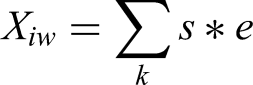
Each respondent’s overall news diet is then summarized in order to capture his/her tendency toward either socioeconomic left or right outlets, on the one hand, and socioculturally liberal or conservative outlets, on the other hand. This is done by first multiplying each outlets ideological slant (s) with the frequency of outlet exposure (e). In the second step, we summarize the product of s × e across all outlets (k):
Data Analysis
We address our research questions and hypotheses using two statistical approaches.
First, to address RQ1 and RQ2 by comparing the relative importance of the two dimensions, we use a random-effects panel model with wave dummies to control for period effects (Finkel, 2008). These models test for outlet-specific selectivity to address whether the two ideological dimensions operate differently in relation to our three levels of news media—and whether the sociocultural value dimension structures audiences in unique ways.
Second, to address H1, H2, and RQ3 concerning ideological reinforcement effects, we rely on recent developments in the longitudinal modeling of reciprocal effects. More specifically, we utilize structural equation modeling to estimate Random Intercept Cross-lagged Panel Models (RI-CLMP) - which has been suggested as the appropriate approach for testing RSM (Slater, 2015; Thomas et al. 2021). Compared to traditional cross-lagged panel models, the RI-CLPM separates stable between-person differences from within-person deviations from these baselines over time (Hamaker et al., 2015; Thomas et al., 2021). The model estimates four components of interest to us, as illustrated in Figure 1. On the between-person level, (
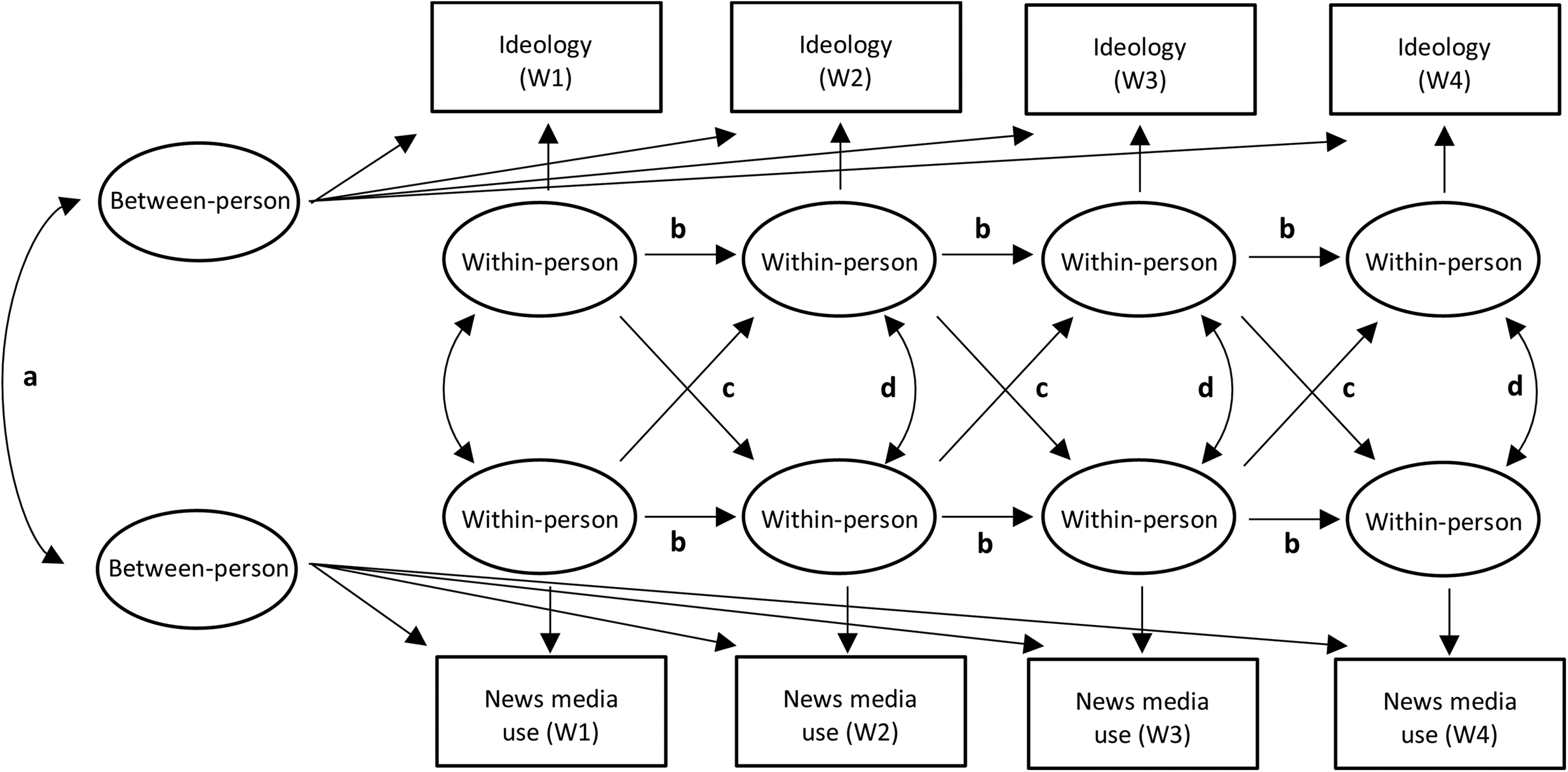
The Random Intercept Cross-lagged Panel Model (RI-CLPM). Note: Illustration of the random-intercept cross-lagged panel model used to estimate between-person and within-person relationships between news media use and ideology.
Results
The relative importance of the socioeconomic and the sociocultural value dimensions is addressed using a series of random effects panel regressions with outlet-specific news media use as outcome variables. Each model controls for sex, age, education, political interest, and wave dummies to capture any time trend. The main findings are presented in Figure 2, which illustrates the marginal effects of the two ideological dimensions, keeping all other variables in the model at their means (for full models, see Table A.2 in the Supplementary Information file). Negative coefficients on the socioeconomic dimension suggest that specific media outlets are used more frequently by people to the left, while positive coefficients reflect a right-leaning bias of users. Correspondingly, negative coefficients on the sociocultural value dimension indicate more frequent usage among culturally liberal respondents, while positive coefficients suggest a higher usage among more culturally conservative citizens.
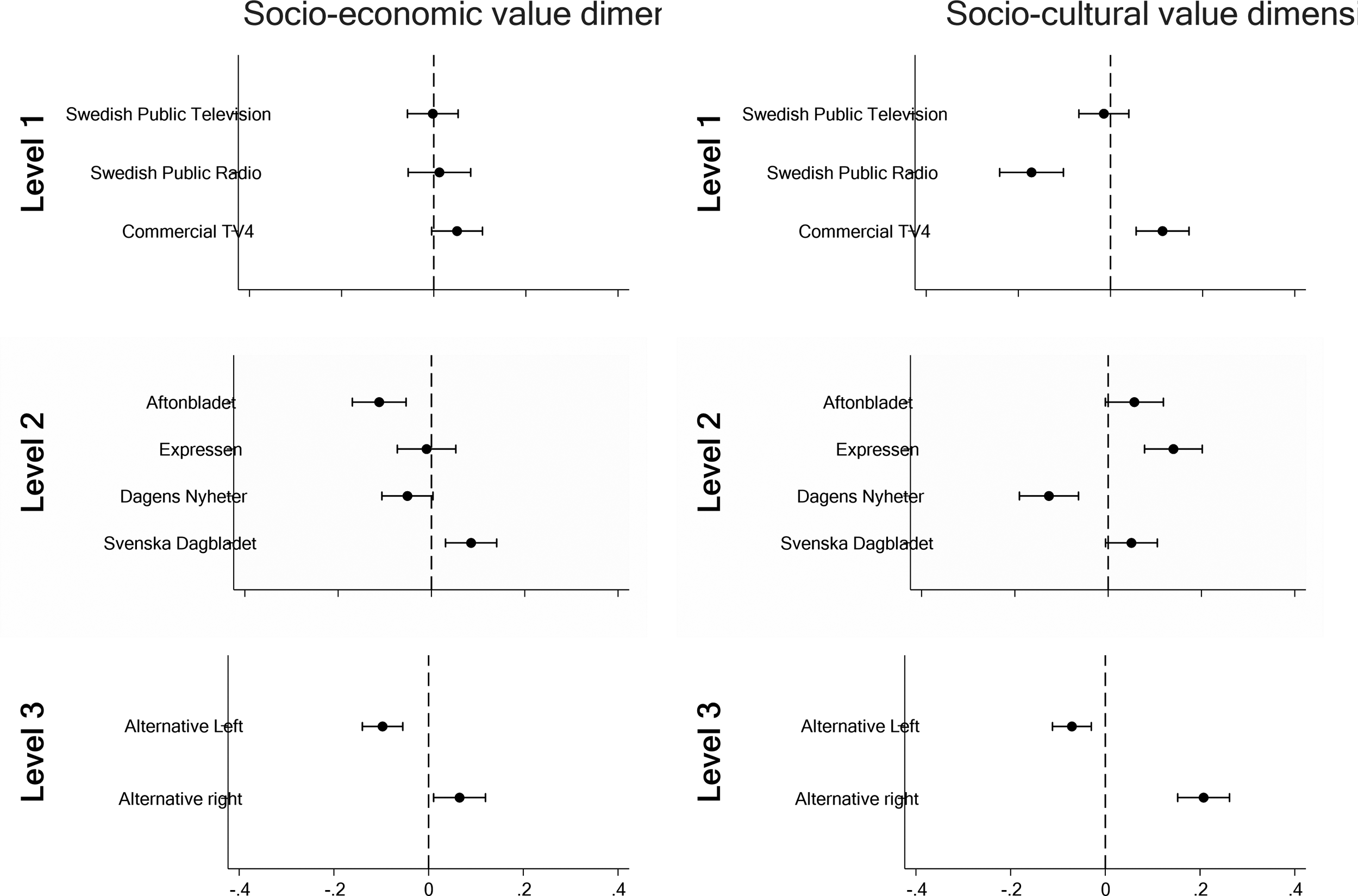
Average marginal effects of the socioeconomic and the sociocultural dimension on news use. Note: Average marginal effects (dydx) from a series of random effect models where the socioeconomic dimension index and the sociocultural cultural dimension index serves as the independent variables and each of the news outlets serves as the dependent variable. Negative coefficients on the socioeconomic dimension means that the outlet is more used by respondents to the economic left and positive coefficients means that the outlet is more used by people who are economically right. Negative coefficients on the sociocultural dimension means that the outlet is more used by people who are culturally liberal and positive values means that the outlet is more used by people who are more culturally conservative. Each model controls for sex, age, education, political interest, and wave dummies. Full model results are presented in Table A.2 in Supplementary Information file.
The socioeconomic value dimension: The graph to the left in Figure 2 focuses on the traditional socioeconomic ideological dimension. With respect to level 1 news outlets—politically non-partisan broadcasting institutions—nothing is going on in terms of ideological audience profiles. Citizens on the socioeconomic left and right sides are as likely to turn to public service television news (SVT), public service radio (SR), and commercial TV4 news. For level 2 outlets—the traditional press with political affiliated editorial pages—left-right issue attitudes are however somewhat more important for explaining news choices. People to the left are more frequent readers of the tabloid Aftonbladet, while citizens with right-wing economic attitudes are more likely to read the broadsheet Svenska Dagbladet. No systematic patterns emerge for Dagens Nyheter (broadsheet) or Expressen (tabloid). Finally, usage of level 3 news outlets—political alternative media—is moderately explained by socioeconomic ideology in the expected directions. Left-wing alternative media is used more frequently by people with socioeconomic left-wing attitudes, while right-wing alternative media is used somewhat more by people with socioeconomic right-wing attitudes.
The sociocultural value dimension: Compared to the socioeconomic dimension, the sociocultural dimension appears to be more clearly related to news use. In fact, there are only three outlets—public service television (SVT), Aftonbladet, and Svenska Dagbladet—where the sociocultural value dimension does not produce significant coefficients. In contrast to the socioeconomic dimension which did not yield any differences among level 1 outlets, there are now clear ideological differences relating to the use of the public service radio (more culturally liberal) and those who consume the commercial TV4-news (more culturally conservative). The observed effects are also more pronounced with respect to level 2 outlets—traditional press with politically affiliated editorial pages. Frequent readers of the broadsheet Dagens Nyheter are considerably more socioculturally liberal while readers of the tabloid Expressen are clearly socioculturally conservative. Finally, the political alternative media have distinct sociocultural audience profiles as well. Although the ideological profile of alternative left outlets is relatively modest, users of alternative right media are clearly socioculturally conservative.
In sum, the sociocultural value dimension has a stronger, more systematic and widespread relationship to news media use (RQ1). The socioeconomic dimension is statistically significant in 4 out of 9 models. This can be compared to the 6 out of 9 significant coefficients for the sociocultural dimension.
Figure 2 also speaks to the second research question concerning how the relationship between ideology and news media use differs across our three-level media classification. This classification appears somewhat more relevant for the traditional socioeconomic dimension than for the sociocultural value dimension. In the former case, ideology clearly matters less for the usage of political non-partisan broadcasting institutions than for other media. The sociocultural value dimension is however highly relevant for all types of media—non-partisan as well as political (RQ2).
Figure 3 provides a visual overview of how both ideological dimensions structure regular use of the different media by spatially positioning each news outlet’s regular audience (more than five times a week) along the two dimensions. The size of circles represents the audience size of each outlet. Since individuals often use more than one news source, there is a significant overlap of respondents across circles. The findings in Figure 3 confirm patterns from the regression models above. The ideological audience profile of the Swedish media environment reflects a division along both the traditional socioeconomic and the sociocultural value dimension—but the differences are most pronounced along the latter dimension. In fact, among the six largest news outlets—SVT, SR, TV4, Aftonbladet, Expressen, and Dagens Nyheter—there is only a 0.2 difference between the average audience left-right position of Aftonbladet and the audience of TV4. This can be contrasted with a 0.75 point difference between the most liberal/conservative outlets (DN/Expressen).
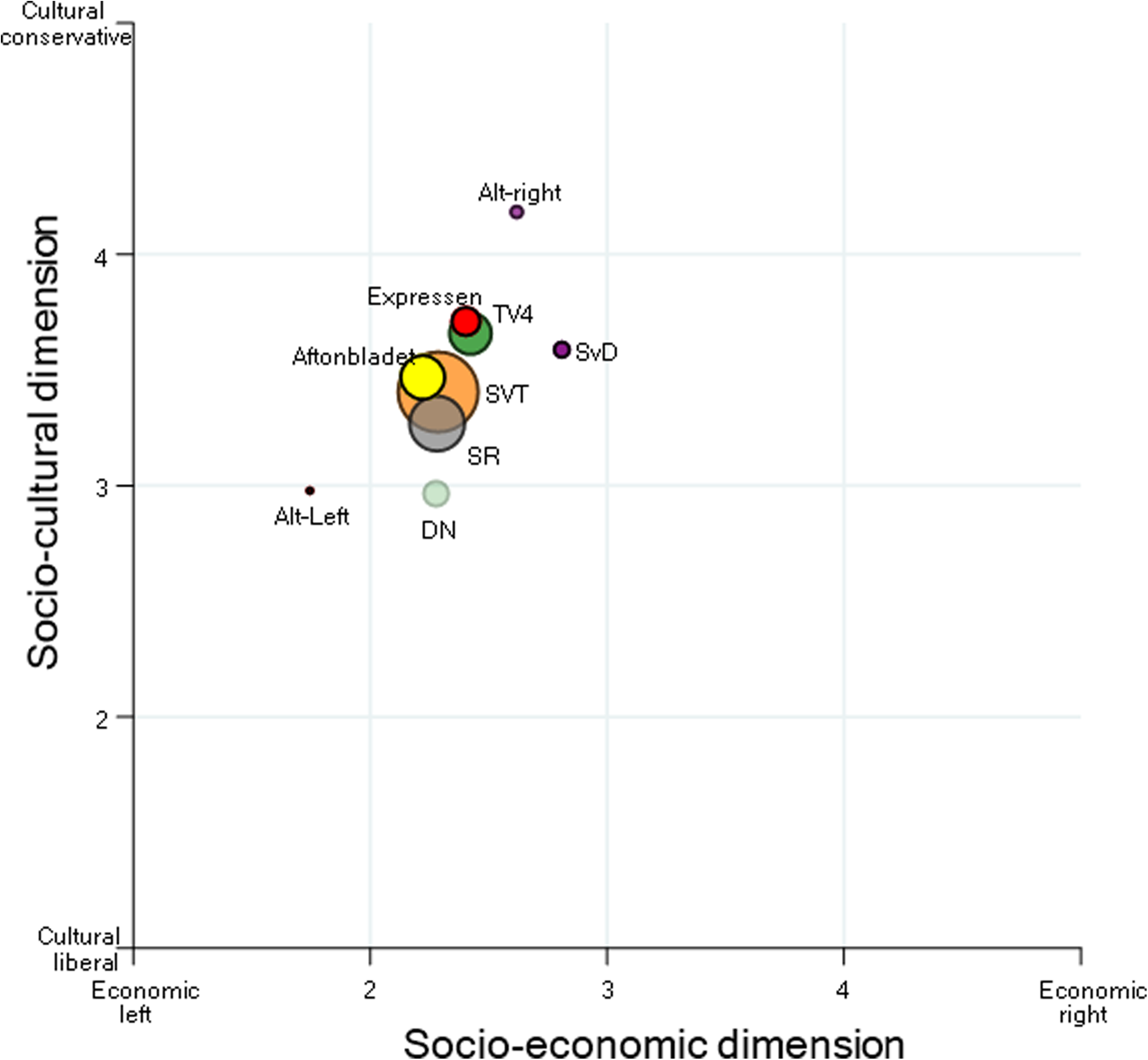
Ideological positioning of regular news audience along the socioeconomic and the sociocultural value dimensions (mean values). Note: The figure displays each outlets regular audience position (those who use the outlet five days a week or more) along the socioeconomic and the sociocultural valued dimension. The sizes of the audiences are based on the number of frequent users (>5 days a week). For alternative left readers, we include respondents who use any of the following outlets five or more days (ETC, Feministiskt Perspektiv; Dagens Arena, Arbetet, Aktuellt Fokus; Fria tidningen; Aktuellt i Politiken). For alternative right readers, we included respondents who used any of the following outlets five days or more a week (Samhällsnytt; Nya Tider; Nyheter idag; Fria tider; Samtiden; Ledarsidorna). For audience placement in wave 2, wave 3, and wave 4, see Figure A.3 in Supplementary Information file.
News diets and ideological reinforcement: Whether the ideological profile of citizens’ news diets has effects on ideological reinforcement over time, is a critical question in discussions regarding the changing media environment. Addressing H1 and H2, Table 1 presents findings from two random-intercept cross-lagged panel models (RI-CLPM) representing the socioeconomic and sociocultural value dimensions respectively. Both model 1 (RMSEA = 0.02; CFI = 1.00) and model 2 (RMSEA = 0.02; CFI = 1.00) fit the data well.
Findings from Random Intercept Cross-Lagged Panel Models (RI-CLPM).
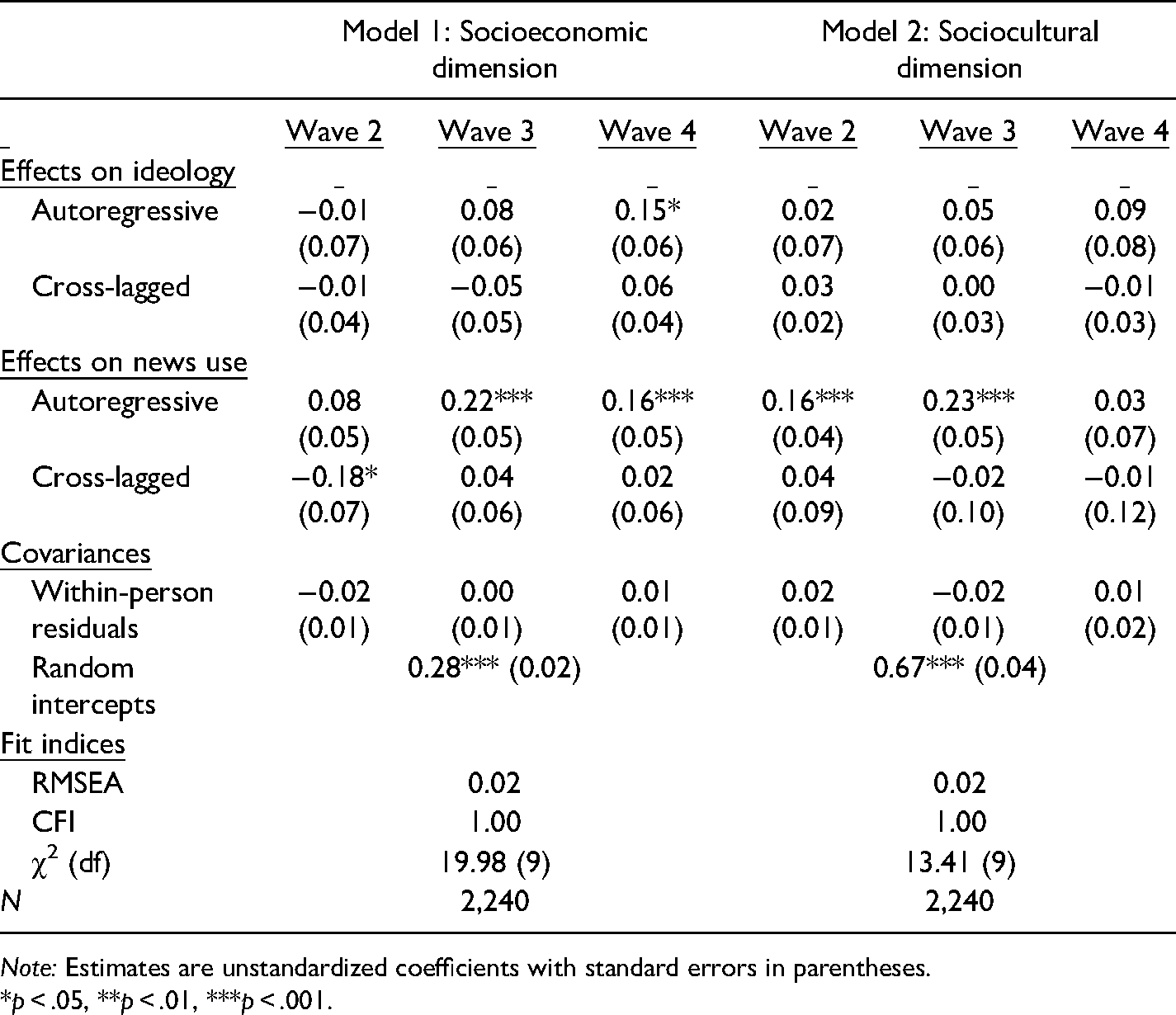
Note: Estimates are unstandardized coefficients with standard errors in parentheses.
*p < .05, **p < .01, ***p < .001.
Looking first at the socioeconomic dimension, we ask whether an ideological news diet across the nine specific outlets is related to ideological attitudes at the between-person and the within-person level. On the within-person side, there are significant autoregressive effects of ideology between wave 3 and wave 4 (b = 0.15, p < .05), and of socioeconomic ideological media use between wave 2 and 3 (b = 0.22, p < .001) as well as between wave 3 and 4 (b = 0.16, p < .001). The only significant intraindividual cross-lagged effect is found between wave 1 and 2 (b = −0.18, p < .05). None of the within-person residual covariances are statistically significant, neither. For the sociocultural dimension, only the autoregressive media diet effects for the first two periods are statistically significant (b = 0.16, p < .001; b = 0.23, p < .001). Thus, there is no evidence of within-person feedback loops or reinforcement over time—either with respect to the cross-lagged effects or the within-person residual covariances. On the other hand, the relationship between ideological media diets and ideological attitudes is clearly related at the interindividual level—both with respect to the socioeconomic (COV = 0.28, p < .001) and the sociocultural value (COV = 0.67, p < .001) dimension of ideology. In sum, these findings suggest the presence of stable between-person relationships between media use and ideology (H1) but lend no support to reciprocal effects at the within-person level (H2). With regard to reinforcement effects, we see no difference between two ideological dimensions (RQ3).
Conclusion and Discussion
Against the background of changing political cleavages across Western democracies, this study has compared the relative importance of the socioeconomic and the sociocultural value dimensions of ideology for selective news exposure, audience composition, and ideological reinforcement in Sweden. Let us briefly summarize and discuss the most important findings.
First, in terms of selective exposure, our findings indicate that the sociocultural value dimension is more important than the socioeconomic dimension for explaining news choices and audience structure. The limited impact of political ideology as a determinant of selective exposure documented in previous research (Dahlgren, 2021; Skovsgaard et al., 2016) may partly reflect a somewhat narrow reliance on the traditional left-right dimension of ideology. By relating the two dimensions of ideology to our three-level classification of news media outlets, previously hidden divisions in audience structure also emerge. Although socioeconomic ideology is consistently unrelated to the usage of non-partisan broadcasting institutions (level 1 news outlets), the sociocultural value dimension is, in contrast, clearly related to the usage of these news sources. Apart from public service television (SVT)—which remains as a catch-all source of news for broad segments of the population—sociocultural divisions are distinct with respect to public service radio (SR) and commercial TV4 Nyheterna. In that sense, the sociocultural value dimension of ideology opens cleavages in audience structure not visible based on the socioeconomic dimension. Not only are new online media changing citizens’ news habits but new political cleavages reshape people’s orientations toward established (nationally leading non-partisan) media as well. With respect to selective exposure theory, understanding political ideology not as a unidimensional but rather as a multidimensional concept may prove crucial for identifying the preferences and values that matter for news choices (Garrett, 2009; Stroud, 2011; 2017).
Second, our findings also indicate that previous attempts to summarize levels of audience polarization at the country level (Dahlgren, 2019; Fletcher et al, 2020; Mitchell et al., 2018), may underestimate political divisions in news choices by not accounting for the sociocultural value dimension. Aggregated comparisons between the two dimensions revealed significantly wider divisions based on the sociocultural than the socioeconomic dimension. At the same time, while the sociocultural value dimension clearly matters, it seems to complement rather than replace the socioeconomic dimension as a factor structuring news audiences. This complementary role resembles how the sociocultural value dimension influences party systems, voter alignments, and public opinion in a broad sense: co-existing with, but adding another layer to, traditional political cleavages (Oscarsson et al., 2021).
Third, we find very little evidence for within-person reciprocal effects between selective news media use and ideology over time—lending no support for reinforcing feedback loops over time (Slater, 2015; Song and Boomgarden, 2017). These findings run counter to some other RSM studies documenting reinforcement effects on ideological attitudes (Dahlgren et al., 2019; Hmielowski et al., 2020). One likely explanation is that our study focuses on pure within-person reinforcement effects only, using the random-intercept cross-lagged panel model (Hamaker et al., 2015; Thomas et al., 2021; see Wojcieszak et al. 2021 for additional within-person evidence of “no effects”). Relationships are more robust at the between-person level, suggesting a stable pattern of de facto selective exposure which structures news audiences along certain ideological lines—but which does not necessarily reinforce these divisions (Stroud, 2017). Thus, the maintenance of news habits and ideological preferences prevails. At least over a time frame of 18 months, which this study covers. These findings, however, do not rule out more long-term ideological reinforcement effects that may operate over several years or even decades (Shehata et al, 2021)—or reinforcing spirals driven by sudden dramatic events triggering ideological identity threats (Song and Boomgarden, 2017; Slater, 2015).
Importantly, our test of the RSM built upon a combined news consumption measure, capturing the ideological profile of citizens’ overall news diets across outlets. Although this approach builds directly on recent operationalizations (Gentzkow & Shapiro, 2011; Fletcher, Cornia, and Nielsen, 2020; Fletcher Robertson & Nielsen, 2021), using audience profiles as a proxy for content differences can only be indicative. What the index taps is the extent to which citizens’ combine news outlets with distinct ideological audience profiles. The procedure allowed us to compute individual-level news diets (1) across a large number of the most important news outlets in Sweden irrespective of platform, and (2) for two separate dimensions of ideology. Inevitably, these measures also depend on the specific survey items used to tap the ideological dimensions. Although the items worked well from a dimensionality perspective, a broader range of survey items would have been preferable. The relative importance of the socioeconomic and sociocultural value dimension should therefore be open to reassessment based on studies having access to a more comprehensive set of items.
Finally, our single-country focus is to some extent a limitation—since we cannot empirically determine how far these findings travel. At the same time, Sweden represents a good case for the larger international trends outlined here. Most importantly, while Sweden is typically described as a country of low levels of polarization from a comparative perspective, such assessments rely primarily on traditional political cleavages. Polarization has increased significantly along the emerging sociocultural value dimension in the past decade (Oscarsson et al. 2021; Mitchell, 2018). At the same time, although Sweden has experienced the same political and media environmental developments as most Western democracies—it may well be the case that the ideological cleavages documented here are even more pronounced in more polarized countries.
Supplemental Material
sj-docx-1-hij-10.1177_19401612221112003 - Supplemental material for Selective Exposure and New Political Cleavages: Media Use and Ideological Reinforcement Over Time
Supplemental material, sj-docx-1-hij-10.1177_19401612221112003 for Selective Exposure and New Political Cleavages: Media Use and Ideological Reinforcement Over Time by Adam Shehata, Mats Ekström and Per Oleskog Tryggvason in The International Journal of Press/Politics
Footnotes
Declaration of Conflicting Interests
The author(s) declared no potential conflicts of interest with respect to the research, authorship, and/or publication of this article.
Funding
The author(s) disclosed receipt of the following financial support for the research, authorship, and/or publication of this article: This project has received funding from the European Research Council (ERC) under the European Union’s Horizon 2020 research and innovation program (grant agreement No 804662). The project was also supported by a grant from the Swedish Research Council (VR 2020-01915).

Supplemental Material
Supplemental material for this article is available online.
Notes
References
Supplementary Material
Please find the following supplemental material available below.
For Open Access articles published under a Creative Commons License, all supplemental material carries the same license as the article it is associated with.
For non-Open Access articles published, all supplemental material carries a non-exclusive license, and permission requests for re-use of supplemental material or any part of supplemental material shall be sent directly to the copyright owner as specified in the copyright notice associated with the article.
