



Abstract
These are challenging times for journalists’ relationship with their audiences. Attacks against “the media” and the increasing weaponization of social media to harass journalists have drawn the attention of scholars worldwide. In the current climate, journalists are not only distrusted but also hated, which creates a series of distinct ramifications. In this article, we suggest a new framework to study journalists–audiences relationship, particularly in times of hostile populism: the imagined journalists approach. A mirror image of the much-studied concept of imagined audiences, imagined journalists refers to the entirety of ideas, feelings, stereotypes, and imaginaries that audiences hold regarding their imagined news producers. It brings together the research on media trust, audiences’ perceptions, antimedia populism, and the emotional turn in journalism—to generate a comprehensive understanding of people’s criticisms, narratives, and priorities. We demonstrate the potential of this approach by analyzing 1,215 responses to an open-ended question regarding journalists’ traits in Israel in 2021. Employing qualitative and quantitative analyses, we find that: (a) right-wing and pro-populist voters hold more negative views of journalists, as expected; (b) voters express three different types of criticism of journalists (professional, personal, and national)—only one of which directly relates to their professional conduct; (c) different types of voters express different types of criticism; and (d) while objectivity and bias remain main concerns, democracy is not a dominant factor in respondents’ thinking on journalists. These findings contribute theoretically and methodologically to future research in the field, as well as to urgent attempts to improve our information environment.
Introduction
The past decade has been particularly challenging for the relationship between journalists and the public. Apart from the competition with social media and the collapse of traditional business models (Cagé 2016; Starr 2012), news organizations worldwide have been subject to intensifying attacks against “the fake news media,” with journalists targeted, smeared, and harassed online and offline (Egelhofer and Lecheler 2019; Miller 2023b; Van Dalen 2021). Research shows this increasing threat to be impactful: it shapes public perceptions of the news media, jeopardizes journalists’ well-being and safety, and has a tangible chilling effect on the news they dare produce (Miller 2023a; Panievsky 2022; Waisbord 2020). In light of these concerning trends, media scholars and practitioners dedicate considerable efforts to improving journalists’ relationships with their audiences. Researchers suggest new forms of public-engaged journalism (i.e., community journalism, solutions journalism, and solidarity journalism), new types of audience-based funding models, and an investigation into journalists’ use of new metrics to learn about their audiences (Coddington et al. 2021; Nelson 2021). However, while massive attention has been given to journalists’ imagined audiences, its mirror image—imagined journalists—has not been conceptualized and studied as such.
In this article, we propose imagined journalists as a new framework to study the relationship between media and publics. Imagined journalists refers to the entirety of ideas, connotations, stereotypes, sentiments, criticisms, priorities, and, increasingly, conspiracy theories that audiences attribute to those who convey them the news. How do people imagine journalists? When asked about journalists, which themes and terms come to people’s minds? Are they concerned with the news that journalists provide them, or with what they understand to be journalists’ character, intentions, interests, or loyalties? While imagined audiences inform how journalists produce news, imagined journalists shape how audiences perceive, understand, or avoid it. The imagined journalists paradigm is intended to overcome the existing research biases (e.g., trust centrism), address timely challenges (e.g., antimedia populism), and help consolidate different aspects of audience research to generate a comprehensive understanding of the image of journalists and journalism in the public mind.
After establishing imagined journalists as a theoretical concept, we will suggest a methodological approach through which to explore it, using a combination of open-ended questions and a large-scale survey. By combining qualitative and quantitative modes of text analysis, this approach offers two significant benefits: (1) investigating people’s views in their own words, while also (2) exploring variations in how people imagine journalists across different groups in society. This is an important point to stress: if one is to improve journalists–publics relationships, multiple strategies are needed. Different communities may have different and even conflicting grievances and demands from the media. Journalists’ responses should vary accordingly.
After presenting our theoretical and methodological approach, we apply it to explore how Jewish Israelis imagine journalists. In 2021, we conducted a large-scale survey in Israel, where journalists are constant targets of populist media bashing and online harassment (Panievsky 2022; Rogenhofer and Panievsky 2020). By combining qualitative and quantitative analyses of responses to an open-ended question and multiple standard variables (e.g., voting intentions and demographic variables), we found that (a) as expected, right-wing and pro-populist voters hold more negative perceptions of Israeli journalists; (b) respondents express three different types of criticism of journalists, only one of which focuses on their professional conduct; (c) different types of voters express different types of criticism, with right-wing and pro-populist voters expressing more personal and nationalist criticisms than others; and (d) while objectivity and bias remain main concerns, voters do not cite democracy as a dominant factor in their thinking about journalists.
The following section reviews the main limitations of the dominant literature on journalism and publics, focusing on two challenges: trust-centrism and antimedia populism. Next, we present imagined journalists as a paradigm, which could help expand and consolidate our understanding of journalists–public relationship by addressing both challenges. Finally, we employ our proposed paradigm by studying how different political communities imagine journalists in Israel in 2021.
Beyond Trust, Role Perceptions, Media Consumption, and News Subscription
The existing literature on news audiences could be broadly classified into four main groups: media (dis)trust (e.g., Suiter and Fletcher 2020); perceptions of journalistic roles (e.g., Tsfati et al. 2006); news consumption and exposure (e.g., Fletcher and Park 2017); and, more recently, willingness to pay for news (e.g., O’Brien et al. 2020).
The first two—media trust and audience perceptions of journalistic roles—are rooted in the literature on journalism and democracy and largely driven by concerns about citizens’ ability to be properly informed about public affairs and engage in democratic processes. The implications of media distrust have been studied, for instance, in relation to news use, trust in other democratic institutions, and liability to disinformation (Ariely 2015; Fletcher and Park 2017). While influential and enlightening, scholars increasingly point at the shortcomings of the prolific literature on media trust—from the lack of conceptual consistency to biases of popular measurement methods, which often rely on preset wording of close-ended questions (Engelke et al. 2019; Fisher 2016; Garusi and Splendore 2023; Knudsen et al. 2022; Markov and Min 2022).
Audience perceptions’ studies provide a deeper glance into people’s preferences regarding the roles journalism fulfills. In Israel, for instance, audiences were found to have different views than journalists regarding the news media’s roles, with journalists prioritizing their interpreting role much higher than citizens (Tsfati et al. 2006). This body of literature moves beyond the axis of trust/distrust. However, audience’s role perceptions were studied principally through quantitative surveys with limited preset answers to choose from, thus priming and framing audiences’ answers (e.g., Willnat et al. 2019). Qualitative research into role perceptions highlights this limitation. Studies into audiences’ perceptions of local media in the Netherlands and lifestyle journalism in South Africa, for instance, found that citizens’ expectations include overlooked professional missions like providing inspiration and aspiration (Banjac and Hanusch 2022; Costera Meijer 2010). In her exploration of citizens’ “deep stories” about American journalism, Palmer (2019) found that her interviewees saw journalists as bullies rather than advocates and did not share the scholarly idealization of the watchdog role of journalism. Quantitative and qualitative research into role perception research thus broadens our understanding of audiences’ expectations of news. Nonetheless, role perception research remains focused on the professional performance of news media, rather than other aspects people might be considering when thinking about journalists and journalism.
The rationale behind the growing research into the two remaining dominant topics —news consumption and subscriptions—is more practical. As news organizations desperately seek new crowd-based funding models, detecting patterns of consumption and subscription becomes critical. The annual report by the Reuters Institute provides insightful information regarding news consumption and subscription worldwide. For instance, more people in various countries claim to actively avoid the news, and only 17 percent paid for any online news in the twenty examined countries (Newman et al. 2022). Such data are invaluable for an industry hoping to find a sustainable business model for news. Yet, as it is oriented toward financial survival, it focuses on those aspects of media–public relations, which seem likely to promote a money exchange between the two.
To address these tendencies, we propose to reorient the scholarly debate from specific questions on trust and consumption toward a broader conceptualization of imagined journalists. We believe that for both the concerns about democracy and the financial future of journalism, the imagined journalists paradigm provides a valuable contribution. The next sections elaborate on the main challenges we identify in the literature at this time—trust-centrism and antimedia populism—before explaining our suggested path forward.
The Problem of Trust-Centrism
Scholars have pointed to several limitations of the rich body of literature on media and trust, which has been flourishing since Donald Trump’s 2016 victory and the Brexit referendum. One is the lack of an agreed definition of media trust (Fawzi et al. 2021; Fisher 2016; Prochazka and Schweiger 2019; Strömbäck et al. 2020). Media trust was defined as “the willingness of the audience to be vulnerable to news content based on the expectation that the media will perform in a satisfactory manner” (Hanitzsch et al. 2018: 5); as “the expectation that the interaction with the trustee would lead to gains rather than losses” (Tsfati and Cappella 2003: 506); and as “the perception of the media being objective, impartial, accurate, or unbiased” (Ardèvol-Abreu and Gil de Zúñiga 2017: 615–16). The scholarly use of the term distrust has been equally confusing, with concepts like media cynicism, media bias, and “the opposite of trust” used inconsistently (Engelke et al. 2019). Apart from the conceptual blurriness, media trust research has been criticized for focusing on the United States and Europe and overlooking the varied reasons of different communities to distrust the media (Banjac 2022; Peterson-Salahuddin 2023; Robinson and Culver 2019). Above all, scholars highlighted the limitations of the particular measures used to indicate media trust.
Over the years, trust was measured mainly through close-ended questions and rating scales, like “do you trust/distrust the media?” or “to what extent do you trust/distrust the media?” (e.g., Hanitzsch et al. 2018; Tsfati and Ariely 2014). Recently, scholars have advanced more nuanced wording, like prioritizing questions about specific news outlets (Strömbäck et al. 2020) and distinguishing low trust from distrust (Engelke et al. 2019) or distrust from cynicism (Markov and Min 2022). Nevertheless, close-ended questions and pre-established answers are still the dominant way to explore media trust and role perceptions (Knudsen et al. 2022). Preset categories, multichoice questions, and standard Likert scale simplify the analysis process and allow for large-scale data collection—but introduce several potential distortions.
First, when presented with a scale that runs from positive affect (“trust”) to negative affect (“distrust”), respondents might choose the option that most reflects their sentiment toward or imagination of the media, even if trust is not necessarily the issue that they would emphasize themselves. The risk is that respondents might be “answering the unmasked question”—namely, providing answers that reflect the attitudes they wish to convey but that researchers have not asked about (Gal and Rucker 2011). As Toff et al. (2021) note, “trust and distrust often serve as a shorthand for what people liked or disliked” (p. 13).
Second, close-ended questions prevent respondents from explaining what stands behind their answers. So far, such questions have been studied mainly qualitatively, through interviews and focus groups (Kaun 2014; Nelson and Lewis 2023; Toff et al. 2021). While still trust-centrist, these studies are revealing. Toff et al. (2021) show that interviewees mean various things when referring to media bias. Nelson and Lewis (2021) emphasize the role of self-perceptions in media trust, which was largely ignored when traditional quantitative measures were applied. Mont’Alvern et al. (2023) highlight the importance of journalists’ intentions in audiences’ determination what consists as “impartial news.” While usually modest in participants’ numbers, these qualitative studies provide useful observations and future research directions. We suggest incorporating these qualitative approaches—together with the research strands abovementioned—under the umbrella of imagined journalists, through which scholars can expand and unite their work on media audiences and publics.
The Populist Challenge
Recent political developments highlighted an additional limitation of the dominant literature: not how it measures issues like trust, but rather what it overlooks when focusing on trust. Over the past decade, populist politicians and movements worldwide have turned their hostility toward the media into a dominant feature of their political agenda (Krämer 2018; Rogenhofer and Panievsky 2020; Van Dalen 2021). Recent studies demonstrate the severe ramifications of antimedia populism (Miller 2023a; Panievsky 2022; Waisbord 2020). Research indicates that this populist media bashing affects the public’s trust (Duyn and Collier 2019; Smith 2010; Watts et al. 1999). However, antimedia populism is not limited to questions of credibility, bias, or trust. It portrays journalists as evil and treacherous, questioning their moral character, motives, and loyalty to the nation (Kenny 2020; Panievsky 2022; Shin et al. 2021). Labels like “enemies of the people” aim not only to sow distrust in the media or to question journalists’ credibility but also to trigger hate. The “fake news” discourse and increasing online violence against journalists reveal worrying resonance of this message of hate (George 2019; Posetti et al. 2021; Shin et al. 2021), which is related but not reduceable to questions of credibility, role perceptions, consumption, or exposure.
Public hostility toward the media is consequential in and of itself. First, it can lead to online abuse, doxing, and even physical violence, harming targeted journalists’ safety and well-being (Mazzaro 2023; Miller 2023a). Second, it creates a chilling effect, encouraging self-censorship and resignation (Panievsky 2022; Waisbord 2020). Third, it might discourage potential sources from collaborating with journalists. Public resentment is hence a key factor, which might be as consequential to the functioning of democracy as trust or consumption, which get much more scholarly and popular attention. Current challenges to journalism thus go well beyond the traditional questions directed at audiences. With the existing literature focusing on trust, role perceptions, consumption, and subscription as main lens into public thinking on journalism, other aspects of audiences’ narratives and sentiments remain overlooked.
We therefore build on recent studies, which deepen our understanding of news audiences through concepts like loyalty and folk theories (Gajardo and Costera Meijer 2023; Juarez Miro 2023; Palmer et al. 2020; Wilner et al. 2021), to propose imagined journalists as a central facet of media–public relationship.
The Imagined Journalists Approach
Considering the current media crisis and the widespread campaign against the media, obtaining a comprehensive perspective on audiences’ views of journalists is a particularly urgent task. We hence developed the theoretical concept of “imagined journalists” and suggest how it could be empirically studied.
Imagined Journalists as a Theoretical Concept
The imagined journalists paradigm is intended to encapsulate the image of journalists in the public mind. Imagined journalists refer to the entirety of ideas, sentiments, stereotypes, narratives, and connotations that audiences hold regarding their imagined news producers. How do audiences imagine journalists? How central are different terms to audiences’ thinking about journalism? Who is concerned with journalists’ professionalism, and who has stronger feelings about journalists’ personality, intentions, or loyalty to the nation? While media scholars offer compelling accounts of journalists’ imagined audiences (Coddington et al. 2021; Nelson 2021), our understanding of how audiences imagine journalists deserves further attention. Unlike imagined audiences (Goffman 1959), which affect journalists’ performance and conduct—imagined journalists shape how people perceive, accept, and respond to news. Simply put, the way we imagine journalists matters for how we think, feel, and engage with news. Studying it is essential in order to grasp the depth of this ever-changing relationship. Moreover, it has important potential implications for issues like media regulation, quality of news, citizens’ willingness to engage in violence toward journalists, and more.
This point is highlighted as our understanding of the role of emotion and identity in the relationship between media and public evolves (Lecheler 2020; Schulz et al. 2020; Suiter and Fletcher 2020). If one recognizes that individuals’ approach to public knowledge is not necessarily determined by a rational evaluation of news outlets’ performance based on previous experience and fact-based evidence—exploring the imaginary universe people associate with journalists has to be the next step to advance research on publics and news.
The imagined journalists approach allows us to bring together findings from traditionally rationalist, transmission-oriented literature on media trust, news use, role perceptions, consumption, and subscription—with arising types of qualitative-oriented research into the stories people tell about the news (e.g., meta-journalistic discourses and folk theories, see Carlson 2017; Palmer et al. 2020) and research on feelings and experiences in journalism (often concerned with news producers rather than audiences, see Jukes 2020; Kotisova 2019; Lecheler 2020; Wahl-Jorgensen 2016). Stories, sentiments, and even conspiracy theories are crucial to fully capture how journalists are imagined, as are trust and exposure. “To encounter news,” Carlson (2017) writes, “is to enter into a relationship” (p. 7). And in relationships, both sides imagine each other, with these imaginations—founded or baseless—informing the relationship, demarcating its potential, and shaping its future.
In recent years, research has shed light on where journalists’ imagined audiences come from: anecdotal knowledge, online interaction, and, more recently, metrics (Coddington et al. 2021; Nelson 2021). These sources of imaginations are dynamic and contextual and a promising research direction for better understanding newsmakers and newsmaking. We contend that the other end of this relationship, how audiences imagine journalists, needs to be similarly investigated. As audiences do not have similar metrics in newsrooms, where do imagined journalists come from? How do these imaginations differ and why?
Theoretically, the imagined journalists approach encourages researchers to engage with the imaginative and affective dimensions of people’s attitudes toward media. As journalists operate in increasingly hostile environments (George 2019), these have been shown to be particularly consequential. The imagined journalists paradigm goes beyond traditional explorations of media trust or news consumption to examine audiences’ narratives and grievances, inviting scholars to integrate research on trust with research on hate, studying credibility alongside stereotypes and loyalty together with bias. These concepts, which originate in different subfields, are all part of the imaginative reflection of journalists and journalism in people’s minds. They all play a significant role in the formation of public knowledge.
Methodological Approach to Imagined Journalists
The imagined journalists paradigm emphasizes the timely need to dedicate more attention to people’s imaginaries of media. While there are various ways to explore imagined journalists, we suggest here exploring it through open-ended survey questions, to be analyzed using both qualitative and quantitative tools. This methodological approach allows respondents to speak their minds undirected by specific wordings, to prevent biases and blind spots stemming from researchers’ presumptions.
Methodologically, there have been two main approaches to audience research: large-scale quantitative survey-based studies and qualitative interview-based studies. Both are valuable and could be used to study imagined journalists—yet both have limitations which our mixed methods approach is intended to tackle. By posing open-ended question to a large sample of survey respondents, we get audiences’ beliefs, connotations, and emotions in their own words—yet in ways that also allow for generalizability as well as effective comparison among different audiences. Thanks to the open-ended format, respondents are invited to express their views freely, with no preset options to choose from. This methodology—increasingly relevant to the study of political identities and beliefs (Condon and Wichowsky 2020)—allows us “to glean the meaning that the people under study attribute to their social and political reality” (Schatz 2009: 5).
Through this two-step method, our work responds to calls for more qualitative research into media understandings (Garusi and Splendore, 2023) and “an open-ended approach” to public trust in the news (Knudsen et al. 2021; Newman and Fletcher 2017). These studies used open-ended questions to reveal respondents’ interpretations of trust, or respondents’ reported reasons for distrust. They introduce a vital step toward developing new approaches to audiences’ research. They do not, however, challenge the trust-centrism that tends to reduce journalists–audiences relationships to questions of credibility or disinformation.
Recent interview-based research explored people’s views more openly and freely, revealing their meta-journalistic discourses and folk theories (Kaun 2014; Nelson and Lewis 2023; Palmer et al. 2020; Wilner et al. 2021). These qualitative studies contribute novelties and nuances to our understanding of audiences’ diverse critiques. Nevertheless, they tend to be limited in terms of sample size and representativeness. Hence, while imagined journalists can be studied qualitatively, we recommend a mixed methods’ analysis to explore and compare how people imagine journalists.
Large-scale surveys with open-ended questions are well-suited to investigate media criticisms by different social groups with distinct priorities, worldviews, political imaginaries, histories, and grievances. In the empirical section of this study, we focus on political communities; the same conceptual and methodological framework, however, could be similarly applied to study imagined journalists of various groups and societies. Through the qualitative thematic analysis, we learn about the terms and frames respondents raise. The quantitative coding then allows us to compare the themes raised by different groups of respondents, thus emphasizing that audiences’ imagined journalists are always varied, nuanced, and diverse.
Empirical Case of Imagined Journalists
We conducted a study designed to explore audiences’ imagined journalists in times of antimedia populism. We analyze survey data of an online representative sample of Jewish Israelis who answered an open-ended question regarding their perceptions of journalists (“In your opinion, what are the prominent traits of journalists in Israel?”), as well as close-ended questions regarding ideological orientation, voting intentions, and demographic variables.
The respondents’ answers were analyzed in two stages. First, we analyzed the responses qualitatively to identify dominant themes. We then used those themes to determine the measures for our quantitative analysis. Our research design allows for a bottom-up classification of attitudes toward journalists, which can then be further analyzed using standard statistical methods. It enables us to explore audiences’ imagine journalists against other factors, like party affiliation, while also maintaining the exploratory aspect of qualitative research.
To demonstrate how imagined journalists can advance and integrate the literature, we focus on two issues. Firstly, previous studies often attributed variations in media perceptions to personal traits, like demographics and ideology (Fawzi et al. 2021; Lee 2010; Tsfati and Ariely 2014). Conservative views and right-wing party affiliation, for instance, have been repeatedly associated with low levels of media trust (e.g., Culver and Lee 2019)—as have populist tendencies (e.g., Fawzi 2019). Taken together, these findings raise the question: who has stronger explanatory power for the negative approach to the media—right-wing or populist tendencies? We address this question by testing the sentiments expressed in responses to open-ended question between right-wing versus left-wing voters and pro-populist versus antipopulist voters. We assign these categories based on voters’ support for the pro-Netanyahu populist coalition versus the anti-Netanyahu coalition, against support for the right versus the left.
Secondly, we build on folk theories and meta-journalistic discourses to explore how publics imagine journalists (Carlson 2016; Nielsen 2016), analyzing which meta-journalistic discourses respondents express unprompted. Specifically, we examine where they align and differ from scholarly discourses. Focusing on imagined journalists thus enables us to unite distinct approaches to the study of how people feel and think about journalists. Our methodological toolkit makes it easier to generate generalizations and facilitates the comparison between narratives, priorities, and grievances.
Data and Methods
The Israeli Case
The relationship between audiences and journalists in Israel has been challenged in recent years by a series of campaigns targeting journalists and news organizations (Panievsky 2022; Rogenhofer and Panievsky 2020). Israel presents a compelling case to explore journalists–audiences relationship in populist times, as the Israeli prime minister, Benjamin Netanyahu, was a pioneer in deploying explicit antimedia rhetoric for political gain—well before many of his global counterparts (Peri 2004). As a result, apart from the intimidation and violence directed at journalists in the occupied Palestinian Territories, the harassment of Israeli journalists within the acknowledged borders of Israel increased in recent years, ranging from online harassment and trolling to physical violence and death threats (Kitain 2017).
Israeli journalists share their declared professional ethos with many of their global counterparts and confront similar commercial pressures—from collapsing business models to deteriorating working conditions (Markowitz-Elfassi et al. 2018). While exceptional, this case can hopefully shed light on journalist–audience relations elsewhere. After years of political parallelism, processes of commercialization and professionalization in the late twentieth century situated the Israeli mainstream media closer to the liberal model of media systems (Peri 2011). However, re-emergence of partisan media and clientelism pushed it closer to the polarized-liberal model, that is “both market-based and ideology driven; professionalized but not fully autonomous, and increasingly open to nonprofessional contributions” (Nechushtai 2018: 184). The increasing attacks launched by the right in recent decades has led Israeli journalists to adopt their working routines, often retreating to self-censorship in their attempt to maintain the public’s trust (Panievsky 2021, 2022).
Survey Design
The data were collected as part of the Israeli Polarization Panel (Gidron et al. 2022), a multiwave panel study centering on the four general elections that took place in Israel in 2019–2021. The sample was recruited through the research firm Midgam-Panel. Our analysis is based on responses from 1,215 participants who answered our open-ended question about the prominent traits of Israeli journalists in an online survey in March 2021, two weeks before national elections. The study was based on an online sample of Jewish Israelis (46.0% women; ages 20–91, Mage = 45.77, SD = 13.47), 61.8 percent identified as secular, and the majority had at least some college education (62.6%). Complete data on our sample are reported in the Supplemental Information file. The study’s panel design posed challenges to local sampling agencies, none of which could reinterview significant numbers of Palestinian citizens of Israel. Therefore, the study does not cover this population, a significant limitation that reflects an ongoing deficiency in Israel’s polling industry (Gidron et al. 2022). The survey was conducted in Hebrew and approved by the institutional review board at The Hebrew University of Jerusalem.
Our open-ended question was broad and exploratory, seeking to uncover how people imagine journalists: “In your opinion, what are the prominent traits of journalists in Israel?” The survey included additional questions regarding ideological orientation, voting intentions, and demographic variables, which enable us to find out which types of criticisms gained greater prominence among different sociopolitical groups. The respondents’ answers were analyzed in two stages.
First Step: Qualitative Thematic Analysis
We thematically analyzed the 1,215 responses to our open-ended question. Thematic analysis was chosen as a flexible method that allows respondents’ own words to lead the analysis (Boyatzis 1998). After the initial familiarization with the data, we searched for meaningful repeating themes. The qualitative analysis employed both data-driven codes (e.g., types of criticism) and theory-driven codes (e.g., meta-journalistic discourses) (Fereday and Muir-Cochrane 2006). The process was repeated and refined by collapsing and renaming themes, focusing on cross-case analysis to detect common patterns among respondents. The main themes included: different types of media criticism, different types of bias claims, references to objectivity, democracy, religion, and Netanyahu himself. Ultimately, we chose to focus on the themes that seemed most rich, relevant, and likely to contribute to the existing research: (a) positive/negative perceptions; (b) types of media criticism (professional, personal, and nationalist); and (c) meta-journalistic discourses (references to objectivity and democracy).
Second Step: Quantitative Measures and Coding
We transformed the findings of the manual thematic qualitative analysis into the following variables: positive versus negative perceptions of journalists; professional, personal, and national criticisms of journalists; and meta-journalistic discourses (see Supplemental Information file, Table A1). Additional themes were not as dominant and will therefore not be included in the analysis below. For instance, we identified several references to religion (e.g., “antireligion lefties,” “religion haters,” and “inciting against orthodox religious people”), particularly among religious orthodox Jews—but those were relatively rare and hence will not be further explored in this paper.
The quantitative analysis allows us to identify all the themes expressed by each respondent. After coder training, we conducted an intercoder reliability between two coders for all different variables in our coding scheme. Intercoder reliability assessment yielded high agreement scores, resulting in (using Krippendorf’s Alpha) no lower than .64. Krippendorf’s Alpha for negative perceptions of journalists was .86. For the three types of critique of journalists: professional was .84, personal was .79, and national .64. For meta-journalistic discourses, journalistic objectivity was .77 and democracy 1.00.
Negative Perceptions of Journalists
To measure the positivity/negativity of respondents’ responses, we coded them as positive (1), neutral (2), or negative (3). Any negative response counted, including when no mentions to distrust. A response was considered neutral in cases with no clear positive/negative tones or both negative and positive references to journalists.
Critique of Journalists
Three types of critique—(a) professional, (b) personal, and (c) national—were each coded on a binary scale as either no (0) or yes (1).
Meta-Journalistic Discourses
In the thematic analysis, we found references to two major meta-journalistic discourses: (a) journalistic objectivity and (b) democracy. References to journalistic objectivity were coded as either journalists are objective (0) or biased (1). Among those who thought journalists were biased, we coded two types of bias claims: journalists lean to the right (0) or to the left (1). We also coded whether respondents mention democracy, to indicate whether respondents consider democracy when evaluating journalists’ work. We coded references to democracy as following: journalists are good (0) or bad (1) for democracy.
The additional variables we examined against our themes stem from existing research on media trust: (a) voting preferences and (b) demographic factors.
Voting Preferences
We asked the respondents which party they intended to vote for in the then-upcoming elections, which were publicly framed as a referendum to determine Netanyahu’s political destiny. We coded voting intentions in binary terms: either vote for right-wing parties (0) or center-left parties (1). We also coded intention to vote for parties that support Netanyahu’s coalition (0) and for parties that oppose Netanyahu’s coalition (1). Netanyahu is an exemplary populist (Levi and Agmon 2021). As such, supporters of Netanyahu’s coalition are not only right-leaning but also populist-leaning. We used these two variables to examine whether right-wing orientation or support for a populist leader were more closely associated with negative perceptions of journalists and different types of media criticism.
Sociodemographic Variables
We include the following variables: age, gender, education, religiosity, and socioeconomic status (SES). SES was measured by asking respondents to rate their (net) average household income per month along a five-point scale (1 = significantly below average, 5 = significantly above average). Education was measured in years of schooling. Religiosity was measured by asking respondents to indicate to which religiosity group they belong (1 = Ultra-Orthodox; 2 = National-Religious; 3 = Traditional; 4 = Secular).
Findings
The dominant themes that emerged from the qualitative analysis were (a) negative perceptions of journalists; (b) types of media criticism (professional, personal, and national); and (c) meta-journalistic discourses (objectivity and democracy).
Imagined Journalists in Israel
Negative Perceptions of Journalists
We found that respondents’ imagined journalists were dominated by negative perceptions, which was the most salient theme in their responses and included expressions of negative professional and affective evaluations, discontent with motives, and general hostility. The term “lefties”—which has become a derogatory term in Israeli public discourse—was one of the most popular words in respondents’ answers. Examples of negative words and phrases respondents used to describe journalists were: “they’re obsessive and hateful,” “irrationally supportive of socialism, the most bleeding ideology in human history,” and “radical lefties, greedy, ratings-driven, looking for blood.” The majority (59.3%) of our respondents expressed negative perceptions of Israeli journalists (see Supplemental Table A2). Only a minority (15.0%) expressed positive attitudes and feelings toward journalists. Examples of positive words and phrases used to describe journalists were: “smart, sharp, meticulous,” “objective, fair, striving for the truth,” “integrity and diligence.” Another 22.6 percent of the respondents expressed both negative and positive attitudes and feelings, or statements with no clear tone (e.g., “they have no particular traits” and “some bend to power, others are courageous”). The dominance of negative perceptions of Israeli journalists is in line with previous studies on high levels of media distrust (Herman 2021), but allows us to further examine the sources and nuances of this negative sentiment, as will be demonstrated below.
Types of Media Criticism: Professional, Personal, and National
Diving deeper into respondents’ negative perceptions, we detected three types of criticisms: (a) criticism about journalists’ professional conduct, (b) personal character, or (c) collective loyalty (in short: professional, personal, and national criticisms; see Table 1). Professional critique was the most salient, with 44.7 percent of respondents expressing such criticism. Examples of professional critiques were: “unprofessional and ignorant,” “biased lefties who express their personal opinions although their job is to communicate the facts!!!!,” and “interrupt their interviewees instead of letting them speak.” The professional critique was followed by personal critique (27.6%) and national critique (3.4%). About one-third of the respondents’ criticism of journalists was thus tied to their personal character or loyal citizenship, rather than their professional reporting. Respondents accused journalists of ill intentions, moral bankruptcy and antipatriotism, using adjectives like “arrogant,” “maniacs,” and “anti-Semite”—terms that are not necessarily directly related to traditional journalistic practices. Examples of responses that criticize journalists’ personal character were: “rude, pretentious, vulgar and blatant,” “shallow, ignorant, lazy,” and “aggressive, unintelligent, conscienceless.” Responses that criticize journalists for their disloyalty to the Israeli state or people were coded as national criticism, for instance: “funded by foreign agents, aim to take down the Israeli state,” “encouraging all the enemies of Israel, from murderous Arabs to Jewish-hating reformists,” and “speaking against our state and our citizens instead of caring for the people.”
Types of Media Criticism.
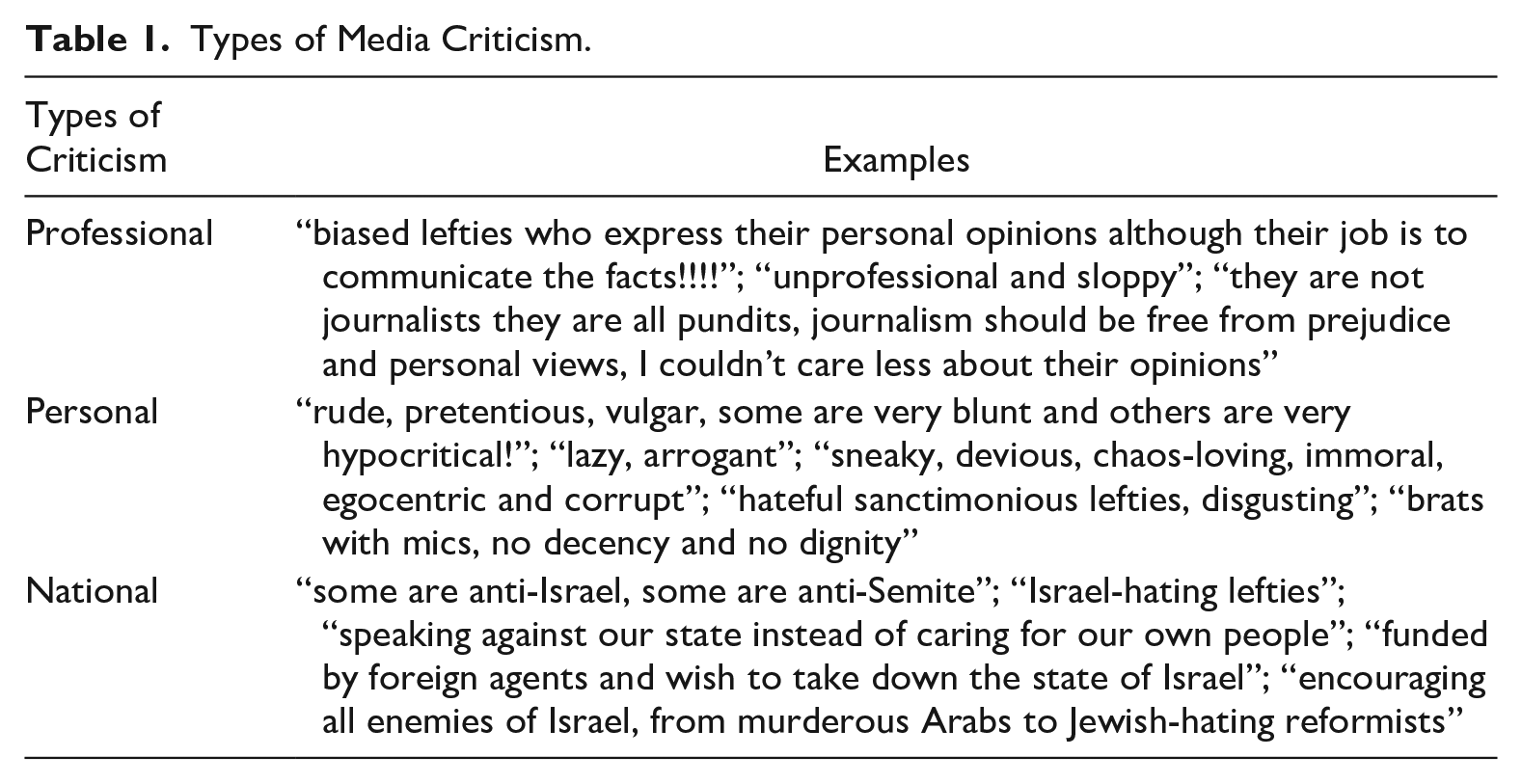
This typology provides a new perspective on the nature of audiences’ discontent with the media. The fact that a considerable portion of our respondents criticized journalists’ personalities or alleged antipatriotism points to a significant deficit in our understanding of how the public perceives journalists and how to change it.
Meta-Journalistic Discourses
Claims of objectivity have long been a powerful source of journalistic authority and legitimacy (Schudson 2001). Our data indicate that objectivity, balance, and bias were indeed dominant in respondents’ answers: 37.8 percent referred mentioned objectivity/bias when asked about their perceptions of journalists. Only 4.9 percent thought journalists were objective (e.g., “neutral,” “operating impartially,” and “communicating opinions from all across the political map”), with 32.9 percent saying Israeli journalists are biased (e.g., “advancing their political agenda instead of reporting objectively,” “outrageously biased,” and “lefties who express their personal opinions in every broadcast”). 0.7 percent of the respondents described journalists as biased to the right, and 13.9 percent mentioned they were biased to the left (see Supplemental Information file, Table A2).
However, another powerful long-standing source of journalistic authority—journalism as a foundational institution of liberal democracy—was almost entirely absent from our participants’ responses. Only 2.1 percent directly mentioned democracy or democratic values. Respondents whose answers mentioned democracy either praised journalists for serving democracy (e.g., “watchdogs of democracy,” “the public’s right to know,” and “freedom of thought, as long as we are a democracy and not a totalitarian state”), or condemned them for betraying it (e.g., “severely hurt our democracy which they pretend to defend,” “the so-called ‘fourth estate’ which in fact tries to take over the state,” and “whining about democracy all day long but censoring everyone who think differently”). Considering the ubiquitous academic writing on journalism and democracy, it is concerning to see that journalists’ democratic role has so rarely resonated with the public. This realization is another benefit of using open questions: it allowed us to detect not only the salient themes raised by voters, but also which ones are not triggered when audiences think about journalists.
Political Orientation and Negative Perceptions of Journalists
Our data show that negative perceptions of journalists were associated with political orientation. Respondents who vote for right-wing parties and those who vote for Netanyahu’s coalition were more likely to express negative perceptions of journalists. Respondents who vote for right-wing parties (78.3%) had higher negative perceptions than those who vote for center-left parties (41.2%). These substantively large differences are also highly statistically significant (chi-square test: χ2 = 145.126; p < .001, see Supplemental Table A3).
These findings are also significant when comparing the differences between those who vote for anti-Netanyahu versus pro-Netanyahu parties. Respondents who vote for pro-Netanyahu parties have a higher level of negative perceptions of journalists (85.9%) than respondents who vote for anti-Netanyahu parties (52.2%). Here too the difference is highly significant (Chi-square test: χ2 = 114.340; p < .001). Interestingly, despite much overlap, respondents who voted for parties supporting Netanyahu’s coalition expressed higher negativity toward journalists than respondents who voted for right-wing parties (including those that did not support Netanyahu).
We estimate ordinary least squares (OLS) regression models to assess these predicators of negative perceptions of journalists (see Supplemental Table A4). Respondents who vote for right-wing parties were significantly more likely to have negative perceptions of journalists (β = .35, p < .001) compared to those who vote for center-left parties. Voters of ultra-Orthodox (β = .11, p < .001) and national-religious (β = .08, p < .05) parties were more likely to have negative perceptions of journalists compared to those voting for secular parties. Respondents with a higher level of education were more likely to have negative perceptions of journalists (β = .10, p < .01). We found a nonsignificant association with respondents’ age (β = −.02, n.s.), Gender (β = −.04, n.s.), and SES (β = −.02, n.s.).
Political Orientation and Types of Media Criticism
Political orientation is correlated not only with negative perceptions of journalists, but also with the type of criticism toward them. Respondents who vote for center-left parties expressed lower levels of personal and national critique against journalists (43.4% personal, 0.7% national, and 0.7% both) compared to those who voted for right-wing parties (45.3%, 2.9%, and 5.5% respectively). Center-left voters had a higher level of professional critique against journalists (55.3%) than right-wing voters (46.3%). These findings are also significant when comparing the differences between those who voted for anti-Netanyahu parties and those who voted for pro-Netanyahu parties. Respondents who voted for pro-Netanyahu parties have a higher level of nonprofessional critique against journalist (49.8% personal, 4.6% national) compared to respondents who voted for anti-Netanyahu parties (40.7% personal, 0.3% national). In other words, while those who voted for right-wing parties expressed more nonprofessional critiques (personal and national) toward journalists than center-left voters, respondents who supported Netanyahu’s coalition expressed even more nonprofessional critiques (personal and national) than respondents who voted for right-wing parties (Figure 1).
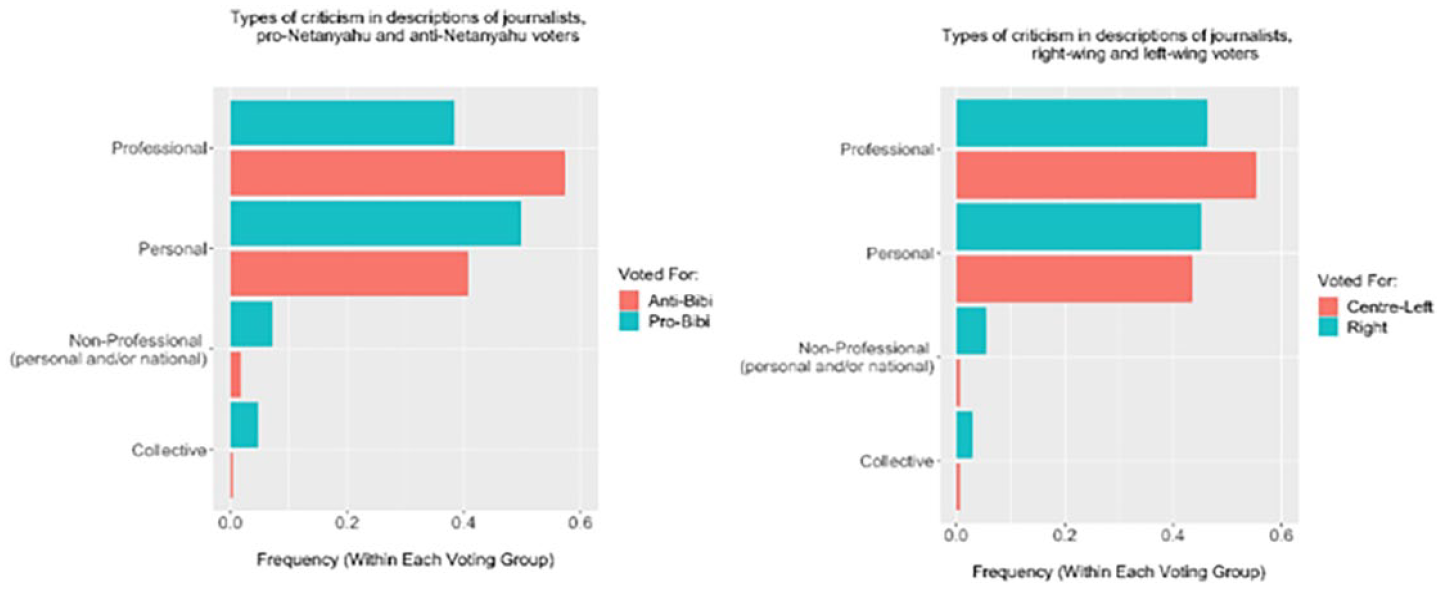
Criticisms of journalists and voting intentions.
Here too, we estimated ordinary least squares (OLS) regression models to assess these predicators of criticism type (see Supplemental Table A5). Respondents belonging to the ultra-Orthodox (β = .15, p < .01) or national-religious community (β = .15, p < .01) were more likely to have nonprofessional criticism compared to secular respondents. However, we found a nonsignificant association with respondents’ age (β = −.02, n.s.), gender (β = −.03, n.s.), education (β = .01, n.s.), and SES (β = −.05, n.s.). Importantly, respondents who voted for pro-Netanyahu parties were more likely to have nonprofessional criticism toward journalists (β = .17, p < .001) than those who voted for anti-Netanyahu parties.
Discussion
The thematic analysis of respondents’ own words, which was coded and tested against quantitative variables, provides a unique insight into how people imagine journalists at times of antimedia populism, when given a free platform.
Negative Perceptions of Journalists
Negative views of the media are not unique to Israel (Palmer et al. 2020). They are, however, a reason of concern for Israeli journalists, not only due to the grim perceptions themselves but also due to their politically polarized nature. The antipress movement in Israel has flourished almost exclusively on the right and could explain the sharp divide in audiences’ perceptions. The affiliation between negative perceptions of Israeli journalists and support for Netanyahu’s coalition can be interpreted as an indication that the populist campaign against journalists is, indeed, effective. This is in line with previous studies, according to which elite cues influence voters’ perceptions of the media (Duyn and Collier 2019; Smith 2010; Watts et al. 1999). Another indication can be found in respondents who repeated familiar populist catchphrases when asked about Israeli journalists (e.g., “fake news,” “funded by foreign agents,” and “attempted coup”). These insights can be drawn thanks to our open-ended approach, which emphasizes audiences’ independent choice of terminology.
Types of Criticism
The typology of media criticisms we found in respondents’ responses—professional, personal, and national—fits the messaging of the right-wing campaign against the Israeli media (Panievsky 2021). This too might indicate the impact of the populist antimedia campaign. More importantly, respondents’ complaints against journalists went far beyond professional journalistic standards and often had little to do with their professional conduct (e.g., “their goal is to take down the Israeli state”). This finding is far from trivial. In the literature, media criticism is tied almost exclusively to journalists’ professionalism.
The substantial portion of nonprofessional criticism (personal and national) of Israeli journalists has several implications. First, it demonstrates that what bothers the public is not limited to questions of trust or bias, but rather it is (also) journalists’ traits, motives, and loyalties. Since voters’ media criticism is concerned with journalists’ personal character and loyalty to the state, improving journalists’ professional conduct will not solve the current challenges to journalists–audiences relationship. This point is crucial since journalists under attack often express the belief that greater adherence to professional norms is the best way to counter antimedia accusations (Panievsky 2021). According to our findings, professional practices are merely one of various concerns people express about journalists and journalism. The “better reporting” strategy might therefore be insufficient; rehabilitating audiences’ relations with the media might require more innovative strategies.
Second, right-wing and pro-populist voters had more nonprofessional criticism of journalists. This might indicate that the populist campaign not only affects media trust but also resentment toward journalists. It might explain why 88 percent of the violent discourse directed against Israeli journalists online came from the right, and only 8 percent from the left (Berl Katznelson Foundation 2020). Such asymmetry can be found in other countries too: Markov and Min (2022: 1103), for example, found that in Serbia, “conservative attitudes predicted media cynicism,” a term which they defined as “a generalized antagonism toward mainstream news media.” This antagonism is distinguishable from distrust. We argue that this sense of animosity requires further academic attention in order to fight digital hate, harassment, and violence against journalists and news organizations.
Meta-journalistic Discourses
The dominance of the notion of objectivity in Israeli voters’ responses is significant. This supports existing studies where the majority of respondents across countries still assesses journalists through the lens of objectivity (Newman et al. 2022). In our study, however, respondents have not merely marked objectivity as an important factor in a preset list of options; instead, when asked about journalists, objectivity was the main concept that came to their minds.
At the same time, only a few of our respondents (n = 25) raised the notion of democracy—either positively or negatively—when asked about Israeli journalists. In other words, democracy was not a primary lens through which voters evaluate journalists in Israel. This finding is surprising considering the rich literature on journalism as a foundational institution of liberal democracy (Curran 2011). It might indicate the lack of effective democratic education in Israel, the failure of the Israeli press to serve—or introduce itself—as the watchdog of democracy, or both.
As Eldridge and Steel (2016) suggest in their work on audiences’ evaluation of news, assessment of journalism may be based on considerations other than idealized professional roles. Looking at imagined journalists, we found that certain much-studied ideals indeed reflect the public’s unprompted concerns (i.e., objectivity/bias), while others are scarcely mentioned (i.e., democracy). The imagined journalism approach continues previous work by not only making space for bottom-up, nontraditional roles of journalism but also beyond journalists’ professional roles and conduct. It allows us to capture the public imagination of journalism, beyond professional ideals and theoretical presumptions. This might be useful as journalists seek to improve their relationship with the public. Understanding which concepts audiences associate with journalism is a vital step forward.
Conclusion
Due to declining levels of news consumption and media trust, much research has been conducted lately about journalists’ need to improve their relationships with the public (Varma 2022; Wilner et al. 2021). Another growing stream of research tackles the need for news organizations to develop audience-supported revenue models (Cagé 2016; Fletcher and Nielsen 2017; O’Brien et al. 2020). Finally, an ongoing discussion surrounds the use of audience analytic data to improve journalists’ understandings of their audiences (Coddington et al. 2021; Nelson 2021). In short, the literature on how journalists imagine the public has grown significantly, yet we know little about how publics imagine their journalists. The populist climate of global politics highlights the need to dedicate attention to audiences’ beliefs, narratives, and sentiments regarding journalists and the news. In this article, we propose an alternative paradigm to study journalists–audiences relationship. We developed the concept of imagined journalists and made a case for using open-ended questions in large-scale surveys to explore what people have in mind when they think about journalists. We applied our approach to explore how different groups of Jewish-Israelis imagine journalists.
Our main takeaways are as follows. First, only some of the negative views that audiences express toward journalists is directly related to their professional conduct. Other—potentially more harmful—criticisms focus on journalists’ perceived personality (“evil”) and loyalty to the nation (“traitors”). Improving journalists’ professional conduct is therefore unlikely to suffice as a measure to improve their relationship with the public. Second, right-wing voters and supporters of Netanyahu’s populist leadership not only expressed more negative views of journalists, but also more criticism of journalists’ personal character and loyalty to the state. Adhering to journalistic professional norms, as was advised and practiced by journalists under attack in Israel and beyond (Krämer and Langmann 2020; Panievsky 2021), might therefore not solve these voters’ discontent. Third, while objectivity and bias were very dominant in respondents’ imagination of journalists, democracy was barely mentioned. Journalists might be interested in educating the public about the societal role of journalism, as it does not seem to be a main lens through which audiences assess journalists and their work.
This exploratory study is, of course, not free of limitations. Its main shortcoming is that the panel method used in the online survey meant that the Palestinian population in Israel was not effectively polled. We came to the understanding that this issue should be tackled by building collaborations between academics, activists, community leaders, polling companies, and funding bodies. We hope to pursue this long-term mission in the future.
Like imagined audiences, imagined journalists are not created equal. Indications for that could be found in Eldridge and Steel’s study on audiences’ evaluation of quality in journalism, which found a significant distinction between audiences’ evaluation of national and local journalism (2016), with the latter being considered less competent professionals. Future research could investigate how imagined journalists differ: What if people imagine certain journalists differently? Why would that be? And could it be used to improve the journalists–publics relationship?
Establishing a healthy relationship between journalists and publics will require lowering levels of distrust and hostility and countering emerging phenomena like online harassment and mob censorship. To do so, a more comprehensive understanding of audiences’ imaginaries is needed. The imagined journalists approach makes one necessary step in that direction, pushing us to investigate the reflection of journalists in the public imagination as part of a rich and complicated relationship between journalists and publics, bringing together different strands of research, and emphasizing contemporary challenges. Future research could hopefully explore how people imagine journalists elsewhere, and how it could help us build better information environments in the future.
Supplemental Material
sj-docx-1-hij-10.1177_19401612241231541 – Supplemental material for Imagined Journalists: New Framework for Studying Media–Audiences Relationship in Populist Times
Supplemental material, sj-docx-1-hij-10.1177_19401612241231541 for Imagined Journalists: New Framework for Studying Media–Audiences Relationship in Populist Times by Ayala Panievsky, Yossi David, Noam Gidron and Lior Sheffer in The International Journal of Press/Politics
Footnotes
Author’s Note
Ayala Panievsky is also affiliated to City University of London, London.
Declaration of Conflicting Interests
The author(s) declared no potential conflicts of interest with respect to the research, authorship, and/or publication of this article.
Funding
The author(s) received no financial support for the research, authorship, and/or publication of this article.

Supplemental Material
Supplemental material for this article is available online.
Author Biographies
References
Supplementary Material
Please find the following supplemental material available below.
For Open Access articles published under a Creative Commons License, all supplemental material carries the same license as the article it is associated with.
For non-Open Access articles published, all supplemental material carries a non-exclusive license, and permission requests for re-use of supplemental material or any part of supplemental material shall be sent directly to the copyright owner as specified in the copyright notice associated with the article.
