



Abstract
As populist campaigns against the media become increasingly common around the world, it is ever more urgent to explore how journalists adopt and respond to them. Which strategies have journalists developed to maintain the public's trust, and what may be the implications for democracy? These questions are addressed using a thematic analysis of forty-five semistructured interviews with leading Israeli journalists who have been publicly targeted by Israel's Prime Minister, Benjamin Netanyahu. The article suggests that while most interviewees asserted that adherence to objective reporting was the best response to antimedia populism, many of them have in fact applied a “strategic bias” to their reporting, intentionally leaning to the Right in an attempt to refute the accusations of media bias to the Left. This strategy was shaped by interviewees' perceived helplessness versus Israel's Prime Minister and his extensive use of social media, a phenomenon called here “the influence of presumed media impotence.” Finally, this article points at the potential ramifications of strategic bias for journalism and democracy. Drawing on Hallin's Spheres theory, it claims that the strategic bias might advance Right-wing populism at present, while also narrowing the sphere of legitimate controversy—thus further restricting press freedom—in the future.
Introduction
Public attacks on the news media have become a dominant feature of the current wave of populist politicians, parties, and movements (Egelhofer and Lecheler 2019; Farhall et al. 2019; Van Dalen 2019). In Europe, the United States, Latin America, the Middle East and beyond, journalists have become accustomed to accusations of bias by populists and their supporters, epitomized by derogatory labels like “fake news” and “enemies of the people.” Research suggests that such rhetoric can polarize and diminish the public's trust in the news media (Pingree et al. 2018; Smith 2010; Van Duyn and Collier 2018; Watts et al. 1999). This surging type of populism may also threaten journalists' safety and freedom, by inciting harassment or violence. This article, however, sheds light on another potential implication of the populist campaign: the chilling effect that risks compromising journalists' work and their ability to fulfill their role within democracy. It does so by uncovering a particular coping strategy that has been repeatedly mentioned in interviews with dozens of Israeli journalists who were publicly attacked by Israel's Prime Minister (PM). This strategy I will call: the strategic bias.
Despite the renewed interest in media and populism, antimedia populism—as a distinct phenomenon—requires further theoretical and empirical explorations. The populist media criticism sets a unique challenge for professional journalists. In line with the populist logic, which divides society to “the real people” and “enemies of the people,” the populist critique attributes the media's alleged bias not to innocent errors or mere negligence, but to journalists' malignant conspiracy against “the people” (Jones and Sun 2017). Journalists are therefore required not only to defend their reputation as credible professionals, but also their legitimacy as citizens. This begs the question: How do journalists respond to these threats posed to their credibility and legitimacy? Which strategies do they apply to counter the populist allegations and maintain the public's trust? And what might be the implications for the news, the political debate, and democracy?
Israel presents a compelling test case. First, Israeli PM Benjamin Netanyahu, an acknowledged populist (Talshir 2018; Weiss Yaniv and Tenenboim-Weinblatt 2016), has begun campaigning against “The Media” long before many of his global counterparts (Peri 2004). Studying the consequences of his antimedia campaign may offer an insight into potential futures of journalism in Israel and elsewhere. Second, alongside exceptional challenges stemming from Israel's geopolitical position, the Israeli media shares various characteristics with many other news industries around the world, from ownership structures to professional norms (Markowitz-Elfassi et al. 2018; Tsfati and Meyers 2012), making the Israeli case a relevant reference point. Third, while prevalent, Israeli populism is understudied; further research could enrich the literature on global populism while also helping de-westernize media studies.
Literature Review
The Challenge of Antimedia Populism
Populist politicians, parties, and movements who devote considerable efforts to the discrediting of “The Media” have become a common phenomenon in various political cultures, with journalists being accused of slanting the news against populists and their followers, for reasons that range from ideological convictions to outright conspiracies. In the section below, I will explicate the unique challenge that antimedia populists pose to professional journalists, the conditions within which this conflict ensues, and the role of the ethos of objectivity in shaping it.
According to Mudde's (2004) definition, which has gained increasing currency over the past few years, populism is a (thin) ideology, which divides society into two homogeneous, antagonistic groups: “the real people” and “the corrupt elites” which conspire against them. As Müller (2016) stresses, however, populists are not only antielitists but also antipluralists, as they claim to exclusively embody “the authentic people” against “the enemies of the people.” This antipluralism posits the populist worldview in direct confrontation with critical journalism: populists demand journalists to serve the public by representing the uniform stance attributed to “the people” by the populist, portraying any criticism of the populist leader as an illegitimate attempt to undermine the people's will (Krämer 2018).
The Brexit referendum and the 2016 US elections spurred a renewed academic interest in the relationship between populism and media. Much of the existing literature investigates the role of the (news and social) media in boosting populism, whether intentionally or unwittingly, due to news values, ideological affinity, or financial incentives (e.g., Pickard 2016; Wodak 2015). The subgenre of populism which is dedicated to undermining journalism has been tackled from several angles. First, historical studies have examined the roots of the antimedia movement, mostly in the United States (e.g., Greenberg 2008). Second, antimedia statements have been analyzed alongside other forms of antielite rhetoric as a specimen of populist discourse (e.g., Engesser et al. 2017). Third, scholars have explored empirically the populist use of partisan media and social media against mainstream media (e.g., Peck 2019).
The current wave of antimedia populism catches journalism at a fragile moment. Social media companies took over the advertising revenues that used to fund modern journalism and provided politicians with a convenient platform for media bashing, thus destabilizing the power balance between politicians and journalists. For populist politicians, who excel on social media, this was particularly beneficial (Engesser et al. 2017). The populist media bashing itself further shifts the power balance in favor of the populists: since negative coverage “confirms” the media's bias against the populists, negative news stories become assets. Classic accounts of journalists–politicians relations delineate a “tug of war” (Gans 1979), an ever-shifting give-and-take, with journalists seeking access and politicians striving for positive coverage. Antimedia populists, however, are less dependent on positive coverage: both positive and negative exposures serve their campaigns. The globalized media sphere enables populist messages to travel across borders, generating cross-national trends. This environment brings journalism to the confrontation with antimedia populism in an inferior position, which might undermine journalists' power to fulfill the roles traditionally attributed to journalism in democratic societies.
Balance, Bias, and Journalists' Response to the Populist Critique
Research on journalists' responses to populist media bashing has only begun to receive scholarly attention. Existing literature on journalists' responses to other forms of media criticism documents strategies ranging from rejection and denial to apology and corrective action (e.g., Hindman 2005). These studies, however, usually focus on criticism regarding a specific incident, reporter, or news item. These forms of criticism differ from present-day antimedia attacks, which constitute a consistent feature of the populist agenda, and target “the foundations of an entire institution” (Koliska et al. 2020: 5).
Recently, a few preliminary studies tackled journalists' responses to antimedia populism, almost exclusively in Germany and the United States (Koliska and Assmann 2019; Koliska et al. 2020; Krämer 2018). These studies often emphasize the role of journalistic norms—and especially the ethos of objectivity—in journalists' encounter with the populist assault. This is hardly surprising, as objectivity, impartiality, and balance have long been used to justify journalistic authority and legitimacy (Schudson 2001). Journalists' alleged bias has thus become a focal point of the populist media bashing. Accusations of media bias are of course nothing new; in the populist context, though, the media's bias is framed as part of a bad-faith elitist conspiracy to subvert “the will of the people,” a narrative that undermines the legitimacy of journalists not only as conveyors of news, but also as members of “the people.” Despite the fierce and frequently justified critiques over the years, which accused objective reporting of advancing an elitist agenda, masking the media's flaws, and clashing with journalism's commitment to democracy and diversity—objectivity has remained a dominant lens through which journalists and audiences assess journalists' performance in various cultures (Hanitzsch et al. 2011; Newman et al. 2020). Bias remained an ultimate professional flaw.
When examining how American journalists defend themselves against Trump's attacks, Koliska et al. (2020) drew on content analysis to conclude that journalists defend “the institutional myth” of journalism by emphasizing ideals like objectivity and even-handedness. Drawing on interviews with German news editors, Koliska and Assmann (2019) indicated that populist attacks on the media have led journalists to place increased emphasis on professional norms and practices, as well as improve their dialogue with their audience. Through an analysis of metajournalistic discourses in the German press, Krämer and Langmann (2020) demonstrate how journalists highlight the role of objectivity and balance when facing Right-wing populism. Krämer (2018) hypothesized that professional ideals like “objectivity” and “balance” might result with journalists normalizing Right-wing populists, in the attempt to prove their allegations false. This article supports Krämer's hypothesis, by illustrating how journalists under attack, who strive to perform balance, are in fact drawn to practice propopulist bias.
Existing literature on bias reveals multiple sources of media bias, from journalists' ideological inclinations to commercial interests of media owners and advertisers (e.g., Herman and Chomsky 1988). Entman distinguishes between two types of bias: content biases, namely, “consistent patterns in the framing of mediated communication that promote the influence of one side in conflicts”; and decision-making biases, which “operate within the minds of individual journalists … and influence the framing of media texts” (Entman, 2007: 166). While content bias refers to slanted news, decision-making bias refers to the production of slanted news, that is, “the motivations and mindsets of journalists who allegedly produce the biased content” (ibid.: 163). Empirical research tends to focus on content bias, relying almost entirely on content analyses. Naturally, interviews are not considered a useful method for studying bias, as journalists are either unaware of their bias or unwilling to reveal it. This article introduces a unique form of bias, which is applied consciously and strategically, for reasons that are socially acceptable (maintaining the public's trust or thwarting media bashing). In such cases, I argue, interviews can reveal bias in journalists' approach to news making. In what follows, I will present and explain the methods, context, and findings that have led me to conceptualize the strategic bias.
Methodology
How do journalists respond to antimedia populism? Which coping strategies do they apply to counter populist allegations and maintain the public's trust? And what may be the implications? This study addresses these questions through a thematic analysis of forty-five semistructured interviews with Israeli journalists who work for leading national news outlets and have been publicly scrutinized by PM Netanyahu. Participants were chosen according to several criteria: working for mainstream national media, both public and commercial, with no ideological affiliation or party ties; covering politics or related beats; and having been publicly condemned by Netanyahu, either by name (thirteen) or as members of a specific newsroom (thirty two). Some were attacked on the PM's Facebook page and public speeches and others were cast as villains in his party's election campaigns. Those who have not faced direct personal attacks have seen their newscast being labeled “fake news” or Bolshevik propaganda. There has not been a control group of political journalists who work for mainstream media and have not been attacked; the rationale was focusing on the strategies developed by journalists under attack, rather than those responding to the general climate of hostile populism.
The cohort includes political correspondents, commentators, news anchors, investigative journalists, and senior news editors. They work for various leading news outlets: TV networks (News 12, News 13, Kan), radio stations (Galatz, Reshet B), newspapers (Yedioth Ahronoth, Maariv), and websites (Ynet, Walla!). The gender balance (thirty-two men and thirteen women) reflects the underrepresentation of women in senior roles within the Israeli news industry (Lachover and Lemish 2018). The interviewees' average age was 44.2 years, slightly older than the average Israeli journalist (Reich et al. 2016). This could be because (1) these journalists cover prestigious beats for national media, which tends to come later in journalists' careers or (2) rhetoric attacks by the PM are rarely directed at junior journalists. This sample of attacked journalists is therefore skewed in favor of powerful individuals: five of the interviewees ranked among the ten most influential journalists in Israel and seventeen among the top fifty (Bein-Lebovitch 2019). The advantage of this sample is that it offers a glance into the state of mind of journalists with considerable power to shape the public debate. Its disadvantage is that their strategies may be affected by their status. This bias, however, appears to characterize the study's population rather than the sample alone.
The interviews lasted ∼100 min and were conducted mostly face to face (a few were held via phone). The main obstacle regarding such “exclusive informants” is lack of access; I used my personal contacts as a former journalist to overcome this obstacle, combined with a snowball approach (Tansey 2007). The nonresponse rate was low, but many interviewees had to be contacted several times and talked into participating, through different channels. As I later found out, a few have even reached out to mutual contacts to confirm whether I could be trusted. I read this behavior as cautious, but also as reflecting willingness to talk, considering the time that was invested into inquiring about my integrity instead of simply declining my request. Notably, while most interviewees in the first round of fieldwork (2017–18) were willing to reveal their identity, two years later (2019-20) almost none of them would. This shift can be explained by the heated atmosphere accompanying the 2019 elections, or the accumulative impact of Netanyahu's antimedia campaign. Due to their concerns, the quotes were anonymized.
The interviews included questions regarding journalists' general thoughts on Netanyahu's antimedia rhetoric, its impact on their lives and work, their personal experience and reactions, and their evaluation of the media's response. Since the question of balance and bias lies at the heart of Netanyahu's media critique, in the second part of the interviews journalists were asked about their views on journalistic objectivity in these times. Interviews can be misleading, of course: interviewees might not share their genuine thoughts, particularly on sensitive issues, and even their sincere thoughts may not reflect their actions. Nevertheless, since journalists' ideas and strategies are the focus of this study, interviews are a useful method. During the interviews, journalists were generally open, rarely refusing to respond but often verifying that their answers will be anonymized or asking to erase certain segments.
Thematic analysis has been employed as a flexible method, which allows the data to lead the analysis, therefore fitting for exploratory, qualitative research of prevalent patterns in journalists' experiences and views (Boyatzis 1998). The themes were established using both data-driven codes and theory-driven codes (Fereday and Muir-Cochrane 2006), with the analysis process repeated and refined, focusing on cross-case analysis. Nvivo has facilitated the process of coding, recoding, collapsing, and renaming themes. While most interviewees declared “business as usual” as the best response to Netanyahu's rhetoric, further questions revealed that many of them have in fact incorporated various changes to their professional decision making. The themes were then classified into two categories: the strategies which journalists under populist attack developed to cover antimedia populism and the strategies which they embraced when covering politics in general. Due to the limited scope, this article focuses on the latter (for more on the first type of themes, see Panievsky 2021). In particular, it outlines the strategic use of defensive bias that journalists under attack embraced to refute Netanyahu's criticism and maintain the public's trust.
The Israeli Context
Following decades of political parallelism, the Israeli news industry embraced the American ethos of objective reporting around the late 1970s (Tsfati and Meyers 2012). From the 1990s onward, Israeli journalism moved closer to the liberal model of media systems due to processes of privatization and professionalization, although state censorship around national security issues kept restraining press freedom (Peri 2011). Currently, the Israeli news media suffers from economic instability and heavy political pressures, manifested in massive cross-ownership and hyperconcentration, reemergence of partisan media, and intensifying clientelist ties between media owners and political actors (Markowitz-Elfassi et al. 2018). These conditions nurture an unaccommodating environment for journalism to carry out its democratic aspirations to inform citizens, enable public deliberation, and hold those in power accountable.
Although the media played a major part in Netanyahu's rise to power, it quickly became one of his primary targets. Netanyahu regularly accuses journalists of running a “witch-hunt” against him, conspiring to take down his government, and siding with Israel's worst enemies. He condemned the public TV broadcaster for “employing fans of terrorists,” and commercial TV newscast News 13 for “conducting a Bolshevik brainwash.” In 2019, his run for election was launched with a billboard campaign presenting four high-profile journalists—three of whom were interviewed for this study—saying: “They won't decide.” Like other populists, Netanyahu has often accompanied his rhetoric with regulation and lawsuits aimed at intimidating journalists, controlling state-owned media, and weakening commercial media (Peri 2004: 234–43). Currently, Netanyahu is charged with bribery, fraud, and breach of trust in three cases, two of which involve his alleged promises to grant media owners regulatory benefits, in exchange for favorable news coverage.
In the early stages of his career, Netanyahu's relationship with the media seemed likely to take a different path: he was frequently praised for his oratory skills and media savviness, with a televised debate facilitating his first election (Blum-Kulka and Liebes 2000). The honeymoon, however, was short: Netanyahu started bashing the Israeli media in the late 1990s, famously encouraging his fans to scream at reporters “they are sca-red!” when he believed they were covering him unfairly. Netanyahu's main claim against the media is that it is “lefty”—a common complaint among Right-wing activists and critics—and specifically, biased against him and his family. However, Netanyahu's targets are those who criticize him or cover his corruption scandals, regardless of their ideological inclinations. As one Right-wing journalist told me: “Even when I criticize Netanyahu from the Right—the comments are ‘you lefty media’.” Over the past few years, at least six journalists who have been publicly scrutinized by Netanyahu have had to use bodyguards after receiving death threats.
Like their counterparts abroad, it is likely that Israeli journalists have been more liberal than the average population. It would be difficult, however, to argue that their liberal tendency translated into evident left-leaning reporting: empirical studies have concluded that the news in Israel was not slanted to the Left (Markowitz-Elfassi et al. 2018; Sheafer and Weimann 2005). Certain scholars note that Netanyahu himself has always been unpopular among journalists (Peri 2004). Nevertheless, recent media analyses have found slanted reporting in favor of the Right, Netanyahu's party, and Netanyahu himself. Toward the September 2019 elections, Netanyahu was granted more than twice the airtime (statements, speeches, and soundbites) than his main challenger (Bein-Lebovitch 2019). Before the 2015 elections, Netanyahu received more favorable coverage than his opponents too (Tsfati 2017). Moreover, currently Netanyahu's associates hold shares in several news outlets, including the most circulated free daily.
Findings and Discussion
This article focuses on journalists' endeavor to counter Netanyahu's populist accusations and maintain the public's trust by intentionally tilting their political reporting rightwards. I propose conceptualizing this strategy as “Strategic Bias”: a performative ideological bias, conducted by journalists in order to defend their public authority and legitimacy—even at the cost of practicing de facto self-censorship. This tendency was associated with concrete professional practices, including important choices that journalists routinely face, like whom to interview, what issues to cover, which terminology to use. I will first delineate the strategic bias and suggest an analytic distinction distinguishing it from other forms of ideological bias. I will then illustrate this finding using empirical data, emphasizing three elements: (1) journalists' declared adherence to the ethos of balanced reporting, (2) how it compels them to practice decision-making bias, and (3) the role of perceived media power within this process. Journalists' restrained use of the term “occupation” will be used to demonstrate the manifestation of strategic bias in the Israeli context. I will conclude by discussing the potential implications for journalism and democracy.
Strategic bias is a form of ideological bias, where journalists knowingly slant the news to favor one candidate, party or political camp—regardless of their personal beliefs and without informing their audience—as a response to challenges to their public credibility and legitimacy. The strategic bias differs significantly from other forms of ideological bias, which have been studied more thoroughly. Unlike unconscious bias, where journalists slant the news in line with their personal political preferences, strategic bias is conducted knowingly and intentionally, and does not necessarily reflect journalists' personal views but serves as a means to achieve public trust and prevent further criticism. 1 Unlike partisan bias, where journalists and outlets consciously and openly slant the news in alignment with their (or their bosses') ideological preferences, strategic bias is not publicly declared. According to Entman's distinction, the strategic bias is a decision-making bias, as it manifests itself in journalists' approach to political reporting (Entman, 2007: 163). In the case below, journalists turned to the strategic bias to counter populist accusations of bias, which served to label them as enemies of the people; it might, nonetheless, be employed under different circumstances too. Future research could test the strategic bias in other settings, to better understand when it appeals to journalists and why (Table 1).
Strategic Bias Versus Other Types of Ideological Biases.
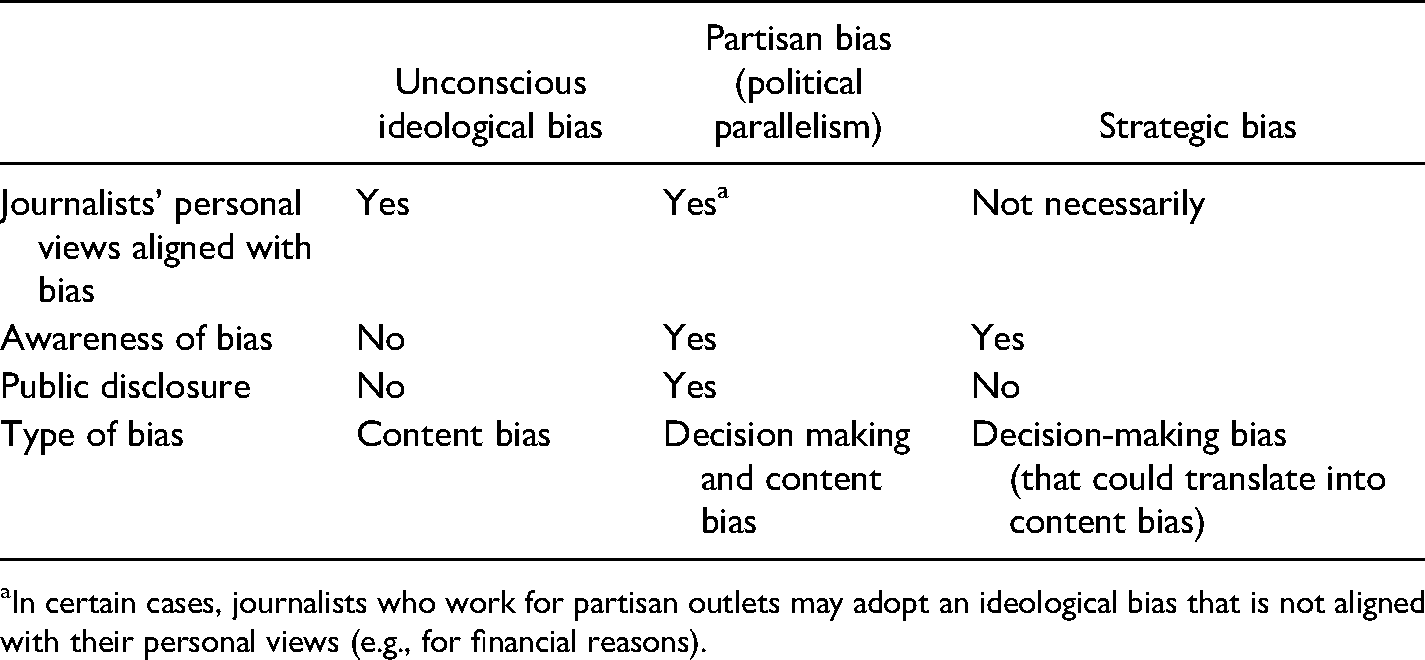
In certain cases, journalists who work for partisan outlets may adopt an ideological bias that is not aligned with their personal views (e.g., for financial reasons).
The Origin of Strategic Bias: In Objectivity We Trust?
Most of the Israeli journalists I interviewed declared that adhering more forcefully to traditional norms of balance and neutrality was the best way to handle the populist claims against the press. While noting that “there's no such thing as total objectivity,” they still perceive objectivity as a paramount professional ideal, that should be practiced, but perhaps as importantly, seen.
“Even if I thought that we should open up to new theories about the profession, like ‘let's report from our personal perspective’ – now is not the right time. Now we must go back to basic,” one TV journalist explained. “Journalism that is focused on bringing the facts hasn't got the luxury of adopting trends and fashions like these. … I find it unacceptable. Maybe I’m old-school, anachronistic, rigid.”
“This is precisely the bottom line: objectivity,” said another political reporter. “There is no journalist who is 100 percent objective … but today people think they know where each journalist stands—is it helpful? I’m not convinced.”
Mostly, journalists interpreted objectivity as political balance, using the terms “balance” and “objectivity” interchangeably. They repeatedly asserted that reinforcing their commitment to balance was the best way to respond to Netanyahu's claims. Recent studies indicate that American and German journalists under populist attack have also advocated for greater commitment to traditional journalistic values (Koliska and Assmann 2019; Koliska et al. 2020). However, when asked about the actual changes they integrated into their reporting due to the populist rhetoric, my interviewees revealed a strategy that clashed with their abstract claims about objectivity.
The Strategic Bias: Leaning to the Right in the Name of Balance
Israeli journalists attested to intentionally leaning rightwards, for the fear of confirming Netanyahu's allegations of a left-wing media bias. This tendency conflicts with their efforts to project invigorated adherence to objectivity and balance—but also, paradoxically, derives from them:
“I’ve been a journalist for 30 years now, and always tried to be fair and balanced,” a TV hostess explained. “I’ve never even told my family whom I vote for! But now, if you’re not on the Right—you’re labelled a ‘lefty’. Journalists distance themselves from the Left, and honestly, I did too. I really didn't want this label.”
“[Netanyahu] has convinced everyone that the media is lefty, and now newspapers—including mine—try hard to prove otherwise,” said a print news editor.
“We must balance any item that might be perceived as ‘lefty’,” said a radio news editor, “but radical right-wing content is just fine.”
The strategic bias has not necessarily reflected journalists' approval of Netanyahu's media critique. In fact, even journalists who insisted that the Israeli media was balanced, or in fact biased to the Right—admitted to leaning rightwards in order to distance themselves from the Left, as a strategic move aimed to preempt and refute Netanyahu's attacks against “the lefty media.” In other words, for some journalists, leaning to the Right was not meant to correct an actual media bias, but rather to perform a “correction” for the bias which they believed their audience believed to exist, as a result of Netanyahu's accusations.
Journalists mentioned concrete implications of this coping strategy:
“The media was constantly on the defence in the past few years,” said a senior print journalist. “It feels like we try to prove that we’re ok. Instead of saying—‘you can attack us as much as you want, we’ll keep doing our job’—we keep apologizing and justifying ourselves. We’ve added more Right-wing hosts, for example.”
“The other day we noticed that the line-up was left-leaning,” a radio host recalled. “My editor panicked, but I told him: ‘It's fine, the next programme will be different’. I knew that if the line-up had been completely right-leaning—none of us would be worried. But I admit that I also told him: ‘perhaps we can postpone one item’. We shouldn't fear from unbalanced line-ups. I’m trying to work on myself about this issue.”
My interviewees framed their conscious efforts to lean rightwards as a means to defend journalism and its public legitimacy, naming socially accepted motivations like “preventing further media bashing” and “maintaining the public’s trust” (by proving that despite the allegations, they were not ‘lefties’ at all). It was intended to perform what journalists believed their audience would perceived as “balanced.” Journalists' hope to escape future attacks could also be interpreted as anticipatory avoidance of pressure, where “journalists … anticipate their critics, giving in sufficiently and in advance to avoid being pressured” (Gans 1979: 249). “Anticipatory avoidance” is, in fact, a form of self-censorship, a journalistic surrender, which portrays the strategic bias in less of a noble light. Strategic bias should therefore be thought of not only as a type of bias, but also as a type of self-censorship, driven by the belief that self-censorship would help restoring the public's faith in journalism. In the Israeli context, this political self-censorship joins the existing national security-based censorship and self-censorship (Peri 2011).
The majority of interviewees dated the origins of the strategic Right-wing bias to years ranging between 2014 and 2019. They attributed its' consolidation to Netanyahu's antimedia rhetoric—which intensified around election campaigns and revelations regarding his corruption scandals—and its impact on his followers and the public conversation. This timeline coincides with a populist turn in Israeli politics (Levi and Agmon 2020) and with the rise in social media use, a powerful tool in Netanyahu's toolkit. Netanyahu has always been considered a media-savvy politician and his campaigns have led the use of advanced technologies to win elections in Israel. Many interviewees mentioned his “army of trolls” on social media as an additional factor which compels them to moderate their criticism of him and his allies:
“Eventually, you get scared,” said a radio news editor, “because you know that Netanyahu has an army of trolls.”
“Netanyahu has many supporters, and his rhetoric incites them,” said a journalist who has often been lambasted by Netanyahu. “You know that if you say anything bad about him, you’ll automatically be flooded on Facebook: ‘you lefty slut’, ‘go kiss Abu-Mazen's ass’. It affects us.”
“Clearly, it's easier for a journalist in the mainstream media to criticise the Left than the Right,” explained a reporter and commentator. “The feeling is that an army of vilifiers and harassers are waiting for you on social media, and it has a chilling effect.”
While in other democratic societies the Left–Right axis is mainly determined by economic positions, in Israel, the dominant rift is the stance toward the Israeli–Palestinian conflict, with the hawkish Right advocating for the annexation of the occupied Palestinian territories, and the dovish Left traditionally supporting a peaceful agreement between the nations, based on the two-state solution (Talshir 2018). Netanyahu's leader-centered populism gave rise to another fissure, which has become increasingly dominant over the past decade, between Netanyahu's supporters and opponents. These two distinctions largely, but not entirely, overlap. When journalists discussed their strategic bias, they referred to both levels: distancing themselves from Left-wing stances on the Palestinian question, as well as fleeing affiliation with the “anti-Netanyahu” camp.
It is difficult to distinguish journalists' responses to Netanyahu's attacks from their responses to other political phenomena, like the long-standing Right-wing efforts to delegitimize the Israeli Left (Levi and Agmon 2020). These efforts have created an asymmetrical political sphere, where the label “lefty” is used as a derogatory term, associated with antipatriotism and autoantisemitism. Such an environment, interviewees attested, has made the affiliation with the Left far more damaging to their reputation. Interviewees implied that the asymmetric political environment in which Netanyahu's accusations resonated has further encouraged the strategic bias:
“I prefer getting criticism from the Left, of course—they are considered traitors anyway,” admitted a TV and radio journalist.
The populist attacks on the Left and the press are not unrelated, and it is no coincidence that both have accelerated during Netanyahu's time in office. As the leader of the Israeli Right for the past decade, Netanyahu played a key role in both campaigns—against the Left and the media—with the former facilitating the latter (once the Left is labeled “treasonous,” all it takes to discredit journalists is linking them to the Left). Asymmetrical political spheres could thus become a facilitating condition, which pushes journalists to use intended bias as a coping strategy with hostile populism.
Saying “The Occupation”: A Test Case for Strategic Bias
When discussing my interviewees' approach to political reporting in times of antimedia populism, the Israeli occupation of the Palestinian Territories was frequently brought up as an example for a topic that has become extremely difficult to address. Although never asked about it directly, several interviewees noted that they would not use the term “occupation” in their reporting anymore—even if the term best describes the situation in the West Bank and Gaza in their view—since the word has been labeled by the Right a “radical lefty” term. One radio host recalled how, following a pilot for a new program, she was told that she did great, but should avoid saying “occupation” again. She said she had never used the term on air since. When asked about the impact of populist attacks on their work, others mentioned their hesitancy when using the term too:
“Frankly, I think twice,” said a veteran journalist. “Sometimes I prefer to spare myself the evil comments. Instead of asking ‘is this the result of 50 years of occupation?,' I’d say ‘some people may say that ….' To tell you I’m proud of that? Of course not. But this is the trickle-down effect of this incitement.”
“It is always on your mind,” added a radio news editor, “the far Right is legitimate, but God forbid if you mention the occupation.”
“You can no longer say ‘occupation’,” agreed a veteran TV anchor. “…Have you seen what happened to [a TV pundit who stuttered when discussing the Israeli-Palestinian conflict]? My heart went out to her. She couldn't say it, she was afraid to say ‘occupation’. And I can see why.”
None of the interviewees had a parallel example for a word that they have stopped using because it was labeled as “too right-wing.” Their understanding of “good journalism” and how their audiences see it have ironically driven them to professional practices that may tilt the entire political debate in favor of the same political figures who express ongoing disrespect towards free press and critical journalism. On the personal level, interviewees expressed hope that their behavior might spare them further attacks by Netanyahu and his supporters, which sometimes amounted to floods of hate messages and death threats. On the professional level, they believed that strategic bias would help them to protect their professional, balanced, façade—and thus their authority, credibility, and legitimacy.
To put things in context, even before Netanyahu's attacks on the Israeli media, Right-wing politicians and pressure groups have used the recurring military conflicts to denounce Israeli journalists as “antipatriotic lefties” (Caspi 1981), although research refutes that Israel's news was biased to the Left or in favor of the Palestinians. In fact, “the Israeli media has been repeatedly shown to be ‘patriotic’ by constructing news frames that reflect and reinforce the belief that Israel is virtuous and victimized” (Markowitz-Elfassi et al. 2018), with military conflicts drawing it even closer to Israel's official policy. This background has created a handy framework for Netanyahu to mark journalists as “enemies of the people,” equating them to Hezbollah leaders and Hamas terrorists. It demonstrates how polarized societies, particularly those haunted by national conflicts, provide fertile ground for demonization of the media, through its association with the nation's perceived enemies (Rogenhofer and Panievsky 2020).
Journalists' avoidance of the word “occupation” demonstrates how consequential strategic bias may be for the Israeli public debate, on one of its most burning issues. Following theories like the spiral of silence (Noelle-Neumann 1974), my interviewees' intentional leaning rightward may further narrow the scope of ideas that can be freely expressed in the public sphere. In their wish to maintain what they believe could rescue their status as authoritative professionals and legitimate members of “the people,” journalists thus participate in the campaign to shift Left-wing ideas and terminology from the sphere of legitimate controversy where political controversy is accepted, to the sphere of diversion where political actors and views are rejected and censored as “unworthy of being heard” (Hallin 1989: 116–18). Hence, although declaredly purported to defend journalism, strategic bias may undermine journalists' professional interests in the long term—as well as the required conditions for a healthy democracy. By exercising self-censorship and slanting the news to the Right, journalists may both serve their populist adversaries at present, and narrow the spectrum of legitimate controversy—thus further restricting journalism and public expression—in the future.
Facilitating the Strategic Bias: The Influence of Presumed Media Impotence
Journalists' perception of media power—and particularly their perceived helplessness, whether justified or not—was a recurring theme in the interviews, which may partially explain journalists' inclination to choose strategic bias as a coping strategy. Interviewees described themselves as relatively weak social actors, facing an omnipotent politician, who is helped by almighty social media platforms. In their eyes, Netanyahu has been far more effective than the mainstream media in shaping public opinion, and their imagined audience has been easily influenced by his populist antimedia rhetoric. Using the expression “lose–lose situation” to describe their position and “win–win situation” to describe Netanyahu's, my interviewees appeared to believe that their potential responses to Netanyahu's rhetoric were limited, and their chances of winning the debate slim. This was evident in quotes like “it’s a winning formula [for Netanyahu],” “there's nothing we can do,” and “it’s a cruel war and I don't think we can win it.” The host of a popular newscast described it as the following:
“Netanyahu managed to push us into this position of ‘the lefty media'. … His blatant media criticism creates a win–win situation. … Each criticism is seen as our revenge for him turning against us. … Secondly, there's self-censorship. Journalists say ‘wait, they’ll say I’m going after him, that I’m part of the campaign, Bibi will slam the network, I’ll come out as a lefty'. And so, Netanyahu wins again.”
Several interviewees expressed their frustration regarding how their attempts to hold Netanyahu into account only empowered him, a frustration that fed into their felt powerlessness. An investigative reporter said:
“Our investigative reports became an asset instead of a burden … Each negative news item ‘proves' that the media is indeed hostile and unpatriotic.”
Journalists' view of their own power as inferior to that of Netanyahu appears to have narrowed down what they saw as potential measures for them to counter Netanyahu's assaults. The strategic bias was meant to negate the grand impact that they believed Netanyahu's rhetoric had over the public—although they used no data or research to test this assumption.
The prolific literature on “the influence of presumed media influence” (Gunther and Storey 2003) indicates that individuals respond and act according to the impact they believe the media has over their fellow citizens. The influence of presumed media influence over journalists has not been thoroughly studied, yet it emerged in my interviewees' accounts as a factor in their decision-making when considering potential responses to antimedia populism. My interviewees demonstrated “the influence of presumed media impotence,” adapting their conduct according to their disbelief in media power. Attributing greater power to Netanyahu has nurtured a sense of helplessness, which limited their professional room for maneuver. “What can we do?” was uttered repeatedly, suggesting that perceived media powerlessness could also serve journalists as a way to evade accountability, retreating into a convenient spot of futility, and hence, nonresponsibility. Whether a genuine perception or mere alibi, I submit that greater academic attention should be dedicated to journalists' perceptions of media influence/impotence, particularly at times when the political sphere and media environment have been going through seismic changes that deeply hampers journalists' ability to respond to populist bashing.
Conclusion: Performing Balance by Practicing Bias
This article sought to explore one of the coping strategies that were adopted by Israeli journalists under populist attack. It proposes the concept of “strategic bias” as a contribution to the literature on media bias, self-censorship, and the evolving research on journalists' responses to antimedia populism. Drawing on interviews with forty-five Israeli journalists, I argue that Netanyahu's campaign against “the lefty media” has reshaped journalists' approach to political reporting. While interviewees stated that adhering more forcefully to objectivity was the best way to cope with Netanyahu's allegations, they have yet applied a “strategic bias” to their reporting: intentionally slanting the news rightwards, in the hope to thus refute Netanyahu's accusations, escape criticism, and maintain their professional façade and public legitimacy. The shift from swearing in the name of balance to intentionally delivering Right-wing bias, is facilitated by “the influence of presumed media impotence”—journalists' self-perception as helpless vis-à-vis Netanyahu's powerful rhetoric. The sources of strategic bias are hence neither journalists' personal ideological inclinations nor commercial interests, but rather a combination of their professional ethos, imagined audience, and perceived power.
The potential implications of these initial findings are unnerving. Antimedia populism poses an exceptional challenge for professional journalism, with populists using accusations of bias to frame journalists as enemies. My findings, however, suggest that journalists' strategies to handle this challenge might be as concerning. First, when journalists intentionally but covertly tilt the news rightwards, the political discursive playing field becomes uneven. This is not a case of unwarranted balance in reporting on an unbalanced reality, which scholars warned against in the past, but a case of wittingly imbalanced reporting, aimed to signal balance rather than practice it. More concerningly, as demonstrated through journalists' avoidance of the term “occupation” with regards to Israel's control over the Palestinian Territories, the strategic bias may serve to silence and censor views that oppose or challenge the antimedia populist, shifting them from the sphere of legitimate controversy to the sphere of deviance (Hallin 1989). Thus, journalists' response to populist rhetoric risks encouraging self-censorship and restricting press freedom.
Laying out the mechanism through which journalists are drawn to professional practices like intentional political bias and self-censorship can help academics and practitioners in reconfiguring better strategies against hostile populism, which would coincide with both the moral objectives and democratic roles of journalism, as well as empirical data on media effects and audience preferences. Such strategies would hopefully encourage journalists to replace the strategic bias with other, research-based approaches that may restore their credibility when facing populist accusations. There is preliminary evidence, for instance, that exposure to research about the hostile media phenomenon can decrease media bias perceptions (Tsfati and Huino 2014). Furthermore, the findings challenge journalists' limited interpretation for balance in journalism, as well as the priority of the ethos of objectivity over other professional ideals, like press freedom. These directions could pave an alternative path for political journalists and newsrooms that face populist critique.
While various other factors are clearly at play, this study focused on how even journalists' good-will efforts to sustain the public's trust in journalism ultimately encourage them to lean rightwards. Indeed, the ethos of objectivity is not unique to journalism's claim for authority. It is foundational to several institutions that constitute the modern liberal democracy, many of which now face populist critique themselves. It is worth asking whether this defensive bias is being used by professionals in other institutions under populist attacks (such as universities or the judiciary). Since the ethos of objective reporting, like many of the conditions that shape the conflict between Netanyahu and the media, are common to news industries elsewhere, I believe that the strategic bias is a useful concept to examine beyond the Israeli case.
The limitations of this exploratory study stem from the use of interviews and the sample of interviewees. The sample of interviewees consists of journalists who work for mainstream national media and have been publicly scrutinized by the Israeli PM; as such, it is biased in favor of high-profile, veteran professionals, who hold relatively powerful positions, and enjoy the economic and symbolic capital that younger, less experienced journalists might lack. Moreover, while interviews serve as a fitting method to investigate journalists' views and strategies, they cannot attest to the extent to which those are ultimately reflected in the news. This article presented evidence of a decision-making bias (Entman 2007), by analyzing journalists' professional considerations. To establish a parallel content bias, future research could examine the findings above through media content analyses from before and after Netanyahu's antimedia rhetoric became a dominant political phenomenon, to determine whether and how journalists' strategic bias has shaped the news. The concept of “presumed media impotence” could be used in future studies to highlight the impact of negative perception of media influence, as well as the significance of journalists' evaluation of media power and lack thereof. Finally, the concept of strategic bias could hopefully be used to explore the strategies and self-censoring practices developed within institutions that are committed to the ethos of balance and impartiality, when facing populist assault on their authority as professionals and legitimacy as members of “the people.”
Footnotes
Declaration of Conflicting Interests
The author declared no potential conflicts of interest with respect to the research, authorship, and/or publication of this article.
Funding
The author received no financial support for the research, authorship, and/or publication of this article.
