



Abstract
We test generational differences in media trust and its antecedents, including political trust, interest, and orientation, as well as perceptions of media inaccuracy and media bias. We rely on original survey data from ten European countries, collected in 2019. We find no differences in the levels of media trust between generations, but we find that key correlates of media trust relate differently to it in different generations. For example, political interest is more strongly correlated with media trust for Millennials than for other generations. Perceptions of bias and inaccuracy have a strong negative correlation with media trust overall, but it is stronger for older generations. These results suggest, that in the long term, societal developments, and in particular debates about media bias and misinformation may impact media trust of young generations differently as they grow older—however, our data give no indication of that creating generational gaps in media trust.
Introduction
The time that one grows up in shapes generations. It can affect what type of media citizens turn to and can make a difference for how they act upon media information (Andersen et al. 2021). But are there generational differences in media trust? The current media ecology is characterized by an ever-growing number of media outlets, increasing “platformization,” and misinformation perceptions among citizens (Bennett and Livingstone 2018; Diehl et al., 2019; Thorson 2020). While younger generations were socialized in this media landscape, older generations can compare it to earlier experiences and may perceive it as disruptive. Consequently, gaps in how much different generations trust the media could emerge. Media trust is relevant because it relates to the evaluation of key information: citizens learn about political events from the news media, act on this information through various political activities, and ultimately make vote decisions that are informed by the news media (Downs 1957; Eveland and Scheufele 2000; Wei and Lo 2006). Using survey data from ten European countries, we test whether there are generational differences in media trust. In addition, we test the relationships of media trust and its key predictors—as identified by previous research—and whether these relationships differ across generations.
Different generations often experience the same political developments differently. Citizens of the WWII-generation may perceive political clashes as more or less dramatic than the generation that formed the peace movement. Older generations might experience digital transformations of the media environment as drastic, while it comes natural to the generation of digital natives, who grew up in this media environment (Prensky 2001). Political socialization research has found each generation's formative years to have a long-lasting impact on how they make sense of political developments, as well as the media's reaction to it (Grasso 2016; Shah 2008). We know that generational differences in media use and its relation to political behavior exist (Andersen et al. 2021; Haenschen and Tedesco 2020; Moeller et al. 2018; Ohme 2019). Generational differences in media trust could therefore not only be relevant for an informed citizenry, but also for how citizens act upon political information they receive from news media. Yet, it is unknown to what extent political socialization is responsible for different levels of media trust among generations.
Exploring these generational differences is important as it allows us to understand which generation is most affected by recent changes in political communication. It also helps revealing how younger generations in particular react to changes of the political and information ecology—which may shape future societal attitudes towards the media. With regard to the misinformation crisis, we can examine whether the generation that experiences their formative years around “fake news” both as a genre (Mourão and Robertson 2019) and label (Egelhofer and Lecheler 2019) is also the one who trusts the media least, or if generations that grew up in a nondigital media system show higher misinformation beliefs and lower media trust.
Our findings suggest that political trust is a strong positive predictor of media trust, whereas perceptions of misinformation and media biases are related to lower levels of trust in the press. While we find no differences between levels of media trust between generations on an absolute level, we find that hypothesized predictors of media trust have different associations with it in the different generations. This suggests that political socialization matters for how citizens translate views on the political sphere and the media system they have developed in their formative years into trust in the media—however, it does not seem to make a difference for the resulting levels of media trust.
Theory
Trust, fundamentally, is one's estimation of how likely an individual or institution will fulfill one's expectations (Baier 1986). Media trust is a reflection of the news media's credibility (Tsfati and Cappella 2003; Tsfati and Peri 2006). According to Kohring and Matthes (2007), media trust relates to the media's performance at selecting topics, selecting facts, the accuracy of depictions, and journalistic assessment. Media trust can relate to the content and information itself, journalists, and news organizations (e.g., Williams 2012). In their study on forty-five countries around the world, Hanitzsch et al. (2018) show that media trust significantly increased in fourteen countries over the last decades. In twenty-four countries, however, media trust was in decline. This shows that media trust is not always a stable perception and relates to political and media-related developments in a country. To understand such developments, it is important to look at attitudes and experiences of citizens that may influence their media trust.
Predictors of Media Trust
Previous research has identified a host of variables that are related to media trust. These can generally be categorized into two factors: features of the media itself and characteristics of the media's audience (Tsfati and Cohen 2012). The former mostly concerns context factors. For example, Schranz et al. (2018) find that media trust is lower in South European media systems, that is, France, Italy, and Spain, and higher in Northern countries like Denmark and Norway. State ownership of television is associated with higher levels of media trust in democratic societies, but with lower levels in nondemocratic societies (Tsfati and Ariely 2014). Journalistic quality has received less attention in media trust research (Wilner et al. 2021) but research suggests that perceptions of bias and accuracy of the news media are important factors that determine media trust (Knight Foundation 2018). Bias and accuracy are perceived differently by audiences (Newman and Fletcher 2017) and are distinct parts of the journalistic objectivity norm (Hackett 2015). While a link between accuracy and bias perceptions is possible (Kocher and Shaw 1981), they can also be independent functions of media trust (Wilner et al. 2021).
In terms of audience characteristics, media trust and political trust, for example, trust in the government (Jones 2004; Köhler and Otto 2018; Lee 2010), as well as interpersonal trust (Tsfati and Ariely 2014), are positively related; this relationship is stronger in countries with a strong party/press parallelism and weaker in countries with more media autonomy and journalistic professionalism (Ariely 2015). Political interest has been found to be positively associated (Tsfati and Ariely 2014) or not associated (Lee 2010) with media trust. News consumption, and particularly use of public broadcasting, TV, and newspapers, is positively associated with media trust (Schranz et al. 2018; Tsfati and Ariely 2014). Internet use, however, is negatively associated with media trust (Tsfati and Ariely 2014). In the American context, Republicans are more distrustful of the media (Brenan 2019; Jones 2004; Lee 2010); in the European context, this is also the case for more right-wing citizens, but there is also a general negative effect of being on the political margins (Schranz et al. 2018). Jones (2004) hypothesizes that conservative's lower trust in the media may be a reaction to a perceived liberal bias of the news media. While some studies (e.g., Lee, 2010) did not find effects of age on media trust, others found effects of cohorts; while younger and older respondents distrust the media more, middle-aged respondents tend to trust the media (Schranz et al. 2018), with the youngest group being most distrustful. Based on this body of research on the antecedents of media trust, as well as data availability, we include (a) political interest, (b) political trust, (c) perceptions of inaccuracy, (d) perceptions of bias, and (e) political orientation in our models as predictors of media trust on an individual level. We do not include country-level variables in this study, as the number of countries in our dataset is not sufficient to draw conclusions about more general country-level effects (Stegmueller 2013).
Generational Differences in Media Trust
Two perspectives can help to understand why generational differences in media trust can emerge: The lifecycle perspective suggests that younger generations are different from older ones, but as they age, will act more or less the same as older generations. The cohort perspective, in turn suggests that each generation, due to the different socialization experiences they make, is composed differently (Andersen et al. 2021; Grasso 2016). While the former perspective suggest that change in social attitudes over a life time is more linear (i.e., if older generations always trusted news more than younger ones), the latter builds more strongly on the assumption of social change due to formative experiences in each cohort (i.e., if a certain type of made a generation less trustful throughout their entire life). Without a truly longitudinal design, lifecycle and cohort effects cannot be fully disentangled. However, our comparative design can help us to distinguish a certain likelihood of patterns that speak for one or the other perspective. If we find strong linearity across generations, differences in media trust may be best explained with lifecycle effects. However, patterns where certain generations stand out or do not follow a clear trajectory would suggest that levels of trust are specific for this certain cohort.
Media environments are an important factor in citizens’ socialization. Roughly speaking, Baby Boomers came of age during the spread of television. In many European countries, the emergence of commercial broadcasting took place in Generation X's formative years, Millennials grew up during the rise of online media (Bakker and De Vreese 2011; Jennings and Niemi 1968; Mindich 2005; Prior 2007). The way a generation experience their media environment during their formative years could shape the role these news sources play for the respective generation in the future. Newer changes in the media environment might be evaluated in comparison to media from those formative years and, hence, can explain how generations’ trust in the media is shaped by recent events. The current media environment is characterized by an ever-growing use of digital media sources, faster publication cycles, and recently, the discussion about media spreading misinformation and disinformation (Bennett and Livingstone 2018; Shehata and Strömbäck 2018; Aelst et al. 2017). Generation Z came of age in a time during which terms like “fake news” were debated both as a genre (Mourão and Robertson 2019) and label (Egelhofer and Lecheler 2019), dominating the debate about the quality of the media. One potential reaction of the youngest generation is that they lose trust in and turn their back to news media (Ohme, in press). Matsa et al. (2018) found that in five of eight Western European countries surveyed, younger adults trust the news media less than those in the oldest age group. Even though trust in news media is not high, young citizens have more trust in specific news outlets than older citizens, such as the BBC (Gramlich 2019). There is not much more evidence on generational differences in media trust. Political trust, which is correlated with media trust, is highest for Baby Boomers, lower for Gen X, and lowest for Millennials (Twenge et al. 2012), and was found to increase in older generations (Dalton 2005; but see van der Brug and van Praag 2007), similar to social trust (Wilkes 2011). However, as Dalton (2005) notes, due to ongoing social modernization, especially young and well educated started to challenge political actors and institutions in general, which may reduce their trust in the media as well. Millennials rate media performance more positively than Baby Boomers (Towner and Lego Munoz 2016). Younger people are also more likely to trust online news sources, and also newspapers and radio news (European Commission 2018). Furthermore, there are some generational differences in media use (Towner and Lego Munoz 2016) and different media diets are associated with different levels of media trust (Fletcher and Park 2017; Tsfati and Cappella 2003; Tsfati and Peri 2006). This suggests the possibility of generational differences in media trust as well. In sum, given that generations experience media—as one important pillar of political socialization—differently in their formative years, generational differences in media trust are conceivable. Therefore, we ask the following research question:
RQ1: Are there generational differences in media trust?
Differences in Predictors of Media Trust
Age cohorts often experience and interpret context factors of media trust, such as political culture or journalistic practices, differently. Hence, the relevance of indicators for media trust evaluations may vary across generations. It is important to investigate such differences to understand how media trust is shaped by recent socialization experience of younger generations that will likely become important in the future.
The political culture in a country influences the level of trust in media (Ognyanova 2019; Metzger et al. 2010). However, indicators of political culture such as political trust, interest in politics, and political orientation have not developed uniformly across generations. Thus, they can play a different role for citizens’ evaluation of media trust. Political trust, for example, can be influenced by changes of political systems as “major institutional reconfigurations” (van der Meer 2017), such as an electoral law reform or constitutional amendments, potentially along with changes in media systems that have a lasting impact on citizens’ evaluation. While not each and every generation in every country may experience such reconfigurations, they can impact political trust for the ones that do. Political interest, in turn, is related to varying understandings of what politics entails, whereas younger generations often show a broader assessment of what is “political” (O’Toole 2003). Older generations often have established a clear political orientation, while such placement is more fluent for younger generations (Doherty et al. 2018) and, given the “leftward drift” amongst many young people, it is often unclear whether a placement on the left-right axis means the same for different generations (Norris and Inglehart 2019; Sloam and Henn 2019). Towards the background of different socialization experiences, it is conceivable that indicators of political culture are not uniform in shaping media trust across generations.
Moreover, the role of journalistic practices for the evaluation of trust in media may vary depending on the time citizens came of age. While the mainstream press has been associated with objective reporting and “telling the truth” in many European contexts, in the digital era and lately throughout the “fake news” debate, media are increasingly accused of spreading misinformation and disinformation. Younger generation came of age at this time and are aware of these claims (Leeder 2019; Ohme in press). At the same time, they may not experience the media environment as dysfunctional and evaluate it more pragmatically, in that biases in reporting or inaccuracies are unavoidable or not even undesirable (Marchi 2012). The question is whether younger generations draw the line for accepted journalistic practices differently than older generations when evaluating their trust in the press. In sum, it is conceivable that the upbringing of different generations and their experiences with politics and the press determines how important different contextual factors are for them when evaluating media trust. Such differences, however, have not previously been investigated; hence we ask:
RQ2: Are predictors of media trust different for different generations?
Method
The data is part of a larger panel survey and was collected by survey company Kantar and its partner panels using online questionnaires among a total of 6.437 respondents in ten countries: Czech Republic (n = 733), Denmark (n = 491), France (n = 752), Greece (n = 493), Germany (n = 505), Hungary (n = 581), the Netherlands (n = 1006), Poland (n = 855), Spain (n = 551), and Sweden (n = 470). Even though we include a variety of countries to better represent citizens in Europe, the number of countries is not large enough to reliably model country-level differences—we thus work with a pooled sample. Light quotas were enforced to ensure representative samples based on age, gender, region, and education. Respondents answered questions in the national languages of the respective countries. Most relevant variables, including media trust, perceptions of media bias, and perceptions of media inaccuracy were measured in Wave 7 of the panel survey, that is, in June 2019. Political interest and political trust were measured in Wave 6 in May 2019. Left-right self-placement was measured in May 2019 and December 2018. Some sociodemographic variables, like age, gender, and education were collected during earlier waves. Descriptive statistics for all variables can be found in Table 1.
Descriptive Statistics.
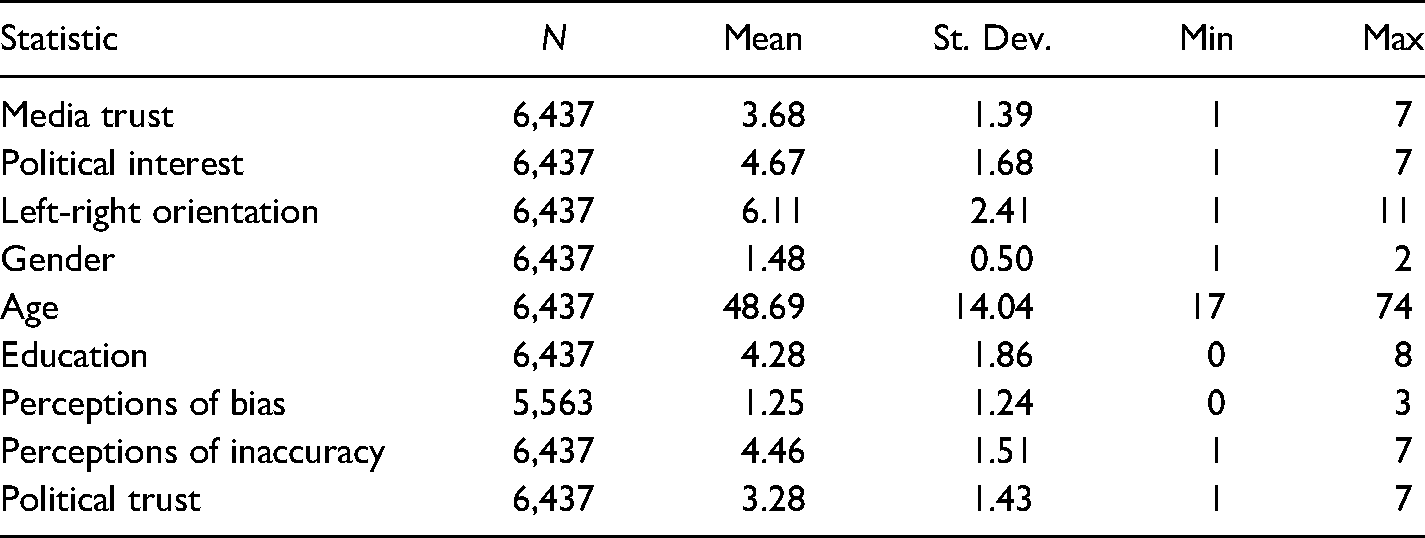
Media trust was measured as the average agreement score with the following five items, originally developed by the Reuters Institute (Newman et al. 2016), ranging from 1 (completely disagree) to 7 (completely agree): “I think you can trust the news most of the time,” “I think you can trust news organizations most of the time,” “I think you can trust journalists most of the time,” “The news media are independent from undue political or government influence most of the time,” and “The news media are independent from undue business or commercial influence most of the time” (Cronbach's alpha = 0.93). Figure 1 shows the mean values of media trust across different generations in the ten countries.
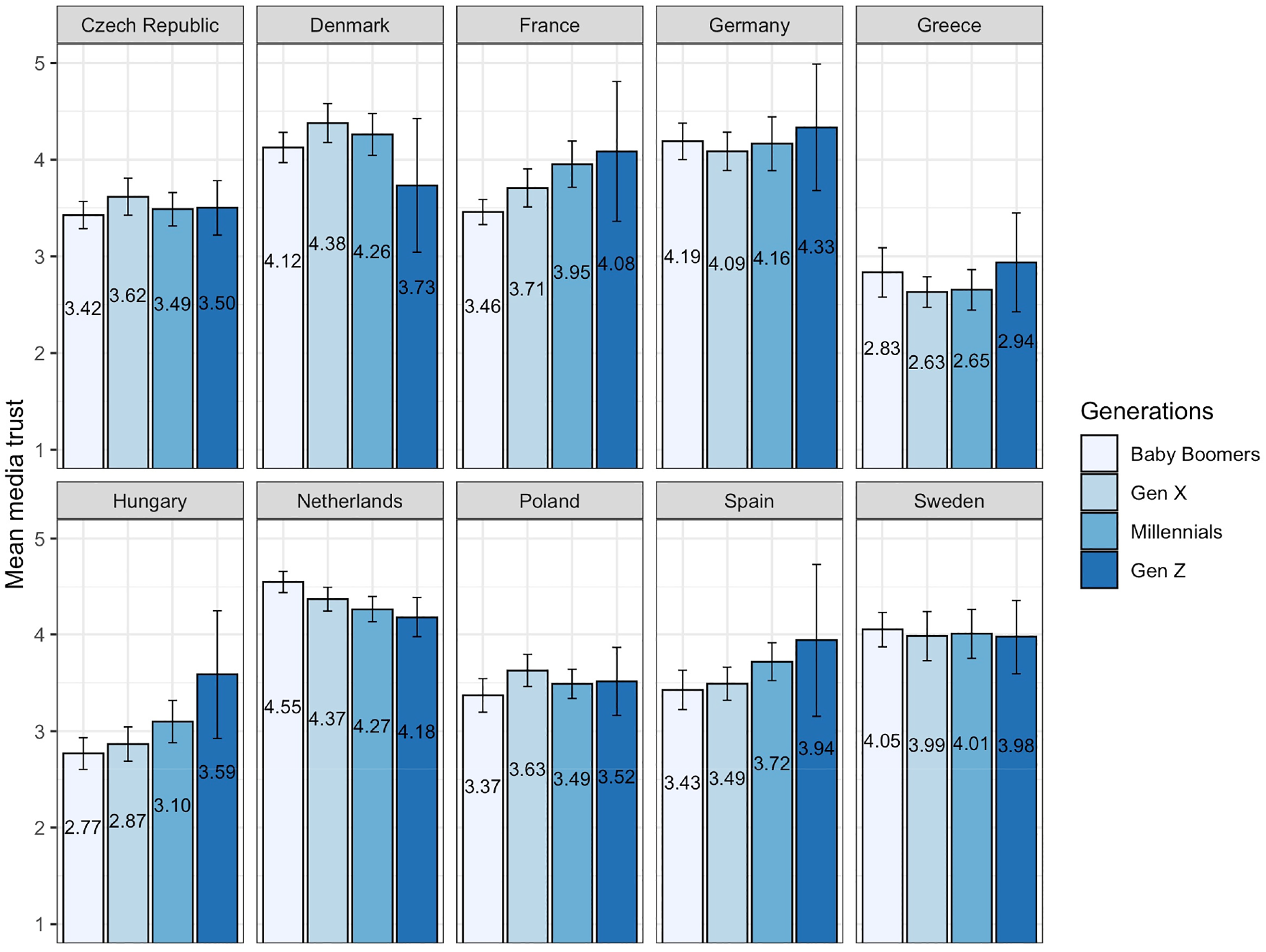
Mean media trust across generations.
Political trust (Cronbach's alpha = 0.92) was measured as the average agreement with the statements “I trust (a) the parliament, (b) politicians, (c) political parties, (d) the legal system, and (e) the government” on a scale from 1 (completely disagree) to 7 (completely agree).
Political interest was measured with the question “How interested would you say you are in politics” on a scale from 1 (not at all interested) to 7 (very interested). In order to assess political orientation, respondents were asked to indicate what their position was on a scale from 0 (left) to 10 (right). Partisan media bias is at the core of media bias perceptions (see Groseclose and Milyo 2005), although other biases can exist. Thus, to measure media bias perceptions, we asked respondents to indicate the extent to which they think that left- or right-wing issues get relatively more coverage in the media on a scale ranging from 1 (left issues get more coverage than right issues) to 7 (right issues get more coverage than left issues), with a mid-point of 4 (left and right issues get equal coverage). This scale was centered around the mid-point and values were then turned into their absolute value, meaning the scale ranges from 0 to 3. Accuracy of reporting is the key criterion of objectivity as an important norm in journalism (Porlezza 2019). Thus, perceptions of accuracy in the media were measured as agreement with the statement “The media do no report accurately on facts that happened” on a scale from 1 (fully disagree) to 7 (fully agree).
Generations were classified as follows, based on Andersen et al. (2021): Generation Z (n = 298) includes those between 17 and 24 years at the time of the survey (2019), Millennials (n = 1542) those between 25 and 39 years, Generation X (n = 2060) those between 40 and 54 years, and Baby Boomers (n = 2537) those between 55 and 74 years. Traditionalists are those between 75 and 100 years; however, this group was very small and likely not representative (due to the online survey approach) in some countries and was therefore excluded from the analyses. This concerned 206 respondents. The number of Gen Z respondents is also rather low at 298, which results in a very low number in some countries. This is likely due to the small size of this generation as such and issues with recruiting very young survey respondents. Table 2 shows the number of respondents for each generation and country. Due to this issue with the Generation Z sample, we interpret all results relating to Generation Z more cautiously in the following. Yet, despite the sampling issue, we decided to include Generation Z in the analysis, as the results might give indications of interesting patterns that can be investigated by future research.
Number of Respondents per Country and Generation.

Results
In order to answer our research questions, we estimated a number of linear regression models, with media trust as a dependent variable, and controlling for respondents’ home countries by including country dummies in all models. Model 1 tests Research Question 1; whether there are generational differences in media trust, not considering any other variables (except for country dummy variables). There are no significant differences, thus we conclude that the different generations do not have different levels of media trust as such. In Model 2, we add several predictors of media trust (i.e., independent variables, without specified causal order). In line with previous research, we find that perceptions of bias in the media and perceptions of inaccuracy are related negatively to media trust, whereas political trust is positively associated with media trust. In contrast to previous findings, we do not find associations of left-right orientation and political interest with media trust. With regard to control variables, we find no significant association of gender with media trust and a negative association with higher levels of education. Models 3 to 6 test Research Question 2—whether the associations of the hypothesized predictors with media trust are different in direction or size across generations. We find interaction effects for perceptions of inaccuracy perceptions, bias perceptions, political interest, left-right orientation, but not political trust. These interaction effects are also visualized in Figure 2. Perceptions of bias have a somewhat weaker association with reduced media trust for Millennials. Perceptions of inaccuracy are most strongly associated with reduced media trust for Baby Boomers, followed by Gen X and Millennials, and least strongly for Gen Z (thought the latter should be interpreted with caution). Political trust is equally associated with higher media trust for all four generations. For political interest, Millennials are different from Baby Boomers: There is a positive association with media trust, whereas there is no association for Baby Boomers. For left-right orientation, Gen Z, the youngest, stands out. More left-wing respondents in our sample have lower media trust than right-wing respondents in this age group, whereas there is no clear association between political orientation and media trust for the other three generations (Table 3). However, this effect could be driven by the composition of the Gen Z sample, in which some countries are overrepresented, while others are underrepresented. It would therefore be interesting to retest in a sample with better Generation Z representation.
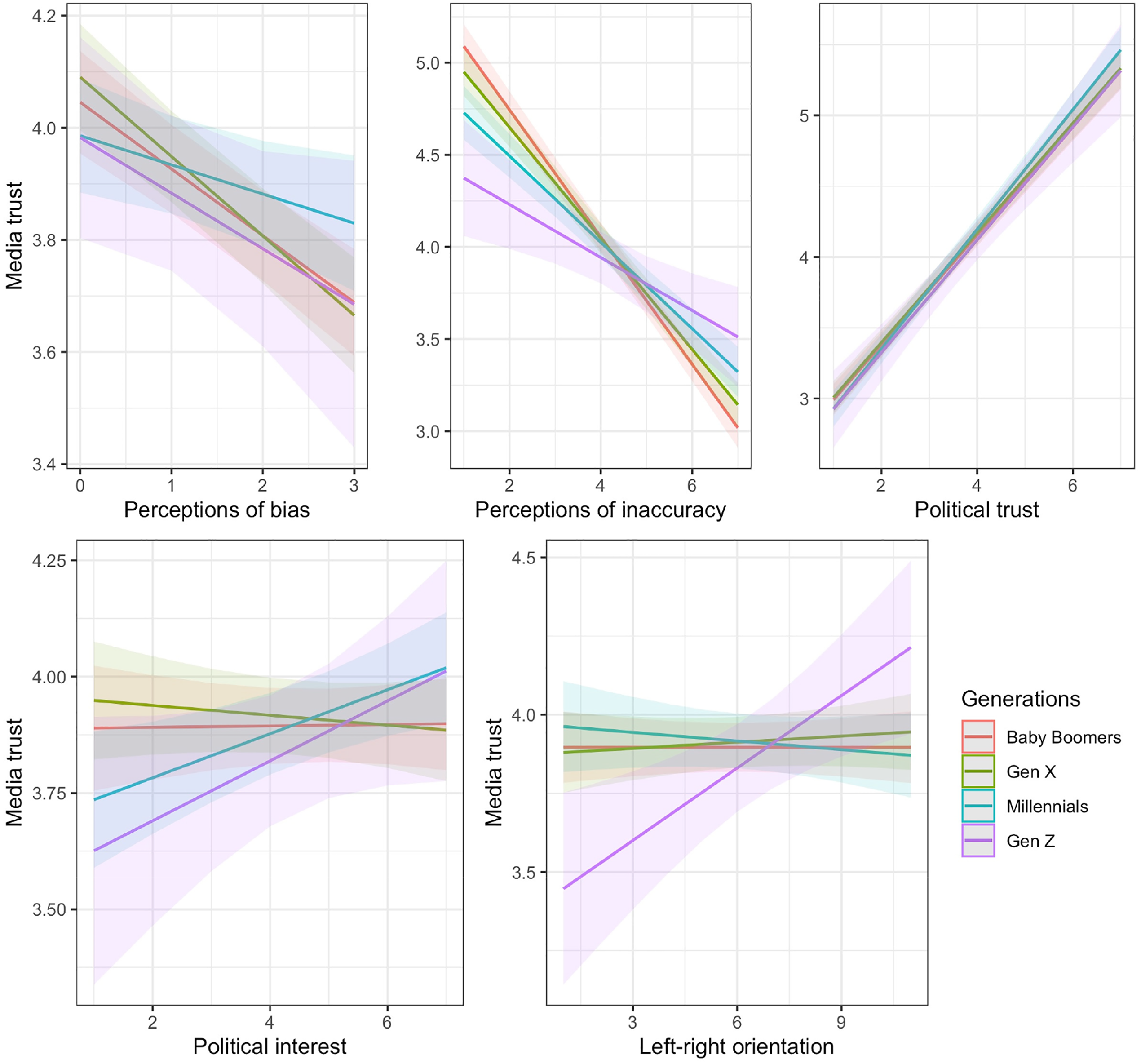
Interaction effects; predicted values of media trust.
Regression Results.
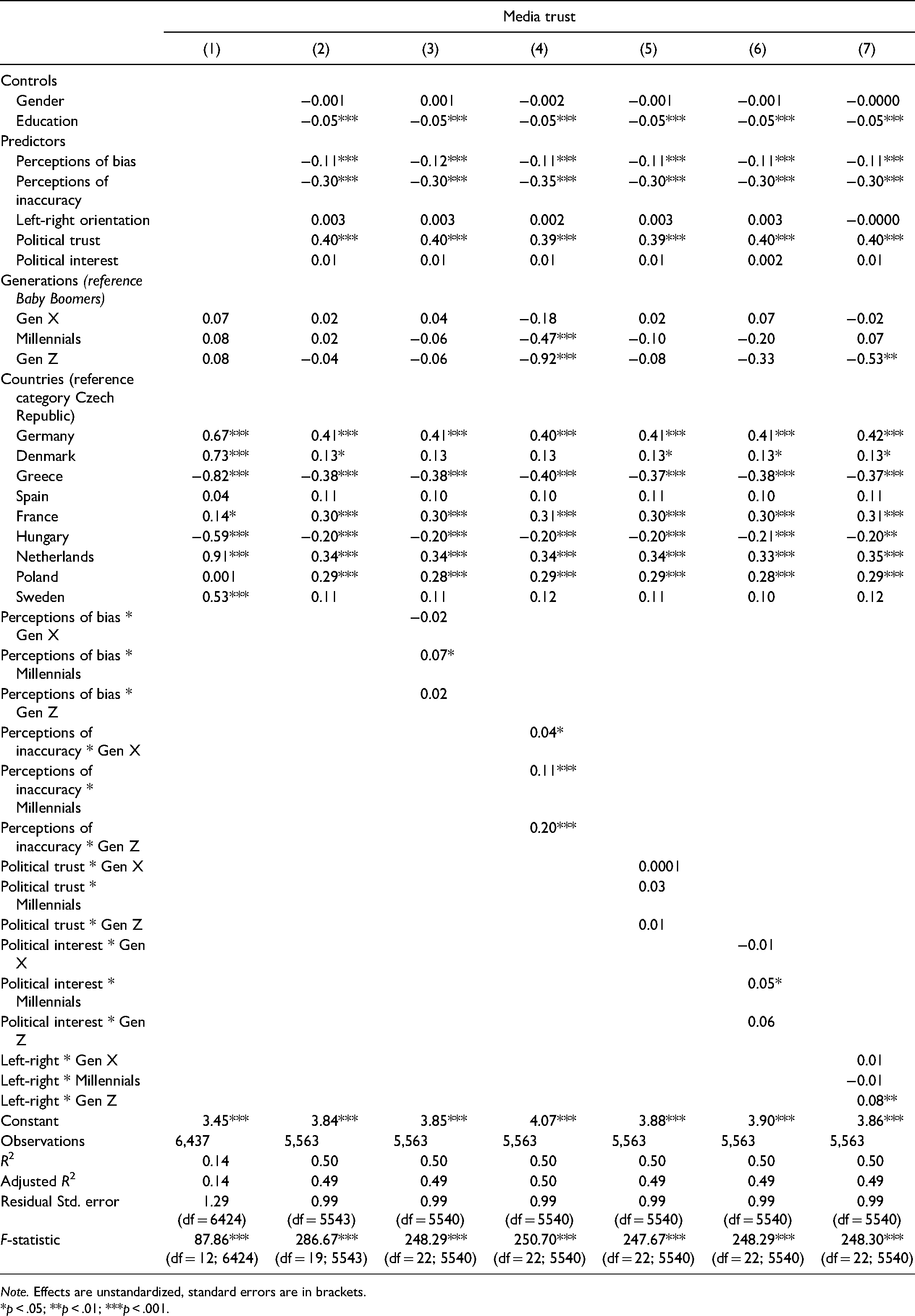
Note. Effects are unstandardized, standard errors are in brackets.
*p < .05; **p < .01; ***p < .001.
Discussion
This study sets out to investigate generational differences in media trust in Europe. Contrary to prior research (Dalton 2005; Twenge et al. 2012), we do not find that the four studied generations—Baby Boomers, Generation X, Millennials, and Generation Z—differ strongly in their levels of media trust. This suggests that there are neither lifecycle nor cohort effects for media trust. Taken together, we do not find evidence for a crisis of media trust in Europe. Future research should investigate European generations’ media trust more extensively, taking context factors of each country more strongly into account than this study was able to do.
Regarding the hypothesized predictors of media trust, this study is able to replicate important results from previous research. Political trust is positively associated with media trust, while perceptions of media bias and inaccuracy were negatively associated with it. However, the causal order of these relationships does not become apparent from our data and could follow the logic of a reinforcing spiral (see e.g., Hanitzsch et al. 2018). Further research on the causal order between media trust, political trust, and bias as well as accuracy perceptions is needed. Contrary to some prior results (e.g., Hanitzsch et al. 2018; Schranz et al. 2018; Tsfati and Ariely 2014) but in line with others (Lee 2010), political interest and the political leaning of citizens were not significantly related to media trust. This could possibly be due to our model including other variables that explain this relationship 1 .
This study is one of the first that tests the relations of a number of various predictors (identified by previous research) with media trust differ across generations. We follow the political socialization argument that experiencing formative years in different times and media systems may be decisive for the extent to which recent developments translate into trust in press and politics for different generations (Ohme and De Vreese 2020). Interestingly, the importance and impact of some predictors of media trust varies across generation. We find evidence that growing up around public debates that dispute quality of media and the term “fake news” may indeed matter for media trust among younger generations, as they might interpret the relevance of journalistic practices differently. First, perceptions of media bias are less strongly associated with lower media trust for Millennials than they are for other generations. Second, perceptions of inaccuracy in the media are less relevant for younger generations’ media trust. Although these effects are small, they could indicate that younger generations are somewhat less sensitive to biases and inaccuracy of reporting than older generations. In other words, they may perceive deviations in reporting from a journalistic standard (i.e., unbiased and accurate) reporting as less relevant for the question of how much they can trust the media (see Marchi 2012). Growing up during debates of whether media are biased or misinform people may lead to normalization of these journalistic deficits among younger generations. Another possible explanation is the much wider variety of news outlets and content that Millennials and Gen Z had at their disposal growing up. Future research needs to test this relationship more thoroughly and take into account whether such a phenomenon relates to the media as such, or only to some media types or sources such as legacy or social media, as suggested by Gramlich (2019). In addition, it is important to follow up on how this chiasma between (in)accuracy perceptions and (dis)trust in media translates into younger generations’ curation of media diets in order to understand how media content influences their political engagement and behavior (Edgerly et al. 2018). The finding that political interest matters more strongly for Millennials’ media trust may relate to previous research that found younger generations to be less interested in politics in general (Andersen et al. 2021; Grasso 2016). Our results add to this strand of research, showing that for younger citizens, lower levels of political interest can be related to trust in media as well. Since this pattern clearly stands out for Millennials and Gen Z, it is more likely that we look at a cohort effect rather than a lifecycle effect.
Our study has several limitations that should be taken into account when interpreting its results. First, the study is cross-sectional, and therefore cannot support any causal conclusions. Furthermore, we used a simple, five-item measure of media trust; future research could incorporate more complex, multidimensional measures of media trust (e.g., Prochazka and Schweiger 2019; Kohring and Matthes 2007). Moreover, it would be interesting to incorporate a larger number of countries in order to be able to test differences in country-specific socialization of different generations. We were not able to collect a large enough and representative sample of the oldest generation, the Traditionalists. For this, one would likely need an offline solution. In addition, given the small proportion of Gen Z in the overall population and the added layer of difficulty in recruiting young survey respondents, the number of Gen Z respondents is quite low in some individual countries, which limits the generalizability of the results relating to that generation. Nevertheless, future research could target these two generations more specifically and possibly would be able to detect additional differences that we were not able to investigate with the given data. Despite its limitations, our study makes an important contribution to the study of media trust and its predictors. Especially if these are cohort, rather than lifecycle, effects, it will be interesting to monitor how media trust develops over time and what factors influence it, as these younger generations grow older.
Footnotes
Declaration of Conflicting Interests
The authors declared no potential conflicts of interest with respect to the research, authorship, and/or publication of this article.
Funding
The authors disclosed receipt of the following financial support for the research, authorship, and/or publication of this article: This research is funded by a grant from the European Research Council (ERC), grant number 647316.
