




Abstract
Oil palm (Elaeis guineensis) is a rapidly expanding crop in the Amazonian region of Brazil. Brazilian law requires all landowners, including oil palm plantations, to maintain forest reserves and forested riparian corridors as a way to limit biodiversity losses. Because of these laws and the forest-like structure of oil palm, these plantations may function as habitat for some native species in the region. We tested this assumption by experimentally translocating Cinereous Antshrikes (Thamnomanes caesius), a forest understory insectivorous bird and nuclear member of mixed-species flocks, from forest reserves to riparian corridors within a large oil palm plantation landscape and tracked their movements back to their home ranges. In total, we recorded the movements of 18 individuals, 8 of which were translocated. The other 10 individuals were tracked within their home ranges in the forest reserves. Six of the eight translocated birds successfully returned to their forest home range, but only one bird flew through the more direct route back through the oil palm matrix while the rest took longer routes through adjoining riparian corridors. Homing time for translocated birds averaged 9.57 (±2.23 SE) days. The home range of birds within the forest reserves averaged 2.39 (±0.69 SE) ha, and, with the exception of the single returning bird, Cinereous Antshrikes were never detected in oil palm. Our results suggest that oil palm plantations are a barrier to movements of our study species, and that riparian corridors connecting forest fragments may be effective routes for dispersal.
Introduction
Determining how species move within human-modified landscapes is one of the most important challenges for conservation biologists (Beier & Noss, 1998; Bélisle, Desrochers, & Fortin, 2001; Fahrig & Merriam, 1994; Ims, 1995; Knowlton & Graham, 2010; Turchin, 1998). Fragmenting a species' preferred habitat with novel land cover, such as agriculture, silviculture, or urban structures, often restricts how far organisms can travel and which routes they can take (Volpe, Hadley, Robinson, & Betts, 2014). For instance, some forest species will not cross large open areas (Laurance, Stouffer, & Laurance, 2004; Lees & Peres, 2009; Robertson & Radford, 2009), while some grassland species may be reluctant to cross dense tree plantations (Allan, Harrison, Navarro, van Wilgen, & Thompson, 1997; Reino et al., 2009). The degree to which a landscape facilitates or impedes a particular species' movements is known as the landscape's functional connectivity (Taylor, Fahrig, Henein, & Merriam, 1993). Functional connectivity is the product of habitat structural connectivity, a species' dispersal capacity, and behavioral responses to changes in habitat structure and composition (Betts, Gutzwiller, Smith, Robinson, & Hadley, 2015). Ultimately, the functional connectivity of a landscape affects a species' spatial distribution, genetic structure, and overall probability of persistence (Baguette & Van Dyck, 2007; Betts et al., 2015; Hanski, 1998).
Translocation experiments can be a powerful tool for understanding the functional connectivity of adjoining habitats for a particular species (Knowlton & Graham, 2010). In such experiments, animals are captured, transported away from their territory or home range, and released, often in locations which force the animal to choose between different habitats when making their way back to or near the capture site (Knowlton & Graham, 2010). Translocation experiments have the advantage of exerting a degree of control over the animal's motivation for movement, capture sites, release sites, and intervening matrix (Betts et al., 2015). Translocation experiments allow the determination of the distances an organism is willing or able to travel, the time required to do so, favored routes, and how the movement behavior is influenced by habitat, landscape features, and configurations (Bélisle, 2005). When a landscape consists of patches of habitat, how a species responds to the intervening matrix is critically important for determining the species' response to the fragmentation (Franklin & Lindenmayer, 2009). Further, well-informed management or conservation action can benefit greatly from species-specific data on connectivity, or resistance, of common habitats (Betts et al., 2014).
Many studies have shown that tropical forest birds are reluctant to venture across relatively novel habitats such as pasture (e.g., Suarez-Rubio, Montealegre, Renjifo, & Renner, 2015; Volpe et al., 2014). However, to our knowledge, no studies have examined the propensity of these birds to cross a new and fast growing human-created land cover, large-scale oil palm (Elaeis guineensis) plantations. This represents a gap in our knowledge of the functional connectivity of different matrix types, especially since oil palm plantations are one of the most rapidly expanding agrosystems in the tropics, with more than 15 million ha already converted (Foster et al., 2011). Biophysical suitability and government incentives, which include zoning areas for the cultivation of oil palm, make the Brazilian Amazon the most important agricultural frontier in the world for this crop (Fitzherbert et al., 2008; Laurance & Butler, 2009). The great majority of oil palm plantations in Brazil are located in the state of Pará, within the Belém Area of Endemism biodiversity hotspot (Brandão & Schoneveld, 2015; Gascon, Bierregaard, Laurance, & Rankin-de-Merona, 2001; Skole & Tucker, 1993); 18% of endangered Brazilian birds occur strictly in Amazonia, and 28% of these species are found only in the Belém Area of Endemism (IUCN, 2016; Ministério do Meio Ambiente [MMA], 2014). This region is also the most critically threatened in all of Amazonia (MMA, 2014), and expanding oil palm in this region is extremely worrisome and warrants careful examination.
Under Brazilian law, all landowners, including oil palm plantation owners, are obligated to keep 50% to 80% of their land as natural forest reserves (reservas legais) and riparian corridors (“áreas de preservação permanente,” henceforth APPs), to help maintain water quality, ecosystem services, and biodiversity (Brasil Lei n° 12.651, 2012; Marques & Ranieri, 2012). These riparian buffers have been legally required and protected by Brazilian Federal legislation since 1965, with designated fixed minimum widths (usually 30–50 m) of forest buffers along waterways (Lees & Peres, 2008). However, these laws are often ignored and rarely enforced in the region (Laurance & Williamson, 2001).
Oil palm is more similar to tropical forest in terms of structural complexity than many local alternative agricultural activities, such as soy beans, sugar cane, and cattle grazing, and, for this reason, it has been suggested that oil palm may have a less inhibitory effect on wildlife movement. However, oil palm plantations are far less structurally complex than primary and secondary forest and are also warmer and less humid (Foster et al., 2011; Turner & Foster, 2009) and may still pose a significant barrier to understory forest bird movement. Nearly all oil palm plantations also lack a vegetative understory, which is known to be important for many species of tropical forest birds (Gillies, Beyer, & St Clair, 2011). Oil palm plantations in eastern Amazonia were found to have impoverished avian communities with low richness and functional diversity compared with other nonforest land-uses such as cattle pasture (Almeida et al., 2016; Lees, Moura, de Almeida, & Vieira, 2015). Many forest birds clearly do not use oil palm plantations as foraging or breeding habitat, but whether they view the plantations as an impediment to routine or dispersal movements is unknown.
We investigated the functional connectivity of the oil palm plantation matrix for a common, territorial forest understory insectivore and nuclear flocking species, the Cinereous Antshrike (Thamnomanes caesius). We chose this species because it is forest dependent and yet persists in human-fragmented landscapes, making it ideal for examining movement in novel landscapes (Hadley & Betts, 2009). Moreover, because Cinereous Antshrikes are nuclear members of mixed-species flocks, they help to maintain flock cohesiveness and their movement behavior likely impacts and reflects that of the dozens of forest understory birds that join the mixed-species flocks. In fact, the loss of Cinereous Antshrikes from small forest fragments in Brazil led to the disintegration of the mixed-species bird flocks associated with them ((Stouffer & Bierregaard,1995). To determine the functional connectivity of the oil palm plantations to Cinereous Antshrikes, we translocated individuals from their home ranges in forest patches across oil palm plantations and into APPs and tracked their return paths. If oil palm plantations do not impede the movement of forest birds, we expected the Cinereous Antshrikes to take the most direct and shortest straight-line route back through the oil palm to their home range. If the oil palm plantations do impede movement, we expected the birds to take longer, more serpentine paths through the APPs to return to their home range in the forest. We also put transmitters on control birds from the same sites where we captured translocated birds and monitored their movements and home ranges within the forest fragments to determine if the birds enter the adjacent oil palm plantations as part of their home ranges.
Methods
Study Area
The study site was the oil palm plantation landscape of the Agropalma Industrial Complex in the municipality of Tailândia, in the southeast of Pará State, Brazil (2°36′18 ″S, 48°47′06 ″W; Figure 1). Agropalma consists of 107,000 ha, with 64,000 ha preserved as forest reserves and 39,000 ha as active palm plantation (the remainder is company infrastructure). The forest reserves consist of 14 fragments (603–16,748 ha) dominated by typical lowland Amazon terra firme forest (Bolfe & Batistella, 2012) and embedded in the oil palm plantation matrix, and forested APPs along the many streams in the landscape (Figure 1). The region's climate is hot and humid, with two well-defined seasons: a dry season between June and November, when the study took place, and a rainy season between December and May. Mean annual precipitation is 2,451 mm, mean temperature approximately 26℃, and relative humidity 88.5% (de Albuquerque, de Souza, de Oliveira, & de Souza Júnior, 2010; de Moraes, da Costa, da Costa, & Costa, 2005). The region is classified as Af and Am, according to the Köppen climate classification (Alvares et al., 2013; Peel, Finlayson, & McMahon, 2007).
Map of Brazil showing the state of Pará (gray) and the four sampled forest reserves (T1–T4) with the Agropalma agro-industrial complex. Upper insert shows aerial view of riparian corridors within the oil palm plantation (photo by Agropalma). Lower insert shows riparian corridor vegetation (photo by C. C. P.).
Focal Species
We selected the Cinereous Antshrike (Thamnomanes caesius; Thamnophilidae) as our focal species, based on their relative abundance in the forest fragments and importance as a nuclear mixed-species flock member that maintain territories year-round (Bierregaard & Lovejoy, 1989; Borges & Stouffer, 1999; Mokross, Ryder, Côrtes, Wolfe, & Stouffer, 2014). Cinereous Antshrikes are small (averaging 14 cm in length and 16 g in weight) forest insectivores that inhabit typical understory of Amazonian terra firme and seasonally flooded tropical forest from Bolivia and Colombia to Venezuela, French Guiana, and eastern Brazil (Zimmer & Isler, 2016). They are easily sexed with males a gray-black and females cinnamon brown. Although young males have a color pattern like that of adult females, juvenile status can be determined by molting pattern, presence of gape, presence of yellowish periorbital area, and cranial ossification.
Capture, Translocation, and Tracking
At four forest reserves within Agropalma boundaries, birds were attracted to mist nets set out along established trails before 12:00 using playback of conspecific calls from July 03–14, 2015. Capture sites were selected to be within a forest reserve (>1,000 ha) but near enough to the oil palm plantation (<200 m) and an APP (<4 km) to allow rapid translocation of individuals. Following capture, birds of both sexes were outfitted with a 0.5 g radio telemetry transmitter (Advanced Telemetry Systems model no. 2415) using eyelash glue to attach these to bare skin on the lower back (Figure 2). The birds with transmitters also received metal bands from the National Research Center for the Conservation of Wild Birds. All adult Cinereous Antshrikes captured were selected for the experiment, except birds with brood patches which were released immediately. Upon release, all birds with transmitters immediately took flight and appeared to have no difficulty flying. We haphazardly assigned each captured bird to either a translocation treatment group or a forest control group that was released at the site of capture, making sure to balance male and female birds in each category in each location. The forest control birds ensured that translocation did not alter the normal habitat selection behavior of treatment birds (Betts et al., 2015), allowed us to determine home ranges of control birds, and whether these home ranges included any of the adjacent oil palm plantations. Control birds were released near the point of capture within the forest fragment. Treatment birds were placed in cotton bags and translocated across the oil palm plantation and released in the nearest border between APP and oil palm plantation, presenting the bird with the option of flying into the riparian forest or the oil palm plantation. All birds were released within 30 min from time of capture. The APP release sites ranged from ∼200 m to 4 km from the forest fragment capture sites and were chosen so that the bird had a choice of returning to its home range by taking the shortest, most direct route back through the oil palm plantation or by taking a longer, meandering route back through the forested APPs. This work was approved by the MMA Instituto Chico Mendes de Conservação da Biodiversidade – ICMBio Sistema de Autorização e Informação em Biodiversidade – SISBIO, with permit number 20902-2 issued to MPDS and the MTU Institutional Animal Use and Care Committee ID# [588706-4] issued to DJF.
Male Cinereous Antshrike (Thamnomanes caesius) with 0.5 g radio telemetry transmitter glued to its back (photo credit F. C. B.).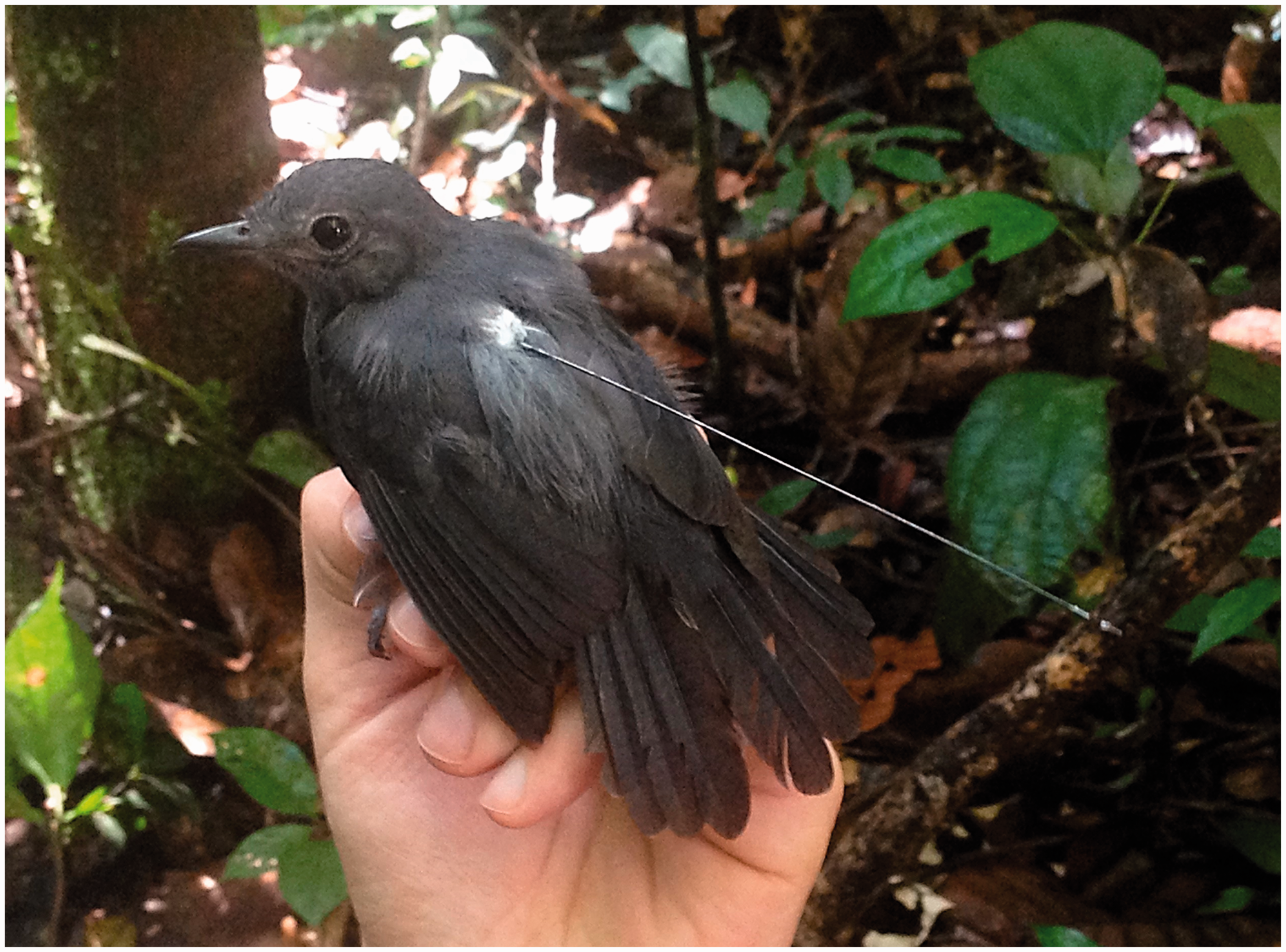
After release, translocated birds were closely monitored by two observers using handheld radio receivers (ATS model 410) and a three-element Yagi antenna (ATS model 148-152). The first pair of translocated birds were relocated every 15 min until dusk of the release day, but finding no sudden movements, we then adjusted our strategy and relocated translocated birds every 15 min for the first hour after release and once daily thereafter. Control birds in the forest were relocated once per day with the same method. Observers tracked the birds until they could confirm the bird's location visually (the majority of the time) or until the signal strength was sufficient that we were confidently within 10 m of the bird. Observers were careful not to approach birds and flush or otherwise affect their behavior, especially within the APPs. Prior to beginning tracking, we experimentally tested the signal strength of the receiver with a known distance to familiarize observers with signal strength and receiver sensitivity gain to make this determination. Locations of each bird were recorded using a handheld GPS unit. Birds were radio-tracked daily for up to 20 days, or until the transmitter fell off or the signal was lost. GPS points from handheld GPS units were imported into ArcGIS, and minimum convex polygons were calculated for birds with at least five confirmed points.
Results
Date (all 2015) and Location of Capture, Pair Status (Single or With a Mate), Sex, Number of GPS Location Points Obtained, Outcome of Transmitter, and Minimum Convex Polygon Home Range Size of Control Birds Not Translocated From their Forest Reserve Home Ranges.

MCP = Minimum Convex Polygon.
Date (all 2015) and Location of Capture, Pair Status (Single or With a Mate), Sex, Number of GPS Location Points Obtained, Days Taken to Return to Home Range, Outcome of Translocation, Distance Translocated and Minimum Convex Polygon Home Range Size of Birds Translocated From Their Forest Reserve Home Ranges Across to a Border Between Oil Palm and APP (Riparian Corridors).

MCP = Minimum Convex Polygon; APP = áreas de preservação permanente.
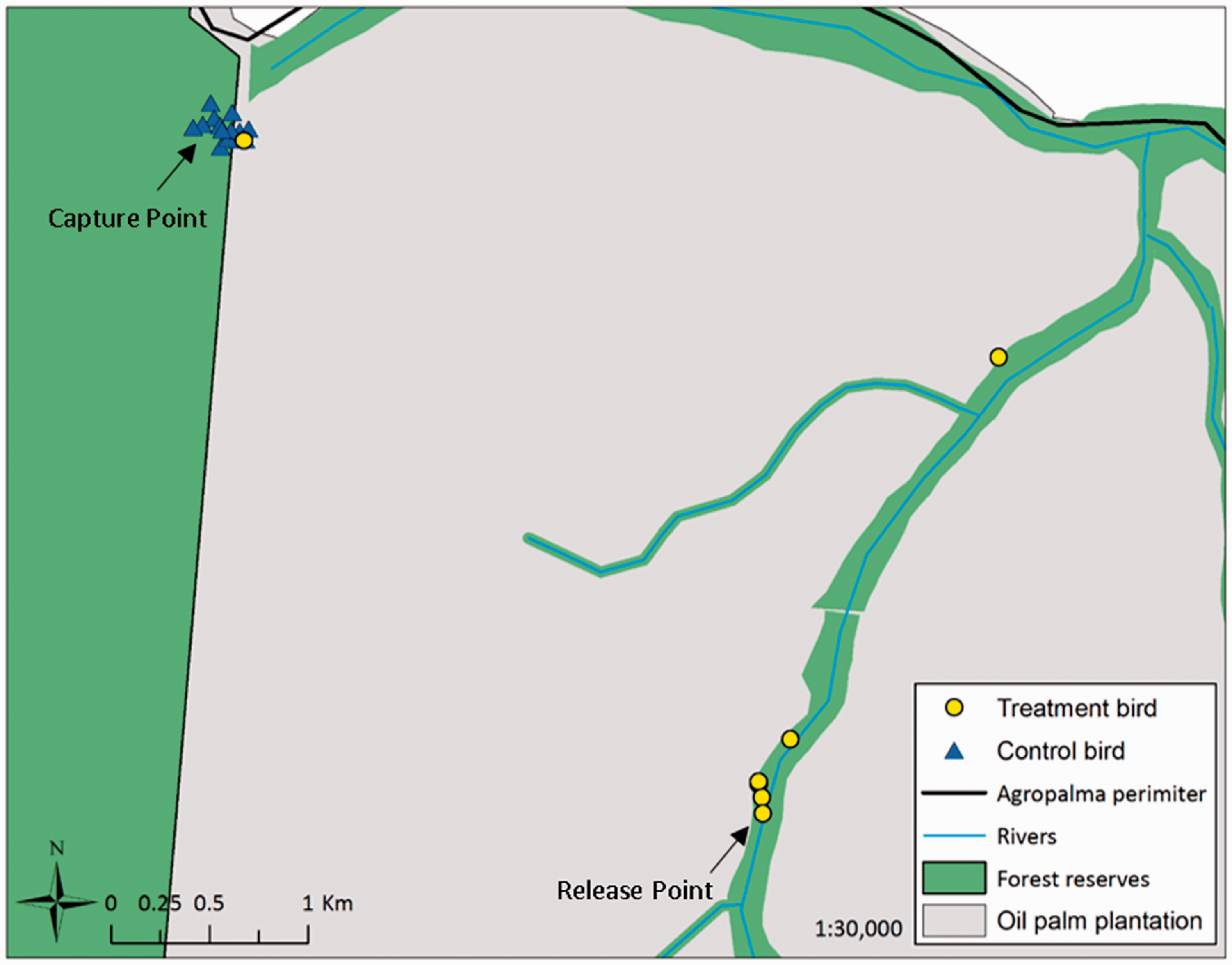
Detection points (yellow dots) of one of the translocated (treatment) Cinereous Antshrikes (Thamnomanes caesius) on it's return to the point of capture in a forest fragment. The bird stayed in the riparian corridor (green on map), even though going back through the oil palm plantation (gray on map) would have been shorter. Blue triangles are detection points of a bird that was not translocated (control) and was captured at the same time and same location as the translocated bird. Birds were never located in the oil palm, although some points appear that way due to the 10 m error in the GPS coordinates.
Discussion
Our results suggest that oil palm plantations in Amazonia provide only very low levels of functional connectivity between forest fragments for many understory forest birds. Cinereous Antshrikes, which lead mixed-species flocks of other understory forest birds, largely avoided passing through oil palm plantations to return to their established home ranges and also did not appear to enter the plantations during their daily movements. Further, in a survey of bird species in the same landscape as this study, Almeida et al. (2016) did not detect this species in oil palm plantations. However, our results show that the APPs along the numerous small streams snaking through the oil palm plantations did greatly increase the overall functional connectivity of the plantation landscape for the Antshrikes. Only one translocated bird took the shortest path through the oil palm to return to the forest (200 m), while the rest opted to take longer routes back through forested riparian corridors.
Existing research on the functional connectivity of different vegetation types for tropical forest birds show low willingness of these species to move across pasture (Castellon & Sieving, 2006; Gillies et al., 2011; Gillies & Clair, 2008; Hadley & Betts, 2009; Suarez-Rubio et al., 2015; Volpe et al., 2014). However, to date no studies have examined the functional connectivity of other types of agricultural matrices, such as oil palm plantations, on Neotropical forest birds. It is generally assumed that the more similar in structure a matrix type is to a species' preferred habitat, the more permeable that matrix type will be to species' movement (Eycott et al., 2012; Prevedello & Vieira, 2010; Watling, Nowakowski, Donnelly, & Orrock, 2011). For this reason, oil palm plantations are sometimes purported to have a more benign impact on forest birds compared with other actual or near monocultures because of their similarity in structure and canopy shade to tropical forest (SEMA, 2014). However, a substantial amount of evidence points to sharp declines in bird species diversity in oil palm relative to native forest (Almeida et al., 2016; Aratrakorn, Thunhikorn, & Donald, 2006; Lees et al., 2015; Peh et al., 2006). Further, one study in the Brazilian Amazon found that nearly 70% of the regional avifauna are not found in the agricultural matrix, regardless of its structural features (Mahood, Lees, & Peres, 2012; Moura et al., 2013).
Our study is the first to show that a leader of mixed-species flocks of understory forest birds is reluctant to even move across oil palm plantations, but that they can move through forested riparian corridors. None of the birds that we translocated remained in the APPs they were released into, and averaged 9 days within them before returning to the forest reserves. We did not detect any Cinereous Antshrikes holding territories in the APPs, though they appear to provide sufficient habitat for short-term stays and possible dispersal. Likewise, Lees and Peres (2008) did not find any Cinereous Antshrikes in forested corridors <200 m in width or in any corridors unconnected to forest fragments, suggesting that corridors are not suitable habitat for this species or the mixed-species flocks they associate with.
While our conclusions are based on a small sample size of a single species in a region of very high-species richness where there can be a diversity of responses to landscape change, our findings are consistent with a growing body of evidence demonstrating the importance of forested corridors for maintaining landscape connectivity for tropical forest birds (Gilbert-Norton, Wilson, Stevens, & Beard, 2010; Gillies et al., 2011; Gillies & Clair, 2008; Ibarra-Macias, Robinson, & Gaines, 2011; Volpe et al., 2014). Future research should explore whether existing APPs are sufficient for juvenile dispersal of forest birds to determine metapopulation dynamics and long-term viability of the forest bird communities in this region. In other parts of Pará state, oil palm producers lack remnant large forest reserves but do have APPs; the value of these forest corridor habitats in the absence of large forest reserves should also be evaluated. Since the 1990s, nearly 30% of former APPs in the Pará region have been destroyed, mainly for agriculture and pasture (de Almeida & Vieira, 2014). Evaluating their benefits to birds and other biodiversity is of the utmost importance to prevent further losses.
Implications for Conservation
How species respond to fragmentation of their habitat often depends on the functional connectivity of the intervening matrix (Volpe et al., 2014), which can be the deciding factor in the species' probability of persisting in human-altered environments (Baguette & Van Dyck, 2007; Hanski, 1998). Neotropical oil palm plantations are expanding at a rapid rate (Gilroy et al., 2015), and it is important to learn how these plantations can be made more biodiversity-friendly (Lees et al., 2015). The State of Pará is expected to be the center of oil palm production in Brazil (Brandão & Schoneveld, 2015), with potentially more than 22 million ha of suitable land for palm, much of it currently covered by native secondary forest. This amounts to an area greater than all of oil palm production in Indonesia and Malaysia (Villela, D'Alembert, Rosa, & Freitas, 2014). Our study shows that some understory forest birds do not move across oil palm plantations if they have a native forest option, and that retaining forest reserves and APPs in oil palm plantation landscapes has a likely benefit to tropical forest bird conservation, especially in southern and eastern Amazonia, which lies within the Arc of Deforestation (Lees & Peres, 2008). The Environmental Council of Pará State recently designated oil palm as a low-impact land-use, meaning that oil palm plantations of less than 20 ha are not required to include APPs or legal reserves, and that oil palm can even be used to restore degraded APPs (Lees et al., 2015). Based on our results, extending this designation to plantations of all sizes would likely be devastating for Amazonian avian biodiversity, and potentially other taxa reliant upon corridors for travel around and through oil palm plantations. The model used by Agropalma, with large fragments of forests interconnected by riparian forests within the oil palm landscape, seems to offer a better alternative for local biodiversity and should be adopted by the oil palm industry in the expansion of this crop in the Amazon. We believe these riparian corridors between forest fragments should be a required and enforced feature of all Neotropical oil palm plantations.
Footnotes
Acknowledgments
The authors thank the Agropalma Group for permitting this research on its property, particularly J. Martins Jr., who facilitated our research and lastly also thank the staff of the Programa de Pós Graduação em Zoologia at the Universidade Federal do Pará for their support and kindness and Conservation International Brazil, who helped establish this research partnership between our universities and Agropalma.
Declaration of Conflicting Interests
The author(s) declared no potential conflicts of interest with respect to the research, authorship, and/or publication of this article.
Funding
The author(s) disclosed receipt of the following financial support for the research, authorship, and/or publication of this article: This research was supported by the National Science Foundation Partnerships in International Research and Education (award number 124344), the NSF International Research Experience for Undergraduates (award number DEB–1019928), and Coordenação de Aperfeiçoamento de Pessoal de Nível Superior (CAPES)/NSF 007/2014. The U.S. Agency for International Development (USAID) – Biodiversity and Socio–Economic Impacts of Palm Oil Bioenergy Development in the Brazilian Amazon, the Fundacao Amazonia Paraense de Amparo a Pesquisa (FAPESPA), and the USDA McIntire–Stennis Program also provided funding support. PVC was supported by a CAPES Doctoral fellowship.