




Abstract
Disposal of industrial wastewater has resulted in increased concentration of heavy metals (HMs) along the coastline of Malaysia. However, little is known about the accumulation capacity of HMs by Rhizophora apiculata in Matang Mangrove Forest Reserve (MMFR) Malaysia. The aim of this study is to measure the concentration of HMs in different ages of mangrove forests. In this study, 15 and 80-year old trees of Rhizophora apiculata were selected for experimentation. Thirty samples of leaves, roots and sediments were analyzed to measure the concentration of HMs in 15 and 80-year-old trees. The measured concentrations of copper (Cu), iron (Fe), manganese (Mn) and zinc (Zn) in leaves, roots and sediments were used to compare bio- concentration and translocation factor between the abovementioned two age groups. Concentration of Mn came out to be significantly higher in leaves than in sediment. This suggested that Rhizophora apiculata was an efficient Mn-extractor. On the other hand, it was found less efficient in extracting heavier metals (Fe, Cu and Zn) from the sediment, as their concentration was lower in leaves and roots as compared to sediments. The translocation factor was highest for Mn, indicating high mobility of Mn from roots towards the leaves. Bio-concentration factor was also found highest for Mn (3.52) followed by Zn (1.88), Cu (1.33) and Fe (0.26). Therefore, it can be concluded that Rhizophora apiculata is more efficient in extracting Mn as compared to Zn, Cu and Fe.
Introduction
Mangroves found at the interface of land and sea are highly productive wetlands of tropical and sub-tropical regions (Alongi Daniel, 2002; Chmura et al., 2003; Gandaseca et al., 2011; Praveena et al., 2008). Mangroves help reduce soil erosion and maintain stability of adjoining landforms (Alongi Daniel, 2002; Clark et al., 1997; Murin, 1995). It has been documented that mangrove sediments act as a sink for heavy metals (HMs) of anthropogenic origin (Peters et al., 1997; Tam & Wong, 1997).
The elevated level of HMs in the environment has become an important issue due to their persistence, toxicity and bio-accumulation in the food web (Haris et al., 2017; Shafie et al., 2013; Soliman et al., 2015). Major sources of HM contamination include agricultural chemicals and industrial effluents. Therefore, high concentration of HMs are found in mangrove areas adjacent to agricultural and industrial zones (Vane et al., 2009). These HMs include Copper (Cu), Nickel (Ni), Zinc (Zn), Lead (Pb), Arsenic (As), Cadmium (Cd) and Manganese (Mn; Chowdhury et al., 2015). In this scenario, phytoextraction is being used to treat HM contamination of soil and water since decades (Kaewtubtim, 2016).
Phytoremediation is a green technology that utilizes different types of plants, called phytoremediators, that extract HMs from the soil (Ismail, 2012). In this regard, Rhizophora apiculata (R.apiculata) is an important mangrove specie found in Matang Mangrove Forest Reserve (MMFR) in Perak state, Peninsular Malaysia. Globally this specie is well known for its ability to improve the water quality by trapping sediments and extracting minerals dissolved in seawater due to their dense root system (Alongi Daniel, 2002; Kathiresan & Bingham, 2001; Mremi & Machiwa, 2003). However, little research is conducted regarding the phytoextraction potential of R. apiculate in MMFR. The present study tries to address this research gap. MMFR has managed and unmanaged forest compartments with different tree ages. Our study focused on two age groups: 15-year-old from managed and 80-year-old from unmanaged compartment, also known as VJR (Virgin Jungle reserve). The following objectives were undertaken; investigate concentration of HMs (Mn, Fe, Zn and Cu) in leaves and roots of R. apiculata specie. Concentration of these HMs were also determined in sediments. In addition, translocation and bioconcentration factor of these HMs were compared between the leaves and root samples of 15 and 80 old aged trees. The results of this study can also be used to assess the phytoextraction behavior of different aged trees of R. apiculata.
Methods
Study Area
The study was conducted in MMFR in Perak state, Peninsular Malaysia (Figure 1). The total area of MMFR is 40,600 ha and is divided into mainland forest (30%) and island forest (70%).
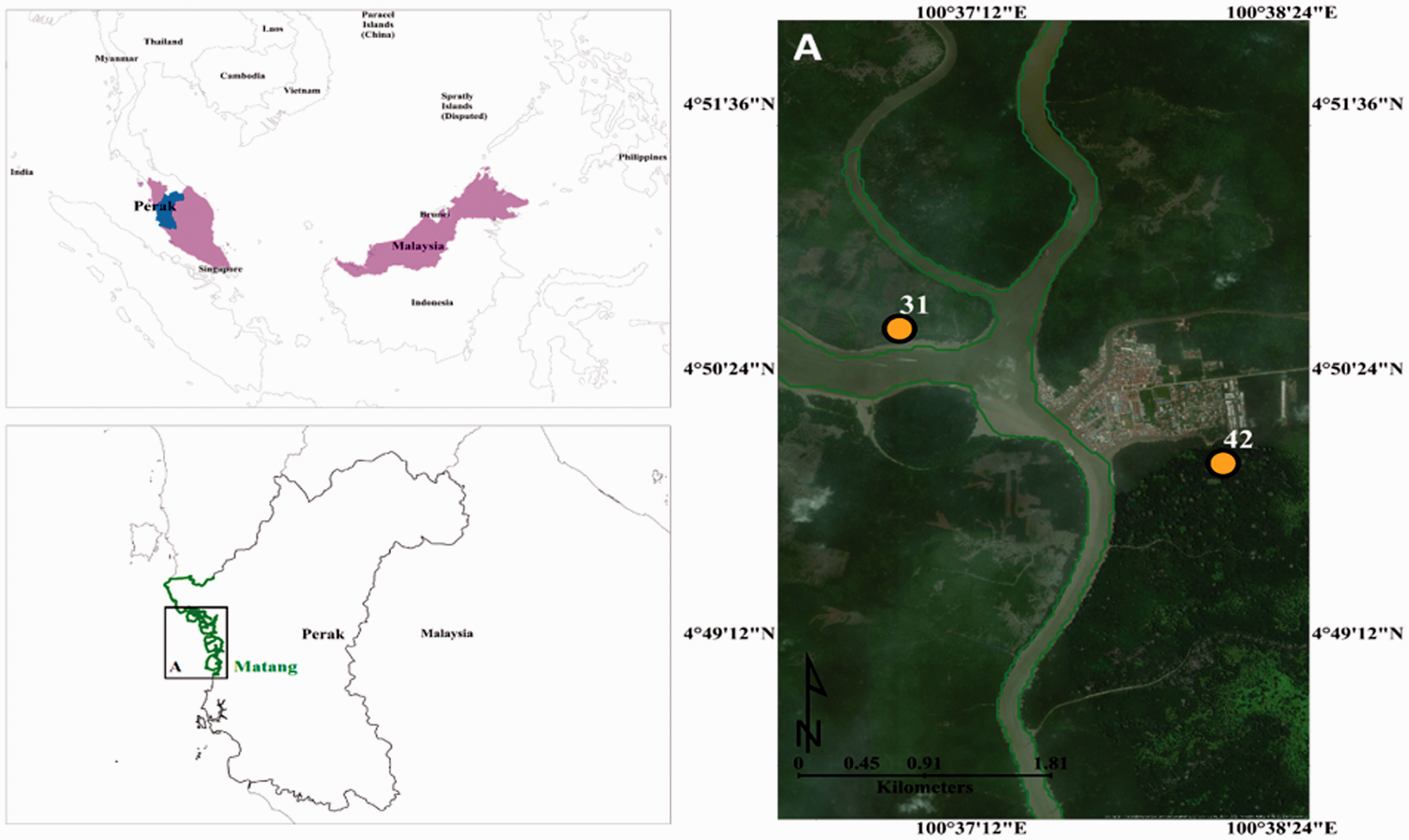
Study Site (A) Matang Mangrove Forest Reserve. Compartments for sampling are shown (yellow dots) by overlaying on imagery from Google Earth (Source: Google Earth Pro V 7.3.2.5776, July 13 2019, lat 4.838128 lon 100.624829, Eye alt 3.52 km, Maxar Technologies, CNES/Airbus). Compartment 42 represents 80 year old trees and compartment 31 represents 15 year old trees.
Sampling Procedure
In this study, 15-year-old (compartment 31, 04° 50.503’ N,100° 36.195' E) and 80-year-old (compartment 42, 04° 50' 04.5'' N, 100° 38' 05.5'' E) trees were selected to obtain samples of leaves, root and sediment (Figure 2). A total of 30 healthy trees (15 trees per age group) were sampled randomly . A metal ball was tied to a rope and launched towards the tree canopy to collect 250 g of fresh leaf samples . To sample roots 7 cm of root section was collected. 400 g of sediment samples were taken at a depth of 10 cm using peat auger during the dry season of 2016. All samples were collected at the same time. Each sample was placed in zip-lock plastic bags, tagged and stored in an ice chest at 4 °C during a five-hour transportation. In the laboratory, leaf and root samples were washed together with deionized water to remove dust, soil particles and algal traces and were oven-dried to a constant weight (Arianto et al., 2015). Subsequently, each leaf and root sample were grinded using porcelain pestle mortar and sieved using mesh size of 2 mm (Tam & Wong, 2000).

Trees of Rhizophora apiculata in Compartment 31(15 Year Old) and 42 (80 Year Old) at Matang Mangrove Reserve Forest, Perak Malaysia.
Heavy Metal Assessment
2 g of each sample (leaves, roots and sediment) was placed in volumetric flasks (250 ml) and 20 ml of aqua regia solution was added (Walsh et al., 1997; HCL: HNO3 in 3:1 ratio). The solution was heated until it became clear and was filtered through ash-less filters (Whatman filter paper no. 2) into 100 ml volumetric flask. The solution was diluted with 40 ml distilled water and analyzed in atomic absorption spectrometer (AAS) to determine the elemental concentration of Mn, Fe, Zn and Cu (Brooks, 1983; Fletcher, 1981; Van Loon, 1985). Sediment physiochemical properties can be found in Supplementary Material.
Translocation and Bioconcentration Factor
Bioconcentration factor (BCF) indicates the capability of plants to take up heavy metals from soil (Qiu et al., 2011; Usman et al., 2012). Translocation factor (TF) shows the efficiency of plants in transporting HMs from belowground to aboveground organs (Usman et al., 2012). TF was calculated using the following equation (Mahdavian et al., 2017).
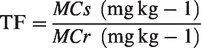
Where MCs and MCr is the metal concentration in shoot and root respectively. The BCFwas calculated using following equation (Kamari et al., 2014).

Where MCs and MCso is the metal concentration in shoot and soil respectively.
Statistical Analysis
Data corresponding to sediments was tested using one -way ANOVA to study the effect of location (compartment). Significant difference between the calculated mean of HM concentration in leaves, root and sediment samples were compared using post-hoc Tukey’s HSD tests. All means are presented with their standard errors and were taken at a significance level of 95% (p < 0.05). The statistical analysis was conducted by using SAS version 9.4.
Results
Sediment Characteristic
Results showed that the sediment fractions were 44.4/0.5/55 versus 41/0.5/58.4 (sand/silt/clay) for 15- and 80-year-old compartments, respectively (Supplementary Material Figure 1). No significant difference was found for pH and salinity between the two compartments (p > 0.05). The pH of sediments collected from 15-year-old and 80-year-old compartments was 4.5 and 5.1 respectively. Soil salinity came out to be 18.8 and 19.1 ppt for 15 and 80-year old compartments respectively.
Heavy Metal Concentration in Sediments and Plant Tissue
Results were described in two ways, firstly comparison of concentration of HMss between age groups and samples (Table 1). Highest concentration of Mn (5 mg kg−1) was found in the leaves of 80-year-old trees followed by 15-year-old trees leaves (3.1 mg kg−1), 80-year-old compartment roots (2.06 mg kg−1) and sediment (2.2 mg kg−1; Table 1). Sediments of 80-year-old compartment had the highest concentration of Zn (0.9 mg kg−1), Cu (0.13 mg kg−1) and Fe (46 mg kg−1). Furthermore, Zn concentration was lowest in the roots of 80-year-old compartment. In case of Fe and Cu the lowest concentrations (3.75 mg kg−1 and 0.05 mg kg−1) were observed respectively in the leaves of 15-year-old trees.
Heavy Metal Concentration of Both Compartments in Leaf, Root and Sediment Samples in mg kg−1.

Bold values indicate the significant differences (p < 0.05) among leaves, root and sediment.
Secondly, concentrations of HMs were compared only between samples (Table 2). Each concentration in Table 2 was the mean taken from the concentration in the 15- and 80-years old compartments. The highest content of Mn (4.26 mg kg−1) was found in leaves followed by roots (1.56) and sediment (1.65) (Table 2), indicating a high metal translocation efficiency from sediments to leaves. Along this line, iron (Fe) content was highest in sediment (42.7 mg kg−1), while leaves (5.44 mg kg−1) and roots (6.02 mg kg−1) contained much less Fe. Hence, R. apiculata does not uptake Fe and accumulats in tissue. Zinc (Zn) was found in similar concentrations in sediments (0.86 mg kg−1), roots (0.52 mg kg−1) and leaves (0.67 mg kg−1), suggesting moderate uptake and efficient translocation. Similarly, Cu concentrations did not differ in sediments, roots and leaves (Table 2).
Mean Heavy Metals Accumulation in Leaves and Roots of Rhizophora apiculata Along With Sediments.

Different superscripts letters indicate the significant differences between both groups (p < 0.05).
Bioconcentration and Translocation Factor
In the present study, BCF of Mn, Zn and Cu were 3.52, 1.88 and 1.33, respectively. BCF of Fe as 0.26 indicated insignificant uptake. Along the same line, Mn (TF = 2.73) and Zn (TF = 1.28) are efficiently translocated from roots to leaves (Figure 3). Whereas Fe and Cu were equally distributed among leaves and roots, which also requires moderate transport.

Bioconcentration (A) and Translocation Factor (B) of the of Rhizophora apiculata.
Discussion
In this study, we measured and compared the concentration of Fe, Cu, Mn and Zn in the leaves, roots and sediment samples of 15- and 80-year old compartments of R. apiculata. The results showed that Mn accumulation was higher in leaves of 80-year-old trees as compared to roots and sediments (Table 2). Similar results have been reported by Kaewtubtim et al. (2016) where Mn accumulation in plant tissue was significantly higher than other metals. According to Greger (2004) low absorption of heavy metals in plants may be due to high level of soil salinity which results in the formation of metal-chloride complexes. Such complexes make the HMs less available for plants to uptake and accumulate. In contrast to the present study, Kamaruzzaman et al. (2009) found that the concentration of Cu was highest in sediments followed by roots, barks and leaves. Other studies (John & Waznah 2011; Kamaruzzaman et al., 2009; ) also reported roots to accumulate more HMs than shoots of the plants (Supplementary Material Table 1). Similar observations were reported for other mangrove species i.e. Rhizophora mucronata and Avicennia marina (Kaewtubtim et al., 2016; I. N. Kumar et al., 2011; Pahalawattaarachchi et al., 2009).
The concentrations of Fe and Cu were higher in roots than in shoots, suggesting efficient uptake and accumulation that might be linked to better oxidation in the rhizosphere (Marchand et al., 2011). However little internal transport of these elements was noticed. High accumulation of HMs in roots is regarded as metal exclusion strategy in plants which is employed to avoid metal toxicity (Marques et al., 2009). Low accumulation of Cu is in line with the findings of Paz-Alberto et al. (2015) where Cu was not detected in R. apiculata tissues along the Subic Bay, Philippine. No strong conclusion can be drawn from the observations in Table 1 and Table 2 about the distribution of HMs between different samples and age groups. Therefore, an additional analysis was carried out in this study. Concentrations in leaves and root were combined and averaged for both age groups separately (Figure 4). Further, concentrations of sediment samples were also combined and averaged for both age groups and compared. Concentrations of Mn, Fe and Cu in R. apiculata tissue samples were higher at the 80-year-old site than at the 15-year-old site. This maybe due to site-effect since 80-year-old compartment is closer to urban area. However, in case of Zn site may not be a limiting factor since no significant difference in Zn concentration was observed between two different ages (Figure 4). It. It can be concluded that phytoremediation potential of R. apiculata increases with age, due to accumulation of metals in tree tissue over time. For sediment samples, similar pattern was observed where Mn, Zn, Cu and Fe concentrations were higher in 80-year-old compartment (Figure 5). Moreover, Mn, Zn and Cu showed significant differences in both compartments (p < 0.05). This pattern was expected because 80-year-old compartment receiveds more heavy metal effluents therefore increasing the pollution level in sediments. Detailed future studies should investigate accumulation rates over time in additional age classes of trees at different study sites.
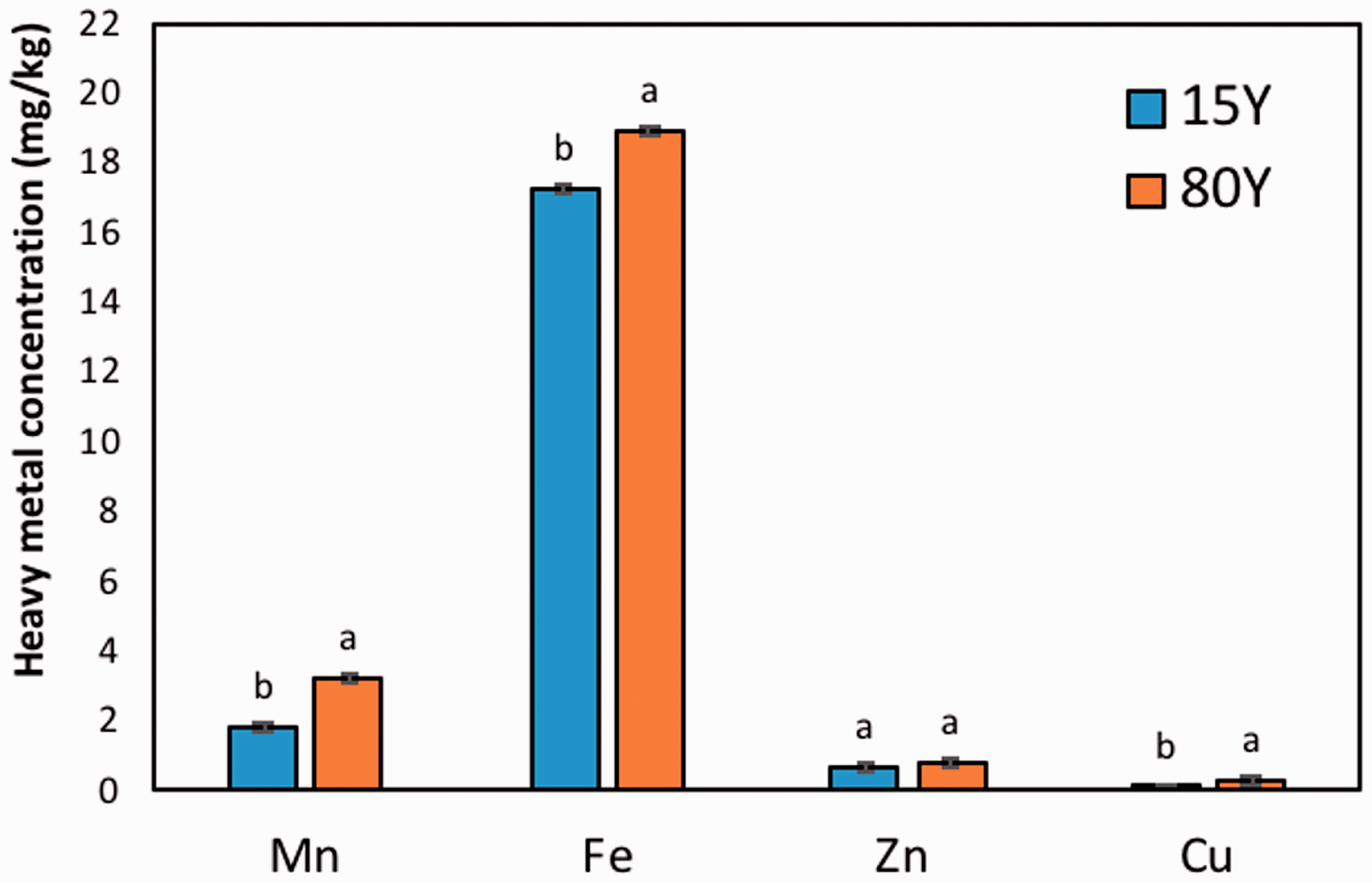
Heavy Metal Concentration in Shoot (Leaves + Roots) of Rhizophora apiculata. Small letters indicate the significant differences between 15 and 80 age groups.

Heavy metal Concentrations in Sediments at Two Different Sites (15 and 80 Years).
BCF and TF are used to estimate the phytoremediation potential of a certain specie (Qiu et al., 2011; Usman et al., 2012). In this study we were able to demonstrate through high metal concentrations in roots combined with TF of more than 1 that R. apiculata have high metal uptake and translocation from soil to root and further from root to shoot (Haque et al., 2008; Hussain et al., 2017; Sun et al., 2009). In phytoremediation technique, effective translocation of pollutants from root to shoot are required that enables speedy harvest and removal of contaminants from the ecosystem (P. B. A. N. Kumar et al., 1995). In this regard, hyper-accumulators are not only tolerant to high concentration of pollutants but also exhibit BCF and TF of greater than 1 (Baker & Whiting, 2002; Ma et al., 2001a). Some established hyper-accumulators, like Pteris vittata, have BCF greater than 100 (Ma et al., 2001b). R. apiculata with BCF and TF of greater than 1 can best be used as phyto stabilizers, functioning as long-term sinks for heavy metals.
Implications for Conservation
R. apiculata is a good selection for phytoremediation in Mn, Zn and Cu contaminated areas. It might not be so relevant for Fe contaminated sites. Salts from sea water are excluded by fine roots and salinity around roots increases, these metals, having potentially negative effects, are not, or only weakly, excluded. Hence, this species might prove to be a valuable phytoremediator for some heavy metals in contaminated areas and ecosystem design (Zimmer, 2018) through (re-)establishing R. apiculata stands in degraded mangrove areas. The difference between younger and older trees might be due to (i) plantation site rather than the age or (ii) simply due to accumulation in plant tissues over time. However future studies are warranted to test the hypothesis that older trees are more efficient in taking up and accumulating heavy metal. Overall, following the ecosystem design concept (Zimmer, 2018), it is suggested to conserve and plant more R. apiculata in heavy metal contaminated areas for remediation and old growth R. apiculata trees should be preserved without any intervention of silviculture practices.
Supplemental Material
sj-xlsx-1-trc-10.1177_1940082920947344 - Supplemental material for Phytoextraction Potential of Rhizophora Apiculata: A Case Study in Matang Mangrove Forest Reserve, Malaysia
Supplemental material, sj-xlsx-1-trc-10.1177_1940082920947344 for Phytoextraction Potential of Rhizophora Apiculata: A Case Study in Matang Mangrove Forest Reserve, Malaysia by Waseem Razzaq Khan, Fahad Rasheed, Syaizwan Zahmir Zulkifli, Mohamad Roslan bin Mohamad Kasim, Martin Zimmer, Ahmad Mustapha Pazi, Nur Amira Kamrudin, Zikria Zafar, I. Faridah-Hanum and M. Nazre in Tropical Conservation Science
Supplemental Material
sj-pdf-2-trc-10.1177_1940082920947344 - Supplemental material for Phytoextraction Potential of Rhizophora Apiculata: A Case Study in Matang Mangrove Forest Reserve, Malaysia
Supplemental material, sj-pdf-2-trc-10.1177_1940082920947344 for Phytoextraction Potential of Rhizophora Apiculata: A Case Study in Matang Mangrove Forest Reserve, Malaysia by Waseem Razzaq Khan, Fahad Rasheed, Syaizwan Zahmir Zulkifli, Mohamad Roslan bin Mohamad Kasim, Martin Zimmer, Ahmad Mustapha Pazi, Nur Amira Kamrudin, Zikria Zafar, I. Faridah-Hanum and M. Nazre in Tropical Conservation Science
Supplemental Material
sj-pdf-3-trc-10.1177_1940082920947344 - Supplemental material for Phytoextraction Potential of Rhizophora Apiculata: A Case Study in Matang Mangrove Forest Reserve, Malaysia
Supplemental material, sj-pdf-3-trc-10.1177_1940082920947344 for Phytoextraction Potential of Rhizophora Apiculata: A Case Study in Matang Mangrove Forest Reserve, Malaysia by Waseem Razzaq Khan, Fahad Rasheed, Syaizwan Zahmir Zulkifli, Mohamad Roslan bin Mohamad Kasim, Martin Zimmer, Ahmad Mustapha Pazi, Nur Amira Kamrudin, Zikria Zafar, I. Faridah-Hanum and M. Nazre in Tropical Conservation Science
Supplemental Material
sj-pdf-4-trc-10.1177_1940082920947344 - Supplemental material for Phytoextraction Potential of Rhizophora Apiculata: A Case Study in Matang Mangrove Forest Reserve, Malaysia
Supplemental material, sj-pdf-4-trc-10.1177_1940082920947344 for Phytoextraction Potential of Rhizophora Apiculata: A Case Study in Matang Mangrove Forest Reserve, Malaysia by Waseem Razzaq Khan, Fahad Rasheed, Syaizwan Zahmir Zulkifli, Mohamad Roslan bin Mohamad Kasim, Martin Zimmer, Ahmad Mustapha Pazi, Nur Amira Kamrudin, Zikria Zafar, I. Faridah-Hanum and M. Nazre in Tropical Conservation Science
Supplemental Material
sj-pdf-5-trc-10.1177_1940082920947344 - Supplemental material for Phytoextraction Potential of Rhizophora Apiculata: A Case Study in Matang Mangrove Forest Reserve, Malaysia
Supplemental material, sj-pdf-5-trc-10.1177_1940082920947344 for Phytoextraction Potential of Rhizophora Apiculata: A Case Study in Matang Mangrove Forest Reserve, Malaysia by Waseem Razzaq Khan, Fahad Rasheed, Syaizwan Zahmir Zulkifli, Mohamad Roslan bin Mohamad Kasim, Martin Zimmer, Ahmad Mustapha Pazi, Nur Amira Kamrudin, Zikria Zafar, I. Faridah-Hanum and M. Nazre in Tropical Conservation Science
Footnotes
Acknowledgments
The authors would like to acknowledge “JK Teknikal Mengenai Penyelidikan dan Pembangunan (R&D) Program Penanaman Bakau dan Spesies Lain yang Sesuai di Pesisiran Pantai Negara” Ministry of Natural Resources and Environment of Malaysia. We would like to thank Dr. Shamsuddin Ibrahim and Dr. Khalid Hakeem for their kind guidance and effort for this research project.
Declaration of Conflicting Interests
The author(s) declared no potential conflicts of interest with respect to the research, authorship, and/or publication of this article.
Funding
The author(s) disclosed receipt of the following financial support for the research, authorship, and/or publication of this article: This research was funded by Forest Research Institute Malaysia (FRIM), UPM Geran Putra and Fundamental Research Grant scheme (FRGS) (Vot. No): (6300835, 9522100, 5540232).

Supplemental Material
Supplemental material for this article is available online.
References
Supplementary Material
Please find the following supplemental material available below.
For Open Access articles published under a Creative Commons License, all supplemental material carries the same license as the article it is associated with.
For non-Open Access articles published, all supplemental material carries a non-exclusive license, and permission requests for re-use of supplemental material or any part of supplemental material shall be sent directly to the copyright owner as specified in the copyright notice associated with the article.
