



Abstract
Objective
Parthenium hysterophorus L. (Asteraceae) is an invasive weed that contains diverse secondary metabolites with reported bioactivities. This study evaluated the phytochemical profile and in vitro antibacterial activity of solvent-fractionated leaf extracts of P. hysterophorus collected from the Borkena River in Kombolcha, Ethiopia.
Methods
Dried leaf powder (300 g) was macerated in methanol (1.5 L) and concentrated to yield 22.3 g crude extract; the crude extract was partitioned into n-hexane, ethyl acetate and methanol fractions. Antibacterial activity was assessed by agar-well diffusion against Staphylococcus aureus, Listeria monocytogenes, Escherichia coli and Klebsiella pneumoniae at 50, 100 and 200 mg/mL (controls: 10% DMSO negative, chloramphenicol positive).
Results
Qualitative screening detected alkaloids, flavonoids, phenols, carbohydrates, glycosides, terpenoids, saponins, steroids and tannins in one or more fractions. The ethyl acetate fraction produced the largest inhibition zones (E. coli: 15.23 ± 0.22 mm at 100 mg/mL and 17.94 ± 0.80 mm at 200 mg/mL), while methanol fractions showed notable activity against L. monocytogenes (11.36 ± 0.50 mm at 200 mg/mL). Hexane fractions were largely inactive.
Conclusion
These results indicate that ethyl-acetate–soluble constituents of P. hysterophorus leaves contain antibacterial agents active against both Gram-positive and Gram-negative pathogens. Follow-up work (MIC/MBC determinations, chromatographic profiling, bioassay-guided isolation and structural identification) is recommended to validate and characterize the active principles.
Keywords
Introduction
Plants are a prolific source of low-molecular-weight secondary metabolites that continue to supply chemical templates and lead compounds for drug discovery. Alkaloids, flavonoids, terpenoids and diverse phenolic structures frequently exhibit antibacterial, antifungal, anti-inflammatory and other pharmacologically useful activities, and recent reviews highlight a renewed interest in plant sources for anti-infective lead discovery.1,2,3,4,5 Recently, phytochemicals have been extensively exploited in the green synthesis of nanoparticles, where they serve as critical reducing and stabilizing agents; within this context, comprehensive phytochemical profiling remains an essential task to identify the specific metabolites responsible for such bio-synthetic potential.6,7
Parthenium hysterophorus L. (Asteraceae) is a globally invasive annual weed native to the Americas that has established widely and is recognized for substantial ecological, agronomic and human-health impacts in invaded regions. Its invasion success is associated with rapid growth, high seed production and production of allelopathic secondary metabolites that suppress neighboring vegetation.8,9,10,11,12
Phytochemical investigations repeatedly report that P. hysterophorus contains a chemically rich ensemble of secondary metabolites, notably sesquiterpene lactones (including parthenin and related pseudo-guaianolides), flavonoids, phenolic acids and volatile terpenoids in flowers, leaves and other organs. Those metabolites have been implicated both in the species’ phytotoxic/allelopathic effects and in diverse bioactivities such as antimicrobial, insecticidal and anti-inflammatory actions, making P. hysterophorus simultaneously an ecological problem and a potential chemical resource.13,14,15,16,12
In Ethiopia P. hysterophorus is well established in disturbed habitats, waterways and rangelands and is increasingly recognized as an agronomic and public-health concern across several agroecological zones. Importantly, both environmental variables (soil, climate, microhabitat) and genetic or biotype variation commonly affect the qualitative and quantitative profiles of plant secondary metabolites; consequently, chemical composition and biological activity may differ substantially between populations and regions. This regional variability motivates population-specific phytochemical and bioactivity studies.17,8,11 Local environmental variables (soil, climate, microhabitat) and genetic/biotype variation commonly alter the qualitative and quantitative profiles of plant secondary metabolites, so chemical composition and biological activity may differ between populations and regions.1,8,5,18 To address this knowledge gap for Ethiopia, the current study uses P. hysterophorus leaf material collected from the Borkena River (Kombolcha, South Wollo); collection coordinates, voucher deposition and handling details are reported in Materials & Methods.
Most routine antimicrobial screening of medicinal plants reports activity for crude extracts or single-solvent extracts; while useful, such approaches obscure which chemical polarity classes contain the active principles. Solvent–solvent partitioning—originally exemplified by Kupchan-style fractionation—is a simple, reproducible liquid–liquid fractionation strategy that separates a methanolic crude extract into fractions of increasing polarity (commonly n-hexane ─> ethyl acetate ─> methanol), thereby concentrating groups of compounds with similar polarity and solubility behavior. This polarity-guided partitioning is widely used in contemporary phytochemical workflows because it simplifies complex matrices and helps localize active chemical space.1,19,20,21,22
Practically, mid-polarity solvents such as ethyl acetate often enrich moderately polar flavonoid aglycones and other semipolar phenolics; nonpolar solvents like n-hexane isolate lipophilic terpenoids and fatty acids; while methanol retains highly polar glycosides, tannins and related compounds. These solvent behaviors are consistently observed across phytochemical studies and explain why fractionation is effective for concentrating different classes of constituents.23,19,24,25 Fractionation adds clear practical value for antibacterial screening. By partitioning a crude extract into chemically simpler pools, it (i) increases the likelihood of detecting diffusible bioactive constituents by concentrating them into discrete fractions, (ii) reduces assay matrix complexity and thus improves signal-to-noise in bioassays, and (iii) prioritizes specific fractions for subsequent chemical profiling or bioassay-guided isolation. Empirical studies across diverse plant taxa repeatedly report that ethyl-acetate or other mid-polarity fractions often show stronger and broader antibacterial activity in agar-diffusion and microdilution assays than do crude extracts or nonpolar fractions, illustrating the operational power of polarity-guided screening for antibacterial discovery.1,23,21,25
Although several studies report antimicrobial activity in P. hysterophorus, many present only crude-extract diffusion data or single-solvent results and lack side-by-side comparisons of solvent fractions from well-documented populations. Moreover, this plant contains biologically potent sesquiterpene lactone that are known skin irritants and can exhibit cytotoxicity in some settings.26,27,15
Accordingly, this study applies solvent fractionation as a practical, evidence-oriented screening tool to locate antibacterial chemical space in a well-documented Ethiopian population of P. hysterophorus. A methanolic crude leaf extract was partitioned sequentially into n-hexane, ethyl acetate and methanol fractions; qualitative phytochemical screening and agar-diffusion antibacterial assays were then used to (i) identify which polarity class concentrates the most diffusible antibacterial constituents in this local population, and (ii) provide an operational rationale for prioritizing fractions for follow-up chemical characterization and preliminary safety assessment. We tested crude and fraction samples against representative Gram-positive (Staphylococcus aureus, Listeria monocytogenes) and Gram-negative (Escherichia coli, Klebsiella pneumoniae) human pathogens. By reporting solvent-wise antibacterial activity for a precisely documented local population, providing qualitative phytochemical context, and outlining explicit next steps (MIC/MBC determination and chromatographic profiling (HPLC, GCMS)), this work fills a regional data gap and generates an evidence base to guide bioassay-guided isolation and preliminary toxicological evaluation.
Materials and Methods
Reagents, Solvents and General Apparatus
Analytical-grade solvents and reagents were used throughout. Solvents: petroleum ether (boiling range 40-60 °C), n-hexane (CAS 110-54-3; Merck), chloroform (CAS 67-66-3; Sigma-Aldrich), ethyl acetate (CAS 141-78-6; Sigma-Aldrich), diethyl ether (CAS 60-29-7), acetone (CAS 67-64-1; Merck) and methanol (CAS 67-56-1; Sigma-Aldrich). Reagents for phytochemical tests included FeCl3 (CAS 7705-08-0; Sigma-Aldrich), Wagner's reagent, Molisch reagent, Benedict's reagent, 1% ninhydrin (CAS 485-47-2; Merck), 10% NaOH (CAS 1310-73-2), concentrated H2SO4 (CAS 7664-93-9), concentrated HCl (CAS 7647-01-0), lead acetate, picric acid (CAS 88-89-1), KOH and dimethyl sulfoxide (DMSO). Chloramphenicol (CAS 56-75-7) and 10% DMSO (CAS 67-68-5; Sigma-Aldrich) were used in antibacterial assays. Major equipment comprised analytical balance, grinder/mill, rotary evaporator with vacuum and water bath, hot plates, separatory funnels and glassware, incubator (37 °C), refrigerator (4 °C), autoclave, micropipettes, sterile Petri dishes and laminar flow hood for plating.
Plant Material and Voucher Specimen
Fresh leaves of Parthenium hysterophorus L. (Asteraceae) were collected from the Borkena River banks (Kombolcha, South Wollo, Ethiopia). Collection details (11.08681° N, 39.73336° E) and a voucher specimen deposited in the Wollo University Herbarium (Voucher No. Sol 004/2024) are provided to facilitate taxonomic verification. Plant material was transported to the laboratory, washed with running water to remove debris, air-dried in the shade at ambient temperature (25 ± 3 °C) for three weeks with occasional turning until constant weight, and then ground to a fine powder using an electric grinder. Powdered material was stored in air-tight containers at 4 °C until extraction (Figure 1).
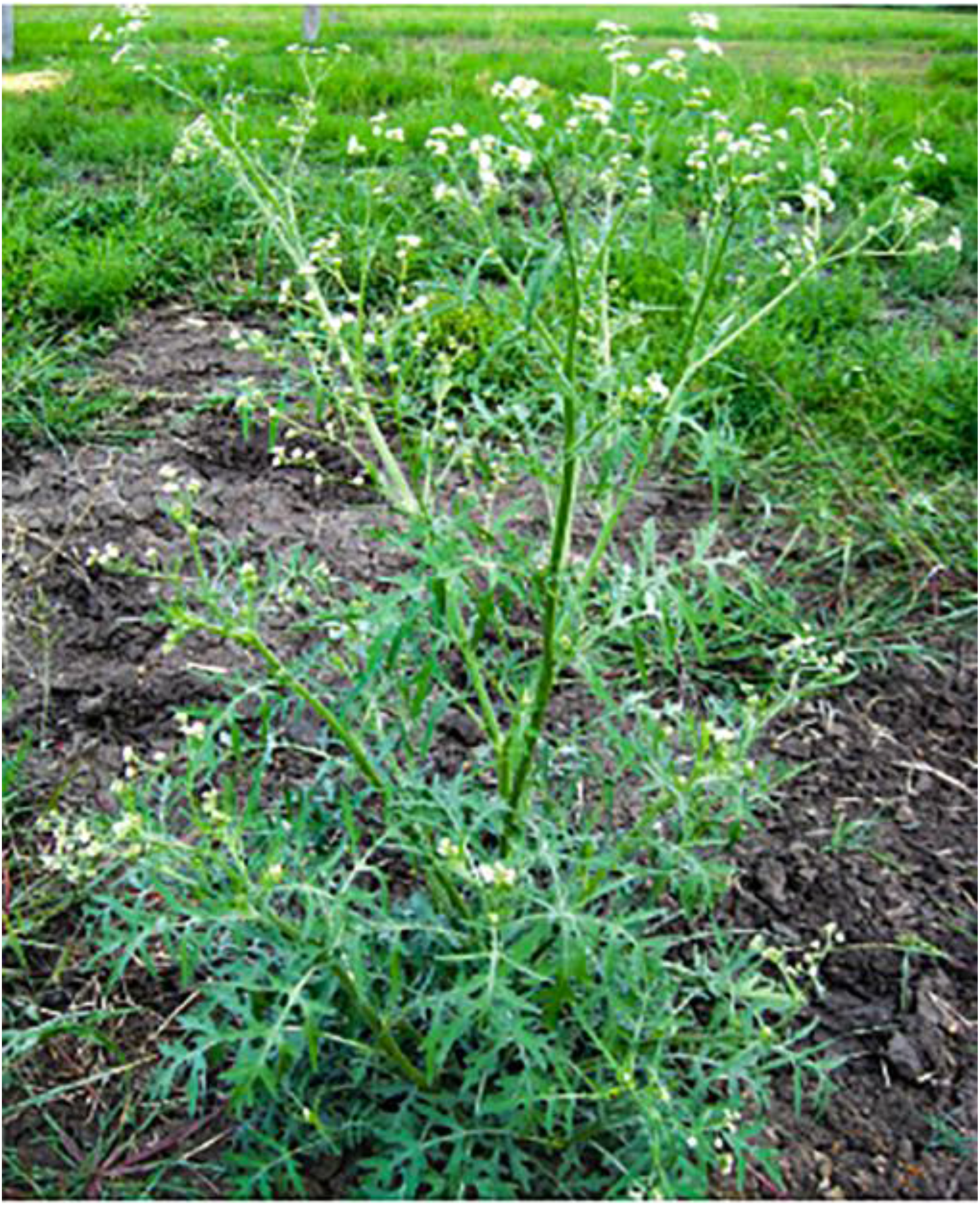
Parthenium hysterophorus plant parts collected from the Borkena River, Kombolcha, Ethiopia.
Preparation of Crude Extract (Maceration)
300 g of dried leaf powder was macerated in 1.5 L methanol (1:5 w/v) in a closed glass vessel at room temperature for 72 h with intermittent shaking. The slurry was filtered first through cotton and then through Whatman No. 1 filter paper. The combined filtrates were concentrated under reduced pressure at 40 °C using a rotary evaporator to remove methanol, yielding a dark brown crude extract (22.3 g). The crude extract was dried to constant weight in a desiccator and the extraction yield calculated as: extraction yield (%) = (mass crude extract / dry mass plant material) × 100. Extracts were stored at 4 °C until fractionation and testing.
Justification
Cold maceration with methanol is a widely used, reproducible approach for exhaustive extraction of polar to mid-polarity secondary metabolites; the 1:5 w/v ratio and 72 h extraction time are common and have been used in comparable phytochemical studies. Solvent removal under reduced pressure at ≤40 °C limits thermal degradation of labile metabolites. 21
Solvent–Solvent Partitioning (Fractionation)
The crude methanolic extract (10.0 g, subsample) was suspended in 100 mL of water–methanol (9:1, v/v) and transferred to a 250 mL separatory funnel. Partitioning was performed sequentially with solvents of increasing polarity following a modified Kupchan scheme: (i) extraction with n-hexane (3 × 100 mL) to yield a non-polar fraction, (ii) extraction of the aqueous-methanol phase with ethyl acetate (3 × 100 mL) to give a mid-polar fraction, and (iii) the remaining aqueous/methanol layer (hereafter “methanol fraction”) was concentrated to dryness. Each organic layer was combined, dried over anhydrous Na2SO4, filtered, and concentrated under reduced pressure (rotary evaporator) to yield the respective fractions. Fractional yields were calculated as: fractional yield (%) = (mass fraction / mass crude extract) × 100. Subsamples (1 g) of each dried fraction were prepared for antibacterial testing.
Rationale
Sequential liquid–liquid partitioning (Kupchan-type fractionation) is a standard, low-cost method for grouping compounds by polarity and is frequently used to prioritize fractions for biological testing. 28
Qualitative Phytochemical Screening
Phytochemical screening of the crude methanol extract and each solvent fraction (n-hexane, ethyl acetate, methanol) was performed using standard qualitative tests to detect major classes of secondary metabolites (alkaloids, flavonoids, phenolics, tannins, saponins, terpenoids, steroids, glycosides, proteins/amino acids, coumarins, quinones and carbohydrates).29,30 Tests were carried out in triplicate and interpreted as present/absent according to classical colorimetric or precipitation reactions. Representative procedures were as follows:
Alkaloids (Wagner's test): 1 mL extract + Wagner's reagent; reddish-brown precipitate indicates presence. Carbohydrates (Molisch's test): 1 mL extract + 2 drops Molisch reagent; careful addition of concentrated H₂SO₄ down the tube wall; violet ring at interface indicates positive. Phenolics/Tannins (Ferric chloride test): extract + 3–4 drops 5% FeCl3; bluish-black/green coloration indicates presence. Flavonoids (NaOH test): 1 mL extract + 2 drops 20% NaOH (yellow), decolorized by HCl indicates flavonoids. Saponins (foam test): vigorous shaking of aqueous extract; persistent froth for >10 min indicates saponins. Terpenoids (Salkowski test): extract + chloroform + concentrated H2SO4 — reddish brown interface indicates terpenoids. Glycosides/Reducing sugars (Benedict's test): hydrolyzed aliquot + Benedict's reagent; brick-red precipitate indicates reducing sugars/glycosides.
These classical assays are described in standard phytochemical methods29,30 and contemporary compilations of screening tests; they provide a rapid screen to guide targeted chemical analysis. All reagents and positive controls were run in parallel.
Microorganisms and Culture Conditions
Bacterial strains used were laboratory strains maintained at the Department of Biology, Wollo University: Staphylococcus aureus, Listeria monocytogenes (Gram-positive), Escherichia coli and Klebsiella pneumoniae (Gram-negative). Working cultures were maintained on nutrient agar and sub cultured twice before use. Prior to susceptibility testing, a fresh colony was inoculated into nutrient broth and incubated at 37 °C until mid-log phase; turbidity was adjusted to 0.5 McFarland standard for disk diffusion assays. 31
Antibacterial Activity Assays: Agar Well Diffusion
Agar-well diffusion assays were performed using a modified CLSI disk-diffusion procedure adapted for agar wells. Mueller–Hinton agar was prepared at 38 g/L according to the manufacturer's instructions, poured to a uniform depth and allowed to dry to remove surface moisture. Test lawns were prepared by swabbing the agar surface uniformly with a standardized 0.5 McFarland bacterial suspension. Sterile wells (6 mm diameter) were cut into the agar and 20 µL aliquots of each fraction solution were applied to the wells; working solutions (50, 100 and 200 mg/mL) were prepared in 10% (v/v) DMSO. A 10% DMSO served as the negative control and chloramphenicol (30 µg per disk) was used as the positive control. 32
After application, plates were held at room temperature for 30 min to allow pre-diffusion, then incubated at 37 °C for 18 h. Zone-of-inhibition diameters (mm) were measured with a digital caliper; for each organism–sample pair measurements were taken in technical triplicate and the assay was repeated on three separate days (three biological replicates; n = 3). Results are reported as mean ± standard error of the mean (SEM). To avoid solvent interference, the applied aliquot and solvent composition were chosen so that the DMSO carried onto the plate did not exceed 2% (v/v) (eg, 20 µL of a working solution prepared in 10% DMSO corresponds to 2% DMSO when considered in a 100 µL assay volume); a DMSO vehicle control was included on every plate. 33
Preparation of Test Samples and Controls
Dried crude extract and fractions were dissolved in analytical-grade DMSO to prepare 0.5 g/mL stock solutions (500 mg/mL). Working concentrations (200, 100, 50 mg/mL) were prepared by serial dilution in 10% DMSO. Chloramphenicol (30 µg disk) was used as a positive control for disk diffusion assays.
Data Analysis
Zone-of-inhibition diameters were recorded for each test sample and reported as the mean ± SEM. Measurements were obtained from three independent biological replicates, each of which was assessed in technical triplicate to ensure measurement reliability and reduce assay variability. For each organism–fraction pair, the total measurements (3 biological × 3 technical) were used to calculate descriptive statistics. Data tabulation and summary calculations were performed in Microsoft Excel (v21). Where relevant, results were compared with positive and negative controls included in each assay plate. Inferential statistical tests weren’t applied, as the study design focused on qualitative and semi-quantitative screening to prioritize fractions. 34
Quality Control, Safety and Ethical Considerations
All assays were performed using sterile technique. Waste solvents were collected and disposed of according to institutional chemical safety procedures. Because P. hysterophorus contains irritant sesquiterpene lactones (eg, parthenin), handling of fresh plant material and concentrated fractions was performed using gloves and eye protection.
Equations and Yields


Results
Extraction Yield and Sample Summary
Maceration of 300 g dried P. hysterophorus leaf powder in methanol (1.5 L) and concentration of the methanolic extract under reduced pressure produced 22.3 g of crude extract (extraction yield = 22.3/300 × 100% = 7.43% w/w). A representative subsample of the crude extract was subjected to sequential solvent–solvent partitioning (n-hexane ─> ethyl acetate ─> methanol) and the resulting dried fractions were used for phytochemical screening and antibacterial testing.
Phytochemical Screening
Qualitative phytochemical tests performed on the crude methanolic extract and each solvent fraction (n-hexane, ethyl acetate, methanol) indicated a varied distribution of major secondary-metabolite classes (Table 1). In summary:
Ubiquitous constituents: Alkaloids, flavonoids, carbohydrates and steroids were detected across all three solvent fractions (n-hexane, ethyl acetate and methanol). Polar-enriched constituents: Glycosides, quinones, terpenoids, saponins and tannins were detected primarily in the methanol fraction. Phenolics: Phenolic reactions were positive in ethyl-acetate and methanol fractions but were not detected in the n-hexane fraction under the applied qualitative tests. Proteins: No proteins were detected in the tested extracts by ninhydrin assay.
Phytochemical Screening (Present/Absent) of Crude Methanol Extract and Solvent Fractions of P. hysterophorus Leaves.

Legend: “+ = positive reaction in triplicate; – = no reaction observed.”
In Vitro Antibacterial Activity (Agar Well Diffusion Results)
The inhibition-zone data (mean ± SEM) obtained by agar diffusion are summarized in Table 2 and illustrated in Figure 2 (representative plate images).

Representative agar-diffusion plates showing inhibition zones produced by the ethyl acetate (EtOAc) fraction of Parthenium hysterophorus against two Gram-positive and two Gram-negative bacteria.
Mean ± SEM Inhibition Zones (mm) for Each Fraction and Concentration Against Test bacteria (Number of Biological Replicates n = 3).

Legends: S. aureus (ATCC 25923); E. coli (ATCC 25922); L. monocytogenes (ATCC 19111); K. pneumoniae (ATCC 13883). Chloramphenicol (30 µg disk) was used as the positive control.
Key observations from the inhibition-zone dataset:
Ethyl-acetate fraction showed the strongest activity overall. The ethyl-acetate fraction produced the largest zones against Escherichia coli (15.23 ± 0.22 mm at 100 mg/mL; 17.94 ± 0.80 mm at 200 mg/mL) and showed clear, concentration-dependent increases in zone diameter for S. aureus and E. coli. These values indicate that compounds with moderate polarity concentrated in the ethyl-acetate fraction are the principal contributors to the observed antibacterial effects. Similar findings (higher activity in ethyl-acetate fractions) have been reported in other P. hysterophorus studies.
35
Methanol fraction exhibited moderate activity, especially against Listeria monocytogenes. The methanol fraction produced an inhibition zone of 11.36 ± 0.50 mm against L. monocytogenes at 200 mg/mL; it showed negligible zones for some Gram-negative strains under the conditions used. The broader spectrum of polar metabolites in the methanol fraction (glycosides, tannins, saponins, quinones) likely explains its activity profile. Hexane fraction was largely inactive in diffusion assays. The hexane fraction produced negligible zones (6 mm, interpreted here as no activity beyond the well diameter) for most test organisms at the tested concentrations, consistent with a low content of diffusible polar antimicrobial compounds in the nonpolar fraction. Concentration dependence. For active fractions (particularly EtOAc), a clear, approximate concentration-dependent increase in inhibition zone was observed (50─>100 ─>200 mg/mL), supporting a dose–response relationship under diffusion conditions.
Discussion
Fraction-Dependent Activity and Likely Chemical Drivers
The pattern observed here as ethyl-acetate fraction > methanol fraction > hexane fraction in antibacterial potency by agar-well diffusion indicates that mid-polarity secondary metabolites (flavonoid aglycones, some phenolics, and certain terpenoids) concentrated into the ethyl-acetate partition are likely responsible for the antibacterial activity. This is consistent with other reports in which ethyl-acetate partitions of P. hysterophorus or similar Asteraceae species showed significant zones of inhibition, particularly against S. aureus and E. coli.35,36,37
Phytochemical Evidence Supports Observed Activity
These qualitative results indicate that the methanol fraction retains a broad spectrum of polar and mid-polar phytochemicals, whereas the ethyl-acetate and hexane fractions are enriched in mid-polar and nonpolar constituents, respectively. The distribution observed here is consistent with polarity-based partitioning: nonpolar terpenoids and lipophilic constituents partition into hexane, moderately polar phenolics and flavonoid aglycones into ethyl acetate, and highly polar glycosides/ tannins into methanol. 38
The detection of flavonoids, alkaloids and phenolic derivatives — chemical classes well known for antibacterial and membrane-active properties — provides a plausible chemical basis for activity. Flavonoids and phenolic acids often inhibit bacterial growth through enzyme inhibition, disruption of cell walls/membranes or interference with nucleic acid function; alkaloids can exert bacteriostatic or bactericidal effects via diverse mechanisms. 39 The methanol fraction's richer complement of glycosides and tannins may explain its moderate activity against L. monocytogenes, a Gram-positive organism often susceptible to polyphenolic compounds.
Comparison with Previously Published Work
Several previous studies have reported antimicrobial activity in P. hysterophorus extracts and have often found mid-polarity solvent fractions (ethyl acetate, chloroform, acetone) to be active. The current results—strong EtOAc activity against E. coli and appreciable methanol activity against L. monocytogenes—align with these reports, reinforcing that P. hysterophorus leaves are a promising source of antibacterial natural products warranting further chemical characterization. 35
The observation that mid-polar fractions often concentrate active phenolics and flavonoids is supported by studies showing that ethyl-acetate fractions of Muntingia calabura contains the highest total phenolic/flavonoid content and the strongest antioxidant activity, and by antibacterial screens of species such as Asystasia spp. and Acronychia pedunculata, where mid-polar (ethyl-acetate/acetone) fractions or semipolar extracts yielded notable antibacterial/ antioxidant activity.40,41,42
Mechanistic Insights into Antibacterial Action
Plant-derived phenolics and terpenoids — both abundant in Parthenium hysterophorus extracts — most plausibly act in part by compromising bacterial membrane integrity and permeability, producing rapid leakage of ions and cytoplasmic contents; this membrane-targeting behavior is widely reported for polyphenols and essential-oil terpenoids and can explain broad, concentration-dependent diffusion activity in agar assays.43,44 Flavonoids and related semipolar phenolics may additionally interact with specific intracellular targets (eg, inhibiting bacterial DNA gyrase/ topoisomerase), producing cell-cycle arrest or bacteriostasis at concentrations that penetrate the cell; several recent studies document flavonoid-mediated inhibition of DNA-supercoiling enzymes and other protein targets.45,46 Alkaloids and certain quinone-type constituents can exert antibacterial effects through multiple routes — membrane perturbation, enzyme inhibition and interference with nucleic-acid or protein synthesis — so their presence would broaden the range of feasible mechanisms and may account for organism-specific activity profiles.47,48
Other important, often complementary mechanisms include inhibition of bacterial efflux pumps (plant constituents can act as efflux-pump inhibitors and thereby potentiate antibiotic activity) and induction of intracellular oxidative stress (ROS generation), both of which have been implicated in antimicrobial activity of diverse plant extracts and can convert a bacteriostatic insult into bactericidal damage.49,50
Limitations and Future Work
This study used qualitative phytochemical screening and agar-diffusion antibacterial assays; therefore, chemical identities and quantitative potencies of active constituents remain uncharacterized. Agar-diffusion is a preliminary screen because inhibition-zone size is affected by compound diffusibility and does not provide MIC/MBC values. To confirm and quantify activity and to link bioactivity to structure, future work should include CLSI-standard broth microdilution (MIC/MBC) assays, chromatographic profiling/quantification (eg, HPLC, GC-MS) with compound isolation and structural elucidation (eg, FTIR, NMR), and cytotoxicity evaluation (eg, MTT, Trypan blue exclusion, LDH release).
To sum up, the solvent-partitioned leaf extracts of P. hysterophorus collected from the Borkena River show solvent-dependent antibacterial activity: the ethyl-acetate fraction concentrated the most potent, diffusible antibacterial components (notably against E. coli and S. aureus), while the methanol fraction displayed activity against L. monocytogenes. Qualitative phytochemical screening supports the presence of flavonoids, alkaloids and phenolic derivatives as likely contributors.
Conclusion
Solvent-partitioned leaf extracts of Parthenium hysterophorus collected from the Borkena River (Kombolcha, Ethiopia) showed solvent-dependent antibacterial activity: the ethyl-acetate fraction concentrated the most diffusible antibacterial constituents and produced the largest inhibition zones against both Gram-negative (E. coli, K. pneumoniae) and Gram-positive (S. aureus) test organisms, while the methanolic fraction exhibited notable activity against Listeria monocytogenes. Qualitative phytochemical screening detected alkaloids, flavonoids, phenolics, tannins and other secondary-metabolite classes that plausibly contribute to the observed bioactivity.
These results identify P. hysterophorus leaves as a promising, locally available source of antibacterial natural products and justify prioritizing the ethyl-acetate and methanol fractions for further investigation. However, the present data are screening-level: agar diffusion assays indicate activity and guide prioritization but do not quantify potency. Therefore, definitive evaluation requires standardized broth microdilution MIC/MBC determinations, chromatographic profiling and bioassay-guided fractionation to isolate and structurally characterize the active compound(s). Before any application, toxicological testing must be performed to flag hazardous fractions.
In summary, this study provides a reproducible, polarity-guided workflow and preliminary evidence that P. hysterophorus leaf fractions—particularly the ethyl-acetate partition—harbor antibacterial constituents worth pursuing with quantitative microbiology and modern chemical-analytical tools.
Footnotes
Acknowledgements
The authors are grateful to Wollo University for providing laboratory facilities and materials, and Amhara Public Health Institute for assisting with the antibacterial assay experiments.

Ethical Approval
No human or animal subjects were used in this study.
Consent to Participate
Not applicable.
Consent for Publication
Not applicable.
Author's Contributions
Asmerom Araya: Conceptualization, methodology design, resource acquisition, investigation, visualization. Solomon Getachew: Conceptualization, formal analysis, manuscript writing (initial draft and final), review/editing. Sisay Awoke and Yirga Adugna: Conceptualization, methodology, review/editing, and supervision. Yimer Seid, Getahun Demeke, Tewodros Mebrate and Temesgen Eshetie: Conceptualization, methodology, and review/editing. All authors have read and approved the final manuscript.
Funding
The authors received no financial support for the research, authorship, and/or publication of this article.
Declaration of Conflicting Interests
The authors declared no potential conflicts of interest with respect to the research, authorship, and/or publication of this article.
Data Availability
All data for this study are available in the manuscript.