



Abstract
Purpose
To explore the efficacy and mechanisms of Jiyin Fang (JYF) against postmenopausal coronary heart disease (CHD) complicated with osteoporosis (OP).
Methods
Firstly, collected ingredients and relative targets of JYF from TCMSP and BATMAN-TCM database, disease targets of CHD and OP from GeneCards, TTD and OMIM database. By use of protein to protein (PPI) network, Gene Ontology (GO) and Kyoto Encyclopedia of Genes and Genomes (KEGG) pathway enrichment analysis, obtained core targets and mechanism pathways. Finally, preliminarily explore the pharmacological effect and major targets partly to explain the mechanism, through experiment of ovariectomized CHD with OP model rats treated with JYF.
Results
Total of 112 ingredients and 253 related targets of JYF, 173 disease targets common to CHD and OP were screened out. PPI network indicated 9 core targets. GO and KEGG enrichment analysis showed 20 major signal pathway. Rats experiment displayed that JYF could ameliorate the structural injury of aortic arch and femur; reduce the abnormal changes of ST segment and T wave of ECG; decrease the content of BGP, OPG, ALP, CTX, IL-6 and TNFα, increase the levels of PINP in serum; inhibit P53, MAPK, NF-κB and IKK protein expression, promote PPARG protein expression of aortic arch; inhibit NRF2, AKT protein expression and up-regulate p-STAT1, MMP9 protein expression in femur.
Conclusion
JYF can achieve the purpose of anti postmenopausal CHD complicated with OP. The potential mechanism may relate to P53/MAPK/NF-κB in aortic arch, and AKT/NRF2/p-STAT1 in bone, due to IL-6 and TNFα.
Introduction
Coronary heart disease (CHD) and osteoporosis (OP) are two common diseases, especially for postmenopausal women. The World Health Statistics Report 2023 points out that cardiovascular disease has the largest number and has become the first of the four major diseases causing death in the world. 1 The incidence rate of CHD, about 10%, in postmenopausal women has increased 3-4 times before menopause. Postmenopausal CHD is the primary cause of death in women. 2 A previous study indicated that more than a half of postmenopausal White women would suffer an osteoporotic-associated fracture, and osteoporotic-related fractures have brought a severe burden on women and healthcare services. 3 Globally, OP affecting 200 million women worldwide, 4 more common than stroke, myocardial infarction, and cancer combined. It is a silent disease usually has no symptoms before the first fracture occurs, 5 however, suddenly changes people's lives and poses a significant threat to personal independence, causing disability, and even death. 6 CHD and OP are often observed in the same postmenopausal women. The incidence of CHD in 40–75 years old OP patients was 14.8%. 7 In a study of nearly 2000 postmenopausal women, 38.25% of coronary artery disease patients also had OP. 8 Postmenopausal women diagnosed with OP have a 47% increased likelihood of developing coronary vascular diseases when compared to those women without. 9 Postmenopausal CHD and OP have been leading to an increasing burden and have become important public health issues. If CHD and OP can be treated simultaneously, it will be twice the result with half the effort.
The link between cardiovascular disease and OP is due to estrogen deficiency in women. Hormone therapy as the primary prevention of chronic conditions in postmenopausal women is associated with some beneficial effects but also with a substantial in crease of risks for harms, such as thromboembolic disease, stroke and breast cancer, which had limited its use. Statins, in addition to inhibiting cholesterol synthesis and anti-inflammatory effects to reduce atherosclerosis and vascular risk, also act on bone, increasing osteoblast differentiation and bone formation from scientific research but little clinical effects. However hepatotoxicity and rhabdomyolysis have been the recognized adverse effects of statins.10,11 Bisphosphonates are the most effective inhibitors of bone resorption, and are widely used for treatment and prevention of OP. One long-term trial of Bisphosphonates evidenced significant gain of bone mineral density and vertebral fracture risk reduction, 12 but no effect on cardiovascular events. 13
In contrast, Chinese medicine, due to its multi-target characteristics has certain advantages in this regards, with less adverse reactions. CHD and OP are long-term symptoms of Postmenopausal syndrome (PMS), and PMS patients often have CHD and OP. In clinical practice, after taking Jiyin Fang (JYF) to treat PMS, typical symptoms of CHD and OP such as chest tightness, chest pain, and bone pain were relieved, demonstrating the curative effect on postmenopausal CHD and OP. JYF is composed by Rehmannia glutinosa (SDH), Epimrdii Herba (YYH), Salviae Miltiorrhiza (DS), Cyperi Rhizoma (XF), Phellodendri Chinrnsis Cortex (HB). Results from preliminary research indicate that JYF has the effects of regulating menopause, calming mind, improving serum estradiol content, inhibiting ovarian ovary cell apoptosis and blood lipids (TC, TG); relief aortic arch vascular injury through GPR30/NF-κB/VEGF signaling pathway in female ovariectomized CHD rats.14–17 According to the current clinical application, Chinese Pharmacopoeia 2020 records and pharmacological research, it is reasonable to infer that JYF has a curative effect on postmenopausal CHD complicated with OP, but the mechanism is not yet clear. Therefore, we conducted this study to explore the efficacy and mechanisms of JYF against CHD complicated with OP.
Traditionally, the understanding of CHD and OP are two independent diseases with completely different medication concept and treatment, with few links. Regarding treatment, hormone replacement therapy is recognized as having therapeutic effects on both, but has definite side effects and is not recommended as the first choice of clinical treatment. Although few drugs have been shown both effects in laboratory, but clinical efficacy is unsatisfactory. This study used one prescription to treat both CHD and OP at the same time, showing the innovation of ideas and methods. In addition, JYF is a prescription for the treatment of PMS; however, we put it into the treatment of postmenopausal CHD complicated with OP, which shows the innovation of idea. The confirmation of JYF efficacy on postmenopausal CHD and OP is expected to make up previous studies, benefit women, and great important.
Methods
Network Pharmacology
Ingredients and Targets of JYF
Search on TCMSP (https://tcmsp-e.com/TCMSP)website with Salvia miltiorrhiza Rehmannia glutinosa (SDH), Epimrdii Herba (YYH), Salviae Miltiorrhiza (DS), Cyperi Rhizoma (XF), Phellodendri Chinrnsis Cortex (HB)as key words respectively, based on the criteria of oral bioavailability (OB) ≥ 30% and drug-likeness (DL) ≥ .18. TCMSP do not record SDH, so we got the ingredients and relative targets of YYH, DS, XF and HB. For SDH, we collected from BATMAN-TCM database (http://bionet.ncpsb.org.cn/BATMAN-TCM/) with Score cutoff > .99 (LR = 1626), P < .05.
Disease Targets of CHD and OP
Respectively screened CHD and OP in GeneCards (https://www.genecards.org/), TTD (https://db.idrblab.net/ttd/), and OMIM (https://www.omim.org/) to collect disease targets, with the criteria of score > 0, standardized by Uniprot database.
Venn Diagram and PPI Network Construction
Matched targets of JYF with disease targets above to carry out the Venn diagram and obtain the common disease targets of CHD and OP, the common targets of JYF and diseases. Inputted 5 drugs (SDH, YYH, DS, XF, HB), their ingredients and common targets of JYF and diseases into cytoscape3.8.2 software to construct the network of “Drug- Ingredient-Disease targets”.
Entered common targets of JYF and diseases into String (https://string-db.org/) database, with the species limited to “Homo sapiens” and a confidence score >.7 for protein to protein interaction (PPI) prediction. The obtained data file was used to draw PPI network by cytoscape3.8.2 software with topology analysis (degree > 7). The processes were Cytoscape→Tools→Networkanalyzer→Networkanalysis→ Analyzen- etwork.
GO and KEGG Pathway Enrichment Analysis
Applied DAVID database to carry out GO and KEGG pathway enrichment analysis. P value <.01 was considered to identify the enriched terms. DAVID6.8GO gene function was used to annotate the role of JYF from three aspects of Biological processes (BP), cell components (CC) and molecular functions (MF) on CHD with OP. The KEGG pathway enrichment analysis was utilized to predict signaling pathway.
Animal Experiment
Animal experiments were carried out under the approval and guidance of Animal core & welfare committee of Liaoning University of Traditional Chinese Medicine.
Study Design
45 adult female Sprague-Dawley rats, SPF grade, body weight (190 ± 10) g, were purchased from Liaoning Changsheng biotechnology Co., Ltd, animal certificate No.: SCXK (Liao) 2015-0001. All rats were housed in standard husbandry conditions: indoor temperature 20–25 °C, humidity 40–50%, 12-h photoperiod and free access to food and water, for 8 weeks.
After 2 days of adaptive feeding, all rats were anesthetized by intraperitoneally injection of 10% Chloral hydrate (.35 ml/100 g) to record ECG for 1 min (V1), than randomly divided into control group (CG), model group (MG), treatment group (JG), with 15 rats in each group, according to their body weight. The interventions were as following:
Rats were feed without any additional treatment.
(untreated postmenopausal CHD complicated with OP) Rats were anesthetized to remove both ovaries with anti-inflammatory process (100,000 U of penicillin was injected intraperitoneally for 3 days to prevent infection) after the operation. 2 days after ovariectomy, vaginal discharge smear was taken once a day for 5 consecutive days to detect estrous cycle. Rats without estrous cycle were raised with high-fat diet, and subcutaneously injected 1.5 ml/(kg•d) of adrenaline hydrochloride injection into the same area for 5 consecutive days/w. Continuous modeling for 8 weeks.18,19
(JYF treated) Rats underwent the same steps as MG above, with JYF treated [7.8 g decoction piece/ (kg•d)].
Briefly, JYF was prepared as follows: Rehmannia glutinosa, Epimrdii Herba, Salviae Miltiorrhiza, Cyperi Rhizoma, Phellodendri Chinrnsis Cortex granule mixed in water, which were produced by Tianjiang Pharmaceutical Co., Ld
Sampling
After an overnight fast, rats were anesthetized by intraperitoneal injection of Chloral hydrate. 1 min ECG (V2) was recorded, than blood samples were collected from the abdominal aortic arch to test serum content of BGP, OPG, PINP, CTX, IL-6 and TNFα by Elisa testing. Latter, open the thorax, cut 3 cm of blood vessels from the initial segment of the Aortic arch, washed it with cool physiological saline, 5 stored at −80 °Cfor protein test of NF-κB and IKK by Western Blot, 10 fixed with 4% formaldehyde for histomorphological observation by hematoxylin-eosin (HE) staining and protein test of P53, MAPK, PPARG by immunohistochemical (IHC) method.
Meanwhile, cut off 1/3 of the proximal end of the right femoral head, fixed with 4% formaldehyde for histomorphological observation by HE staining and protein test of p-STAT1, MMP9, NRF2, AKT by mIHC.
Statistical Methods
Statistical analysis was performed by IBM SPSS Statistics 19.0. Data were represented as the mean ± standard deviation
Results
Prediction of Core Targets and Signaling Pathway of JYF Against Both CHD and OP
Prediction of Targets
There were 112 ingredients and 253 targets of JYF. The target numbers of CHD and OP were 9071 and 5307 respectively. After processing, 2804 disease targets of CHD with OP were identified. 173 targets of JYF against CHD with OP were obtained (Figure 1). On the network of “Drug-Ingredient-Disease targets” (Figure 2), there were 290 notes and 1434 edges. PPI network diagram (Figure 3) included 109 notes and 2808 edges. According to degree resulting from topology analysis, we identified top 10 targets (degree > 50) as core targets: IL6、AKT1、TP53、STAT3、EGFR、TNF、IL1B、JUN、CASP3、NFKB1.

Venn diagram.

Drug-Ingredient-Disease targets. All nods were visualized in degree value, the larger the node, the darker the color indicate the greater importance of treating diseases. In this network, the red diamond represents five herbs composing JYF, circle represents ingredients, and square represents disease targets of JYF against both CHD and OP.
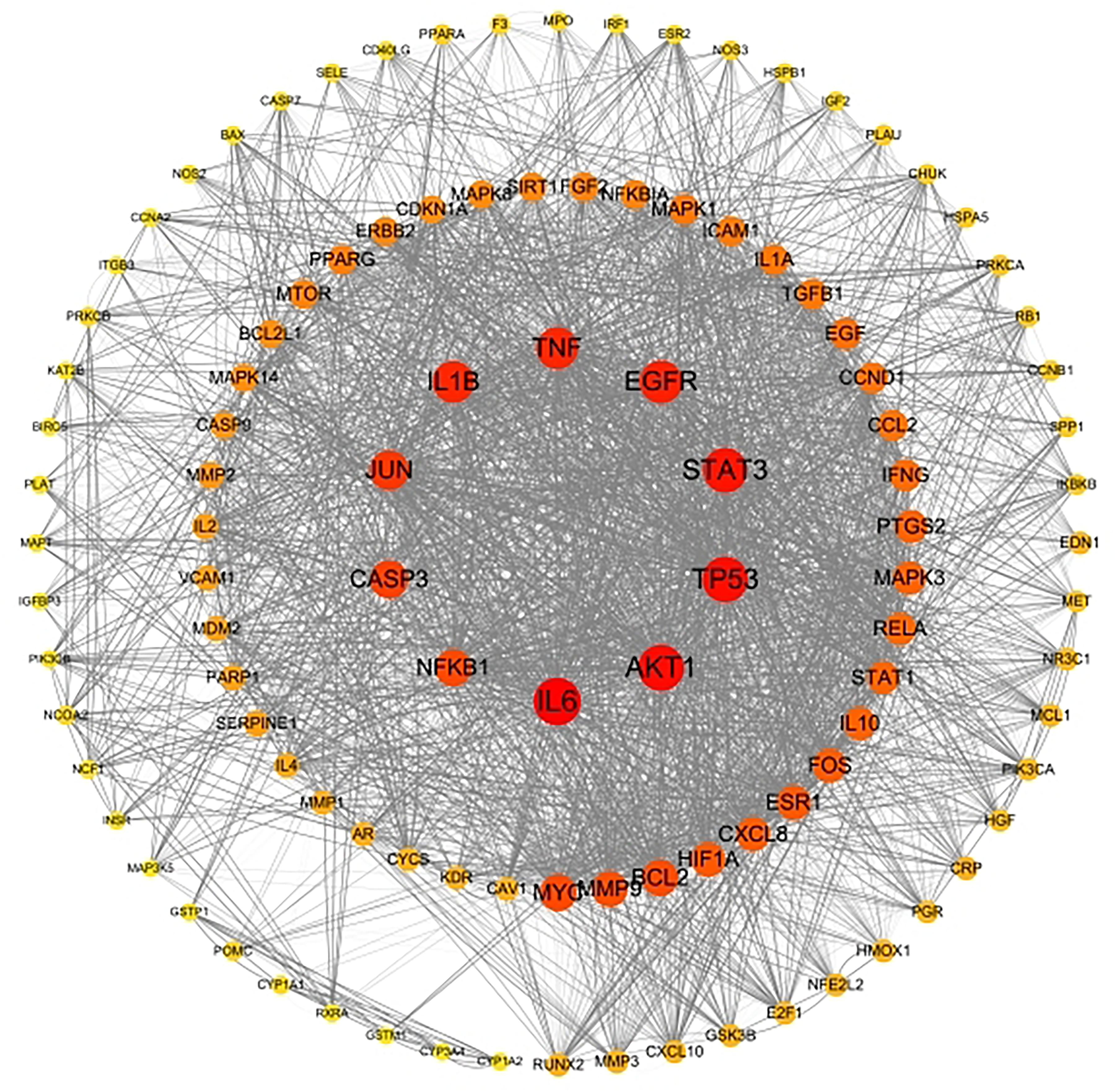
Protein-Protein Interaction (PPI) network diagram. All nods were visualized in degree value. The larger the node, the redder the color, the higher degree value is.
Prediction of Signaling Pathway
A total of 474 items for BP, 45 items for CC and 82 items for MF were enriched through GO function enrichment analysis. The top 10 items of enriched respectively were listed on Figure 4.

Go enrichment analysis. X-axis represents gene ratio. Y-axis represents the name of biological processes.
The KEGG pathway enrichment analysis screened out a total of 154 signaling pathways related to the curative effect of JYF against CHD with OP. Considering P value and count, top 20 signaling pathway were listed on Figure 5.

KEGG pathway enrichment dot-plot diagram, the top 20 signaling pathway regulated by JYF. X-axis represents enrichment. Y-axis represents enriched pathways. The size of the dots indicates the number of target genes in a certain pathway, and the colors reflect the values of p.adjust, from green to red.
Animal Experiment
Vascular Structure
As Figure 6 showed, the vascular endothelium of aortic arch in CG was smooth, without proliferation, and the endothelial cells were arranged neatly. In MG, the vascular structure was severely damaged, and the cells were arranged irregularly with many edema cells; the elastic plates were broken or intertwined; local cells were shed or missing, with foam cells inside, even plaques appeared. The vascular structure of the JG was nearly normal, with missing endothelial cells and a basic arrangement of cells in a strip shape.

Aortic arch by H&E staining. Scale bars: 100 μm.
Bone Structure
Figure 7 demonstrated that the bone trabeculae of the rats in CG were intact, tightly connected, and regularly arranged, forming a network with each other, and the bone marrow cavity was small. In MG, bone trabeculae were disordered, thinner, sparser, and less connected, with visible broken ends. In the JG, the number of connected trabecular increased, the bone marrow cavity became smaller, and the trabeculae were arranged neatly and more robust, compared with MG rats.

Photomicrograph of femoral head by H&E staining. Scale bars: 200 μm.
ECG Changes of ST Segment and T Wave
Obtain the change value by subtracting V1 from V2.
Compared with CG, there was significant difference in MG, with ST segment depression and T wave inversion (P < .01). In JG, the abnormal changes of ST segment and T wave depression (P < .05) returned, compared with MG (Table 1).
Changes of ECG (

Note: compared with MG *P < .05, **P < .01.
Serum biochemical marker
As shown (Figure 8), there was a significant increase in the mean values of serum BGP, OPG, CTX-1, IL-6 and TNFα (P < .01), while reduce a value of serum PINP in the MG, compared with their corresponding values in CG; In JG, the serum content of BGP, OPG, CTX-1, IL-6, TNFα (P < .01) was reduced, serum PINP value was increased (P < .05), compared with MG.

Serum content of BGP, OPG, PINP, CTX, IL6, TNFα (
Expression of P53, MAPK, PPARG Protein in Aortic Arch
In MG, the results reported a significant higher expression of P53, MAPK protein (P < .01), while lower expression of PPARG protein, compared with CG (P < .01). JG returned the abnormal expression of those proteins above, as Figure 9 showed.

Expression of P53, MAPK, PPARG protein of aortic arch. Scale bars: 20 μm. Note: compared with MG *P < .05, **P < .01.
Expression of NF-κB and IKK Protein in Aortic Arch
The expression of NF-κB and IKK protein of MG was excessive than those of the CG and JG (P < .01). There was a down regulation after the treatment of JYF, compared with MG (P < .01), as Figure 10 showed.

Expression of NF-κB and IKK protein in aortic arch. Note: compared with MG **P < .01.
Expression of NRF2, AKT, p-STAT1, MMP9 Protein in Femur
To export the mechanisms of JYF against OP, we test the production of NRF2, AKT, p-STAT1, MMP9 protein in femur. The results indicate that the level of NRF2, AKT in JG was higher than in the MG (Figure 11). JYF inhibited the production of p-STAT1 and MMP9 protein in femur (Figure 12).
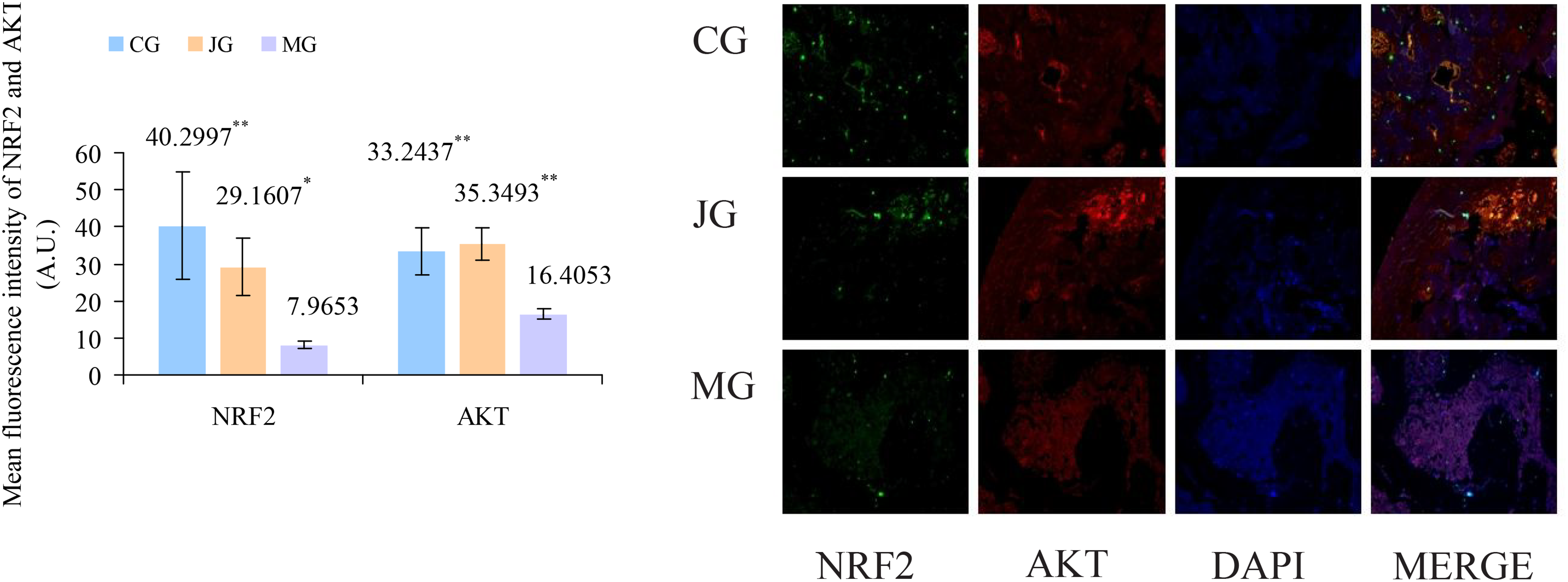
Expression of NRF2, AKT protein in femur (×200). Note: compared with MG *P < .05, **P < .01.

Expression of p-STATE1, MMP9 protein in femur (×200). Note: compared with MG *P < .05, **P < .01.
Discussion
Estrogen has protective effect on cardiovascular, and can reduce the incidence and mortality of CHD, symbolized on the effect on vascular wall, relaxes coronary artery for improving cardiac blood flow, affects lipid vascular wall deposition, coagulation system, antioxidant system, inflammatory factors, participates in vascular calcification, stabilizes tight junction of vascular endothelium for regulating endothelial permeability. In bone tissue, estrogen is the main bone resorption inhibitor, which can directly inhibit the function and activity of osteoclasts. Estrogen can also directly stimulate the activity of osteoblasts, promote the proliferation and differentiation of osteoblasts and the formation of collagen tissue, increase bone matrix synthesis, and promote bone formation. When estrogen levels decrease, OP happens, due to bone resorption exceeds bone formation. Therefore, estrogen decline after ovariectomy can induce postmenopausal CHD complicated with OP.
Structure of aortic arch and bone are the most intuitive pathological reaction of disease. Changes in ST segment and T wave of ECG can judge whether the heart is normal or not, which is a necessary factor for early diagnosis of CHD. Bone Gla protein (BGP), osteoprotegerin (OPG), procollagen I N-terminal propeptide (PINP), C-terminal cross-linked telopeptide of typeⅠcollagen (CTX-1) are often used as markers of bone formation and resorption, which are important for detecting OP. 20 After bilateral ovariectomy, the rats without estrus were considered to have menopause. ST segment and T wave low and flat of ECG suggested myocardial ischemia. Additionally, the aortic structure changes with foam cells and plaques corresponded to the characteristics of CHD. At the same time, there were changes on bone related biomarkers BGP, OPG, CTX-1, and PINP in serum. Bone trabeculae were disordered, thinner, sparser, and less connected, with visible broken ends, which can be considered as OP. So that, we can determine the success of postmenopausal CHD combined with OP modeling.
The results of JG displayed that, compared with MG, JYF can relieve the structure damage of aortic arch and femur; reduce the abnormal changes of ST segment and T wave of ECG; regulate the content of bone biomarkers BGP, OPG, ALP, CTX and PINP in serum. Those provided the evidence that JYF has therapeutic effect on postmenopausal CHD complicated with OP. For exploring mechanisms, we utilized the method of network pharmacology to collect data from databases, predict the targets and potential pathways for treating postmenopausal CHD and OP by JYF, and verify through animal experiments.
Network pharmacology enables pharmacodynamic predictions based on patterns of interactions between drugs and potential targets, and helps identify drug targets, especially in complex diseases involving synergy of multiple targets. Network pharmacology analysis showed that JYF has 173 targets associated with both CHD and OP. PPI provided IL6、AKT1、TP53、STAT3、EGFR、TNF、IL1B、JUN、CASP3、NFKB1 as top 10, according to degree. Results from GO enrichment analysis, about the JYF mechanism told us the gene expression, cell proliferation, apoptotic process, protein phosphorylation deserve attention, those occur in nucleus, cytosol cytoplasm and membrane, involving protein, enzyme, DNA and ATP. Totally 154 KEGG pathways were enriched in this study. Considering P value and count, significant pathways relate to JYF pharmacological effects involved lipid metabolism, inflammatory process and apoptosis, like lipid and atherosclerosis, apoptosis, TNF signaling pathway, PI3K-AKT signaling pathway, which can influence each other. Combined with PPI analysis, this time we looked at the core targets of P53, MAPK, NF-κB, IKK, PPARG, NRF2, AKT, p-STAT1, MMP9, because the lipid metabolism effect has been examined earlier.
TNF and IL-6 are two important cytokines that play key roles in immune response and inflammatory processes. These cytokines trigger a series of signaling events by binding to specific receptors on cell membranes. IL-6 and TNFα levels increase in postmenopausal women, and both are potent stimulators of bone resorption, 21 osteoclast proliferation and differentiation,22,23 have close association with the severity of atherosclerosis. 24
TNF mainly binds to TNF receptors on cell membranes, and then activates IKK kinase, resulting in phosphorylation and degradation of IkB protein, thus enabling NF-κB dimer to be released and enter the cell nucleus to promote transcription of related genes. This process involves not only activation of NF-κB signaling pathway, but also inflammation, cell growth and apoptosis, etc TNF can also activate MAPK signaling pathway downstream by binding to TNFR1 on cell surface. By binding to specific receptors on cell membranes, IL-6 activates the JAK-STAT pathway, a pathway that interacts with MAPK and NF-κB signaling pathways; ultimately affect MAPK and NF-κB activity, although this process may involve multiple signal transduction steps and cross-talk mechanisms. Activated NF-κB signaling could regulate the gene transcription of adhesion molecules and inflammatory-associated factors, causing endothelial damage, especially vascular cell adhesion molecule-1 (VCAM-1) and IL-6. VCAM-1 could decrease NO activity, and adhere to damaged endothelial cells, which induce platelet activation and adhesion, 25 causing vascular plaque. Activated MAPK induces the expression of proinflammatory effector molecules. 26 Various functions of MAPK have been identified, including up regulation of the cell adhesion molecules E-selectin and VCAM-1 and the chemokinemonocyte chemoattr-actant protein-1 (MCP-1), all involved in pro-inflammatory signaling and local recruitment of immune cells. MAPK has also been shown to be involved in regulation of endothelial cell permeability. 27 The described functions of MAPK in endothelial cells are associated with CHD development and progression, or might even represent drivers. In additionally, it has been found that activation of MAPK signaling pathway can activate NF-κB, cause nuclear transport, thus mediating inflammatory response. 28 P53 mediates stimulation of proinflammatory cytokine secretion, involving promoting NF-κB activation induced by TNF, thereby, participates in inflammation. 29 In the wtp53 cell-context, activated MAPK phosphorylates directly wtp53, contributing to its activation, and stabilize p21 mRNA orchestrating growth arrest or apoptosis. 30 IL-6 can affect the expression and function of P53 through activating STAT3 signaling pathway. PPARG is able to enhance insulin sensitivity, promotes adipogenesis, and exerts anti-inflammatory and anti-atherosclerotic effects. 31 Recent study indicated that PPARG is involved in anti-inflammatory function through inhibiting MAPK/NF-κB pathway. 32 Up regulation of PPARG led to inactivation of NF-κB and MAPK directly, thereby reducing inflammation and inhibiting cell death processes, protecting endothelial cells from injury. Thus, an inflammatory amplification network, P53/MAPK/NF-κB, is formed, interacted with TNF and IL-6 and PPARG negative regulation in blood vessel. We confirmed that JYF can down regulate excessive expression of P53, MAPK, NF-κB and IKK in aortic arch, up regulate PPARG expression, so that protect from CHD due to recover vascular structure and function on CHD rats.
At the same time, TNF activates Akt signaling pathway by binding to TNFR2 (tumor necrosis factor receptor 2). IL-6 initiates Akt protein by activating PI3 kinase (PI3K), produces PI3-phospholipase diketone (PIP3), as a major pathway relate to pharmacological effects of JYF. AKT stimulation and regulate the proliferation, differentiation and apoptosis of osteoblasts. 33 Also, AKT can activate the expression of downstream protein NRF2 through its own phosphorylation, 34 thereby promoting antioxidant enzymes, and protecting osteoblasts from oxidative stress induced injury.
STAT1 is an important protein that links signal transduction between cell membrane receptors and effectors, a key factor in regulating senescence of osteoblast. STAT1 in cytoplasm can be phosphorylated and polymerized to form homo-or heterodimers under the stimulation of extracellular signals, and then enter the nucleus to promote the transcription of target genes. AKT regulates STAT1 activity by phosphorylating it. p-STAT1 induces cell cycle arrest 35 and promote macrophages differented into osteoclasts, leading to bone destruction. 36 MMP9 proposed that the metalloproteinase traffics to the nuclear compartment where it cleaves histione HSK 18-Q19, thereby promoting osteoclastogenic gene activation. 37 MMP9 inhibits the resorptive activity of mouse osteoclasts in vitro and in vivo and human osteoclasts in vitro. In vivo, Mmp9/Mmp14 conditional double-knockout mice exhibited marked increases in bone density and displayed a highly protected status against ovariectomy-induced pathologic bone loss. 38 It is worth noting that regulation of MMP9 is associated with multi-genes. p-STAT1 directly affects MMP-9 expression through its expression level, with positive correlation. 39 NRF2 regulates MMP-9 expression by activating its downstream Keap1/Nrf2 pathway, and can also be activated by AKT. Our study exhibits that after JYF administration, expression of AKT and NRF2 up regulated with opposite regulation of p-STAT1, MMP9 on OP femur. In this study, we confirmed that JYF can down regulate excessive expression of P53, MAPK, NF-κB and IKK in aortic arch, up regulate PPARG expression, so that protect from CHD due to recover vascular structure and function on CHD rats. And than, our study exhibits that after JYF administration, expression of AKT and NRF2 up regulated with opposite regulation of p-STAT1, MMP9 on OP femur.
In clinical practice, after taking JYF to treat PMS, typical symptoms of CHD and OP such as chest tightness, chest pain, and bone pain were relieved, demonstrating the curative effect on postmenopausal CHD and OP, but insufficient evidence, the mechanism not yet clear. Therefore, we conducted this study. The results preliminary confirmed the efficacy and mechanism of JYF in treating postmenopausal CHD and OP. JYF has good application prospects. In future research, attention will be paid to collecting clinical data and improving experimental studies as candidate varieties for new drugs, to compensate for the current lack of drugs that can simultaneously treat postmenopausal CHD and OP.
This study has potential limitations and still needs further improvement. Firstly, considering that the initiating link of CHD is endothelial injury, research on the mechanism of anti postmenopausal CHD focuses on the protective effect on the aortic arch, but there are deficiencies in myocardial injury. In terms of evaluating OP, bone density/CT testing was not conducted, but HE and biomarkers were mainly used for explanation, which may not direct enough. Meanwhile, the study only conducted animal experiments and did not conduct cell co culture experiments for reconfirmation. The aim of this study is to preliminarily determine the effect and mechanism of JYF anti postmenopausal CHD complicated with OP. The myocardium and cell experiments for mechanism verification are currently underway.
Conclusions
In conclusion, JYF was effective in treating Postmenopausal CHD complicated with OP. The potential mechanism may relate to P53/MAPK/NF-κB in aortic arch and AKT/NRF2/p-STAT1 in bone, due to IL-6 and TNFα.
Footnotes
Acknowledge
The authors acknowledge the assistance of pharmacology department and animal experimental Center, Liaoning Academy of Traditional Chinese Medicine (The Second Hospital Affiliated to Liaoning University of Traditional Chinese Medicine).
Declaration of Conflicting Interests
The authors declared no potential conflicts of interest with respect to the research, authorship, and/or publication of this article.
Ethical Approval
This study was approved by Animal Care & Welfare Committee of Liaoning University of Traditional Chinese Medicine, Liaoning Province, China. Ethical approval number is 21000092019032
Funding
The authors disclosed receipt of the following financial support for the research, authorship, and/or publication of this article: Liaoning Provincial Natural Science Foundation: Effect and Mechanism of Jiyin Granule on Female Coronary Heart Disease Based on NF-κB Pathway (grant number .20180540141); Liaoning Provincial Science and Technology Plan Joint Plan (Fund): Exploring the Protective Effect and Mechanism of Jiyin Fang Granule on Myocardium of Menopausal Coronary Heart Disease caused by Ferroptosis on E2/P53/SLC7A11 Axis (grant number 2023-MSLH-150)

Statement of Human and Animal Rights
All of the experimental procedures involving animals were conducted in accordance with the Institutional Animal Care guidelines of Liaoning University of Traditional Chinese Medicine, China and approved by the Animal Care & Welfare Committee of Liaoning University of Traditional Chinese Medicine, Liaoning Province, China.
Informed Consent
There are no human subjects in this article and informed consent is not applicable.