



Abstract
Background
Justicia insularis (Acanthaceae) T. Anderson is ethnopharmacologically used in Nigeria for the treatment of diseases including malaria. Therefore, this study was designed to investigate in vivo antiplasmodial effect of J. insularis leaf in Plasmodium berghei-infected mice, characterize its constituents, and carryout in silico studies of its compounds.
Methods
Standard protocols were followed in the processing of the plant leaves, extraction, fractionation, isolation, and characterization, evaluation of in vivo antiplasmodial assay, retrieval of Plasmodium falciparum serine hydroxymethyl transferase (PfSHMT) and Plasmodium falciparum erythrocyte membrane protein 1 (PfEMP-1) proteins, absorption, distribution, metabolism, excretion, and toxicity (ADMET), and docking studies. Gas chromatography-mass spectrometry (GC-MS) was employed to isolate and characterize the compounds; SWISSADME and ADMET lab 2 enhanced the evaluation of pharmacokinetic properties, PyRx for docking analysis; Biovia discovery studio for 2D visualization, and PyMol software for 3D visualization of the ligand-protein interactions.
Results
The dichloromethane (61.59%) and ethyl acetate (73.15%) fractions had the best therapeutic indices and compared favorably with chloroquine (81.58%) in the curative antiplasmodial assay. The GC-MS analysis revealed 20 already reported antiplasmodial compounds with hexanoic acid 1,1-dimethylethyl ester, octadecanoic acid docosyl ester, and trans-β-ocimene as the lead compounds based on their binding affinities, permeation of the blood-brain-barrier, non-inhibition of metabolizing enzymes, ease of excretion, non-carcinogenicity, as well as non-violation of Lipinski's criteria.
Conclusion
Octadecanoic acid docosyl ester and hexanoic acid 1,1-dimethylethyl ester bonded the tetrahydrofolate-binding sites of PfSHMT, caused inhibition of DNA synthesis, and apoptosis, whereas trans-β-ocimene inhibited PfEMP-1, reversed the attachment of parasitized red blood cells to micro-vascular endothelium as their mechanism of action for parasitemia clearance. Moreover, these lead compounds reported for the first time in the dichloromethane and EtoAc fractions of this plant are responsible for the remarkable antiplasmodial activity observed in this study.
Introduction
Malaria is a potentially fatal disease caused by Plasmodium falciparum abbreviated P. falciparum. 1 In 2019, the estimated global malaria prevalence was 229 million cases with mortality rate of 409,000 persons, predominantly, young children in sub-Saharan Africa. 2 Nigeria had the highest number of global malaria prevalence (25% of global malaria prevalence) and accounted for the highest number of mortality (24% of global malaria mortality).3,4 More so, a study revealed resistant strains of P. falciparum to common antimalarial chemotherapies, 5 necessitating the development of novel antimalarial medications. So, diverse protein targets and pathways have been studied for the unraveling of novel medicines; however, others are still under clinical trials. 6 Therefore, the screening of many chemical libraries against protein targets is necessary in the investigation of antimalarial targets from novel pathways unrelated to drug resistance. 7
Moreover, P. falciparum known to enhance serious malaria pathogenesis 8 could invade red blood cell (RBC) and liver cells of people; however, it is believed that P. falciparum erythrocyte membrane protein 1 (PfEMP-1) binds to the endothelial cell receptors CD-36, thrombospondin, and intercellular adhesion molecule 1, and exists a receptor related to malaria that mediates attachment of parasitized red blood cells (pRBCs) to micro-vascular endothelium. The specific binding point on PfEMP-1 and corresponding receptors on the host cells could potentially serve as targets for creating substances aimed at reversing the binding of pRBCs, thereby, stopping the blockage of micro-vessels and offering a promising approach for treating malaria.8,9
Also, P. falciparum serine hydroxymethyl transferase (PfSHMT), a pyridoxal-5′-phosphate-dependent enzyme is known to catalyze the reversible conversion of serine and tetrahydrofolate (THF) through the α-elimination and replacement mechanism in order to yield glycine and 5,10-methylenetetrahydrofolate (CH2-THF).
10
It is a part of the deoxythymidylate (dTMP) synthesis cycle where dTMP (a nucleotide precursor for DNA synthesis) is biosynthesized, and the oxidized folate compounds thus generated are recycled by a synchronizing cooperation of PfSHMT and the other two enzymes in the cycle: dihydrofolate reductase (DHFR) and thymidylate synthase (TS).
10
At present, drugs targeting TS and DHFR in malaria parasites and cancer cells have been compromised due to target mutation
11
; therefore, alternative drugs that have new enzyme targets are urgently needed. PfSHMT has gained increasing attention as a new potential antimalarial and anticancer drug target.
11
Although several inhibitors of cytosolic PfSHMT have been reported,
12
attempts to search for new effective compounds have continued to reduce drug resistance challenges. The effective compounds are proposed to compete with THF and
It is worthy of note that the most effective antimalarial medications have been derived from natural sources throughout the history of malaria chemotherapy; 7 conversely, Asanga et al 14 corroborated that the tropical forests in Nigeria are vested with many medicinal plants; so, robust researches and implementation of research findings, the isolation and characterization of bioactive compounds in these plants, as well as the integration of orthodox and traditional medicine could drastically boost health care delivery in Nigeria. One of these medicinal plants with reported ethnopharmacological relevance as well as its natural products with reported pharmacological activities is Justicia insularis abbreviated J. insularis.
J. insularis T. Anderson (Acanthaceae family) is a vegetable used for both nutritional and medicinal purposes, such as digestive, weaning agent, malaria remedy, and laxative. 15 The leaf extract of the plant has been reported to enhance ovarian folliculogenesis and fertility in female rats, 16 antioxidant, 17 and antianemic 18 activities. Compounds such as clerodane diterpenoids (16(α/β)-hydroxy-cleroda-3,13 (14)Z-dien-15,16-olide and 2,16-oxo-cleroda-3,13(14)E-dien-15-oic acid) have been isolated and characterized from the plant's leaf extract. 19
In addition, despite the management of malaria with traditional medicine and chemotherapies, the validation of the mode of action of the lead compounds is a serious concern. So, the discovery of therapeutics has been a serious concern on how ligands are docked with their receptors 8 ; therefore, the initial phase of drug discovery and development involves lead identification. During this process, chemical compounds are challenged to interact with their protein targets to alter their functions. In order to be effective against some target proteins like PfSHMT and PfEMP-1; lead compounds should ideally exhibit some degree of precision and potency. Hence, this study was geared towards the validation of the antiplasmodial potentials of J. Insularis leaves, isolation and characterization of its bioactive compounds using gas chromatography-mass spectrometry (GC-MS), as well as the in silico prediction of its ligands against PfSHMT and PfEMP-1 proteins.
Results and Discussion
Results
The Antiplasmodial Activities of the Extract and Fractions of J. insularis Leaves
The leaf extract and its fractions exerted dose-dependent reductions in parasitaemia of the treated mice in the suppressive antiplasmodial assay. From Table 1, the parasitemia reduction was only statistically significant (P < 0.01) at the highest dose when compared to the control; however, the chemosuppression of the parasites and mean survival time (MST) for EtoAc fraction (64.21% and 27.00 days) was higher than dichloromethane (DCM) fraction (51.04% and 22.33 days) but favorably comparable to chloroquine (72.65% and 29.50 days). Also, from Table 2, the parasitemia reductions in the repository antiplasmodial assay were statistically significant (P < 0.01-0.001) relative to the control at higher doses of the extract (300 and 450 mg/kg) body weight of mice. Here, the chemosuppression of the parasites and MST for pyrimethamine (81.82% and 29.00 days) was better than the extract (450 mg/kg) (38.48% and 19.00 days) and EtoAc fraction (26.56% and 18.33 days), respectively. Moreover, Table 3 revealed the result for the schizonticidal antiplasmodial assay evidenced with progressive dose-dependent reduction of parasitaemia in all the extract/fraction-treated groups relative to control as well as statistical significance (P < 0.001) relative to the negative control. The chemosuppression of the parasites and MST for EtoAc fraction (73.15% and 28.66 days) was higher than DCM fraction (61.59% and 25.00 days) and favorably comparable to chloroquine (81.58% and 29.83 days).
Suppressive Antiplasmodial Activities of the Extract and Fractions of J. insularis Leaf (n = 5).
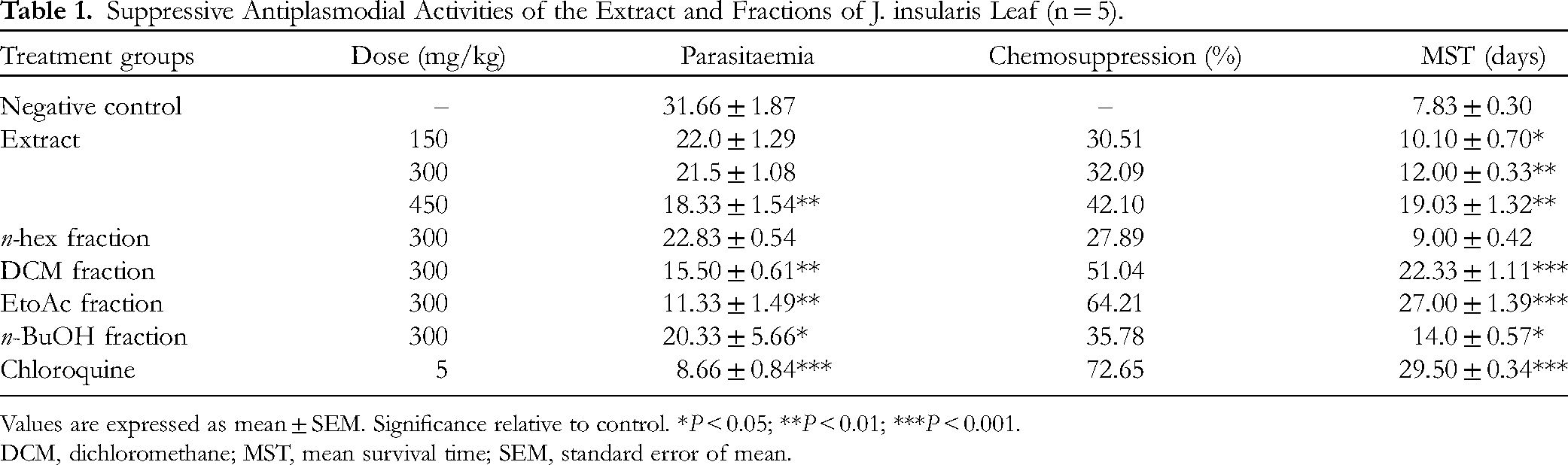
Values are expressed as mean ± SEM. Significance relative to control. *P < 0.05; **P < 0.01; ***P < 0.001.
DCM, dichloromethane; MST, mean survival time; SEM, standard error of mean.
Prophylactic Antiplasmodial Activities of the Extract and Fractions of J. insularis Leaf (n = 5).

Values are expressed as mean ± SEM. Significant relative to control. *P < 0.05; **P < 0.01; ***P < 0.001.
DCM, dichloromethane; MST, mean survival time; SEM, standard error of mean.
Schizonticidal Antiplasmodial Activities of the Extract and Fractions of J. insularis Leaf (n = 5).
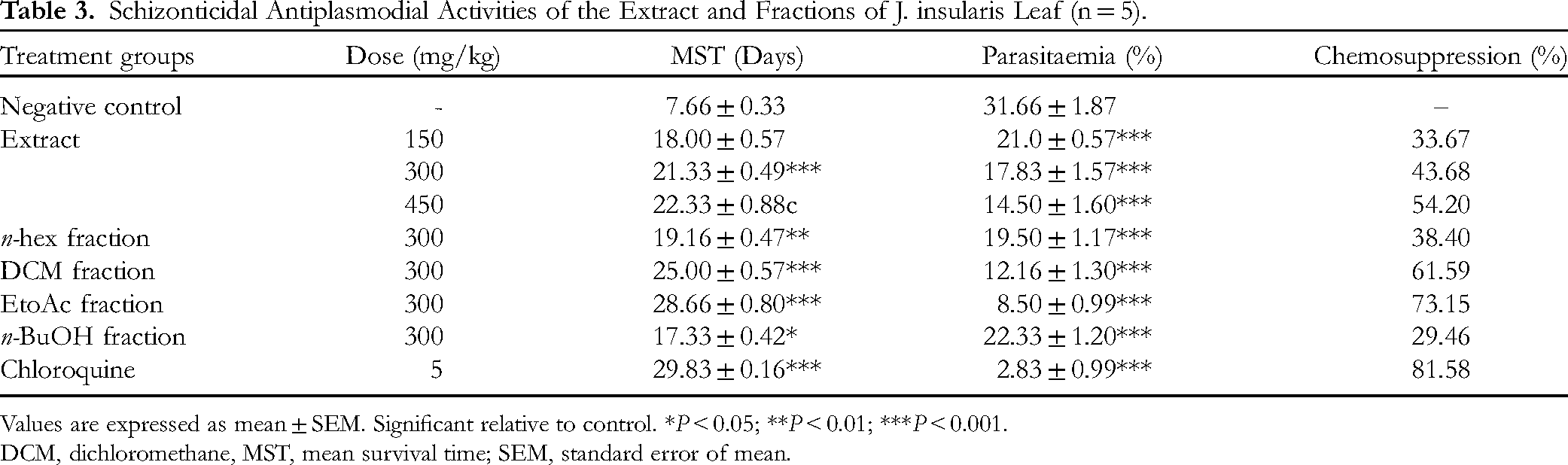
Values are expressed as mean ± SEM. Significant relative to control. *P < 0.05; **P < 0.01; ***P < 0.001.
DCM, dichloromethane, MST, mean survival time; SEM, standard error of mean.
The Effect of the Extract/Fractions of J. insularis Leaves on the Rectal Temperatures of Infected Mice
The administration of the extract and fractions of J. insularis leaves as well as chloroquine to P. berghei-infected mice in curative antiplasmodial test did not cause any significant difference (P > 0.05) in the rectal temperature (Table 4) of the treated mice when compared with the control.
Effect of the Extract and Fractions of J. insularis Leaves (n = 5) on Rectal Temperature of Mice Infected with P. Berghei During Established Infection.

Values are expressed as mean ± SEM.
DCM, dichloromethane; SEM, standard error of mean.
GC-MS Analysis
GC-MS analysis (Table 5) of DCM fraction revealed some pharmacologically active compounds such as glyceraldehyde; hexanoic acid; 1,1-dimethylethyl ester; hexanoic acid, butyl ester; hexanoic acid, 2,4-dimethyl-, methyl ester; E-2-tetradecen-1-ol, oxirane, tetradecyl-; trans-β-ocimene; α-pinene among others. Also, the GC-MS analysis (Table 6) of EtoAc fraction indicated that it contains unsaturated fatty acids such as hexanoic acid; pentanoic acid, 3-methyl-; hexanoic acid, 1,1-dimethylethyl ester; hexadec-9-enoic acid; 7-tert-butyldimethylsilyloxy-, methyl ester; heneicosanoic acid, methyl ester; octa-2,4,6-triene; 1,3,6-heptatriene, 5-methyl-, (E)-; phytol, acetate; octadecanoic acid, 2-hydroxy-1,3-propanediyl ester; octadecanoic acid, docosyl ester; and others.
GCMS Analysis of DCM Fraction of J. insularis Leaf.
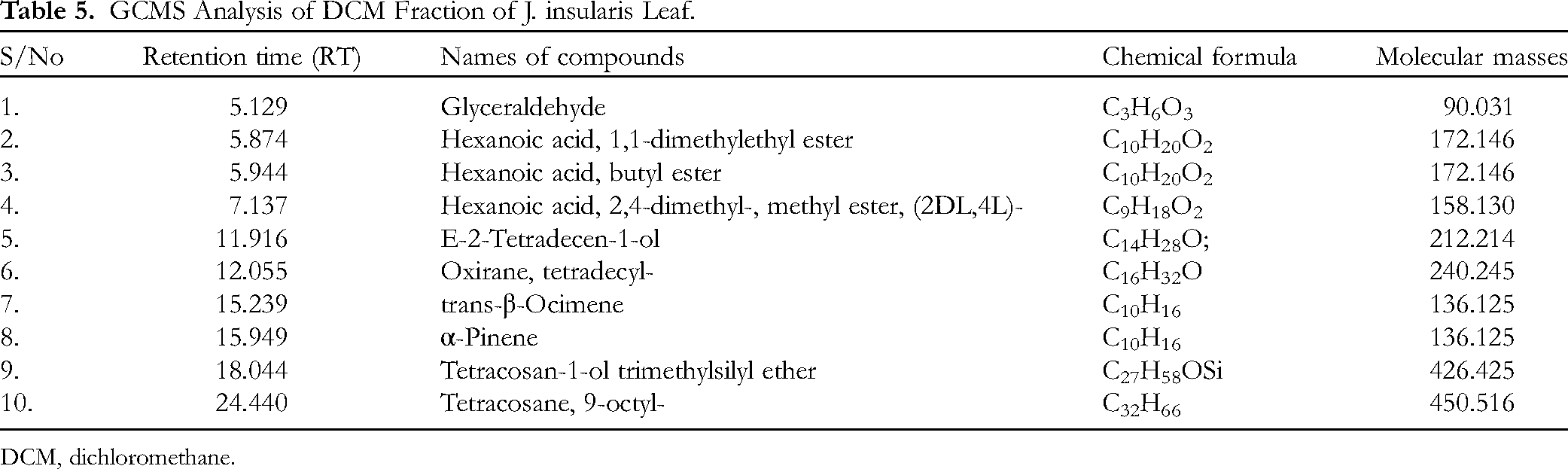
DCM, dichloromethane.
GCMS Analysis of EtoAc Fraction of J. insularis Leaf.

Molecular Docking Analysis
The result (Table 7, Figures 1 and 2) of the docking analysis revealed the interactions of 1BJ4 with selected ligands (A1, A2, A3, A4, A5, and A6) and standard drug (CQ). Ligand A3 binding energy (−6.1 kcal/mol) was lower than that of CQ (−4.8 kcal/mol); however, that of ligands A1 (−4.7 kcal/mol) and A5 (−4.3 kcal/mol) were higher but compared favorably with the standard drug. Further analysis on the binding pocket of the protein revealed that ligand A3 formed an alkyl, pi-alkyl, and 3 hydrogen bonds with the amino acid residues at the active site of the protein. Also, the functional groups in ligand A1 were able to form 2 hydrogen bonds via Thr163 and Phe125 as well as pi-sigma bond with Ala162 at the active site of IBJ4. Consequently, ligand A5 generated both alkyl and pi-alkyl interactions with Ala162, Leu149, and Phe125 as the amino acid residues at the active site of IBJ4 at various bond distances whereas CQ interaction with IBJ4 revealed that Thr163 formed a conventional hydrogen bond while both Leu149 and Ala162 formed alkyl and pi-alkyl interactions with the functional groups in chloroquine, respectively.

2D and 3D visualization of protein-ligand interaction of 1BJ4 with CQ, A1, A2, and A3.
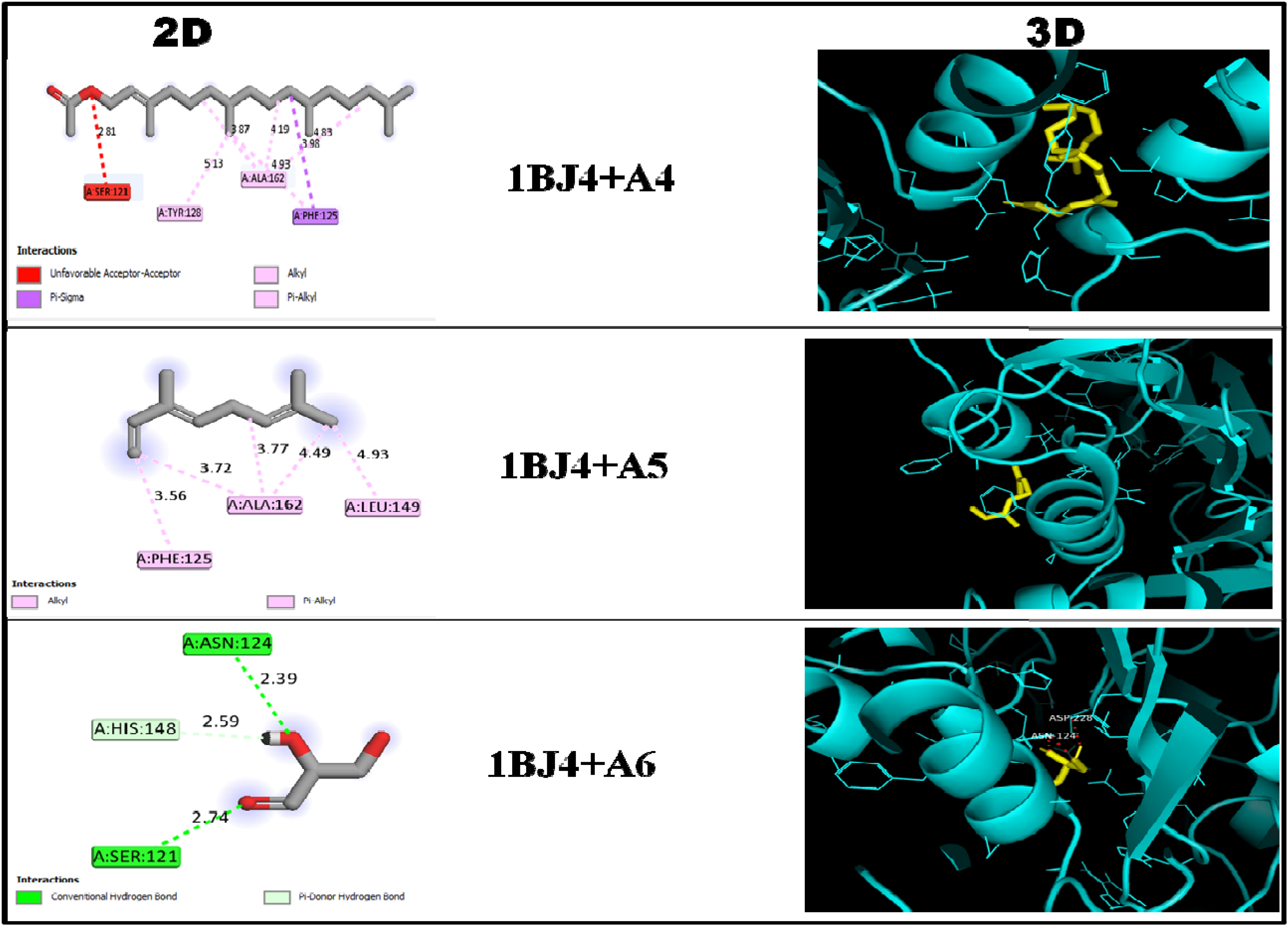
2D and 3D visualization of protein-ligand interaction of 1BJ4 with A4, A5, and A6.
Molecular Docking Analysis of Selected Compounds from the Fraction of J. insularis Against 1BJ4 and 3C64 Proteins.

Keys: CQ = Chloroquine; A1= Hexanoic acid, 1,1-dimethylethyl ester; A2= Octa-2,4,6-triene; A3= Octadecanoic acid, docosyl ester; A4= Phytol, acetate; A5= Trans-β-Ocimene; A6= Glyceraldehyde
According to the results (Table 7, Figures 3 and 4) of the docking analysis, the interactions of 3C64 with chloroquine (CQ) and selected ligands (A1, A2, A3, A4, A5, and A6) occurred. The binding energy of CQ (−5.4 kcal/mol) was lower than those of the selected ligands; however, the binding energies of ligands A5 (−4.8 kcal/mol), A4 (−4.6 kcal/mol), A3 (−4.5 kcal/mol), and A2 (−4.5 kcal/mol) compared favorably with that of CQ. Further analysis of these ligands’ interactions at the active site of 3C64 revealed that CQ formed some carbon-hydrogen bonds via Asp21 and Lys24; Tyr55 and Ile20 revealed alkyl and pi-alkyl interactions with the functional groups in CQ, whereas Trp25 formed a pi-pi stacked interaction with the aromatic ring in CQ. Also, ligand A5 through Trp25 formed a pi-sigma bond with the protein whereas the presence of Lys24 at the protein's active site enhanced the formation of alkyl and pi-alkyl interactions with the functional groups in CQ. The interaction of 3C64 with ligands A2, A3, and A4 via their various amino acid residues at the protein's active site revealed majorly alkyl and pi-alkyl interactions with these ligands.

2D and 3D visualization of protein-ligand interaction of 3C64 with CQ, A1, A2, and A3.

2D and 3D visualization of protein-ligand interaction of 3C64 with A4, A5, and A6.
ADMET Studies on Selected Ligands and Chloroquine
The absorption, distribution, metabolism, excretion, and toxicity (ADMET) results (Table 8) revealed that the Caco-2 permeability values for ligands A1, A2, A4, A5, and A6 were −4.162, −4.726, −4.568, −4.557 and −5.123, respectively. More so, the gastrointestinal tract (GI) absorption indices for ligands A1 and A3 were high whereas ligands A1 and A2 showed maximal plasma protein binding (PPB) in percentages as 87.559% and 10.061%. Also, ligands A1, A3, and A5 revealed they could cross the blood-brain-barrier (BBB); however, of all the ligands, it was only A3 and A4 that showed they could inhibit CYP2C9. Moreover, ligands A1, A2, A4, and A5 revealed excellent clearance levels as 11.519, 9.583, 5.081, and 7.761, respectively. Although ligands A1 and A2 revealed they could induce minimal carcinogenicity, ligands A4, A5, and A6 are non-carcinogens. In addition, all the ligands with exception of ligands A3 obeyed Lipinski rule of five with at most one violation.
ADMET Properties of Selected Bioactive Compound.

GI, gastrointestinal tract; BBB, blood-brain-barrier; PPB, plasma protein binding; ADMET, absorption, distribution, metabolism, excretion, and toxicity.
Discussion
Malaria pathogenesis normally reveals hyperparasitaemia, hyperthermia, and hyperpyrexia 20 ; however, these symptoms if not averted with chemotherapies and medicinal plants could trigger deleterious complications with possibilities of mortality; so, J. insularis leaves are ethnopharmacologically used for the purpose of attenuating the above symptoms in patients. Therefore, this study was designed to validate the antimalarial potentials of this plant in order to provide scientific basis for its usage as an antimalarial plant. The study revealed that the extract and fractions significantly reduced parasitaemia in dose-dependent manner in all the antiplasmodial assay models with EtoAc and DCM fractions exhibiting the best chemosuppressive and schizonticidal activities; this result was in tandem with previous reports8,21 on other medicinal plants having antiplasmodial activities and acting through the suppression of parasite growth as well as suicidal attack on its schizonts. It is worthy of note that the antiplasmodial activities of the following compounds have been reported hexadecanoic acid methyl ester; 9,12-octadecadienoic acid methyl ester (linoleic acid); 9,12,15-octadecatrienoic acid methyl ester (linolenic acid); and 9-octadecenoic acid20,22,23; phytol;24,25 and monoterpenes such as limonene and others (trans-β-ocimene and α-pinene) 26 ; therefore, these compounds profiled from GCMS analysis could have contributed to the observed antiplasmodial activity of J. insularis leaves through a particular mechanism of action. Also, the plant's ability to prolong the MST of the mice suggested their abilities in parasitaemia clearance, thereby, aiding the mitigation of malaria pathogenesis and its associated symptoms in mice. This result was consistent with the report 14 on prolonged MST for mice treated with Nauclea latifolia roots.
Also, fever is one of the cardinal symptoms of malaria; however, P. berghei infection in mice is reported to be associated with hypothermia rather than pyrexia. 27 The result on rectal temperature of the infected mice in this study revealed insignificant difference between the mean temperature values of both the treated and negative control mice, suggesting that they were hypothermic. This hypothermia may have resulted from the various physiological effect of P. berghei in mice, leading to body heat loss, and death of mice. 28 More so, carbohydrate, lipid, and protein metabolisms in mice are negatively affected by P. berghei invasion 29 ; therefore, the decreased metabolic rate in these mice correlated their decreased body temperature 30 ; hence, the resultant hypothermia.
Moreover, molecular docking as a computational tool is designed to accentuate the best binding orientation that compounds interact with their target proteins; it reveals the biological efficacy as well as the binding affinities of compounds, thereby, enhancing the prediction of their potential therapeutic effect.
31
The lowest binding affinities observed for octadecanoic acid docosyl ester and hexanoic acid, 1,1-dimethylethyl ester interaction with PfSHMT as well as trans-β-ocimene, phytol acetate, and octadecanoic acid docosyl ester interaction with PfEMP-1 that were better than chloroquine proved that these compounds’ antiplasmodial activities were through the inhibition of PfSHMT that led to the mitigation of DNA synthesis in the parasites as well as the inhibition of PfEMP-1, a receptor that mediates the attachment of pRBCs to micro-vascular endothelium, thereby, resulting in the parasitemia clearance. It is worthy of note that some researchers
8
posited that lead compounds had lower docking scores; therefore, the lower score function during docking simulations is an advantage for the prediction of both strength and type of signals produced during the structure-based design of drugs. Conversely, the lower binding affinity in these compounds could be attributed to the presence of carbonyl group (C = O) that participated in the hydrogen bonding, Vander Waal forces, and electrostatic interactions, thus, facilitating the compounds interaction with these proteins. Consequently, the interaction of trans-β-ocimene (a monoterpenoid) with PfEMP-1 revealed a pi-sigma bond; however, Li et al
32
reported that pi-sigma interaction contributed to specificity and stability of receptor-ligand interaction as well as influenced their binding affinities during docking simulations. Therefore, hexanoic acid 1,1-dimethylethyl ester and octadecanoic acid docosyl ester with the least binding energies had the best interaction and antiplasmodial activities against PfSHMT, implying that they competed with THF and
The evaluation of the ADMET properties of the ligands as part of in silico studies provided understanding of the compounds’ pharmacokinetics and physicochemical properties in the human system. The Caco-2 cells are often used by researchers to imitate the human intestinal wall because they act similarly as the human intestine. 32 Here, the Caco-2 permeability values for all the compounds were within acceptable limits. Also, the GI absorption being very critical in drug discovery process because of its role in the bioavailability of drugs connote the process by which drugs are absorbed into the blood stream through the GI 33 ; therefore, hexanoic acid 1,1-dimethylethyl ester and octadecanoic acid docosyl ester that revealed high absorption in the GIT suggested they could enhance high bioavailability. Conversely, PPB as an index of drug distribution refers to the rate at which substances bind to the proteins within the blood plasma. 34 So, drug-plasma interaction influences several factors such as metabolism, excretion, and bioavailability; therefore, hexanoic acid 1,1-dimethylethyl ester and octa-2,4,6-triene revealed maximum PPB indices from the analysis. More so, BBB permeant as the ability of a substance to cross the BBB and enter into the central nervous system has provided the basis for drug distribution and evaluation. Therefore, artemisinin-based compounds and quinine based derivative are known to cross the BBB, necessitating their usage in the treatment of cerebral malaria 35 ; so, hexanoic acid 1,1-dimethylethyl ester, octadecanoic acid docosyl ester, and trans-β-ocimene are prospective agents for cerebral malaria treatment because they revealed their abilities in crossing the BBB. Moreover, drug metabolism is mostly mediated by a class of enzymes that belong to the cytochrome P450 family; they enhance biotransformation, detoxification, and excretion of drug metabolites in the system. However, compounds that inhibit this group of enzymes could possibly enhance toxicity in the system; however, all the compounds with the exception of octadecanoic acid docosyl ester and phytol acetate revealed that they were not inhibitors of monooxygenases and that their metabolites could not induce toxicity. Furthermore, renal clearance as drug excretion index is a pharmacokinetic parameter that is critical in the evaluation of the ease of drug metabolites elimination from the system; it also give a clue on the steady state concentration of a substance in the plasma; therefore, all the compounds with the exception of octadecanoic acid docosyl ester and glyceraldehyde revealed excellent clearance level and the possibility of their metabolites easily excreted through the kidney to avert toxicity. In addition, carcinogenicity as a toxicological parameter is used to reveal compounds that could induce carcinogenesis and mutagenesis. Here, phytol acetate, trans-β-ocimene, and glyceraldehyde revealed their non-carcinogenic potentials. Nevertheless, Lipinski's rule as a drug-likeness criteria is a set of rule used for the assessment of the resemblance of a potential drug to known drugs based on their structural and physiochemical properties 36 ; so, the rule has helped in the profiling of compounds with undesirable properties. All the compounds with the exception of octadecanoic acid docosyl ester violated at most one Lipinski's rule of five; therefore, they are drug-like molecules. Conclusively, ADMET studies is a paramount tool in drug discovery as it has enhanced the understanding of the pharmacokinetics, physicochemical, and drug-like properties of the studied compounds.
Conclusion
The EtoAc and DCM fractions of J. insularis leaf that had the best antiplasmodial therapeutic indices in P. berghei-infected mice were subsequently isolated and characterized with GC-MS to give 20 bioactive compounds with already reported antiplasmodial activities. However, the docking of these compounds with PfSHMT and PfEMP-1 generated their binding energies, bond distances, hydrogen bonds, and amino acid residues while the ADMET profiling revealed the pharmacokinetics, physicochemical, and drug-like properties of the compounds. Moreover, octadecanoic acid docosyl ester, hexanoic acid 1,1-dimethylethyl ester, and trans-β-ocimene were the lead compounds in terms of their binding energies, permeation of BBB, non-inhibition of metabolizing enzymes, ease of absorption, distribution, excretion, and non-violation of Lipinski's rules as well as favorable comparison with chloroquine in terms of their binding energies and ligand-protein interactions. Therefore, octadecanoic acid docosyl ester and hexanoic acid 1,1-dimethylethyl ester are proposed to mitigate malaria pathogenesis by competitively binding to the THF-binding sites of PfSHMT, causing the inhibition of DNA synthesis, and parasite apoptosis whereas trans-β-ocimene mediated its antiplasmodial activity through the inhibition of PfEMP-1, a receptor that mediates the attachment of pRBCs to micro-vascular endothelium, thereby, resulting in parasitaemia clearance.
Materials and Methods
Collection and Identification of Plant Material
The leaves of J. insularis were collected in January 2022 from the medicinal plants farm, University of Uyo, Uyo, Akwa Ibom State, Nigeria. The plant was identified and authenticated by Dr Uduak Eshiet, a taxonomist in the Department of Botany and Ecological Studies, University of Uyo, Nigeria. A voucher specimen (FPH 83b) of the plant was deposited in the Department of Pharmacognosy and Natural Medicine herbarium, University of Uyo, Nigeria.
Extraction
The leaves were washed with distilled water and shade dried at temperature (26 OC) for 2 weeks. The dried leaves (1728 g) were cut into smaller pieces, pulverized to powder, and divided into two parts. One part (497 g) was macerated in 4 L of ethanol (80%) for 72 h, while the remaining part (1231 g) was successively macerated for 72 h in 7.3 L of n-hexane (n-hex), 6.8 L of DCM, 4.1 L of ethyl acetate (EtoAc), and 3.2 L of butanol (BuOH), respectively. The filtrate of each extract and fraction was concentrated and evaporated to dryness in vacuo (40O C) by using a rotary evaporator. The various yields were calculated as follows: 99.5 g of extract (20.01%), 196.9 g of n-hex (16.0%), 45.5 g of DCM (23.12%), 49.1 g of EtoAc (24.91%), and 70.7 g of n-BuOH (35.9%); then, the extract and fractions were stored in a refrigerator (−4 OC), until used for the study. 37
Microorganisms (Parasites)
Chloroquine-sensitive strain of Plasmodium berghei (abbreviated P. berghei) ANKA strain was obtained from the National Institute of Medical Research, Yaba, Lagos, Nigeria, and maintained by sub-passage of blood from infected to healthy mouse once every 7-8 days.
Parasite Inoculation
Each mouse used in the experiment was inoculated intraperitoneally with 0.2 mL of infected blood containing about 1 × 10⁷ P. berghei parasitized erythrocytes collected from an infected mice with 20-30% parasitaemia. The inoculum consisted of 5 × 10⁷ P. berghei-infected erythrocytes per milliliter prepared by determining both the percentage parasitemia and the erythrocytes count of the donor mouse and diluting the blood with isotonic saline in proportions indicated by both determinations.
20
Parasitemia was monitored by standard methods: thin blood smears were made on glass slides, fixed using methanol, stained using Giemsa stain, and parasitemia was counted using a microscope and calculated as a percentage of infected RBCs relative to the total number of cells in a microscopic field at ×100 magnification according to the formula
38
as given below:
Experimental Animals
Swiss Albino Wistar mice (18-25 g) of both sexes used in the study were obtained from the University of Uyo's animal house. They were kept in standard plastic cages in a well-ventilated room and acclimatized for 10 days before the experiments. The mice were fed on standard pelleted diet and water ad libitum. The care and use of animals were conducted in accordance with the National Institute of Health Guide for the Care and Use of laboratory Animals (NIH Publication, 1996). Approval (approval number: UUY/0420) for the study was obtained from the University of Uyo's Animal Ethics Committee.
Drug Administration
The extract, fractions, chloroquine, and pyrimethamine used in the study were obtained from a commercial pharmacy in Uyo, Nigeria, and administered orally with the aid of a stainless metallic feeding cannula.
Determination of Median Lethal Dose (LD50)
The determination of median lethal dose (LD50) of the extract was carried out in mice using oral (p.o) route by modified method of Lorke. 39 The mice in groups of three each were administered different doses of the extract (100-5000 mg/kg). They were observed for the manifestation of physical signs of toxicity such as writhing, decreased motor activity, decreased body/ limb tone, decreased mobility, and death. The mortality in each group within 24 h was recorded. The LD50 value was calculated as geometrical means of the maximum dose producing 0% (a) and the minimum dose producing 100% mortality (b); therefore, LD50 =√ab and was estimated to be = 5000 mg/kg body weight of mice.
Antiplasmodial Assay
The Evaluation of Suppressive Antiplasmodial Activities of the Drug, Extract, and Fractions of J. insularis Leaves (4-day test)
This test was used to evaluate the chemosuppressive activity of the extract, fractions, and chloroquine against early P. berghei infection in mice. This was done as described by Asanga et al
40
and Okokon et al.
41
Forty-five mice were randomly divided into nine groups of five (5) mice each. On the first day (D0), the 45 mice were inoculated with the parasite and randomly divided into the various groups and were given extract, fractions, chloroquine, and distilled water. The mice in groups (1-3) were given extract (150, 300, and 450 mg/kg) body weight of mice respectively; groups (4-7) were given n-hex, DCM, EtoAc, and n-BuOH fractions, respectively, at 300 mg/kg body weight of mice; group 8 mice (positive control) were given chloroquine at 5 mg/kg body weight of mice; then, group 9 mice (negative control) were given distilled water at 10 ml/kg body weight of mice. All the groups of mice were treated for 4 consecutive days (D0-D3) between 8am and 9am; on the fifth day (D4), thin films were made from their tail blood. The films were stained with Giemsa stain to reveal parasitized erythrocytes out of 500 in a random field of the microscope. The rectal temperature of each mouse was taken daily for 5 days to monitor changes in the body temperature of the mice. The average chemosuppression of parasitemia was calculated according to the formula
42
as follows: (average % parasitemia positive control – average % parasitemia negative control)/ (average % parasitemia negative control). The MST of the mice in each treatment group was determined over a period of 29 days (D0-D28), as follows:
The Evaluation of Prophylactic Antiplasmodial Activities of the Drug, Extract, and Fractions of J. insularis Leaves
This was evaluated using the method.42,43 The mice were randomly divided into nine groups of five mice per group. Groups (1-3) were given extract (150, 300, and 450 mg/kg) body weight of mice, respectively; groups (4-7) were given n-hex, DCM, EtoAc, and n-BuOH, respectively, at 300 mg/kg body weight of mice. Mice in group 8 (positive control) were given pyrimethamine at 1.2 mg/kg body weight of mice, whereas the mice in group 9 (negative control) were given distilled water (10 ml/kg) body weight of mice. The administration of the drugs, extract, and fractions continued for 3 consecutive days (D0-D2); on the fourth day (D3), the mice were inoculated with P. berghei. The parasitemia level was assessed through blood smears 72 h later and the MST of the mice was calculated over a period of 29 days.
The Evaluation of the Curative Antiplasmodial Activities of the Drug, Extract, and Fractions of J. insularis Leaves
This test was used to evaluate the schizonticidal activity of the extract, fractions, and chloroquine in established P. berghei-induced infection. This was conducted according to the methods described by Asanga et al 42 and Okokon et al. 43 Forty-five (45) mice were intraperitoneally inoculated with P. berghei on the first day (D0); 72 hours later (D3), the mice were divided into nine groups of five mice per group. Groups (1-3) were given different doses of the extract (150, 300, and 450 mg/kg) body weight of mice, respectively. Mice in groups (4-7) were given n-hex, DCM, EtoAc, and n-BuOH fractions, respectively, at the dosage of 300 mg/kg body weight of mice. Mice in group 8 (positive control) were treated with chloroquine at 5 mg/kg body weight of mice, whereas those in group 9 (negative control) were given distilled water (10 ml/kg body weight of mice). The extract, fractions, and chloroquine were administered once daily for 5 days. Giemsa stained thin smears were prepared from tail blood samples collected on each day of treatment to monitor the parasitemia level. The rectal temperature of the mice was taken on days 0, 3, 5, and 7, whereas the MST of the mice in each group was determined over a period of 29 days (D0-D28).
Gas Chromatography-mass Spectrometry Analysis of the Fractions
GC-MS data of the fractions (DCM and ethyl acetate) (10 mg each) being the best based on their antiplasmodial therapeutic indices were recorded on an Agilent 7890 A gas chromatograph connected with an Agilent MS model 5975C MSD detector (Agilent Technologies, USA). A HP5-MS column 5% phenyl-methylpolysiloxane, 30 m × 0.25 mm × 0.25 µm was used with a helium gas flow under a pressure of 10 psi. The injector temperature was set at 280 °C. The oven temperature started from 150 °C for 3 min (min), increased to 300 °C at 10 °C/min, and held for 5 min at 300 °C. The mass spectrometer was operated using the electron ionization mode at 70 eV. The fractions were either directly injected in n-hexane or after derivatizing to form TMSi derivatives with N,O-Bis(trimethylsilyl)trifluoroacetamide as described previously. 20 The National Institute of Standards and Technology (NIST) database and ChemStation data system were used to compare the retention indices and mass spectrum fragmentation patterns of the isolates to identify the compounds inside them. The compounds’ molecular masses, formula, names, and retention times were all recorded.
The Assessment of the Physicochemical and Pharmacokinetics Properties of the Bioactive Compounds from J. insularis Leaves
Prediction of Target and ADMET Properties of the Ligands
This analysis was carried out using two online tools: swissADME (http://www.swissadme.ch/) and ADMET lab 2.0 (https://admetmesh.scbdd.com/) 8 ; the ADMET properties of the ligands employed in this study were predicted. The different ADMET properties of the ligands and the chloroquine were predicted by using their different canonical strings or Simplified Molecular-Input Line-Entry System strings that were retrieved from the PubChem web platform (https://pubchem.ncbi.nlm.nih.gov/pccompound) in their 3D conformation. All the relevant parameters including Lipinski's rule of five and Ghose parameters were recorded. Using the SWISSADME Target Prediction tool, the targets of the different ligands were determined. 44
Target Proteins Properties and Molecular Docking of the Bioactive Compounds
In this study, the three-dimensional structures of the target proteins: recombinant serine hydroxylmethyltransferase and MC179 portion of the cysteine-rich inter-domain region of PfEmp-1 with PDB ID, 1BJ4 and 3C64, respectively, were obtained from protein data bank (PDB). The ligands and chloroquine were gotten from Pubchem (https://pubchem.ncbi.nlm.nih.gov), whereas the target proteins were retrieved and downloaded in PDB format from the Research Collaboratory for Structural Bioinformatics (RCSB) (www.RCSBPDB.org) and docked blindly. 8 The downloaded proteins were prepared using Biovia Discovery Studio version 21.1.020298 8 ; the protein preparation steps involved the removal of water molecules and native ligand groups present, as well as the addition of polar hydrogen atoms. After the proteins preparation, molecular docking analysis was carried out using PyRx. 45 The results of this analysis were evaluated based on the compound with highest negative binding energy. Also, the 2D visualization of the docking experiment was carried out by using the Biovia discovery studio as it provided an understanding of the specific amino acid residues and their types of interaction between the ligands and the target proteins. Moreover, the PyMol software 46 was employed in providing the 3D visualization of the ligand-receptor interactions, and these visualizations provided better understanding of the docking processes.
Statistical Analysis
Data collected were analyzed using one-way analysis of variance followed by Turkey's multiple comparison post-test (Graphpad prism software Inc. La Jolla, CA, USA). Values were expressed as mean ± standard error of mean (SEM) and significance relative to control were considered at P˂0.001 and P˂0.05.
Footnotes
Acknowledgements
The authors are grateful to Mr Nsikan Malachy and other staff Animal House of Pharmacology and Toxicology Department, University of Uyo for providing technical assistance as well as the editor and reviewers for the review processes.
Authors’ Contributions
Conceptualization and methodology: Enyiekere VJ, Okokon JE, and Asanga EE. Software and statistical analysis: Ekeleme CM and Asanga EE. Resources: Asanga EE, Enyiekere VJ, and Okokon JE. Writing, review, and editing: Asanga EE, Enyiekere VJ, Okokon JE, Anagboso MO, and Ise UP. Supervision: Okokon JE.
All the authors read the manuscript and the authors’ list and consented to the publication.
Availability of Data and Materials
Datasets generated in this study are available from the corresponding author on request.
Declaration of Conflicting Interests
The author(s) declared no potential conflicts of interest with respect to the research, authorship, and/or publication of this article.
Funding
The authors received no financial support for the research, authorship, and/or publication of this article.
Ethical Approval
The NIH guidelines for the care, handling, and use of experimental animals (NIH Publication, 1996) and compliance with ARRIVE guidelines were judiciously followed. Moreover, the Animal Ethics Committee of the University of Uyo, Akwa Ibom State, Nigeria (approval number: UUY/0420) approved the experimental protocol.
Informed Consent
All the authors contributed their quota to the research, they have thoroughly read, and have approved the manuscript to be published.
