



Abstract
Background
This study aimed to evaluate the protective effects of dried and milled banana (BN) against streptozocin (STZ), nicotinamide (NA), and high-fat diet (HFD)-induced diabetes mellitus (DM) in 8-week-old spontaneously hypertensive rats (SHRs).
Methods
First, we analyzed the resistance starch contents, anti-oxidant compositions and activity, and α-glucosidase inhibitory effects of the BN. Then the DM animal model was performed. The SHRs were randomly divided into 3 groups. The control group was fed normal chow, the DM group was injected with STZ/NA and fed HFD, and the DM/BN group was injected with STZ/NA and fed HFD having the carbohydrate content replaced with BN.
Results
After 4 weeks, hyperglycemia and hypoinsulinemia occurred; moreover, HbA1c levels were higher and glucagon-like peptide 1 concentrations were lower, but blood pressure and heart rate did not worsen in the DM group. Related glucose metabolism and vasorelaxation proteins were disrupted by DM. However, in the DM/BN group, all of the above biochemical parameters were ameliorated by improving glucose homeostasis and clearly brought about improvements in blood pressure and heart rate as well.
Conclusion
Together, the functional compositions of banana may help to improve DM, hypertension, and related complications.
Introduction
Diabetes is a chronic metabolic disease characterized by elevated levels of blood glucose, which can damage the heart, blood vessels, eyes, kidneys, and nerves. 1 Type 2 diabetes mellitus (T2DM) is more common in adults and occurs when the body becomes insulin resistant or cannot secrete enough insulin. In the past 3 decades, the global diabetes prevalence in 20 to 79 years old in 2021 was estimated to be 536.6 million people. Over half a billion people are living with diabetes worldwide which means that over 10.5% of the world's adult population now have this condition, rising to 12.2% (783.2 million) in 2045. 2 Diabetes enhances oxidative/nitrative stress and the expression of inflammatory signaling molecules, 3 and these factors deteriorate lipid metabolism and glucose homeostasis and damage blood vessels. 4 If not diagnosed early, these conditions can cause cardiovascular damage, particularly the endothelium-dependent vasorelaxation 5 and myocardium 6 impaired, eventually increasing the risk of hypertension, cardiac fibrosis, cardiomyopathy, and atherosclerosis.5-10
Medication control is widely recommended for the management of T2DM. Nevertheless, despite the advances in its management, the incidence and prevalence of this disease are still high. According to a population survey administered by Taiwan's Ministry of Health and Welfare, adults and teenagers in Taiwan do not consume enough fruits and vegetables, which is a major factor responsible for increasing the prevalence of metabolism syndromes and T2DM.11,12 It has been found that the ingestion of sufficient fruits and vegetables reduces the incidence of metabolism-related syndromes and T2DM. 13 Although T2DM and its complications can be controlled through medication, the consumption of functional foods (such as foods that show health benefits beyond basic nutrition, providing health promotion, or against disease) could be 1 complementary treatment option. The positive effects of a healthy diet on reducing the risk of diseases are widely known; therefore, functional foods are considered important factors in the prevention and control of metabolic syndromes and T2DM. 14
The banana variety used in this experiment is Giant Cavendish banana (Musa spp., Cavendish sub-group AAA). It is currently the most widely grown banana variety in Taiwan. One hundred grams of the banana fruit supplies 90 calories and is rich in vitamin B complex, vitamin C, manganese, potassium, and dietary fiber. Furthermore, banana possesses antioxidants, α-amylase, and α-glucosidase inhibitory effects, and a low glycemic index, an appropriate dietary choice for people with diabetes.15,16 So, banana is generally recommended for the control of diabetes. 17 This highly prevalent fruit and related products, such as flour, are well worth studying in depth, particularly regarding its potential in preventing and treating T2DM and the associated disorders.18,19
In this study, we used dried and milled unripe green banana (BN) as the protagonist to analyze its composition, efficacy, and pharmacological mechanism for anti-DM effects. We induced T2DM in spontaneously hypertensive rats (SHR) by injecting streptozocin (STZ) and nicotinamide (NA) and feeding them either a regular diet, a high-fat diet (HFD), or an HFD having carbohydrate content replaced with BN. Furthermore, we investigated the mechanisms underlying the anti-DM effects of BN.
Materials and Methods
Production of BN
The production of BN was referred to as the preparation method of banana powder at He Jin Noodles Field (Guanmiao district, Tainan, Taiwan). The peeled unripe bananas were exposed to the sun for about 3 days, dried in an oven at 57 °C for 24 h, and then grind into powder.
Functional Compositions Analysis of BN
For the resistance starch (RS) assay, 0.5 g of BN was treated with successive washes of 80% alcohol, 50% alcohol, and water to remove soluble sugar and other soluble substrates. The solution was centrifuged at 1500×g for 10 min to remove the supernatants, and the pellets were dissolved by adding 2 mL of 2 M KOH for 20 min. Then the solution was mixed with 8 mL of 1.2 M sodium acetate buffer (pH 3.8) and 0.1 mL of reactive enzyme solution (including pancreatic α-amylase and amyloglucosidase) in a water bath at 50 °C for 30 min. To mix 0.1 mL solution with 3 mL of glucose oxidase/peroxidase reagent, the sample was incubated at 50 °C for 20 min, and then measured the absorbance of the solution at 510 nm against with the blank. RS contents were analyzed using an RS assay kit (Megazyme, Bray Business Park). 20
A hundred grams of BN were sonicated in 500 mL of 95% alcohol for 2 h and allowed to stand for overnight. After filtering, the solution was evaporated in vacuum to remove the solvent. 21 The levels of flavonoids, polyphenol, and anthocyanins were determined. The total flavonoids estimation of BN was compared using the aluminum chloride colorimetric method, and quercetin was used to obtain the calibration curve. The 2,4-dinitrophenylhydrazine colorimetric method was used with naringenin as the reference standard. The total polyphenols and anthocyanins levels were determined as described previously. 22 Gallic acid was used as a standard for total polyphenols, and the absorbance was measured at 750 nm using a spectrophotometer. Catechin was used as a standard for anthocyanins, and the absorbance was measured at 510 nm using a spectrophotometer.
Estimation of Antioxidant Activity of BN
The materials and methods for BN extraction were previously described.21,23 Spectrophotometric analysis was performed to evaluate the radical scavenging ability of the BN extract against 2,2-diphenyl-1-picrylhydrazyl (DPPH) as described in previous studies. 24 Exactly 100 µL of the samples (various concentrations; standards and the peeled green banana extract 1, 10, 20, and 40 mg/mL) were combined with 400 μL methanol, and 500 μL DPPH were incubated in the dark for 20 min. DPPH radical inhibition and the decrease in absorbance were read at 517 nm. The radical scavenging activity was calculated from the equation: % of radical scavenging activity = (△absorbance of control − △absorbance of sample)/△absorbance of control)) × 100%.
Estimation of α-Glucosidase Inhibitory Activity of BN
The materials and methods for BN extraction were previously described.21,23 The methods for enzymatic inhibition assays were modified from Boue et al 22 For the α-glucosidase assay, 50 μL of the sample (10, 100, 200, and 400 mg/mL), buffer control, or positive control (2–500 μg/mL acarbose) were added to 100 μL of a 1 U/mL α-glucosidase solution and incubated for 10 min. A 50 μL aliquot of 5 mM p-nitrophenyl-α-D-glucopyranoside was added and incubated for 5 min at 25 °C. Before and after incubation, the absorbance was read at 405 nm using a BioRad 3550 microplate reader. Results were calculated as follow: % enzyme inhibition = [(△absorbance of control − △absorbance of extract)/△absorbance of control)] × 100%.
Animals and Experimental Diets
We used STZ/NA injection and an HFD to induce DM in an SHR model, an accepted research model for DM. 25 SHR was the Wistar-Kyoto inbred rat. The blood pressure and heart rate of SHR were gradually increased at 5–6 weeks old. After 8 weeks of age, the blood pressure and heart rate reached approximately 180 mmHg and 400 times/min. We obtained 8-week-old male SHR from Taiwan's National Laboratory Animal Breeding and Research Center (Taipei, Taiwan) and housed them under constant temperature and illumination (light between 7:30 and 19:30). The rats were randomly divided into 3 groups and for 4 weeks. One group was fed normal chow (normal chow; no. MFG, autoclavable pellet, from National Laboratory Animal Breeding and Research Center, Taipei, Taiwan) (control group, n = 8) for 6 weeks, the other 2 groups were injected with STZ (50 mg/kg) and NA (60 mg/kg) and fed an HFD (60% energy from fat, 21.3% energy from carbohydrates and 18.7% energy from protein) for 1 week, then were injected with STZ (40 mg/kg) again for another week. Animals with fasting blood glucose over 200 mg/dL were considered diabetic status. These 2 groups were randomly divided into DM group (n = 8) for the second group, and the third group fed the HFD in which the carbohydrate was replaced with BN (DM/BN group, n = 8) for 4 weeks (Figure 1). The nutritional compositions of the diets fed to these rats are shown in Table 1. The body weight, blood pressure, and heart rate were measured and recorded. At the end of the study, the rats were euthanized, and the blood, liver, skeletal muscle, and aorta were collected and stored in protein-lysis buffer solution at −80 oC until analysis. All animal procedures used in this study complied with the standard laboratory practices protecting animal welfare. This study was approved by the Animal Care and Use Committee of the Meiho University (approval number: MU-ACUC-2019-09).

The flow chart of animal experiment design.
Nutrient Compositions of Experimental Diets.

Abbreviations: BN, dried and milled banana; HFD, high-fat diet; HFD + BN, high-fat diet + dried and milled banana.
Measurement of Blood Pressure and Heart Rate
Blood pressure and heart rates of SHR in all groups were monitored using the rat tail-cuff blood pressure system Softron BN 98-A (Softron Co., LTD).
Measurement of Serum Biochemical Parameters
Blood samples were measured for blood glucose, glycated hemoglobin (HbA1c) levels using a HITACHI Clinical Analyzer 7070. The levels of insulin and glucagon-like peptide 1 (GLP-1) were measured using enzyme-linked immunosorbent assay (ELISA) kits (Mercodia; and R&D Systems).
Western Blot Analysis
The homogenized tissues were centrifuged at 12 500×g for 30 min, and supernatants were stored at −70 °C until further analysis. Aliquots of tissue homogenates were used for a protein assay performed using a Bio-Rad protein assay reagent (Thermo Fisher Scientific) and analyzed via western blotting. glucose homeostasis proteins, including AMP-activated protein kinase (AMPK), insulin receptor (IR), insulin receptor substrate 1 (IRS-1), phosphatidylinositol-3-kinase (PI3K), Akt/PKB, glucose transporter-4 (GLUT-4), hexokinase (HXK), pyruvate kinase (PK), glycogen synthase kinase-3α (GSK-3α), phosphoenolpyruvate carboxykinase (PEPCK), and glucose-6-phosphatase (G6Pase), peroxisome proliferator-activated receptor-γ (PPAR-γ); vasocontraction and vasodilation-regulating proteins, including angiotensin II receptor type 1 (AGTR1), AGTR2, endothelin receptor A (ETAR), ETBR, endothelial nitric oxide synthase (eNOS) and p-eNOS. The relative expression of the proteins in each tissue was quantified via densitometric scanning of the western blots using the Image-pro plus software (Media Cybernetics).
Statistical Analysis
Statistical analysis was performed using SPSS (SPSS, version 19.0). Statistical significance of multiple samples was analyzed using a one-way analysis of variance (abbreviated one-way ANOVA) with Tukey's post hoc method or Student's t-test in unpaired and paired samples, respectively. A P-value <.05 was considered significant.
Results
The Functional Compounds, Antioxidant Activity, and α-Glucosidase Inhibitory Effects of BN
The chemical analysis showed that 100 g of BN contained 9.8 g of RS, 38 0μg of flavonoids, 22650 μg of polyphenols, 2490 μg of anthocyanins (Table 1), and 203.6 mg of potassium. BN cleaned the DPPH completely at 40 mg/mL. The α-glucosidase inhibition analysis showed that BN could inhibit α-glucosidase ability in a dose-dependent manner (Table 2). The results demonstrated that the BN had the functional components.
The DPPH Clearance Rate (%) and α-Glucosidase Inhibitory Rate of BN.

DPPH, 1,1-diphenyl-2-picrylhydrazyl; BN, dried and milled banana. BN extract was from the 30% BN.
Effect of BN on Body Weight Gain, Ameliorating Hyperglycemia and Hypoinsulinemia in Diabetic SHR
The body weight compared with rats at the initial stage as 295.1 ± 4.1 g, the control group was 340.4 ± 9.3 g (+15.2%), but DM and the DM/BN group were 239.4 ± 8.8 g and 261.4 ± 7.1 g, and −18.1% and −9.7% less than the controls after 4 weeks, respectively. However, the DM/BN group showed a gentler decline in weight compared to the DM group (Table 3).
Effect of Experimental Diets on Body Weight in SHR.

Control refers to feeding normal chow; DM refers to SHR injected with STZ/NA and fed HFD; DM/BN referes to SHR were injected with STZ/NA, and fed HFD with BN. *p < 0.05 versus Control group; #P < .05 versus DM group. Abbreviations: HFD, high-fat diet; NA, nicotinamide; STZ, streptozocin; BN, dried and milled banana; DM, diabetes mellitus; SHR, spontaneously hypertensive rat.
Effects of BN on the Expression of Glucose Metabolism-Related Proteins in Diabetic SHR
In the DM group, the IR, PI3K, GLUT4, and PPAR-γ levels of adipose tissues were reduced compared to the control group, and such reductions were not observed in the DM/BN group. These findings suggested that BN could improve glucose uptake into adipose tissue (Figure 2).

DM and DM/BN affected the protein expression of glucose uptake in the adipose tissues of spontaneously hypertensive rats. One group was fed normal chow (control group), 1 injected with STZ/NA and fed HFD (DM group), and 1 injected with STZ/NA, and fed HFD that its carbohydrate replaced with BN (DM/BN group) for 4 weeks. Each value represents mean ± SD (n = 8). * P < .05 versus Control; #P < .05 versus DM.
The protein expression analysis found that the DM group had lower levels of AMPK, IR, IRS-1, PI3K, Akt/PKB, GLUT-4, PPAR-γ, HXK, and PK in skeletal muscles and higher levels of GSK-3α, PEPCK, and G6Pase in the liver compared to the control group. BN reversed the changes observed in the protein levels in the DM group. These findings suggest the possible reason that the SHR of the DM group had hyperglycemia and the control group did not. The results also provide some insight into how the BN improve the symptoms (Figures 3 and 4).

DM and DM/BN affected the protein expression of glucose homeostasis in the skeletal muscles of spontaneously hypertensive rats. One group was fed normal chow (control group), 1 was injected with STZ/NA and fed HFD (DM group), and 1 was injected with STZ/NA, and fed HFD that its carbohydrate replaced with BN (DM/BN group) for 4 weeks. Each value represents mean ± SD (n = 8). * P < .05 versus Control; #P < .05 versus DM.

DM and DM/BN affected the protein expression of gluconeogenesis in the livers of spontaneously hypertensive rats. One group was fed normal chow (control group), 1 was injected with STZ/NA and fed HFD (DM group), and 1 was injected with STZ/NA, and fed HFD that its carbohydrate replaced with BN (DM/BN group) for 4 weeks. Each value represents mean ± SD (n = 8). * p < 0.05 versus Control; #p < 0.05 versus DM.
Effects of BN on the Blood Pressure and Heart Rate in Diabetic SHR
The blood pressure and heart rate of the control group and the DM group were no different. The blood pressure and heart rate were not deteriorated further by the STZ/NA and HFD. On the other hand, in DM/BN group, the heart rate was slowed down in the third week, and the blood pressure and heart rate were decreased in the fourth week, indicating BN had a beneficial effect on ameliorating hypertension and tachycardia (Table 5).
Effects of BN on the Expression of Proteins Related to Vasocontraction and Vasodilation
The DM group with hypertension had higher levels of AGTR2 and ETAR and lower levels of ETBR and p-eNOS than the control group. The DM/BN group had higher levels of AGTR2, ETBR, eNOS, and p-eNOS, and lower levels of AGTR1 and ETAR than the DM group. These findings showed that DM with hypertension stimulated vasocontraction and damaged vasodilation, perhaps immediately following some cardiovascular disease, and our results showed that BN reversed the damage (Figure 5).

DM and DM/BN affected the protein expression of vasocontraction and vasorelaxation in the aorta of spontaneously hypertensive rats. One group was fed normal chow (control group), 1 was injected with STZ/NA and fed HFD (DM group), and 1 was injected with STZ/NA, and fed HFD that its carbohydrate content replaced with BN (DM/BN group) for 4 weeks. Each value represents the mean ± SD (n = 8). * p < 0.05 versus Control; #p < 0.05 versus DM.
Discussion
This study is the first report to demonstrate clearly the action mechanism of banana to ameliorate diabetes and hypertension in animal model. Even if the banana is dried and milled, the functional ingredients and dietary fiber of the banana is still retained. The chemical analysis demonstrated that the dried and milled banana (BN) possessed functional compounds, such as RS, flavonoids, polyphenol, anthocyanins, potassium, and showed antioxidant activity and α-glucosidase inhibitory effect. However, there may be other components that have not been found, which need to be further analyzed in the future. In the in vivo experiments, we found that BN improved glucose homeostasis by promoting glucose uptake, enhancing insulin signaling in the skeletal muscle and adipose tissue, and ameliorating glycogen synthesis and gluconeogenesis in the liver. The BN possessed the efficacy to attenuate DM. Moreover, BN not only improved the hypertension and tachycardia in diabetic SHR but also reversed the vascular dysfunction damaged by DM.
There are many reports demonstrating that flavonoids, polyphenol, and anthocyanins of banana possess antioxidant activity and can ameliorate DM and prevent cardiovascular risks.26,27 The subjects undertake a 4-week supplementation with native banana starch to improve the insulin sensitivity in obese T2DM. 17 Dietary fiber as the nondigestible carbohydrates and lignin are intrinsic and intact in plants, whereas functional fiber consists of the isolated nondigestible carbohydrates, providing beneficial physiological effects in human beings. RS escapes digestion in the small intestine and could be considered a functional fiber owing to its degradable nature and beneficial physiological effects. 28 We believe that the efficacy of BN on ameliorating diabetes is derived from these functional components.
Body weight reduction, hyperglycemia, and insulin level reduction have been considered as the typical characteristics of diabetes. Our results were consistent with these characteristics. In rats treated with STZ, beta-cells are destructed by STZ, and resulted insulin production lower, in turn enhancing blood glucose level. The body decreases blood glucose uptake and causes excessive breakdown of the muscle tissues, fats, and proteins, thus inducing body weight loss. 29 The DM group had higher blood glucose, HbA1c, and lower insulin levels than the controls after 4 weeks, evidently indicating the DM had been induced. The DM/BN group showed a significant reversal in the blood glucose, HbA1c, and enhanced insulin levels (Table 4). In addition, GLP-1 induces insulin secretion to regulate blood glucose, 30 which was observed the reducing in the DM group, and reversing in the DM/BN group. Thus, we suggested that BN ameliorated hyperglycemia via increasing insulin secretion, glucose uptake, and glucose metabolism. On the other hand, DM reduced insulin secretion and glucose uptake, but enhanced lipid catabolism, so we observed the bodyweight loss in the DM group. BN reversed those damages and maintained the body weight.
The Glycemic Biochemical Parameters of SHR.
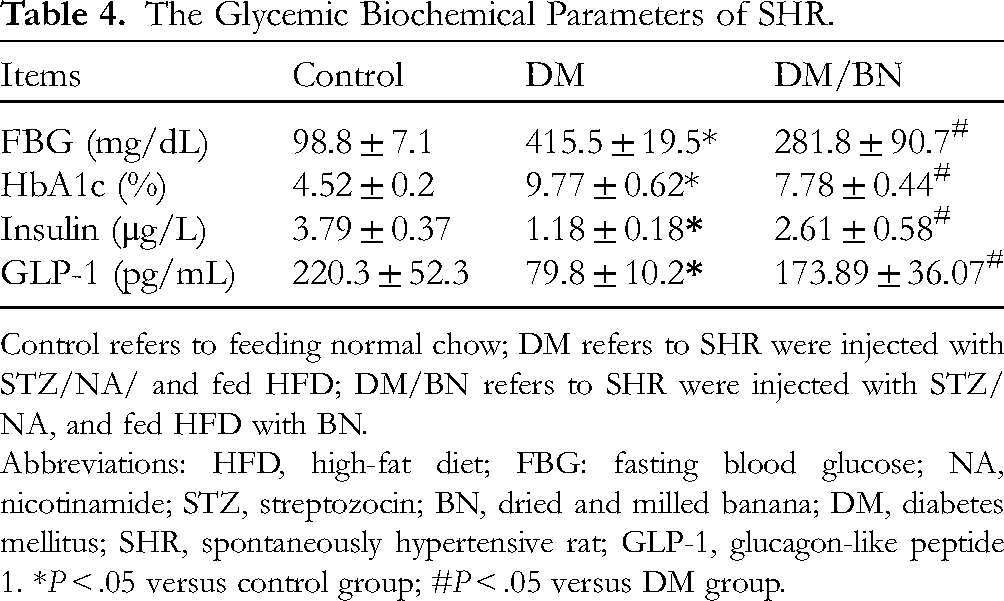
Control refers to feeding normal chow; DM refers to SHR were injected with STZ/NA/ and fed HFD; DM/BN refers to SHR were injected with STZ/NA, and fed HFD with BN.
Abbreviations: HFD, high-fat diet; FBG: fasting blood glucose; NA, nicotinamide; STZ, streptozocin; BN, dried and milled banana; DM, diabetes mellitus; SHR, spontaneously hypertensive rat; GLP-1, glucagon-like peptide 1. *P < .05 versus control group; #P < .05 versus DM group.
As we know, adipose tissue, skeletal muscle, and liver are the important places of glucose for consumption, deposition, and conversion into glycogen. In addition, the sensitivity of insulin plays the most crucial role. After insulin binding on IR, enzymes involved in glucose metabolism are activated sequentially, such as PI3K and Akt/PKB stimulating GLUT expression, HXK and PK enhancing glycolysis, downregulation of GSK-3α stimulating glycogenesis, and lower down of PEPCK and G6Pase decreasing gluconeogenesis.31-33 However, hyperglycemia, insulin resistance even DM reduce IR sensitivity, glucose uptake ability, glycolysis, and glycogenesis and increase gluconeogenesis proteins expression. 34 AMPK and PPAR-γ are other pathways to regulate blood glucose. AMPK and PPAR-γ also promote insulin sensitivity and maintain glucose homeostasis, and DM worsens their activities. 35 The protein expression analysis found that the DM group had lower levels of AMPK, IR, IRS-1, PI3K, Akt/PKB, GLUT-4, PPAR-γ, HXK, and PK in skeletal muscles and higher levels of GSK-3α, PEPCK, and G6Pase in the liver compared to the control group. BN reversed the changes observed in the protein levels in the DM group. The results provide an insight into how the BN improves the symptoms (Figures 3 and 4).
The purpose of choosing 8-week-old SHRs and making them suffer from DM was to estimate the changes in the cardiovascular function in this model of hypertension combined with DM. Although the blood pressure and heart rate of SHR did not worsen after 4 weeks of DM, worsening cardiac complications were observed. The blood pressure and heart rates of the DM group were not found to be higher than the control group (Table 5). We suggested that perhaps the duration of our experiment was too short to increase blood pressure and heart rate. However, the DM/BN group did have more moderate blood pressure and heart rate than either the DM group or the control group. Many reports have proved that the banana could ameliorate blood pressure,36,37 and that is associated with potassium-rich in the banana. 38 Thus, we suggested that the effect of BN ameliorated hypertension and tachycardia was partially related to the richness of potassium.
The Effects of BN in Blood Pressure and Heart Rate of SHR.

Control refers to feeding normal chow; DM refers to SHR were injected with STZ/NA and fed HFD; DM/BN refers to SHR were injected with STZ/NA, and fed HFD with BN.
Abbreviations: HFD, high-fat diet; SBP, systolic blood pressure; DBP, diastolic blood pressure; MBP, mean blood pressure; HR, heart rate; NA, nicotinamide; STZ, streptozocin; BN, dried and milled banana; DM, diabetes mellitus; SHR, spontaneously hypertensive rat. *P < .05 versus control group; #P < .05 versus DM group.
Vascular contraction and relaxation activities are adversely influenced by long-term higher blood glucose, or insulin resistance, leading to hypertension. These crucial biochemical parameters damage the endothelium-dependent relaxation and cause serious vascular contraction. 39 For example, AGTR1 and ETAR increase vasocontraction. AGTR2 and ETBR induce the release of nitric oxide (NO), an endothelium-derived relaxing factor. 40 eNOS produces NO, which dilates blood vessels and protects the cardiovascular system. 41 In hyperglycemia, the levels of AGTR1 and ETAR, and AGTR2, ETBR, and eNOS, lead to adverse changes in the blood pressure. Our study found that the DM group had higher levels of ETAR and lower levels of ETBR and p-eNOS than the control group, demonstrating that DM worsened vascular function. The DM/BN group with hypertension had higher levels of AGTR2, ETBR, eNOS, and p-eNOS, and lower levels of AGTR1 and ETAR than the DM group. After feeding HFD with BN as a carbohydrate substitute for 4 weeks, the DM/BN group had reduced levels of AGTR2, ETBR, eNOS, and p-eNOS, and lower levels of AGTR1 and ETAR changes, indicating that BN could inhibit DM-induced vascular dysfunction. We believe this occurrence after BN ameliorated hyperglycemia, insulin resistance, hypertension, and tachycardia.
Conclusion
The BN ameliorated the hyperglycemia, and hypoinsulinemia induced by STZ/NA and HFD, and reversed hypertension and tachycardia in diabetic SHR. The results indicate BN possesses the richness of RS, antioxidants, and potassium, so it can improve DM, hypertension, and tachycardia; and inhibit DM-induced vascular dysfunction. We suggest the BN could be used as an effective dietary intervention for ameliorating DM, hypertension, and tachycardia (Figure 6). Taken together, banana is a healthy fruit, and a beneficial resource of starch can be recommended to produce various staple foods, such as noodles, pasta, or bread, to prevent DM conveniently.15-20 Whether banana still has similar effects after it is made into food remains to be studied. To analyze the bioactivities and applications of banana production will be the next challenge.

Hypothetical mechanisms of BN in treating STZ/NA/HFD-induced DM. BN ameliorated hyperglycemia, hypoinsulinemia, hypertension and tachycardia. The vasocontraction and vasodilation related proteins were recovered by BN. Taken together, the BN could be used as a functional food for controlling DM and its complications. Abbreviations: HFD, high-fat diet; NA, nicotinamide; STZ, streptozocin; BN, dried and milled banana; DM, diabetes mellitus.
Supplemental Material
sj-pptx-1-npx-10.1177_1934578X231213225 - Supplemental material for Effect Evaluation of Banana on Improving Hyperglycemia and Hypertension in Diabetic Spontaneously Hypertensive Rats
Supplemental material, sj-pptx-1-npx-10.1177_1934578X231213225 for Effect Evaluation of Banana on Improving Hyperglycemia and Hypertension in Diabetic Spontaneously Hypertensive Rats by Hui-Li Lin, Yu-Hsiu Tseng, Chien-Chih Yeh, Ya-Mei Chen and Kuo-Ping Shen in Natural Product Communications
Supplemental Material
sj-pptx-2-npx-10.1177_1934578X231213225 - Supplemental material for Effect Evaluation of Banana on Improving Hyperglycemia and Hypertension in Diabetic Spontaneously Hypertensive Rats
Supplemental material, sj-pptx-2-npx-10.1177_1934578X231213225 for Effect Evaluation of Banana on Improving Hyperglycemia and Hypertension in Diabetic Spontaneously Hypertensive Rats by Hui-Li Lin, Yu-Hsiu Tseng, Chien-Chih Yeh, Ya-Mei Chen and Kuo-Ping Shen in Natural Product Communications
Supplemental Material
sj-pptx-3-npx-10.1177_1934578X231213225 - Supplemental material for Effect Evaluation of Banana on Improving Hyperglycemia and Hypertension in Diabetic Spontaneously Hypertensive Rats
Supplemental material, sj-pptx-3-npx-10.1177_1934578X231213225 for Effect Evaluation of Banana on Improving Hyperglycemia and Hypertension in Diabetic Spontaneously Hypertensive Rats by Hui-Li Lin, Yu-Hsiu Tseng, Chien-Chih Yeh, Ya-Mei Chen and Kuo-Ping Shen in Natural Product Communications
Supplemental Material
sj-pptx-4-npx-10.1177_1934578X231213225 - Supplemental material for Effect Evaluation of Banana on Improving Hyperglycemia and Hypertension in Diabetic Spontaneously Hypertensive Rats
Supplemental material, sj-pptx-4-npx-10.1177_1934578X231213225 for Effect Evaluation of Banana on Improving Hyperglycemia and Hypertension in Diabetic Spontaneously Hypertensive Rats by Hui-Li Lin, Yu-Hsiu Tseng, Chien-Chih Yeh, Ya-Mei Chen and Kuo-Ping Shen in Natural Product Communications
Supplemental Material
sj-pptx-5-npx-10.1177_1934578X231213225 - Supplemental material for Effect Evaluation of Banana on Improving Hyperglycemia and Hypertension in Diabetic Spontaneously Hypertensive Rats
Supplemental material, sj-pptx-5-npx-10.1177_1934578X231213225 for Effect Evaluation of Banana on Improving Hyperglycemia and Hypertension in Diabetic Spontaneously Hypertensive Rats by Hui-Li Lin, Yu-Hsiu Tseng, Chien-Chih Yeh, Ya-Mei Chen and Kuo-Ping Shen in Natural Product Communications
Footnotes
Acknowledgments
The authors would like to thank Miss Yi-Chen Tu and Mr Bor-Chun Yeh for their technical advice and support.
Author Contribution
Hui-Li Lin, Yu-Hsiu Tseng, and Kuo-Ping Shen designed the research; Hui-Li Lin, Chien-Chih Yeh, and Kuo-Ping Shen performed the experiments; Hui-Li Lin, Yu-Hsiu Tseng, Chien-Chih Yeh, and Ya-Mei Chen analyzed the data; Kuo-Ping Shen and Hui-Li Lin wrote the manuscript; All authors read and approved the final manuscript.
Data Availability Statements
The data underlying this article will be shared on reasonable request to the corresponding author.
Declaration of Conflicting Interests
The authors declared no potential conflicts of interest with respect to the research, authorship, and/or publication of this article.
Ethical Approval
This animal experiment complied with the relevant regulations of IACUC, and was approved by the Animal Care and Use Committee of the Meiho University (approval number: MU-ACUC-2019-09).
Funding
The authors disclosed receipt of the following financial support for the research, authorship, and/or publication of this article: This work was supported by funding from Ministry of Science and Technology (MOST 108-2320-B276-002-MY3 and MOST 109-2637-H-328-002).
Statement of Human and Animal Rights
All animal procedures used in this study complied with the standard laboratory practices protecting animal welfare.

Supplemental Material
Supplemental material for this article is available online.
References
Supplementary Material
Please find the following supplemental material available below.
For Open Access articles published under a Creative Commons License, all supplemental material carries the same license as the article it is associated with.
For non-Open Access articles published, all supplemental material carries a non-exclusive license, and permission requests for re-use of supplemental material or any part of supplemental material shall be sent directly to the copyright owner as specified in the copyright notice associated with the article.
