



Abstract
Keywords
Introduction
Angina pectoris (AP) tends to be the main factor of disability and death in the Chinese population. 1 In addition, persistent chest pain will decrease the quality of life and seriously threaten people's health. 2 At present, drug intervention is commonly used in the treatment of stable AP, and surgical revascularization has a significant benefit in AP when symptoms are refractory to drug control.3,4 In addition, research manifests that stress-induced myocardial ischemia could be reduced by a low-fat diet and physical exercise in coronary artery diseases, which then relieves angina symptoms. 5 Medication consists of long-acting nitrates, β-blockers, calcium antagonists, and potassium channel openers. However, there are certain side effects and unpredictable adverse reactions. Research suggested 6 that traditional Chinese medicine (TCM) displays favorable effects on the treatment of AP with fewer toxic side effects. Consequently, an increasing number of researchers have embarked on exploring the mechanism of TCM on AP. Moreover, the superior drug pair will be selected to guide the clinical practice and the new drug development.
In the clinical application of TCM, the use of a single herb to ameliorate diseases is limited, and TCM herbs often need to be used in combination to achieve the greatest efficacy. Therefore, based on this traditional compatibility theory of TCM, we proposed the hypothesis that the drug pairs of corydalis rhizome (CR)-chuanxiong rhizome (CXR), CR-angelica dahuricae radix (ADR), or CR-astragali radix (AR) has a superior effect on the treatment of AP compared to CR alone. Meanwhile, the significant difference in ameliorating AP among the 3 drug pairs was also probed. Among them, CR, a plant of the Papaveraceae family, whose chemical compounds mainly include alkaloids, steroids, organic acids, and sugars, possesses the effects of anti-inflammatory, acid-suppressing, vasodilating, spasmolytic,7–9 and is often used to alleviate pain in clinical practice of TCM. 10 CXR, a plant of the Umbelliferae, whose chemical compounds mainly consist of phthalides, dimers, alkaloids, organic acids, polysaccharides, cerebrosides, and ceramides. Among them, phthalides compounds are CXR's main chemical components, which have anti-myocardial ischemia, anti-atherosclerosis, and anti-platelet aggregation effects.11,12 ADR, a plant of the Umbelliferae, whose chemical compounds are mainly volatile oil, methylene, hexadecenoic acid, cyclohexene, etc., has anti-inflammatory, analgesic, and vasodilator effects. 13 AR, a Leguminous plant, whose chemical components are mainly triterpene saponins, various flavonoids, and polysaccharides, can protect cardiovascular and cerebrovascular function, improve immune function, and regulate blood pressure.14,15 Additionally, in the present study, CR-AP was considered as a control group while (CR-CXR)-AP, (CR-ADR)-AP, and (CR-AR)-AP were considered as experimental groups.
Network pharmacology is a new method involving traditional pharmacology, bioinformatics, chemical informatics, and network biology. 16 At present, it has been widely applied to explore the primary pharmacological effects and molecular mechanisms in TCM by constructing a medicals-disease-targets network. 17 Based on network pharmacology, this study analyzed the molecular mechanisms and potential pharmacological effects of CR-CXR, CR-ADR, and CR-AR in treating AP from the perspective of multiple components, targets, and pathways. Meanwhile, it may provide a scientific basis for new drug developments to ameliorate AP.
In addition to network pharmacology, we introduce the principal component analysis (PCA) method to support the key pathway. The PCA is a multivariate statistical method that reduces the dimensionality of the data and retains most of the changes in the data set, 18 so that each group could be manifested by rather few variables. As a primary mathematical analysis method, PCA is currently widely applied in the medical field. 19
Meanwhile, we applied meta-analysis to compare the effect of CXR, ADR, or AR respectively combined with CR on the amelioration of AP, in order to explore their significant differences and further find the superior drug pairs. In recent years, meta-analysis has greatly developed in many fields, such as epidemiology, psychology, and educational research, especially medical research.20–22 This method provided a novel idea to compare drug pairs or different drugs, whose results may further offer a reference for future clinical medication.
In this study, based on the theory of drug pair combination and synergistic efficiency, the mechanism of different drug pairs to ameliorate AP and the differences between drug pairs were explored by applying modern network pharmacology and meta-analysis methods in order to screen out the superior drug pairs, which provides insight into the precision treatment of traditional medicine. A workflow of the analysis processes for CR, CXR, ADR, AR, and AP targets identification and mechanism investigation is shown in Figure 1.

The pharmacologic mechanism workflow of CR-CXR, CR-ADR, or CR-AR to treat AP based on network pharmacology approaches.
Materials and Methods
Screening of Active Compound of 4 Herbs and Prediction of Corresponding Targets
Chemical compounds of the 4 herbs (CR, CXR, ADR, and AR) were obtained from the Traditional Chinese Medicine Systems Pharmacology Database and Analysis Platform 23 (TCMSP, https://tcmsp-e.com/) where 499 herbs and 12144 chemical constituents are available from Chinese Pharmacopoeia (2010). To avoid missing the active ingredients due to the low (limited) oral bioavailability (OB) value or druglikeness (DL) value, there was no limitation to the OB value and DL value. In addition, the database of the Encyclopedia of Traditional Chinese Medicine 24 (ETCM, http://www.tcmip.cn/ETCM/index.php/Home/Index/) (402 herbs, 7284 ingredients, and 2266 targets) and the Bioinformatics Analysis Tool for Molecular mechanism of Traditional Chinese Medicine 25 (BATMAN-TCM, http://bionet.ncpsb.org.cn/batman-tcm/) were also used to supplement the active ingredients and targets of 4 drugs. Subsequently, the active ingredients of CR, respectively, combined with CXR, ADR, or AR.
Screening the Target of AP
The medical subject headings “Angina pectoris” and “AP” were applied to perform keyword searches in the GeneCards database 26 (https://www.genecards.org/) and selection through the criterion of relevance score > 1.5. In addition, the Therapeutic Target Database 27 (TTD, https://db.idrblab.org/ttd/), the DisGeNET database 28 (https://www.disgenet.org/), and Online Mendelian Inheritance in Man database 29 (OMIM, https://mirror.omim.org/) were used to explore the potential targets of AP. Subsequently, the targets from 4 databases were merged and duplicate values were removed to obtain the ultimate targets of the disease.
Construction of the Protein-Protein Interaction (PPI) Network
The intersection targets of CR-AP, (CR-CXR)-AP, (CR-ADR)-AP, and (CR-AR)-AP were extracted. They were imported into the STRING 30 (Version: 11.5) (https://cn.string-db.org/cgi/input?sessionId=bZ84DxG2vPw0) database to build a PPI network model, respectively. Finally, the options “multiple proteins” and “homo sapiens” were applied. In the STRING database, species were restricted to Homo sapiens. The minimum required interaction score was 0.15 for the low confidence, 0.4 for the medium confidence, 0.7 for the high confidence, and 0.9 for the highest confidence. In general, the greater the confidence score was, the greater the accuracy would be. Therefore, based on the extraction of data that is set to “highest confidence” > 0.9, which meets the accuracy and quality requirements of PPI. 31 Meanwhile, the nodes of disconnect were hidden in network and export files.
Construction of Networks
The PPI file was imported into Cytoscape (Version: 3.7.2) software 32 (http://www.cytoscape.org/), an open-source platform, whose purpose is to analyze complex network diagrams to obtain the PPI core network, core targets, and key compounds of different drug pairs for regulating AP. Meanwhile, the important network topology parameters were selected by calculating the degree, betweenness centrality, and closeness centrality. The degree was calculated by the function of “network analysis” in Cytoscape, 33 which means that a node is directly connected with other nodes in the network. 34 Closeness centrality and betweenness centrality were calculated by the CytoNCA, a Cytoscape plugin. The degree value also served as an assessment for the significance of core targets.
Enrichment Analysis of Gene Ontology (GO) and Kyoto Encyclopedia of Genes and Genomes (KEGG) Pathway
GO is a major bioinformatics initiative that aims to unify the representation of genes and gene product attributes of all species, including biological processes (BP), molecular functions (MF), and cellular components (CC). BP represents a specific objective that the organism achieves via genetically programming. 35 MF is considered as an expression of biochemical activity. 36 CC describes parts of cells and structures associated with cells throughout the taxonomy range. 37 The metabolic pathways of gene products in cells and their functions are analyzed through the KEGG, 38 which has gradually become a comprehensive knowledge database of functional interpretation and practical application of genomic information. 39 The intersection targets of CR-AP, (CR-CXR)-AP, (CR-ADR)-AP, and (CR-AR)-AP were imported into the Metascape 40 platform (https://metascape.org/gp/index.html#/main/step1) to analyze the enrichment of BP and KEGG pathways, respectively. Then, the species of “homo sapiens” genes were selected. In the Enrichment analysis, “KEGG Pathways” and “GO Biological Processes” were chosen for enrichment analysis of KEGG Pathways and BP, respectively. Meanwhile, the GO term and KEGG pathways with a P value < .01 were set for further research. Finally, the enrichment results were visualized via the bioinformatics platform (http://www.bioinformatics.com.cn/).
PCA
PCA of KEGG pathways and BP were performed by SPSS (Version: 26.0) software to support and find the key pathways and BP. The new data (Z-score) were obtained by standardizing the original data of KEGG pathways and BP. The Kaiser–Meyer–Olkin (KMO) statistic and Bartlett's test of sphericity were performed to test the applicability of factor analysis.
Meta-Analysis
Meta-analysis is primarily the systematic synthesis or used to merge results from single, independent research to account for differences, heterogeneity, and sensitivity of study methods and results by calculating overall or “absolute” effects by statistical methods. 41 Common steps in meta-analysis include (1) identifying a research topic, (2) systematic review: searching literature related to the topic, developing the inclusion and exclusion criteria, assessing the quality of included articles, (3) extracting data, (4) standardizing and weighing studies, and (5) finally estimating the effect. 42 Furthermore, metan, a subcommand of meta-analysis, 43 can help to skip the first 4 steps of traditional meta-analysis and directly evaluate the effect, if data required by metan has been obtained. 44 In our study, the data used for the analysis mainly comes from GO enrichment analysis and the KEGG pathway. With the metan command, the significant difference in the drug pairs for treating AP can be directly analyzed.
In meta-analysis, for dichotomous outcomes, risk ratio or relative risk, odds ratio, and risk difference can be used to assess differences between 2 groups. For continuous data, overall effectiveness presented on the same scale was expressed as the mean and standard deviation (SD) and analyzed by calculating mean differences (MD), while the difference in the measurement method or unit was analyzed by calculating the standardized mean differences (SMD).
Following the Cochrane Handbook for Systematic Reviews of Interventions, the overall effectiveness of the KEGG pathway and BP data were considered continuous. Besides, in the meta-analysis, I-square (I2) was applied to evaluate the study heterogeneity. Study heterogeneity was divided into 4 levels. An I2 value of 0% was considered to have no heterogeneity; values greater than 25%, 50%, and 75% were considered to indicate low, medium, and high heterogeneity, respectively. When the I2 value was less than 50%, it was regarded as falling into the acceptable range. The level of statistical significance was set at P < .05
Construction of Herb-(Key Compound)-(Core Target)-KEGG Pathway Network
The key compounds and core targets of CR, CR-CXR, CR-ADR, and CR-AR were mapped in the KEGG pathway of AP. Meanwhile, the herb-(key compound)-(core target)-KEGG pathway network was constructed by Cytoscape software. In addition, the top 20 KEGG pathways were selected. The shape became bigger, as the degree value increased, which indicates that the compounds are more vital.
Statistical Analysis
The enrichment of BP and KEGG were analyzed by the Metascape platform, while Cytoscape (Version: 3.7.2) software performed topology analysis. Statistical differences of drug pairs were analyzed by metan command. In addition, P < .05 was treated as statistically significant.
Results
Active Compounds and Related Targets of Drugs
The active compounds in the TCMSP, ETCM, and BATMAN-TCM databases were merged, and duplicate values were deleted. One hundred six compounds of CR, 214 compounds of CXR, 207 compounds of ADR, and 84 compounds of AR were selected. Then, the compounds of CR-CXR, CR-ADR, and CR-AR were combined separately, and the repeated values of the drug pairs were deleted. Finally, 298 compounds and 1372 targets of CR-CXR, 289 compounds and 1559 targets of CR-ADR, and 180 compounds and 1177 targets of CR-AR were selected (Supplementary Table S1).
Related Targets of AP
A total of 1345 related targets were obtained from GeneCards, TTD, OMIM, and DisGeNET databases and 1202 targets were finally retained after deleting duplicate values. Furthermore, the intersection targets of CR-AP (Figure 2A), (CR-CXR)-AP (Figure 2B), (CR-ADR)-AP (Figure 2C), and (CR-AR)-AP (Figure 2D) were taken, respectively. In addition, the Venn diagram was drawn on the Jvenn platform (http://jvenn.toulouse.inra.fr/app/example.html) by intersecting the targets.

Intersection targets of (A) CR-AP, (B) (CR-CXR)-AP, (C) (CR-ADR)-AP, and (D) (CR-AR)-AP.
Ultimately, 189 intersection targets of CR-AP, 275 intersection targets of (CR-CXR)-AP, 299 intersection targets of (CR-ADR)-AP, and 251 intersection targets of (CR-AR)-AP were extracted separately (Figure 2).
Analyses of PPI Network
The intersection targets of CR-AP, (CR-CXR)-AP, (CR-ADR)-AP, and (CR-AR)-AP were separately imported into the STRING platform to construct the PPI network. According to prespecified conditions, the PPI network of CR-AP with 188 nodes, 512 edges, 5.45 average node degree, and 0.4 average local clustering coefficient was obtained, with a PPI enrichment P value < 10 e−16; then, this PPI file was imported into Cytoscape. The proteins with a 2-fold median value were screened from the network to obtain the PPI core network. As shown in Figure 3A, the core proteins of the PPI in the CR-AP are JUN, MAPK1, AKT1, TP53, and so on, which may play a critical role in ameliorating the AP with CR. Among them, the activation of JUN (also known as transcription factor AP-1) and nuclear factor κB (NF-kB) will cause a feed-forward mechanism, aggravating the production of proinflammatory cytokine 45 that induce pain. 46 Mitogen-activated protein kinase (MAPK), a family of serine/threonine protein kinases, 47 involves cellular proliferation, differentiation, development, inflammatory responses, and apoptosis. 48 The study found that the activation of the MAPK signaling pathway may play an essential role in the production and maintenance of pain. 49 AKT, a serine/threonine kinase, including 3 isoforms (AKT1, AKT2, and AKT3), participates in the function of glucose metabolism regulation, protein synthesis, neovascularization, and so on. 50 Among the 3 isoforms, the AKT1 genetic absence will result in the dysfunction of endothelial cells and reduce the migration and survival of vascular smooth muscle cells, thereby facilitating atherosclerosis and occlusive coronary arterial disease, 51 which may be related to the marked reduction in the production of NO and endothelial cell viability. 50 Additionally, research indicates that the hypersensitivity of pain could be reversed by continuous administration of TP53 in males, which may play a crucial role in ameliorating pain. 52

Screening of PPI core network. Core proteins of CR-AP, (B) core proteins of (CR-CXR)-AP, (C) core proteins of (CR-ADR)-AP, and (D) core proteins of (CR-AR)-AP.
The PPI network of (CR-CXR)-AP with 274 nodes, 830 edges, 6.06 average node degree, and 0.406 average local clustering coefficient was received, P value < 10 e−16. The proteins with a 1-fold median value were screened from the network to acquire the PPI core network. As shown in Figure 3B, the core proteins of PPI are SRC, JUN, MAPK1, AKT1, and so on, which may contribute to ameliorating the AP with (CR-CXR)-AP. Notably, the non-receptor tyrosine kinase SRC is anchored in the N-methyl-D-aspartate receptor (NMDAR) complex by the adaptor protein of NADH dehydrogenase subunit 2 (ND2). 53 Besides, NMDAR has been found to be closely related to visceral pain. 54 Meanwhile, evidence suggests that the pain could be relieved by destroying the interaction of the Src-ND2. 55
The PPI network of (CR-ADR)-AP with 298 nodes, 1061 edges, 7.12 average node degree, and 0.426 average local clustering coefficient were gained, P value < 10 e−16. The proteins with a 2-fold median value were screened from the network. As shown Figure 3C, the core proteins of the PPI are PIK3CA, MAPK3, SRC, MAPK1, and so on. Phosphatidylinositol-4,5-bisphosphate 3-kinase catalytic subunit alpha (PIK3CA) is also referred to as PI3 K, which plays a vital role in inducing the inflammatory response by the activation of PI3 K/Akt signaling pathway. 56 Interestingly, Liao. et al. found that inflammatory pain could be markedly relieved by injecting the PI3 K inhibitor. 57 The PPI network of (CR-AR)-AP with 250 nodes, 734 edges, 5.87 average node degree, and 0.41 average local clustering coefficient was obtained, P value < 10 e−16. The proteins with a 2-fold median value were screened from the network. As shown in Figure 3D, the core proteins of the PPI are MAPK1, AKT1, JUN, TP53, and so on.
Analyses of Compound-Target Network
According to the topological analysis, there were CR-AP with 278 nodes (89 compounds and 189 genes) and 935 edges, (CR-CXR)-AP with 535 nodes (260 compounds and 275 genes) and 1939 edges, (CR-ADR)-AP with 548 nodes (249 compounds and 299 genes) and 2182 edges, and (CR-AR)-AP with 411 nodes (160 compounds and 251 genes) and 1401 edges, with a higher edge. To obtain the key compounds, the compounds with more than a 2-fold median value for degree and betweenness centrality, more than the median of closeness centrality, were screened from the network. 58 Finally, 78 nodes (10 compounds and 68 targets) and 250 edges were obtained for CR-AP (Figure 4A). One hundred sixty-eight nodes (45 compounds and 123 targets) and 773 edges were obtained for (CR-CXR)-AP (Figure 4B). One hundred fifty-two nodes (35 compounds and 117 targets) and 711 edges were received for (CR-ADR)-AP (Figure 4C). One hundred eighteen nodes (21 compounds and 97 targets) and 464 edges were obtained for (CR-AR)-AP (Figure 4D). Furthermore, the targets corresponding to the screened compounds were imported into the STRING platform. It was found that the PPI network of CR-AP was with 4.98 average node degree and 0.399 average local clustering coefficient, (CR-CXR)-AP with 5.8 average node degree and 0.431 average local clustering coefficient, (CR-ADR)-AP with 6.6 average node degree and 0.438 average local clustering coefficient and (CR-AR)-AP with 5.58 average node degree and 0.416 average local clustering coefficient. Compared with CR-AP, it could be inferred that CXR, ADR, and AR compounds had an enhancement effect on CR.

Network diagram of key compound targets. (A) Network diagram of CR-AP, (B) network diagram of (CR-CXR)-AP, (C) network diagram of (CR-ADR)-AP, and (D) network diagram of (CR-AR)-AP. (Red nodes stand for the key compounds and blue nodes stand for the core target).
Moreover, the size of node represents the importance of node. The greater the degree value is, the bigger the shape will be, which suggests that the node is of more significance . 34 According to the degree value of compounds, the top 10 compounds, include Oleic Acid, Quercetin, Isocorydine, Protopine, Emodin, Glaucine, Corydaline, Allocryptopine, Yuehchukene, and Tetrahydropalmatine compounds of CR-AP. The Quercetin, Palmitic Acid, Tetrahydropalmatine, Glaucine, Thymol, Corydaline, Yuehchukene, Oleic Acid, Chrysophanol, Emodin, and Beta-Elemene are compounds of (CR-CXR)-AP; The Quercetin, D-Carvone, (-)-Carvone, Undecylenic Acid, 1-Methyl-2-Pentadec-6-Enyl-4(1 h)-Quinolone, Glaucine, Corydaline, Tetrahydropalmatine, Carvacrol, and Yuehchukene are compounds of (CR-ADR)-AP; The Quercetin, Tetrahydropalmatine, Glaucine, Corydaline, Yuehchukene, Kaempferol, Daidzein, Palmitic Acid, Oleic Acid, and Emodin are compounds of (CR-AR)-AP.
GO and KEGG Enrichment Analyses
GO enrichment analysis included 390 BP in the CR-AP which described the function of gene products. The top 20 BP terms (P < .01) 58 in CR-AP had “circulatory system process”, “response to wounding”, “positive regulation of protein phosphorylation”, “regulation of ion transport”, etc. (Figure 5A). GO enrichment analysis involved 407 BP in the (CR-CXR)-AP. The top 20 BP terms (P < .01) in the (CR-CXR)-AP included “circulatory system process”, “regulation of ion transport”, “regulation of secretion”, “ion homeostasis”, “positive regulation of protein phosphorylation”, etc. (Figure 5B). GO enrichment analysis included 354 BP in (CR-ADR)-AP. The top 20 BP terms (P < 0.01) in the (CR-ADR)-AP included “blood circulation”, “ion homeostasis”, “regulation of secretion”, “positive regulation of protein phosphorylation”, etc. (Figure 5C). GO enrichment analysis contained 422 BP in (CR-AR)-AP. The top 20 BP terms (P < 0.01) in the (CR-AR)-AP included “circulatory system process”, “positive regulation of protein phosphorylation”, “regulation of ion transport”, etc. (Figure 5D).

The core target BP enrichment pathway. (A) The BP enrichment of the CR-AP, (B) the BP enrichment of the (CR-CXR)-AP, (C) the BP enrichment of the (CR-ADR)-AP, and (D) the BP enrichment of the (CR-AR)-AP. GO showed the top 20 BP terms with a P value < .01.
For the enrichment analysis of the KEGG signal pathway, the y-axis represents the KEGG signaling pathway of the target genes, while the x-axis represents enrichment. The size of the dot indicates the number of genes, and the color that continuously changes from blue to red represents the lowest to the highest P value. The larger the dot, the redder the color, which means the pathway is essential. 59 Therefore, the KEGG pathways included 215 results in CR-AP. The top 20 KEGG terms (P < .01) involved “fluid shear stress and atherosclerosis”, “AGE-RAGE signaling pathway in diabetic complications”, “cAMP signaling pathway”, “HIF-1 signaling pathway”, “Rap1 signaling pathway”, and “the cancer-associated pathways” (Figure 6A). The KEGG pathways included 263 results in (CR-CXR)-AP. The top 20 KEGG terms (P < .01) were enriched in “fluid shear stress and atherosclerosis”, “pathways in cancer”, “serotonergic synapse”, “neuroactive ligand-receptor interaction”, “renin secretion signaling pathways”, “NF-kappa B signaling pathways”, “cGMP-PKG signaling pathways”, and “calcium signaling pathways” (Figure 6B). The KEGG pathways included 283 results in (CR-ADR)-AP. The top 20 KEGG terms (P < .01) are enriched in “pathways in cancer”, “serotonergic synapse”, “arachidonic acid metabolism”, “regulation of lipolysis in adipocytes”, “adrenergic signaling in cardiomyocytes”, “renin secretion”, “neuroactive ligand-receptor interaction”, “NF-kappa B signaling pathway”, and “cAMP signaling pathway” (Figure 6C). The KEGG pathways included 267 results in (CR-AR)-AP. The top 20 KEGG terms (P < .01) had the “serotonergic synapse”, “regulation of lipolysis in adipocytes”, “pathways in cancer”, “platelet activation”, “insulin resistance”, “fluid shear stress and atherosclerosis”, “cAMP signaling pathway”, “calcium signaling pathway”, “HIF-1 signaling pathway”, and “AGE-RAGE signaling pathway in diabetic complications” (Figure 6D).

The core target of KEGG pathway analysis. (A) The KEGG pathway analysis of the CR-AP, (B) the KEGG pathway analysis of the (CR-CXR)-AP, (C) the KEGG pathway analysis of the (CR-ADR)-AP, and (D) the KEGG pathway analysis of the (CR-AR)-AP. The KEGG pathway showed the top 20 KEGG terms with a P value < .01. The size of the node indicates the number of genes in the pathway, and the color of the node corresponds to P value ranges.
In addition, the KEGG pathway of the “fluid shear stress and atherosclerosis” (Figure 7A), and the “pathways in cancer” (Figure 7B) are shown in Figure 7. It shows that AP can be ameliorated by common genes of 3 drug pairs to some degree. In the “fluid shear stress and atherosclerosis” signaling pathway, common genes mainly relieve the symptoms of AP by promoting the production of anti-atherosclerotic factors and inhibiting the generation of pro-atherosclerotic factors. In common genes, the production of NO is promoted by KDR and nitric oxide synthase (NOS3) genes to achieve the effects of vasodilation and anti-atherosclerosis, which in turn ameliorates AP. CYBA and RAC relieve the symptoms of AP by inhibiting the production of pro-atherosclerosis.
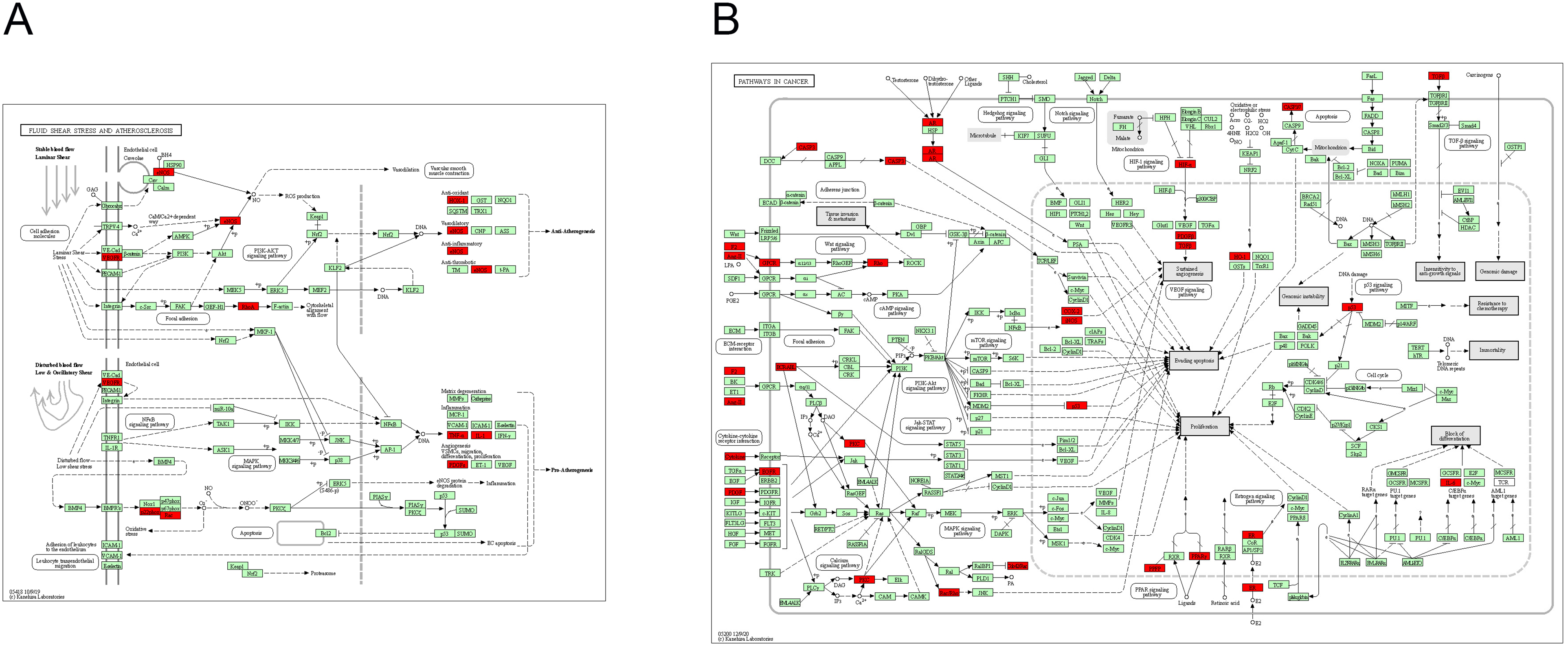
The Kyoto Encyclopedia of Genes and Genomes (KEGG) signaling pathway of the “fluid shear stress and atherosclerosis” (A) and “pathways in cancer” (B). Red represents the common genes of the drug pairs.
PCA
Data Standardization Processing and the Applicability Test of Factor Analysis
According to the PCA, the KMO value of the KEGG pathway and BP 18 indicated a certain correlation among those variables (Table 1).
KMO and Bartlett's Test of KEGG Pathway and BP.

Abbreviations: BP, biological processes; KEGG, Kyoto Encyclopedia of Genes and Genomes; KMO, Kaiser–Meyer–Olkin.
The Process of PCA
The variance contribution rate and the cumulative contribution rate of each component were calculated by the PCA method. Both the KEGG pathway (2.050) and BP (2.068) had only 1 eigenvalue greater than 1 (Tables 2 and 3). Therefore, only 1 principal component was extracted by SPSS (Version: 26.0) statistical analysis, which in turn, no factor rotation was performed. In addition, the cumulative contribution of the principal components of the KEGG pathway accounted for 68.347% of the total variance. The incremental contribution of the principal components of the BP was responsible for 68.940% of the total variance. These results showed that the quality level of the overall indicator could be described by principal components.
Total Variance Explained by Kyoto Encyclopedia of Genes and Genomes (KEGG) pathway.

Total Variance Explained of Biological Processes (BP).

Principal Component Score and Comprehensive Score
The component matrix of the KEGG pathway (Table 4) and BP (Table 5) was extracted by the PCA method to calculate the principal component score and comprehensive score. According to Tables 2 and 3, the square roots of 2.050 and 2.068 were calculated, and 1.432 and 1.438 were finally obtained. Then, 

Component Matrix of Kyoto Encyclopedia of Genes and Genomes (KEGG) pathway.

Component Matrix of Biological Processes (BP).

According to Figure 6A, CR mainly intervened AP through the pathways of “fluid shear stress and atherosclerosis”, the “AGE-RAGE signaling pathway in diabetic complications”, the “cAMP signaling pathway”, the “HIF-1 signaling pathway”, the “Rap1 signaling pathway”, and the “pathways in cancer”. Meanwhile, the chief pathways of CR interventing AP were significantly enhanced (Table 6). In addition, it was revealed that the “pathways in cancer”, “fluid shear stress and atherosclerosis” all play significant roles in the intervention of AP. However, the “pathways in cancer” is not typical given its broad scope. Consequently, this is congruent with the findings in Figure 6.
The Principal Component Score and a Comprehensive Score of the KEGG Pathway.

Abbreviations: AP, angina pectoris; AR, astragali radix; ADR, angelica dahuricae radix; CR, corydalis rhizome; CXR, chuanxiong rhizome; KEGG, Kyoto Encyclopedia of Genes and Genomes.
Similarly, according to Figure 5A, BP was mainly enriched in the “circulatory system process”. However, the main BP of CR-AP had been strengthened through the combination of CR-ADR, CR-CXR, and CR-AR (Table 7 and Supplementary Table S3). Especially the “circulatory system process” (blood circulation is one of its sub-terms) participated by the combination of CR-ADR played an essential role in the treatment of AP, which is also consistent with the results in Figure 5. In addition, the combination of drug pairs also enhanced other BPs such as “ion homeostasis”, “ion transport regulation”, and “secretion regulation”.
The Principal Component Score and a Comprehensive Score of BP.
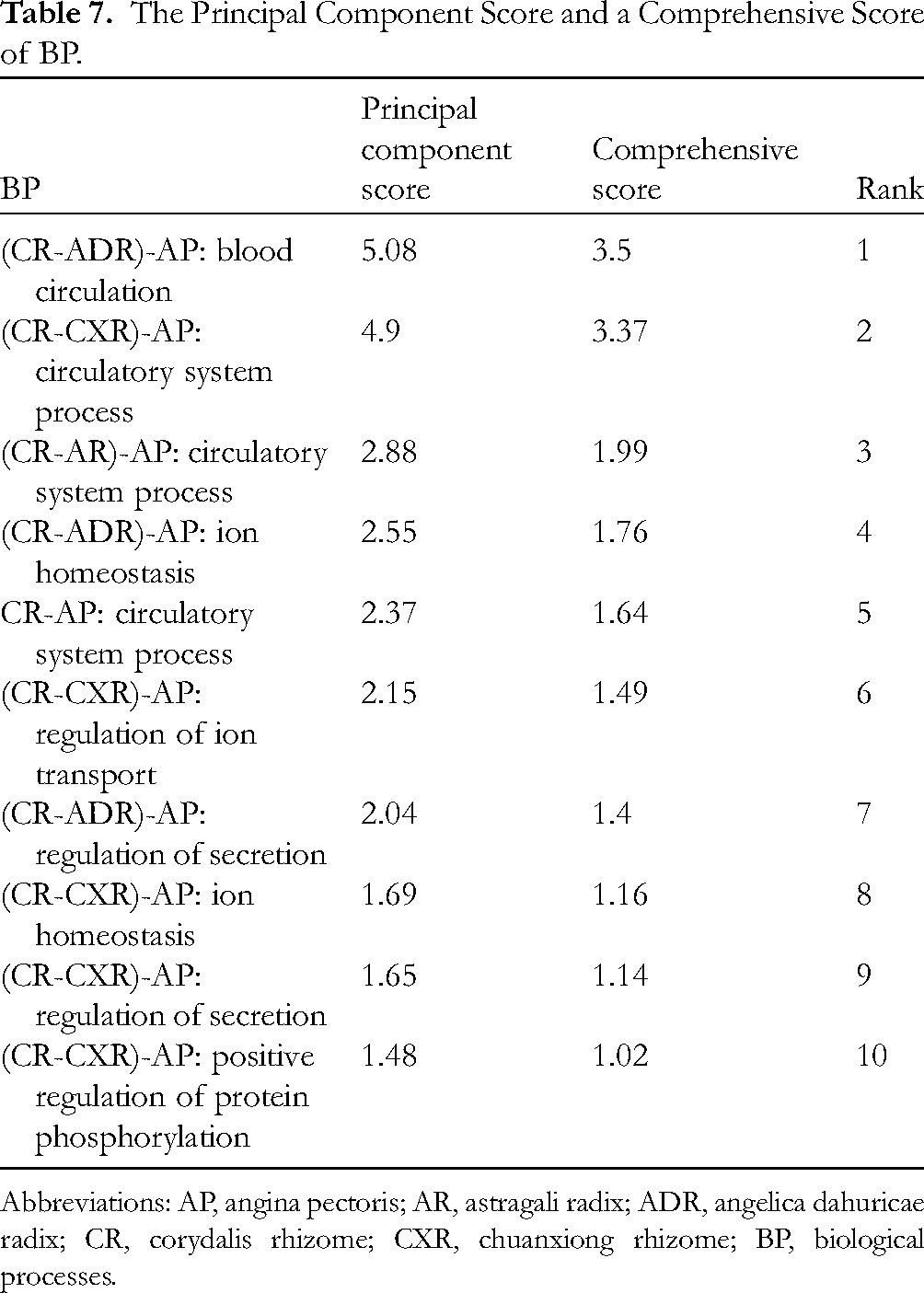
Abbreviations: AP, angina pectoris; AR, astragali radix; ADR, angelica dahuricae radix; CR, corydalis rhizome; CXR, chuanxiong rhizome; BP, biological processes.
Meta-Analysis
To further observe the effects of the different drug combinations on the amelioration of AP, a significant difference between the KEGG pathway and BP was separately performed by the Stata software. SMD was used in this study due to the unclear data units of the KEGG pathway and BP.
After respectively combining CR with the 3 herbs, the KEGG pathway (SMD = 0.74, 0.23 to 1.25, I2 = 0%) and BP (SMD = 0.97, 0.45 to 1.49, I2 = 0%) have enhanced tendency compared with the control group. Meantime, P value was less than .05, revealing that the combination of CR-CXR (SMD = 0.87, −0.03 to 1.76) had a significant effect on the KEGG pathway compared with the combination of CR-ADR (SMD = 0.62, −0.26 to 1.49) and CR-AR (SMD = 0.74, −0.15 to 1.62) (Figure 8A). The combination of CR-CXR (SMD = 1.18, 0.26 to 2.10) also significantly ameliorated the BP compared with the combination of CR-ADR (SMD = 0.95, 0.05 to 1.85) and CR-AR (SMD = 0.79, −0.10 to 1.68) (Figure 8B).
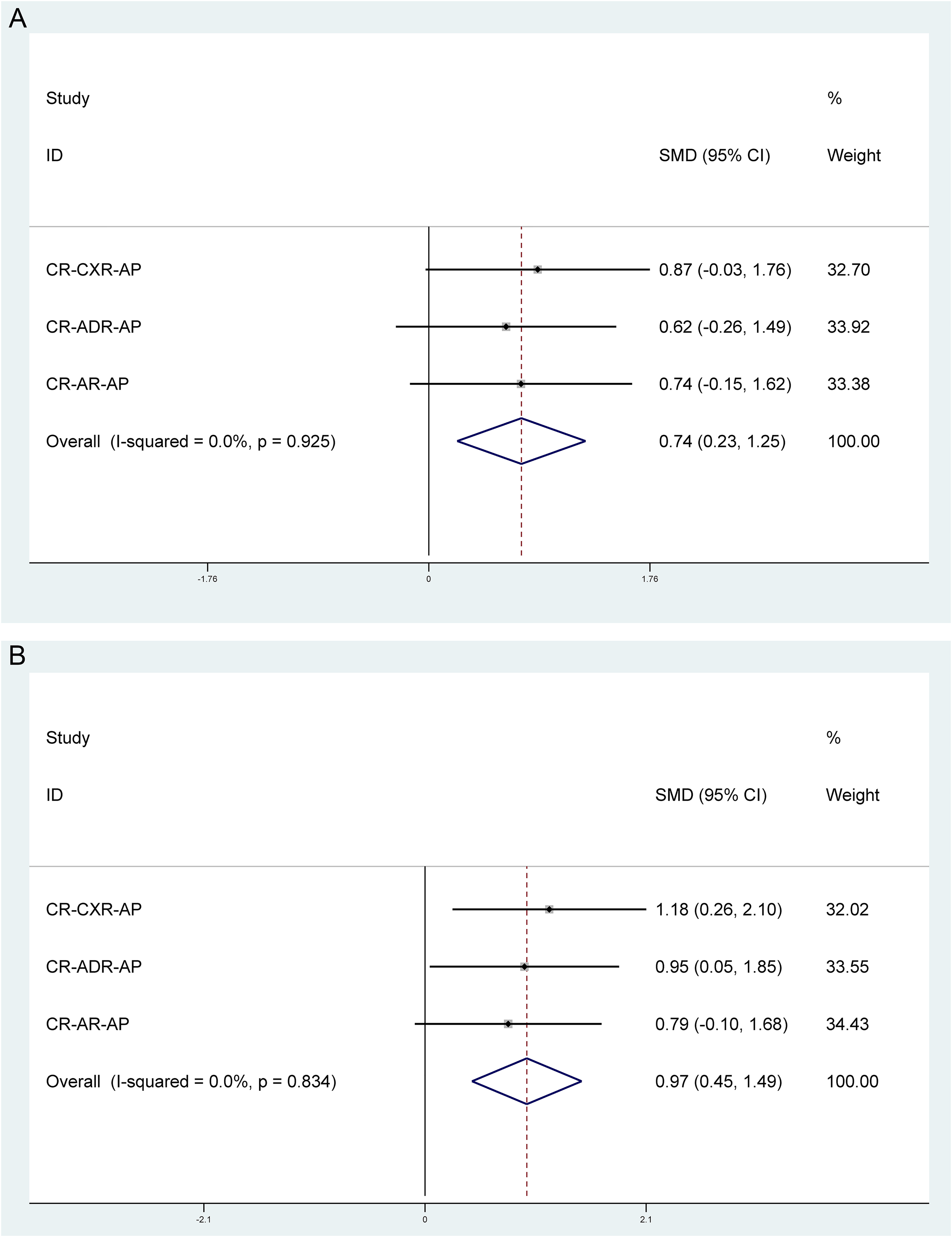
Forest plot displaying the effect of different drug pairs on AP of the experimental when compared with the control group. As determined by measuring (A) the KEGG pathway (P = .005) and (B) BP (P = .000). Both (A) and (B) experimental groups were higher than the control group.
Network of Herb-(Key Compound)-(Core Target)-KEGG Pathway
According to the degree value (Figure 10 and Supplementary Table S4), the key compounds of drug pairs mainly exerted effects on the PTGS2 and NOS targets through “fluid shear stress and atherosclerosis”, and “pathways in cancer”, respectively.
Therefore, through the analysis of all the above results, it is found that the Quercetin, Tetrahydropalmatine, Glaucine, and other key compounds participated by the combination of CR-CXR will act on PTGS2, PTGS1, ADRB2, ADRA2C, NOS3 through “pathways in cancer”, “fluid shear stress and atherosclerosis”, “serotonergic synapse”, “neuroactive ligand-receptor interaction”, “renin secretion”, “NF-kappa B signaling pathways”, “cGMP-PKG signaling pathways”, and “calcium signaling pathways”. Similarly, the Glaucine, Tetrahydropalmatine, and other key compounds participated by the combination of CR-ADR will act on PTGS2, PTGS1, ADRB2, and SCN5A through “pathways in cancer”, “serotonergic synapse”, “arachidonic acid metabolism”, “regulation of lipolysis in adipocytes”, “adrenergic signaling in cardiomyocytes”, “renin secretion”, “neuroactive ligand-receptor interaction”, “NF-kappa B signaling pathway”, and “cAMP signaling pathway”. The Quercetin, Tetrahydropalmatine, Glaucine, and other key compounds participated by the combination of CR-AR will act on PTGS2, PTGS1, ADRB2, and NOS3, through the “serotonergic synapse”, “regulation of lipolysis in adipocytes”, “pathways in cancer”, “platelet activation”, “insulin resistance”, “fluid shear stress and atherosclerosis”, “cAMP signaling pathway”, “calcium signaling pathway”, “HIF-1 signaling pathway”, and “AGE-RAGE signaling pathway in diabetic complications”.
Discussion
Analgesic Mechanism Analysis of CR, CXR, ADR, and AR by TCM and Modern Medicine
AP is also called “chest impediment” in TCM, whose primary syndrome is the deficiency of Qi with blood stasis or phlegm turbidity. Consequently, AP is often a disease of deficiency and excess syndromes. Besides, it could be caused by dysfunction of liver, spleen, or kidney. Accordingly, therapeutical principles include reinforcing Qi and warming yang, invigorating spleen and stomach, and nourishing liver and kidney; The symptoms can be relieved by activating blood circulation to remove blood stasis and regulating the flow of Qi to solve phlegm. 60 According to the Chinese Pharmacopoeia (Edition 2020), the efficacy of CR and CXR is to activate blood, regulate the flow of Qi, and relieve pain; ADR can dispel wind and relieve pain, while AR can promote blood and qi circulation to relieve pain. Besides, CR and CXR are used for chest impediment and heart pain, ADR for eyebrow prism pain, and AR for arthralgia and numbness. Meanwhile, the 4 herbs are all warm in nature and can alleviate pain to some degree. From the perspective of TCM, this is a reason that the AP could be relieved by the CR, CXR, ADR, or AR.
Besides, the Chinese Pharmacopoeia shows that the meridian-oriented effect of each herb is different. For instance, CR enters the liver and spleen meridians; CXR enters the liver, gallbladder, and pericardium meridians; ADR enters the stomach, large intestine, and lung meridians; AR enters the lung and spleen meridians. After the respective combination of CR with the CXR, ADR, or AR, the drug pairs will act on multiple viscera and bowels. This reveals that the AP could be more effectively relieved by the drug pairs of CR-CXR, CR-ADR, and CR-AR than single CR. Among them, the combination of CR-CXR may ameliorate AP more effectively than the other 2 pairs. The possible reason is that CR and CXR have the function of warming yang, activating blood, and promoting qi to relieve pain. Additionally, another reason is that CR and CXR enter the liver meridian. The liver, with dispersal and dredge functions as well as storing blood, can promote the blood circulation. Importantly, AP is mainly caused by insufficient coronary blood supply, rapid temporary ischemia, and hypoxia of the myocardium. Consequently, insufficient coronary blood supply can be ameliorated by normal liver function, then relieving the symptoms of AP.
On the other hand, from the perspective of the pathway, the “pathways in cancer” is not representative due to its broad scope. Therefore, the “fluid shear stress and atherosclerosis” pathway were analyzed in the KEGG signaling pathway. It could be observed that (CR-CXR)-AP (Figure 9A), (CR-ADR)-AP (Figure 9B), and (CR-AR)-AP (Figure 9C) were mainly involved in this pathway in Figure 9 and Table 7. Among them, CR-AR mainly ameliorated AP by inhibiting the production of pro-atherosclerotic factors, but CR-CXR alleviated AP by simultaneously inhibiting pro-atherosclerosis and promoting anti-atherosclerosis, which means that inhibiting pro-atherosclerosis and promoting anti-atherosclerosis simultaneously may be more effectively ameliorate the symptoms of AP.

The KEGG signaling pathway of the “fluid shear stress and atherosclerosis”. Red represents the genes of the (CR-CXR)-AP (A), the (CR-ADR)-AP (B), and the (CR-AR)-AP (C).
It is worth noting that the Venn diagram and PPI results indicate that (CR-ADR)-AP has more intersecting targets; the average node degree and average local clustering coefficient are also higher than the other 2 drug pairs. However, among these crucial pathways and BP, the percentage of (CR-ADR)-AP was lower than that of (CR-CXR)-AP (Tables 6 and 7). It may imply that more intersecting targets of (CR-ADR)-AP act on AP through nonessential pathways and BP. Therefore, we speculate that although (CR-ADR)-AP has more intersecting targets, it is not as effective in relieving AP as (CR-CXR)-AP.
Pharmacological Effects Analysis of Drug Compounds in Meliorating AP
According to the results of network pharmacology analysis, the key compounds of CR-CXR, CR-ADR, and CR-AR mainly acted on the targets of PTGS1, PTGS2, and ADRB2 through different pathways. Meanwhile, NOS3 target was also acted on by CR-CXR and CR-AR.
In addition, according to Figure 10, the Quercetin degree value of (CR-CXR)-AP (Figure 10B) and (CR-AR)-AP (Figure 10D) were higher than that of CR-AP (Figure 10A). At the same time. The Glaucine and Corydaline degree values of (CR-ADR)-AP (Figure 10C) were also higher than those of CR-AP. This may be a potential reason why the drug pairs are better than single CR in relieving AP. Quercetin of (CR-CXR)-AP was taken as an example to explore this reason. The targets corresponding to Quercetin of (CR-CXR)-AP were all included in the Quercetin original data of CR-AP. However, compared with Figure 10A, F2, IL10, INSR, MMP1, PLAT, AKT1, PRKCB, IFNG, CCL2, and ALOX5 targets were specific targets of (CR-CXR)-AP. These targets were finally eliminated in the raw data of CR-AP due to the relatively small degree value. Nonetheless, with the combination of CR and CXR, these targets were also directly related to the compounds of CXR based on their connection to CR compounds, which raises the degree value of these targets and increases the degree value of Quercetin. Besides, these targets mainly meliorated the symptoms of AP by anti-inflammatory, 61 regulating myocardial collagen fibers, 62 Ca2+, 63 thrombosis, 64 etc. They could be some mechanisms via the combination of CXR and CR to enhance the anti-AP effect.

The key compound-target-pathway network displaying the pathways of key compounds acting on targets. (A) pathways through which the key compounds of CR act on targets, (B) pathways through which the key compounds of CR-CXR action on targets, (C) pathways through which the key compounds of CR-ADR act on targets, and (D) pathways through which the key compounds of CR-AR act on targets.
Studies have shown that Quercetin can inhibit low-density lipoprotein oxidation, reduce adhesion molecules and other inflammatory markers, and enhance non-endothelial-dependent vasodilation. It also protects nitric oxide (NO) and endothelial function based on oxidative stress. NO can inhibit atherosclerosis and promote vasodilation, which in turn relieves the pain.65–67 Therefore, it means that NO plays an essential role in improving cardiovascular disease symptoms.
Glaucine [(S)-1,2,9,10-Tetramethoxyporphyrin] can directly relax vascular and non-vascular smooth muscle cells and relieve the excessive tension of blood vessels.68,69 It mainly inhibits the hydrolysis of cAMP by inhibiting the production of 3′,5′-cyclic adenosine monophosphate (cyclic AMP) phosphodiesterase in intestinal smooth muscle cells and bovine aortic smooth muscle cells. Glaucine displayed similar Ca2+ antagonist properties in the rat cerebral cortex. 69
Corydaline is a new mu (MOR) agonist with a G protein-biased profile. 70 MOR, delta (DOR), and kappa (KOR) are the 3 main types of opioid receptors.71,72 Meanwhile, as a primary opioid analgesic target, MOR is the most clinically used target73,74 as well as DOR and KOR.71,72 In addition, Gαi, a main subfamily of G-protein-coupling preference, activates the PI3 K pathway, resulting in AKT activation, which in turn promotes the production of NO synthase, 75 increasing the production of NO. On top of that, corydaline can also facilitate the generation of acetylcholine by inhibiting acetylcholinesterase. 76 Intriguingly, acetylcholine in serum binds to muscarinic receptors on the vascular endothelium could also increase NO production 77 (Figure 11).

The mechanism of Quercetin, Corydaline, and Glaucine for pain relief.
Oxidative stress, inflammation, and elevated low-density lipoprotein are related to the occurrence of cardiovascular diseases, 78 while the cardiovascular system could be protected by the anti-oxidative stress and anti-inflammatory effects of CR.
Association Analysis of Core Targets and Meliorating AP Mechanisms
Prostaglandin G/H synthase 1 (PTGS1) is constitutively expressed by many cell types, and it has been involved in many pathophysiological processes including pain and inflammation. 79 Prostaglandin G/H synthase 2 (PTGS2) was initially cloned by researchers as a growth factor-inducible immediate-early gene expressed via fibroblasts.80–83 Studies have shown that the induction of IL-113 in human monocytes and the down-regulation of glucocorticoids have been confirmed and expanded to reveal the key effect of PTGS2 in the process of strict regulation of inflammation, injury, and other prostaglandin biosynthesis. 84 Specific pharmacological inhibitors of PTGS2 will not cause the side effects of gastric mucosal damage.85,86
Beta-2 adrenergic receptor (ADRB2), a G protein-coupled receptor, 87 encompasses immune cells and non-immune cells. Meanwhile, ADRB2 agonists can regulate inflammatory signals through ADRB2-dependent signals, which indicates that ADRB2 signaling could be a significant target of regulation for its protective function in various tissues. 88
ADRA2C (alpha-2C adrenergic receptor) is expressed in the brain, atrium, kidney, liver cells, and vascular smooth muscle cells from the peripheral vasculature.89–92 Vasoconstriction caused by cold, emotional stress, or exposure to vibrations can be relieved by the ADRA2C subtype, which is silent at 37 °C but works at lower temperatures. 93
The SCN5A gene encodes the α subunit of the cardiac sodium channel Nav1.5, which is known to be responsible for maintaining the normal function of the inward sodium current. SCN5A variants relate to Brugada syndrome, long QT syndrome, cardiac conduction system dysfunction, dilated cardiomyopathy, 94 etc.
NOS3 synthesizes NO by converting L-arginine, NADPH, and O2 into L-citrulline and NADP+. 95 Moreover, arterial vasodilation could be induced by NO.96–98
Enrichment and Meta-Analysis of Drug Pairs to Meliorate AP
The BP shows that CR-AP, (CR-CXR)-AP, (CR-ADR)-AP, and (CR-AR)-AP are all involved in the “circulatory system process” (blood circulation is one of its sub-terms). Among them, CR-AP, (CR-CXR)-AP, and (CR-AR)-AP are involved in the regulation of “ion transport”. The KEGG enrichment analysis revealed that the chief pathways were concentrated on “fluid shear stress and atherosclerosis”, and “pathways in cancer”. Among them, “fluid shear stress and atherosclerosis” make a difference in regulating blood circulation based on our analysis. Therefore, the promotion of blood flow and the remission of myocardial ischemia could occur by ameliorating the circulatory system, in turn treating diseases.
Moreover, shear stress can also regulate many signal transduction molecules in endothelial cells, including cAMP, cGMP, intracellular Ca2+, 99 etc. Importantly, these signal transduction molecules play a key role in relieving the pain100–102
According to the PCA of the KEGG pathway, the relevant scores of “pathways in cancer” and “fluid shear stress and atherosclerosis” are higher than other pathways, which mean that the 2 pathways may play an essential role in ameliorating AP. However, these 2 pathways do not take the dominant position in the improvement of AP by CR (Table 6). But through the combination of CR with CXR or AR, these pathways played a leading role in reducing the symptom of AP. Based on this, we take “fluid shear stress and atherosclerosis” as an example. From Figure 10, we can infer that CR, respectively, combined with CXR, ADR, or AR may increase the degree value of “fluid shear stress and atherosclerosis” by additionally acting on PLAT, EDN1, MAPK14, AKT1, ARHGEF2, CCL2, CTNNB1, IFNG, and other targets.
Moreover, according to the PCA of BP, the comprehensive score of the “circulatory system process” was greater than other BP indicators, particularly the CR-ADR blood circulation score. It may indicate that the initial step in relieving AP is to enhance the patient's circulatory system. Normal blood circulation may not only alleviate AP but also protect against other cardiovascular disorders. Besides, the enrichment value of the KEGG pathway and BP were analyzed in metan command to observe the significant difference between drug pairs. The combination of CR-CXR had a significant enhancement on the KEGG pathway and BP, compared with the other 2 pairs. It means that the combination of CR-CXR may be more effective in treating AP. Importantly, phthalides, as the main chemical components of CXR, can inhibit the expression of CD137, a member of the tumor necrosis factor receptor superfamily,103,104 by down-regulating the expression of activator protein-1 (AP-1) and AKT/NF-κB nuclear factor κB signaling pathways, thereby ameliorating atherosclerosis induced by a local immune response to lipid deposition, facilitating vascular patency and alleviating AP. 105 This discovery is consistent with the TCM principle that “pain due to stagnation of qi and blood, while pain relief due to smooth circulation of qi and blood”. Previous studies have shown that plaque instability can be induced by CD137, resulting in severe atherosclerosis plaque calcification. 106 Meanwhile, the binding site of NF-κB (binding site at position −911 to −898) and AP-1 (−866 and −1117 bp regions) is a promoter of CD137, which is related to the induction of the activation of CD137. 107 Furthermore, the study indicates that the expression of CD137 could be modulated by PI3 K and AKT, which is possibly attributed to the regulation of NF-κB via the PI3 K/AKT signaling pathway. 105
Based on the above findings, we speculate that CR combined with CXR, ADR, or AR may be a potential approach for the AP treatment, particularly the CR-CXR. Despite these outcomes, this study still suffers from the insufficient selection on databases. Further studies are required to verify the action mechanism by pharmacokinetics.
Conclusions
This study compared the combination of CR with CXR, ADR, or AR on the amelioration of AP by the KEGG pathway, BP, and other methods of network pharmacology. According to the meta-analysis, the combination of CR-CXR might have a superior effect on ameliorating symptoms of AP by participating in the “circulatory system process”, “fluid shear stress and atherosclerosis”, and “pathways in cancer”, particularly the PTGS1, PTGS2, ADRB2, ADRA2C, NOS, and other targets. Besides, ADR and AR may also separately synergize CR to ameliorate AP by enhancing the degree value of IL6, SCN5A, TIRAP, CCL5, PRKCB, GSTM1, MMP1, AKT1, IL10, INSR, and other AP targets. In addition, this study provides a protocol with meta-analysis and PCA for investigating the potential efficacy and action pathways of the combination of CR-CXR, CR-ADR, and CR-AR in the treatment of AP.
Supplemental Material
sj-docx-1-npx-10.1177_1934578X231152309 - Supplemental material for Distinguish the Characteristic Mechanism of 3 Drug Pairs of Corydalis Rhizome in Ameliorating Angina Pectoris: Network Pharmacology and Meta-Analysis
Supplemental material, sj-docx-1-npx-10.1177_1934578X231152309 for Distinguish the Characteristic Mechanism of 3 Drug Pairs of Corydalis Rhizome in Ameliorating Angina Pectoris: Network Pharmacology and Meta-Analysis by Zhenwei Zhai, Zhishan Zhu, Fanjing Kong, Danni Xie, Jie Cai, Jingyi Dai, Yanmei Zhong, Yanxiong Gan, Shichao Zheng, Ying Xu and Tao Sun in Natural Product Communications
Supplemental Material
sj-docx-2-npx-10.1177_1934578X231152309 - Supplemental material for Distinguish the Characteristic Mechanism of 3 Drug Pairs of Corydalis Rhizome in Ameliorating Angina Pectoris: Network Pharmacology and Meta-Analysis
Supplemental material, sj-docx-2-npx-10.1177_1934578X231152309 for Distinguish the Characteristic Mechanism of 3 Drug Pairs of Corydalis Rhizome in Ameliorating Angina Pectoris: Network Pharmacology and Meta-Analysis by Zhenwei Zhai, Zhishan Zhu, Fanjing Kong, Danni Xie, Jie Cai, Jingyi Dai, Yanmei Zhong, Yanxiong Gan, Shichao Zheng, Ying Xu and Tao Sun in Natural Product Communications
Supplemental Material
sj-docx-3-npx-10.1177_1934578X231152309 - Supplemental material for Distinguish the Characteristic Mechanism of 3 Drug Pairs of Corydalis Rhizome in Ameliorating Angina Pectoris: Network Pharmacology and Meta-Analysis
Supplemental material, sj-docx-3-npx-10.1177_1934578X231152309 for Distinguish the Characteristic Mechanism of 3 Drug Pairs of Corydalis Rhizome in Ameliorating Angina Pectoris: Network Pharmacology and Meta-Analysis by Zhenwei Zhai, Zhishan Zhu, Fanjing Kong, Danni Xie, Jie Cai, Jingyi Dai, Yanmei Zhong, Yanxiong Gan, Shichao Zheng, Ying Xu and Tao Sun in Natural Product Communications
Supplemental Material
sj-docx-4-npx-10.1177_1934578X231152309 - Supplemental material for Distinguish the Characteristic Mechanism of 3 Drug Pairs of Corydalis Rhizome in Ameliorating Angina Pectoris: Network Pharmacology and Meta-Analysis
Supplemental material, sj-docx-4-npx-10.1177_1934578X231152309 for Distinguish the Characteristic Mechanism of 3 Drug Pairs of Corydalis Rhizome in Ameliorating Angina Pectoris: Network Pharmacology and Meta-Analysis by Zhenwei Zhai, Zhishan Zhu, Fanjing Kong, Danni Xie, Jie Cai, Jingyi Dai, Yanmei Zhong, Yanxiong Gan, Shichao Zheng, Ying Xu and Tao Sun in Natural Product Communications
Supplemental Material
sj-docx-5-npx-10.1177_1934578X231152309 - Supplemental material for Distinguish the Characteristic Mechanism of 3 Drug Pairs of Corydalis Rhizome in Ameliorating Angina Pectoris: Network Pharmacology and Meta-Analysis
Supplemental material, sj-docx-5-npx-10.1177_1934578X231152309 for Distinguish the Characteristic Mechanism of 3 Drug Pairs of Corydalis Rhizome in Ameliorating Angina Pectoris: Network Pharmacology and Meta-Analysis by Zhenwei Zhai, Zhishan Zhu, Fanjing Kong, Danni Xie, Jie Cai, Jingyi Dai, Yanmei Zhong, Yanxiong Gan, Shichao Zheng, Ying Xu and Tao Sun in Natural Product Communications
Supplemental Material
sj-docx-6-npx-10.1177_1934578X231152309 - Supplemental material for Distinguish the Characteristic Mechanism of 3 Drug Pairs of Corydalis Rhizome in Ameliorating Angina Pectoris: Network Pharmacology and Meta-Analysis
Supplemental material, sj-docx-6-npx-10.1177_1934578X231152309 for Distinguish the Characteristic Mechanism of 3 Drug Pairs of Corydalis Rhizome in Ameliorating Angina Pectoris: Network Pharmacology and Meta-Analysis by Zhenwei Zhai, Zhishan Zhu, Fanjing Kong, Danni Xie, Jie Cai, Jingyi Dai, Yanmei Zhong, Yanxiong Gan, Shichao Zheng, Ying Xu and Tao Sun in Natural Product Communications
Supplemental Material
sj-docx-7-npx-10.1177_1934578X231152309 - Supplemental material for Distinguish the Characteristic Mechanism of 3 Drug Pairs of Corydalis Rhizome in Ameliorating Angina Pectoris: Network Pharmacology and Meta-Analysis
Supplemental material, sj-docx-7-npx-10.1177_1934578X231152309 for Distinguish the Characteristic Mechanism of 3 Drug Pairs of Corydalis Rhizome in Ameliorating Angina Pectoris: Network Pharmacology and Meta-Analysis by Zhenwei Zhai, Zhishan Zhu, Fanjing Kong, Danni Xie, Jie Cai, Jingyi Dai, Yanmei Zhong, Yanxiong Gan, Shichao Zheng, Ying Xu and Tao Sun in Natural Product Communications
Supplemental Material
sj-docx-8-npx-10.1177_1934578X231152309 - Supplemental material for Distinguish the Characteristic Mechanism of 3 Drug Pairs of Corydalis Rhizome in Ameliorating Angina Pectoris: Network Pharmacology and Meta-Analysis
Supplemental material, sj-docx-8-npx-10.1177_1934578X231152309 for Distinguish the Characteristic Mechanism of 3 Drug Pairs of Corydalis Rhizome in Ameliorating Angina Pectoris: Network Pharmacology and Meta-Analysis by Zhenwei Zhai, Zhishan Zhu, Fanjing Kong, Danni Xie, Jie Cai, Jingyi Dai, Yanmei Zhong, Yanxiong Gan, Shichao Zheng, Ying Xu and Tao Sun in Natural Product Communications
Footnotes
Author’s Contribution
TS and YX designed, reviewed, and supervised the research. YXG and SCZ proposed the conceptualization. ZWZ, JC, and JYD analyzed the data, prepared, and wrote the manuscript. ZSZ, FJK, and YMZ performed data curation and validation. DNX performed visualization. All authors read and approved the final version of the manuscript.
Declaration of Conflicting Interests
The authors declared no potential conflicts of interest with respect to the research, authorship, and/or publication of this article.
Funding
The authors disclosed receipt of the following financial support for the research, authorship, and/or publication of this article: This work was supported by the China Postdoctoral Science Foundation (grant number 2021M690491); Sichuan Science and Technology Program (grant numbers 2021YJ0254, 2021YJ0178, and 2020GFW194); and Xinglin Scholar Research Promotion Project of Chengdu University of TCM (grant numbers ZRQN2020008 and MPRC2021034).

Supplemental Material
Supplemental material for this article is available online.
Ethical Approval
Ethical approval is not applicable for this article.
Statement of Human and Animal Rights
This article does not contain any studies with human or animal subjects.
References
Supplementary Material
Please find the following supplemental material available below.
For Open Access articles published under a Creative Commons License, all supplemental material carries the same license as the article it is associated with.
For non-Open Access articles published, all supplemental material carries a non-exclusive license, and permission requests for re-use of supplemental material or any part of supplemental material shall be sent directly to the copyright owner as specified in the copyright notice associated with the article.
