



Abstract
This work briefly reviews cancer chemoprevention. This is a very challenging field, as products with a high level of toxicity such as chemotherapeutic agents may be proposed and accepted only under life-threatening conditions. Cancer chemoprevention is otherwise limited to completely safe substances, preferably having neither toxic nor side effects, administered in relatively low amounts. Phases of clinical trials, therapeutic end-points, and biomarkers of chemoprevention are difficult to be defined. The clinical trials needed to prove the efficacy of chemopreventive agents must be very long and extremely widespread to achieve significance, with many variables difficult to control, and therefore subjected to many confounding factors. This makes them almost impossible. It is, therefore, no surprise, if the progress of chemoprevention has been so far very limited. There are only a few examples of direct use of chemopreventive agents, under investigation, but with anything but established protocols, in addition to indirect uses such as general supplementation with antioxidant, anti-inflammatory, and immune-supportive agents. Cancer chemoprevention remains a potentially very rewarding approach, certainly worth further study, but extremely difficult to pursue, in need of different methodological approaches to producing valuable chemopreventive compounds of clear dosages and benefits.
Keywords
Introduction
Chemopreventive agents for cancer are not a novelty. Many reviews so far have proposed a list of natural compounds of interest and their potential application, more than reporting the results of successful clinical trials which are in short supply. Natural chemopreventive and chemotherapeutic agents for cancer were extensively reviewed 6 years ago. 1 This work concluded the development of natural chemopreventive products was potentially very rewarding but extremely challenging. This was the reason why positive conclusive statements about specific agents were impossible at the time. The aim of this review is to discuss the progress to date in cancer chemoprevention by natural products.
The food selection has been anecdotally associated with the risk of developing cancer. Anti-cancer properties have been historically attributed to foods, 2 such as carrots (β-carotene), tomatoes (lycopene), indoles, turmeric (curcumin), green tea (catechins), berries (anthocyanins), broccoli (sulforaphane), beans (fiber), cinnamon, nuts, olive oil, citrus fruit (ascorbic acid), flaxseed, garlic (allicin), and fatty fish (vitamin D and omega-3). While cancer chemoprevention may also be based on the substances contained in these foods, it is more than reducing the risk of cancer with healthy food choices.
The idea of cancer chemoprevention originated through this anecdotal experience with healthy foods, plus epidemiological studies, mostly of cancer chemotherapy. For instance, the occurrence of cancer rates is believed to be lower in people who take plant food 3 or Mediterranean food. 4 While such an explanation is suppositional more than a proven fact, 5 based upon the hypothesis that consuming vegetables and fruits helps with cancer chemoprevention, isolation, and study of dietary components were performed. These studies demonstrated the positive effects of β-carotene, lycopene, indoles, curcumin, catechins, and anthocyanins, which are the compounds present in carrots, tomatoes, cabbage, turmeric, tea, and blueberry. Additionally, most chemotherapeutic agents are also of natural origin. 1 Not only terrestrial plants, 6 but also marine organisms, have been used for the isolation and characterization of novel potential chemopreventive molecules. 7 This gives a large number of compounds of interest as chemopreventive agents.
After having identified these many potential chemopreventive agents, the issue was then to clarify which specific use every agent could have, and to achieve which measurable result at what dosage. While preliminary laboratory experiments and animal models certainly help, it is only through clinical trials that chemoprevention may progress. Unfortunately, these trials are everything but straightforward. More effective products but with a high level of toxicity or side effects cannot be used as chemopreventive agents. 1 Products of no toxicity or side effects and administered only in relatively low amounts usually have minimal clinical effects. Biomarkers for cancer chemoprevention are difficult to be defined. 1 The trials needed must be very long and extremely widespread to achieve significance, with many variables difficult to control, and therefore subjected to many confounding factors. 1 None of the clinical trials performed so far has been fully satisfactory, with most of them negative or null, rather than positive.8,9 Because of these mostly negative results, 8 some scientists have also suggested dismissing the concept of cancer chemoprevention. 9
While cancer chemoprevention is certainly difficult, many clinical trials are ongoing investigating the chemopreventive properties of many agents or their derivatives. At clinicaltrials.gov, 10 117 studies are found searching for chemopreventive effects.
In addition to the consumption of healthy foods, in the following 2 sections, we separate the use of indirect and direct chemopreventive agents, which are attempting to make general cancer development less likely through supplementation, or more directly targeting specific types of cancer expected to be likely in selected individuals.
Natural sources of cancer chemopreventive agents and cancer chemopreventive pathways are proposed in Figure 1. In the following section, dealing with direct chemopreventive agents, the first part describes potential chemopreventive agents, while in the second part, specific attempted applications are listed.
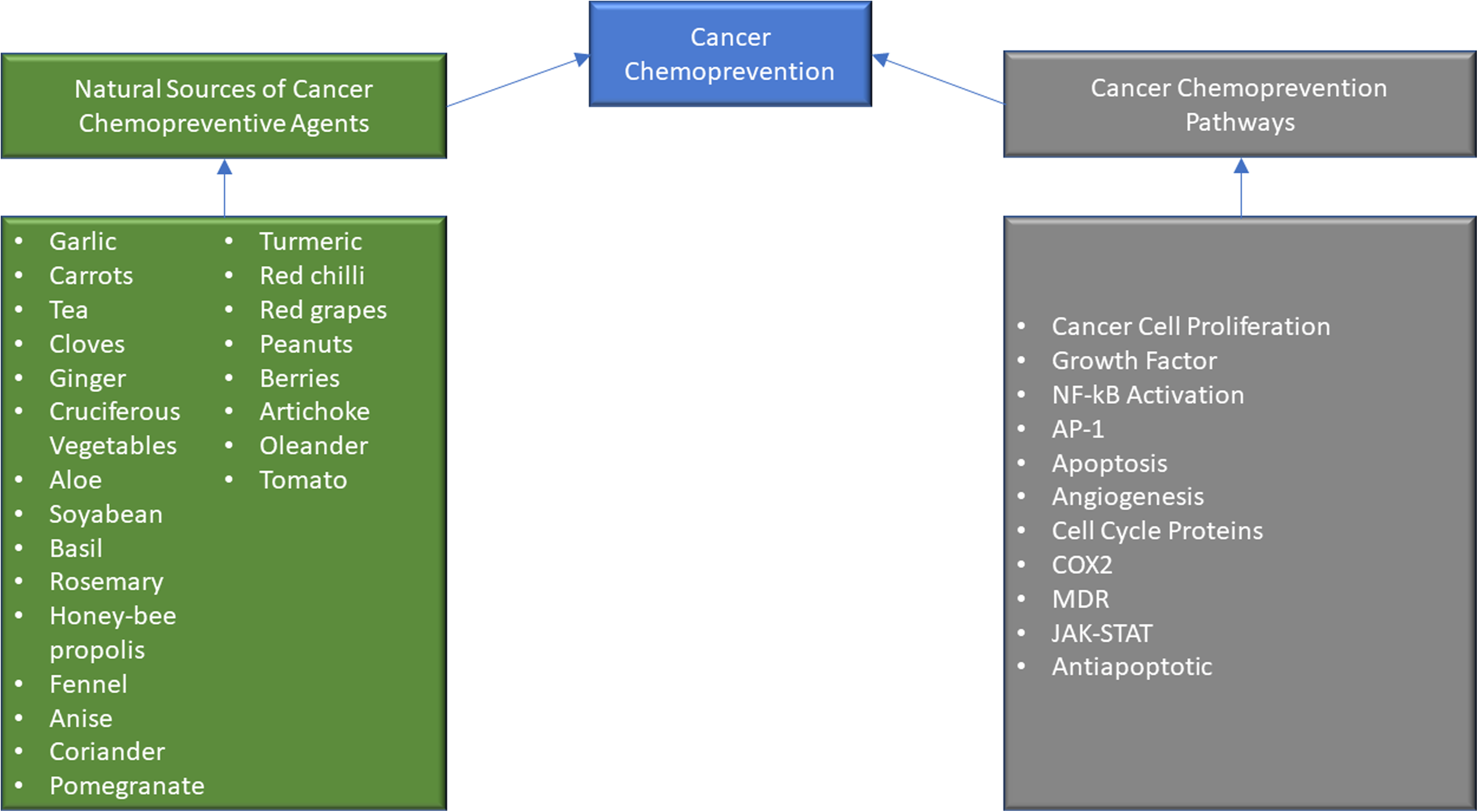
Natural sources of cancer chemopreventive agents and cancer chemopreventive pathways. Table created after Dorai and Aggarwal. 11
The novelty of this article is to provide an updated status of natural products used for cancer chemoprevention, explaining the minimal progress experienced so far with the difficulty to undertake traditional trials given the difficulties of assessing cancer chemoprevention, which makes this much more complicated than for example cancer chemotherapy. Thus, this article suggests working on novel assessment approaches, better controlling confounding factors, and selecting novel endpoints. While many more excellent review works have been proposed,12–15 what is missing is fully satisfactory clinical trials showing benefits on objective endpoints from the administration of specific substances in specific amounts without the presence of confounding factors.
The articles were sourced by searching google scholar with the keyword “cancer chemoprevention,” and with keywords specific to chemoprevention compounds, and selecting the works with the higher number of citations published in the same years.
Indirect Chemopreventive Agents
Indirect chemopreventive agents are simply either antioxidant or anti-inflammatory agents, and sometimes also agents working towards boosting the immune system, which have no toxicity, and no side effects administered as supplements in moderate quantities. It is claimed that the best way to prevent cancer is by maintaining good health, exercising, and eating a nutritious whole-food diet rich in fruits and vegetables, 16 and regularly assuming supplements to further balance the dietary intake. Most of the supplements marketed as cancer preventive or therapeutic agents are in reality only suggestions of substances that may prevent or reduce the progression of cancer, without any clear deterministic link.
Of those dietary supplements which may help to prevent or cure cancer, ground flax seed, garlic, ginger, green tea, selenium, turmeric, vitamin D, and vitamin E have been listed. 16 Garlic has general protective effects including antibacterial properties and may stop the activation of cancer-causing substances. Ginger has anti-inflammatory properties. Green tea works as an antioxidant and an anti-inflammatory agent. Selenium, a mineral, removes free radicals. Turmeric (curcumin), works as a metabolite, anti-inflammatory, antineoplastic, hepatoprotective, and neuroprotective agent, as well as an inhibitor, immunomodulator, and iron chelator. As better discussed later, curcumin may either block cancer cells from multiplying, or also kill colon, breast, prostate, and melanoma cancer cells. Vitamin D is a group of fat-soluble secosteroids responsible for many biological effects. For example, cholecalciferol (D3) works as a pro-hormone relevant for maintaining calcium levels and promoting bone health. Vitamin D helps the immune system function. Low vitamin D levels have been associated with certain types of cancer. Vitamin E is a strong antioxidant and free radicals’ scavenger.
Regarding other popular supplements, β-carotene works as a biological pigment, a provitamin A, a human metabolite, a cofactor, and an antioxidant. Lycopene works as an antioxidant. Indoles may extend the health span in diverse organisms, such as mice, the nematode worm Caenorhabditis elegans, and fruit flies. (+)-Catechins work as antioxidants. Anthocyanins also are flavonoids with antioxidant effects. Sulforaphane, a compound obtained from cruciferous vegetables, has been linked to health benefits. It neutralizes toxins, works as an antioxidant canceling out free radicals, and works as an anti-inflammatory agent. It may protect DNA and slow tumor growth. L-ascorbic acid works as a water-soluble vitamin, vitamin C, coenzyme, antioxidant, and cofactor. It is the conjugate acid of an L-ascorbate.
General supplementation with all these substances may certainly be considered the use of indirect chemopreventive agents. However, benefits are advocated, more than scientifically measured. Quantities have also been only vaguely established, and generally moderate. It must be mentioned that the direct use of these substances as chemopreventive agents, which is discussed in the following section, has often failed to deliver the expected outcomes. For example, the intake of vitamin E has been associated not only with the reduction but also with the opportunity to increase the risk of specific cancers. It has been suggested 17 that vitamin E ingested in supplements that are rich in γ- and δ-tocopherols, is cancer preventive, while supplementation with high doses of α-tocopherol is not. In one report, 18 vitamin E supplementation was not associated with a general reduction in total mortality, cancer incidence, or cancer mortality, but was linked to a statistically significant reduction in the incidence of prostate cancer. However, in another study, 19 dietary supplementations with vitamin E significantly increased the risk of prostate cancer. If the findings of clinical studies about the association between vitamin E and cancer risk remain inconclusive, 20 then also the opportunity to receive benefits from supplementation with vitamin E is quite controversial.
Direct Chemopreventive Agents
There is the opportunity of defining chemopreventive agents with a much stronger and more direct effect on specific types of cancer. Direct chemopreventive agents, target the inhibition of specific types of cancer development through the administration of quantities of the chemopreventive natural compounds that are more significant than those of general supplementation.
Cancer chemoprevention uses compounds to either prevent cancer cell growth or alter carcinogenesis. 21 Direct cancer chemopreventive agents must be advanced through efficient clinical studies, which as previously mentioned, are everything but simple. The mechanism of carcinogenesis is a complicated process, and numerous subcellular changes occur before a tumor is detected. These alterations include origination, promotion, and spreading. The cancer chemopreventive agents attempt to disturb the carcinogenesis pathways by mostly delaying or blocking the origination process proactively negating the necessity for treatment. As clinical studies are difficult, most of the positive experiences in cancer chemoprevention have been obtained in animal models. For example, cancer chemoprevention has been implemented with success in rodents. 22 Genetically modified subjects or the application of carcinogens produce tumors in specific organs. A group using chemopreventive molecules is identified to stop tumorigenesis without toxicity compared to a control group.
Limited clinical trials have sometimes also turned out positive. Tamoxifen and raloxifene have been shown to be very effective in the prevention of breast tumors in high-risk women. 23 Estrogen receptor antagonism is the crucial mechanism for these 2 agents. As there are also some side effects, the risk-to-benefit ratio needs to be carefully assessed. 24 Trials are being performed for breast tumors not only with tamoxifen and raloxifene but with other aromatase inhibitors as well. Letrozole is also recommended against breast cancer as it inhibits the synthesis of androgens to estrogens. 25
Regarding prostate cancer, as previously mentioned, vitamin E has been used in clinical trials, with controversial results.17–20 Finasteride is also a potential chemopreventive agent being investigated for the reduction of the risk of developing prostate cancer. The risk of prostate cancer may be reduced by taking finasteride, 26 a specific steroid inhibitor, as also suggested by clinical trials.
Aspirin is used against colon cancer because of its anti-inflammatory properties.27,28 Celecoxib, effective against cyclooxygenase 2, may reduce familial adenomatous polyposis which is a precursor of colon carcinoma. Celecoxib has also been used for colon cancer.29–31 However, regular use with large doses is not recommended due to severe cardiovascular side effects, bringing back the issue of risk to benefit ratio.
Many natural products such as metformin, polyphenon E, retinoids, soy isoflavones, vitamin C, vitamin D, and vitamin E, are undergoing specific clinical trials for their possible use as chemopreventive agents either alone or in combination. 1
Curcumin is one of the most interesting compounds being investigated, with many different possible uses.32–37 Curcumin has not demonstrated yet good clinical results due to weak absorption and metabolism. However, compounds derived from curcumin are promising.
Bruceantin is a cancer chemotherapeutic compound with a weak effect on cancer patients who are terminally ill 38 but may help in cancer chemoprevention. 39 Bruceantin is a strong cell-differentiating agent. It can stop tumor propagation at low concentrations without demonstrating toxicity.40–42 Additional mechanisms of action have been recently proposed. 43 This compound has been employed in a fashion similar to that of tamoxifen, but other uses are possible.
Resveratrol is another potentially strong cancer chemopreventive agent. It is known to inhibit cyclooxygenase. It has been used against skin carcinogenesis through a unique pathway. 44 Well beyond cancer chemoprevention, amelioration of a plethora of other diseases has been investigated with resveratrol, most notably cardiovascular, diabetes, and age-related diseases. 45
Dietary phytochemicals may work as efficient chemopreventive agents because of their multiple functions. 46 Regulation of cancer cell growth by some of them follows different mechanisms. 46 The group belonging to the genus Kalanchoe (subgenus Bryophyllum, Crassulaceae) is considered particularly useful. 46 Endophytic fungi can similarly produce other clinically active natural molecules. 47 For example, isolates obtained from the wood of Taxus fuana are potentially interesting. Clinical trials are however missing.
A healthy diet that includes vegetables and fruits enriched in flavonoids is recommended for the management of obesity, cardiovascular disorder, diabetes, and cancer. 48 Flavonoids are polyphenols with strong antioxidant and anti-carcinogenic activities. 48 Dietary flavonoids reduce the risk of different types of cancers. While the intake of dietary flavonoids reduces the risk of different types of cancers, such as gastric, breast, prostate, and colorectal cancers, there are no trials proving causation in addition to correlation with specific types of cancers.
β-Carboline molecules work as chemopreventive and chemotherapeutic agents. 49 β-Carboline alkaloid enriched extract from Rauwolfia vomitoria has been reported to have anti-prostate cancer activity. 50
Vitamin A, curcumin, isothiocyanate, green tea, luteolin, resveratrol, genistein, lycopene, bitter melon, withaferin A, and guggulsterone have been proposed for the chemoprevention of head and neck squamous cell carcinoma (HNSCC). 51
Many isothiocyanate groups may be synthesized from glucosinolates of cruciferous vegetables. 52 Numerous isothiocyanates are anticarcinogenic in addition to working as general detoxifying agents.
Procyanidin is a natural polyphenol that possesses anti-inflammatory, antiproliferative, and anticancer activities. 53 Procyanidin inhibits the proliferation of tumor cells in cell culture and in vivo targeting intracellular signaling pathways such as pro-inflammatory mediators, mediators of cell life and deaths, angiogenic and metastatic mediators, kinase enzymes, and transcription factors. The complete chemopreventive mechanisms of action of procyanidin are yet not fully understood. Clinical trials of procyanidin for specific cancer types are still missing. The polyphenols of tea, selenium, soy proteins, vitamins, and resveratrol have been proposed as natural chemopreventive agents against prostate cancer (PC). 54
Preclinical in vivo experiences have suggested many other natural chemopreventive compounds of potential use to reduce the generation of cancer precursors and the progression of cancer lesions 55 through various potential mechanisms of action. Chemopreventive agents that impact oxidative stress and lipid peroxidation causing DNA damage have been proposed. 56 Chalcones possess specific cancer chemopreventive properties. However, to avoid side effects, either low doses or intermittent administration are considered. 57 Many traditional herbals and food have chemopreventive effects. 58 One hundred seventy-nine phytochemicals, including flavonoids, terpenoids, alkaloids, phenylpropanoids, and stilbenes from traditional Chinese Medicines have been listed. 58
Glucosinolates may have chemopreventive use. 59 They are antioxidants. 60 The biology and biochemistry of glucosinolates have been reviewed. 61 Natural glucosinolates and their degraded derivatives isothiocyanates (ITCs) have reduced cancer cell growth in epidemiological investigations. 59 ITCs also suppress chemical-mediated tumorigenesis in animal models. The clinical efficiency of ITCs is due to their cytotoxic nature against numerous cancer cell lines. The mechanisms of glucosinolate-mediated reduction of carcinogenesis include induction of cell death, regulation of xenobiotic pathways, oxidative function, inhibition of caspase enzymes, angiogenesis, histone deacetylation, and cell cycle blockade. The crucial pathways of ITC-promoted apoptosis in cancer cell lines are however not known yet with certainty. Cruciferous vegetables may also reduce the risk of cancers for other reasons, such as digestive initiation and formula for detoxification, inflammation, angiogenesis, metastasis, and effects on the epigenetic system. 62 The ITCs are capable of inducing cell growth arrest and apoptosis in skin melanoma cells.
Flavonoids, alkaloids, and carotenoids have also demonstrated clinical effects against cancers. 63 Many herbal medicines from different parts of the plants such as stem, roots, leaves, bark, seed, flower, and fruit which are nontoxic and bear no side effects are all potential chemopreventive agents.
Individual tocopherols may work as cancer chemopreventive agents. Bladder cancer (BC) was investigated using tocopherols as a chemopreventive agent. 64 Delta-tocopherol is more efficient than isomeric tocopherols. This is due to the generation of stress at the endoplasmic reticulum (ER). Cells treated with delta-tocopherol show an autophagy-like phenotype.
The chemopreventive properties of Hedera Nepalensis have been studied in vitro. 65 The hexane and ethyl acetate extracts of the plants have superior chemopreventive activity. Antioxidants are generally used to remove free radicals from the body and therefore, they reduce oxidative stress-mediated disorders. 66 Triphala, a powerful herbal remedy that consists of Haritaki, Bibhitaki, and Amla used in traditional Ayurvedic medicine, works as an antioxidant. It destroys free radicals maintaining antioxidant enzyme and nonenzyme concentrations. It also reduces fat peroxidation. Triphala works by modulating various cell signaling mechanisms. Triphala may help against certain cancers.66–70
Dichloromethane and methyl alcohol extracts of Seriphidium herba-alba have been proposed as cancer chemopreventive agents against human breast cancer and hepatocellular carcinoma cells. 71 Artesunate, curcumin, resveratrol, magnolol, and fucoxanthin, have been proposed to control the epidermal growth factor receptor (EGFR) 72 and thus work as chemopreventive agents.
Salvianolic acid B (SalB) has been proposed as a potent chemopreventive agent for head and neck squamous cell carcinoma (HNSCC). 73 Given its weak systemic delivery ability and bioavailability, 73 a phospholipid complex impregnated with nanoparticles (PLC-NPs) of SalB against HNSCC (HN13, HN30) and Leuk1 cells was investigated. 73 Intracellular accumulation of SalB was significantly higher when HN13, HN30, and Leuk1 cells were incubated with SalB-PLC-NPs complex (nano-SalB) as against free-SalB.
Tamoxifen shows a remarkable decrease in invasive breast cancer. 74 Citrus fruit may have anticancer properties. 75 Flavonoids from citrus peels demonstrated potent anti-tumor activities in cancers of the skin, colon, prostate, lung, and liver. 76
Phytochemicals from edible plants such as cruciferous vegetables (phenethyl isothiocyanate, benzyl isothiocyanate, and sulforaphane), withaferin A (WA), and honokiol (HNK) may work as chemopreventive agents. 77 They may selectively induce cancer cell death by targeting mitochondrial activity.
Resveratrol, curcumin, genistein, and gingerol, can minimize the risk of cancer or alter the period of tumor life. 78 The chemopreventive activity of these agents is due to the inhibition of carcinogenesis (inflammation, transformation, and proliferation). These agents also affect the final phase of carcinogenesis, angiogenesis, and metastasis.
Phenyl polyyne alcohols obtained from polyacetylene triol have also been suggested as chemopreventive agents. 78 4-Fluorophenyl, 3-chlorophenyl, and 3,4-dioxolophenyl-substituted compounds exhibited good quinone reductase induction activity, and relatively low cytotoxicity. Colitis-associated cancer (CAC) is a serious inflammatory bowel disease 79 that the ethyl acetate extract of Ilex rotunda Thunb may prevent.
Eight xanthone compounds isolated from Calophyllum elatum Bedd 80 have shown inhibitory activity against Epstein-Barr virus (EBV) selectively without exerting cytotoxicity. These compounds could also be used for cancer chemoprevention. Isogarciniaxanthone E 21 is effective in inhibiting the growth of skin tumors in mice.
Bioassays are an alternative to clinical trials to progress the development of chemopreventive agents. The benefits of taxol used as a cancer chemopreventive agent are evidenced in several bioassays. For example, investigations on epigenetics 81 and signaling routes, 82 and Keap1-Nrf2-ARE have emerged as useful methods in the identification of cell defense and survival.83–85 Some assays targeting the initiation, promotion, and propagation phases of carcinogenesis are being performed. 86
While this list, which only includes a few of the many natural products proposed as cancer chemopreventive agents, is certainly large, we must stress the fact once more that almost none of the proposed agents has yet been proven effective without any doubt in clinical trials against distinctive cancer types.
Discussion and Conclusions
Many works are being conducted in cancer chemoprevention, but the perspective of this technique remains vague. Systematic development of cancer chemopreventive agents is possible, but it is a complicated task. As a matter of fact, direct cancer chemopreventive agents targeting specific types of cancer are in short supply.
The development of such agents is more challenging compared to the identification of chemotherapeutic agents. In chemoprevention, suitable biomarkers are not available and significant trials, with a large population and conducted over a long time, are necessary to prove the clinical value, with many variables difficult to control. Minimum toxicity and side effects are permitted. The effects of small doses are logically limited. Many confounding factors exist. Genetic, lifestyle, and environmental factors affect the probability to develop cancer. The etiology of malignancy is sometimes extremely complicated to track. For this reason, most of the work done so far in the development of cancer chemopreventive agents has been inconclusive.
While some scholars have possibly been too harsh in describing the chemoprevention effort as destined for failure 9 we remain optimistic about cancer chemoprevention, which however remains a very challenging but potentially an extremely rewarding approach87–89 to prevent cancer, definitively in need of appropriate new methodological approaches to permit progress. The relevance of this work is also to have highlighted the need for different clinical trials versus those attempted so far, which haven’t produced too much progress.
Footnotes
Declaration of Conflicting Interests
The author(s) declared no potential conflicts of interest with respect to the research, authorship, and/or publication of this article.
Funding
The author(s) received no financial support for the research, authorship, and/or publication of this article
