



Abstract
Keywords
Introduction
Ischemic heart disease (IHD) is a chronic and complex disease characterized by pathological changes in the coronary arteries and myocardium, as well as myocardial ischemia, which is an imbalance between coronary blood flow and myocardial demand. 1 This disease involves several stages and clinical syndromes, 2 and it has become the leading cause of death worldwide, with its prevalence rising each year. 3 Cardiovascular and psychiatric illnesses are major public health problems due to their high disease burden and prevalence. 4 Psychological disorders, including depression, are widespread mental illnesses with complicated pathophysiology that reduce patients’ quality of life and affect the prognosis of many diseases.5, 6 Studies have shown that individuals with depression have a 30% higher risk for cardiovascular disease than those without depression. 7 At this stage, there is an urgent need to explore the prevention and treatment of IHD, and depression may aggravate the symptoms of IHD and reduce patient compliance and treatment effects. Traditional antidepressants, including selective serotonin reuptake inhibitors (SSRIs), are commonly used to control depressive symptoms. Long-term use of traditional antidepressants such as SSRIs has been associated with several adverse effects, and patients with IHD are at risk of abnormal bleeding after receiving SSRI treatment. 8 Resultantly, there is an urgent need to explore new drugs to treat patients with concurrent IHD and depression.
According to traditional Chinese medicine, IHD involves qi deficiency and blood stasis, which are also crucial factors in the pathogenesis of depression. Danshen is a traditional Chinese medicine widely used in clinical practice for promoting blood circulation, 9 clearing the heart, eliminating vexation, cooling blood, and treating carbuncles. 10 Modern medicine has demonstrated that it can dilate arteries, increase coronary blood flow, reduce ischemia-induced cell damage, and improve cardiac function. 11 Furthermore, antidepressant effect of Danshen receiving more and more attention from researchers. 12 However, there is no research on the mechanism of action of Danshen in treating concurrent IHD and depression.
Network pharmacology can be used to build a “disease-target-drug” network and predict the relevant targets of the disease and the molecular mechanism of drug action.13, 14 Molecular docking is a standard approach to predicting the interaction, potential binding mechanism, and binding affinity between receptors and drug molecules. 15 Molecular dynamics simulation (MDS) is an important tool for evaluating the stability and flexibility of protein-ligand complexes by describing the dynamic behavior of ligands at the active sites of proteins based on molecular force fields. 16 This study applied network pharmacology, molecular docking, and MDS to explore the potential targets and possible mechanisms of action of Danshen in treating concurrent IHD and depression. A flowchart of the study design is presented in Figure 1.

Flowchart of research design.
Materials and Methods
Screening of Active Ingredients and Prediction of Candidate Targets
The Traditional Chinese Medicine Systems Pharmacology Database and Analysis Platform (TCMSP) database 17 (http://tcmspw.com/tcmsp.php) was used to retrieve the effective active ingredients of Danshen based on the following screening criteria: oral bioavailability (OB) ≥ 30% and drug-likeness (DL) ≥ 0.18. The candidate targets of the active ingredients were also retrieved from the TCMSP database. The UniProt database 18 (https://www.uniprot.org/) was used to normalize the candidate target names.
The Cytoscape 3.8.2 software was used to construct the interaction network between the active ingredients and their candidate targets. 19 The Analyze Network plug-in was used to determine the core active ingredients.
Screening of Disease-Related Targets
We searched the Genecards database 20 (https://www.genecards.org/) and the DisGeNet database 21 (https://www.disgenet.org/home/) using the keywords “depression,” “depressive disorder,” and “ischemic heart disease” to obtain candidate targets of IHD and depression. Targets with relevance score ≥ 1 in the Genecards database were selected as potential targets. Similarly, the screening threshold in the DisGeNet database was set as score_gda ≥ median.
TBtools 22 was used to construct a Venn diagram to determine the intersection targets of Danshen, depression, and IHD.
Construction of Protein–Protein Interaction (PPI) Network and Acquisition of Core Targets
The STRING database 23 (https://string-db.org/) was used to construct the PPI network of intersection targets. The intersection targets were inserted into the database, the species was changed to “Homo sapiens,” the confidence score was set to 0.4, and the rest of the parameters were set to system defaults. The Cytoscape 3.8.2 software was used to visualize the interaction network. CytoNCA plugin was used to analyze the topological parameters of the PPI network of intersection targets, including degree centrality (DC), eigenvector centrality (EC), local average connectivity (LAC), and betweenness centrality (BC), closeness centrality (CC), and network centrality (NC). When all six topological indicators were greater than the median, the target was considered a core target in the PPI network. Subsequently, the PPI network of the core targets was visualized using Cytoscape software.
The Gene Ontology (GO) and Kyoto Encyclopedia of Genes and Genomes (KEGG) Pathway Enrichment Analyses of Intersection Targets
The Metascape database 24 (https://metascape.org/gp/index.html) was used for the GO enrichment analysis of the intersection targets. The enrichment analysis of the KEGG pathway was performed with the GlueGO software package of the Cytoscape 3.8.2 software, and the conditions were set as P < 0.01, Kappa score = 0.4. The results were visualized using the bioinformatics platform (http://www.bioinformatics.com.cn/).
Construction of the intersection network of core active ingredients, intersection targets, and KEGG pathways.
The Cytoscape 3.8.2 software was used to construct the interaction network of core active ingredients, intersection targets, and KEGG pathways.
Molecular Docking
The chemical structures of the core active ingredients were obtained from the PubChem database 25 (https://pubchem.ncbi.nlm.nih.gov/) in sdf format and converted into pdb format using the Open Babel 3.1.1 software. The crystal structures of the core target proteins were obtained from the RCSB PDB database 26 (https://www.rcsb.org/) and stored in pdb format. The receptor proteins were optimized using the Pymol software to remove water and other small molecules. Subsequently, the Autodock 1.5.6 software was employed for hydrogenation, charge calculation, and receptor selection. Following that, the ligands were imported into Autodock 1.5.6 software for processing, hydrogenation, selection, and searching for twisted key. The receptors and ligands were saved in pdbqt format. The docking box was set using the grid box function in the software. The proteins were encapsulated by adjusting the target protein X-Y-Z coordinates and the grid box size, and the parameter value of the configuration file was num_modes = 9, exhaustiveness = 8, and energy_range = 3. We attached the docking parameters to the Supplemental Material. Then, the AutoDock Vina software 27 was run to dock the core active ingredients and the core target proteins nine times, and the final result was the maximum binding energy with the largest absolute value of each docking. The visualization of the docking results was completed with the Pymol software.
MDS
GROMACS 5.1.2 software for the Linux system was used to perform the MDS. The topological files of proteins were generated using the GROMOS96 43a1 force field, whereas the topological files of the ligands were generated using the GROMOS87 force field of the PRODRG website (http://davapc1.bioch.dundee.ac.uk/cgi-bin/prodrg/submit.html). The SPC water model was used to define periodic boundary conditions, and Na + /Cl− was introduced to balance the system charge. The steepest descent method with >50000 steps and a force of 10.0 kJ/mol was then used to minimize the system energy. The 100 ps NVT equilibration was performed once the system energy was at its minimum. In the pre-equilibration stage, the Define = −DPOSRES was used to positionally constrain the protein and ligand with heating ranging from 0 to 300 K. The pressure was controlled using the Berendsen technique. The reference pressure was set to 1 bar, and a 100 ps NPT equilibrium was conducted. Finally, a 10 ns MDS was performed.
The gmx_rms, gmx_gyrate, and gmx_sasa programs were then imported. The root mean square deviation (RMSD), protein radius of gyration (Rg), and solvent accessible surface area (SASA) were calculated and visualized using the qtgrace software. The binding free energies of the protein-ligand complexes were calculated using the gmx_mmpbsa28, 29 of the molecular mechanics Poisson–Boltzmann surface area (MM-PBSA) method. 30,31
Results
Screening of Active Ingredients and Prediction of Candidate Targets
The TCMSP database search yielded 202 active ingredients. With the screening criteria of OB ≥ 30% and DL ≥ 0.18, 65 active ingredients were identified (Table 1). A total of 131 candidate targets of Dashen were identified and named using the UniProt database.
The Active Ingredients of Danshen.

The Cytoscape 3.8.2 software was used to construct the interaction network between the active ingredients of Danshen and candidate targets (Figure 2). The analyze network plug-in was used to analyze the network, and the top three luteolin (55), tanshinone IIA (39), and salviolone (38) were selected as core active ingredients based on the degree value.

The interaction network between the active ingredients and candidate targets of Danshen.
Screening of Disease-Related Targets
The disease-related targets were obtained by searching the Genecards database, and the relevance score ≥ 1 was calculated to obtain 3317 candidate targets for depression and 196 candidate targets for IHD. Relevant targets were obtained by searching the DisGeNet database, and the score_gda ≥ 0.02 was calculated to obtain 955 candidate targets for depression. Score_gda ≥ 0.01 was calculated to obtain 756 candidate targets for IHD. Then, after merging and deduplication, a total of 3537 candidate targets for depression and 834 candidate targets for IHD were obtained. A Venn diagram was used to intersect the candidate targets of Danshen, depression, and IHD. A total of 39 intersection targets were obtained (Figure 3).

Venn diagram and UpSet diagram of intersection targets of Danshen, IHD, and depression.
Protein–Protein Interaction (PPI) Network
The 39 intersection targets of Danshen, IHD, and depression were imported into the STRING database to obtain a PPI network of 39 nodes and 350 edges. The Cytoscape 3.8.2 software was used for visualization (Figure 4A). The nodes of the PPI network were calculated using the CytoNCA plug-in. A total of 14 core targets, including AKT1, TNF, IL6, MMP9, CASP3, IL10, PTGS2, STAT3, PPARG, IL4, EGFR, MAPK14, NOS3, and EDN1, were identified. The parameters are presented in Table 2. Figure 4B displays the network diagram of the predicted core targets.

Construction of the PPI network. (A) PPI network of Danshen acting on IHD and depression targets. (B) Network diagram of predicted core targets.
Parameter Information of 14 Core Targets.

GO and KEGG Pathway Enrichment Analysis of Intersection Targets
The Metascape database was used to perform the enrichment analysis of the 39 intersection targets, with P < 0.01 and the number of enriched genes ≥ 3 as the screening conditions. In terms of biological processes (BPs), the intersection targets were mainly enriched in the positive regulation of protein phosphorylation, blood circulation, muscle cell proliferation, cell migration regulation, and cell motility. In terms of cellular components (CCs), the intersection targets were mainly enriched in the membrane raft, membrane microdomain, caveola, plasma membrane raft, and endoplasmic reticulum lumen. In terms of molecular functions (MFs), the intersection targets were mainly enriched in the cytokine receptor binding, receptor-ligand activity, signaling receptor activator activity, cytokine activity, and signaling receptor regulator activity (Figure 5).

Top 10 results of BPs, CCs, and MFs in GO enrichment.
The ClueGO software package in the Cytoscape 3.8.2 software was used to perform the KEGG pathway enrichment analysis of the intersection targets. The conditions were P < 0.01 and Kappa score = 0.4 (Figure 6). Each node represents a KEGG enrichment entry, and nodes with the same color represent biological functions with similar processes. The darker the label color, the more significant the enrichment. The intersection targets were primarily enriched in pathways such as AGE-RAGE signaling pathway in diabetic complications, T cell receptor signaling pathway, lipid and atherosclerosis, toxoplasmosis, IL-17 signaling pathway, VEGF signaling pathway, relaxin signaling pathway, JAK/STAT signaling pathway, colorectal cancer, platelet activation, pathways in cancer, regulation of lipolysis in adipocytes, and serotonergic synapse (Figure 7).

Network diagram of KEGG pathway enrichment of intersection targets.

The proportion of KEGG pathway enrichment of intersection targets.
Construction of the Intersection Network of Core Active Ingredients, Intersection Targets, and KEGG Pathways
The interaction connection between three core active ingredients, 38 intersection targets, and 13 significantly enriched KEGG pathways was constructed using the Cytoscape 3.8.2 software (Figure 8). The IL-17 signaling pathway, the VEGF signaling pathway, and the JAK/STAT signaling pathway have been connected with red lines to highlight the interaction connection.
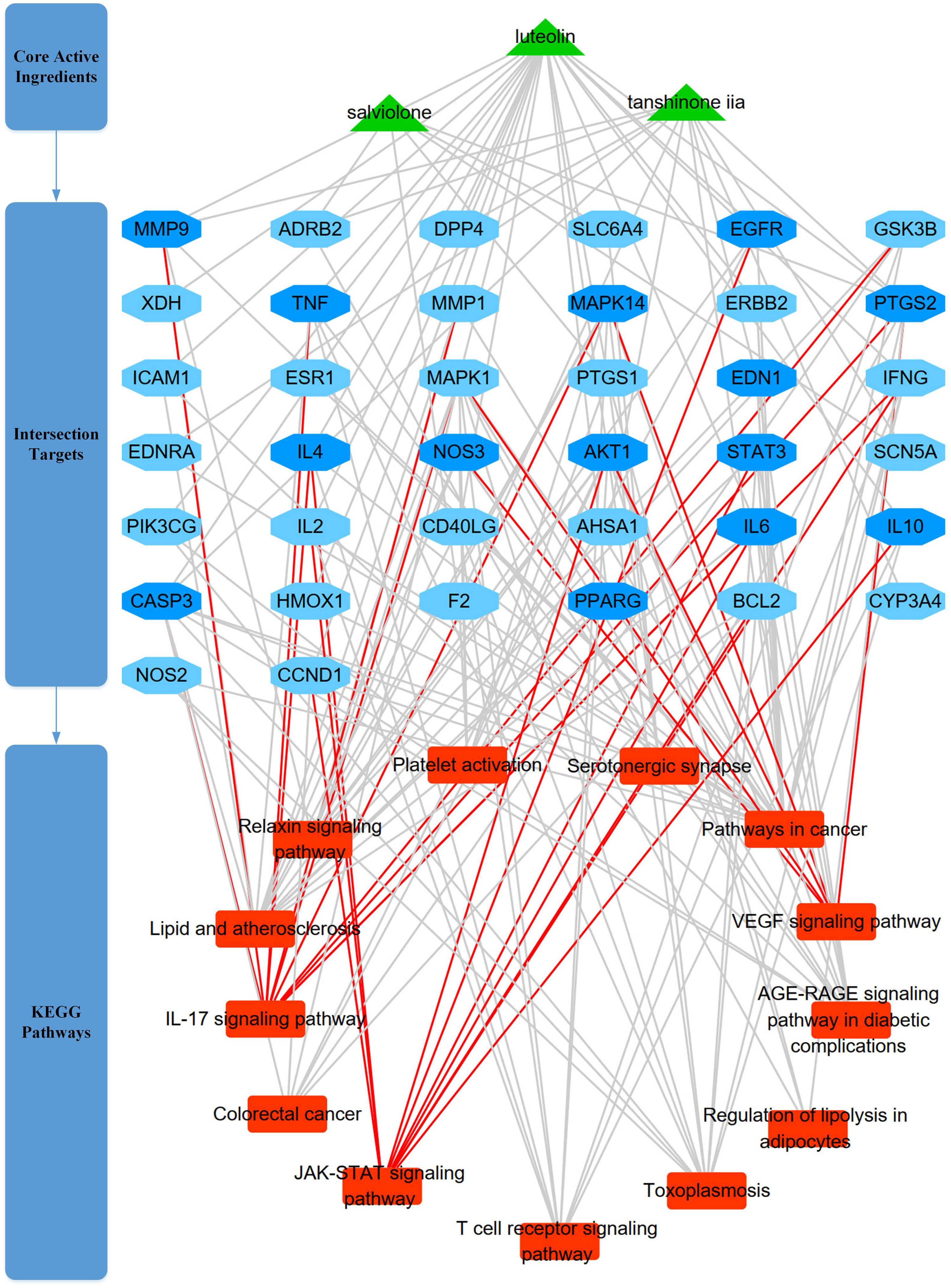
Interaction network of core active ingredients-intersection targets-KEGG pathways. Light blue hexagons represent common targets of Danshen in IHD and depression, and dark blue hexagons represent core targets.
Molecular Docking
We used Autodock 1.5.6 and Autodock Vina to complete the molecular docking of the three core active ingredients (luteolin, tanshinone IIA, and salviolone) and 14 core targets (AKT1, TNF, IL-6, MMP9, CASP3, IL-10, PTGS2, STAT3, PPARG, IL-4, EGFR, MAPK14, NOS3, and EDN1), as shown in Figure 9. Generally, binding energy less than −5.0 kcal/mol suggests that a protein has a good binding activity with small molecules.32,33 The minimum binding energies of the three core active components and 14 core target proteins were less than −5.0 kcal/mol, and the RMSD values were all 0, less than 2 Å, indicating that the core active ingredients can effectively bind to the core target proteins. Then, we used the Pymol software to visualize the binding mode. We used the top eight binding energy of protein-ligand complexes as an example, as shown in Figure 10, and other results have been presented in the supplementary file 6.
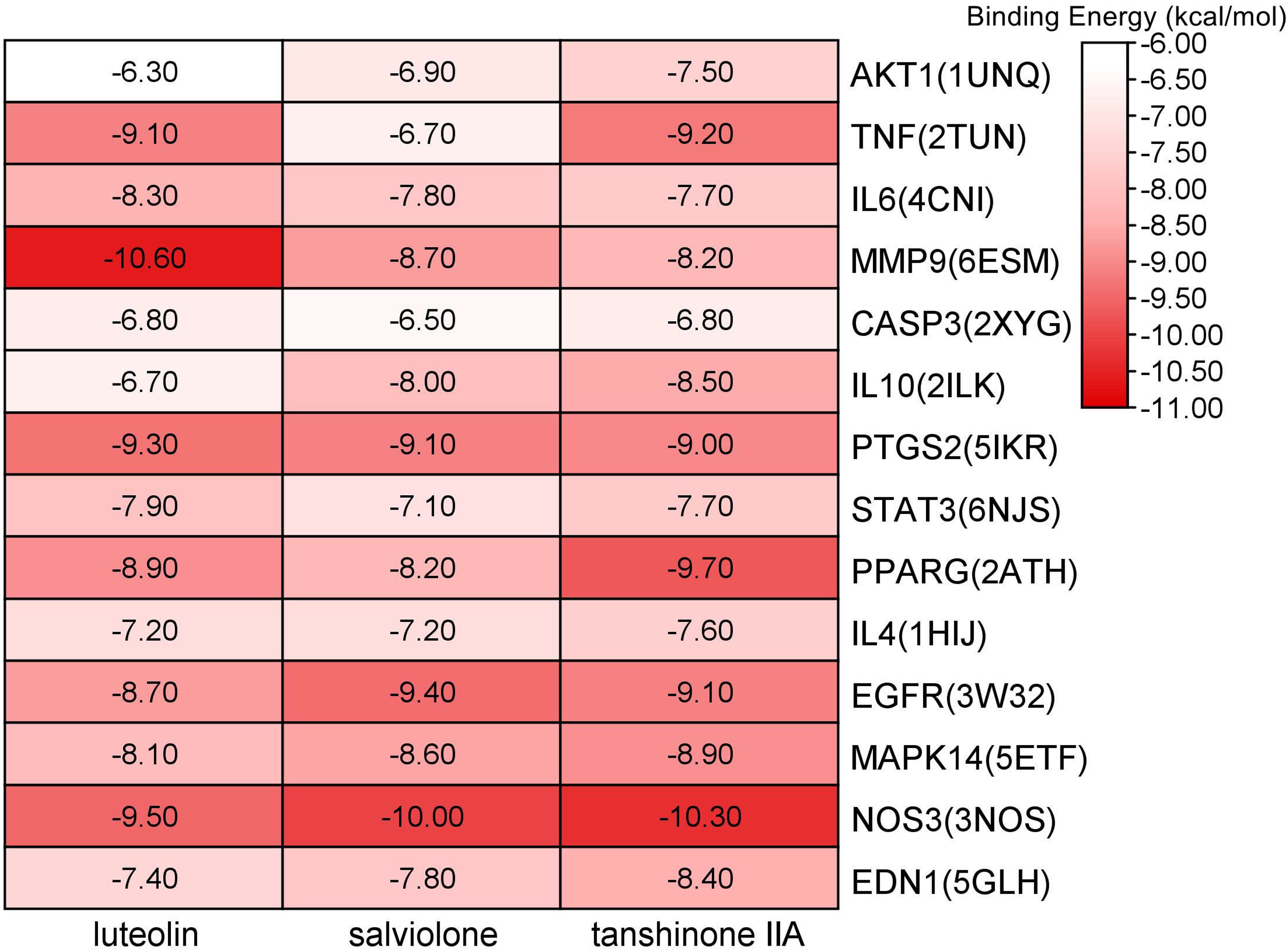
Molecular docking binding energy heat map of 3 core active ingredients and 14 core targets.

Molecular docking models of the top 8 binding energy of protein-ligand complexes.
MDS
In order to evaluate the stability of protein-ligand docking complexes, we used AKT1-tanshinone IIA and MMP9-luteolin complexes as examples to perform 10 ns MDS. The RMSDs of backbone-backbone and ligand-ligand were obtained (Figures 11A and 11B). The RMSD reflects the movement of protein-ligand complexes during MDS. 34 The RMSD of the AKT1-tanshinone IIA backbone-backbone stabilized after 2 ns with a mean value of 0.234 ± 0.043 nm; the RMSD of the MMP9-luteolin backbone-backbone stabilized after 1 ns with a mean value of 0.194 ± 0.0189 nm. The RMSD of the AKT1-tanshinone IIA ligand-ligand was stable after 1 ns with a range of 0.032 ± 0.009 nm. The RMSD of the MMP9-luteolin ligand-ligand was stable after 1 ns with a range of 0.099 ± 0.0198 nm. However, it fluctuated slightly at 7–8 ns and then became stable. The results of RMSD indicated that the ligand-protein binding was relatively stable and would not change considerably.

(A) RMSD of backbone-backbone. (B) RMSD of ligand-ligand. Red represents the complex of AKT1-tanshinone IIA, black represents the complex of MMP9-luteolin.
Rg is a physical quantity used to characterize a protein's overall tightness during ligand binding and simulation, 35 with lower values indicating denser and more structurally stable proteins. During the simulation, we calculated the Rgs of the AKT1-tanshinone IIA and luteolin-MMP9 (Figure 12A). The Rg of AKT1-tanshinone IIA gradually decreased, stabilized after 2 ns, and then fluctuated slightly but remained constant, with an average value of 1.423 ± 0.013 nm; the Rg of luteolin-MMP9 also gradually decreased, stabilized after 2 ns, and then fluctuated slightly but remained constant, with an average value of 1.453 ± 0.009 nm. Protein solvent accessible surface area (SASA) has also been identified as a critical factor in protein folding and stability studies. 36 We calculated the SASA of the protein-ligand complex (Figure 12B). The changing pattern of SASA was essentially consistent with that of Rg. The patterns for AKT1-tanshinone IIA and luteolin-MMP9 of gradually decreased and stabilized after 2 ns, with average values of 72.899 ± 2.465 nm2 and 76.234 ± 3.141 nm2. Thus, the Rg and SASA results indicated that tanshinone IIA to AKT1 and luteolin to MMP9 had little effect on the protein structure and could form stable complexes.

(A) Analysis of Rg. (B) Analysis of SASA. Red represents the complex of AKT1-tanshinone IIA, black represents the complex of MMP9-luteolin.
In addition to analyzing the MDS trajectory data of AKT1-tanshinone IIA and luteolin-MMP9 complexes, we also calculated the binding free energy using the MM-PBSA method. The binding free energy is the sum of all non-bonded interactions, which can help researchers more accurately assess the binding ability of ligands to their receptors. The results are presented in Table 3. The binding free energy of AKT1-tanshinone IIA was −98.362 kJ/mol, and the binding free energy of luteolin-MMP9 was −198.318 kJ/mol. The results are significant, indicating that they can be tightly bound. Among them, van der Waals energy, electrostatic energy, and nonpolar solvation energy were beneficial to the binding of proteins and ligands, while polar solvation energy was not conducive to the binding of them.
Calculation of Binding Free Energy of AKT1-Tanshinone IIA and Luteolin-MMP9 Complexes.
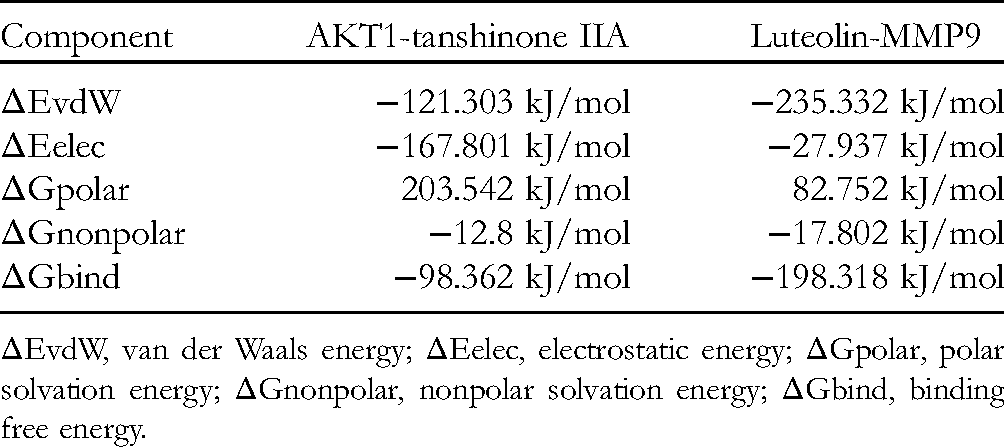
ΔEvdW, van der Waals energy; ΔEelec, electrostatic energy; ΔGpolar, polar solvation energy; ΔGnonpolar, nonpolar solvation energy; ΔGbind, binding free energy.
Discussion
IHD continues to be the leading cause of death worldwide, and its prevalence is increasing yearly. 37 The etiology of IHD is complex, with atherosclerosis, coronary microvascular dysfunction, inflammation, and vasospasm all contributing to the disease's pathophysiology. 38 Depression is the leading cause of disability worldwide and a critical risk factor for physical illness.39–41 The pathophysiology of depression is primarily based on the monoamine theory, neuroendocrine hypothesis, immunological and cytokine hypothesis, neuron and neural plasticity, and neurotrophic factor hypothesis, among others; however, the precise mechanism remains unknown. Studies have revealed an association between IHD and depression. 7 As a result, treating patients with concurrent IHD and depression is challenging, and there is currently no intervention for the treatment of patients concurrently with these two diseases. This challenge makes the development of safe and effective drugs for the treatment of patients with concurrent IHD and depression of great value. Treatment with traditional Chinese medicine has multiple components, multiple targets, low cost, and no apparent toxic or side effects. Traditional Chinese medicine has considerable therapeutic value in treating various chronic and complex diseases, especially in long-term clinical practice. Danshen is widely used in treating cardiovascular diseases, such as IHD.42–44 In addition, Danshen possesses sedative and anxiolytic effects. 45 Therefore, we reasonably speculate that Danshen has the potential to treat concurrent IHD and depression, but its precise mechanism of action remains unknown, and further research is needed.
This study used network pharmacology, molecular docking, and MDS to explore the potential targets and mechanisms of action of Danshen in treating concurrent IHD and depression. To verify the consistency of the data sources, the TCMSP database was used consistently to obtain the active ingredients of Danshen and the relevant potential targets. Luteolin, tanshinone IIA, and salviolone were selected as the core active ingredients by constructing the interaction network of the active ingredients and the candidate targets. The targets of Danshen in IHD and depression were mainly enriched in positive regulation of protein phosphorylation, blood circulation, IL-17 signaling pathway, VEGF signaling pathway, and JAK/STAT signaling pathway. AKT1, TNF, IL-6, MMP9, CASP3, IL-10, PTGS2, STAT3, PPARG, IL-4, EGFR, MAPK14, NOS3, and EDN1 were identified as the core targets of Danshen in IHD and depression. Molecular docking and MDS were used to further verify the network pharmacology findings.
Luteolin, a naturally occurring flavonoid, has a variety of pharmacological activities, including antioxidant, anti-inflammatory, and antitumor activities. 46 It has been demonstrated to improve myocardial contractility and inhibit inflammation and cell death. Blood reperfusion in rats provides myocardial protection, and this mechanism is highly related to the SHP-1/STAT3 signaling pathway. 47 Notably, MA et al 48 demonstrated that luteolin could activate the JAK1/STAT3 signaling pathway, inhibit M1-type polarization of microglia, and treat depression. Therefore, we preliminarily speculate that luteolin acts via the JAK/STAT signaling pathway in treating concurrent IHD and depression. Tanshinone IIA has the potential to protect the cardiovascular system by stabilizing atherosclerosis, improving acute myocardial ischemia, and regulating myocardial cell apoptosis and autophagy.49,50 These cardiovascular effects may be related to the upregulation of the expression of the PI3K/Akt/mTOR signaling pathway in cardiomyocytes, thereby exerting anti-myocardial ischemia and hypoxia effects.51,52 Several researchers have tentatively confirmed the antidepressant effect of tanshinone IIA. 9 This effect may be due to tanshinone's ability to block the action of monoamine oxidase, slowing down the breakdown of monoamine transmitters. Salviolone, the first tropolone compound isolated from Danshen, has several pharmacological effects, including antioxidant, inhibition of cancer cell growth, migration, and invasion.53,54 However, there have been few investigations on salviolone in IHD and depression, and it is worthwhile to conduct further relevant tests in the future.
AKT1, TNF, IL-6, MMP9, CASP3, IL-10, PTGS2, STAT3, PPARG, IL-4, EGFR, MAPK14, NOS3, and EDN1 were identified as core targets. Akt1 is a PI3K downstream substrate linked to nociceptive information processing, anxiety, and depression-like behaviors. 55 The AKT1 gene variant rs1130214 has been related to antidepressant medication responsiveness in patients with depression. 56 Furthermore, the data indicate that activating Akt signaling in endothelial cells may promote angiogenesis in the myocardium and that the PI3K-AKT signaling pathway might reduce myocardial damage following ischemia by mobilizing various endogenous cardioprotective pathways.57,58 Mounting evidence suggests that inflammation is essential in developing IHD and depression. TNF and IL-6 are critical pro-inflammatory cytokines. TNF induces the production of cytokines such as IL-6 and is involved in the inflammatory process of several diseases, including IHD and depression.59–62 In addition, anti-inflammatory cytokines, such as IL-4 and IL-10, are involved in the development of IHD and depression and are important targets for improving these disease conditions.63–66 PPARG plays a central role in controlling lipid metabolism and is involved in pathological processes such as obesity, diabetes, and atherosclerosis. 67 CASP3 (Caspase-3) is the primary executor of apoptosis. Downregulation of CASP3 reduced the infarct size and apoptosis index of cardiomyocytes in an experimental model of myocardial infarction, 68 improving cardiac function. The correlation between CASP3 and cardiomyocyte apoptosis in IHD has significant research value. In addition, studies have shown that CASP3 levels are increased in the cerebral cortex, frontal cortex, or hippocampus of chronically stressed rats,69–71 and the overexpression of CASP3 in the hippocampus plays an essential role in the pathogenesis of depression. 72
Prostaglandin-endoperoxide synthase 2 (PTGS2) plays a crucial role in the inflammatory cascade that triggers depression, as well as in regulating vascular tone and thrombosis.73–75 STAT3, an essential component of the JAK/STAT signaling pathway, is closely related to the growth, proliferation, and survival of central cells and immune response. 76 It plays a protective role against myocardial ischemia injury under stress conditions. 77 Matrix metalloproteinases (MMPs) are significantly involved in the development and regulation of inflammatory processes, including cardiovascular and central nervous system diseases.78,79 In addition, MMPs play an essential role in the occurrence and development of coronary atherosclerosis. 80 MMPs are involved in the pathological inflammatory process of depression. MMP9, one of the most robust markers of major depressive disorder, 81 has a significant correlation with depressive symptoms 82 and has been demonstrated to play a critical role in the function and morphology of excitatory synapses. 83 Epidermal growth factor receptor (EGFR) is involved in inflammation and cell proliferation and migration, enhancing the deposition of extracellular matrix components that contribute to vascular diseases, including atherosclerosis. 84 Several experimental studies have demonstrated that inhibition of EGFR signaling significantly reduces atherosclerosis in mouse models.85,86 EGFR plays an essential role in the development of depression. 87 EGFR-mutant non-small-cell lung cancer can cause depression by mediating inflammatory factors. 88
Mitogen-activated protein kinase 14 (MAPK14), an important part of the MAP kinase signal transduction pathway, plays a critical role in inflammation, wound healing, cell growth, differentiation, and apoptosis. Gorog et al. 89 demonstrated that the activation of MAPK14 increased myocardial infarct size after ischemia-reperfusion, whereas MAPK14 inhibitors reduced myocardial ischemia-reperfusion injury. END1, an endogenous regulator of vasoconstriction, plays a crucial role in maintaining vascular tone and cardiovascular homeostasis. 90 NOS3 is the primary source of endothelium-derived nitric oxide (NO), which plays a key role in regulating vascular wall function and cardiovascular homeostasis and is an important mediator of atherosclerotic diseases. 91 In addition, NO signaling is associated with the pathogenesis of anxiety and depression.92,93 Studies have demonstrated that NOS3 inhibition in the dorsolateral periaqueductal gray may have an anxiolytic effect. 94 In summary, we speculated that these 14 core targets may play critical roles in the development of IHD and depression.
We used molecular docking and MDS to further verify the results obtained by network pharmacology. The results of molecular docking revealed that the core active ingredients (luteolin, tanshinone IIA, and salviolone) in Danshen had optimal binding activities with the 14 core targets (AKT1, TNF, IL-6, MMP9, CASP3, IL-10, PTGS2, STAT3, PPARG, IL-4, EGFR, MAPK14, NOS3, and EDN1), which preliminarily justified the appropriateness of Danshen in the treatment of IHD and depression. We selected the complexes AKT1-tanshinone IIA and MMP9-luteolin as examples for MDS. The results showed that AKT1-tanshinone IIA, and MMP9-luteolin could be closely combined, and the docking complexes were stable.
To more systematically understand the relevant mechanism of action, we performed GO and KEGG pathway analyses of the candidate targets. In the GO enrichment analysis, BPs mainly involved the positive regulation of protein phosphorylation, blood circulation, muscle cell proliferation, positive regulation of cell migration, and positive regulation of cell motility. The KEGG pathway enrichment analysis revealed that intersection targets were mainly enriched in the IL-17 signaling pathway, the VEGF signaling pathway, and the JAK/STAT signaling pathway. The distribution of related targets or key targets in the pathways is shown in Figure 13. The IL-17 signaling pathway plays an essential role in immune and inflammatory processes. This pathway is divided into six components from A to F, of which A and F are the most critical. 95 Several studies have demonstrated that IL-17A can promote atherosclerosis. IL-17A inhibition can markedly reduce the size of atherosclerotic lesions,96–98 and animal and clinical studies have revealed that elevated levels of IL-17A are also associated with depression.99,100 IL-17A and IL-17F can activate multiple downstream cascade signaling pathways, such as NF-kappaB and MAPK, which promote the pathological process of inflammatory depression, 101 inducing the expression of pro-inflammatory cytokines, such as PTGS2 and TNF-α, IL6, and other targets closely related to inflammation. These cytokines recruit neutrophils and monocytes to sites of inflammation, activate MMPs such as MMP9, and play a role in cardiac apoptosis. 102 The vascular endothelial growth factor (VEGF) family regulates functions such as angiogenesis, inflammation, resistance to oxidative stress, and lipid metabolism, 103 and also plays an essential role in mediating normal cardiac function by maintaining vascular homeostasis. 104 Both luteolin and tanshinone IIA have been reported to affect VEGF expression or secretion.105,106 The JAK/STAT pathway is closely related to inflammation. The components of this pathway are widely expressed in the cerebral cortex and hippocampus. 107 The JAK/STAT pathway is the primary signal transduction pathway for several cytokines and growth factors. It is involved in multiple physiological processes related to the pathogenesis of depression, including cell proliferation, differentiation, apoptosis, inflammation, and synaptic plasticity. 108 Furthermore, Billah et al. proposed that preconditioning IL-6 to participate in autophagy would activate the JAK/STAT-dependent mechanism, which could serve as a potential new therapeutic option for treating IHD. 109 The effect of Danshen in treating concurrent IHD and depression may be via the JAK/STAT signaling pathway.

Distribution maps of key KEGG signaling pathways. (A) IL-17 signaling pathway. (B) VEGF signaling pathway. (C) JAK/STAT signaling pathway. Green represents the targets in the pathways, pink represents the intersection targets of Danshen, IHD, and depression, and red represents core targets.
In summary, Danshen has a multi-component, multi-target, and multi-pathway regulatory impact on concurrent IHD and depression. The study provides evidence for the molecular mechanism and therapeutic targets of concurrent IHD and depression, as well as the clinical application of Danshen. However, this study still has some limitations. The study is the outcome of virtual prediction using databases and computer aid. Further in-vitro and in-vitro trials are required to investigate the clinical application of Danshen.
Conclusion
In this study, it hypothesized that Danshen was primarily involved in the regulation of core targets such as AKT1, TNF, IL-6, MMP9, CASP3, IL-10, PTGS2, STAT3, PPARG, IL-4, EGFR, MAPK14, NOS3, EDN1, and key pathways such as the IL-17 signaling pathway, VEGF signaling pathway, and JAK/STAT signaling pathway play roles in the treatment of IHD and depression by reducing the inflammatory response, promoting angiogenesis, inhibiting oxidative stress, and inhibiting apoptosis upon interaction with the core ingredients (luteolin, tanshinone IIA, and salviolone). These findings provide a theoretical basis for further studying the mechanism of action of Danshen in the treatment of concurrent IHD and depression.
Supplemental Material
sj-xlsx-3-npx-10.1177_1934578X221143637 - Supplemental material for Exploring the Potential Mechanism of Danshen in the Treatment of Concurrent Ischemic Heart Disease and Depression Using Network Pharmacology, Molecular Docking, and Molecular Dynamics Simulation
Supplemental material, sj-xlsx-3-npx-10.1177_1934578X221143637 for Exploring the Potential Mechanism of Danshen in the Treatment of Concurrent Ischemic Heart Disease and Depression Using Network Pharmacology, Molecular Docking, and Molecular Dynamics Simulation by Zhiyao Liu, Hailiang Huang, Ying Yu, Yuqi Jia, Xiaowen Dang, Yajie Wang and Lei Huang in Natural Product Communications
Supplemental Material
sj-xlsx-4-npx-10.1177_1934578X221143637 - Supplemental material for Exploring the Potential Mechanism of Danshen in the Treatment of Concurrent Ischemic Heart Disease and Depression Using Network Pharmacology, Molecular Docking, and Molecular Dynamics Simulation
Supplemental material, sj-xlsx-4-npx-10.1177_1934578X221143637 for Exploring the Potential Mechanism of Danshen in the Treatment of Concurrent Ischemic Heart Disease and Depression Using Network Pharmacology, Molecular Docking, and Molecular Dynamics Simulation by Zhiyao Liu, Hailiang Huang, Ying Yu, Yuqi Jia, Xiaowen Dang, Yajie Wang and Lei Huang in Natural Product Communications
Supplemental Material
sj-xlsx-5-npx-10.1177_1934578X221143637 - Supplemental material for Exploring the Potential Mechanism of Danshen in the Treatment of Concurrent Ischemic Heart Disease and Depression Using Network Pharmacology, Molecular Docking, and Molecular Dynamics Simulation
Supplemental material, sj-xlsx-5-npx-10.1177_1934578X221143637 for Exploring the Potential Mechanism of Danshen in the Treatment of Concurrent Ischemic Heart Disease and Depression Using Network Pharmacology, Molecular Docking, and Molecular Dynamics Simulation by Zhiyao Liu, Hailiang Huang, Ying Yu, Yuqi Jia, Xiaowen Dang, Yajie Wang and Lei Huang in Natural Product Communications
Supplemental Material
sj-xlsx-6-npx-10.1177_1934578X221143637 - Supplemental material for Exploring the Potential Mechanism of Danshen in the Treatment of Concurrent Ischemic Heart Disease and Depression Using Network Pharmacology, Molecular Docking, and Molecular Dynamics Simulation
Supplemental material, sj-xlsx-6-npx-10.1177_1934578X221143637 for Exploring the Potential Mechanism of Danshen in the Treatment of Concurrent Ischemic Heart Disease and Depression Using Network Pharmacology, Molecular Docking, and Molecular Dynamics Simulation by Zhiyao Liu, Hailiang Huang, Ying Yu, Yuqi Jia, Xiaowen Dang, Yajie Wang and Lei Huang in Natural Product Communications
Supplemental Material
sj-xlsx-7-npx-10.1177_1934578X221143637 - Supplemental material for Exploring the Potential Mechanism of Danshen in the Treatment of Concurrent Ischemic Heart Disease and Depression Using Network Pharmacology, Molecular Docking, and Molecular Dynamics Simulation
Supplemental material, sj-xlsx-7-npx-10.1177_1934578X221143637 for Exploring the Potential Mechanism of Danshen in the Treatment of Concurrent Ischemic Heart Disease and Depression Using Network Pharmacology, Molecular Docking, and Molecular Dynamics Simulation by Zhiyao Liu, Hailiang Huang, Ying Yu, Yuqi Jia, Xiaowen Dang, Yajie Wang and Lei Huang in Natural Product Communications
Supplemental Material
sj-docx-8-npx-10.1177_1934578X221143637 - Supplemental material for Exploring the Potential Mechanism of Danshen in the Treatment of Concurrent Ischemic Heart Disease and Depression Using Network Pharmacology, Molecular Docking, and Molecular Dynamics Simulation
Supplemental material, sj-docx-8-npx-10.1177_1934578X221143637 for Exploring the Potential Mechanism of Danshen in the Treatment of Concurrent Ischemic Heart Disease and Depression Using Network Pharmacology, Molecular Docking, and Molecular Dynamics Simulation by Zhiyao Liu, Hailiang Huang, Ying Yu, Yuqi Jia, Xiaowen Dang, Yajie Wang and Lei Huang in Natural Product Communications
Footnotes
Authors’ Contributions
Zhi-yao Liu designed and wrote the manuscript. Yu-qi Jia collected the data. Xiao-wen Dang, Ya-jie Wang, and Lei Huang analyzed the data. Hai-liang Huang and Ying Yu reviewed the manuscript and made comments. All authors read and approved the final manuscript.
Declaration of Conflicting Interests
The author(s) declared no potential conflicts of interest with respect to the research, authorship, and/or publication of this article.
Funding
The author(s) disclosed receipt of the following financial support for the research, authorship, and/or publication of this article: This study was received support from the Shandong Traditional Chinese Medicine Science and Technology Development Planning (No. 2017-018).
Ethical Approval
Ethical Approval is not applicable for this article.
Statement of Human and Animal Rights
This article does not contain any studies with human or animal subjects.
Statement of Informed Consent
There are no human subjects in this article and informed consent is not applicable.
Data Availability
The data involved in this study are available from the corresponding authors upon request.
Trial Registration
Not applicable, because this article does not contain any clinical trials.

Supplemental Materials
Supplementary 1: 65 active ingredients of Danshen. Supplementary 2: 131 targets of active ingredients. Supplementary 3: 3537 targets of depression and 834 targets of IHD. Supplementary 4: The Intersection network of core active ingredients, core targets, and key pathways; 5. Molecular docking parameters and results of three core effective active ingredients in Danshen with 14 core targets; 6. The binding models of three core effective active ingredients in Danshen with 14 core targets.
References
Supplementary Material
Please find the following supplemental material available below.
For Open Access articles published under a Creative Commons License, all supplemental material carries the same license as the article it is associated with.
For non-Open Access articles published, all supplemental material carries a non-exclusive license, and permission requests for re-use of supplemental material or any part of supplemental material shall be sent directly to the copyright owner as specified in the copyright notice associated with the article.
