



Abstract
Keywords
Introduction
Parkinson's disease (PD) is a common neurodegenerative disease of the aged, with progressive necrosis of dopaminergic (DA) neurons in the substantia nigra and striatum and deficiency of DA transmitters as the main pathological basis. 1 The clinical symptoms of PD include motor symptoms and non-motor symptoms. Motor symptoms mainly include static tremor, myotonia, bradykinesia, and postural balance disorder. 2 At present, levodopa remains the most effective drug in treating PD. 3 However, long-time use of levodopa causes great complications and side effects. 4 In order to reduce the adverse reactions caused by levodopa and improve the clinical efficacy, levodopa is often used in combination with other drugs, such as Chinese herbal medicines (CHMs). Based on the basic pathogeneses of traditional Chinese medicine (TCM), 5 which are deficiency of liver and kidney, internal movement of deficient wind, endogenesis of phlegm and blood stasis, spirit damage, and obstruction of channels, the combined applications of CHMs and levodopa have made great progress in treating PD.6,7
After the comprehensive application of evidence-based medicine principles, network data mining methods, and the Apriori algorithm of association rules, the basic anti-PD Chinese herbal prescription was screened out. Guishao Pingchan Recipe (GPR), which consists of six natural products: Rehmanniae Radix Praeparata, Testudinis Carapax et Plastrum, Paeoniae Radix Alba, Gastrodiae Rhizoma, Chuanxiong Rhizoma, and Arisaema Cum Bile (Support 32.5%, Confidence 100.0%, Lift >1.0). 8
Due to the multi-component, multi-functional, and multi-pathway characteristics of CHMs, it is difficult to study systematically. At present, no relevant research has been systematically discovered to explain the mechanism of GPR in the treatment of PD. The previous research model of a single target, single component, and single pathway could not reflect the pharmacodynamic substance basis and formulation rules of CHMs. 9 From a holistic perspective, network pharmacology, 10 which combines systems biology, multidimensional pharmacology, bioinformatics, network analysis, and other disciplines, could explain the relationship between TCM components, corresponding targets, and diseases and systematically expound the mechanism of GPR in treating PD and guide the synthesis of new drugs. This study aims to dissect the mechanism of GPR granule on PD and lay a foundation for the better prevention and treatment of PD.

Methods
Screening of Active Compounds and Target Prediction of GPR
All the chemical components of GPR were identified from the TCMSP database (http://ibts.hkbu.edu.hk/LSP/tcmsp.php), Batman-TCM database (http://bionet.ncpsb.org/batman-tcm/), Chinese Pharmacopoeia (2020 edition), and critical literature reviews. Therefore, we considered oral bioavailability (OB) ≥30%, 11 drug-likeness (DL) ≥ 0.18, 12 intestinal epithelial permeability (caco-2permeability) ≥0.4, 13 and blood–brain barrier (BBB) set at −0.3 14 to be suitable conditions to screen the effective components of GPR. After that, targets prediction score cutoff ≥20 and targets analysis P<0.05 were included in the Batman-TCM database. Screened components were linked to the PubChem database (https://pubchem.ncbi.nlm.nih.gov/) to obtain structural information. In addition, TCMSP (http://ibts.hkbu.edu.hk/LSP/tcmsp.php), Sea Search (http://sea.bkslab.org/), and Swiss Target Prediction (http://www.swisstargetprediction.ch/) were used to predict the targets of components (species selection Homo sapiens). Then, genes corresponding to the targets were obtained from the Uniprot database (http://www.uniprot.org/). Subsequently, all corresponding targets were acquired after removing repetitive targets.
Screening of Disease Targets and Construction of the Herb–Component–Target Network
Gene Cards database (https://www.genecards.org/Search/) and Drug Bank database (https://go.drugbank.com/) were used to collect targets of the disease by searching for the keyword “Parkinson's disease.” The targets of the components of GPR mentioned in section 1.1 were mapped to the disease targets. The overlapping targets were chosen as the related targets of GPR in treating PD. Subsequently, the potential targets of GPR against PD were collected, and the herb–component–target network was constructed by Cytoscape 3.8.2.
Construction and Analysis of Protein–Protein Interaction Network
Cytoscape 3.8.2 was used to construct the protein–protein interaction (PPI) network, and the degree value of each node in the network was calculated. All intersection targets were imported into the String database (https://string-db.org/cgi/input.pl), with the species limited to “Homo sapiens” and the required score of 0.400, to construct a PPI network. After network analysis, the top 10 hub proteins in the PPI network were selected by Cyto-Hubba, a plug-in in Cytoscape 3.8.2.
Gene Ontology Functional Enrichment and Kyoto Encyclopedia of Genes and Genomes Pathway Enrichment Analysis
Gene ontology (GO) functional enrichment and Kyoto Encyclopedia of Genes And Genomes (KEGG) pathway enrichment analysis were conducted to elucidate the importance of biological effects on potential targets and signaling pathways in the network based on DAVID database. 15 GO enrichment analysis and KEGG pathway enrichment analysis of target proteins were performed based on the String database (https://string-db.org/cgi/input.pl) (Organism selected by Homo sapiens). The bubble chart was shown by the Web site (http://bioinformatics.com.cn/).
Molecular Docking
Molecular docking was used to explore the binding sites between small molecules and large proteins. 16 The key targets ranked relatively top in the PPI network were selected for molecular docking with the main components of GPR. The crystal structure files of these target proteins were obtained from the RCSB PDB database (http://www.rcsb.org/) and saved as PDB files, with the species limited to “Homo sapiens.” Then, the Pubchem database (https://pubchem.ncbi.nlm.nih.gov/) and ZINC database (http://zinc.docking.org) accessed to the component pharmacodynamic molecules were selected as ligands and saved as mol2 files. The binding energy between target proteins and components was obtained by AutoDock Vina, and the results of molecular docking simulation were visualized by Pymol.
Results
Screening and Target Prediction of Main Active Components
A total of 17 active compounds from GPR were retained by searching and screening repeated components, with 3 from Rehmanniae Radix Praeparata, 2 from Testudinis Carapax et Plastrum, 3 from Paeoniae Radix Alba, 2 from Gastrodiae Rhizoma, 5 from Chuanxiong Rhizoma, 2 from Arisaema Cum Bile. Sitosterol in Rehmanniae Radix Praeparata, Arisaema Cum Bile, and Paeoniae Radix Alba; stigmasterol in Rehmanniae Radix Praeparata and Arisaema Cum Bile; perlolyrine in Chuanxiong Rhizome and Arisaema Cum Bile removed 4 overlapping compounds, leaving 13 compounds (Table 1). It was suggested that these active compounds may be necessary for therapeutic effects. In addition, 971 targets (243 overlapping targets were excluded from Chuanxiong Rhizoma, Arisaema Cum Bile, Paeoniae Radix Alba, and Rehmanniae Radix Praeparata) with a high matching degree were obtained by searching and screening the repeated targets, with 432 of Chuanxiong Rhizoma, 174 of Testudinis Carapax et Plastrum, 193 of Paeoniae Radix Alba, 161 of Gastrodiae Rhizoma, 173 of Rehmanniae Radix Praeparata, and 81 of Arisaema Cum Bile. After screening, the top 10 targets were PTPN1, CYP19A1, CYP17A1, CA2, AR, CDC25B, NR3C1, NR1H3, CDC25A, and CA1, with degree values of 7, 7, 6, 6, 5, 5, 5, 5, 5, and 5, respectively (Table 2).
Main Components of GPR.

Components Correspond to the top 10 Targets.

Construction of the Herb–Component–Target Network
Cytoscape 3.8.2 was used to construct the herb–component–target network comprising 609 nodes and 988 edges (Figure 1). The red represents six natural products, the green represents components, and the blue represents targets. The degree value in the network indicates the number of connecting edges of the node. Higher the value means more important node. 17 Nodes connected with more compounds or targets are identified as key nodes and play a pivotal role in the network. In the network, a component corresponds to multiple targets, and several components share a common target simultaneously. This phenomenon coincides with the concept of TCM: Treating different diseases with the same method and treating the same disease in different ways. The size of nodes is directly proportional to the degree of nodes, and each edge represents the interaction between the herbs, compounds, and targets. Network analysis calculates the topological characteristics of specific nodes, contributing to identifying the biological information from complex network relationships (Figure 2). 18

The PPI network of overlapping targets.

The herb–component–target network.
Construction of the PPI Network and Screening of Hub Genes
To construct a PPI network, all intersection target genes associated with GPR and PD were input in String (https://string-db.org/cgi/input.pl) database, with the species limited to “Homo sapiens.” The size of nodes is proportional to the importance of nodes, and each edge stands for the interaction between compounds and targets, 227 nodes and 1996 interaction edges in the network (Figure 1). larger circle means greater degree value). CytoHubba plug-in was used to obtain the hub targets, which present high connectivity. According to the centrality-lethality rule, highly connected targets are more likely to be critical targets than random selection and are more important for maintaining network connectivity. 19 The top 10 hub targets including GAPDH, MAPK3, VEGFA, EGFR, SRC, APP, HRAS, HSP90AA1, JUN, and CXCR4, with degree values of 106, 86, 82, 78, 76, 69, 68, 66, 59, and 53 (Figure 3, deeper color means higher value). Degree is the main topological parameter for judging the importance of network nodes. The degree value in the network indicates the number of connections with the node, and if the value is larger, the node has more interactions with other nodes and the targets may be central hubs in disease networks. 18 It was suggested that these targets may play vital roles in GPR against PD.

The 10 hub targets.
GO Functional Enrichment and KEGG Pathway Enrichment Analysis
The main biological processes and pathways involved in target proteins were analyzed by GO functional enrichment and KEGG pathway enrichment analysis. The results showed that 135 items of cell components were obtained by GO enrichment analysis, of which 101 were statistically significant (P < 0.01), such as mitochondrion, cytoplasm, intrinsic component of the plasma membrane, neuron projection, etc (Figure 4A). Next, in 187 items of molecular function, 111 items were statistically significant (P < 0.01), for example, catalytic activity binding, kinase activity, drug binding, phosphotransferase activity, protein tyrosine kinase activity, etc (Figure 4B). Besides, 1753 biological processes were obtained, in which 1229 items were statistically significant (P < 0.01), primarily including positive regulation of kinase activity, regulation of cell death, cellular response to oxygen-containing compound, and positive regulation of phosphate metabolic process (Figure 4C). Thus, it can be speculated that GPR exerts its pharmacological effects on PD by involving these cell components, molecular functions, and biological processes. In virtue of DAVID bioinformatics resources, 200 KEGG pathways were analyzed, 164 of which were statistically significant (P < 0.01), and the top 10 critical pathways were selected and displayed in (Figure 5), such as cAMP signaling pathway, PI3K/Akt signaling pathway, Rap1 signaling pathway, Calcium signaling pathway, Ras signaling pathway, HIF-1 signaling pathway, MAPK signaling pathway, Oxytocin signaling pathway Phospholipase D signaling pathway, and Relaxin signaling pathway. The results suggested that the potential mechanism of GPR to treat PD involved in these pathways by acting on targets.

Bubble chart of the result of the GO functional enrichment analysis (A: cell components; B: molecular function; C: biological process).
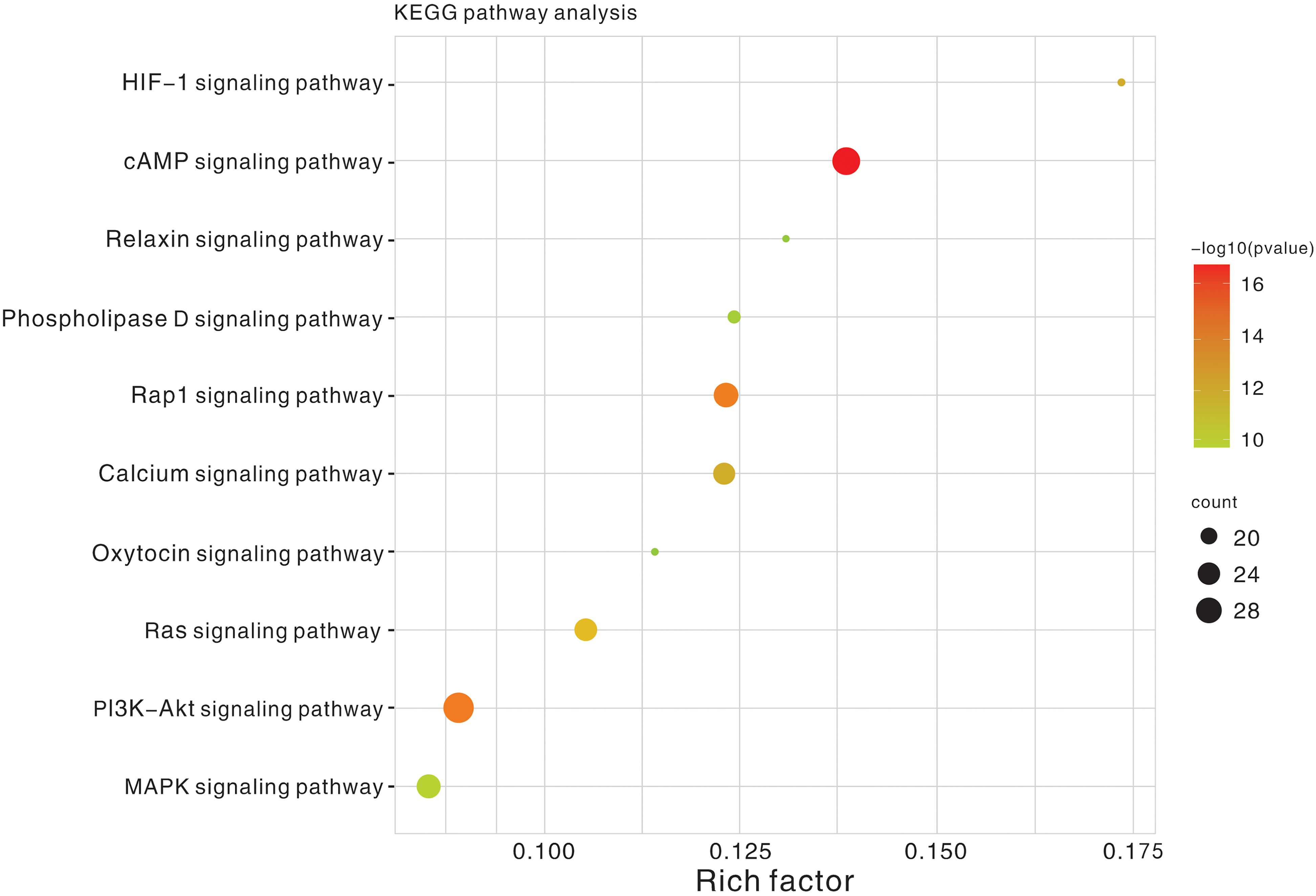
Bubble chart of the result of KEGG pathway enrichment.
Molecular Docking Verification
Before molecular docking, water molecules, hydrogen bonds, and ligands in the protein structure need to be removed and docking files prepared. The lower the binding energy, the more stable the conformation. Molecular docking was applied to analyze the binding of the core targets (MAPK3, SRC, APP, CXCR4, HRAS, JUN, and VEGFA) and 13 components of GPR (except for MOL002140 and MOL002202, 2D structure cannot dock with the targets, probably since too flexible), respectively. Candidate target proteins, including APP (PDB ID:4pqd), MAPK3 (PDB ID:4qtb), JUN (PDB ID: 1sqk), CXCR4 (PDB ID: 3odu), and VEGFA (PDB ID:3v2a), were conducted molecular docking with important candidate components, including sitosterol (MOL000359), 4-Cholesten-3-one (MOL013112), stigmasterol (MOL000449), wallichilide (MOL002157), and so on. The binding energy score results are listed in Table 3. In detail, the binding energy scores of CXCR4-sitosterol and VEGFA- sitosterol were -4.42 and -5.46 kcal•mol − 1, APP-4-Cholesten-3-one and MAPK3-4-Cholesten-3-one were -5.17 and -5.53 kcal•mol − 1, CXCR4- Paeoniflorin was 0.29 kcal•mol − 1, and JUN- Mairin was −0.5 kcal•mol − 1, respectively (Table 3). From Table 3, the binding energy of VEGFA- sitosterol and MAPK3-4-Cholesten-3-one was lower than others, which indicated that MAPK3 and VEGFA were the key target of GPR against PD. The results were visualized by Pymol shown in Figure 6. The component had few hydrophobic residues around it and binds to the target mainly through electrostatic interactions (hydrogen bond), and the yellow dashed line in the figure represented the hydrogen bond. According to the results, the binding was good, indicating the components of GPR have a good binding ability with the core targets of PD.

Molecular docking site. (A) CXCR4-sitosterol, (B) VEGFA- sitosterol, (C) APP- 4-Cholesten-3-one, (D) MAPK3- 4-Cholesten-3-one, (E) CXCR4- Paeoniflorin, (F) JUN- Mairin.
Molecular Docking Binding Energy (kcal•mol−1).

Discussion
PD, also known as paralysis tremor, belongs to the category of “fibrillation syndrome.” Finding effectual interventions that could slow or stop the progression of PD remains a priority for patients and researchers. So far, there is no evidence that drugs have a definite disease-modifying effect on PD. In modern medicine, the most commonly used anti-PD drugs are levodopa, which supplement the lost dopamine but fail to restore the degeneration of neurons, and have relatively large adverse reactions after long-term use. 20 Based on clinical practice, evidence-based medicine principles and network data mining methods, the research group used the Apriori algorithm of association rules to obtain commonly used drug combination and screened out the anti-PD Chinese herbal prescription: Rehmanniae Radix Praeparata, Testudinis Carapax et Plastrum, Paeoniae Radix Alba, Gastrodiae Rhizoma, Chuanxiong Rhizoma, and Arisaema Cum Bile. 8 TCM has a history of more than one thousand years in China and has been widely used in the treatment of neurological diseases. However, the specific mechanism of CHMs components in treating diseases is still unclear. At present, there are few studies on the mechanism of CHMs prescriptions in the treatment of PD. In this study, the network pharmacology method was adopted. 21 Multiple databases in term of component, target, disease, and bioinformation annotation were used to construct and analyze the network to predict the mechanism of GPR in treating PD. Based on the basic pathogenesis of TCM (deficiency of liver and kidney, internal movement of deficient wind, endogenesis of phlegm and blood stasis, spirit damage, and obstruction of channel. 5 GPR, composed of six natural products, has different therapeutic effects on PD. Testudinis Carapax et Plastrum nourishes Yin and latent Yang as well as kidney and bones and could cure Yin deficiency and Yang hyperactivity and internal movement of deficiency wind. Rehmanniae Radix Praeparata has the effect of nourishing blood, Yin, and essence, and filling marrow. Gastrodiae Rhizoma could relieve wind and spasmodic, calm liver Yang, dispel wind, and smooth collaterals. Arisaema Cum Bile combined with Gastrodiae Rhizoma contributes to wind quenching and calming. Chuanxiong Rhizoma promotes blood circulation and Qi, dispelling wind and relieving pain. Paeoniae Radix Alba nourishes blood and Yin, suppresses liver Yang, and assists other drugs to play the effect of reinforcing liver and kidney, benefiting blood of the essence, soothing wind, and quivering. Based on syndrome differentiation, GPR could relieve symptoms and alleviate the pain of patients.
This report showed that sitosterol, stigmasterol, and Perlolyrine were overlapping components in four natural products. Molecular docking results showed that 4-Cholesten-3-one had lower binding energy with MAPK3, APP, and other targets. The results implied that sitosterol, 4-Cholesten-3-one, stigmasterol, and Perlolyrine may be the core components of GPR against PD. At present, the pathogenesis of PD is not clear and may be related to oxidative stress, 22 mitochondrial dysfunction, 23 neuroinflammation, 24 protein aggregation and overexpression, 25 Ca2+ homeostasis,26,27 as well as genetic and environmental factors. Currently, there is no effective treatment method for PD, and CHMs have the characteristics of multiple components, multiple targets, and multiple pathways, which has a unique curative effect on PD. Clinically, the curative effect of CHMs on non-motor symptoms is more obvious.28,29 Various components of GPR have been proved to be effective in treating animal models of PD. It has been found that Testudinis Carapax et Plastrum extract contains a large number of fatty acids, including 4-Cholesten-3-one, 30 which can promote the proliferation of endogenous neural stem cells after focal ischemia. 31 Other studies 32 have found that Testudinis Carapax et Plastrum extract can improve the rotation behavior of PD rat and increase the content of dopamine in the striatum. Gastrodin was confirmed in vivo to increase total antioxidant capacity, reduce inflammatory response, improve the motor symptoms of PD rat, and alleviate neurotoxicity in striatal.33,34 The research showed that tetramethylpyrazine from Chuanxiong Rhizoma has a significant preventive effect on MPTP-induced DA neuron injury, as evidenced by improved motor impairment, enhanced TH expression, and the content of dopamine and its metabolite. For rats with PD, tetramethylpyrazine could provide neuroprotection by inhibiting inflammatory responses, reducing neuronal apoptosis and preventing neuronal loss. 35 In the MPTP-induced PD model, tetramethylpyrazine could protect DA neurons from damage by inhibiting the downregulation of nuclear factor erythroid 2 p45-related factor 2(Nrf2) and glutathione cysteineligase catalytic subunit (GCLC), maintaining redox balance and inhibiting apoptosis. 36 Paeoniflorin from Paeoniae Radix Alba, which inhibits the overactivation of astrocytes and apoptosis of neurons, has good neuroprotective effects.37,38
The results of PPI network and molecular docking indicated that MAPK3, VEGFA, EGFR, SRC, HRAS, JUN, and CXCR4 may be the key targets of GPR against PD. The binding energy scores of CXCR4- sitosterol and VEGFA- sitosterol were -4.42 and -5.46 kcal•mol − 1 and APP-4-Cholesten-3-one and MAPK3-4-Cholesten-3-one were -5.17 and -5.53 kcal•mol − 1. Molecular docking visualization results displayed that the screened core targets indeed stably combine with sitosterol, 4-Cholesten-3-one and stigmasterol. Accordingly, it can be inferred that MAPK3, APP, and VEGFA were the key targets for the treatment of PD. It has been reported that SRC, 39 JUN, 40 EGFR 41 are related to tumor, apoptosis, and proliferation, and VEGFA is closely related to angiogenesis. It has been reported that 42 APP was closely related to the occurrence and development of Alzheimer's disease (AD), so it was speculated that APP may also participate in the neuropathy of PD. MAPK3 involved in cell proliferation, differentiation and apoptosis, 43 and anti-inflammatory. 44 Inhibition of VEGFA transcription is said to alleviate inflammation by inhibiting angiogenesis. 45 VEGFA is well-known to induce BBB disruption. 46 One study showed 47 that oligomeric α-activated astrocytes, increased the expression of VEGFA and NO, disrupted BBB permeability. It has been reported that CXCR4 is associated with an increased risk of PD. 48 The substantia nigra striatum systems of PD patients showed high expression of chemokine receptor CXCR4. 49 A study had shown 50 that EphA1 can inhibit inflammatory factors through the CXCL12/CXCR4 signaling pathway and improve the inflammatory response and neuropathological changes in MPTP-induced PD mouse models; therefore, blocking CXCR4 signaling may be an effective treatment for PD. 51 GAPDH gene is an important factor in the pathogenesis of PD. 52 Studies have shown that GAPDH was involved in the formation of Lewy body in PD patients, 53 and the mechanism may be related to apoptosis. 54
Additionally, the KEGG pathway enrichment analysis suggested that GPR may act on a variety of pathways, including cAMP signaling pathway, PI3K/Akt signaling pathway, Rap1 signaling pathway, Calcium signaling pathway, MAPK signaling pathway, and Oxytocin signaling pathway. A report 55 has shown that the MAPK signaling pathway is involved in the pathogenesis of PD, and phosphorylated JNK protein is highly expressed in the brain of PD patients. Besides, MAPK signaling is involved in various physiopathological processes, such as cell growth, development, differentiation, and apoptosis, and as a regulator of inflammation and stress response. 56 It has been reported that the PI3K/Akt signaling pathway may have mediated the protection of paeoniflorin against MPTP, suggesting that the PI3K/Akt pathway is an important signaling pathway that could promote neuronal growth and survival. 38 By activating the PI3K/Akt signaling pathway and regulating downstream apoptotic proteins could ameliorate pathological damages, oxidative stress and inhibit apoptosis. 57 Experimental studies 58 have reported that anti-inflammatory and neuroprotective effects may be obtained in a mouse model of PD by successive activation of the Sonic hedgehog (SHH) and PI3K/Akt signaling pathways. The PI3K/Akt signaling pathway may play an important role in the mechanism of acupuncture therapy in MPTP-induced PD mice, preventing the degeneration of DA neurons and improving motor function. 59
In summary, based on the network pharmacology and molecular docking. The analysis results showed that sitosterol, 4-Cholesten-3-one and stigmasterol were the effective components of GPR in the treatment of PD, and MAPK3, APP, and VEGFA were the key targets of the treatment. They participated in catalytic activity binding, protein tyrosine kinase activity, regulated the cell death, drug binding, and regulated cAMP signaling pathway, PI3K/Akt signaling pathway, Rap1 signaling pathway and other signaling pathways. GPR may act on multiple targets through multi-pathway to carry out its therapeutic in PD. This study analyzed the interaction of the multi-component and multi-target of GPR and disease targets and revealed the potential mechanism of GPR in treating PD. However, the network pharmacological analysis of GPR only considers the closeness of interaction between herbs and disease, without considering the difference in the intensity of interaction between drugs, targets, and disease. Besides, the principle of drug compatibility, drug dosage, and decocting method also not be considered. CHMs treatment of diseases has the characteristics of multi-component, multi-target, and multi-channel, but lacks specificity. It is necessary to study the specific mechanism of disease treatment in depth. The results preliminarily predicted the mechanisms related to the therapeutic effects of GPR against PD and provide a significant basis and reference for further exploration.
Footnotes
Author Contributions
Li-Juan Tan, Ying Yu, and Ze-Hai Fang: contributed equally to this work. Li-Juan Tan, Ying Yu, and Ze-Hai Fang: conceived and designed the research; Li-Juan Tan, Ying Yu, and Ze-Hai Fang: performed the research; Li-Juan Tan, Ying Yu, and Ze-Hai Fang: data curation; Li-Juan Tan, Ying Yu, Ze-Hai Fang, and Jiong-Lu Zhang: wrote this paper, formal analysis, research methods and software usage analysis, extracted data, writing-original draft, writing review, and editing; Hong-Jie Liu and Hai-Liang Huang: funding, project administration, supervision, and revised the manuscript; Hong-Jie Liu and Hai-Liang Huang: primary responsibility for final content. All of the authors have read, reviewed, and approved to the published version of the final manuscript.
Declaration of Conflicting Interests
The author(s) declared no potential conflicts of interest with respect to the research, authorship, and/or publication of this article.
Funding
This study was supported by the National Natural Science Foundation of China (No. 82074306), Guangdong Basic and Applied Basic Research Foundation (No. 2019A1515010644), and Shandong Provincial Natural Science Foundation (No. ZR2021MH179).
