



Abstract
Mosquito-borne diseases are a consistent problem in Vietnam. Additionally, freshwater snail species are agricultural pests and are known to be intermediate hosts for several parasitic worms. There is a need for new and complementary botanical pesticidal agents for controlling these pests and essential oils have shown promise. In this work, essential oils from 2 species of Callicarpa (C. rubella and C. sinuata) and 4 species of Premna (P. chevalieri, P. corymbosa, P. maclurei, and P. tomentosa) were screened for mosquito larvicidal activity against Aedes albopictus and Culex quinquefasciatus and for molluscicidal activity against 3 freshwater snail species, Gyraulus convexiusculus, Pomacea canaliculata, and Tarebia granifera. Callicarpa rubella essential oil showed exceptional larvicidal activity against Cx. quinquefasciatus with 24-h LC50 of 9.8 μg/mL. In addition to C. rubella, the essential oils of P. chevalieri and P. tomentosa showed notable molluscicidal activities against P. canaliculata with LC90 values ≤ 20 μg/mL. These Callicarpa and Premna essential oils were all rich in sesquiterpenes and should be considered for continued investigation as botanical pesticidal agents.
Introduction
Synthetic pesticides have played an important role in controlling mosquitos and snails for decades. However, synthetic pesticides are harmful to the environment and human health, the most serious is the development of pesticide resistant target organism populations.1‐4 In recent years, essential oils have emerged as a biodegradable, nontoxic, and environmentally friendly source of pesticides.5,6 Essential oils are rich and complex in chemical composition, which make it difficult for target organisms to become resistant to the essential oils.6,7
Some freshwater snail species are important as intermediate hosts that cause diseases in humans or animals. Pomacea canaliculata (Lamarck) is native to South America. 8 In many Southeast Asian countries, P. canaliculata is of particular interest as a troublesome invasive species and considered one of the most harmful pests to rice. Moreover, P. canaliculata is an intermediate host for human parasites such as Angiostrongylus cantonensis, which leads to eosinophilic meningitis, 9 Gnathostoma spinigerum, which is the cause of gnathostomiasis, 10 and Angiostrongylus vasorum which leads to eosinophilic encephalitis, 11 and the intestinal fluke Echinostoma ilocanum. 12
Gyraulus convexiusculus (Hutton) is an intermediate host for several trematode parasites13,14 including Echinostoma revolutum, Australapatemon burti, 15 Artyfechinostomum malayanum (intestinal flukes), 16 Sanguinicola armata (blood fluke), 17 and Cercaria sp. 18 In addition, G convexiusculus is an intermediate host of Olveria indica, an amphistome parasite. 19
Tarebia granifera (Lamarck) is a host of several parasitic trematodes including Paragonimus westermani (the oriental lung fluke) as well as the intestinal flukes Haplorchis taichui, 20 Centrocestus formosanus, and Haplorchis pumilio. 21 This species is also considered to be an intermediate host of Philophthalmus gralli, which is the cause of oriental eye-fluke in birds. 22
The Asian tiger mosquito, Aedes albopictus (Skuse) is distributed throughout the world. This species acts as a vector of viruses such as the dengue viruses, chikungunya virus, 23 and Zika virus. 24 The mosquito Culex quinquefasciatus (Say) is one of mosquito vectors transmitting lymphatic filariasis, including Saint Louis encephalitis virus, 25 West Nile virus, 26 and Zika virus. 27 Lymphatic filariasis affects over 120 million people in 81 countries throughout the tropics and sub-tropics of Asia, Africa, the western Pacific, and parts of the Caribbean and South America; and an estimated 1.34 billion live in areas where filariasis is endemic and are at risk of infection. 28
The essential oil compositions and larvicidal activities against Aedes aegypti have been reported for Callicarpa rubella, C. sinuata, 29 Premna chevalieri, P. corymbosa, P. maclurei, and P. tomentosa. 30 In this present work, we have extended the pesticidal bioassays to include mosquito larvicidal activities against Aedes albopictus and Culex quinquefasciatus as well as molluscicidal activities against 3 freshwater snail species, Gyraulus convexiusculus, Pomacea canaliculata, and Tarebia granifera. In addition, we have screened these essential oils for insecticidal activity against the non-target water bug, Diplonychus rusticus.
Results and Discussion
Essential Oil Compositions
The major components of the essential oils for the Callicarpa and Premna species, previously published, are summarized in Table 1.
Major Components of the Leaf Essential Oils of Callicarpa and Premna Species From Vietnam a .
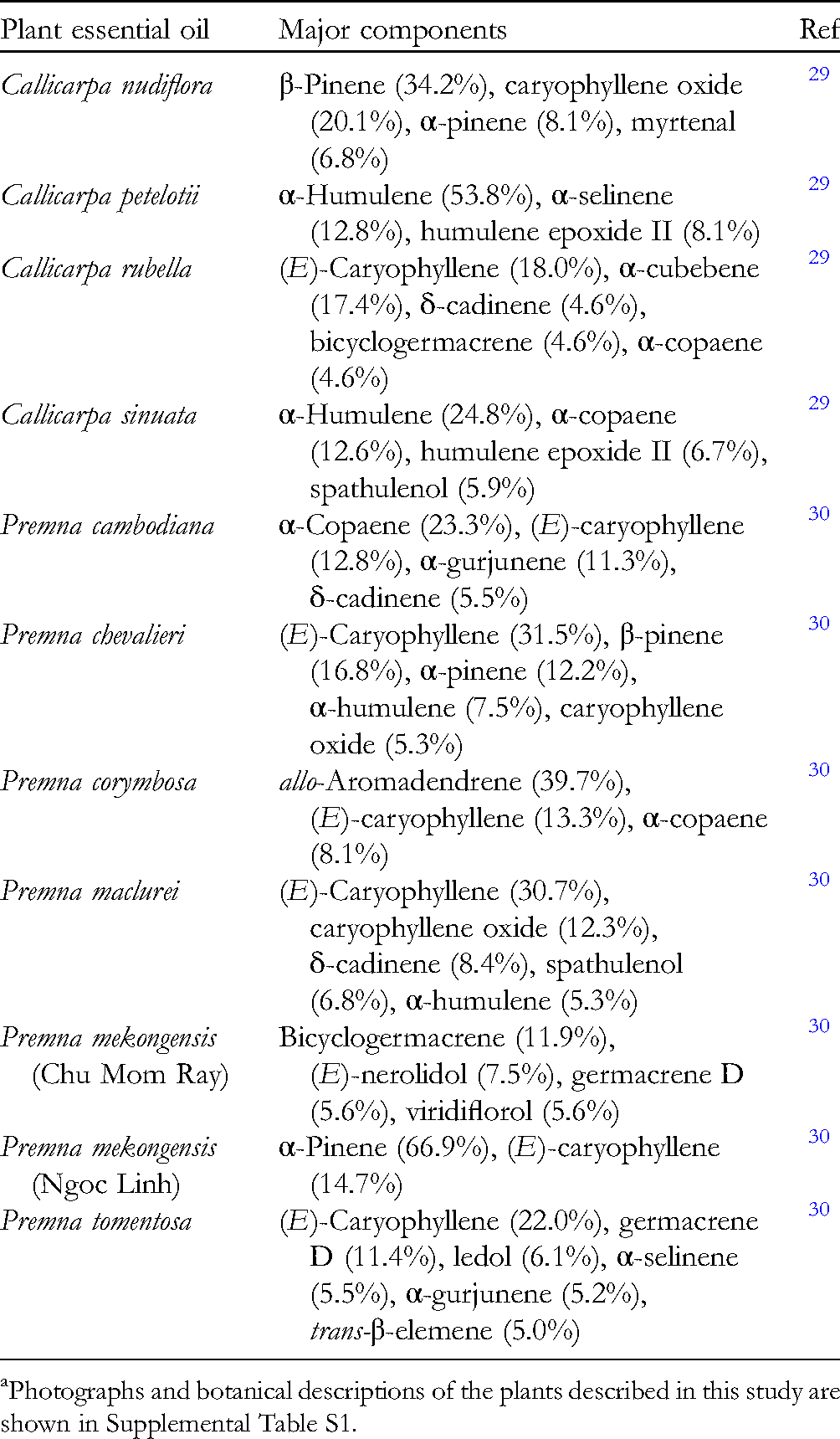
Photographs and botanical descriptions of the plants described in this study are shown in Supplemental Table S1.
Mosquito Larvicidal Activity
The C. rubella, C. sinuata, P. chevalieri, P. corymbosa, P. maclurei, and P. tomentosa leaf essential oils were screened for mosquito larvicidal activity against Aedes albopictus and Culex quinquefasciatus (Table 2). In addition, the essential oils were tested for insecticidal activity on the non-target water bug, Diplonychus rusticus (Figure 1).

Chemical structures of the main compounds of essential oils Callicarpa and Premna species from Vietnam.
Mosquito Larvicidal Activities of Callicarpa and Premna Essential Oils a .

Data are presented as LC50 and LC90 values with 95% confidence limits (log-probit analysis) obtained from 6 independent experiments carried out in quadruplicate, after 24-h and 48-h of treatment.
SI = selectivity index = LC50 (non-target species)/LC50 (mosquito larvae).
Not tested due to insufficient essential oil.
Dias and Moraes 31 have suggested that essential oils with 24-h LC50 less than 100 μg/mL should be considered to be “active” while LC50 above 100 μg/mL should be “inactive.” Using this criterion, all of the Callicarpa and Premna essential oils could be considered to be active. Based on our experience,29,30,32,33 however, we suggest amending the definition of active larvicidal essential oils. Essential oils with 24-h LC50 <10 μg/mL should be considered “exceptionally active,” those with 24-h LC50 between 10 μg/mL and 50 μg/mL “very active,” those with 24-h LC50 between 50 μg/mL and 100 μg/mL “moderately active, and LC50 > 100 μg/mL are “inactive.” In this case, C. rubella leaf essential oil is exceptionally active against Cx. quinquefasciatus, but only marginally active on Ae. albopictus larvae. In a previous study, C. rubella essential oil showed a 24-h LC50 of 26.0 μg/mL (ie, very active) against Ae. aegypti . 29
In addition to the breakdown based on lethality of the essential oils against the target organisms, we can propose a “selectivity index” (SI, see Table 2) based on the lethality of each essential oil against target organisms compared to its lethality against non-targets (in this case, D. rusticus). That is, not only are larvicidal activities important, but also selectivity for the target species is also important. In this study, C. rubella essential oil showed the best overall selective lethality on Cx. quinquefasciatus compared to D. rusticus. Of course, the selectivity index will depend on the non-target organism(s) chosen and it remains to be determined what constitutes a “good SI.”
Most of the Callicarpa and Premna essential oils in this study were dominated by sesquiterpenes. It is tempting to suggest that sesquiterpenes are responsible for the larvicidal activities observed. The major sesquiterpene components in C. rubella essential oil were (E)-caryophyllene (18.0%) and α-cubebene (17.4%). The high concentration of (E)-caryophyllene in C. rubella oil cannot account for the exceptional larvicidal activity of that essential oil on Cx. quinquefasciatus, however. The sesquiterpenes (E)-caryophyllene, α-humulene, and caryophyllene oxide showed only weak activity against Cx. quinquefasciatus with 24-h LC50 values of 161, 108, and 99 μg/mL, respectively (see Supplemental Table S2). 34 Nevertheless, (E)-caryophyllene was present in most essential oils with strong larvicidal activity. 7 Essential oils characterized by (E)-caryophyllene and caryophyllene oxide exhibited larvicidal activity against Ae. aegypti.35,36 Piper purusanum essential oil is characterized by (E)-caryophyllene, α-humulene, and germacrene D, and has shown strong larvicidal activity against Ae. aegypti and Ae. albopictus. 37 The unripe fruit peel of Hymenaea courbaril essential oil was characterized by germacrene D (31.9%) and (E)-caryophyllene (27.1%) and exhibited strong larvicidal activity against Ae aegypti. 38 Sesquiterpene hydrocarbons and oxygenated sesquiterpenoids dominated the essential oil of Callicarpa candicans, which showed exceptional mosquito larvicidal activities against Ae. aegypti and Cx. quinquefasciatus (24-h LC50 = 2.7 and 1.2 μg/mL, respectively). 29 Interestingly, Premna flavescens, with 92.2% sesquiterpene hydrocarbons, was relatively inactive against Ae. aegypti and Ae. albopictus larvae with 24-h LC50 values of 64.7 and 90.0 μg/mL, respectively. 30 Apparently, synergistic and/or antagonistic effects of essential oil components play a role in the larvicidal activities. 39
Callicarpa nudiflora essential oil was dominated by β-pinene (34.2%) and the very good larvicidal activity of C. nudiflora against Ae. albopictus (24-h LC50 = 33.00 μg/mL) can be attributed to the larvicidal activity of β-pinene against Ae. albopictus (24-h LC50 = 8.51 μg/mL, see Supplemental Table S2). Likewise, P. mekongensis essential oil from Ngoc Linh, an α-pinene-rich chemotype (66.9% α-pinene) also showed good larvicidal activity against Ae. albopictus with 24-h LC50 of 25.67 μg/mL and SI of 5.1. Essential oils are complex mixtures of many compounds, and synergistic effects between the essential oil components are likely responsible for the enhanced larvicidal activities compared to the individual components that were tested. Essential oils containing high levels of α-pinene showed strong larvicidal activity against Culex pipiens40‐42 and Ae. albopictus. 43
Molluscicidal Activity
The Callicarpa and Premna leaf oils were screened for molluscicidal activity against the freshwater snails, Gyraulus convexiusculus, Pomacea canaliculata, and Tarebia granifera (Table 3).
Molluscicidal Activities of Callicarpa and Premna Essential Oils a .

Data are presented as LC50 and LC90 values with 95% confidence limits (log-probit analysis) obtained from 5 independent experiments carried out in quadruplicate, after 24-h of treatment with an additional 24-h recovery time.
SI = selectivity index = LC50 (non-target species)/LC50 (snails).
Not tested due to insufficient essential oil.
The World Health Organization (WHO) has defined “active” molluscicidal botanicals as those that have LC90 ≤ 20 μg/mL. 44 Based on this criterion, P chevalieri essential oil was active against G. convexiusculus and P. canaliculata, while C. rubella and P. tomentosa essential oils were active against P. canaliculata. In addition to these lethality data, C. rubella, P. chevalieri, and P. tomentosa essential oils were relatively selective for P. canaliculata compared to the non-target water bug with selectivity indices > 10.
In contrast to larvicidal activities, (E)-caryophyllene, α-humulene, and caryophyllene oxide have shown molluscicidal LC90 values around 20 μg/mL on P canaliculata (see Supplemental Table S3), 34 and likely contributed to the molluscicidal activities of C. rubella, P. chevalieri, and P. tomentosa essential oils against P. canaliculata. The sesquiterpenoid-rich P. mekongensis essential oil (from Chu Mom Ray) showed excellent molluscicidal activity against G. convexiusculus and P. canaliculata with LC90 values of 12.10 and 11.61 μg/mL, respectively, and SI values of 9.0 and 17.1, respectively. The role of sesquiterpenoids in molluscicidal activity has also been observed in previous studies. The essential oil of Xylopia langsdorffiana, characterized by germacrene D (22.9%), trans-β-guaiene (22.6%), and (E)-caryophyllene (15.7%), exhibited strong molluscicidal activity against Biomphalaria glabrata with an LC50 value of 5.6 µg/mL. 45 Schinus terebinthifolius essential oil, containing sabinene (14.9%), γ-elemene (13.2%), and β-elemene (6.6%), was active against Theba pisana with an LC50 value of 8.36 µg/mL. Meanwhile, Vitex agnuscastus essential oil consisting of (E)-caryophyllene (15.2%), 1,8-cineole (13.0%), and bicyclogermacrene (7.3%) exhibited an LC50 value of 20.72 µg/mL. 46 Other studies that support this trend include the essential oil from the stem bark of Ocotea bracteosa 47 and the leaf essential oil of Eugenia uniflora. 48
Materials and Methods
Isolation of Essential Oils
The essential oils were extracted from the fresh leaves of the plants by hydrodistillation. The leaves were shredded and hydrodistilled using a Clevenger type apparatus (Witeg Labortechnik). The essential oils were dried over anhydrous Na2SO4 and stored in sealed glass vials at 4 °C until used for analysis and bioactivity assays.
Preparation of Test Solutions
For all experiments, a 1% stock solution of the essential oils was prepared by dissolving each essential oil using ethanol. Different volumes of stock solution were introduced into test beakers containing 150 mL of distilled water to obtain test solutions with the desired concentrations.
Mosquito Larvicidal Assays
Adult Aedes albopictus mosquitoes were maintained continuously under laboratory conditions such as relative humidity 75%, temperature 25 ± 2 °C, cycles 12-h light and 12-h dark. Aedes mosquito larvae were reared in plastic containers and were fed on Koi fish food, the water in the plastic containers was renewed daily with tap water overnight. The eggs and first and early second instar larvae of Culex quinquefasciatus were collected in wild environments such as tires and ditches. The larvae were fed on the ripe fruit of Ficus racemosa until reaching the third and early fourth instar.
The essential oils were screened for larvicidal activity against Ae. albopictus and Cx. quinquefasciatus as described previously 32 : 4 replicates, 20 larvae third and early fourth instar each, with essential oil concentrations of 100, 50, 25, 12.5, 6, and 3 μg/mL, permethrin positive control, larvicidal effects assessed after 24 and 48 h, lethality data analyzed by log-probit 49 analysis to obtain LC50, LC90, and 95% confidence limits using Minitab® 19 (Minitab, LLC).
Insecticidal Assay
Adults of Diplonychus rusticus (water bug) were collected from the wild, maintained in glass tanks (60 cm long × 50 cm wide) with a water depth of 20 cm under the same conditions for other organisms. Eichhornia crassipes plants were introduced into the tanks to help the water bug maintain its behaviors.
The essential oils were screened for insecticidal activity against the non-target water bug, Diplonychus rusticus as previously described 50 : Quadruplicate assays, 20 adult insects each, essential oil concentrations of 200, 150, 100, 75, 50, and 25 μg/mL, insect lethality assessed after 24 and 48 h, log-probit analysis.
Molluscicidal Assays
The Premna and Callicarpa essential oils were screened for molluscicidal activity against Gyraulus convexiusculus, Pomacea canaliculata, and Tarebia granifera as previously described 34 : Quadruplicate assays, 20 snails each, essential oil concentrations of 100, 50, 25, 12.6, and 6 μg/mL, tea saponin positive control, 24-h treatment, followed by 24-h recovery in fresh water, lethality data analyzed by log-probit.
Conclusions
Based on the pesticidal activity data presented in this report, we conclude that C. rubella essential oil could be an effective mosquito control agent for Cx. quinquefasciatus with limited environmental impact. In addition, the essential oils C. rubella, P. chevalieri, P. mekongensis, and P. tomentosa should be considered for control of the agricultural pest P. canaliculata. Additional research is needed to determine appropriate formulations to extend the lifetimes of the essential oils in the field as well as field trials to determine efficacy in the field as well as any detrimental environmental effects. These studies are currently being carried out in the laboratory of Nguyen Huy Hung. Additional studies are also necessary to examine more essential oil components for biological activity, both individually and in mixtures to assess synergistic activities.
Supplemental Material
sj-docx-1-npx-10.1177_1934578X221110660 - Supplemental material for Pesticidal Activities of Callicarpa and Premna Essential Oils From Vietnam
Supplemental material, sj-docx-1-npx-10.1177_1934578X221110660 for Pesticidal Activities of Callicarpa and Premna Essential Oils From Vietnam by Nguyen Huy Hung, Do Ngoc Dai, Truong Nguyen Cong, Nguyen Anh Dung, Le Duy Linh, Vo Van Hoa, Tran Thu Hien, Nguyen Thi Hong Chuong, Vu Thi Hien, Bui Van Nguyen and William N. Setzer in Natural Product Communications
Supplemental Material
sj-docx-2-npx-10.1177_1934578X221110660 - Supplemental material for Pesticidal Activities of Callicarpa and Premna Essential Oils From Vietnam
Supplemental material, sj-docx-2-npx-10.1177_1934578X221110660 for Pesticidal Activities of Callicarpa and Premna Essential Oils From Vietnam by Nguyen Huy Hung, Do Ngoc Dai, Truong Nguyen Cong, Nguyen Anh Dung, Le Duy Linh, Vo Van Hoa, Tran Thu Hien, Nguyen Thi Hong Chuong, Vu Thi Hien, Bui Van Nguyen and William N. Setzer in Natural Product Communications
Supplemental Material
sj-docx-3-npx-10.1177_1934578X221110660 - Supplemental material for Pesticidal Activities of Callicarpa and Premna Essential Oils From Vietnam
Supplemental material, sj-docx-3-npx-10.1177_1934578X221110660 for Pesticidal Activities of Callicarpa and Premna Essential Oils From Vietnam by Nguyen Huy Hung, Do Ngoc Dai, Truong Nguyen Cong, Nguyen Anh Dung, Le Duy Linh, Vo Van Hoa, Tran Thu Hien, Nguyen Thi Hong Chuong, Vu Thi Hien, Bui Van Nguyen and William N. Setzer in Natural Product Communications
Footnotes
Acknowledgments

Declaration of Conflicting Interests
The authors declared no potential conflicts of interest with respect to the research, authorship, and/or publication of this article.
Funding
The authors disclosed receipt of the following financial support for the research, authorship, and/or publication of this article: This research was funded by NAFOSTED (Vietnam), grant number 106.03-2019.25.
Supplemental material
Supplemental material for this article is available online.
References
Supplementary Material
Please find the following supplemental material available below.
For Open Access articles published under a Creative Commons License, all supplemental material carries the same license as the article it is associated with.
For non-Open Access articles published, all supplemental material carries a non-exclusive license, and permission requests for re-use of supplemental material or any part of supplemental material shall be sent directly to the copyright owner as specified in the copyright notice associated with the article.
