



Abstract
In the present study, the chemical composition of the essential oils from aerial parts of Ballota nigra subsp. uncinata (Bég.) Patzak collected in Sicily was evaluated by gas chromatography (GC) and GC-mass spectrometry. The main components of the oil were (E)-phytol (20.0%), α-pinene (9.0%), hexahydrofarnesyl acetone (5.7%), and α-selinene (5.1%). Cluster analysis of the essential oil compositions of all the taxa belonging to B. nigra s.l. group was performed.
Keywords
Ballota L. (Lamiaceae) is a genus belonging to the tribe Stachydeae, subtribe Ballotae. The Plant List, which has been used to validate the scientific names of the species, includes more than 160 scientific plant names of species rank for the genus Ballota. Of these, only 30 are accepted species names. They are native to Macaronesia, Europe, Mediterranean to West Asia, Mauritania, Chad, and South Africa. Ballota species are perennial herbs characterized by flowers held in verticillasters and by an unpleasant aromatic foliage. 1
Lamiaceae taxa have attracted interest by the researcher for the valuable biological properties of their extracts, such as antibacterial, antioxidant, and hypoglycemia. 2 Furthermore, Lamiaceae essential oils have shown a promising anti-inflammatory potential 3 and are widely used in aromatherapy for several minor clinical uses. 4 In this context, Ballota species have been used in folk medicine as antiulcer, antispasmodic, diuretic, choleretic, antihemorrhoidal, and sedative agents. 5 The antimicrobial activities 6 -8 and the antioxidant activities 9 of Ballota species were recently reported as well as the antifungal activities of some flavonoids isolated from 2 species. 10,11 The water extract has been reported to have antinociceptive, antiinflammatory, and hepatoprotective activities. 12 In Europe, the polar extracts of the flowering aerial parts of Ballota are commonly used due to their neurosedative activity. 13,14 More recently, the general antioxidant activity, 15 the in vitro inhibition of LDL (low-density lipoprotein) peroxidation 16 and the antibacterial activity 17,18 of these plants have been published. Phytochemical investigations showed that labdane diterpenoids, flavonoids, and phenylpropanoids are the characteristic features of the genus, and recently the occurrence of non-volatile and volatile metabolites, the ethnopharmacological uses, and the biological properties of all the studied taxa of Ballota have been reviewed. 19
As a continuation of our researches on Ballota species, 20 -22 we decided to investigate the chemical composition of the essential oil B. nigra subsp. uncinata, collected in Sicily.
Ballota nigra subsp. uncinata (Bég.) Patzak (syn. Ballota nigra subsp. ruderalis (Sw.) Briq.) is present in the western part of North Africa, Southern Europe, Turkey, and Mediterranean Middle East. 23 Previous investigations on this taxon reported the occurrence of only 1 labdane diterpenoid, dehydrohispanolone, 24,25 the chemical composition of the essential oil of Turkish accession, 26 and its antilisterial activity against L. monocytogenes. 27
Results and Discussion
Hydrodistillation of B. nigra subsp. uncinata (
Percent Composition of the Essential Oils of Aerial Parts of Ballota nigra subsp. uncinata Arranged by Class.

aHP-5 MS column.
bHP Innowax column.
cB.n.u.: Ballota nigra L. subsp. uncinata (Fiori et Beg.) Patzak.
d1: Retention index, 2: mass spectrum, 3: co-injection with authentic compound.
et: Trace, <0.05%.
The main constituents of
Table 2 reports the main compounds of the essential oils of the different taxa of B. nigra sl. group studied so far.
Considering the compounds occurring in the oils with an abundance of more than 3% only, the comparison of our data with those reported in the literature (Table 2) allows to point out some interesting considerations.
Main Compounds (>3%) of the Essential Oils From the Aerial Parts of Taxa of Ballota nigra sl Group.
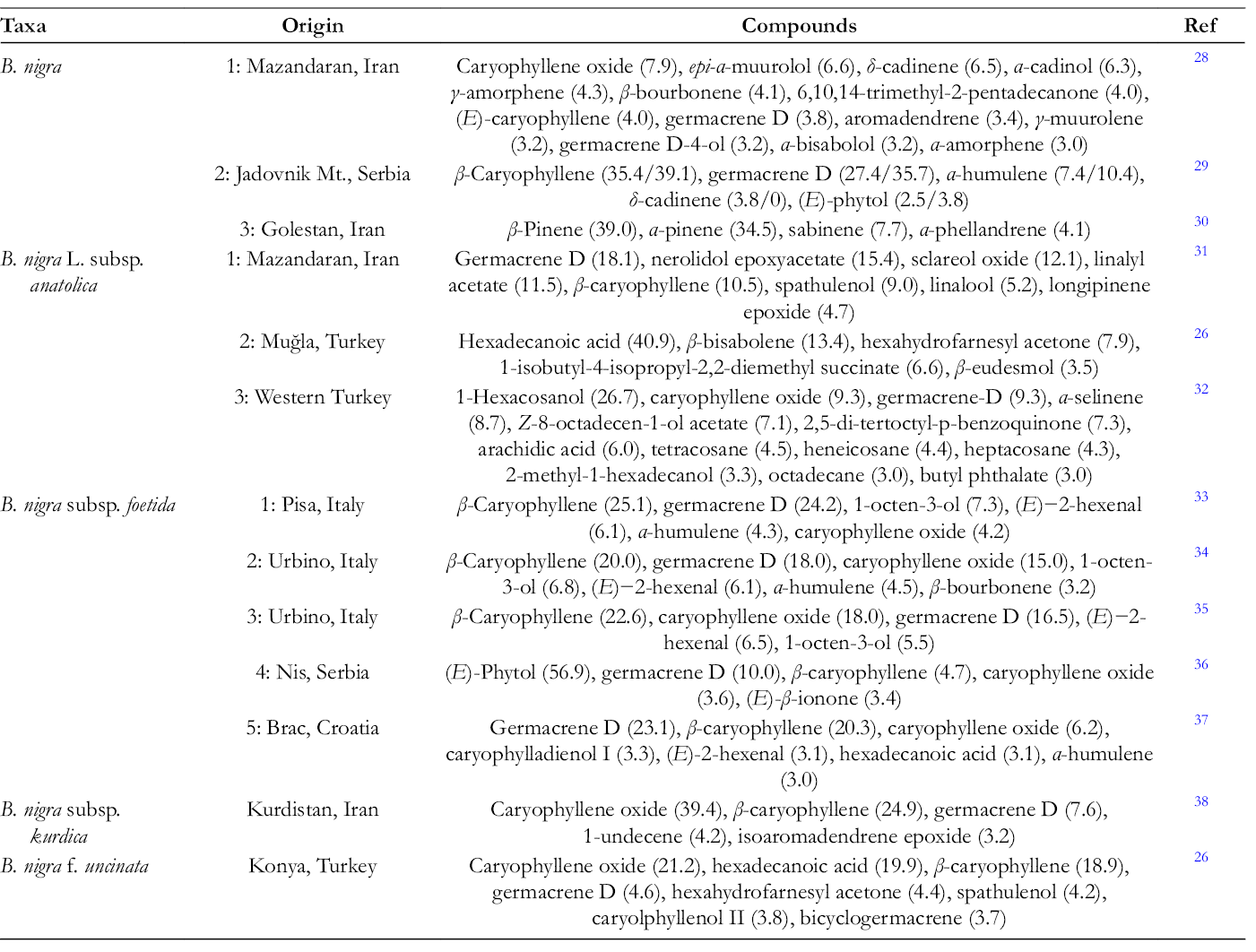
Almost all the B. nigra species contain the sesquiterpenes caryophyllene and/or caryophyllene oxide among the main compounds with the exception of 2 cases: B. nigra 3 collected in Iran 30 and B. nigra subsp. anatolica 2 collected in Turkey. 26
The B. nigra subsp. uncinata, we examined, contains on the contrary to the previously investigated B. nigra subsp. uncinata, also a relevant amount (9%) of monoterpene α-pinene exclusively contained in the B. nigra 3 collected in Iran. 30 A cluster statistical analysis (Figure 1) of these data, based on a comparison of the species according to the relative amounts of compounds, shows a certain resemblance of our sample with B. nigra subsp. foetida 4 collected in Serbia. 36 In fact, both species, apart from caryophyllene and germacrene D, are the only ones containing the diterpene phytol as the most abundant compound.

The dendrogram of the clusters obtained by statistical analysis.
Experimental
Plant Material
Aerial parts (flowers, stems, and leaves) of B. nigra subsp. uncinata (Bég.) Patzak (
Isolation of the Essential Oil
The air-dried samples (200 g) were ground in a Waring blender and then subjected to a single hydrodistillation for 3 hours using n-hexane as the solvent, according to the standard procedure previously described.
39
The extracts were dried over anhydrous sodium sulfate and then stored in sealed vials, at −20°C, ready for the gas chromatography (GC) and GC-mass spectrometry (MS) analyses. The samples yielded 0.016% (
Gas Chromatography–Mass Spectrometry
Analytical GC was carried out on a Perkin-Elmer Sigma 115 GC fitted with an HP-5 MS capillary column (30 m × 0.25 mm), 0.25 µm film thickness. Column temperature was initially kept at 40°C for 5 minutes, then gradually increased to 250°C at 2°C/min rate, held for 15 minutes and finally raised to 270°C at 10°C/min. Diluted samples (1/100 v/v, in n-pentane) of 1 µL were injected at 250°C, manually, and in the splitless mode. Flame ionization detection (FID) was performed at 280°C. GC-MS analysis was performed on an Agilent 6850 Ser. II apparatus, fitted with a fused silica DB-5 capillary column (30 m × 0.25 mm), 0.33 µm film thickness, coupled to an Agilent Mass Selective Detector MSD 5973; ionization voltage 70 eV; electron multiplier energy 2000 V. GC conditions were as given; transfer line temperature, 295°C. Analysis was also run by using a fused silica HP Innowax polyethyleneglycol capillary column (50 m × 0.20 mm, 0.20 µm film thickness). In both cases, helium was used as carrier gas (1 mL/min). Identification of compounds was carried out using NIST 11, Wiley 9, FFNSC 2, and Adams databases. 40 These identifications were confirmed by linear retention indices with those available in literature by the SciFinder database. Some of the compounds were also confirmed by comparison of mass spectra and retention times with standard compounds available in the laboratory. The retention indices were determined in relation to a homologous series of n-alkanes (C8–C30) injected under the same operating conditions. Component relative concentrations were calculated based on GC peak areas without using correction factors.
Statistical Analysis
It was carried out using the cluster method by Primer 6 41 using a matrix composed of the amount (%) of the 50 compounds occurring in 14 subspecies of B. nigra with abundance >3%.
Footnotes
Acknowledgments
The GC–MS spectra were performed at the “C.S.I.A.S.” of the University “Federico II” of Napoli.
Declaration of Conflicting Interests
The author(s) declared no potential conflicts of interest with respect to the research, authorship, and/or publication of this article.
Funding
The author(s) disclosed receipt of the following financial support for the research, authorship, and/or publication of this article: the assistance of the staff is gratefully appreciated. This work was supported by grant from MIURITALY PRIN 2017 (Project N. 2017A95NCJ).
