



Abstract
The chemical constituents of essential oils extracted by hydrodistillation from Piper klotzschianum, P. hispidum, and P. arboreum, collected from the remaining Atlantic forest in Sergipe State, were characterized and submitted to cytotoxic and larvicidal activity assays. The major constituents identified (stems, fresh, and dried leaves) were (E)-caryophyllene (16.8%) and bicyclogermacrene (21.6%). Germacrene D (22.8%) was identified only in P. klotzschianum and P. hispidum. A high percentage of β-pinene (27.2%) and α-pinene (7.2%) were present in P. klotzschianum stems and δ-3-carene in the fresh and dried leaves of P. hispidum (17.4% and 19.1%, respectively). Piper klotzschianum showed the best cytotoxic activity, inhibiting human hepatocellular carcinoma (27.3 µg/mL), human promyelocytic leukemia (33.8 µg/mL), and murine melanoma (37.9 µg/mL) cell lines. Larvicidal activity was also tested and the essential oil from the dried leaves of P. klotzschianum was the most potent against Aedes aegypti larvae, with an LC50 value of 122.4 µg/mL.
The genus Piper contains more than 1000 species represented by herbs, shrubs, and trees. This genus is considered the most important (economically and ecologically) of the family Piperaceae. 1 Species of this genus are widely distributed in the tropical and subtropical regions of the world and exhibit diverse chemical compositions, including monoterpenes, sesquiterpenes, arylpropanoids, alkaloids, amides, neolignans, steroids, kavapyrones, chalcones, dihydrochalcones, piperolides, flavones, and flavanones. 2
The family Piperaceae, mostly Piper species, is known for its larvicidal activity 3,4 and several medicinal properties (eg, antitumor activity). 5 -8 Data obtained by Garcez et al 9 show that of the 11 active substances identified in the family Piperaceae, 10 occur in the genus Piper. The relatively high activities shown by this genus is due to the presence of amides. According to Silva et al, 10 amides are among the groups with the highest number of compounds with larvicidal and insecticidal activity. 11,12 Piper compounds also presented different biological activities, such as antibacterial, antifungal, anticancer, spermicidal, and anti-inflammatory. 13 -15 Retrofractamide A, isolated from P. nigrum, 16 and 1-butyl-3,4-methylenedioxy-phenyl, the major constituent of the oil extracted from the leaves, stems, fruits, and roots of P. klotzschianum, 17 have shown promising activity against Aedes aegypti. High efficiency in this regard has also been observed using ethanolic extracts of P. longum, P. sarmentosum, and P. ribesoides. 18
Dengue affects more than 390 million people per year, 19 and cancer diagnoses have greatly increased in the last decade. This study aimed to investigate the chemical constituents, as well as larvicidal and cytotoxicity activities, of essential oils obtained from P. klotzschianum, P. hispidum, and P. arboreum, collected from the Atlantic forest in Sergipe State, Brazil.
All of the Piper species studied contained essential oils, with yields ranging from 0.08% to 1.12%, based on the total sample weight. The highest oil content was found in the dried leaves of P. arboreum (1.12%) (see Supplementary Material Table S1).
Twenty-five compounds were identified in the essential oils of P. klotzschianum, representing 88.7% for fresh leaves, 85.9% for dried leaves, and 91.4% for stems (based on total compounds detected by gas chromatography-mass spectrometry [GC-MS] analysis). The essential oils of this species contain high percentages of sesquiterpenes, including germacrene D (22.8% ± 0.8% fresh leaves, 13.4% ± 0.5% dried leaves, and 7.3% ± 0.3% stems), bicyclogermacrene (21.6% ± 0.8% fresh leaves, 14.6% ±0.9% dried leaves, and 13.4% ± 0.6% stems), and (E)-caryophyllene (14.1% ± 0.7% fresh leaves, 16.8% ± 0.7% dried leaves, and 11.9% ± 0.1% stems). β-Pinene (27.2% ± 0.3%) and α-pinene (7.2% ± 0.5%), present in the stems, were responsible for the high levels of nonoxygenated monoterpenes (37.7%) (see Supplementary Material Table S2) Differences observed in the volatile percentage and chemical composition of fresh and dried leaves are probably linked to the fact that, on drying, the constituents were either volatilized due to the heating process or oxidized. Similar results were reported by Pimentel et al 20 who studied the influence of drying on the composition of the essential oil of P. piscatorum.
In the studies on P. hispidum, 21 compounds were identified, totaling 95.1% for fresh leaves, 94.1% for dried leaves, and 85.4% for stems. The major constituents of fresh and dried leaves, respectively, were germacrene D (33.9% ± 0.4% and 31.0% ± 0.2%), δ-3-carene (17.4% ± 0.2% and 19.1% ± 0.5%), (E)-caryophyllene (13.8% ± 0.6% and 14.9% ± 0.2%), and bicyclogermacrene (7.1% ± 0.8% and 6.2% ± 0.1%). For the essential oil obtained from the stems, germacrene D (18.8% ± 0.9%), (E)-caryophyllene (14.2% ± 0.8%), δ-cadinene (10.6% ± 0.3%), bicyclogermacrene (9.3% ± 0.1%), α-ylangeno (6.5% ± 0.6%), and α-muurolol (6.2% ± 0.8%) were the major constituents (see Supplementary Material Table S2).
In the essential oils of P. arboreum, 27 compounds were identified, totaling 83.6% for fresh leaves, 83.8% for dried leaves, and 81.7% for stems. Bicyclogermacrene (28.8% ± 1.0% and 23.7% ± 0.5%) and (E)-caryophyllene (15.6% ± 0.6% and 18.5% ± 0.1%) were the major constituents of the fresh and dried leaves, respectively. On the other hand, caryophyllene oxide (9.7% ± 0.4%) and spathulenol (9.7% ± 0.3%) were present in the stems in higher percentages compared with the fresh and dried leaves (see Supplementary Material Table S2).
The nonoxygenated monoterpenes (Figure 1a) showed relatively high percentages in the stems of P. klotzschianum (37.7%), notably β-pinene (27.2% ± 0.3%) and α-pinene (7.2% ± 0.5%), as also reported by Martins et al 21 who extracted β-pinene (32.5%) and α-pinene (17.6%) in high concentrations from the leaves of P. capense and P. umbellatum. The fresh leaves (17.9%) and dried leaves (20.0%) of P. hispidum contained high levels of δ-3-carene (17.4% ± 0.2% and 19.1% ± 0.5%, respectively), while P. arboreum showed the lowest percentage of nonoxygenated monoterpenes.

Percentage comparisons of nonoxygenated monoterpenes (a), nonoxygenated sesquiterpenes (b), and oxygenated sesquiterpenes (c) in the species studied.
The nonoxygenated sesquiterpenes were the compounds that best represented the essential oils of the studied Piper species (Figure 1b). Some sesquiterpenes were present in all 3 Piper species, as was the case for (E)-caryophyllene and bicyclogermacrene, while germacrene D was observed only in P. klotzschianum and P. hispidum. These were the main compounds responsible for the high levels of sesquiterpenes. Other species have also shown high percentages of germacrene D, for instance, P. rupestres var. rupestres (15.0%) and P. goesii (28.9%), 22 while (E)-caryophyllene has been identified in P. sarmentosum Roxb. (13.9%). 23 (E)-Caryophyllene (8.9%) and bicyclogermacrene (7.4%) have been found in P. gaudichaudianum Kunth; 24 (E)-caryophyllene (11.3%) and germacrene D (12.8%) in P. jimbriulatum; 25 and germacrene D (30.2%), (E)-caryophyllene (15.5%), and bicyclogermacrene (34.7%) in the leaves of different accessions of P. dilatatum. 26
Oxygenated sesquiterpenes were present in higher concentrations in the essential oils of P. arboreum stems (32.2%), followed by P. klotzschianum dried leaves (24.1%) (Figure 1c). Oxygenated sesquiterpenes were identified in P. arboretum, represented mainly by spathulenol (9.7% ± 0.3%) and caryophyllene oxide (9.7% ± 0.4%). These substances were also found by Mundina et al 25 in high yields in P. obliquum (spathulenol 10.6% and caryophyllene oxide 8.3%). The oxygenated sesquiterpenes in dried leaves of P. klotzschianum are represented by spathulenol (11.1% ± 0.5%) and caryophyllene oxide (7.5% ± 0.9%).
We found that the essential oil obtained from the dried leaves of P. klotzschianum was the most potent larvicide, with an LC50 value of 122.4 ± 1.3 µg/mL, followed by the essential oil obtained from the dried leaves of P. hispidum (LC50 of 141.9 ± 2.3 µg/mL) (Table 1). The essential oil obtained from the fresh leaves of P. klotzschianum had lower larvicidal activity, with an LC50 value of 223.1 ± 1.3 µg/mL, probably due to the absence of spathulenol in the chemical composition. Other authors have reported the larvicidal potential of essential oils containing spathulenol. 27 -29 However, this is the first report of the larvicidal activity of essential oils obtained from P. hispidum and P. arboretum.
Lethal Concentration Values for Essential Oils Obtained From the Leaves of the Piper Species Tested for 24 hours.

Table 2 shows the results of the cytotoxicity assay for the samples tested at a single concentration (50 µg/mL). Samples that were able to inhibit the proliferation by at least 75% were considered active. Thus, only the P. klotzschianum stems (94.8% ± 1.9%) and P. klotzschianum fresh leaves (93.2% ± 0.7%) were selected. Additionally, the essential oils were tested to calculate their IC50.
Percent Inhibition of Cell Proliferation in Cell Lines HepG2 and HL-60.

The values represent the percentage cellular inhibition ± standard error of 2 independent experiments performed in triplicate applying the alamarBlue method with 72 hours of exposure. Bold values represent 95% of significance interval.
Table 3 shows the IC50 values obtained. Four tumor cell lines were tested with increasing concentrations of essential oil (39-50 µg/mL). According to previous studies, essential oils that exhibit IC50 values <30 µg/mL are considered promising. 30,31 Thus, the essential oil extracted from P. klotzschianum stems (27.3 µg/mL) showed promising cytotoxic activity against HepG2 cells. The cytotoxicity toward normal cells (PBMCs) was also evaluated.
IC50 Values for Cytotoxicity in Tumor Cells Versus Normal Cell Lines.
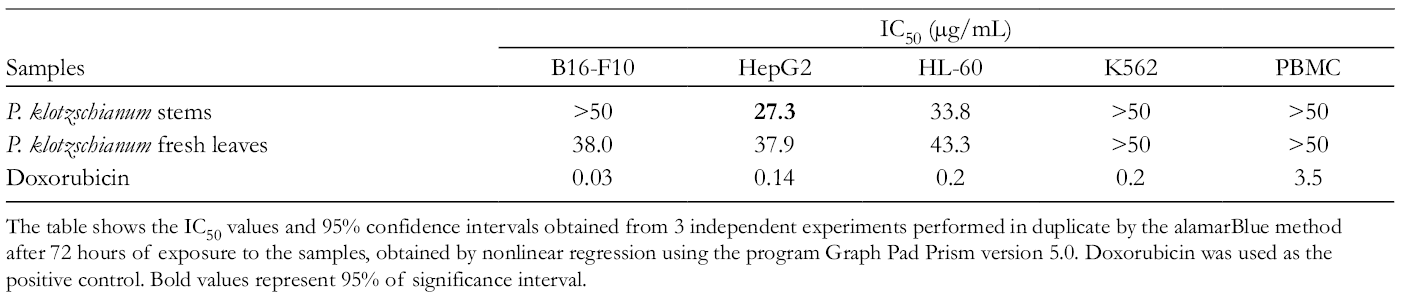
The table shows the IC50 values and 95% confidence intervals obtained from 3 independent experiments performed in duplicate by the alamarBlue method after 72 hours of exposure to the samples, obtained by nonlinear regression using the program Graph Pad Prism version 5.0. Doxorubicin was used as the positive control. Bold values represent 95% of significance interval.
Piper klotzschianum stems and fresh leaves were not cytotoxic toward normal cells at the concentrations tested (IC50 >50 µg/mL) (Table 3). Doxorubicin (Dox), used as the positive control, returned IC50 values of 0.03 to 3.5 µg/mL for B16-F10 and PBMC cell lines, respectively.
The results of this study show that the essential oils obtained from the fresh and dried leaves of Piper species present similarities in terms of their major constituents (bicyclogermacrene, (E)-caryophyllene, and germacrene D). However, there were significant differences in relation to the monoterpene fractions, as in the case of P. klotzschianum (β-pinene, α-pinene) and P. hispidum (δ-3-carene). The essential oils were able to inhibit tumor cell proliferation, thus demonstrating their potential as anticancer treatments. The essential oils could also induce larval death in the case of the mosquito Aedes aegypti.
Experimental
Gas Chromatography-Mass Spectrometry
Mass spectra were recorded on a GC-MS spectrometer (Shimadzu QP5050A) operating at 70 eV, equipped with a split-splitless injector and Rtx-5 MS Restek fused silica column (5% phenyl-methylpoly-siloxane, 30 m × 0.25 mm i.d. and film thickness 0.25 µm). The GC conditions used were as follows: programmed heating from 50°C to 200°C at 4°C/min, then 10°C/min to 300°C, followed by 5 minutes under isothermal conditions. The injector was maintained at 300°C. Helium was used as the carrier gas at 1.0 mL/min and the sample (1 µL) was injected in split mode (1:30). The ionization process in the gas chromatography-flame ion detection was carried out with a flame produced from hydrogen gas 5.0 (30 mL/min) and synthetic air (300 mL/min). Data processing was performed using the GC Postrun Analysis (Shimadzu Labsolutions) software.
Plant Material
Piper hispidum was collected in January 2013 from a preserved area of the National Forest of Ibura, Nossa Senhora do Socorro, Sergipe State, Brazil. Piper klotzschianum and P. arboreum were collected from the Ecological Park Serra of Itabaiana, Itabaiana, Sergipe State, Brazil. The plants were identified by Prof Dr Adalto de Souza Ribeiro of the Federal University of Sergipe (UFS) and voucher specimens were deposited at the herbarium at the UFS under voucher numbers ASE 29962 (-10.775967, -37.338786), ASE29960 (-10.775278, -37.337878), and ASE 29961 (-10.776628, -37.338489), respectively. The leaves and stems were dried in a circulating air oven (Marconi, model MA0351336) at 50°C and triturated in a 4-knife mill (Marconi, model MA680); the powder was stored until extraction.
Hydrodistillation of Essential Oil
The essential oils were obtained by hydrodistillation using a Clevenger-type apparatus. The leaves (fresh or dried; 100 g) and dried stems (50 g) of the plants collected were placed in round-bottomed flasks with 1.5 and 1 L of distilled water, respectively. The samples were heated (in a blanket) until boiling. The hydrodistillation process lasted 180 minutes after the appearance of first aqueous/essential oil condensation in the Clevenger. The essential oils obtained were separated from the aqueous solution using ethyl acetate, and anhydrous sodium sulfate was used to remove the remaining water. The oils were transferred to amber glass vials, dried under nitrogen, and stored. The oil yield was expressed in percentage terms (w/w, Table S1). All extractions (fresh and dried leaves and stems) were performed using samples of Piper collected from either the National Forest of Ibura or Ecological Park Serra of Itabaiana. Stems and leaves were separated, dried (if necessary), crushed, and divided into 3 samples to be extracted.
Larvicidal Activity
Aliquots of the essential oils (12.5-500 µg/mL) were placed in a beaker (50 mL) and dissolved in 1.5% H2O/DMSO (20 mL). Fifty-third instar A. aegypti larvae were placed in each beaker. After 24 hours, at room temperature, the number of dead larvae was counted and the lethal percentage calculated. A control using 1.5% H2O/DMSO was carried out in parallel. For each sample, 3 independent experiments were run. 32 The average lethal concentration (LC50) values for all essential oils tested were calculated using probit analysis. 33
Cytotoxicity Toward Tumor Cell Lines In Vitro
Samples were diluted in sterile pure DMSO at a concentration of 10 mg/mL. Samples were initially tested at a single concentration of 50 µg/mL. The active samples were subsequently tested at essential oil concentrations ranging from 39 to 50 μg/mL (Tables 2 and 3).
Cytotoxicity Assay
To assess the cytotoxicity of the compounds, alamarBlue assay was performed after 72 hours of sample exposure. AlamarBlue, identified as resazurin 34 is a fluorescent/colorimetric indicator with redox properties. As with tetrazolium salts, alamarBlue is reduced in proliferating cells. The oxidized form is blue (not fluorescent/nonviable cell) and the reduced form is pink (fluorescent/viable cell). Thus, the color change reflects the cell proliferation. This assay was initially used to indicate growth and/or cell viability by monitoring lymphocyte proliferation. 35 Initially, cells were plated in 96-well plates (100 µL per well of the 0.3 × 10⁶ cells per mL cell suspension solution and 0.7 × 10⁵ cells per mL of adherent cells). After 24 hours of incubation, the test samples dissolved in DMSO (final concentration of 50 µg/mL) were added to each well and incubated for 72 hours. DOX was used as the positive control. The negative control received the same amount of DMSO. Four hours (24 hours for PBMC) before the end of the incubation period, 20 µL of a stock solution (0.312 mg/mL) of alamarBlue (resazurin) was added to each well. The absorbance was measured at a wavelength of 570 nm (reduced) and 595 nm (oxidized) using a plate reader. 35 The percentage inhibition was calculated, the percent inhibition × log concentration was recorded, and the average inhibitory concentration (IC50) values were determined by nonlinear regression using GraphPad Software, version 5.0.
Cells
Human hepatocellular carcinoma (HepG2), human promyelocytic leukemia (HL-60), murine melanoma (B16-F10), human chronic myelogenous leukemia (K562), and peripheral blood mononuclear cell activated with ConA-normal lymphoblasts (PBMC) were donated by Hospital AC Camargo, São Paulo, SP, Brazil. The cells were cultured in cell culture bottles (75 cm3 volume; 250 mL) using the medium RPMI 1640 supplemented with 10% fetal bovine serum. The cells were kept in incubators with an atmosphere of 5% CO2 at 37°C. Cell growth was monitored daily using an inverted microscope. The medium was changed when the cell growth reached the confluence required for the renewal of nutrients. Trypsin (0.25%) was used for the maintenance of adhered cells, ensuring that the cells detached from the walls of the bottles. Cell cultures were found to be negative for mycoplasma, as evaluated using Hoechst staining (Mycoplasma Stain Kit, Cat. MYC1, Sigma-Aldrich, St Louis, MO, USA).
Supplemental Material
Supplementary material - Supplemental material for Antitumor and Aedes aegypti Larvicidal Activities of Essential Oils From Piper klotzschianum, P. hispidum, and P. arboreum
Supplemental material, Supplementary material, for Antitumor and Aedes aegypti Larvicidal Activities of Essential Oils From Piper klotzschianum, P. hispidum, and P. arboreum by Rafaely N. Lima, Adauto S. Ribeiro, Gilvandete M.P. Santiago, Cinara O. d´S. Costa, Milena B. Soares, Daniel P. Bezerra, Saravanan Shanmugam, Lisiane dos S. Freitas, Pericles, B. Alves in Natural Product Communications
Footnotes
Acknowledgments
We are thankful to CAPES (Coordenação de Aperfeiçoamento de Pessoal de Nível Superior), project PROMOB-Fapitec/CApES) and UFS.
Declaration of Conflicting Interests
The author(s) declared no potential conflicts of interest with respect to the research, authorship, and/or publication of this article.
Funding
The author(s) declared no financial support for the research, authorship, and/or publication of this article.
References
Supplementary Material
Please find the following supplemental material available below.
For Open Access articles published under a Creative Commons License, all supplemental material carries the same license as the article it is associated with.
For non-Open Access articles published, all supplemental material carries a non-exclusive license, and permission requests for re-use of supplemental material or any part of supplemental material shall be sent directly to the copyright owner as specified in the copyright notice associated with the article.
