Rhus tripartitum (Ucria) Grande leaves and fruits were investigated for their contents in phenolic compounds, essential oils, and fatty acids. Chemical composition and antioxidant potential of these secondary metabolites were investigated using chromatographic tools and different antioxidant tests. Results displayed high amounts of phenolic compounds in leaves, concomitant with important antioxidant potentialities, probably due to their richness in phenolic acids and flavonoids as identified by reverse phase high performance liquid chromatography (RP-HPLC). Amounts of essential oils were higher in leaves. Oxygenated sesquiterpenes are exclusively synthesized by the fruits, expressing better antioxidant activities.
Introduction
Different antioxidant formulations are being sold as diet supplements by nutraceutical and food companies in developed nations.
1
Enhancement of the diet with naturally occurring antioxidants is one of many proposed solutions to fight the deleterious effects of reactive oxygen species (ROS).2,3 Besides, the increasing consciousness about the toxic effects of synthetic antioxidants has driven the interest of consumers and industry towards the use of natural additives in food, pharmaceutical, and cosmetic products as a replacement for synthetic chemicals.
1
This upheaval involves a constant growing requirement of raw materials and new ingredients from natural sources.1,2 In this context, plants constitute the major source of diverse bioactive compounds.
4
Underutilized plant species can fulfill this demand due to their richness in phenolics, vitamins, minerals, and other bioactive compounds, but they are not exploited on a large scale.
5
Results and Discussion
Extract yields:
Fraction yields varied significantly as a function of the studied organs (Table 1). In fact, yields registered in leaf extracts were more important than their similar in the fruits (2.6% vs 0.98% dry weight (DW)). This fact may be explained by the differences in the chemical composition of the 2 organs and the affinity of the solvent to the different classes of phenols. Ethyl acetate is a medium polarity solvent, usually used to extract phenols of low to medium weight, and it is essentially known for its affinity to flavonoids and some phenolic acids.
6
The leaves constitute the place of photosynthesis hence the need for the presence of antioxidant molecules, such as flavonoids, to cope with the deleterious effects of reactive oxygen species generated during this process. On the other side, the lowest yields of the fruit extract may be explained by the richness of this organ with polar substances with high molecular weight such as tannins, carbohydrates, and glycosylated compounds, generally abundant in fruits as they ensure their color, energetic value, and sweetness.
7
Means followed by the same letter in the row are not significantly different at P < .05 (means of 3 replicates).
Abbreviations: AsA: Ascorbic Acid; BHA: butylated hydroxyanisole; BHT: butylated hydroxytoluene; BCBT: β-carotene bleaching test; CTC: condensed tannins content; DPPH test: 2,2-diphenyl-1-picrylhydrazyl test; EC50: effective concentration at which the absorbance was 0.5; FRAP test: ferric reducing antioxidant power; IC50: inhibiting concentration of 50% of the synthetic radical DPPH; mg CE.g−1 DW: milligram catechin equivalent per gram dry weight; mg GAE.g−1 DW: milligram gallic acid equivalent per gram dry weight; TPC: total polyphenols content; TFC: total flavonoid content; TAA: total antioxidant activity.
Phenolic compound contents:
Leaf phenolic amount is high (Table 1). Besides, estimation of the amounts of total flavonoids showed that these molecules are very abundant, especially in leaves. This result is perfectly in agreement with the point discussed above and dealing with the high affinity of the ethyl acetate to this class of phenolic compounds. Amounts of condensed tannin in fruits represent only a quarter of those depicted in leaves. For all the studied classes of these secondary metabolites, amounts recorded in the leaves are highest when compared to the fruits. The disparity of phenolics accumulation in leaf and fruit tissues is probably related to the morphological and physiological differences of these organs, strictly linked to the roles they insure in plants
8
and to biotic and/or abiotic factors.
9
The comparison of our results to previous studies on Rhus tripartitum phenolic contents extracted by ethanol (27.8 mg GAE.g−1DR),
10
water (154.22 mg GAE.g−1DR),
10
and methanol (0.98-3.23 mg GAE.g−1DR)
11
highlighted the importance of the solvent fractionation that we adopted and the efficiency of the ethyl acetate to extract a maximum of phenolic compounds.
Antioxidant activities of R tripartitum extracts: Total antioxidant activity (TAA) differed greatly among the studied organs of this species (Table 1). The total antioxidant activity of leaf extract is nine fold higher than that of fruit extract. Concerning the antiradical activity, leaf extracts expressed a very high capacity to quench the 2,2-Diphenyl-1-picrylhydrazyl (DPPH) radical, and so largely exceeded the antioxidant efficiency of the synthetic butylated hydroxytoluene (BHT) and ascorbic acid (AsA). Antiradical activity of the fruit extracts is high too, but not as much as that of the leaves. The same tendency as DPPH test is observed for the ferric reducing antioxidant power (FRAP) of leaf extracts. Conversely to the previous 3 antioxidant tests, results of the β-carotene bleaching power divulged the prepotency of the fruit extracts, expressing an extraordinary capacity of inhibition of linoleic acid oxidation (inhibiting concentration of 50% of the synthetic radical DPPH [IC50] = 34 µg.mL−1) when compared to the leaf extracts (150 µg.mL−1). It even exceeded the antioxidant effects of the positive controls BHT and BHA (Table 1). The presence of different antioxidants can hinder the extent of β-carotene bleaching by neutralizing the linoleate free radical, and eventually, other free radicals in the system. These findings were supported by the organ significant variability of this activity which is fourfold, and even more, higher in fruit extract than in leaf ones. The discrepancy of the β-carotene bleaching test (BCBT) results when compared to the other 3 tests may be explained by the presence of characteristic phenolic compounds in the fruits having a high capacity of inhibition of lipid peroxidation, while leaf extracts contain rather molecules capable of trapping free radicals or chelating transition metals. The high antioxidant activity of R tripartitum extracts could be arising from their high contents of phenolics, flavonoids, and condensed tannins. Previous studies on the antioxidant activities of R tripartitum aerial part extracts obtained by methanol
11
ethanol and water
10
showed that these extracts are far less effective than ethyl acetate extracts that we obtained. This fact confirms our solvent choice based on its affinity to phenols of low to medium weight, essentially its affinity to flavonoids and some phenolic acids.
RP-HPLC identification of R tripartitum leaf and fruit phenolic compounds:
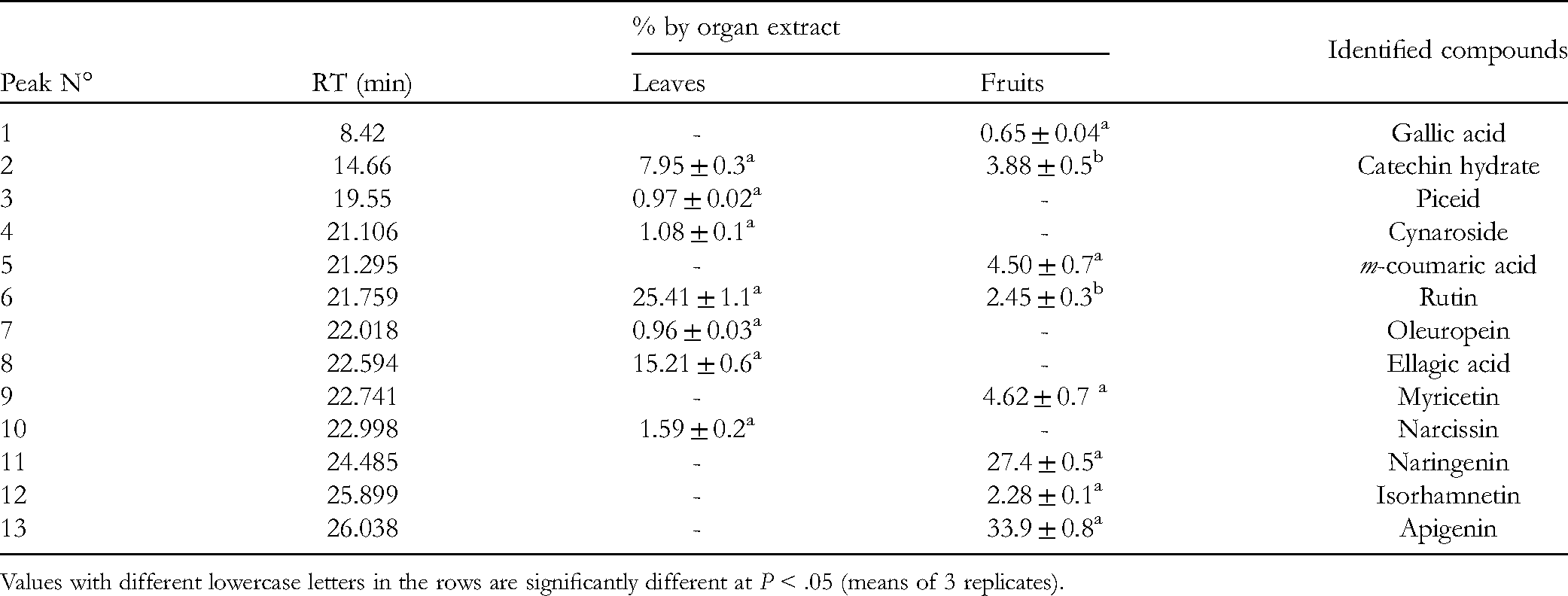
Seven phenolic compounds were identified in leaf extract (Table 2), with rutin and ellagic acid as major ones. Eight compounds were identified in the fruit extract. Apigenin and naringenin are dominant phenolics in this organ. The fruit composition is enriched with a variety of flavonols (eg rutin, myricetin, and isorhamnetin), besides the m-coumaric acid. The specific segregation of R tripartitum phenolics and related antioxidant properties is closely tied to the physiological specificity of the plant organ. The phenolic composition of R tripartitum leaves is basically constituted by phenolic acids and flavonoids (majorly represented by the rutin). As for the fruit, and apart from gallic and m-coumaric acids, the phenolic profile of this organ is exclusively belonging to the large group of flavonoids. These differences among organs’ chemical composition explain, partially, the disparity of the antioxidant activities between the studied extracts. Besides, Tlili et al
11
established the phenolic composition variability among localities and ripening stages in fruit methalonic extracts. They found that flavone and betulinic acid are dominant phenolics in R tripartitum fruit, regardless of the locality and maturation stage, which is completely different from the chemical composition that we found dominated by apigenin and naringenin, even for the fruits collected in the same stage (intermediate maturation stage). These differences may be explained by 2 hypotheses. The first one is resumed in intra-specific variability that may be due to specific edapho-climatic conditions among localities and/or genetic mutations. The second hypothesis is based on technical factors, mainly the extraction solvent and method. In fact, the principal objective of the solvent fractionation is to obtain a concentrated phenolic fraction using the ethyl acetate which is capable to extract flavonoids and phenolic acids, waxes are eliminated by petroleum ether while polar molecules such as sugars migrated in the aqueous phase.
3
Important phenolic compound contents (especially flavonoids), their chemical composition (dominated by phenolic acids and flavonoids in both leaf and fruit), and their related antioxidant activities are the most powerful proof of the efficiency of this extraction technique and of the right choice of solvent.
Values with different lowercase letters in the rows are significantly different at P < .05 (means of 3 replicates).
Essential oil yields:
R tripartitum is a medicinal plant widely distributed in Tunisia and North Africa in general. An originality of our work consists in the quantitative and qualitative study of these secondary metabolites and their variation according to the plant parts. The hydrodistillation of the 2 studied organs of R tripartitum gave different oils both of densities, colors, and smells. Indeed, leaves contain respectable quantities of essential oils, representing 1.1 ± 0.03% of DM versus only 0.04 ± 0.002% of DM in the fruits. A recent study on the aerial parts of Algerian provenances of this species collected in the flowering stage showed that essential oils yield is low with an average of 0.16% DM.
12
This drop in the amount of the essential oils may be due to the poorness of branches on these molecules while they represent an important part of the DM. From these observations arises the importance of studying separated organs to better evaluation of the richness of R tripartitum on these molecules.
Chemical composition of R tripartitum essential oils:
Chemical composition of R tripartitum essential oils is represented in Table 3. Leaf ones are dominated by monoterpene (77.72%) and sesquiterpene hydrocarbons (representing only 16.99% of the identified compounds). However, those obtained from the fruits are a mixture of mono- and sesquiterpene hydrocarbons and, to a lesser extent, oxygenated sesquiterpenes (13.56%), which are exclusively produced by the fruits of this species, with viridiflorol as a major compound of this class. From another side, it can be seen that there are 4 major and common monoterpene hydrocarbons in both leaf and fruit essential oils, namely α-pinene, δ-3-carene, α-limonene, and α-terpinolene. The dominance of monoterpene hydrocarbons in leaf essential oils is counterbalanced by the abundance of both sesquiterpene hydrocarbons and oxygenated sesquiterpenes in the fruit ones. This chemical composition seems to be a common trait in related species of this genus.13-15 The comparison of the chemical compsition of essential oils provided by this study to Algerian ones allows us to deduce that Tunisian specimens produce differnt major compounds and may so be classified as different chemotypes from Algerian ones.
12
The comparison of our chemical analyses to this study allows us to deduce that Tunisian provenance presents different chemotypes from Algerian ones.
RIA and RIB: Retention indices calculated using an apolar column (HP-5) and polar column (HP-INNOWax). C: Retention indices relative to C8 to C40 n-alkanes on the (HP-INNOWax).
Abbreviations: Co-GC, co-injection with authentic compound; RI: retention index; MS, mass spectrum.
Values followed by the same lowercase letter in the rows did not share significant differences at 5% (Duncan test) (means of 3 replicates ± S).
Antioxidant activities of R tripartitum essential oils:
Apart from the iron-reducing capacity, where the differences between the 2 organs are not significant, the other tests used showed a variation of the antioxidant potential between the leaves and fruits of R tripartitum (Table 4). The capacity of the essential oils to act as antioxidant molecules thus expressed is higher than that determined in the essential oils extracted from aromatic plants.16,17 The biological activity of essential oils depends on the chemical composition and functional groups (alcohol, phenol, terpenes and ketones). Thus, the nature of the terpenic compounds and their proportions play a determining role in the antioxidant activity of the oils.
18
This property seems to be attributed to oxygenated monoterpenes, especially phenols and aldehydes.
19
These chemical classes are poorly represented in R tripartitum oils, which explain to some extent, their antioxidant potential. The antioxidant activity hence determined can be linked to their richness in monoterpene hydrocarbons, especially in α-pinene which acts as a scavenger of free radicals.
13
On the other hand, the prepotency of fruit oils over leaf ones is closely related to its richness in mono- and sesquiterpenic oxygen compounds.
Means followed by the same letter are not significantly different at P < .05 (means of three replicates).
Abbreviations: BCBT: β-carotene bleaching test; DPPH test: 2,2-diphenyl-1-picrylhydrazyl test; EC50: effective concentration at which the absorbance was 0.5; FRAP test: ferric reducing antioxidant power; IC50: inhibiting concentration of 50% of the synthetic radical DPPH.
Oil yield and fatty acid composition:
Nowadays, the new fashion wave invading the research world is the investigation of new sources of seed oils from underexploited plants. To the best of our knowledge, this is the first work describing the extraction of fatty acids of R tripartitum leaves and the analysis of their chemical composition, in comparison with the fruits one. Oil contents are expressed as % dry weight basis (Table 5). Oil contents are almost fivefold higher in leaves than in the fruits. These results are of great importance when arguing about the nutritional and industrial importance of R tripartitum. However, Tlili t al.
20
found higher amounts in the fruits collected in the same maturation stage but from other locations. Fatty acid composition of both organs (Table 5) is dominated by C18 fatty acids, represented by oleic, linoleic, and palmitic acids. The sum of these compounds gathered is in the range of 84.8% and 72.5% of leaf and fruit oils, respectively. Besides, good proportions of stearic acid were detected too. Previous study on R tripartitum fruit oils obtained at the intermediate maturation stage showed that they are dominated by higher percentages of palmitic acid and lower ones of oleic and linoleic acids
20
when compared to our samples. These differences highlight the important effects of biotic and abiotic factors on the amounts and chemical composition of these molecules.
Values with different lowercase letters in the same row are significantly different at P < .05 (means of three replicates)
Abbreviations: DBI: double-bound index; MUFA: monounsaturated fatty acid; PUFA: polyunsaturated fatty acid; SFA: saturated fatty acid; UFA: unsaturated fatty acid.
A common objective of the scientists and nutritionists from all around the world is to find the balance between a secure intake, high quality, and nutritional value of natural products. Thus, the study of fatty acid profiles is a key tool in the determination of the comestible oil quality. Analysis of R tripartitum lipid composition indicated that saturated fatty acids (SFAs) part was statically the same in the studied organs, representing less than 1/5 of the identified fatty acids. However, R tripartitum leaves and fruits are characterized by the presence of high amounts of mono- (MUFAs) and polyunsaturated fatty acids (PUFAs) (Table 5). Generally, the lipid storage composition represents high percentages of unsaturated fatty acids (UFAs), the most abundant of which are oleic and linoleic acids, in addition to a ratio of UFAs/SFAS exceeding 3 to ensure a longer shelf life and effective protection against lipid peroxidation and food spoilage.
20
Proportions of UFAs are 80.95% and 78.48% in leaves and fruits, respectively, and so are four times higher than SFA levels, which are revealed by the ratios SFAs/UFAs equal to 4.5 and 4.00 in leaves and fruits, respectively (Table 5). These ratio values are higher than the usual recommended ones. The major MUFA found in these plant leaves and fruits is oleic acid. This fatty acid is widely recognized for its action in reducing the peril of ROS-induced diseases and improving the immune system due to its anti-inflammatory activity.
21
In addition, it was extensively demonstrated that dietary MUFAs have positive effects in preventing cancer.
21
Moreover, studied parts are rich in PUFAs, mainly linoleic acid (18:2n-6) and to a lesser extent α-linolenic acid (18:3n-3) that are considered essential as they are not synthesized by the human metabolism and so, must be supplied through the diet.
21
The double-bound index (DBI) is another parameter calculated to highlight the quality of the obtained oils by reflecting the degree of fatty acids insaturation. Its values are equal to 1.18 and 1.03 in leaf and fruit oils, respectively. This result is important since these values exceed the DBI calculated from conventional medicinal and comestible seed oils such as Foeniculum vulgarae Mill (DBI = 0.64-0.91) and Cuminum cyminum L. (DBI = 0.43-0.81).
22
Experimental
Plant sampling:
The genus Rhus, commonly known as Sumac, belongs to the Anacardiaceae family and contains over 250 individual species generally used as spices. R tripartitum (Ucria) Grande locally known as “ Jdari”, is a low spiny bush growing on hard rock outcrops and hillsides. This species is commonly used in traditional medicine for treating diarrhea, dysentery, and ulcer.
23
R tripartitum was harvested at the end of March, when the fruit was in the intermediate stage of ripening, having a mahogany brown color. Samples were collected in the eastern center of Tunisia (N 34° 44′, E 10° 46′) belonging to the arid zone (mean annual temperature 21.5°C, mean annual rainfall 290mm). The harvested plant was identified at the Biotechnology Center of Borj Cedria. A voucher specimen (RT-CBBC-53) was deposited in the herbarium of the Laboratory of Aromatic and Medicinal Plants (LPAM). Leaves and fruits were separated, air-dried at the shadow then grounded.
Extraction of phenolic compounds:
Leaf and fruit powder were subjected to a differential extraction using diverse polarity solvents (eg petroleum ether, ethyl acetate, acetone, and water) as described by Jallali et al.
3
Yields are expressed as % of the primary used plant material. Dry residues were stored in the darkness at 4°C until analysis.
Determination of total polyphenol content:
Colorimetric quantification of total polyphenol was determined as described by Dewanto et al,
24
using the Folin–Ciocalteu reagent. Total phenolic content of plant aerial parts was expressed as mg GAE.g−1 DW through the calibration curve with Gallic acid ranging from 0 to 400 µg.mL−1 (r2 = 0.99). All samples were analyzed in triplicate.
Estimation of total flavonoid content:
Total flavonoids were measured according to Dewanto et al .
24
Total flavonoid content was expressed as mg CE.g−1 DW, through the calibration curve of ( + )-catechin ranging from 0 to 400 µg.mL−1 (r2 = 0.99). All samples were analyzed in triplicate.
Quantification of total condensed tannins:
Proanthocyanidins were measured as described by Sun et al.
25
The amount of total condensed tannins are expressed as mg CE.g−1 DW. The calibration curve ranges from 0 to 400 µg.mL−1 (r2 = 0.99). All samples were analyzed in 3 replications.
RP-HPLC identification of R tripartitum phenolic compounds:
The identification of R tripartitum phenolic compounds was done using Agilent 1260 HPLC system consisting of a vacuum degasser, an autosampler, and a binary pump with a maximum pressure of 600 bar (Agilent technologies), equipped with a reversed-phase C18 analytical column of 4.6 × 100 mm and 3.5μm particle size (Zorbax Eclipse XDB C18). The DAD detector was set to a scanning range of 200 to 400 nm. Column temperature was maintained at 25°C. The injected sample volume was 2 μL and the flow rate of mobile phase was 0.4 mL.min−1. Mobile phase B consisted of 0.1% formic acid Milli-Q water and mobile phase A was methanol. The elution program was as follows: 0 to 5 min: 90% to 80% B; 5 to 10 min: 80% to 70% B; 10 to 15 min: 70% to 50% B; 15 to 20 min: 50% to 30% B; 20 to 25 min: 30% to 10% B; 25 to 30 min: 10% to 50%B; 30 to 35 min: 50% to 90% B. Each sample was directly injected and chromatograms were monitored at 280 nm.
Essential oils isolation:
Triplicate samples of 100 g of leaves and fruits were subjected to hydrodistillation in 1L of deionized water using a Clevenger apparatus for 4 and 6 h, respectively. Obtained oils were dried over anhydrous sodium sulphate and stored at + 4
°
C until tested. Essential oil yields were expressed as percent of the plant material weight used.
Gas chromatography (GC) analysis:
GC analysis was carried out using an Agilent 6890 gas chromatograph equipped with a flame ionization detector and split–splitless injector attached to HP-INNOWax polyethylene glycol capillary column (30m × 0.25mm; 0.25µm film thickness). One micro-liter of the sample (dissolved in hexane as 1/50 v/v) was injected into the system. The compounds were identified by comparing their relative retention times with those of authentic compounds injected in the same conditions and by comparing their retention index (RI) calculated with C8 to C40 Alkanes Calibration Standard (40147-U, Supelco, Germany).
Gas chromatography/mass spectrometry (GC-MS) analysis of essential oils:
Identification of the essential oils was performed using a Hewlett Packard HP5890 series II GC-MS equipped with an HP5MS column (30 m × 0.25 mm). Helium was used as carrier gas at 1.2 mL.min−1. Each sample (1µL) was injected in the split mode (1:20), the program used was isothermal at 70°C, followed by 50 to 240°C at a rate of 5°C.min−1, then held at 240°C for 10 min. The mass spectrometer was an HP 5972. The total electronic impact mode at 70 eV was used. The components were identified by comparing their relative retention times and mass spectra with the data from the library of essential oils constituents, Wiley, MassFinder, and Adams GC-MS libraries and by comparing their RI calculated with C8 to C40 Alkanes Calibration Standard (40147-U, Supelco, Germany).
Fatty acid extraction:
Oils were obtained according to ISO method 659:1998.
20
Powder samples (30 g) were extracted with petroleum ether in a Soxhlet apparatus for 4 h. Extracts were concentrated using a rotary evaporator under reduced pressure at 50°C and then oils were dried with nitrogen before storing at −20°C. Analyses were performed in triplicate.
Preparation and GC-MS and GC-FID analysis of FAMEs:
FAMEs were prepared as described by Megdiche-Ksouri et al.
26
The identification of FAMEs was performed using an HP-5980 Series II instrument, equipped with HP-5MS capillary column (30m × 0.25mm; 0.25µm film thickness) and split/splitless injector (220°C). The oven temperature was held at 150 °C, then programmed to increase 15°C.min−1 until reaching 220°C, and detained isothermally at 220°C for 5 min. The carrier gas was helium used at an initial flow rate of 1 ml.min−1. Split ratio was 20:1. Injection volume was equal to 2µL. The components were identified by comparing their relative retention times and mass spectra with the data from the library of fatty acids constituents: Wiley, MassFinder, and Adams GC-MS libraries. The quantification of fatty acid methyl esters, expressed as percentages, was obtained directly from GC-FID peak area integration using an Agilent 6890 gas chromatograph equipped with HP-INNOWax capillary column. Supelco 37 Component FAME Mix (CRM47885, Supelco, Germany) was used as standard calibration to identify fatty acid methyl ester.
Antioxidant Activities of R tripartitum Extracts and EOs
TAA:
Experiments were conducted according to Koleva et al.
27
The antioxidant capacity was expressed as mg GAE.g−1 DW. The calibration curve range was 0 to 500 µg.mL−1. All samples were analyzed in triplicate.
DPPH assay:
DPPH quenching ability was measured according to Hanato et al.
28
All samples were analyzed in triplicate. The results are expressed as IC50 (µg.mL−1) which is the Inhibiting Concentration of 50% of the synthetic radical.
FRAP assay:
The iron (III) reductive capacity was assessed as described by Oyaizu.
29
Results are expressed as Effective Concentration at which the absorbance was 0.5 (effective concentration at which the absorbance was 0.5 [EC50] in mg.mL−1) obtained from linear regression analysis.
BCBT:
The antioxidant activity of the extracts was evaluated in terms of β-carotene bleaching as described by Koleva et al.
27
The results are expressed as IC50 (µg.mL−1) which is the Inhibiting Concentration of 50% of the β-carotene initially used.
Statistical analysis
Means were statistically compared using the STATI-CF program. A one-way analysis of variance (ANOVA) and Newman–Keuls multiple range tests were carried out to test any significant difference between samples at P < .05. Values were the means of 3 replicates.