



Abstract
Even after one and a half years since the outbreak of COVID-19, its complete and effective control is still far from being achieved despite vaccination drives, symptomatic management with available drugs, and wider lockdowns. This has inspired researchers to screen potential phytochemicals from medicinal plants against SARS-CoV-2, adopting a bio-informatics approach. The current study aimed to assess anti-viral activity of the phytochemicals derived from Ayurvedic medicinal plants against SARS-CoV-2 drug targets [3-chymotrypsin-like protease (3CLpro) and RNA dependent RNA polymerase (RdRp)] using validated in silico methods.3D Structures of 196 phytochemicals from three Ayurvedic plants were retrieved from PubChem and KNApSAcK databases and screened for Absorption Distribution Metabolism Excretion and Toxicity(ADMET) to predict drug-likeness. The phytochemicals were subjected to molecular docking and only three showed promise: Acetovanillonewith a binding affinity of −4.7Kcal/mol with RdRp and −4.1 Kcal/mol with 3CL pro; myrtenol with equivalent values of −4.3 Kcal/mol with RdRP and −3.2 Kcal/mol with 3CLpro; and nimbochalcin with equivalent values of −5.0Kcal/mol with RdRp and −4.9 Kcal/mol with 3CLpro. Molecular dynamics simulation (50ns) analysis was made of 3CLpro and RdRp using Autodock Vina 1.1.2 software and VMD software. After ADMET analysis, 78 phytochemicals were found suitable for molecular docking. Three, namely acetovanillone, myrtenol and nimbochalcin from Picrorhiza kurroa, Azadirachta indica and Cyperus rotundus,respectively,exhibited good binding affinity with 3CLproand RdRp of SARS-CoV-2. Interaction analysis, molecular dynamics simulations and MM-PBSA calculations were executed for two complexes, acetovanillone_RdRp and myrtenol_3CL pro.Acetovanillone_RdRpcomplex did not display any structural change after MD simulation as compared to myrtenol_3CL pro. The overall stability of acetovanillone_6NUR was 154.7 kJ/mol, and for myrtenol_1UJ1 90.5 kJ/mol.In silico analysis revealed that acetovanillone (Picrorhiza kurroa) and myrtenol (Cyperus rotundus) possess anti SARS-CoV-2 activity. Further studies are needed to validate their efficacy in biological models.
Introduction
A recent second wave of SARS-CoV-2 has taxed the overburdened healthcare systems and economies across the world. In India, it has spread like a ‘tsunami’, leading to 2,343,152 active COVID-19 cases, with 318 895 deaths, as of May 28.th, 2021. 1 The effective transmission capability and shorter incubation of the mutant virus is considered as a major cause for the rapid transmission of the virus, which mostly affects younger individuals, along with the co-morbidity of the older population. 2 People infected with SARS-CoV-2 have shown mild to severe symptom severity including fever, cough, apnea, dyspnea, pneumonia and diarrhea. 3 More than a year has passed, but the pandemic is yet to be controlled effectively, owing to the unavailability of effective antiviral drugs and the scarcity of vaccines to prevent SARS-CoV-2 infection. A few vaccines are available in different parts of world and others are at the trial stage. 4 However, effective prophylactic therapy is still required as vaccinating the entire population is not feasible with the recurrent mutations of SARS-CoV-2. Many repurposed drugs have been hypothesized and are under clinical trials such as chloroquine, remdesivir, favipiravir, darunavir, umifenovir, nitazoxanide, and thalidomide. 5
In this current scenario, the identification of promising anti-viral compounds from natural sources by a repurposing approach is still relevant for the early prevention and effective management of the SARS-CoV-2 infection. For finding appropriate antiviral agents against COVID-19, many prior antiviral, anti-hypertensive, and anti-inflammatory drugs have been repurposed against the targets of SARS-CoV-2 using computational methods. 6 However, adverse effects of these drugs such as hepatotoxicity, renal toxicity, and teratogenicity7 limit their use in co-morbid conditions. In these contexts, indigenous traditional systems of medicines are preferred owing to their rich source of natural phytochemicals and long history of safe human usage. Natural molecules have inspired many successful drug discoveries . 8 This is supported by the fact that traditional Chinese herbal formulations have proven their efficacy in preclinical and clinical studies against SARS and influenza outbreaks in 2003 and 2009, respectively. 9 Asian countries like China, Japan and Korea are successfully using indigenous traditional medicines, in addition to modernmedicine to combat the ongoing pandemic.10-13 India has also taken proactive steps to harness the benefit of Ayurveda, the indigenous Indian system of medicine against COVID-19. Ayurvedic medicines with the support of classical textual references and proven immunomodulatory, anti-inflammatory and antioxidant properties are currently being explored in different research trials against SARS-CoV-2 .14-16 It was hypothesized that identifying new antiviral indications from traditionally used plants would render additional benefits in terms of safety, and higher translational value.
Three medicinal plants, namely Picrorhizakurroa(Kutki), Azadirachta indica (Neem) andCyperusrotundus(Mustak), were selected based on their Ayurvedic indications against respiratory illness, and antipyretic properties. 17 Candidature of these plants as antiviral,14,18,19 anti-inflammatory,20,21 antioxidant,16,22 and immunomodulatory 23 agents is also supported by research evidence. Moreover, it is anticipated that medicinal plant based ligands can fulfil the two fold criteria for potential anti SARS-CoV-2 pharmacological agents, ie inhibiting viral entry, and enhancing the host immunity to combat the virus. 24 In this context, computational techniquesare employed to screen large numbers of natural compounds to find the best ones for inhibiting SARS-CoV-2 target proteins.
Among different viral proteins and proteases, RNA dependent RNA polymerase (RdRp) and 3-chymotrypsin-like protease (3CL.pro)are crucial for viral replication,25,26 and hence are considered as promising drug targets. Their selection is further supported by reports on virtual screening of existing antiviral drugs27,28 and their interaction with natural agents.29-32
The aim of the present study was to explore,throughin silico analysis, the inhibitory effects of phytochemicals present in Picrorhiza kurroa (Kutki), Azadirachta indica (Neem) and Cyperus rotundus(Mustak) against the SARS-CoV-2 targets RdRp and 3CL.pro
Materials and Methods
Retrieving Herbal Compounds and Preparation of Drug Library
The 3D structures of 196 phytochemicals from 3 medicinal plants were retrieved from PubChem, 33 KNApSAck and ChEMBL 34 databases. Compounds whose .mol/.sdf were not available were drawn and converted using Online SMILES Translator and Structure File Generator (https://cactus.nci.nih.gov/translate/).
Retrieving Target Receptors
The target receptors were retrieved from RCSB PDB (https://www.rcsb.org/) with their PDB ids as −6NUR (RdRp) and 1U1J (3CL.pro), respectively.
Pharmacokinetic, Pharmacodynamics and Physicochemical Analyses
In order to select the best, soluble, druggable, leadlike and non-violating drug compounds for the study, the drug library [n = 196] was subjected in clusters to ADME analysis using Swiss ADME tool. 35 Compounds selected by ADME screening were then subjected to a toxicity analysis using software – TEST (https://www.epa.gov/chemical-research/toxicity-estimation-software-tool-test), ProToxII 36 and Pred-hERG. 37
Target Optimization
The target receptors were screened for post-translational modification (PTM) check using Vienna PTM, 38 and protein topologies were prepared using PDB2gmx of GROMACS,39,40 which were then used to select the best optimized protein targets for molecular docking approaches.
Molecular Docking Study
Active Site Prediction
This was executed using 3DLigandSite. 41 and COACH-D. 42 so as to find active sites/binding pockets in the selected target receptors where the probability is high of binding of drugs with a stable free energy.
Preparing Compounds for Docking
The target receptors were converted from .pdb to .pdbqt, whereas the drug compounds were converted from .mol2/.mol/.sdf to .pdbqt and then subjected for docking in AutoDock Vina. 43 For multi-drug docking, PyRx. 44 was used, which works for virtual screening and docking in Autodock Vina.First, the two targets were uploaded andchecked to see if any cofactors, bound ligands, metals, ions, and water molecules were present with them. If so, they were removed and polar charges were added to the targets. After completing this step, they were saved as .pdbqt files. The phytochemical file was further uploaded and the active binding site was set to the original ligand with respect to all the atoms within a 10-Å distance. All the phytochemicals were first energy minimized using the conjugate gradient (CG) algorithm that follows the universal forcefield (UFF) for optimization. This was carried out for a total of 200 steps and was terminated when there was an energy difference of less than 0.1.
Interaction Analysis
The best docked complexes were subjected to an interaction analysis to check the formed interactions between the protein and the ligand using Protein Ligand Interaction Profiler (PLIP). 45
Molecular Dynamics Simulations
The best docked protein receptor and ligand complexes were subjected to a refinement and molecular dynamics simulation (MDS) using Chemistry at Harvard Macromolecular Mechanics (CHARMM). 46 and Visual Molecular Dynamics (VMD), 47 respectively. The protein complexes which were .pdb complex files were converted into.psf and trajectory files were retrieved, which were then used to minimize solvate, neutralize, and then refine the complex structures. Generalized Born Molecular Mechanics(GBMM) was deployed to retrieve the approximate results in an explicit solvent. In this study, NVT dynamics was employed, which holds temperature and volume constant. The Noose-hover temperature was set to 300 K and the entire simulation was executed in 1000 steps for 50 ns. Topology and force field parameters were assigned from the CHARMM27 protein lipid parameter set 48 for the proteins and the CHARMM General Force Field (CgenFF) parameter for the small molecule ligand. 49 The Molecular Mechanics-Poisson-Boltzmann surface area (MM-PBSA) approach was also deployed to estimate the binding free energy (delta G) for complexes over simulation time.This was executed using the APBS plugin available in VMD software.
Results
ADMET Analysis
The prepared drug library (n = 196) was subjected to pharmacokinetic (PK), pharmacodynamic (PD) and physicochemical analyses. Herbal compounds which had a high GI absorption, solubility, blood-brain-barrier (BBB) permeability, a good LOGP value, and which did not violate any of the rules, namely – Lipinski's RO5, Veber's, Ghosh's, Egan's and Mugge's, respectively. Phytochemicals which had a good bioavailability, and lead likeness score with a better synthetic accessibility were selected.
Out of 196, 78 compounds passed the ADME analysis, and were then subjected to toxicity screening. This was performed in order to select compounds which showcased no susceptible toxicity or binding to any toxic receptor. Based on the toxicity analysis, three phytochemicals were shortlisted namely- acetovanillone, myrtenol and nimbochalcin. Details of the ADMET results for these three compounds are represented in Table 1. The results of the remaining herbal compounds are provided in supplementary Table S1.
ADMET Results of the Selected Phytochemicals.

Target Optimization
The optimization of RdRp(PDB id: 6NUR) and 3CL.pro(PDB id: 1UJ1) was performed to alleviate any steric clashes present before the protein preparation step. There were no mutated amino acids or any other post translational modifications present in their tertiary structure. Figure 1 showcases the mesh representation of both the target receptors- 3CL.pro (PDB Id: 1UJ1) and RdRp(PDB Id: 6NUR) after the optimization.

Target receptors after target optimization: 3CL pro [PDB Id: 1UJ1] and b]rdRp[PDB Id: 6NUR].
Molecular Docking
Out of the best ADMET screened compounds, we identified the three most effective, which had a better binding affinity towards the target receptor proteins in molecular docking. Details of the docking scores of these phytochemicals are given in

Best docked phytochemicals with 3CL pro and rdRp receptors.
Scores for Docked Complexes for Target Receptors 3 CL .pro and RdRp.
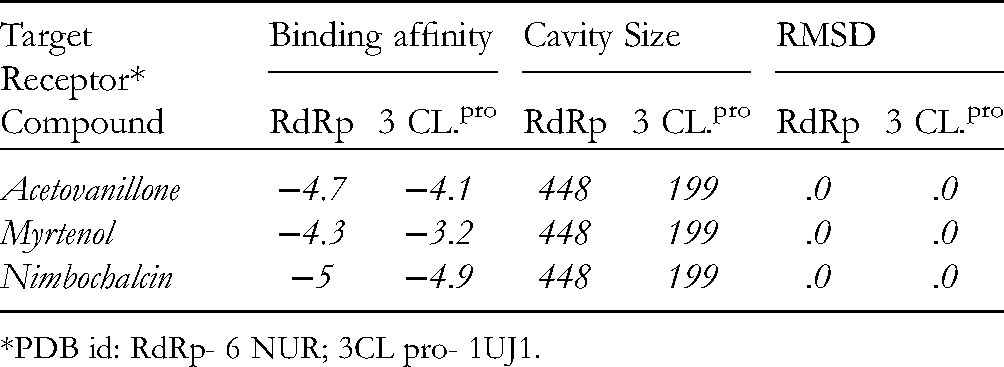
*PDB id: RdRp- 6 NUR; 3CL pro- 1UJ1.
Interaction Analysis
Before subjecting the docked complexes for molecular dynamics simulation, we performed an interaction analysis in order to select the best bound drug-target complex for simplification. Any complex is considered to be a strong complex only when it contains many hydrogen bonds. Thus, we discern that out of these complexes, myrtenol, acetovanillone and nimbochalcinformed strong hydrogen bonds with RdRp and 3CL.pro

Interactions formed between phytochemicals and target receptors. The blue line represents hydrogen bonding, the dotted line hydrophobic interactions, and the Green line pi interaction.
Acetovanillone, on the other hand, formed four hydrogen bonds with residues of glycine (GLY), serine (SER), cystine (CYS) and glutamic acid (GLU) of chain A of target receptor 3CL.pro alongside a single hydrophobic bond with a residue of glutamic acid positioned at 166 of chain A, whereas, it formed three hydrogen bonds, a single bond with aspargine(360A ASN) and two bonds with tyrosine (530A TYR), and five hydrophobic interactions with glutamine (370A GLU), valine (373A VAL) and tyrosine (374A & 530 A TYR). It also formed a pi citation interaction with tyrosine [530A TYR]. Nimbochalcin formed no hydrogen bonds with 3CL.pro, but seven hydrophobic interactions with residues of glutamine (GLN)(110A), valine (VAL)(202A), threonine (THR)(292A), and two bonds with phenyalanine(PHE) (294A)and isoleucine (ILE)(249A).
With RdRp, acetovanillone formed three hydrogen bonds with residues of aspargine(ASN) located at 360A, and two bonds with tyrosine (TYR) positioned at 530A, five hydrophobic interactions with glutamic acid [370A GLU], two with valine (373A VAL), and two with tyrosine (374A & 530A TYR). It also formed a single pi interaction with tyrosine [530A]. Myrtenol, on the other hand, formed only two hydrogen bonds with residues of glycine (413A GLY) and tyrosine (546A TYR), alongwith two hydrophobic bonds with glutamine (413A GLN) and tyrosine (546A TYR). Nimbochalcin showed two hydrogen bonds with threonine alone (111A & 292A THR), and five hydrophobic interactions with phenyalanine(8A PHE), aspargine(151A ASN), isoleucine (249A ILE), threonine (292A THR), and proline (293A PRO). Nimbochalcin formed a pi stacking bond with RdRp with a residue of phenyalanine(PHE) located at 294 of chain A. Since nimbochalcin did not form any hydrogen bonds with 3CL pro and only two hydrogen bonds with RdRp, it was not selected for molecular dynamics simulations (MDS).
Molecular Dynamics Simulation (MDS)
For dynamics simulation, the most stable target-ligand complexes were selected, namely, acetovanillone_RdRp and myrtenol_3CL.pro After molecular simulation and refinement, it is evident that the complexes have been refined to their best potential and the overall energy of the complex has also been stabilized with all the structures having a good RMSD score.

The refined complexes a] myrtenol bound to 3CL.pro, and b]rdRp with acetovanillone.
MM-PBSA Energy Values with RMSD Scores of the Simulated Complexes.

Root mean square deviation (RMSD) analysis indicates various hinges/ fluctuations that are present in the structure during molecular dynamic simulation (MDS) that consist of the stability of the refined structure and confirms whether the simulation has been equilibrated. The ligand binding poses energy and interactions formed between the target receptor and the ligand are directly related and heavily dependent on residual fluctuation values 63. The superimposition analysis of both the complexes, myrtenol_1UJ1 and acetovanillone_6NUR, was carried out using both open and closed conformation of the target receptors. Before and after MD simulation of the dynamics trajectory was analyzed using PyMol software (https://pymol.org/2/). RMSD(Myrtenol_1UJ1) = .95 (260 to 260 atoms)] indicates that there are many changes in the structure, while RMSD [Acetovanillone_6NUR] = .00 (1084 to 1084 atoms) discerns that no significant change incurred as a resultof refinement. The MM-PBSA calculation of binding energy shows that acetovanillone is stably bound to 6NUR when compared to the binding of myrtenol to 1UJ1. The overall stability of acetovanillone_6NUR is 154.7 kJ/mol, while that of myrtenol_1UJ1 is 90.5 kJ/mol. The higher the stability, the better is the affinity between the phytochemical and the target receptor.
Discussion
Traditional medicines, like Ayurveda and Traditional Chinese medicine (TCM) have been sourced for developing potential antiviral drugs. 8 Several in silico studies have been published analyzing compounds derived from Ayurvedic medicinal plants, but rarely have these compounds been rationalized with classical Ayurvedic indications. 50 With an intention to search for an effective therapeutic agent against SARS-CoV-2, the present study attempted to perform in silico analysis of Ayurvedic medicinal plants used in respiratory illnesses.
Phytochemicals from the selected Ayurvedic medicinal plants, namely Picrorhiza kurroa, Cyperus rotundus and Azadirachta indica were subjected to ADME criteria and toxicity analysis for assessing their drug likeness. Subsequently, acetovanillone/apocynin (Picrorhiza kurroa), myrtenol (Cyperus rotundus) and nimbochalcin(Azadirachta indica) were bound to both RdRp and 3CLpro of SARS-COV-2, suggestive of their good human intestinal absorption (HIA) and blood-brain barrier (B.B.B) infiltration,with low toxicity. These observations assured the requisite pharmacological activity and minimal failure rate of these phytochemicals in the drug development stages. Authenticity of the ADME results and toxicity prediction were ensured by using SwissADMEsoftware. Further, we deployed Bioinformatics resources, PyRx, which is compatible with Autodock Vina for the purpose of fulfilling ligand-based drug discovery (LBDD).
The compounds meeting the ADMET criteria were subsequently assessed for binding energy, and hydrogen and hydrophobic interactions with the target receptors in order to select the potential antiviral ligands. The results revealed acetovanillone (apocynin) and myrtenol as the top scoring receptor-ligand complexes, stabilized by hydrogen-bonding, and van der Waals and electrostatics interactions. These interactions are indeed prerequisites for biological functions and successful drug developments. Additionally, acetovanillone (apocynin) and myrtenol were also substantiated through 50 ns MD simulation studies.In accordance with the recent published molecular docking studies withRdRp,51,52 our results showed good conformational binding for the ligands with the largest and deepest cavity in RdRp (Table 2). As the cavity size affects the binding affinity, inthe case of 3CL.pro, the small ligands were seen to fit into the small sized cavity without any hindrance as compared to the larger phytochemicals. All three phytochemicals showcased good binding affinity with RdRp when compared to 3CL.pro, butmyrtenol, being a small sized ligand, was well fitted in both the target receptors.
The molecular docking analysis corroborated that acetovanillone (apocynin), myrtenol and nimbochalcin have potential to act against SARS-CoV-2 targets, specifically 3CL.pro and RdRp. This is in concordance with the docking paradigm, ie ligand binding conformation is the global minima of the protein-ligand potential energy function. Thus, the ligand configuration in the target protein is the global minimum search problem for the energy target function, which relies upon the degrees of freedom (DOF) of the target-ligand complex. Therefore, phytochemicals targeting these viral proteins are considered as potent inhibitors of SARS-CoV-2. Previous studies have also confirmed the multiple pharmacological properties of acetovanillone (apocynin), myretenol and nimbochalcin, includingantiviral, antioxidant 53 , and anti-inflammatoryactivities. Apocynin is considered as an antioxidant agent as studies have shown that it inhibits NADPH oxidase activity and improves ROS scavenging. 54 Apocynin is extracted from the roots and rhizomes of Picrorhiza kurroa, which has been traditionally used for the treatment of liver and upper respiratory tract disorders. 55
Experimental studies have reported myrtenol as an anti-inflammatory agent with antioxidant properties. It was suggested that it modulated acute inflammation through the inhibition of cytokines release and neutrophil migration. 56 Myrtenol-containing plant extracts are used in folk medicine for the treatment of anxiety symptoms, gastrointestinal pain, inflammation and infection. Studies have reported that myrtenol reduced damage caused by experimental asthma by reducing the inflammatory indices, normalizing the level of interleukins and balancing oxidative stress in the lungs. 57 Interestingly, acetovanillone (apocynin) and myrtenol also exhibited activity against cytokine storm in cell line studies. 58 Cytokine storm is characterized by high levels of pro-inflammatory cytokines,59,60 such as raised interleukins (IL-1B, IL-1RA, IL-7, IL-8, IL-9, IL-10), fibroblast growth factor (FGF), granulocyte-macrophage colony stimulating factor (GM-CSF), and IFNγ, which further lead to multi organ failure and ultimately death. 61 Studies have reported that acetovanillone (apocynin) can enhance SOCS3 expression and suppress IL17, to reduce cytokine storm. Myrtenol is also found to reduce the expression of proinflammatory cytokines like TNF and IL-1. 57
The results of this in silico study confirm that acetovanillone (apocynin), and myretenol can possess antiviral properties, which is in agreement with recent reports that have confirmed these properties along with their anti-inflammatory effects. Thus, acetovanillone (apocynin), and myretenol can be considered as potential lead compounds against SARS-COV-2. However,preclinical and clinical studies are needed to investigate the in silico predictions in the biological models for further therapeutic applications.
Conclusion
Utilizing computational drug design and discovery pipeline, we have identified potential phytochemicals from Ayurvedic medicinal plants that can inhibit 3CLpro and RdRp of SARS-CoV-2 and check its replication. A further molecular docking approach validated the stability of the receptor ligand complexes based on free energy calculations and per residue analysis. Overall results revealed that acetovanillone and myrtenol possess good binding affinity with 3CL pro and RdRp. We believe that further in vitro, in vivo and clinical studies are needed to validate the efficacy of these phytochemicals derived from these Ayurvedic plants against SARS-CoV-2.
Supplemental Material
sj-xlsx-1-npx-10.1177_1934578X211056753 - Supplemental material for Ayurvedic Medicinal Plants Against COVID-19: An In Silico Analysis
Supplemental material, sj-xlsx-1-npx-10.1177_1934578X211056753 for Ayurvedic Medicinal Plants Against COVID-19: An In Silico Analysis by Bharat Krushna Khuntia, Vandna Sharma, Sahar Qazi, Soumi Das, Shruti Sharma, Khalid Raza and Gautam Sharma in Natural Product Communications
Supplemental Material
sj-docx-2-npx-10.1177_1934578X211056753 - Supplemental material for Ayurvedic Medicinal Plants Against COVID-19: An In Silico Analysis
Supplemental material, sj-docx-2-npx-10.1177_1934578X211056753 for Ayurvedic Medicinal Plants Against COVID-19: An In Silico Analysis by Bharat Krushna Khuntia, Vandna Sharma, Sahar Qazi, Soumi Das, Shruti Sharma, Khalid Raza and Gautam Sharma in Natural Product Communications
Footnotes
Declaration of Conflicting Interests
The author(s) declared no potential conflicts of interest with respect to the research, authorship, and/or publication of this article.
Funding
The author(s) disclosed receipt of the following financial support for the research, authorship, and/or publication of this article: GS, BK, and VS acknowledge the Ministry of AYUSH, Government of India, for support through the Center of Excellence scheme to Center for Integrative Medicine and Research [CIMR], AIIMS, New Delhi. SQ is supported by DST-Inspire Fellowship by the Department of Science & Technology, Government of India.

Supplemental Material
Supplemental material for this article is available online.
References
Supplementary Material
Please find the following supplemental material available below.
For Open Access articles published under a Creative Commons License, all supplemental material carries the same license as the article it is associated with.
For non-Open Access articles published, all supplemental material carries a non-exclusive license, and permission requests for re-use of supplemental material or any part of supplemental material shall be sent directly to the copyright owner as specified in the copyright notice associated with the article.
