



Abstract
Astragaloside IV is the main active ingredient of Astragalus membranaceus. Studies have found that it can promote the proliferation of osteoblasts and can antagonize the apoptosis of mouse osteoblasts induced by hydrogen peroxide, but its molecular mechanism for the treatment of osteoporosis is still not clear. First, we used 3 online platforms: CTD, PharmMapper and SwissTargetPrediction to retrieve the targets of Astragaloside IV, and collected osteoporosis-related targets. Next, we used Cytoscape 3.7.2 software to construct a visual network diagram of PPI and further screened the key genes of Astragaloside IV in the treatment of osteoporosis using cluster analysis. Finally, after the receptor and ligand were docked, the binding activity was assessed by docking score. We obtained 102 overlapping targets of Astragaloside IV and osteoporosis. According to the node degree value in the PPI network, the top 10 genes were PIK3CA, MAPK1, SRC, STAT3, VEGFA, HSP90AA1, RELA, AKT1, IGF1, EGFR, of which SRC, AKT1, PIK3CA could bind stably to Astragaloside IV. KEGG pathway enrichment results showed that Astragaloside IV treated osteoporosis through 10 main pathways, including PI3K-Akt signaling pathway, FoxO signaling pathway, MAPK pathway, and so on. The classification of these pathways belongs to signal transduction, immune system, development and regeneration and endocrine system. Astragaloside IV is significantly related to several pathways involved in osteoporosis, such as PI3K-Akt, FoxO signaling pathway and MAPK pathway. SRC, AKT1, and PIK3CA can bind stably with Astragaloside IV, and they may be hub genes for the treatment of osteoporosis.
With the aging of the world population, the incidence of osteoporosis is also increasing year by year. 1 Osteoporosis is a systemic metabolic bone disease characterized by reduced bone mass and reduced bone density, which are prone to fractures. 2,3 According to statistics, there are more than 200 million people suffering from osteoporosis in the world. The prevalence rate of women over 60 years old is higher than 49%. Epidemiological surveys show that the overall prevalence of osteoporosis among people over 50 years old in China is 19.2%. 4 The clinical manifestations of osteoporosis are bone pain and fragility fractures. The quality of life of patients is reduced, and even paralysis is caused. It has become one of the chronic diseases that seriously affect the health of the middle-aged and elderly people. The occurrence of osteoporosis is a complex biological process involving multiple factors and multiple genes. The drugs commonly used to treat osteoporosis mainly include bone resorption inhibitors (bisphosphonates, estrogen, etc.), osteogenic drugs (parathyroid hormone, statins), calcium supplements, etc. 5 However, long-term use of these drugs may increase the incidence of gynecological cancer, cardiovascular disease and thrombosis. 6,7 Therefore, more effective and safer intervention strategies are needed for osteoporosis treatment. Chinese herbal medicine has a long history of preventing and treating osteoporosis, and has the advantages of definite curative effect and fewer side effects. 8,9 Astragalus membranaceus is a commonly used traditional Chinese medicine for the treatment of osteoporosis. 10,11 Astragaloside IV is the main active ingredient of Astragalus membranaceus. Studies have found that it can promote the proliferation of osteoblasts and can antagonize the apoptosis of mouse osteoblasts induced by hydrogen peroxide, 12,13 but its molecular mechanism for the treatment of osteoporosis is still not clear.
Network pharmacology is an emerging discipline that can use bioinformatics and network analysis methods based on the theory of systems biology to reveal the mechanism of action of drugs. In this study, we analyzed the mechanism of Astragaloside IV in the treatment of osteoporosis through network pharmacology approach. First, we used 3 online platforms: CTD, PharmMapper and SwissTargetPrediction to retrieve the targets of Astragaloside IV, and collected osteoporosis-related targets. Next, we used Cytoscape 3.7.2 software to construct a visual network diagram of PPI and further screened the key genes of Astragaloside IV in the treatment of osteoporosis using cluster analysis. Finally, after the receptor and ligand were docked, the binding activity was assessed by docking score. Network pharmacology research flow chart for Astragaloside Ⅳ in the treatment of osteoporosis is shown in Figure 1.

Network pharmacology research flow chart for Astragaloside Ⅳ in treatment of osteoporosis.
Materials and Methods
Astragaloside Ⅳ Chemical Structure
PubChem (https://pubchem.ncbi.nlm.nih.gov) is an open repository for information on chemical substances and their biological activities, which maintained by the US National Center for Biotechnology Information. We obtained the 2D and 3D chemical structure of Astragaloside IV using the PubChem database (Figure 2).

Astragaloside Ⅳ chemical structure (C41H68O14).
Prediction of Astragaloside Ⅳ Targets
CTD (http://ctdbase.org/) is a feature-rich open source database that can obtain information on the interaction of chemical substances and genes. 14 PharmMapper (http://www.lilab-ecust.cn/pharmmapper/) is an online platform for pharmacophore matching and potential drug target identification using multiple algorithms. 15 SwissTargetPrediction (http://www.swisstargetprediction.ch/) is a web tool for predicting drug target information based on chemical structure. 16 We used these 3 databases to retrieve the targets of Astragaloside IV, and standardized the gene ID using the UniProt database (https://www.Uniprot.org/).
Prediction of Osteoporosis-Related Targets
Osteoporosis-related targets were collected from 3 databases, namely DisGeNET (https://www.disgenet.org/), TTD (http://db.idrblab.net/ttd/) and Drugbank (https://www.drugbank.ca/). 17 -19
Construction and Analysis of Protein Interaction Network
The common targets of Astragaloside IV and osteoporosis were imported into STRING (https://string-db.org/, version: 11.0) to obtain the protein-protein interaction (PPI). 20 Then we used Cytoscape 3.7.2 software to construct a visual network diagram of PPI and further screened the key genes of Astragaloside IV in the treatment of osteoporosis using cluster analysis. 21
GO and Pathway Enrichment Analysis for Key Targets
DAVID (https://david.ncifcrf.gov/, version: 6.8) is an online biological information database that can provide systematic and comprehensive biological function annotation information for large-scale genes or proteins. 22 Imported key genes into DAVID and STRING for GO and KEGG pathway enrichment analysis (P < 0.05).
Molecular Docking of Astragaloside IV and Key Targets
The 3D structure of the target protein was downloaded from PDB (https://www.rcsb.org/) and saved in pdb format. We used Pymol software to remove water molecules and small molecule ligands of the target protein. 23 The hydrogenated protein was subsequently prepared for docking calculations using AutoDockTools software. After the receptor and ligand were docked, the binding activity was assessed by docking score.
Results
Targets Relevant to Astragaloside Ⅳ Treatment of Osteoporosis
We searched DisGeNET, TTD, and Drukbank databases respectively with the keyword “Osteoporosis” and identified 1179 osteoporosis-related targets. We also obtained 315 Astragaloside Ⅳ targets after removing duplicates. According to the Venn diagram (Figure 3) of Astragaloside IV and osteoporosis intersection targets, we found that there were 102 common targets.

The venn diagram of Astragaloside IV and osteoporosis intersection targets.
Network Construction and Analysis
After the common targets were uploaded to STRING (at 90% confidence), the PPI network with 69 nodes and 245 edges was constructed using Cytoscape 3.7.2 software (Figure 4). In the generated network, nodes represented targets, and edges represented the interaction between targets. We used the Cytohub plug-in to analyze the network topology properties. The degree value of node reflected the importance of the node in the network. In the PPI network, the node color changed from yellow to red reflected the degree value changed from low to high. The top 10 genes were PIK3CA, MAPK1, SRC, STAT3, VEGFA, HSP90AA1, RELA, AKT1, IGF1, EGFR. Their degree values were more than 2 fold of the median degree of all nodes in the network. 24

PPI network. PPI: Protein-protein interaction.
The MCODE plug-in was used to decompose the PPI network, and 3 closely connected sub-modules in the network were identified, including one 4-cores (the connectivity of each node in the module is at least 4) and three 2-cores (Figure 5). This sub-module represented the interaction between closely related proteins to complete specific molecular functions. The genes in the 4-cores sub-module were closely related to molecular functions such as nitric-oxide synthase regulator activity, 1-phosphatidylinositol-3-kinase activity, and non-membrane spanning protein tyrosine kinase activity. The genes in the first 2-cores sub-module were closely related to fibronectin binding, phosphatidylinositol-4,5-bisphosphate 3-kinase activity, growth factor binding. The genes in the second 2-cores sub-module were closely related to NFAT protein binding, phosphatase binding, RNA polymerase II-specific DNA-binding transcription factor binding. The genes in the third 2-cores sub-module were closely related to growth factor receptor binding, cytokine activity, protein domain specific binding.

Densely linked modules included in target network of Astragaloside IV.
Enrichment Analysis of Key Targets
In the results of the enrichment of KEGG pathways, the pathways of basic biological processes were screened with a P value less than 0.01 (5 parts in the KEGG pathway database: Metabolism, Ginetic Information Processing, Environmental Information Processing, Cellular Processes, Organic Systems), and an enriched cluster containing 104 pathways was obtained (enrichment score = 4.09). According to the FDR value of these pathways, 10 pathways related to osteoporosis were screened out, including HIF-1 signaling pathway, PI3K-Akt signaling pathway, Toll-like receptor signaling pathway, TNF signaling pathway, Osteoclast differentiation, and FoxO signaling pathway, Ras signaling pathway, Estrogen signaling pathway, VEGF signaling pathway, MAPK signaling pathway (Table 1). Then we classified and visualized the pathways based on the number of key genes in these pathways (Figure 6), and constructed a target-pathway association network (Figure 7). The classification of these pathways belongs to Signal transduction, Immune system, Development and regeneration, and Endocrine system, which were the key targets of Astragaloside IV to interfere with the biological process of osteoporosis.
KEGG Signaling Pathways Regulated by Important Targets.


Bubble diagram of top 10 KEGG enrichment pathways.

Target-pathway interaction network. (yellow oval nodes represent key targets of Astragaloside IV, and blue diamond nodes represent pathways).
According to P value < 0.01, the top ten items of biological process(BP) of GO enrichment were positive regulation of cell migration, negative regulation of cell death, regulation of intracellular signal transduction, positive regulation of intracellular signal transduction, cellular response to organic substance, cellular response to chemical stimulus, positive regulation of protein phosphorylation, regulation of cell migration, transmembrane receptor protein tyrosine kinase signaling pathway, regulation of phosphorylation. And the top ten items of cellular component (CC) of GO enrichment were vesicle lumen, platelet alpha granule lumen, vesicle, secretory granule lumen, cytoplasmic vesicle, secretory granule, alphav-beta3 integrin-IGF-1-IGF1R complex, extracellular space, endomembrane system, extracellular region. And the top ten items of molecular function (MF) of GO enrichment were kinase binding, protein kinase binding, enzyme binding, phosphotransferase activity, signaling receptor binding, protein binding, kinase activity, protein-containing complex binding, protein kinase activity, phosphatidylinositol-4,5-bisphosphate 3-kinase activity (Figure 8). According to the analysis results of BP, CC and MF, Astragaloside IV treatment of osteoporosis was associated with protein kinase activity, positive regulation of protein phosphorylation, regulation of cell migration and positive regulation of intracellular signal transduction.
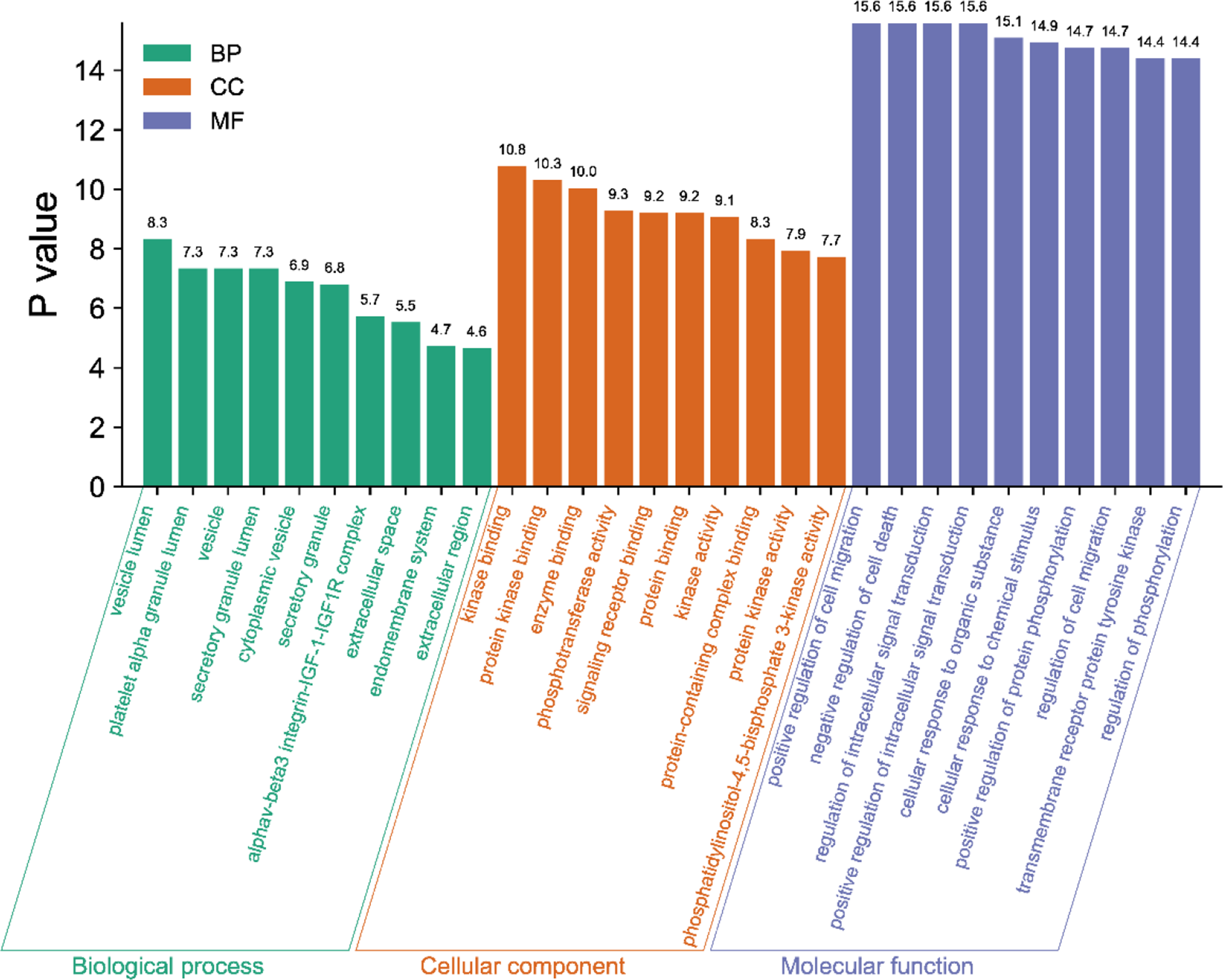
Go enrichment analysis.
Verification of Molecular Docking Between Astragaloside IV and Key Targets
Molecular docking was a computational process that could effectively predict the non-covalent binding of receptors and ligands. 25 Docking score of the receptor and the ligand was less than −4.25 kcal·mol-1, which indicated that they had a certain binding activity. If their docking score was less than −5.0 kcal·mol-1, it meant they had good binding activity, and their docking score was less than −7.0 kcal·mol-1, it meant they had strong binding activity. 26 A total of 21 proteins in the key targets have good binding activity to Astragaloside IV, among which the top 6 docking score is: SRC, AKT1, MAPK14, ALB, IL1B, PIK3CA (Table 2). The docking results showed that SRC and Astragaloside IV formed hydrogen bonds at THR-523, ALA-390, and PHE-405; AKT1 and Astragaloside IV formed hydrogen bonds at ASN-279, LYS-276, and TYR-18; MAPK14 and Astragaloside IV formed hydrogen bonds at ALA-111 and ALA-157; ALB and Astragaloside IV formed hydrogen bonds at GLU-141 and PHE-149; IL1B and Astragaloside IV formed hydrogen bonds at ASN-108; PIK3CA and Astragaloside IV formed hydrogen bonds at SER-773 and PHE-934 (Figure 9).
Molecular Docking Score.


Molecular docking model diagram.
Discussion
With the aging of the global population, the incidence of osteoporosis has increased year by year, which has placed a heavy burden on public health services. 27 Astragaloside IV has a certain effect on the prevention and treatment of osteoporosis, but due to the complex pathological process of osteoporosis, involving the common regulation of a variety of cells, growth factors, and nuclear transcription factors, its mechanism of action is not clear. 28 We screened out 1,179 targets related to osteoporosis according to the set criteria. After removing the duplication, we also obtained 315 Astragaloside IV targets, of which 102 common targets are the common targets of Astragaloside IV and osteoporosis. We used the Cytohub plug-in to analyze the PPI network topology properties. According to the node degree value, the top 10 genes are PIK3CA, MAPK1, SRC, STAT3, VEGFA, HSP90AA1, RELA, AKT1, IGF1, EGFR. We used the MCODE plug-in to decompose the PPI network, and the results showed that these key targets were closely related to molecular functions such as nitric-oxide synthase regulator activity, 1-phosphatidylinositol-3-kinase activity, non-membrane spanning protein tyrosine kinase activity and growth factor binding. KEGG pathway enrichment results showed that Astragaloside IV treated osteoporosis through 10 main pathways, including HIF-1 signaling pathway, PI3K-Akt signaling pathway, Toll-like receptor signaling pathway, TNF signaling pathway, and Osteoclasts differentiation and FoxO signaling pathway, Ras signaling pathway, Estrogen signaling pathway, VEGF signaling pathway, MAPK signaling pathway. The classification of these pathways belongs to signal transduction, immune system, development and regeneration and endocrine system.
Bone is a highly vascularized tissue with abundant blood supply. The process of bone repair and regeneration is closely related to angiogenesis. Blood vessel formation can provide oxygen and nutrients for bone formation, and blood vessels regulate bone formation and remodeling by mediating the interaction between osteoblasts, osteoclasts and vascular cells. Blood vessel formation can provide oxygen and nutrients for bone formation, and blood vessels regulate bone formation and remodeling by mediating the interaction between osteoblasts, osteoclasts and vascular cells. A large number of studies have shown that the HIF/VEGF pathway plays an important role in regulating vascular bone formation. In the process of endochondral ossification, blood vessels are closely related to cartilage growth. VEGF is the most critical angiogenic factor downstream of HIF-1, which can regulate angiogenesis and bone formation through signal transduction. 29 -31 PI3K/Akt signaling pathway is an important regulator of cell proliferation, metastasis, adhesion and apoptosis. 32 The PI3K/Akt signaling pathway can act on its specific target genes such as Forkhead Transcription Factor (FoxO), Glycogen Synthase Kinase (GSK3β) under oxidative stress, thereby reducing the degree of oxidative damage of osteoblasts and osteoclasts. 33 Studies have shown that growth factors such as insulin and insulin-like growth factor (IGF) can activate the PI3K/Akt signaling pathway, thereby affecting the formation, differentiation and function of osteoblasts and osteoclasts, and play a role in regulating bone mass and bone strength. 34 Akt, also known as protein kinase B (PKB), is a serine/threonine specific protein kinase. Akt1 can phosphorylate FoxO3a and prevent it from accumulating to the nucleus, which can transactivate the destruction of the pro-apoptotic molecule (Bim) in osteoblasts of its downstream target gene, thereby inhibiting osteogenic apoptosis. 35 -37 Mitogen-activated protein kinase (MAPK) is a highly conserved serine/threonine protein kinase family, which plays an important role in many life activities of cells, and is the main carrier for signal transmission through the cell surface to the nucleus. The MAPK signaling pathway mainly includes ERK1/2 pathway, JNK pathway, P38 pathway and MAPK-1 pathway. At present, 4 isomers of p38MAPK have been found, namely p38α (MAPK14), p38β (MAPK11), p38γ(MAPK12), and p38δ (MAPK13). P38 can be activated by inflammatory mediators (TNFα, IL-6 or IL-1) or anti-inflammatory factors (EGF, TGF-β) and then activate transcription factors NF-ΚB, p53, Stat3, etc., ultimately improving osteoporosis by promoting bone formation and inhibiting osteoclast differentiation. 38 -40 IL-1β and IL-6 inhibit the ability of osteoblasts to tend to PDGF-BB and other cytokines through the P38 pathway, which ultimately affects bone remodeling and participates in the development of inflammatory bone diseases and osteoporosis. TNF-α inhibits osteoblast differentiation and enhances osteoclast production, and plays an important role in bone remodeling by regulating the MAPK pathway. 41,42 Non-receptor c-SRC tyrosine kinase is an important factor in bone homeostasis. It is highly expressed on osteoclasts and can negatively regulate the activation of osteoblasts. 43 Activation of SRC kinase and intracellular MAPK signaling pathway can promote angiogenesis in bone tissue.
Conclusion
This study showed the mechanism of Astragaloside IV’s “multi-target and multi-pathway” prevention and treatment of osteoporosis. Astragaloside IV is significantly related to several pathways involved in osteoporosis, such as PI3K-Akt, FoxO signaling pathway and MAPK pathway. SRC, AKT1, and PIK3CA can bind stably with Astragaloside IV, and they may be hub genes for the treatment of osteoporosis. This study provides a further scientific basis for Astragaloside IV to treat osteoporosis, and its exact mechanism still needs to be verified by subsequent experimental studies.
Footnotes
Declaration of Conflicting Interests
The author(s) declared no potential conflicts of interest with respect to the research, authorship, and/or publication of this article.
Funding
The author(s) disclosed receipt of the following financial support for the research, authorship, and/or publication of this article: This study was supported by the National Natural Science Foundation of China (No. 81903877); Shaanxi Provincial Department of Science and Technology Project (No. 2020JM-589); Shaanxi University of Traditional Chinese Medicine Innovation Team Project (No. 2019-QN02).
