



Abstract
In the process of fighting against COVID-19 in China, Xingnaojing injection has been recommended for its clinical treatment, but the information about its active components and mechanism is still lacking. Therefore, in this work, using network pharmacology and molecular docking, we studied the active components of Xingnaojing injection having anti-COVID-19 properties. Using the DL parameter, TCMSP and CNKI databases were used to screen the active components of the Xingnaojing injection. Then, the SwissTargetPrediction webserver was used to collect the corresponding gene targets, and the gene targets related to COVID-19 were searched in the Genecards database. The DAVID database was used to enrich the function of gene targets, and the KOBAS3.0 database for the annotation of related KEGG pathways. The “components–targets–pathways” network of Xingnaojing injection was constructed with Cytoscape 3.6.1 software. The protein–protein interaction networks were analyzed using the String database. Specific proteins, SARS-COV-2 3 Cl, ACE2, and the active components were imported into Discovery Studio 2016 Client for molecular docking studies. From the Xingnaojing injection, a total of 58 active components, including Divanillalaceton and Q27139023, were screened. These were linked to 53 gene targets including mitogen-activated protein kinase 1 (MAPK1), tumor necrosis factorTNF, epidermal growth factor receptor, MAPK3, and 196 signaling pathways related to COVID-19, such as apoptosis, C-type lectin receptor signaling pathway, and hypoxia-inducible factor 1 signaling pathway. Furthermore, molecular docking studies were performed to study potential binding between the key targets and selected active components. Xingnaojing injection exhibits anti-COVID-19 effects via multiple components, multiple targets, and multiple pathways. These results set a scientific basis for further elucidation of the anti-COVID-19 mechanism of Xingnaojing injection.
Since December 2019, the novel coronavirus pneumonia (COVID-19) has swept the globe. As of September 21, 2020, there were 90 885 confirmed cases with 4744 deaths in China, and 4 451 714 confirmed cases with 216 411 deaths in Europe. The origin of the novel coronavirus is still unknown. However, with its spread to 209 countries and regions, world health has been challenged significantly. COVID-19 is mainly transmitted by droplets and aerosols, but can also spread via contact. All populations are susceptible to COVID-19 due to its strong infectivity that causes rapid widespread transmission. Mild COVID-19 patients exhibit symptoms of fever, fatigue, and dry cough, while the severe cases have been reported to suffer from dyspnea, respiratory distress syndrome, and septic shock. In some patients, symptoms such as headache, nausea, and vomiting have also been noticed. 1 -3 Astonishingly, recent evidence suggests that coronavirus not only affects the respiratory tract, but can also invade the central nervous system causing nervous system diseases. 4,5 Also, compared with the young population, the disease prevalence and mortality among the elderly are significantly higher. 6 Presently, balancing the inflammatory factors, improving immunity, and inhibiting cell apoptosis are major therapeutic directions for the treatment of COVID-19. 7,8 Drugs such as abidol, radcivir, chloroquine, and other chemical drugs have been reported to have good curative effects, but there is still insufficient evidence to support their role in completely eradicating COVID-19. 9,10 Therefore, there is an urgent need for either novel anti-COVID-19 drugs and/or a vaccine that can effectively control the coronavirus disease.
In China, traditional Chinese medicine (TCM) has a history of over 5000 years for its safety and effectiveness. Since January 27, 2020, China has released several versions of the COVID-19 treatment guideline. 11 The latest versions, the seventh (see website: http://www.nhc.gov.cn/xcs/zhengcwj/202003/46c9294a7dfe4cef80dc7f5912eb1989.shtml) and eighth editions (see website: http://www.nhc.gov.cn/xcs/zhengcwj/202008/0a7bdf12bd4b46e5bd28ca7f9a7f5e5a.shtml) also include the usage of Xingnaojing injection, which is a widely used TCM preparation consisting of Borneolum Syntheticum, Moschus, Curcumae Radix, and Gardeniae Fructus. Xingnaojing injection has significant curative effect in the adjuvant therapy of AECOPD complicated with respiratory failure type II, which can effectively inhibit the inflammatory reaction, and improve blood gas indexes, thus enhancing the quality of life. 12 Therefore, to promote further this prescription, its active components, and the potential mechanism of action against COVID-19 must be examined thoroughly.
The network pharmacology method integrates system biology, multiple pharmacology, and computer analysis technology. Using a large number of databases and statistical algorithms, it identifies the synergistic effects of multiple components, multiple targets, and multiple pathways of diseases, breaking the previous concept of a single-component/single-target disease. 13,14 Also, it explores the interaction between drugs and potential targets and establishes a “components–targets–pathways” network to associate drugs and diseases systematically and comprehensively. 15 This is also consistent with the holistic and systematic characteristics of TCM in treating diseases. 16,17
High-throughput molecular docking technology is widely applied to study the active sites of drugs by simulating interactions between receptors and drug molecules. 18 Thereby, it has also played an immense role in the research of natural products. 19 In this study, using network pharmacology, we constructed the “active components–targets–pathways” network diagram of Xingnaojing injection. Furthermore, we used high-throughput molecular docking technology to predict the potential active components and mechanism of action of Xingnaojing injection (Figure 1). These findings set the basis for further research in this direction.

The flowchart describing the design of the study.
Materials and Methods
Collection and Screening of Active Components
To obtain information about the active components, all TCM in Xingnaojing Injection including Borneolum Syntheticum, Moschus, Curcumae Radix, and Gardeniae Fructus were searched by herb names in TCMSP (http://lsp.nwu.edu.cn/tcmsp.php) and CNKI (http://kns.cnki.net/) databases. The structure of each component was download using the PubChem website and stored in SDF format. 20 Since this drug is an injection, along with DL ≥0.18, oral bioavailability was also used as a screening standard.
Prediction and Screening of Anti-COVID-19 Targets of the Active Components
To find relevant targets, active components were analyzed using the SwissTargetPrediction server (http://www.swisstargetprediction.ch/) 21 by setting the Probability value >0. Then, the potential gene targets were saved. Also, using the keywords “coronavirus disease 2019,” “novel coronavirus pneumonia” and “novel coronavirus 2019,” genes related to COVID-19 were retrieved from the GeneCards database. These were then compared with the potential gene targets of the active components. Finally, the potential gene targets of Xingnaojing Injection linked to COVID-19 were summarized.
Gene Ontology and Pathway Enrichment Analysis
The potential gene targets were uploaded to the KOBAS 3.0 database (http://kobas.cbi.pku.edu.cn/kobas3) for KEGG pathway annotation. These enriched pathways were considered important ones that were affected by Xingnaojing injection in the treatment of anti-COVID-19. For Gene Ontology (GO) enrichment analysis, the data were imported into the DAVID database (https://david.ncifcrf.gov/summary.jsp), with the setting identifier as OFFICIAL_GENE_SYMBOL, and species as Homo sapiens. Using a threshold value of P ≤.05, the top 12 GO enrichment and KEGG pathway annotation results were further analyzed using the Omicshare platform.
Components–Targets–Pathways Network Construction
A components–targets–pathways network was constructed by importing the active components, gene targets, and enrichment pathways into the Cytoscape 3.6.1 software. Active components and gene targets, gene targets, and enrichment pathways represent the input nodes, respectively. The association between the 2 nodes is represented by an edge. The 2 groups of networks were merged to obtain the components–targets–pathways network. In the components–targets–pathways network, the high-degree components were regarded as important active components.
Construction of Protein–Protein Interaction Network and Molecular Docking
To generate the target protein interaction network, the gene targets were imported into the STRING database (https://string-db.org/). The TSV file was downloaded and imported into Cytoscape 3.6.1 software and the network analyzed using the Network Analysis function.
From the protein interaction network, higher-degree targets were searched for the corresponding protein in the PDB database (https://www.rcsb.org/) and the high-resolution protein structure files were retrieved. Finally, using the Discovery Studio 2016 Client, target proteins, and the chemical structures of the active components were subjected to molecular docking studies.
Results
Collection of Active Components
After excluding those without a target, 58 potential active components were selected. The specific information is presented in Table 1.
Potential Active Components of Xingnaojing Injection.

Collection of Potential Targets
A total of 702 potential gene targets of the active components, including the 262 COVID-19 related genes, were analyzed using the Venny program, an interactive tool for comparing lists with Venn’s diagrams (Figure 2). Finally, a total of 53 potential anti-COVID-19 targets genes were identified. The specific information is shown in Table 2.

Intersection of gene targets of active components and COVID-19-related genes.
Potential Gene Targets of Xingnaojing Injection in COVID-19 Treatment.

Abbreviations: EGFR, epidermal growth factor receptor; TNF, tumor necrosis factor.
Target Function and Pathway Annotation
KEGG pathway annotation revealed that 218 pathways are linked to 53 potential gene targets; among these, 196 are significantly related (P ≤ .05). The top 12 pathways are associated with apoptosis, C-type lectin receptor signaling pathway, and hypoxia-inducible factor 1 (HIF-1) signaling pathway (Figure 3).

KEGG pathway enrichment analysis of Xingnaojing injection in COVID-19 treatment. TNF, tumor necrosis factor.
GO enrichment analysis includes cell component (CC), biological process (BP), and molecular function (MF). The top ones in CC are extractive region, extrinsic component of cytotoxic side of plasma membrane, and extractive space (Figure 4(A)). The top in BP are peptidyl tyrosine autophosphorylation and peptidyl tyrosine phosphorylation (Figure 4(B)), and in MF, protein tyrosine kinase activity and steroid hormone receptor activity (Figure 4(C)).

Gene ontology enrichment analysis of Xingnaojing injection in COVID-19 treatment. (A) Cell component, (B) biological process, (C) molecular function.
Construction of Active Components–Gene Targets–Enrichment Pathways Network
Finally, 58 active components, 53 gene targets, and 12 pathways were selected to construct the network of active components–gene targets–enrichment pathways (Figure 5). There are 123 nodes (58 active components, 53 targets, 12 pathways) and 464 edges. We found that the anti-COVID-19 effects of Xingnaojing injection are through multiple components, multiple targets, and multiple pathways. Among the active components, based on the higher-degree value, Divanillalaceton and Q27139023 were selected for molecular docking. Their structures are shown in Figure 6.

Components–targets–pathways network. The green, dark blue, and purple nodes represent the pathways, active components, and target genes, respectively.

Structure of the active components. (A) Divanillalaceton, (B) Q27139023.
Construction of the Protein–Protein Interaction Network and Molecular Docking
The gene targets were imported into the STRING database and the interaction network of the corresponding proteins was constructed (Figure 7(A)). Targets mitogen-activated protein kinase 1 (MAPK1), MAPK3, and epidermal growth factor receptor (EGFR) were selected for molecular docking. We found that the novel coronavirus pneumonia is closely linked to 2 target proteins ACE2 and SARS-COV-2 3 Cl. Therefore, these 2 proteins, along with the active components, were further subjected to molecular docking studies. The protein–protein interaction network between ACE2 and the top 20 target proteins is shown in Figure 7(B).

Protein–protein interaction network. (A) Interaction of the potential targets of Xingnaojing injection in COVID-19 treatment. (B) Interaction of the top 20 targets with ACE2.
For molecular docking, corresponding protein structures were obtained from the PDB database. Then, the 3-dimensional (3D) structure of the target proteins and the components were subjected to molecular docking using the Discovery Studio 2016 client. From the protein structure file, the water molecules, hydrogen bonds, and protoligands were omitted. Specific details, including the docking fraction, are presented in Table 3. Two-dimensional and 3D views of the protein and the docking component are shown in Figures 8 and 9.
LiDockScore of the Active Components and Target Proteins.

Abbreviations: EGFR, epidermal growth factor receptor; MAPK, mitogen-activated protein kinase.

Molecular docking of each protein with Divanillalaceton. (A) Divanillalaceton-6G54, (B) Divanillalaceton-4QTB, (C) Divanillalaceton-6DUK, (D) Divanillalaceton-6M2N, (E) Divanillalaceton-3D0G. 2D, 2-dimensional; 3D, 3-dimensional.
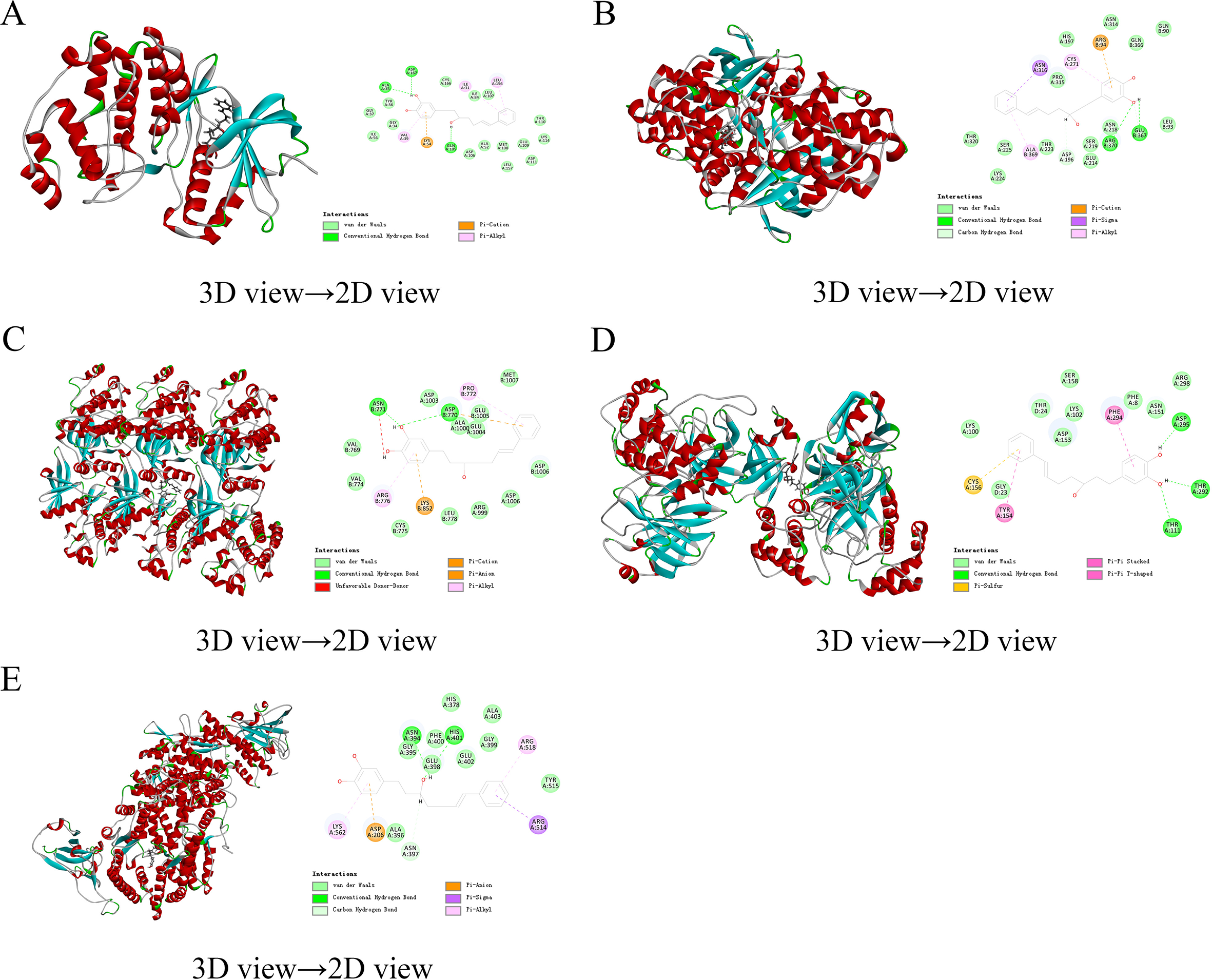
Molecular docking of each protein with Q27139023. (A) Q27139023-6G54, (B) Q27139023-4QTB, (C) Q27139023-6DUK, (D) Q27139023-6M2N, (E) Q27139023-3D0G. 2D, 2-dimensional; 3D, 3-dimensional.
To assess the quality of docking between the component and protein, a LiDockScore of >100 was considered as effective binding. Five proteins and 2 components had docking fractions >100, as shown in Table 3. Among these, EGFR and Q27139023 exhibited the strongest binding having a LiDockScore of 122.06. Overall, the corresponding docking scores suggest effective binding between the active components and key targets. They also suggest that the prediction results of network pharmacology are reliable and accurate.
Discussion
In this study, using the “Components–Targets–Pathways” network, we examined the potential active components, targets, and anti-COVID-19 mechanism of Xingnaojing injection. The 58 active components of Xingnaojing injection showed a significant correlation with COVID-19. Among these, Divanillalaceton and Q27139023 exhibited the strongest correlation, suggesting their potential action against the virus. The active components affected 53 gene targets related to COVID-19. Among these, MAPK1, MAPK3, EGFR, tumor necrosis factor (TNF), and other target proteins were strongly correlated with the virus. Interestingly, these are also the potential key gene targets of Xingnaojing injection. Furthermore, KEGG pathway annotation revealed that apoptosis, C-type lectin receptor signaling pathway, HIF-1 signaling pathway, and other COVID-19-linked pathways had significant differences, indicating that Xingnaojing injection can regulate multiple biological pathways. Molecular docking also revealed effective binding among the selected active components and the target proteins, indicating the reliability and accuracy of the network pharmacology analysis.
At present, reducing apoptosis by regulating the imbalance of inflammatory factors and improving immunity are considered the main directions in COVID-19 treatment. In rats, Xingnaojing injection was shown to block the inflammatory responses via the SIRT1 pathway and dramatically mitigated cerebral ischemia/reperfusion (I/R) injury. 12 Gardeniae Fructus in Xingnaojing injection is known to have a preventive effect on chronic pancreatitis. 22 MAPK, an important transmitter of signals from the cell surface to the nucleus, is an important protease that regulates cell proliferation. By downregulating MAPK1, lipopolysaccharide-induced acute lung injury can be reduced significantly. 23 TNF is a key gene regulating inflammation. Its deficiency regulates the production of inflammatory factors, leading to lung pathology and death in respiratory poxvirus infection. 24 EGFR, a receptor for epithelial growth factor, cell proliferation and signal transduction mediate autophagy and have been associated with non-small-cell lung cancer. 25
Apoptosis is the major cause of tissue injury. In lung diseases too, accompanied apoptosis can lead to severe lung injury. Interestingly, vitamin D reduces lung injury by promoting epithelial repair, reducing epithelial cell apoptosis, and inhibiting transforming growth factor-β-induced epithelial–mesenchymal transition. 26 C-type lectin receptor signaling pathway mediates intracellular signaling cascades to induce the production of inflammatory cytokines and chemokines, which consequently trigger innate and adaptive immunity. C-type lectin regulates the Toll-like receptor signaling pathway, thereby regulating the adaptive immune regulation of DCS to bacteria, fungi, and viral pathogens. 27 HIF-1 signaling pathway is vital for the regulation of oxygen homeostasis. It is known that hydrogen sulfide can inhibit cigarette smoke-induced inflammation and injury of the alveolar epithelial cells by inhibiting the PHD2/HIF-1 α/MAPK signal pathway. 28
Conclusion
COVID-19 disease is a serious threat to people’s health and reduces the quality of life. In this study, using the “components–targets–pathways” network, we analyzed the active components and comprehended the pharmacological mechanism of Xingnaojing injection against COVID-19. We found that Xingnaojing injection functions by multiple components, multiple targets, and multiple pathways. These findings provide a strong theoretical basis for further systematic experimental research related to the anti-COVID-19 action of Xingnaojing injection.
Footnotes
Acknowledgments
We sincerely thank all colleagues from Key Laboratory of Traditional Chinese Medicine Resources and Chemistry of Hubei Province, Wuhan, China, who advised on the process of writing the paper.
Data Availability Statement
For reasonable requirements, the data related to this study can be requested from the corresponding author.
Declaration of Conflicting Interests
The author(s) declared no potential conflicts of interest with respect to the research, authorship, and/or publication of this article.
Funding
The author(s) disclosed receipt of the following financial support for the research, authorship, and/or publication of this article: This work was supported by the National Natural Science Foundation of China (No. 31570343).