



Abstract
The fruits of Chinese dwarf cherry (Cerasus humilis (Bge.) Sok.), which is unique to China, can be canned and used to make products such as jam and wine. They also contain abundant bioactive compounds, including cinnamoylquinic acids and flavonoids. However, there has been no systematic study on the functional compounds in these fruits. In this study, the polyphenol compounds of 28 different genotypes of Chinese dwarf cherry in Liaoning province were systematically characterized using high-performance liquid chromatography with photodiode array detection and HPLC coupled with quadrupole time-of-flight mass spectrometry. A total of 31 polyphenols, including 6 anthocyanins, 7 cinnamoylquinic acids, 1 flavone, and 17 flavonols, were identified, and 23 of these compounds were detected in Chinese dwarf cherry for the first time. In addition, 4 genotypes showed higher total polyphenol content and antioxidant activities. It may be advantageous to use these 4 genotypes for commercial processing of Chinese dwarf cherry fruits into healthcare products. The results of this study will improve understanding of the chemical mechanism of polyphenols formation and lay the foundation for selective functional composition breeding in Chinese dwarf cherry.
Introduction
Chinese dwarf cherry (Cerasus humilis (Bge.) Sok.), which belongs to the genus Cerasus in the family of Rosaceae, is a small dwarf shrub that originated in the north of China. 1 It is mainly distributed in Hebei, Inner Mongolia, Jilin, Liaoning, Heilongjiang provinces, and so on. It usually grows on sunny slopes or the edge of dunes. 1 Chinese dwarf cherry is of strong ecological value. It shows resistance to cold, drought, barren soil, and high salt. 2 It is an excellent plant of wind-preventing and sand-fixing in north China. In addition, the fruit kernel of Chinese dwarf cherry, called “Yuliren,” can be used as medicine. 3 The Chinese dwarf cherry has recently attracted more and more attention because many nutrients and active compounds have been identified in the fruit, including minerals, sugars, organic acids, volatile components, and flavonoids. 4 -8 They are not only consumed as fresh fruits but also used in wine, vinegar, jam, and other products. 9 -11 Therefore, the fruits quality, especially the composition and content of the active components, have a great influence on the Chinese dwarf cherry industry.
Polyphenols represent a class of polymers having aromatic rings that are directly attached to hydroxyl groups. Polyphenols are important secondary metabolites in plants and are an integral part of the human diet for they are widely found in fruits, vegetables, and cereals. Polyphenols also have diverse biological activities, including antioxidant, antimicrobial, antiaging, anti-inflammatory, and anticancer activities. 12 -15 Cherry is one of the most important dietary sources of polyphenol compounds. 16 The Chinese dwarf cherry is also endowed with a high polyphenol content. However, there are many differences in fruit polyphenol composition and content among different genotypes and cultivars, and systematic and comprehensive method for the analysis of polyphenols has not been established yet in Chinese dwarf cherry. 7,17 In Liaoning province, one of the main areas of Chinese dwarf cherry production, the characteristics of cherry fruit, especially polyphenol content and antioxidant activity, have not yet been evaluated. In addition, a few polyphenols have been detected in the fruit of Chinese dwarf cherry nowadays. 5,7,17,18 Therefore, it is necessary to perform a more comprehensive analysis of polyphenol compounds in Chinese dwarf cherry genotypes.
In this study, the polyphenol compounds in the fruits of 28 different Chinese dwarf cherry genotypes were systematically characterized using high-performance liquid chromatography-photodiode array detection (HPLC-DAD)/quadrupole time-of-flight mass spectrometry (Q-TOF-MS), and the total polyphenol content (TPC) was also evaluated. Furthermore, the 1,1-diphenyl-2-picrylhydrazyl free radical (DPPH) assay, the 2,2′-azinobis-(3-ethylbenzothiazoline-6-sulfonic acid (ABTS) assay, and the ferric reducing ability of plasma (FRAP) assay were used to assess the antioxidant activities in each sample. To the best of our knowledge, this work is the first report on the polyphenol content as well as the antioxidant activities of Chinese dwarf cherry genotypes from Liaoning province. The results of this study will improve the economic utilization of Chinese dwarf cherry fruits and also promote the development of healthy beneficial food products.
Materials and Methods
Standards and Reagents
The standard cyanidin 3-O-glucoside (Cy3Glc) was obtained from Extrasynthese (Genay, France). Quercetin 3-O-glucoside (Qu3Glc), kaempferol 3-O-glucoside (Ka3Glc), and gallic acid (GA) were purchased from Shanghai Tauto Biotech Co. Ltd. (Shanghai, China). Quercetin 3-O-rutinoside (rutin) and trans-5-O-caffeoylquinic acid (5-CQA) were provided by the National Institute for the Control of Pharmaceutical and Biological Products (Beijing, China). Folin-Ciocalteu’s phenol reagent, 1,1-diphenyl-2-picrylhydrazyl radical (DPPH▪), 2,2′-azinobis-(3-ethylbenzothiazoline-6-sulfonic acid) (ABTS▪+), and 2,4,6-tripyridyl-S-triazine were purchased from Sigma-Aldrich (St Louis, United States). Other analytical chemicals were obtained from Beijing Chemical Works (Beijing, China). Ultrapure water was prepared using a Milli-Q System (Millipore, Billerica, MA, United States).
Plant Materials
Mature fruits of 28 genotypes Chinese dwarf cherry (C. humilis (Bge.) Sok.) (named 1-28) were selected and used as the experimental materials in this study (Figure 1). Three replicates of each analysis were carried out for each genotype. All samples were collected at the Chinese dwarf cherry germplasm resources nursery at the Institute of Pomology of the Chinese Academy of Agricultural Sciences (latitude 40°45′E, longitude 120°51′N; Huludao, Liaoning), and grown under the same cultivation conditions. The fresh fruits were collected and placed in an airtight preserving box containing ice bags. The cores were removed and the fresh berries were weighed immediately upon arrival at the laboratory. Then, the fresh berries were freeze-dried for 12 hours and weighed again. The freeze-dried berries were extracted for further studies.

Eight representative genotypes of Chinese dwarf cherry.
Extraction Procedures
The extraction was performed according to a previously described method with slight modifications. 19 Approximately 1.0 g of freeze-dried berries (with cores removed) were pulverized in liquid nitrogen, extracted with 2 mL of 2% formic acid methanol (v/v) in a 10 mL test tube, then shook by a vortex, sonicated with an ultrasonic cleaner for 20 minutes, and then centrifuged at 10 000 g for 10 minutes. The supernatants were collected into fresh tubes. Then, we repeated the extractions for a second and third time by adding an additional 2 mL extraction solution to the residue. All extracts were combined and filtered through 0.22 µm reinforced nylon membrane filters prior to analysis.
High-performance Liquid Chromatography with Photodiode Array Detection System and Conditions
High-performance liquid chromatograpy analysis was performed on a Dionex (Sunnyvale, CA, United States) system, which included a P680 HPLC pump, a PDA100 photodiode array detector, an UltiMate 3000 autosampler, and a TCC-100 thermostatted column compartment. An ODS-80Ts QA C18 column (250 mm × 4.6 mm, Tosoh, Tokyo, Japan) was used, which was protected with a C18 guard cartridge. Eluent A was 10% formic acid in ultrapure water (v/v), and eluent B was 1% formic acid in acetonitrile (v/v). The following gradient elution was used: 5% B at 0 minute, 18% B at 45 minutes, 25% B at 65 minutes, and 5% B at 70 minutes. The flow rate was 0.8 mL/min. The column temperature was maintained at 35°C for all analyses. The injection volume was 10 µL. Chromatograms were acquired at 525 and 350 nm for anthocyanins and other polyphenol compounds. The photodiode array spectra were recorded from 200 to 800 nm.
Mass Spectrometry
Mass Spectrometry (MS) analysis was performed on an Agilent 1260 Infinity II LC system equipped with an Agilent 6520 Accurate-Mass Q-TOF mass spectrometer with dual ESI source (Agilent Technologies, United States). Chromatographic column and HPLC conditions were the same as those described in the Section “High-performance Liquid Chromatography with Photodiode Array Detection System and Conditions”. The ionization interface was operated in both positive-ion (PI) electrospray mode for anthocyanins and negative ion (NI) mode for other polyphenol compounds. The conditions were the same both in PI and NI electrospray modes. Source parameters were as follows: gas (N2) temperature, 350°C; gas flow, 12 L/min; and nebulizer gas pressure, 30 psi. Scan source parameters: VCap voltage, 3500 V; fragmentor voltage, 80 V; skimmer1 voltage, 65 V; and OctopoleRFPeak voltage, 750 V. The following conditions were used for MS: scan range, 100-1000 (m/z); MS scan rate, 1.0 second; MS/MS scan rate, 4.0 seconds; and collision energy, 30 V. Dual source technology was applied for mass accuracy. ESI-L low concentration tuning mix was used to adjust the mass calibration of the instrument during analysis. Data were processed by Agilent MassHunter Analysis B.04.00 software.
Quantitative Analysis of Polyphenol Compounds
The polyphenol compounds in each sample were measured semi-quantitatively by performing linear regression of commercial standards. Cy3Glc (525 nm), 5-CQA (350 nm), and rutin (350 nm) were used as standards for anthocyanins, cinnamoylquinic acids, and flavonoids, respectively. These standards were prepared at concentration ranges from 10 to 1000 µg/mL. Each concentration standard was prepared in 3 replicates. The equations used for calculations were Cy3Glc, y (peak area) =613.21 × (concentration) +1.73 (r2 = 0.9999); 5-CQA, y (peak area) =296.52 × (concentration) +0.44 (r2 = 0.9997); and rutin, y (peak area) =360.23 × (concentration) +0. 72 (r2 = 0.9999). The polyphenol compound contents were presented as milligrams of standard per 100 g of dry weight (DW).
Total Polyphenol Content
The TPC of different samples was measured using the Folin-Ciocalteu method. 20,21 The results were expressed as milligrams of GA equivalent content per 100 g DW. All samples were analyzed in triplicate.
Antioxidant Capacity
The DPPH, ABTS, and FRAP assays were used to assess the antioxidant capacities. These assays were performed based on the methods described before (Wang et al, 2015). The following linear regression equation was obtained: DPPH, y (scavenging ratio) =5.7228 × (GA equivalents content) +0.0184 (r2 = 0.9991); ABTS, y (absorbance) = 7.8581 × (GA equivalents content) +0.0198 (r2 = 0.9934); and FRAP, y (absorbance) = 8.9767 × (GA equivalents content) − 0.0172 (r2 = 0.9987). The results were presented as milligrams of GA equivalents content per g DW.
Statistical Analysis
One-way analysis of variance, correlation analysis, and cluster analysis were performed using SPSS 21.0 (IBM). P < 0.05 was considered statistically significant.
Results and Discussion
Method Validation
In order to obtain higher separation efficiency and peak resolution of the target compounds, chromatographic conditions were optimized. To verify the reliability of the optimized separation method (Figure 2), analytical parameters were determined for anthocyanins using Cy3Glc, for cinnamoylquinic acid using 5-CQA, and for other flavonoids using rutin. All 3 calibration curves had high linear regression coefficients (r 2 ≥0.9997) within the test range. The limits of detection values were 0.47, 0.05, and 0.84 µg/mL, while the limits of quantification values were 0.16, 1.58, and 2.81 µg/mL, respectively (Table S1).

High-performance liquid chromatograpy elution profiles of polyphenols from Chinese dwarf cherry. (a) anthocyanins detected at 525 nm and (b) other polyphenols detected at 350 nm.
The precision of the optimized method was studied by examining the repeatability (intra-day analysis, n = 6) and intermediate precision (inter-day analysis, n = 3) for 31 compounds separated from genotype No. 10 and No. 11 because they contained all components. Six samples of these 2 genotypes were extracted and analyzed on the same day to determine the intra-day precision. Two samples per day were also extracted and evaluated on 3 consecutive days to determine the inter-day precision. The relative standard deviations (RSDs) were all less than 1.64% for the intra-day test and less than 2.66% for the inter-day analysis (Table S2). The low RSD values obtained for all compounds demonstrate that the optimized method has high repeatability and intermediate precision.
Identification of Polyphenol Compounds
The HPLC chromatogram (detected at 525 nm) showed 6 peaks corresponding to anthocyanins, a1-a6, in the extracts from Chinese dwarf cherry fruit (Figure 2a). Based on the UV-Vis absorption spectra and aglycone fragment ions, there were only 2 aglycones, cyanidin and pelargonidin, in the fruits of Chinese dwarf cherry (Table 1, Figure S1A). The MS/MS ion (m/z 287[Y0]+) observed for a1, a2, and a5 in the PI mode indicated that these anthocyanins were cyanidin derivatives. On the other hand, a3, a4, and a6 were pelargonidin derivatives (m/z 271[Y0]+). Generally speaking, the glycosylation of anthocyanins occurs at the 3- and 5-hydroxyls. 22 Harborne found that glycosylation at different positions discriminated the value of E 440/E vis-max. 23 The E 440/E vis-max ratios between different cyanidin derivatives (30%) and pelargonidin derivatives (44%) were similar in this study, indicating that these 6 anthocyanins were all 3-substituted anthocyanins. 23,24 Subsequently, a1 was verified as Cy3Glc by co-eluting with its corresponding standard. Using published MS spectra, the rest of the anthocyanins were readily identified as cyanidin 3-O-rhamnosyl-hexoside (Cy3RhaHex, a2), pelargonidin 3-O-hexoside (Pg3Hex, a3), pelargonidin 3-O-rhamnosyl-hexoside (Pg3RhaHex, a4), cyanidin 3-O-acetyl-hexoside (Cy3acetylHex, a5), and pelargonidin 3-O-acetyl-hexoside (Pg3acetylHex, a6). 18 However, we were unable to detect 4 anthocyanins previously reported in Chinese dwarf cherry: cyanidin 3-xylosyl-rutinoside, 5-methylpyranocyanidin 3-glucoside, delphinidin 3-glucoside, and delphinidin 3-acetyl-glucoside. 5,7
The UV-Vis Spectra and Mass Spectrometry Data Used for the Identification of Polyphenols in Chinese Dwarf Cherry.

aCompounds a1 to a6 were detected in the positive ion mode, others were detected in the negative ion mode.
A total of 25 polyphenols (in addition to anthocyanins) were definitely or tentatively identified in Chinese dwarf cherry, including 7 cinnamoylquinic acids, 1 flavone, and 17 flavonols (Table 1). Except for 2 flavonols (f2 and f5), all of these compounds were detected in Chinese dwarf cherry for the first time. 11 In addition, 4 compounds were identified by comparing retention times and UV spectra with authentic standards: 5-CQA (c5), Qu3Rut (f1), Qu3Glc (f2), and Ka3Glc (f8).
The observation of fragment ion in the NI mode indicated that c1, c2, c3, c4, c5, c6, and c7 were cinnamoylquinic acids (Figure S1B). The MS results showed the presence of quinic acid and caffeic acid in the structure of peaks c1 and c4. 25,26 These 2 peaks were inferred to be caffeoylquinic acids. Peaks c2 and c3 were inferred to be p-coumaroylquinic acid based on the data of measured mass (m/z 337[M−H]−, m/z 191, and m/z 163). 26 Molecular ions at m/z 367[M−H]− and fragment ions at m/z 191 were detected for c6 and c7. Peaks c6 and c7 were inferred to be 5-O-feruloylquinic acid and 4-O-feruloylquinic acid according to their retention time, respectively. 26
Based on the UV absorption and MS/MS data, 4 flavonol aglycones and 1 flavone aglycone, including quercetin (f3, f4, f5, f6, f7, f12, f14, and f17) (m/z 300[Y0−H]− and m/z 301[Y0]−), hydroxylkaempferol (f10) (m/z 300[Y0−H]−), kaempferol (f13, f15, and f18) (m/z 284[Y0−H]−), isorhamnetin (f11 and f16) (m/z 314[Y0−H]−), and luteolin (f9) (m/z 285[Y0]−), were identified in the fruits of Chinese dwarf cherry (Table 1). In principle, any of the hydroxyl groups can be glycosylated of flavonoids but certain positions are favored: for example, the 7-hydroxyl group in flavones, and the 3- and 7-hydroxyls in flavonols. 22 In this study, derivatives (except f9) were determined to be substituted at 3-hydroxyl because of the 17-22 nm hypsochromic shifts in UV λmax (Band I), while f9 was substituted at 7-hydroxyl. 27 Flavonoids f5 and f7 had the same mass spectra as quercetin 3-O-pentosides (molecular ion m/z 433[M−H]− in the NI mode). Glycosides with arabinose elute before their corresponding xyloses. 21,28,29 Peaks f5 and f7 were identified as quercetin 3-O-arabinoside (Qu3Ara) and quercetin 3-O-xyloside (Qu3Xyl), respectively. 11 Peaks f3, f4, f9, f11, and f13 were determined to be flavonoid-O-di-glycosides according to their molecular ion data (Table 1). Peaks f3 and f9 were presumed to be quercetin 3-O-rhamnosyl-rhamnoside (Qu3RhaRha) and luteolin 7-O-rhamnosyl-rhamnoside (Lu7RhaRha), respectively, owing to a fragment loss of 292 u. Peak f4 was revealed to be quercetin 3-O-rhamnosyl-pentoside (Qu3RhaPen) based on a fragment loss of 278 u. A fragment loss of 308 u indicated that f11 and f13 were linked with rhamnosyl-hexoside; f11 was identified as isorhamnetin 3-O-rhamnosyl-hexoside (Is3RhaHex); and f13 as kaempferol 3-O-rhamnosyl-hexoside (Ka3RhaHex). For peaks f10, f12, f15, and f16, the loss of 204 u (162u + 42 u) identified them as hydroxylkaempferol O-acetyl-hexoside (Hk3acetylHex), quercetin 3-O-acetyl-hexoside (Qu3acetylHex), kaempferol 3-O-acetyl-hexoside (Ka3acetylHex), and isorhamnetin 3-O-acetyl-hexoside (Is3acetylHex), respectively. Peak f17 was determined to be quercetin 3-O-acetyl-rhamnoside (Qu3acetylRha) for it had a loss of 188 u. A molecular ion at m/z 651[M−H]− in the NI mode was found for f6 and f14. The loss of 350 u indicated that they were linked with acetyl-rhamnosyl-hexoside. These peaks were identified as quercetin 3-O-acetyl-rhamnosyl-hexosides (Qu3acetylRhaHex). The loss of 334 u indicated that f18 was linked with acetyl-rhamnosyl-rhamnoside, and this peak was identified as kaempferol 3-O-acetyl-rhamnosyl-rhamnoside (Ka3acetylRhaRha).
Content of Polyphenols
The total anthocyanin (TA) content in fruits varied across different genotypes of Chinese dwarf cherry (Figure 3), ranging from 1.46 to 517.92 mg/100 g DW. In order to compare with other species berries, we used water content (Table S3) to calculate TA content per fresh weight (FW). It was previously found that the average TA across various strawberry cultivars was 34 mg/100 g of FW, while TA in Chinese dwarf cherry genotype No. 20 was nearly 72.13 mg/100 g FW. 30 -32 And Cy3Glc was the most abundant anthocyanin which accounted for 32.31% to 80.82% of TA.

Polyphenols composition obtained by high-performance liquid chromatography from 28 genotypes Chinese dwarf cherry (quantification was semi-quantitative based on calibration with cyanidin 3-O-glucoside, trans-5-O-caffeoylquinic acid, and quercetin 3-O-rutinoside).
We had only detected 3 types of cinnamoylquinic acids, including caffeoylquinic acid, p-coumaroylquinic acid, and feruloylquinic acid. The total cinnamoylquinic acid (TC) content varied depending on the genotype (Figure 3, Table S3). The lowest TC was 0.52 mg/100 g DW in genotype No. 1 and the highest was 43.02 mg/100 g DW in genotype No. 6.
The total flavonoid (TF) (not including anthocyanins) content varied among all samples. TF content in genotype No. 27 was nearly 5 times higher than that in genotype No. 13 (Figure 3 and Table S3). Total flavonoid includes 17 flavonols and 1 flavone, and the flavonol content is higher than the flavone content, accounting for 67.42% to 92.08% of TF. The content of quercetin (Qu) derivatives was proportionally highest among flavonols, accounting for 63.27% to 83.92% of the flavonols content, followed by kaempferol (Ka) derivatives. Qu3Ara was the dominant component, with content ranging from 7.44 to 37.89 mg/100 g DW. Genotype No. 27 which had the highest content of Qu3Ara would be useful for producing medicinal products because Qu3Ara has many useful medicinal activities, such as antimalarial, anti-diabetes, antibacterial, and antioxidant. 33 -37
Total Polyphenol Content and Antioxidant Activity
The TPC and antioxidant activities (from the DPPH, ABTS, and FRAP assays) of different Chinese dwarf cherry genotypes, determined using the reference standard GA, are shown in Figure 4. Total polyphenol content ranged from 9.84 mg/g DW for No. 22 to 28.47 mg/g DW for No. 3. The TPC of genotype No. 3, 6, and 18 was significantly higher than that of the other genotypes (P < 0.01). However, the differences between these 3 genotypes were not statistically significant. Only the TPC of No. 22 was significantly lower than that of the other genotypes (P < 0.01).
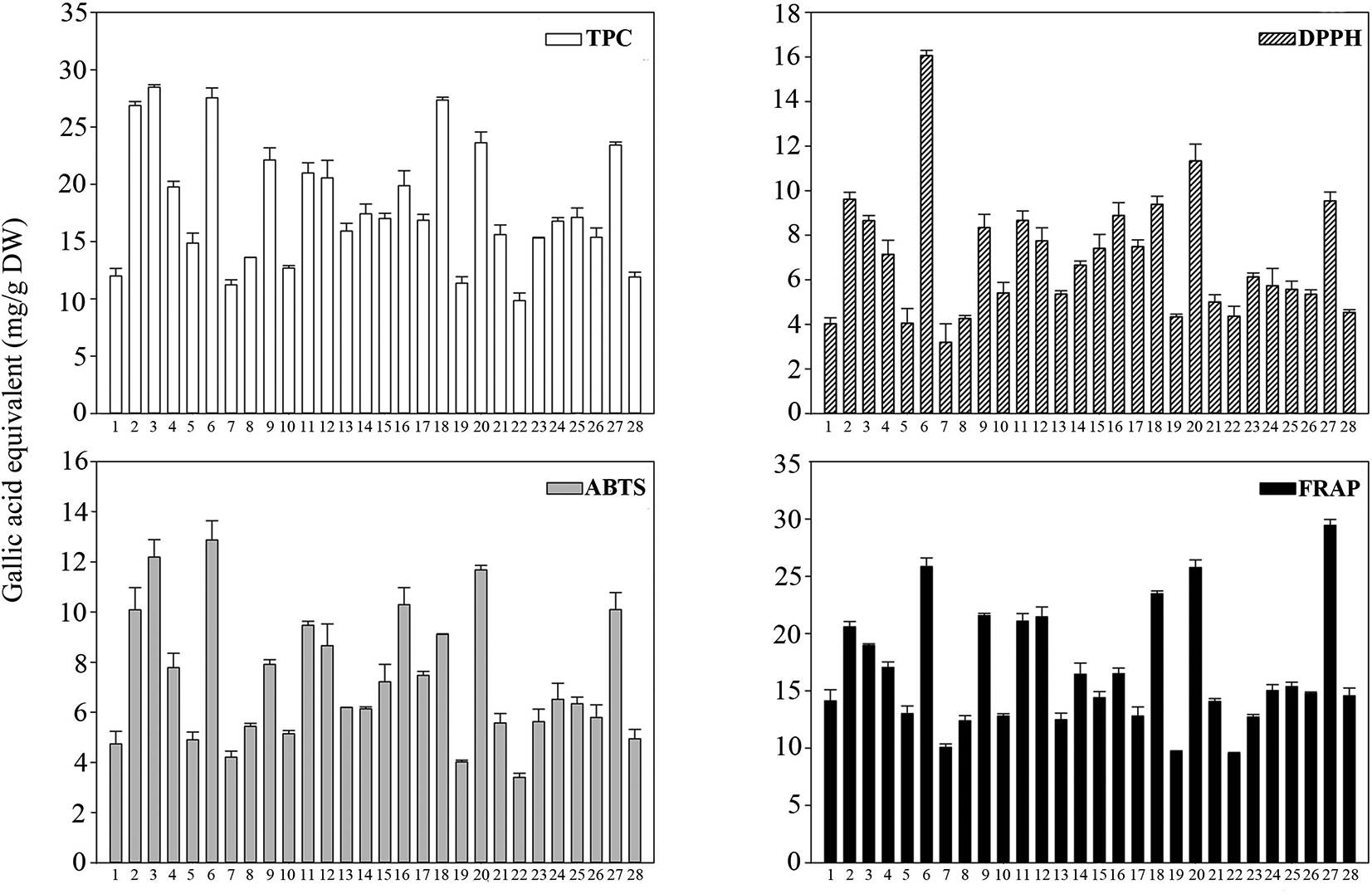
Total polyphenol content and antioxidant activities, as revealed by DPPH, ABTS, and ferric reducing ability of plasma assays involving in 28 genotypes Chinese dwarf cherry (mg/100 g DW) (mean ± SD, n = 3).
The results of the 3 antioxidant activity assays were similar, although there were some discrepancies. In the DPPH assay, the values ranged from 3.19 mg/g DW for No. 7 to 16.06 mg/g DW for No. 6. Among 28 genotypes, only No. 6 and No. 20 showed higher levels than the other genotypes. In the ABTS assay, the values ranged from 3.40 mg/g DW for No. 22 to 12.88 mg/g DW for No. 6. Six genotypes with the highest antioxidant activities were No. 2 (10.10 mg/g DW), No. 3 (12.20 mg/g DW), No. 6 (12.88 mg/g DW), No. 16 (10.30 mg/g DW), No. 20 (11.68 mg/g DW), and No. 27 (10.10 mg/g DW). Interestingly, the values from the FRAP assay were higher than those from the DPPH and ABTS assays, ranging from 9.52 mg/g DW for No. 22 to 29.44 mg/g DW for No. 27. Taking all 3 assays into consideration, genotype No. 6, 18, 20, and 27 showed the highest antioxidant activities. It may be advantageous to use the fruits of these 4 genotypes for commercially processing into healthcare products.
Correlation Analysis
The results of correlation analysis among TA, TC, TF, TPC, and antioxidant activities from each assay (DPPH, ABTS, and FRAP) were presented in Table 2. Total polyphenol content had the highest contribution to antioxidant activity based on the DPPH (r = 0.837), ABTS (r = 0.889), and FRAP (r = 0.830) assays. This result was in accordance with recent publications that suggested that the higher the TPC, the stronger the antioxidant activity. 19,38
Correlation Coefficients of the Total Anthocyanin, Total Cinnamoylquinic Acid, Total Flavonoid, Total Polyphenol Content, and Each Antioxidant Activity Assay.
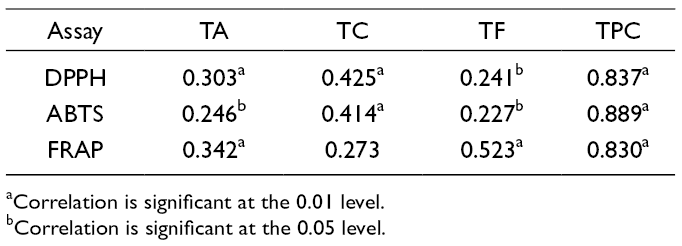
aCorrelation is significant at the 0.01 level.
bCorrelation is significant at the 0.05 level.
Cluster Analysis
Hierarchical cluster analysis was used to evaluate the collected samples of Chinese dwarf cherry. TA, TC, TF, TPC, and antioxidant activities from DPPH assay, ABTS assay, and FRAP assay were used as variables to establish hierarchical cluster analysis. Cluster analysis provided a dendrogram, and 28 genotypes were finally classified into 2 groups (cluster I and cluster II) with Ward’s method (Figure 5). There were 17 Chinese dwarf cherry genotypes falling into cluster I in which lower contents of TA and TPC were detected. Cluster II consisted of 11 Chinese dwarf cherry genotypes and was further divided into 2 sub-clusters, which were described as cluster II-1 and cluster II-2. Cluster II-1 contained 10 Chinese dwarf cherry genotypes, and TA ranged from 3.75 mg/100 g DW for No. 27 to 102.42 mg/100 g DW for No. 1. While TA of cluster II-2 (No. 20 517.92 mg/100 g DW) was the highest among all 28 samples. From pharmacological activity perspective, cluster II may be of greater value than cluster I.

The hierarchical cluster dendrogram of 28 Chinese dwarf cherry genotypes.
Conclusions
In this study, polyphenols in the fruits of Chinese dwarf cherry from Liaoning province were assessed using HPLC-DAD/HPLC-Q-TOF-MS. A total of 31 polyphenols, including 6 anthocyanins, 7 cinnamoylquinic acids, 1 flavone, and 17 flavonols, were identified, and these polyphenols provide scientific evidence for the medicinal value of Chinese dwarf cherry. Four genotypes, No. 6, 18, 20, and 27, showed higher TPC and antioxidant activities, and these 4 genotypes are good candidates for commercial processing into healthcare products. These results will enhance our knowledge of the chemical composition of the fruit of Chinese dwarf cherry and lay the foundation for the comprehensive utilization of Chinese dwarf cherry fruits.
Supplemental Material
Supplementary Material - Supplemental material for Analysis of Polyphenols Composition and Antioxidant Activity Assessment of Chinese Dwarf Cherry (Cerasus humilis (Bge.) Sok.)
Supplemental material, Supplementary, for Analysis of Polyphenols Composition and Antioxidant Activity Assessment of Chinese Dwarf Cherry (Cerasus humilis (Bge.) Sok.) by Qian Wu, Ru-Yu Yuan, Cheng-Yong Feng, Shan-Shan Li, and Liang-Sheng Wang in Natural Product Communications
Footnotes
Acknowledgments
We would like to thank Professor Liandeng Dou (Institute of Pomology of Chinese Academy of Agricultural Sciences) for providing the samples.
Declaration of Conflicting Interests
The author(s) declared no potential conflicts of interest with respect to the research, authorship, and/or publication of this article.
Funding
The author(s) declared no financial support for the research, authorship, and/or publication of this article.
References
Supplementary Material
Please find the following supplemental material available below.
For Open Access articles published under a Creative Commons License, all supplemental material carries the same license as the article it is associated with.
For non-Open Access articles published, all supplemental material carries a non-exclusive license, and permission requests for re-use of supplemental material or any part of supplemental material shall be sent directly to the copyright owner as specified in the copyright notice associated with the article.
