



Abstract

When I started in my role as Managing Editor of the Journal of Diabetes Science & Technology (JDST) middle of 2011, some 13 years ago, I had only limited insights into what this means in daily practice. David C. Klonoff and I exchanged many ideas when JDST was established as a fully electronic journal with a clear focus on diabetes technology.
In the following, I’ll describe (briefly) some of the lessons I have learned during the years; however, let me address at first the question why I’m stepping back and why now. The latter question is relatively easy to answer, I turned 70 years of age some months ago. I promised my wife (and myself) years ago that I’d cut down by obligations/working hours when reaching this “time barrier.” More seriously, when I talked with my old boss Michael Berger some decades ago about why he is stepping back as Editor of Diabetologia, his clear statement was, that journals should have new editors now and then, there is a need for new thoughts and fresh spirit. I acknowledge that I have certain topics that are closer to my heart than others, which has an impact on accepting manuscripts into the review process or not. Younger colleagues should take over, for them digitalization is a topic they have grown up with. They are also treating patients every day with novel diabetes technology products. In addition, journals should also take care of gender aspects more adequately.
Coming back to the workload. I have published 190 manuscripts in JDST over time (many also before I started as Editor), including several editorials, commentaries, and so on, while I acted as Managing Editor. The editorials (like this one) do cover a range of topics, sometimes they have tackled topics that are not mainstream, and at least two were focusing on the success of JDST itself.1,2 Editorials are a good chance to express your thoughts, criticisms, and so on, to highlight certain issues, and to push topics forward. When you are working on manuscripts you have no idea about how the numbers of publications sum up over time.
At such a point in time, it is a good option for me to reflect on this and which impact these publications—hopefully—have had on the impressive progress we all have seen in the area of diabetes technology in the last two decades. Diabetes technology is now one of the major pillars for the treatment of patients with diabetes, this also explains the success of respective conferences and other related journals.
The more important part of my work is the work I had with handling all the submissions to JDST, very much supported by the Editorial Office (see below). I have seen hundreds of manuscripts each year, with a quite significant increase over time, especially in the last few years (Figure 1). In total, we talked about well above 3,000 manuscripts that I had a look at.
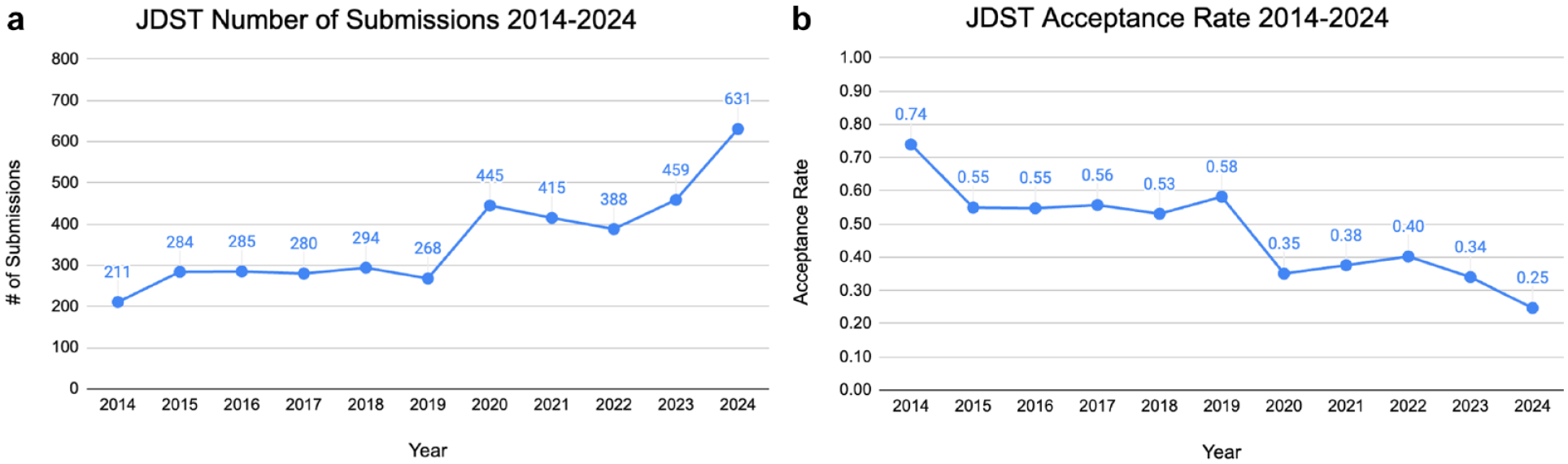
(a) Manuscripts that were submitted to JDST in the years from 2014 to 2024. The number of manuscripts submitted in the first six months of 2024 was doubled, assuming a similar submission rate for the second half of the year. (b) Decline of the acceptance rate of JDST in the years from 2014 to 2024. The number for 2024 is projected.
David took care of the organization of the Special Theme issues that we publish regularly in JDST, which cover quite a range of topics. In our opinion, the guest editors who handle the manuscripts for these issues do a great job and the contributions in these issues add a lot to the scientific literature.
Assessing all these manuscripts means endless hours in front of a notebook, my wife can tell you stories about this. I guess that in daily life I spent two to three hours per day (including weekends. . .) looking at the manuscripts, selecting reviewers, and reading the reviewer’s comments to make appropriate decisions. As an Editor, you feel obliged to handle every submission with sufficient focus and love. The increase in submissions in the last few years (especially after getting an impact factor) was not helpful in this respect. As a practical consequence of this increase in workload, in the future, more manuscripts will be handled not only by my successor as Managing Editor but also by other appointed editors.
It is of interest to note how many manuscripts that are submitted to JDST have nothing or very little to do with diabetes technology, which is the focus of our journal. In addition, many manuscripts are of such poor quality or not of interest to our readers (according to the beliefs of David and myself) that we have rejected them early on, that is, not forwarding them into the review process. Also, a portion of the manuscripts were rejected because of negative reviews by the reviewer (I assume that this is less than 10%). In summary, this has increased our rejection rate of manuscripts over the years to such an extent, that the acceptance rate is now 25%.
Most of the manuscripts that we receive are from authors who are located in the United States (in 2024 22.5%), followed by India with 10.2% Italy with 7.5%, and Germany also with 7.5%. When it comes to accepted manuscripts, 43.0% are from the United States, 15.2% from Germany, 7.6% from the United Kingdom, 6.3% from Australia, and 5.1% from Italy. In the last years for some reason, many of the rejected manuscripts are coming from South Asia and the Near East. It appears as if something has happened there in the last few years that makes a journal like JDST so attractive for colleagues in these countries, that we get many submissions. It might be worth to more systematically evaluate where all the manuscripts we are receiving are coming from (i.e., from which country),
Another interesting question is, what the main topics are that the manuscripts are dealing with, and how these have changed over time. Just as an example, on a topic that has changed a lot in the last 13 years, we do not receive many manuscripts that deal with blood glucose measurement systems anymore and also the acceptance rate of these has decreased drastically over the years. In contrast, we publish many manuscripts about systems for automated insulin delivery.
Another critical aspect is that I have the “feeling,” that the number of manuscripts written by AI has increased a lot in the last few years. When submitting a manuscript, the authors have to tick a box that asks specifically for this; however, it is not trivial to check if the response given is an honest one. We might have to establish more systematic measures to evaluate this topic in the future.
Let me apologize to all authors that I have disappointed over time by not accepting their manuscripts. We at the editorial office have tried to handle all manuscripts in due time, on average a first decision was made within 14 days (in 2024) and a final decision within 21 days. I think we have done a pretty good job with a mean turnaround time of 3 weeks; however, in some cases (let me blame some reviewers who did not send in their reviews in due time . . .), the response time was longer I acknowledge, sorry!
If you believe that numerous people are working at the editorial office of JDST, this is not the case. One or two editorial assistants and I have done most of the work, the publisher (SAGE) came into the game once the manuscripts were accepted for publication. Let me express my sincere thanks to all of the ladies in the Editorial Office (there were simply no men) I had the honor to work together with over the years. Their work is decisive for a smooth and adequate handling of all manuscripts.
We, David and myself, were somewhat disappointed about how slow and time-consuming it was to get an Impact Factor for JDST; however, we were quite pleased to see how high it was once it was issued. Just to mention it, the CiteScore of JDST has gone up continuously over the last years, from 5.4 in 2018 to 7.1 in 2021 and 7.3 in 2022. The JDST is also ranked quite high by SAGE in all the manuscripts this published has an overview about, it has ranked position 55 of the 232 manuscripts in Endocrinology, Diabetes, and Metabolism. To my understanding, this is also a reflection of the quality of work we have done over the last 15 years since JDST was established. One way to characterize quality is the number of full-text downloads of manuscripts from the JDST homepage at SAGE. This number was 617,105 in 2022, 669,520 in 20223, and 312,848 in the first four months of 2024.
One major time-consuming task for each Editor is to find reviewers. 3 On one hand, each scientist would like to get his work published after a fair and constructive review process, on the other hand, this requires that colleagues are willing to invest their “brain” in reading the manuscripts carefully and come along with constructive (!) comments. This is a good chance to express my sincere thanks (!) to all colleagues that I could convince over time to act as reviewers for JDST. Many of them are also members of the Editorial Board of JDST. I fully acknowledge that it is quite often a task you are getting little credit for and your benefit by learning something might also be limited in many cases. Nevertheless, it is impressive to see how the reviewers have done an excellent job, in well above 95% of the cases I would say. It is also interesting to see, how different reviewers interpret their job, some have responded with two lines only (especially with good manuscripts), while others have submitted twenty pages full of comments (no joke!), for a given manuscript (sometimes for the same manuscript. . .).
One of the reasons for me to resign as Managing Editor is my impression that—at least for me—it is getting more difficult to find reviewers. Many of my academic friends might have the feeling that I have asked them often enough and therefore decline my invitations to review manuscript xyz. Let me apologize for torturing you so often over the years! Many of them have grown older together with me and have already stepped back from academic/professional obligations. As an Editor, you have only limited time to stay in contact with current activities and projects, at the end, you don’t know the young and dynamic people well enough to convince them to be reviewers for JDST.
Let me make one point clear, most often when you submit a manuscript and get several comments from at least two colleagues you are frustrated and have the tendency to say, come on boys, you have not read the manuscript carefully enough, I have provided all the information you are asking for now. In truth, when reading your manuscript again (which holds for me as well), you have to acknowledge that most often they are right. In other words, in most (if not in all. . .) cases the reviews are helpful and an adequate handling of the comments helps to improve the quality of the manuscript considerably.
This brings me to another, sometimes tricky task, you have as editor: do you accept a given manuscript based on the reviews or do you reject it? Besides the recommendations made by the two reviewers and your view of the manuscript, you as editor have to take other considerations into account, for example, whether is this a timely manuscript that fits well into the journal, is the range of topics we present in JDST attractive for our readers, and so on. These are thoughts you already have when you had a first look at the manuscript and select potential reviewers; however, the comments of the colleagues in front of you sometimes change your mind. To be honest, sometimes it is shocking to see how critical the comments of colleagues are toward a given manuscript, which I regarded as interesting. My excuse is that you can’t be an expert in all areas of research, this is why you need colleagues covering quite a range of topics that are willing to act as reviewers. In case the reviewer recommends rejection of a given manuscript, we, that is, David Klonoff and I, discussed this before making a final decision. Over all these years and the many papers we have seen, it is impressive to reflect on how seldom (!) David and I were in disagreement, this happened only in a handful of cases.
Because of how much progress diabetes technology has made in the last 30 years and especially in the time I had the honor to be the Managing Editor of JDST, with a clear focus on the clinical outcome of patients with diabetes, I predict a great future for JDST!
In the end, I can only thank David Klonoff heart fully for the excellent cooperation over many years, and express my thanks to our readers for the good ride; however, enough is enough. No worries, I’ll remain close to JDST and wish my successor(s) also a good ride!
Footnotes
Acknowledgements
I thank David Klonoff for his excellent comments.
Abbreviations
AID, automated insulin delivery; PwD, people with diabetes
Declaration of Conflicting Interests
The author(s) declared the following potential conflicts of interest with respect to the research, authorship, and/or publication of this article: LH is a shareholder of the Profil Institut für Stoffwechselforschung GmbH, Neuss, Germany; Science Consulting in Diabetes GmbH, Düsseldorf, Germany; and diateam GmbH, Bad Mergentheim, Germany. LH is a consultant for several companies that are developing novel diagnostic and therapeutic options for diabetes treatment.
Funding
The author received no financial support for the research, authorship, and/or publication of this article.
