



Abstract

Introduction
Use of continuous glucose monitoring (CGM) devices is on the rise.1,2 Interestingly, in an analysis of the Food and Drug Administration Manufacturer and User Facility Device Experience (MAUDE) database, more than 25 000 complaints of CGM device inaccuracy have been filed. 3 We sought to determine whether glucose levels differ between the left and right arms.
Methods
We combined data from two prospective clinical trials that placed a CGM on generally healthy individuals between the ages of 18 and 65 years.4,5 Participants underwent simultaneous insertion of a FreeStyle Libre CGM sensor on each of the arms. The CGM sensor measured glucose concentrations from interstitial fluid every 15 minutes (10-14 days). Participants maintained their normal daily activities during the study.
The mean time-matched inter-arm difference in glucose levels and the differences in time below range (TBR, <70 mg/dL), time in range (TIR, 70-180 mg/dL), and time above range (TAR, >180 mg/dL) were assessed between the arms. All analyses were performed using the paired Student t test or Fisher exact test as appropriate.
Results
A total of 51 118 paired CGM measurements were analyzed incorporating a total of 54 unique participants (22 ± 6.7years, 81% female, 76% right arm dominant). Participants were primarily Asian or Caucasian (72% and 24%, respectively) with 4% of another race. All participants were healthy, except one individual who had diabetes. The mean difference between the time-matched left and right arms was 0 ± 1 minute (P = .998).
The mean glucose level in the right arm was significantly higher than the left arm by 3.7 ± 10.2 mg/dL (P < .001). The absolute difference between the left and right arm’s glucose value was 7.7 ± 7.6 mg/dL with 2.1% of the readings being different by ≥30 mg/dL. The right arm was higher than the left arm 66% of the time (by ≥1 mg/dL) and lower 29% of the time (by ≥1 mg/dL).
Glucose levels (Figure 1) were classified as TBR for 20.2% of the time in the right arm compared with 27.6% in the left arm (P < .001), TIR for 76.2% in the right arm compared with 69.1% in the left arm (P < .001), and TAR for 3.6% in the right arm compared with 3.3% in the left arm (P = .769).
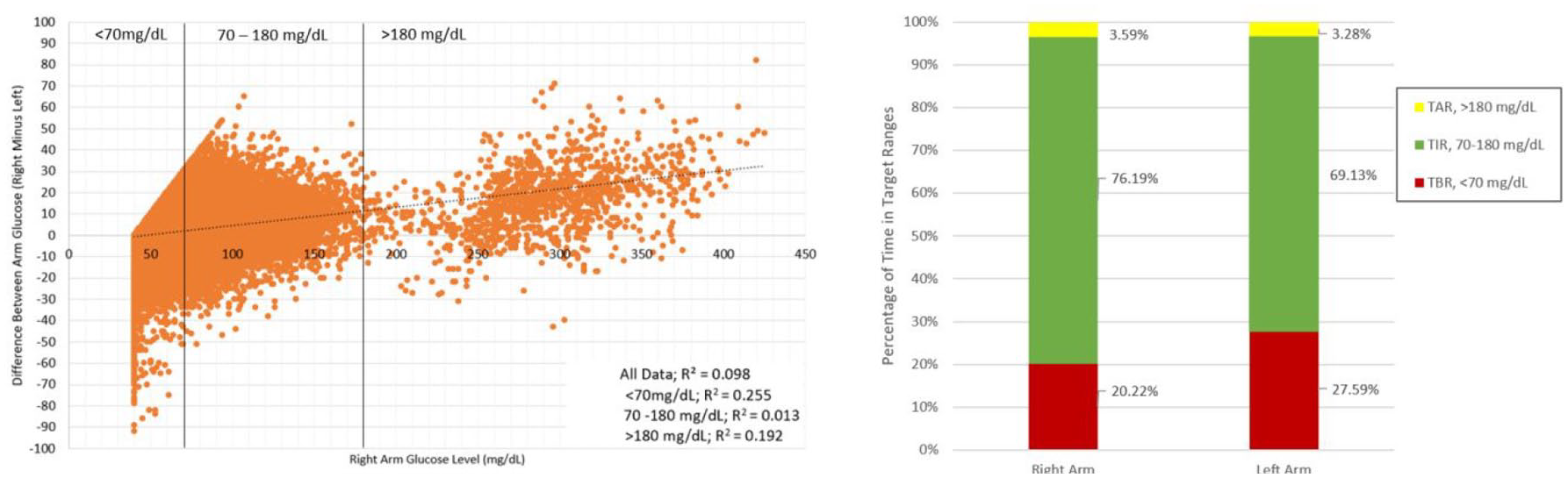
Difference between left and right arms; inter-arm glucose difference vs right arm glucose level (left); percent time in glucose target range (right). Abbreviations: TAR, time above range; TIR, time in range; TBR, time below range.
Discussion
The significant inter-arm difference in glucose values indicates arm selection with CGMs needs better understanding. A TBR/TIR difference of 7% between arms would translate to a difference in hypoglycemic duration of more than 1.5 hours in a day. These findings are important as the 2019 international consensus report, endorsed by the American Diabetes Association, recommended daily targets for TBR (<4% of day), TIR (>70% of day), and TAR (<25% of day) for patients with diabetes using CGMs.
The mechanisms explaining these inter-arm differences are unknown, but are likely not driven by arm dominance, or perfusion differences.4,5 Although the inter-arm glucose difference would generally not be clinically concerning in an acute setting, this degree of difference could change clinical trial study design and interpretation. Future studies are needed to evaluate the true clinical impact of these findings in patients with diabetes.
Footnotes
Declaration of Conflicting Interests
The author(s) declared no potential conflicts of interest with respect to the research, authorship, and/or publication of this article.
Funding
The author(s) received no financial support for the research, authorship, and/or publication of this article.
Abbreviations
CGM, continuous glucose monitoring; MAUDE, Manufacturer and User Facility Device Experience; TBR, time below range; TIR, time in range; TAR, time above range.
