



Abstract

Introduction
The first continuous glucose monitors (CGM) have been introduced more than 20 years ago and today multiple options exist. 1 These options consist of real-time CGM (rt-CGM) and intermittent CGM (iCGM) or Flash monitors. The rt-CGM measure the glucose levels continuously and can alert if a patient is moving toward a hypo- or a hyperglycaemic event. The iCGM, however, only show the glucose levels when the patient actively scans the device.
Multiple studies have shown that implementing CGM in routine clinical care has positive effects, regardless of the type of CGM. 2 The main benefit is that CGM show real-time glucose levels and fluctuation, thereby overcoming limitations of “old” metrics such as HbA1c and fasting glucose levels. However, despite recommendations, routine use of CGM in clinical practice remains scare. 3 A possible explanation for this is the fact that using and interpreting results from CGM remains difficult for health care practitioners. Furthermore, analyses of the data in clinical trials differ widely and are therefore difficult to generalize and use in clinical practice. 2
Recently, the American Diabetes Association (ADA) published a guideline on how to use CGM in daily practice. 3 To date, no tool exists that can easily and intuitively provide these data from CGM. Several statistical packages do exist that can assist in extracting data from the CGM (e.g., HbA1c, glycemic excursions).4,5 However, a major drawback of these packages is that the user needs to be familiar with programming and the output is often in mg/dL or %, making implementation and interpretation for clinicians that use other metrics difficult. Moreover, analyses packages of manufacturers are not insightful in how analyses are done and which algorithms are used.
Through this letter we wish to introduce the Continuous Glucose Data Analysis (CGDA) Package in the programming language R. This is an easy-to-use, free package that incorporates the ADA recommendations, has graphical output, and provides output in all commonly used metrics (i.e., glucose mmol/mol, mg/dL, and HbA1c % as well as mg/dL).
Methods
The CGDA package has been forked from the open source package “cgmanalysis,” 4 and supports glucose data from all CGM. The complete R package can be found on GitHub (https://GitHub.com/EvdVossen/CGDA), making it modifiable for users that want to change certain threshold values. GitHub also contains a step-by-step guide on how to install and run the package, with an example data set. Moreover, this information can also be provided directly by the corresponding author.
Results
The output of the CGDA package is a CSV/Excel file with summary statistics (Table 1). The files can be presented as individual subjects, or as groups. The package will also provide an output using the ADA Time-In Range criteria, which are particularly useful when studying a diabetic cohort.
Output of Summary Measures by the CGDA Package.
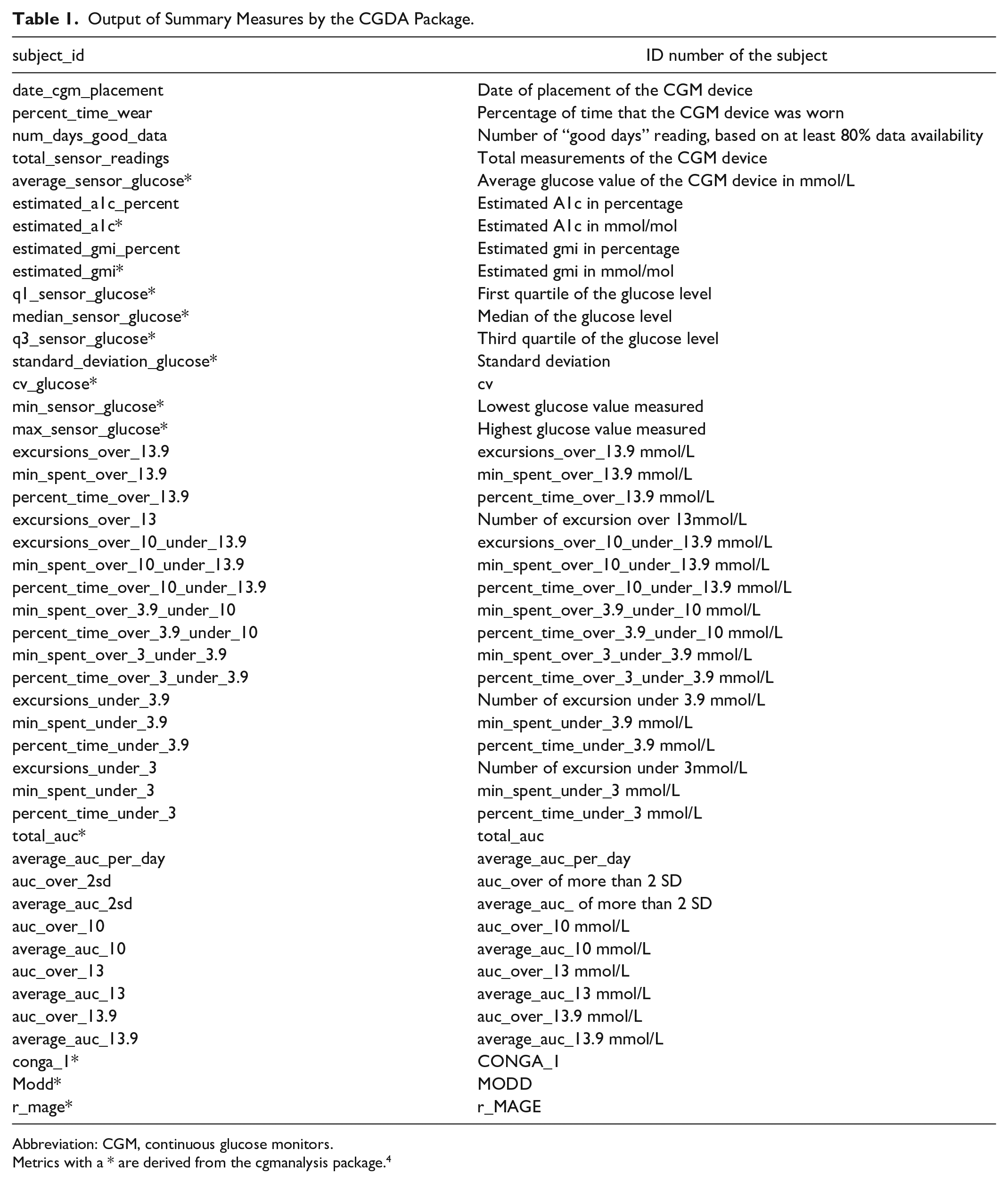
Abbreviation: CGM, continuous glucose monitors.
Metrics with a * are derived from the cgmanalysis package. 4
Conclusion
The CGDA package offers a simple and intuitive function to analyze data from CGM, regardless of manufacturer. The CGDA provides graphical output and summary statistics making classical parametric and nonparametric testing feasible. The CGDA package can provide a basis for clinicians and researchers in standardizing the methods in which CGM data are analyzed.
Footnotes
Abbreviations
ADA, American Diabetes Association; CGM, continuous glucose monitors; iCGM, intermittent continuous glucose monitors; rt-CGM, real-time continuous glucose monitors.
Author Contributions
I.A., E.W.J.v.d.V., and D.N.M.B. wrote the script and the first draft of the manuscript. M.N. and E.L. coordinated the project and helped finalize the manuscript. All authors have read and approved the final version of the manuscript.
Declaration of Conflicting Interests
The author(s) declared no potential conflicts of interest with respect to the research, authorship, and/or publication of this article.
Funding
The author(s) disclosed receipt of the following financial support for the research, authorship, and/or publication of this article: I.A. is supported by a JPI MICRODIET Grant (5290510105). E.W.J.v.d.V. is supported by a CVON consortium grant INCONTROL 2 (2018-27). M.N. is supported by a ZONMW-VICI grant 2020 (09150182010020).
