




Abstract

Type 2 diabetes self-management education (DSME) is widely accepted as an integral aspect of type 2 diabetes care associated with clinically meaningful improvements in health outcomes. 1 However, healthcare reorganization and social distancing necessitated by the COVID-19 pandemic have seen face-to-face DSME mostly cease. Massive open online courses (MOOCs) provide a high-volume, low-cost DSME delivery mechanism compliant with social distancing guidelines.
In response to the COVID-19 pandemic, we developed and delivered a free MOOC in type 2 DSME over two days in April 2020. 2 Just under 1000 users participated in the MOOC with approximately two-thirds completing it fully. Initial evaluation found the social learning environment provided by the MOOC to be user-friendly, engaging, and motivating. Two hundred and twenty-two participants with type 2 diabetes consented to and provided details for recontact aiming to help establish medium-term impact of the MOOC, and herein we share the findings from our six-month follow-up survey.
Participants were invited to participate in a follow-up survey six months post-MOOC via email invitation. One hundred and thirty responses were received (response rate 59%, see Table 1); 58% of respondents agreed that they had made a sustained change in their diabetes self-management following the MOOC, and 71% agreed their self-management confidence had improved. Seventy percent of respondents felt they had made progress toward achieving the self-management goal(s) they self-assigned during the MOOC. Users were asked in the pre-MOOC, post-MOOC, and follow-up survey to rate their agreeableness to the statements “I know enough about my health” and “I manage my diabetes well,” and 87 and 85 respondents had matched responses available in all surveys for each statement, respectively. A statistically significant improvement in median response from neutral to agree for statements “I know enough about my health” and “I manage my diabetes well” was observed between responses between the pre-course versus post-course survey (P < .02 and P < .005, respectively) and pre-course versus follow-up survey (P < .001 and P < .001, respectively). Eighty-two percent of respondents agreed they would benefit from further online DSME. Respondents were invited to leave free-text feedback; many voicing appreciations for the MOOC with some providing anecdotal reports of weight loss following lifestyle change attributed to the MOOC. Where weight loss was quantified by respondents, there were examples of substantial weight loss that should align with significant metabolic changes (eg, “I have lost 1 stone and 9 pounds at a steady rate since end of April. . . My blood sugar level has gone down to a prediabetes level and target is full remission. Thanks!”).
Results Summary.
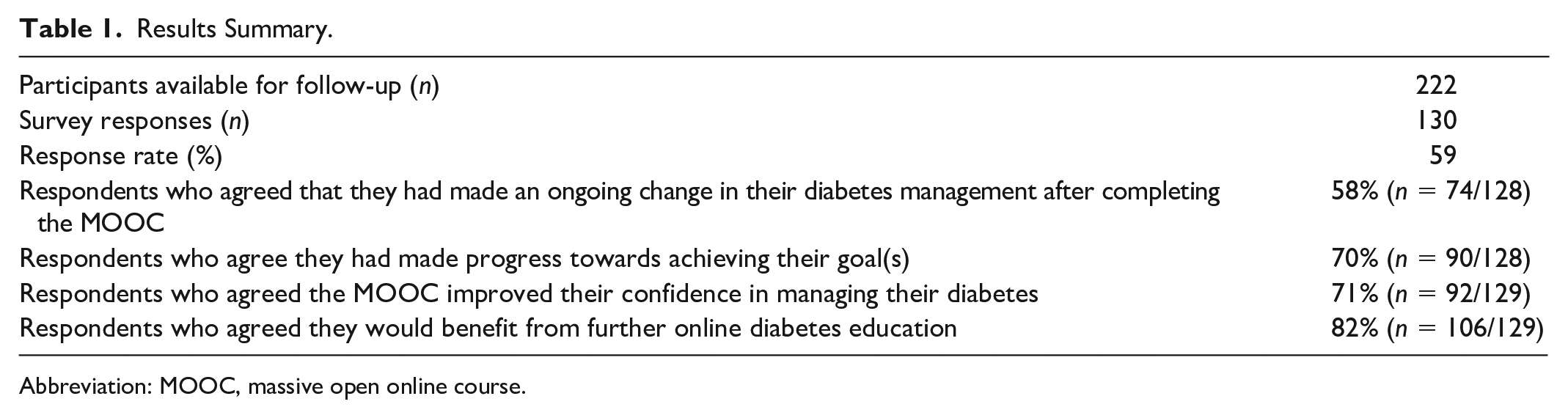
Abbreviation: MOOC, massive open online course.
Our MOOC follow-up survey at six months found most participants with type 2 diabetes made ongoing changes to their diabetes self-management and made progress toward achieving their self-assigned goal(s) with improved confidence in their self-management. In this motivated cohort, we found a sustained improvement in self-reported health knowledge and self-management ability at six months following MOOC completion. These findings support this MOOC as a successful DSME intervention that may prevent COVID-19 lockdown-related self-management deterioration; however, additional evaluation regarding diabetes outcomes (HbA1c, BMI) is required to establish true impact, particularly if digital DSME solutions are to displace face-to-face interventions in future.
Footnotes
Abbreviations
DSME, diabetes self-management education; MOOC, massive open online course
Declaration of Conflicting Interests
The author(s) declared the following potential conflicts of interest with respect to the research, authorship, and/or publication of this article: SCM, KMC, DG, DB, and SGC are employees of MyWay Digital Health Ltd. DJW and SGC are cofounders and shareholders of MWDH.
Funding
The author(s) disclosed receipt of the following financial support for the research, authorship, and/or publication of this article: This work was funded by MyWay Digital Health Ltd.
