




Abstract

The lifetime risk of developing a foot ulcer in patients diagnosed with diabetes mellitus (DM) is estimated to be 15%, 1 and the risk of recurrence is approximately 40% at one-year. 2 Because of the enormous psychological, physical and financial burden of diabetic foot ulcers (DFUs), a strong emphasis has been placed on the prevention of DFUs in high-risk individuals, including those with a past history of a DFU, peripheral neuropathy, or foot malformations (eg, Charcot deformity). 3 Conventional preventative measures include patient education on proper foot care, frequent surveillance by healthcare providers, and use of proper footwear. 1 Despite this emphasis on prevention, recent evidence suggests that nontraumatic lower extremity amputations, which result in permanent disability for patients with DFUs, are increasing after nearly two decades of decline. 4
Recently, there has been a strong interest in the use of self-monitoring devices for improving DFU prevention. Several wearable and smart home objects are being designed to detect early signs of ulcer formation. 5 Patient adherence to any monitoring device has been shown to be critical for the prevention of DFUs in many studies. 6 However, there is a paucity of literature assessing the willingness of patients to initially acquire and adopt wearable devices for avoiding DFU formation.
We evaluated whether high-risk patients with diabetes are willing to implement wearable technology to prevent DFU formation. We analyzed patient interest around advancing wearable technology through an anonymous, voluntary survey. Adult diabetes patients18 years or older with a history of peripheral neuropathy, foot deformity, and those with and without DFU who presented to a tertiary care center were included. Surveys were performed consecutively. All research activities for this study were deemed exempt from ethical review by the institutional review board at University of Michigan Medical School.
Descriptive statistics were calculated to describe survey responses. We used t-tests and chi-square tests to compare the responses of diabetes patients with and without DFUs. One hundred forty-nine patients met the inclusion criteria for this study. One hundred patients completed the questionnaire, a response rate of 67%. Fifty-four patients had a history of a previous DFU, while 46 patients had no history of previous ulceration.
Patients with no history of a prior DFU were significantly more interested in preventing foot ulcers (P = .003) when compared to those with a prior history of a DFU (Figure 1). Patients without a history of ulcer formation were significantly more likely to obtain a self-monitoring device compared to patients with a prior history of a DFU (86.97% vs 68.52%, P = .02) Overall, our findings support including advanced self-monitoring technology in DFU prevention because it has strong potential for adoption among high risk patients with diabetes. Our results suggest that diabetes patients with no history of a prior DFU are more motivated to prevent foot ulcers and more likely to adopt technologies. Therefore, we recommend that healthcare professionals focus on early adoption of technologies for ulcer prevention in patients who lack a history of a prior DFU. However, since home-monitoring devices are most efficacious in those with a history of a previous ulcer, healthcare professionals should develop strategies to better educate these high-risk patients, to hopefully improve adoption rates of these new ulcer-prevention technologies.
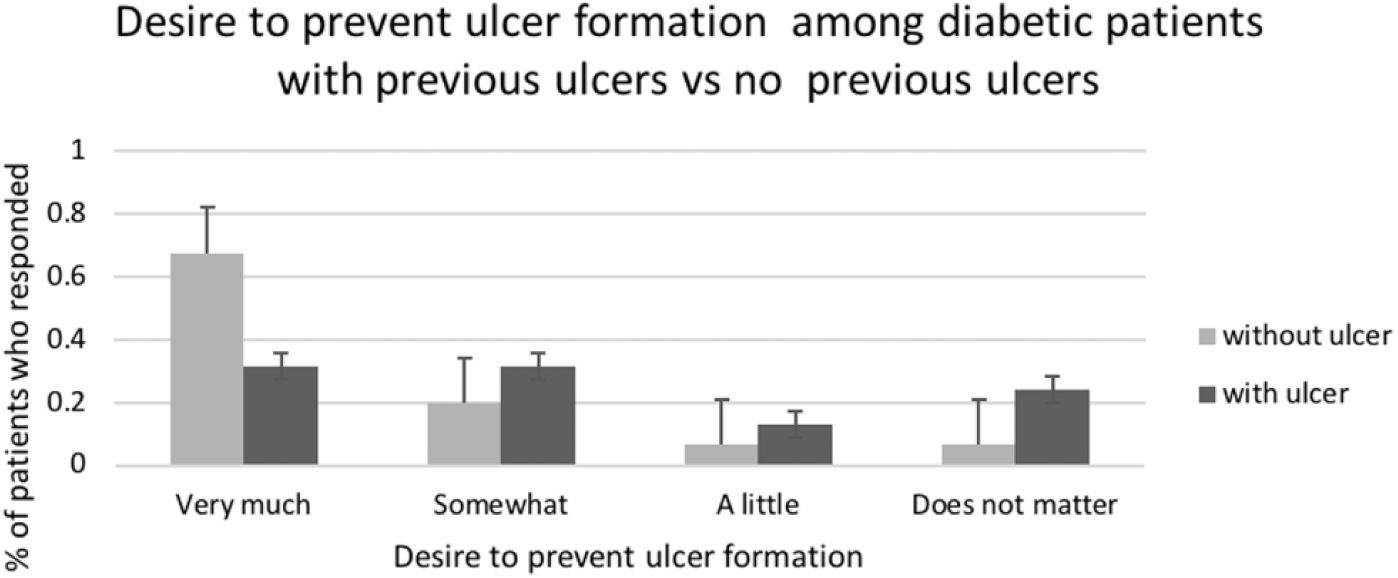
Responses from diabetes patients with and without a prior history of a DFU about how much they “wanted” to prevent an ulcer. *P < .05.
Footnotes
Abbreviations
BMI, body mass index; DFU, diabetic foot ulcer; DM, diabetes mellitus.
Declaration of Conflicting Interests
The author(s) declared no potential conflicts of interest with respect to the research, authorship, and/or publication of this article.
Funding
The author(s) received no financial support for the research, authorship, and/or publication of this article.
