



Abstract
This study uses content analysis to explore the way a news organization's norms and expectations is tied to video production style and extends Rogers's Diffusion of Innovations theory. The study compares the current online video production styles from legacy print, legacy TV, and digital native news organizations based in the United States. Over time, while these organizations have converged into one screen for viewers, their differing organizational histories, traditions, and norms affect the way they produce video news. The analysis found legacy print organizations continue to produce slower-paced videos without scripted narration; TV organizations use scripted narration with one correspondent; and digital natives produce stories with quick pacing and a mix of narrator types. Diffusion of Innovations theory helps to explain why these organizations offer distinct production styles that are not converging in form.
Early in the digital age, disparate newsrooms hoped to adapt with convergent strategies, with print and TV organizations joining forces with the goal of producing multimedia news (Klinenberg, 2005; Singer, 2003). Many of those experiments faltered, as it became clear that technology alone cannot unite organizational purpose, and that economic, institutional, and cultural factors affect news practice (Singer, 2003; Thornton & Keith, 2009). Yet because of its popularity and profit-potential, the pressure to produce video continues, no matter the platform (Benes, 2017; Thurman & Lupton, 2008). As one TV executive put it, “it's just going to be video” (Wenger, 2022, p. 56).
Different types of news organizations may share the same screen, but early in the digital age, they did not embrace the production affordances of video technology in the same way (Kalogeropoulos & Nielsen, 2018). TV organizations have been creating filmic or video stories for decades, but newspaper organizations only started to produce video in the early 2000s—and they set out to create a video form all their own (Bock, 2012a). Without ties to legacy media, the digital native news organizations that arrived shortly thereafter, such as The Huffington Post in 2005 (Stelter, 2008) and Vox in 2014 (Vox Staff, 2017), are free to develop a style of their own (Kalogeropoulos & Nielsen, 2018).
A majority of Americans receive news from a phone or tablet, and that number is expected to rise (Forman-Katz & Matsa, 2022). The look and feel of news in terms of graphic presentation is converging, as designs for different organizations have been found to be similar (Cooke, 2005). Video is unique for its reflection of stylistic and narrative choices. Our study was designed to carefully examine whether news organizations are converging stylistically or “staying in their legacy lanes.” We compared the production choices of three types of institutions: those with a newspaper tradition (legacy print, LP for short), TV news organizations (TV), and digital natives (DN). The findings extend Rogers’s (2003) Diffusion of Innovations theory (DOI), which helps explain why the same technology might be deployed differently across organizations.
Review of the Relevant Literature
The form of news matters, not only for the way it cultivates user engagement, but for its relationship to news practice (Barnhurst & Nerone, 2001). News form, in terms of material production and narrative, is a product of technological affordances, political-economic realities, and social-organizational systems (Barnhurst & Nerone, 2001). DOI helps explain the way those same realities might affect the way an organization makes production choices (Rogers, 2003).
Diffusion of Innovations Theory
Rogers (2003) used the phrase “diffusion of innovations” to describe a sociological process of change. He argued that new ideas and technologies are introduced through channels over time and are either adopted or rejected. He identified five innovation characteristics that influence the rate of adoption:
Relative advantage: favorability and difference compared to present technology; Compatibility: fit with adopters’ current values, needs, interests, and experience; Complexity: the cognitive effort needed to learn about and use an innovation; Trialability: a period of familiarization, practice, and experimentation with an innovation to make commitment judgments; and Observability: the ability of adopters to recognize changes and stimulate visible results in and outside the organization.
Innovations are adopted more quickly when these characteristics are viewed favorably by implementers (Dickerson & Gentry, 1983; Zaitseva, 2019). This is important for considering technology in journalism, as an innovation might conflict with historic core news values, norms, and standards (García-Avilés et al., 2019). Journalists who decide to change may co-opt innovation to extend their routines and ideals (Lewis, 2012). For instance, Puijk et al. (2021) found journalists in Norway resisted the additional work posed by video and other technologies. Singer (2004a, 2004b) noted existing organizational demands do not go away when an innovation like video production is adopted, and journalists may perceive such change as additional work. Deuze (2004) and Boczkowski (2004) found journalists prefer online practices that adhere closely to traditional routines. Assaf (2021) found video's diffusion in newspaper organizations has been hampered by its steep learning curve and an ethos that favors word over image.
Video News Narrative
News narratives are distinct from other types of storytelling in part because they use a recognizable form to establish journalists as reliable arbiters of reality (Ben-Porath, 2007; Epstein, 1973; Schudson, 2003). Journalistic conventions, such as quoting practices, third-person declarative voice, and references to eyewitnessing, are among the linguistic tools journalists use to construct their authority (Bell, 1991; Zelizer, 1995, 2007). Visual journalism's authority is established by the camera's recording of reality and journalistic witnessing (Zelizer, 2005). TV news uses a journalist's narration to contextualize images and efficiently recount events (White, 2005; Zettl, 2011), but this is not the only way to tell a visual story. Many newspaper organizations have chosen to let stories unfold without a reporter track, in part to distinguish their work from TV news and in part to offer a richer visual experience (Bock, 2012b). Cummins and Chambers (2011) found production choices are not merely esthetic, for something as mechanical as high resolution can be seen as more credible by an audience. Quality production matters, too, as poorly constructed videos are a turn-off for many viewers (Chen et al., 2017).
Digital video offers nearly unlimited layers of sound and image. The editing process is no longer linear; a producer can work on the middle of a story, return to the start, and move around as needed (Dancyger, 2007). Sports and entertainment producers led the way with advances in editing techniques for TV, largely influenced by the once revolutionary cable channel MTV, known for fast edits, multiple perspectives, and camera moves (Beatty, 2016; Caldwell, 1995). MTV's impact seems to have moved even to news, as research has found broadcast news to employ shorter soundbites and more frequent appearances by on-air presenters (Barnhurst & Steele, 1997; Grabe & Bucy, 2011). The average shot in TV news is less than 5 s (Leetaru, 2019) and broadcast students are taught that shots of 3-to-5s are standard (Rosengard, 2012). In terms of content, researchers have found news in all modes has become “softer” or less event-driven, devoted to lifestyle topics, and presented in simpler ways (Boczkowski, 2009; Hamilton, 2011; McManus, 1994).
Video Production Diffusion
In the early 21st century, when newspapers were compelled to add video to their websites, some organizations tried to do this by combining print and TV operations (Gordon, 2003; Quinn, 2004; Wallace, 2009). These efforts evolved into the attempted physical and cultural convergence of newsrooms (Ketterer et al., 2004; Singer, 2004a, 2004b). Most efforts proved fruitless, failed, or were given up (Madigan, 2016; Thornton & Keith, 2009; Wiles, 2015). Silcock and Keith (2006) noted journalists from these camps could barely speak each other's professional language. Journalists were pressured to learn new technological skills and adopt new routines, but often resisted (Boczkowski, 2005; Deuze, 2007a, 2007b). When forced to make the transition, photographers and reporters in print organizations embraced a form that contrasted with television, one without scripted narration that appealed to journalists averse to performing as news presenters (Bock, 2012a).
TV newsrooms have faced less disruption in the digital age yet are compelled by multifaceted competition to embrace social media and digital streaming (Papper, 2011). Many newsrooms have hired multimedia journalists to produce stories individually instead of collaboratively, which saves money and in some cases allows for more assignment flexibility (Perez & Cremedas, 2014). The format of a traditional TV story, or “package,” remains largely unchanged (Cummings, 2014). The pace of production for TV news is much faster than with other platforms, and journalists are expected to efficiently produce daily, often event-driven content (Wenger & Owens, 2013).
Organizations that Hurcombe et al. (2019) described as “born digital” were free to invent their own storytelling forms (Kalogeropoulos & Nielsen, 2018). Digital natives adhere to traditional news values (García-Perdomo & Magaña, 2020), yet recognize the unconstrained opportunity presented by online channels, thus more easily adapting and refabricating journalism practices (Deuze, 2006; García-Avilés, 2019; Nee, 2013). Studies have found DN sites are more likely to incorporate social media elements such as tweets or Instagram posts, rely on curation from other organizations, and develop unique forms such as “listicles” to grab and hold attention (Hurcombe et al., 2019; Tandoc & Foo, 2018; Tandoc & Jenkins, 2017). Studies of DN sites suggest their emerging form borrows from legacy media while also taking advantage of digital affordances (Thomas & Cushion, 2019). Beatty (2016) identified a nontraditional video format typical for DN, marked by a less linear, even disjointed narrative. Canella (2018) found TV organizations are more likely to use vertical video now that clips from smart phones are often incorporated into stories. Even jump cuts—abrupt edits within action, once considered “mistakes”— have become acceptable with the growth of vlogging (McMullan, 2021).
All news organizations are challenged by today's economic disruption (Ferrucci & Perreault, 2021). Staff are spread thin, pursue too many projects with short-term goals, and struggle to receive proper leadership, resources, and training (García-Avilés et al., 2019; Micó et al., 2013). Video continues to offer a revenue remedy, especially because it is attractive to a younger audience (Berthelsen & Hameleers, 2021). Decades into the new century, as more Americans receive news from phones and tablets, are news videos converging in form, or do they continue to reflect legacy practices?
Hypotheses
The DOI theory suggests that traditions and norms will shape the way organizations make use of technological affordances. This, along with our review of research on video production styles and trends, suggests several sets of predictions for the sample. Our first set of hypotheses proposes that digital native video news will reflect an “MTV” style as described by Beatty (2016) in that:
Hypothesis 1: DN stories will be less timely compared with LP or TV.
Hypothesis 2: DN stories will make greater use of music than LP and TV.
Hypothesis 3: DN will use more unconventional editing techniques than LP or TV, such as
Hypothesis 3a: vertical video; Hypothesis 3b: repeated shots; Hypothesis 3c: jump cuts within a sound bite.
Previous research on pacing (Leetaru, 2019; Rosengard, 2012) prompts the following:
Hypothesis 4: DN stories will be longer than LP and TV stories.
Hypothesis 5: The pacing of LP stories will be slower than TV stories.
Hypothesis 6: LP stories will use longer stretches of natural sound than TV stories.
Research on digital media culture (Deuze, 2006) suggests that production will be more collaborative and diffuse, which can be hypothesized as:
Hypothesis 7: DN will use more participatory production options, such as:
Hypothesis 7a: user-generated media; Hypothesis 7b: social media elements; Hypothesis 7c: stolen shots.
Hypothesis 8: DN will use more multimedia elements such as:
Hypothesis 8a: still photos; Hypothesis 8b: multiple still photos such as montages, or full-screen graphics.
Method
To test these hypotheses, we designed a content analysis to compare stories from three organizational types: LP, TV, and DN, coding them according to a set of dimensions that reflect visual storytelling decisions.
Sampling
We collected a stratified sample from the three organizational types during the week of October 5, 2020. Because we focus on form, not content, we did not use a constructed week and chose this week in part for the sake of convenience and also because it did not coincide with any major national stories, disasters, or election coverage (Hester & Dougall, 2007; Riffe et al., 1993). A G*Power analysis demonstrated that adequate statistical power = 0.70 could be achieved with a minimum sample of 129 stories gathered from three independent groups. We opted to select 50 stories from each group for the sake of statistical confidence.
Newspaper organizations. We randomly selected 25 LP sites from the Alliance for Audited Media's list of the 100 largest newspapers by circulation (McIntyre, 2017). We first searched for local video news on an organization's homepage. If that failed, we used the site's search engine using terms such as “video,” “multimedia,” “watch,” and “see.” Sometimes it was necessary to use YouTube to search for an LP's local news videos, as they were occasionally hard to locate on LP websites. We downloaded two stories per organization.
TV news organizations. We started by identifying markets, randomly selecting 25 of the top 100 TV markets according to Nielsen Designated Market Area (DMA) data, which ranks based on the number of viewing households (Nielsen, 2021). We then identified stations producing news and selected the first station in each DMA as listed on Station Index, an online directory of all local broadcast channels (Top 100 Television Markets - Station Index, n.d.). Stations atop the list in each market have the lowest channel number, and generally have the longest history and news operations. We downloaded two of the most recent featured news videos from each station's website.
Digital native organizations. The population for DN outlets is smaller, so we randomized a list of 37 DN news organizations compiled by the Pew Research Center (2019). Sites from that list devoted to gaming and movies were pulled from the sample, and our final DN list included 10 sites devoted to news, far fewer than LP and TV outlets. Consequently, we “dipped” more often into these sites and downloaded five videos per DN organization.
Codebook Development
Three coders worked with a codebook that underwent multiple iterations and revisions during a training period until acceptable intercoder reliability on separate samples of stories could be achieved using Krippendorff's alpha (Hayes & Krippendorff, 2007). One variable, “hard and soft news,” was included for its indirect reflection of production technique, as daily deadlines can be expected to shape production choices. All other variables in the codebook pertained directly to form, such as narration scripting, editing, pacing, and jump cuts. The relevant variables and their K-alphas are provided in Table 1
Reliability Coefficients for Study Variables.
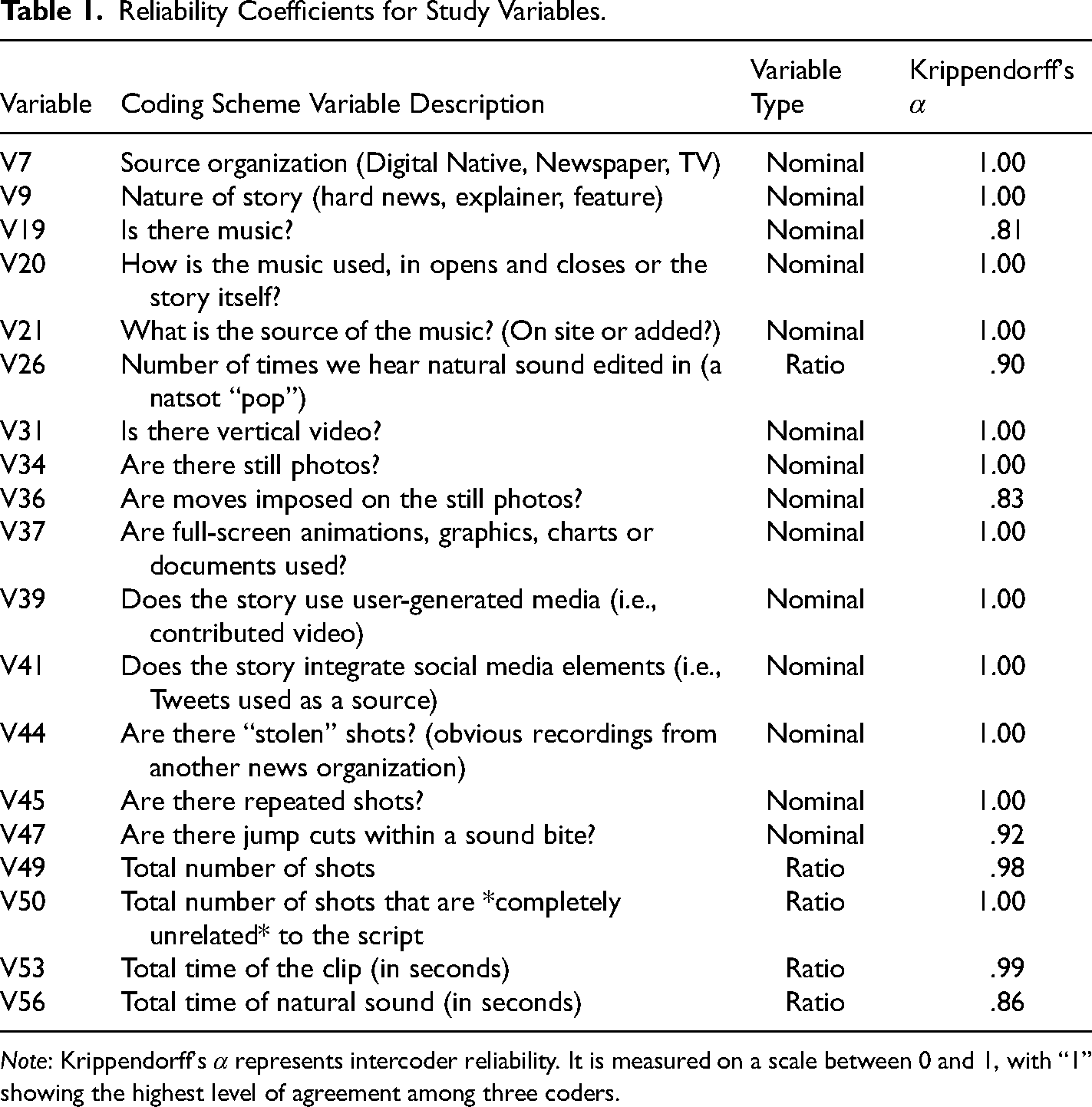
Note: Krippendorff's α represents intercoder reliability. It is measured on a scale between 0 and 1, with “1” showing the highest level of agreement among three coders.
Results
The sample revealed a wide range of production styles. Sampled stories included everything from raw police cam video to longer, highly produced stories with multiple musical interludes. Many DN stories were what journalists call “backgrounders” or explainer stories, such as a mini documentary (just under 13 min) from Vox about a Uranium mine on Native American land. The DN sample posted extended feature stories, too. For example, the entertainment website TMZ posted an 18 min montage of the way TikTok users danced to one popular musical riff.
The content analysis suggests that the three types of organizations each offer a distinct video storytelling style. As DOI would predict, organizations use digital affordances in ways that reflect organizational values and their ability to re-tool their practices (Puijk et al., 2021; Rogers, 2003). As previous research has found (Bock, 2012b) that LP organizations tend to post subject-driven videos without scripted narrative, while TV organizations copy reporter packages straight from newscasts to the web. DN organizations are forging their own way, and the content analysis offers details about their fast-paced, presenter-centric, entertaining narrative form.
Style and Substance
Research suggests digital culture is influenced by an “MTV” style, with more entertaining or soft stories, music use, and unconventional editing. Hypothesis 1 predicted DN news would be less timely. Feature and explainer stories contrasted with hard news stories as markers of “timeliness.” Two stories with an undefined story form, marked as “unknown,” were excluded from the dataset to satisfy accuracy of a chi-square test of independence. DN stories were significantly less timely than those posted by LP and TV organizations, Χ2 (4, N = 148) = 49.53, p < .05, Cohen's W = .58. Hypothesis 1 was supported. See Table 2 for chi-square results.
Chi-Square Results for H1, H2, H3a, H3b, H3c, H7a, H7b, H7c, H8a, and H8b.
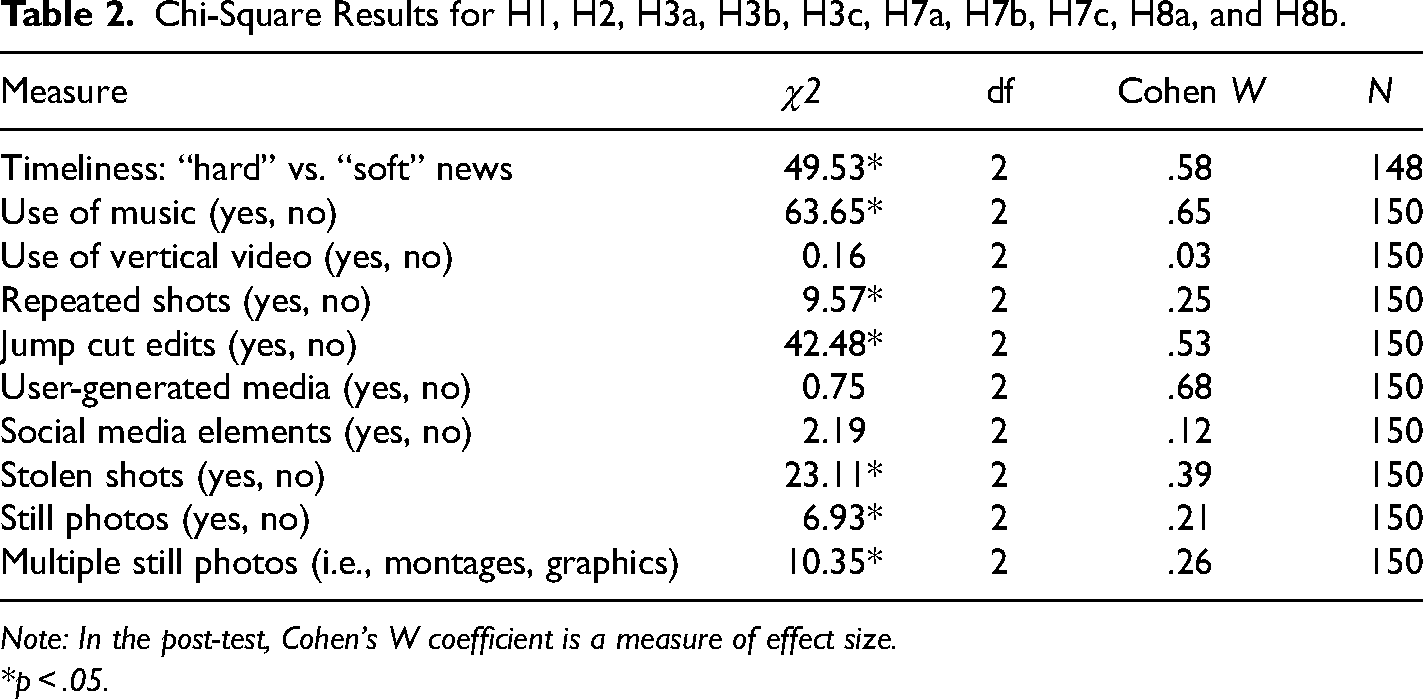
Note: In the post-test, Cohen's W coefficient is a measure of effect size.
*p < .05.
Hypothesis 2 predicted DN stories would make greater use of music. DN used music more than LP and TV, Χ2 (2, N = 150) = 63.65, p < .05, Cohen's W = .65. Hypothesis 2 was supported. To a significant level, DN organizations added music often and throughout stories, usually as a “bed” under an entire video.
Hypothesis 3 predicted DN would use more unconventional editing elements. Three chi-square tests of independence measured whether there were relationships between organizational type and use of vertical video (H3a), repeated shots (H3b), or jump cuts within a sound bite (H3c). There was no significant difference among the organization types in their use of vertical video (H3a
Temporal Elements
The literature suggests story length, pacing, and use of natural sound will vary according to norms for LP, TV, and DN organizations. A one-way analysis of variance (ANOVA) tested the relationship in each instance. Hypothesis 4 predicted DN would naturally take more advantage of the web's atemporality and post longer stories than LP and TV
Descriptive Statistics for Editing Conventions (N = 150).
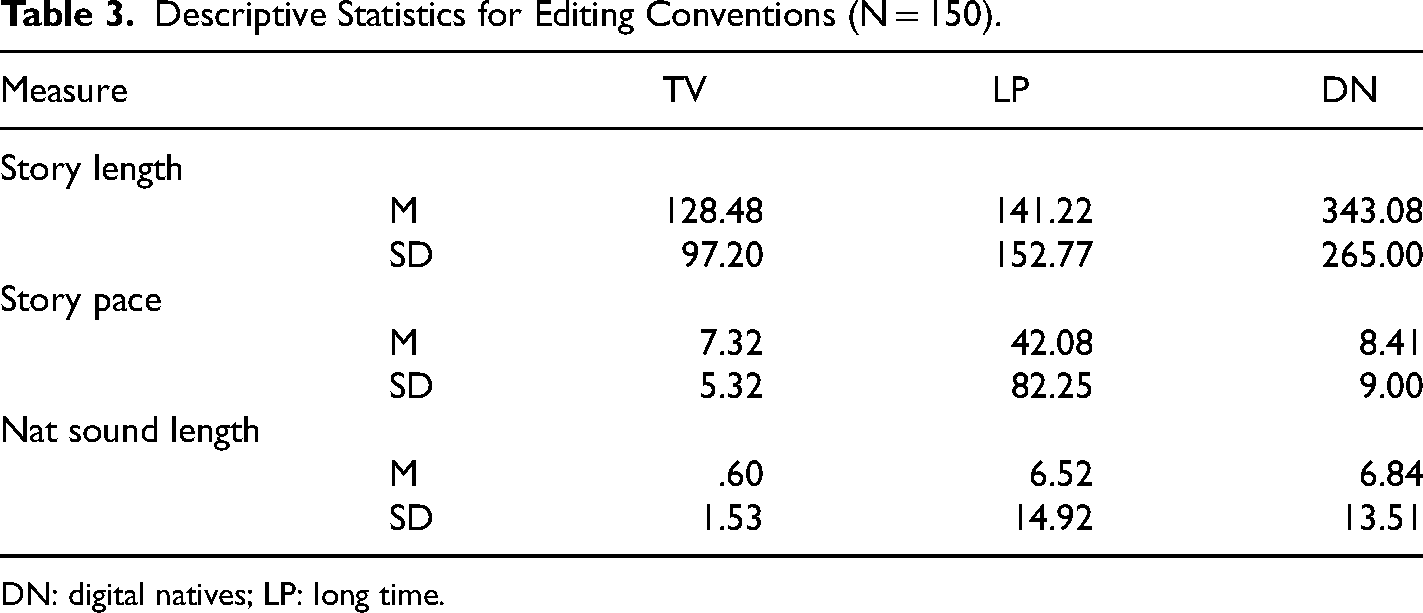
DN: digital natives; LP: long time.
Univariate Analysis of Variance for Editing Conventions.
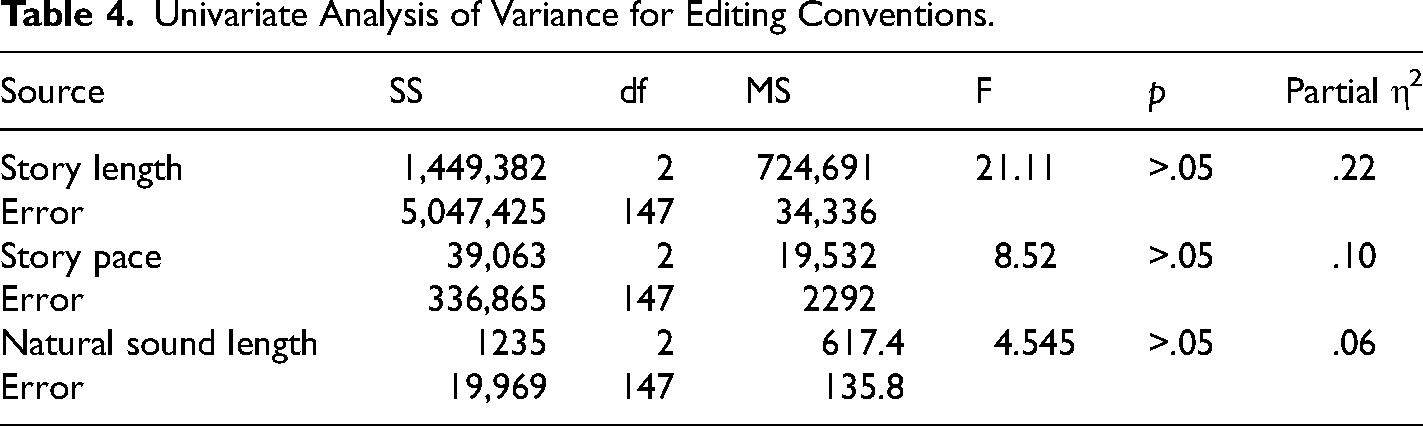
Mean Squares on Dependent Variables for News Organization Types.
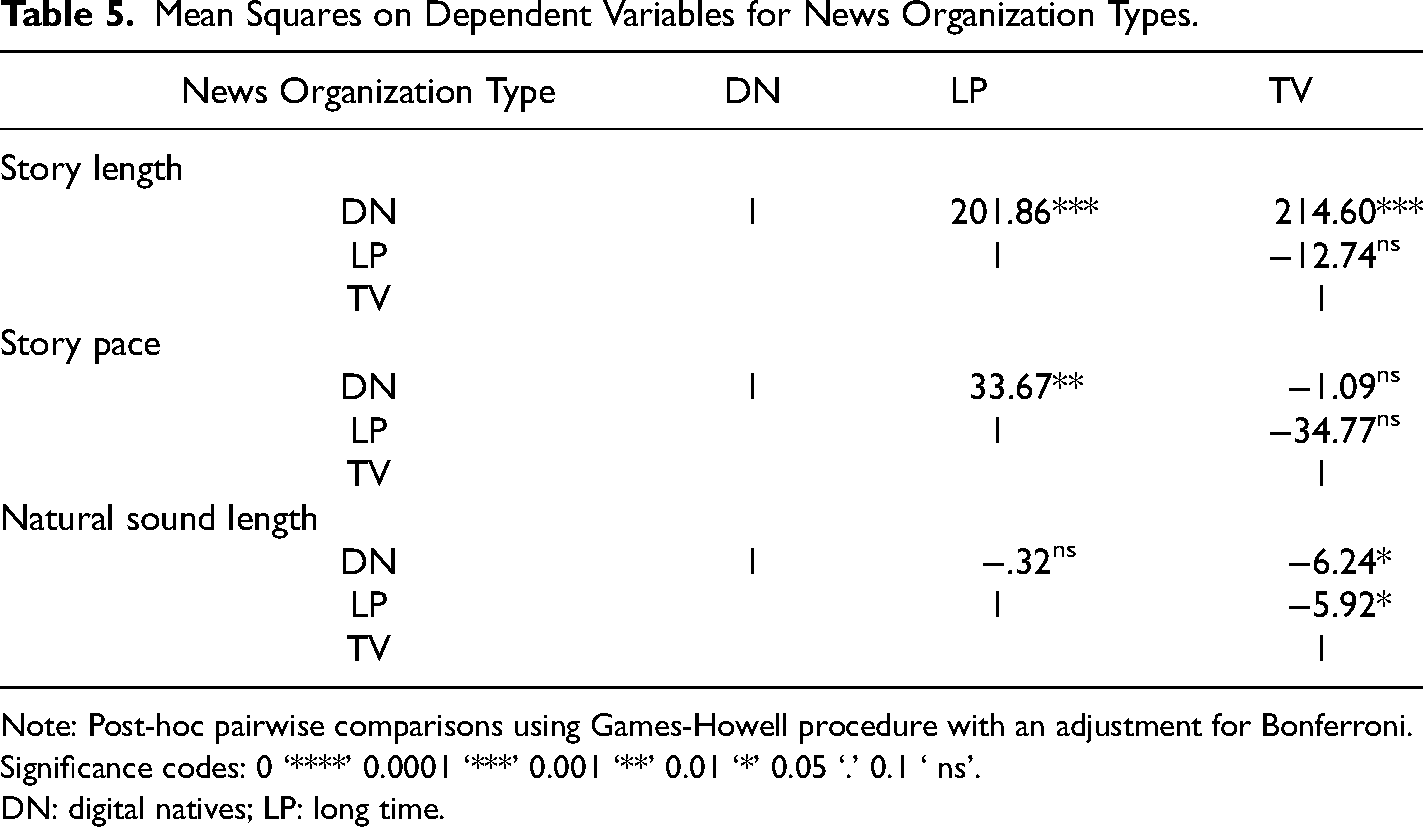
Note: Post-hoc pairwise comparisons using Games-Howell procedure with an adjustment for Bonferroni.
Significance codes: 0 ‘****’ 0.0001 ‘***’ 0.001 ‘**’ 0.01 ‘*’ 0.05 ‘.’ 0.1 ‘ ns’.
DN: digital natives; LP: long time.
Hypothesis 5 predicted LP stories would be slower paced than TV, as measured by a longer average shot time in seconds. That relationship was significant with the average LB shot length (M = 42.08; SD = 82.25), F (2,147) = 8.52, p < .05, partial η2 = .10. A post-hoc analysis showed LP stories were slowest, followed by TV and DN. Hypothesis 5 was supported.
Hypothesis 6 posited LP stories would use longer stretches of natural sound than TV stories. The overall ANOVA testing a relationship between a news organization type and natural sound duration was found to be significant: F (2,147) = 4.55, p < .05, with a medium effect size of partial η2 = .06. However, in a post-hoc analysis of pairwise comparisons, we did not find a significant relationship specifically for LP organizations. Thus, Hypothesis 6 was not supported.
Digital Affordances and Multimedia
Three chi-square tests of independence showed DN stories did not incorporate user-generated media more than others (H7a), Χ2 (2, N = 150) = .75, p > .05, Cohen's W = .68, nor did they utilize social media elements more than others (H7b), Χ2 (2, N = 150) = 2.19, p > .05, Cohen's W = .12. DN, significantly more often than others, relied on shots recorded from other news outlets (H7c), Χ2 (2, N = 150) = 10.35, p < .05, Cohen's W = .26.
In a comparison of additional multimedia elements, DN were ahead of LP and TV in the use of still shots (H8a), Χ2 (2, N = 150) = 6.93, p < .05, Cohen's W = .21, and montages or graphics (H8b), Χ2 (2, N = 150) = 10.35, p < .05, Cohen's W = .26. H8a and H8b were supported.
Discussion
This content analysis extends Rogers’ (2003) DOI theory, as it has identified significant differences between video production styles associated with legacy news organizations and digital natives. Technological affordances are being deployed differently, and seem to coincide with institutional traditions and norms. As DOI research has found elsewhere, journalists adopt new technologies in a social system that reflects the culture, values, and conditions of their newsroom. This was reflected in the video styles for each of the three categories we studied, which seem to reflect differences in two key dimensions of Rogers's theory: compatibility and complexity. LP organizations continue to produce stories in ways that differentiate their product from broadcast news, compatible with their values. TV organizations have done little to adapt their style to web consumption, with stories simply cut and posted out of newscasts. DN organizations can easily adopt new storytelling technologies because their journalists have not spent decades doing it another way.
Beyond the study's formal hypothesis and implications for DOI, the findings point to an overall softening, and evidently cost-cutting trend in news video production online. The MTV influence on all media, but especially on DN, is evident in pacing, music use, editing, and blend of participatory elements. The form of digital video news is entertaining and rejects editing conventions from the last century while retaining the fast pace of TV news. Not surprisingly, DN sites make the most use of multimedia resources, speaking the language of social media users.
In the past, production techniques for news hardly mattered. Today's audience, however, increasingly turns to one screen for news, and that screen delivers a tsunami of video content, with everything from talking hamsters to exercise coaching to election coverage. Users are expected to sort through it as they seek quality information. The findings of this content analysis underscore the findings of interview research by Kalogeropoulos and Nielsen (2018) and suggest news organizations make production decisions based more on cost and newsroom traditions than the needs of the audience or editorial principles. The panoply of online video form suggests this is an era of experimentation without a clear purpose directed toward larger democratic goals.
Limitations
This study was not an experiment, and therefore did not test audience responses to these various production choices. Previous research (Chen et al., 2017; Cummins & Chambers, 2011) suggests the audience notices production style and may associate it with credibility, but the effects of specific choices such as narrative voice, pacing, and music needs further investigation. This study also took place during the start of the COVID-19 pandemic, which had a significant impact on the news industry (García-Avilés, 2021) and may have affected video production choices. This study is further limited for the way it sampled one brief time frame. Because so many of the variables are nominal, the results are only able to describe limited features of narrative form without delving into elements of deeper storytelling potential, such as emotion, character development, and persuasiveness.
Suggestions for Further Research
Future studies might benefit from a longitudinal sampling system or a larger sample size. A content analysis can only hint at the causes of trends. Other methods, such as newsroom observation or interviews, are necessary to more deeply understand why video news takes its current form online.
Conclusion
Viewers may be converged in front of one screen for all media consumption, but this project suggests newsroom practices have not converged. Entrenched values in legacy media organizations are reflected in production styles of online video news. Just because it is possible to create stories with quick edits, engaging graphics, or quality camera work does not mean all journalists are interested in or able to embrace these techniques. As organizations turn, turn, and turn again to video, it will be important to consider which of these techniques are esthetic fads and which ones best serve the needs of the news audience.
Footnotes
Declaration of Conflicting Interests
The authors declared no potential conflicts of interest with respect to the research, authorship, and/or publication of this article.
Funding
The authors received no financial support for the research, authorship, and/or publication of this article.
