



Abstract
The relationship between news media and social media platforms is complex, involving dependencies and conflicts. Being present on these platforms offers benefits, such as increased visibility and engagement, particularly with younger audiences. However, platforms also function as gatekeepers through guidelines and algorithmic filtering, impacting the spreading of news media content. Snapchat, popular among young audiences, has been adopted by many traditional news outlets as a more playful distribution channel. Limited research exists on how newsrooms navigate Snapchat’s guidelines and the consequences of violating these, including practices like “flagging,” and the interplay between editorial decisions and algorithms. This study relies on an ethnographic fieldwork at the Norwegian Public Service Broadcaster’s (NRK) editorial group “NRK UNG” (NRK Youth) publishing news to young audiences on Snapchat. The study expands on gatekeeping theory, incorporating recent advancements, and illustrates how the journalists navigate Snapchat’s algorithmic gatekeeping. The study thus highlights the interplay between human news judgment and algorithmic news dissemination on Snapchat at various stages of the news production process.
Introduction
In many Western countries, legacy media struggle to reach younger audiences with news. For Public Service Media (PSM) the problem of attracting younger audiences makes it increasingly difficult to obtain near-universal reach in line with their public service remit (Schultz et al., 2019). This potentially threatens PSM’s popular support and the legitimacy of their public funding. Capturing young people’s news interest has thus become a key strategic priority for PSM. Establishing a presence on social media platforms could benefit PSM by expanding audience reach and engaging young demographics (Van Es and Poell, 2020). However, it creates dependencies on platform logics, including datafication and algorithmic filtering, driven by commercial rather than public service interests (e.g. Nielsen and Ganter, 2022). The algorithmic systems underpinning platforms like Facebook, Instagram and Snapchat serve as gatekeepers in the information flow, influencing news circulation and distribution (Hermida, 2020). When publishing news for younger audiences on social media, journalists must navigate these gatekeeping practices to maximise reach for identified newsworthy content.
As platforms have gained power in news production and dissemination, concerns regarding their impact on journalistic integrity, public opinion, and political discourse have been emphasised. These present unique challenges to PSM, which are expected to uphold ideals of universality, independence, diversity, and accountability (Cabrera Blázquez et al., 2022; Jones et al., 2022). Moreover, the potential negative impact of platform gatekeeping has relevance for PSM’s relationship with younger audiences, given the centrality of these digital intermediaries as gateways to hard-to-reach youth.
The present study delves into the intricate relationship between journalistic and platform gatekeeping in a PSM newsroom catering to a young audience on Snapchat. Despite TikTok’s widespread popularity among young people in numerous countries, Snapchat has maintained its prominence in Norway for several years, boasting a staggering user base of 86% of young females and 82% of young males aged 18–29 (Kantar, 2023). This platform plays a pivotal role in the social media distribution strategies of news media organisations (García-Avilés, 2020; Lee, 2019; Newman, 2018).
Nevertheless, scholarly exploration of how newsrooms navigate Snapchat’s rules and regulations, and how they both utilise and are constrained by the platform’s audience metrics and guidelines in disseminating news to younger audiences, remains scarce. To our knowledge, no prior studies have examined gatekeeping practices between journalists and Snapchat within a PSM newsroom context. This study investigates how journalists produce news content for Snapchat while upholding their PSM obligations, and the ensuing implications for content dissemination and audience reach. Responding to the growing calls for research on platform configurations among news publishers (Chua and Westlund, 2022), how journalistic gatekeeping navigates algorithmic selection and content ranking on platforms (Kristensen and Bro, 2023), and instances of content moderation (Poell and Nieborg, 2018), this study asks:
RQ: In a PSM newsroom targeting young audiences on Snapchat, how do journalists navigate gatekeeping between publisher and platform at various stages of the publication process?
Based on qualitative analysis from ethnographic research, providing unique insights into decision-making and content shaping within this newsroom, this study reveals intricate gatekeeping processes pre-, during, and post-publication. Seeking to advance gatekeeping literature, we explore this interplay from the point of view of the journalists, unpacking how they navigate Snapchat’s algorithmic gatekeeping. This includes journalists’ interpretation of audience metrics and analytics, navigation of Snapchat’s guidelines and understanding of audiences’ responses to news stories reflected in the analytics. Together, this assemblage of factors shapes NRK’s news flow on Snapchat. We termed this interplay “dynamic gatekeeping,” to reflect the reciprocal influence throughout the publication process. We focus specifically on how NRK UNG journalists navigate this interplay, acknowledging the limited transparency of algorithmic processes, colloquially referred to as the “black box” (Pasquale, 2015).
Through illustrative examples, we delineate instances of dynamic gatekeeping throughout the news publication process. Heightened algorithmic influence, especially Snapchat’s response to violating community guidelines, known as “flagging,” led to journalists carefully strategising their approach to story presentation. The intrusive nature of flagging occasionally caused frustration. Initially, we establish a theoretical gatekeeping framework, before contextualising our study within the domain of publisher–platform dynamics. Then we delve into the practical manifestations of these gatekeeping practices at NRK UNG before concluding, prompting critical reflections on the integrity of PSM and the extent of editorial autonomy vis-à-vis the platform.
Literature review
This article incorporates insights from two bodies of literature. The first offers a review of scholarly advancements regarding platforms and publishers, with emphasis on PSM, clarifying key concepts such as algorithms and audience analytics. The second gives an overview of gatekeeping theory in journalism, discussing its evolution and ongoing relevance as a theoretical lens for our empirical study.
Publisher’s complex relationship to platforms
Platformisation, defined as the “penetration of the infrastructures, economic processes, and governmental frameworks of platforms” in different sectors and spheres of life (Poell et al., 2019: 5–6) has had a profound impact on news production and distribution. News publishers including PSM rely on platforms to leverage audience reach and engagement (Nielsen and Ganter, 2022; Steensen and Westlund, 2020). Younger audiences, in particular, frequently depend on social media platforms as their main source of news (Newman et al., 2023), prompting PSM to build platform presence (Steensen and Westlund, 2020) to reach youth and live up to their mission of universality (Sehl, 2020; Sehl et al., 2021). Moreover, platform infrastructures could offer access to audience data (e.g. Poell et al., 2023; Zamith, 2018), paramount for news publishers competing for audience attention (Myllylahti, 2020). Audience content preferences, once kept at a distance from newsroom priorities (Costera Meijer, 2020), are captured by metrics (measures) and analytics (measurement systems) (Zamith, 2018), which influence editorial decision-making on the selection, presentation, and distribution of news (Tandoc, 2014).
While access to metrics offers benefits such as increased reach and improved brand recognition, especially among youth, it also poses significant risks for publishers, including the loss of editorial autonomy (Meese, 2023; Nielsen and Ganter, 2022). On social media platforms, publishers do not control content distribution; instead, distribution is mediated through algorithmic classification and ranking systems (Thorson, 2020). These systems of “networked information algorithms” are not simply mathematical procedures inscribed in predefined lines of code, but assemblages of institutionally situated code, practices, and norms “with the power to create, sustain, and signify relationships among people and data through minimally observable, semiautonomous action” (Ananny, 2016: 93). In concert with the datafication of user behavior and platform governance frameworks, algorithms condition how and to whom publishers’ content is displayed (e.g. Kristensen and Bro, 2023). News media, including PSM, have progressively aligned practices to the affordances of platforms and algorithmic recommender systems (e.g. Bailo et al., 2021; Nielsen and Ganter, 2022; Van Es and Poell, 2020), raising concerns that the intricate and opaque nature of these systems might disrupt accountability, decision-making processes, and professional judgment and “create intelligibility problems” among journalists who struggle to understand the mechanisms that shape how news is distributed and displayed (Jones et al., 2022). For example, a platform’s governance framework could jeopardise journalistic values and integrity when automated techniques for content moderation restrict the distribution of news stories on certain topics (Gillespie, 2018). Snapchat has been described as “heavy handed” in this respect imposing platform regulation on publishers’ editorial processes (Rashidian et al., 2019). Research has also found that Snapchat is one of the platforms that publishers feel most negatively towards (Newman, 2018).
Platforms are uniquely positioned to change their service offerings, algorithms, content guidelines, community standards, etc. and quite often do so (Nielsen and Ganter, 2022) as they evolve their business (Poell et al., 2023), sometimes with profound impact on the visibility of news content. This is exemplified by Facebook/Meta’s fluctuating treatment of publishers – first offering attractive incentives, then deprioritising news in favour of posts from family and friends (ibid.). Given these complexities, publishers have adopted varied strategies: some focus on building platform presence, while others prioritise direct audience relationships on their own channels and engage in platform counterbalancing to reduce reliance on external platforms (Chua, 2023; Chua and Westlund, 2022). Previous research suggests varying opportunities for publishers to negotiate their position and operate independently from platforms, depending on platform characteristics, type of news publisher and stage of news production (Poell et al., 2023). While editorial processes such as gathering information and producing stories could run (relatively) independently from platform companies, news content distribution and marketing are increasingly integrated with platform infrastructures (ibid.).
In summary, the growing research literature on platform–publisher dynamics identifies a multitude of factors that shape how news content circulates on platforms. To position these factors in a more theoretical perspective, we turn to gatekeeping theory in journalism studies. This framework, encompassing a wide array of ideas regarding news flow and the “gates” it traverses before and after publication (Kristensen and Bro, 2023), offers a pertinent theoretical basis for comprehending the intricate processes entailed in PSM’s production and distribution of news to young audiences on Snapchat.
Gatekeeping theory
Gatekeeping theory concerns how information is filtered, selected, and controlled by gatekeepers who hold power in social structures. The concept of gatekeeping is understood as the process of items moving through a channel, where gatekeepers control the entrance and exit gates (Wallace, 2017) and accounts for “the process of culling and crafting countless bits of information into the limited number of messages that reach people each day” (Shoemaker and Vos, 2009: 1). In journalism research, gatekeeping theory has been widely applied to describe the journalistic process of selecting, packaging, and distributing news content to the public, emphasising the function of journalists as information mediators (Shoemaker, 1991). It involves their navigation of this role amid influences at various levels, from the individual to the societal, with particular emphasis on the impact of news production routines (Shoemaker and Vos, 2009).
This gatekeeping role has a distinct normative dimension in the sense that journalists recognise a responsibility to pass along information that is important and beneficial to the public and filter out that which is perceived as the opposite (Singer, 2008). Despite critiques of this idealistic view and recognition of various factors beyond public responsibility that influence gatekeeping practices (Heinderyckx and Vos, 2016), this moral obligation remains firmly established within and outside the journalistic profession as a core element of journalism (Kovach and Rosenstiel, 2021). The normative aspect of journalistic gatekeeping is particularly relevant in the context of PSM, which are committed to promoting public values in their sourcing of news and information (see e.g. Túñez-López et al., 2021).
Gatekeeping in journalism emerged in the mid-20th century (White, 1950) when news was scarce and controlled by traditional media. In the digital era, gatekeeping theory in journalism research faces both reaffirmation and challenges (Singer, 2023). On one hand, the notion of news media as gatekeepers is considered outdated in a media space increasingly shaped by technology, which allows everybody to produce and distribute news (Vos and Thomas, 2019). Alternative concepts such as gatewatching (Bruns, 2005) and way-finding (Pearson and Kosicki, 2017) describe evolving journalistic roles. On the other hand, gatekeeping is still “alive and kicking” in the news environment (Heinderyckx, 2015: 254) through a variety of filtering mechanisms, including legacy news media (Heinderyckx and Vos, 2016). Rather than making the gatekeeping concept obsolete, altered news flow patterns in digital spaces redefine the purpose, nature, temporality, agents, and context of gatekeeping (Heinderyckx, 2015) “inviting new gatekeepers to the table” such as digital platforms (Kristensen and Bro, 2023). Gatekeeping in the context of journalism has thus evolved from shaping the news environment to contributing to it (Heinderyckx and Vos, 2016).
In line with these observations, Hermida (2020) introduced the concept of “post-publication gatekeeping,” merging human gatekeeping with the material aspects of technological products and infrastructures, such as algorithmically driven digital platforms, along with the ensuing social habits of news consumption and circulation (see also Salonen et al., 2023). Algorithms represent “one final gatekeeper in a long process of engineering, database design and calculations” based on usage patterns and context, content characteristics, and a list of variables and weights used by algorithms to decide how content will be mediated to audiences (Kristensen and Bro, 2023: 5). As Singer notes (2023), scholarly attention is shifting towards the relatively unexplored concept of post-publication gatekeeping. This concerns how users influence the subsequent selection of news by journalists and introduces the notion of participative gatekeeping to capture the impact of audience analytics and metrics in editorial decision-making – from short-term promotional gatekeeping, where real-time metrics are used to position content online, to developmental and experimental strategies that shape future news coverage grounded in hypotheses of audience behavior gleaned from analytics (Blanchett, 2021; Blanchett Neheli, 2018). These perspectives on gatekeeping at the intersection between algorithmic classification and ranking systems on platforms, and usage practices related to those systems on the part of media consumers and producers, provide a relevant framework for understanding the complex processes involved in PSM’s production and distribution of news to young audiences on Snapchat.
The case of NRK and Snapchat
The Norwegian Broadcasting Company (NRK) is Norway’s PSM organisation. It is state-owned and publicly funded. The Norwegian media system in Hallin and Mancini’s (2004) typology is classified as a democratic corporatist media system model. NRK holds a central position, with 91% of the population as daily users (NRK, 2022), 80 % trust NRK and 65 % consider news from PSM important for society (Newman et al., 2023). NRK aims to facilitate public discourse and provide essential information for democratic engagement (Sjøvaag et al., 2019). PSM’s ambition of near-universal reach (Schultz et al., 2019) also applies to NRK. Reaching youth with news is particularly challenging (NRK, 2016). To address this, NRK actively explored social media for content distribution. Snapchat is among the most popular platforms for young Norwegians, used daily by 86% of youth aged 18–29 years (Kantar, 2023). NRK was among the first news organisations to use Snapchat to reach younger audiences (NRK, 2014). In 2020 NRK Nyheter (News) was launched on Snapchat Discover. By 2022, 271,000 users subscribed, (NRK, 2022) that is actively chose to follow. The NRK daily Snapchat “edition” was at the time of the fieldwork produced by 7–10 young journalists (and interns) in the NRK UNG newsroom, responsible for creating original news content and modifying content from other NRK departments for Snapchat, choosing material relevant to individuals from 13 to 23. Throughout the fieldwork, the daily edition contained 11–13 “slides” or “snaps” that collectively formed news stories. NRK UNG also creates news content for NRK’s proprietary platform nrk.no with the goal of bringing youth “home” to their own platform. However, this study focuses on NRK’s navigation of the relationship to Snapchat.
While NRK was building presence to reach youth on Snapchat, the broadcaster reduced its presence on other social media, prioritising engagement on proprietary platforms. This shift was evident in the discontinuation of large social media accounts, including NRK News on Facebook, the banning of TikTok and scaling down on Instagram and YouTube (Soldal and Solberg, 2024). Studies highlight how changes in Facebook’s algorithms affected the institutional relationship between media outlets and Facebook (Meese and Hurcombe, 2021). Prioritising Snapchat over other social media suggests a pragmatic approach that values reaching a crucial demographic, over the risks of platforms dependence and power imbalances in the platform–publisher relationship (see e.g. Nielsen and Ganter, 2022).
Methods
This study draws on the first author’s ethnographic research at NRK from September to December 2022, incorporating field notes, interviews, internal online chats, and logs. The news workers at NRK (7–10 throughout the period) were “job shadowed” and interviewed in situ, with questions asked and clarifications sought continuously. Four formal interviews were conducted, adding to the rich material from observation and ad hoc interviews, all conducted during the fieldwork. Additionally, documentation from Snapchat’s Story Studio provided a plethora of analytics concerning NRK’s Snapchat content. The two authors conducted a joint cite-back session, inviting NRK UNG’s journalists (N = 7) to discuss and supplement preliminary findings 6 months after fieldwork, ensuring validity of findings and aligning with the ethos of “giving back to the communities visited by ethnographers” (Gupta and Kelly, 2014; Rupp and Taylor, 2011). Returning research, testing relevance, and involving research subjects in analysis is integral to ethnographic research, turning interlocutors into active co-collaborators for mutual learning (Simonsen and Robertson, 2012: 101).
The fieldwork data underwent multi-step coding. Initial daily coding by the first author structured observations during fieldwork. Next, a thematic analysis in NVivo was conducted, coding all themes and subthemes related to algorithms, analytics, flagging, guidelines, and the relationship with Snapchat, among the prominent. An inductive approach (Denzin et al., 2023) explored the qualitative data’s meaningful and symbolic content to understand human behaviour and motivations.
The authors collaboratively identified three gatekeeping dynamics based on the NVivo codes, outlining how Snapchat’s algorithms and audience metrics influence news filtering, selection, and control across journalistic workflow stages. These dynamics encompass pre-, during, and post-publication phases, revealing interactions between journalists, Snapchat’s algorithms, and audiences. Additionally, a review of data harvested from Snapchat’s Story Studio documented all “flagged” stories, that is those violating content guidelines, resulting in algorithmic restrictions. NRK UNG staff and other sources were assigned numerical identifiers for partial anonymity (news workers 1–10). Other sources, such as the SoMe-responsible at NRK, interviewed during fieldwork, consented to being identified by title. Written consent was obtained, and the data collection process was approved by the Norwegian Centre for Research Data (NSD).
Findings
The three gatekeeping themes in the data material unveil a nuanced interplay of algorithmic and human dynamics within the news production process. We differentiate them by the degree of human versus algorithmic influence on news provision and the stage of news production – pre-, during, or post-publication. Subsequent sections will delve into these gatekeeping dynamics, utilising detailed fieldwork descriptions.
Pre-publication gatekeeping and the impact of Snapchat metrics
Pre-publication dynamic gatekeeping encompasses the interplay between NRK UNG news staff and insights from Snapchat Story Studio during the planning and production of the daily Snapchat edition. This process entailed a distinct sensemaking approach, where the newsroom staff prioritised and produced news stories based on the interpretation of metrics from Snapchat Story Studio. The daily run-through of Snapchat metrics was pivotal, benefiting from the platform’s default “logged in” nature, providing more detailed audience data than NRK’s optional login on proprietary platforms.
Every morning, the newsroom staff would monitor Snapchat’s Story Studio together, showing key performance indicators for the previous day’s Snapchat edition. They examined metrics such as click-through and drop-off rates, total reading time, attachment conversion (swipe-up to longer text or videos), shares, screenshots, and audience demographics.
These metrics unveiled the intricate relationship between content, audience preferences, and Snapchat’s algorithms. The algorithms wielded influence over exposure to NRK’s content within the Snapchat platform. This daily run through of analytics in the Story Studio entailed a process of interpretation in which the algorithms played a subtle yet important background role: algorithms as well as audiences’ preferences influenced metrics, which in turn were used to inform news prioritisation.
During the metrics assessment, the discussion revolved around the target group’s performance for the edition of the previous day. Engaging audiences beyond the intended demographic was often interpreted as the content not resonating as planned. Instances where metrics showed engagement from demographics such as “women, 35” caused frustration among journalists. Comments like “Oh, no, here she is again” conveyed how reaching older audiences fell short of the newsroom’s objectives.
The mandate to reach the youth, combined with metric insights, influenced both news topic selection and presentation. Journalists typically pitched topics trending on Snapchat, Instagram, or TikTok, or themes that engaged youth, such as mental health, gaming, or celebrities. When suggesting stories, they often emphasised ideas that resonated with the target group as “something youth are interested in” or a “typical young angle.” Presentation formats and story topics were chosen to maximise audience engagement in the target group based on accumulated metrics insights, such as age, gender, click-through rate and what young audiences would “swipe up” to read more about.
The importance of getting the topic and presentation mix right, was emphasised as it would have significant impact on performance. When they achieved success – such as with a Snapchat story featuring a popular young, Norwegian influencer in an appealing close-up picture – unique views increased. In this case more than tripling compared with an average day. Evaluation of content selection and presentation were common in the newsroom logs: “The selection of stories is right, and they are all relevant to our target group. These are well told, close encounters with people who are open and honest, important stories for youth.”
Working with Snapchat metrics occasionally led to frustration, especially when the news workers experienced “doing everything right” but did not see the desired results in performance. In such instances, the opaque nature of Snapchat’s algorithms was often blamed for underperformance, as illustrated in this quote: “When we look at the metrics, we can see that the numbers are down. Even though we do all the things we know work. It’s hard to explain why. It might be because of the algorithms.” (news worker 1)
While metrics influenced news content prioritisation and presentation in daily Snapchat story planning, the news staff rejected the notion of being “slaves to the metrics.” They emphasised making independent editorial decisions, discussing news values, ethics, and source criticism. Decisions on coverage prioritised general news situations and breaking news, such as the war in Ukraine and major national political events, over metrics performance. The team also adapted content appealing to the younger demographic from other parts of NRK, such as the culture, sports, documentary, or podcast section.
Moreover, they stressed the significance of content diversity over time to meet the needs of their varied target audience and to remain relevant. When topics that the news team considered newsworthy did not perform well, they frequently modified their approach to presenting the news rather than abandoning the topic.
For instance, when metrics showed greater reach for climate and environmental stories before 2020 than post-Covid-19, they adopted a more constructive framing, focusing on hope and progress, as illustrated in the following quote: “Stories about the environment have declined. It’s much harder to engage audiences with this topic now. If we use a more positive angle, it performs a bit better”. (news worker 3)
In summary, the newsroom’s decisions, determining news coverage and presentation, entailed an ongoing negotiation between Snapchat metrics and journalistic authority. This gatekeeping encompassed a complex interplay among key factors influencing news production: On one side, the news workers’ accumulated knowledge of young people’s preferences, based on detailed metrics in Snapchat Story Studio, shaped by the interplay between algorithms and audience engagement with content; on the other side, news decisions were influenced by the current news situation and access to a plethora of content from other parts of NRK, as well as the journalists’ own ideas for topics and events to cover and their attention to diversity in the overall content mix. As NRK UNG’s news stories were distributed on Snapchat, their appeal was measured and shown through analytics in the Story Studio, subsequently informing decisions on future news stories. This formed a continuous gatekeeping loop involving audiences, algorithms and newsworthiness assessment based on professional news values applied by the news staff.
Publication-stage gatekeeping – ABCD-testing of tiles
At the point of publication of NRK UNG’s stories, Snapchat’s algorithms played a more direct role, notably in the practice of “tiling” and algorithmic testing of “tiles”. Tiling referred to creating a “front page” for their daily Snapchat edition to be featured in the content mix on Snapchat Discover, competing with other suppliers. These tiles served as the audiences’ gateway to NRK UNG’s Snapchat stories and were crucial for the spreading of content.
The tiles’ purpose was to prompt Snapchat users to click on it and access the full edition. The ABCD-testing of tiles occurred in the first hours after publication through Snapchat’s Story Studio. The newsroom typically published 11–13 single slides per edition, featuring a mix of news stories – some presented with 3–4 slides, or in a single “snap”. The four tiles were then algorithmically tested by Snapchat, and the tile with the most potential to engage audiences was the “winning tile”.
For the subscribers, the “winning tile” was automatically featured in the Discover interface. For non-subscribers, it was up to the algorithm and the behaviour of the users, for example via sharing, to determine if and who viewed it. The specifics of this dissemination remained partially concealed within the algorithmic “black box”. While journalists believed the “winning” tile would be featured for the rest of the day, there was some uncertainty, because sometimes different journalists observed varying tiles displayed on the same day.
The newsroom staff consistently sought to decipher the opaque ABCD-testing, occasionally experimenting with four slightly different tiles for the same news story to grasp the most effective presentation format. This learning process formed an iterative cycle, where the newsroom proposed content types, received feedback from Snapchat’s algorithmic tile selection, and adjusted tiling practices based on insights. Described by one journalist, this mirrored the principle of “survival of the fittest.” As he said, “On Snap, you have the ABCD-testing. It’s kind of Darwinistic” (news worker 2).
Understanding how this worked was crucial to expanding the Snapchat audience beyond current subscribers. Designing and testing tiles were frequent topics among the news workers, addressing the challenge of optimising reach within their target demographic. Tiling represented a specific gatekeeping competency, where insights from ABCD-testing informed the daily Snapchat edition’s publishing. This was particularly noticeable among newer newsroom recruits who considered ABCD-testing and tiling unfamiliar territory that needed to be learned and mastered.
News workers often portrayed getting the tiling right as a challenging task, especially when facing unexplained fluctuations in reach. If daily views decreased without apparent reason, journalists experimented with altering tiling practices to assess potential improvements. This adaptive approach aimed to respond to elusive and unpredictable algorithm adjustments. Snapchat’s changes were sometimes perceived as frustrating and disempowering, summarised by NRK’s SoMe-responsible: “When the tech giants tweak the algorithms, it affects our content. We do not have editorial or publishing control on social media, and this shows the importance of scaling down and being less dependent on social media.”
There were accounts of how the newsroom reached out to Snapchat inquiring about underperforming stories. After making contact, sometimes they observed improved performance, indicating human intervention in the algorithms’ functioning. This mix of automated and human content moderation on Snapchat’s behalf is explained on Snapchat’s Privacy and Safety Hub (Snapchat, 2024). This mix was also commented on in the group interview: “It’s obvious that they (humans) are also in there, not just a stupid algorithm controlled by robots, but some humans, too.” (news worker 2)
While Snapchat’s algorithms wielded considerable gatekeeping power through ABCD-testing, the newsroom-controlled story selection and daily edition composition by arranging the order of news stories. They often experimented by putting the top story towards the end while creating a “front page” tile to encourage readers to click through the entire edition, minimising drop-off rates.
If all four tiles were constructed as variations of the daily top story, journalists would strategically influence the algorithm to feature this story in Snapchat Discover. Alternatively, testing different tiles representing several different news stories would leave it to the ABCD-testing to decide which tile would promote the daily edition on Snapchat Discover.
In summary, gatekeeping at the publishing point of the production process was heavily influenced by Snapchat’s algorithms. This was evident in content selection, and how the newsroom tailored content to align with how they perceived the algorithmic and audience influence. Audience preferences indirectly impacted newsroom decisions, mediated by the mix of algorithms’ determinations on content likely to generate the highest audience engagement, and audiences sharing and interacting with the content. However, exploring this further is outside the scope of this study. Despite newsroom decisions on Snapchat edition structure and content, reach was confined by constraints imposed by the third-party platform and its ever-evolving algorithms.
Post-publication stage gatekeeping – the practice of «flagging» stories
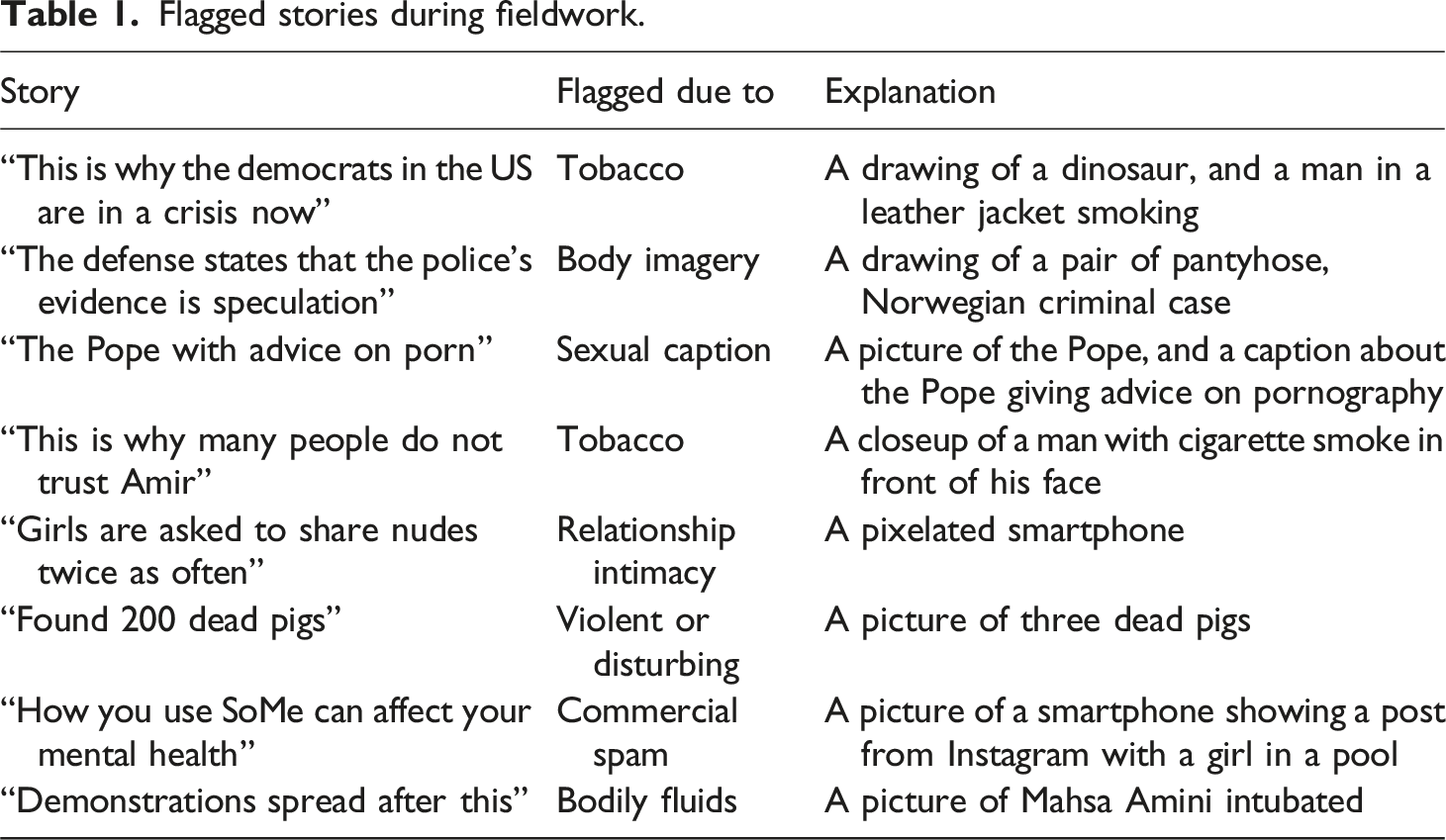
At post-publication stage, we see a specific type of gatekeeping, where Snapchat’s algorithm impeded NRK UNG’s news content dissemination due to “flagging” that indicated violations of Snapchat’s community guidelines. This flagging practice represents the most intrusive algorithmic gatekeeping in our study. Flagging restricts the distribution of certain tiles in NRK UNG’s stories solely to NRK’s Snapchat subscribers. This moderation process significantly impacts NRK’s reach to new audiences, superseding editorial decisions and disqualifying content deemed crucial and relevant by journalists.
Flagged stories during fieldwork.
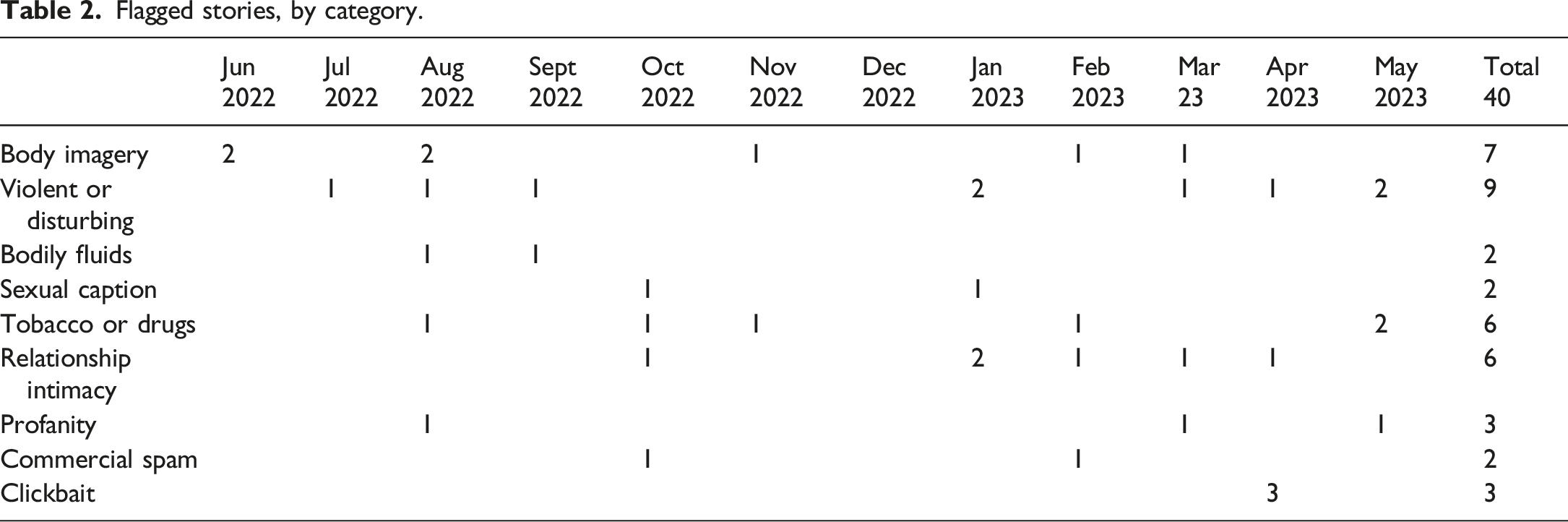
Flagged stories, by category.
While the journalists didn’t inherently oppose Snapchat’s community guidelines, as they expressed understanding related to graphic content and the protection of young audiences, they were often frustrated with their implementation. Violations resulted in the specific content receiving a “flag” visible in the Snapchat Story Studio, prompting complaints about the algorithm’s restrictive filtering. This sentiment is illustrated by the following quote, where content was flagged as “commercial spam” for featuring a person holding a recognisable brand of smartphone. “Sometimes, things that have been flagged could have performed well [on Snapchat]. It’s a shame. And weird. I can understand that this tile was not the biggest hit. A guy and a phone. But it is strange …” (news worker 1)
This quote illustrates how puzzling the staff found the flagging practice and the difficulty of seeing the logic behind the filtering process. They noted inconsistencies in the flagging process, observing that content related to weapons, despite violating guidelines, was rarely flagged. Conversely, they observed more frequent flagging of what they perceived as less controversial topics such as female health (mentioning periods) or contraceptives (pictures of condoms). This led them to believe that the guidelines were not uniformly enforced, as articulated in the following quote: “Weapons, they [Snapchat] don’t care about. Showing blood, or having a period, though, that is not OK.” (news worker 7)
This observation is supported by the overview of flagged stories (Table 2). During this year, no story was flagged for violating the “weapons” category, which the news staff found paradoxical, given the frequent inclusion of the war in Ukraine in their Snapchat dissemination, often featuring pictures of weapons. Past encounters with content moderation led to an accumulation of “flagging knowledge” among the staff, resulting in specific practices to avoid future flagging. Elements such as pictures or words were occasionally altered to “avoid the flag”, or stories were drawn instead of using photographs. For instance, the following example illustrates how staff tried to adhere to Snapchat guidelines. In this case, a close-up image of the Pope with the caption “The Pope gives advice on porn” was flagged for violating “sexual caption” restrictions, and the staff discussed substituting the word porn (which they knew would get flagged) for “adult movies” or other more neutral words.
The staff were more concerned when flagging was perceived to compromise their editorial integrity, expressed by one journalist (news worker 2) as sometimes “conflicting with our interests.” Dilemmas arising from the disparity between Norwegian journalistic ethical guidelines, notably less restrictive, and Snapchat’s rules were emphasised by NRK’s SoMe-responsible, acknowledging NRK’s unique role in the Norwegian media landscape: “We’d prefer exceptions from the [Snapchat] guidelines, especially considering we are a public service broadcaster.”
In summary, the previous section emphasises how post-publication, the Snapchat algorithm exerted substantial gatekeeping influence on the distribution of content considered ethical and valuable by journalists. Flagging, in essence, overruled journalistic priorities and decision-making, compelling journalists to adapt continually to guideline restrictions. These content moderation procedures were often internalised as daily practices, but also caused occasional frustration, raising concerns about conflicting interests between Snapchat and NRK as a PSM.
Discussion and conclusion
This study has demonstrated how journalists in a PSM newsroom navigate gatekeeping practices during news dissemination on Snapchat. We have introduced the term “dynamic gatekeeping” to highlight how the journalists navigate the interplay between traditional journalistic gatekeeping and the algorithmic gatekeeping of Snapchat. This involves, among other factors, flagging when guidelines were violated, and how audience engagement manifested through metrics and analytics influenced the gatekeeping. Bringing together and supplementing previous research on post-publication gatekeeping (Hermida, 2020; Salonen et al., 2023), and participative gatekeeping (Blanchett, 2021), our study of dynamic gatekeeping contributes to scholarship showing the intricacies of gatekeeping in the platform era. The interplay that characterises dynamic gatekeeping has been identified across different phases of the news production process – in the planning phase, during the publication of stories and post-publication. At each stage, we observe different levels of journalistic control in shaping news provision. These findings provide important insights regarding journalistic power vis-à-vis platforms and raise questions about PSM integrity when targeting younger audiences on third-party platforms.
In the pre-publication phase, our study shows how insights gleaned from metrics and analytics in Snapchat’s Story Studio shape decisions regarding story selection and design. There is complex, reciprocal interaction between accumulated knowledge about young people’s preferences, partly based on how the audience screenshot and share tiles and stories, but also influenced by the opaque, algorithmic structures behind the spreading of content concealed within the “black box” (Pasquale, 2015). The interpretation of these analytics is combined with traditional, journalistic gatekeeping whereby stories are selected based on professional judgement of newsworthiness. In this phase, journalists thus exercised considerable control over the selection and framing of stories, although their decisions were influenced by accumulated insights derived from metrics and analytics available to them in Snapchat’s Story Studio.
At the next stage, the ABCD-testing of tiles, we observe how the algorithm and ABCD-testing serve as helpful yet limiting tools for journalists, allowing for experimentation with story designs but affording no control over which versions of stories reach parts of which audiences or why certain versions are prioritised. At this stage, the PSM newsroom is relinquishing considerable power to the platform, demonstrating how publishing on Snapchat comes at a high cost in terms of journalistic control, autonomy, and integrity.
This becomes even more evident at the post-publication stage, where the practice of flagging occurs. Here we observe how Snapchat is essentially taking gatekeeping control. While there is a dynamic element here too, as NRK journalists occasionally reach out and communicate to Snapchat human moderators about the flagging, the power dynamics between the platform and the newsroom remain severely unbalanced, with PSM newsrooms subject to heavy-handed filtering mechanisms beyond their control. The study thus demonstrates how Snapchat functions as a “super-editor,” its influence becoming increasingly pronounced and intrusive as we progress further into the publishing process. These insights supplement and nuance previous research on post-publication gatekeeping (Hermida 2020; Salonen et al., 2023), and participative gatekeeping (Blanchett, 2021) by demonstrating how journalistic autonomy and integrity vary along the publishing process. As such, our findings support the idea that the power of the platform (Nielsen and Ganter, 2022) is relational, and contingent on where in the production process we direct our analytical lens (Poell et al., 2023).
Our findings on how Snapchat’s flagging of content reduces the distribution of significant news stories, highlight discrepancies between platform community guidelines and PSM’s ideals of universality. Paradoxically, the broadcaster’s aim to reach younger audiences with important content by building a platform presence is simultaneously hindered by the community guidelines of the platform, as flagging filters out important content that NRK aims to deliver to young audiences. Building and maintaining NRK’s Snapchat presence thus supports as well as contradicts PSM’s obligation to reach the entire population. This represents a considerable dilemma for the PSM organisations which they are yet to solve. While they have systematically downsized their presence on other social media platforms, they have maintained their news distribution on Snapchat. Our findings demonstrate how this strategy comes at a high price. It prompts the question: Is the downside of disseminating news to young people on Snapchat, such as the loss of journalistic integrity, authority, and significance for NRK’s esteemed position in Norwegian society, outweighed by the potential gain of accessing this hard-to-reach group on the platform’s terms?
While the newsroom staff have a solid understanding of Snapchat’s guidelines, their comprehension of flagging inconsistencies is more limited, prompting concerns about the platform’s content moderation transparency. Further research is warranted to explore how journalists adapt their news dissemination strategies to circumvent interventions like flagging on social media platforms. Notably, this study predates the Digital Services Act, suggesting the importance of investigating its implications from various perspectives.
We acknowledge several limitations of this study. Given that the study focuses solely on the perspective of journalists within a small editorial group and through a PSM lens, generalisation is impossible. We advocate for future, comprehensive studies exploring the complex relationship between journalists and platforms, from several perspectives and theoretical lenses. The dilemmas related to reaching youth with news on social media are still understudied, including comprehending the mechanisms that shape how news is distributed and displayed (Jones et al., 2022).
Ethnography is efficient for a deeper understanding of complex issues but also time-consuming. Even so, this study only sheds light on how journalists navigate dynamic gatekeeping. We advocate for further ethnographic investigations into the intricate interplay between journalists and third-party platforms where algorithms partially are in charge, as they illuminate factors that are challenging to uncover through surveys or interviews. These include potential adaptation to practices like flagging, sometimes even happening inadvertently. In addition, over-arching studies as suggested by Poell et al. (2023) are needed to bridge the fields of platform studies and journalism.
NRK has already withdrawn from Facebook, banned TikTok and reduced its presence on most social media drastically. What the future holds for this PSM’s complex relationship with Snapchat is hard to predict. At the time of submitting, Snapchat is still an important place for NRK to build its brand, experiment with formats, learn from and interact with the hard-to-reach young audiences, but the focus has shifted towards prioritising news dissemination targeting young audiences on proprietary platforms.
Footnotes
Acknowledgements
We extend our heartfelt appreciation to the NRK staff, particularly those at NRK UNG, for their willingness to participate in this ethnographic inquiry. Special acknowledgment is due to the Digital Journalism Research Group at Oslo Metropolitan University, notably Oscar Westlund and Karoline Ihlebæk, for their invaluable insights. We also express sincere gratitude to the anonymous reviewers and editors for their constructive contributions to this research endeavor.
Declaration of conflicting interests
The author(s) declared no potential conflicts of interest with respect to the research, authorship, and/or publication of this article.
Funding
The author(s) received no financial support for the research, authorship, and/or publication of this article.
