




Abstract
This paper presents work surrounding INJECT, a newsroom innovation offering digital tools to support journalists. Research showing increasing time and resource pressure on journalists has led to concerns about the demise of investigative reporting and the ability of today’s journalists to interrogate information adequately. Some digital innovations (e.g. tools facilitating robot journalism) have been viewed with suspicion by newsrooms. This paper reports on a research project that seeks to create an innovative tool to support the creative capabilities of time and resource poor journalists. The INJECT project used the advanced information discovery capabilities of digitisation to help journalists find new angles on stories and this paper analyses the extent to which such initiatives might harness digital innovation to benefit both the quality and range of reporting and thereby enhance creativity. It examines the potential of an information processing model of creativity derived from the INJECT tool to assist and support journalists, exploring the theoretical impact as well as the practical implications reported from the newsroom.
Introduction
This article engages with the growing use of computational technologies in the newsroom, focusing in particular on an EU supported project, INJECT. The growth of computational journalism has seen developments of a wide range of tools relating to the production of news stories. In many cases these are concerned with varieties of ‘robot reporting’ enabling computers to replace routine newsroom tasks (Chiusi and Beckett, 2019), often with a view to making efficiencies. However, in other cases, computational algorithms can enhance a journalist’s ability to generate innovative and creative angles on stories, potentially assisting, for example, complex investigations or producing illuminating graphical presentation. This analysis, reported as part of the INJECT research project, focuses on the latter endeavours. It seeks to establish what kinds of computational technologies might enhance creativity in journalism, based on an information processing model of creativity applied to support journalism.
The literature review presents a survey of the current role of computational technologies in newsrooms and explores what kinds of task are being undertaken by digital innovations. The subsequent section analyses the development of INJECT – a tool devised to provide digital support for journalists to discover and examine creative angles on news stories (INJECT, 2019). It reports an evaluation of the tool’s use in newsrooms which revealed that journalists used the tool to generate more creative stories. The paper ends with a discussion of a new information processing model of creativity in journalism that could be used to direct the development of digital support tools for journalist creativity.
Literature review
Recognition that developments in computer technology – advanced computing capabilities applied to complex problems – can support journalism and enable its automation has led to the exploration of ‘computational journalism’ and ‘algorithmic journalism’ (Anderson, 2012: 1005; Coddington, 2015: 331; Diakopoulos, 2019: 1180); ‘machine-written news’ (Van Dalen, 2012: 648); ‘robot journalism’ (Thurman et al., 2017: 1251; Van Dalen, 2012: 648) and the ‘robotic reporter’ (Carlson, 2015: 416). Coddington (2015: 334) distinguishes this automation of journalism from ‘computer assisted reporting’ and ‘data journalism’. Some authors (Franklin and Canter, 2019) suggest all these could come under the umbrella term of ‘digital journalism’, dating back to the first use of computers in newsrooms in the 1950s. Others (Kobie, 2018) suggest an umbrella term of ‘AI-supported journalism’, but it is generally acknowledged in the literature that Artificial Intelligence (AI) is a term often used by both academics and practitioners but seldom clearly defined (Chiusi and Beckett, 2019). The literature as a whole suggests that computers and digital tools are now an integral part of journalistic practice and the use of them to support reporting can no longer be considered atypical. Projects such as INJECT and JournalismAI – a collaboration between the LSE and the Google News Initiative (JournalismAI, n.d.) – aim to work with journalists to explore how AI innovation can support good journalism. However, despite such projects, a persistently raised concern (Delcker, 2019; Van Dalen, 2012) is that ‘machine-written news’, written without the need for human intervention beyond the machine’s development and programming (Carlson, 2015: 417) may threaten journalists’ professional identity, causing them to re-evaluate their role in the newsroom.
Research in this area reports on recent examples of automated journalism – sport and business sections feature heavily (e.g. Thurman et al., 2017) and most predict a general growth of computer-assisted automation in the newsroom that will substantially change journalists’ working practices. Authors in the earlier literature commonly mention the suspicion with which journalists view this trend, fearing job losses: ‘An algorithm is cheaper than an editor’ (Thurman, 2011: 411). Automation is thus sometimes viewed as a threat to jobs in the context of concerns about the financial sustainability of quality journalism when many mass media outlets find revenue, whether from advertising or circulation, shrinking (Cairncross, 2019). Quality has also been a concern, with some respondents in the research literature arguing that the bar is set so low in much online news reporting that the automated content robot journalists produce is no worse than that appearing on free online sites (Van Dalen, 2012). Others argue that the proliferation of apps to assist journalists in their work could lead to an over-reliance that could negatively impact critical thinking (Thurman, 2017). However, more recent research suggests developments in AI and innovations like INJECT may have both improved the quality of automated news and allayed the fears of newsroom journalists (Graefe and Bohlken, 2020; INJECT, 2019).
Spyridou et al. (2013) argue that some journalists fail to embrace new technologies because they are unwilling to relinquish control; lack time due to increased workload and are subject to a rigid professional culture, processes and norms. Scholars grappling with theories of creativity in journalism (e.g. Markham, 2012; Montal and Reich, 2017) raise concerns over the extent to which increasing use of automated searches and algorithms reduces the key journalists’ tenets of autonomy and agency. However, Van Dalen (2012) among others, argues that automation in the newsroom forces journalists to re-evaluate their role, allowing them to view automated content creation as not only a threat but also as complementary to and supportive of their more ‘human’ skills such as the ability to deliver creative, complex linguistic sentences with personality and humour. This leads to an ‘us versus them’ framing of the issue among journalists – can human journalists compete with their robotic counterparts? Much of the literature discusses the replacement of journalists with robots, which is described as ‘disruptive’ (Carlson, 2015; Wu et al., 2019). Among concerns about such disruption are ethical questions – for example, copyright and transparency (Thurman et al., 2016) as well as the implications for personalisation of news choices (Thurman, 2011; Zamith, 2019).
Additionally, there are implications for journalism education and the requirement for journalists to understand the scope of technology. Recent research (Anderson, 2018; Graefe, 2016; Milosavljević and Vobič, 2019) indicates journalists agree computers can carry out mundane tasks, leaving them to undertake more in-depth and time-consuming reporting such as investigations. In the future there could be more blending between human journalists and their digital tools (Van Dalen, 2012), integration described by Graefe (2016: 11) as forming a ‘man-machine marriage’.
Others suggest that computational technologies in the newsroom can indeed help journalists do their best work, rather than replace them altogether. Milosavljević and Vobič (2019: 1) take what they call a ‘human still in the loop’ perspective, where humans remain dominant in the production of journalism but the increasing use of digital tools to support their work shows a transformation in journalism practice whereby new technologies are embedded within newsroom norms and processes. Deuze (2019) amongst others, characterises journalism as an inherently creative process, curtailed by the rigid routines of the media industry and the economic realities of news-making. This begs the question as to whether digital tools harnessing computational technologies might produce more creative journalistic practices?
To answer this question, an interdisciplinary team was formed to examine the issue, grounded in theories of digital creativity. This analysis reflects the mixed disciplinary backgrounds of the team members, and the debates and discussions they have had during the writing of this article about the development of INJECT, a digital tool for journalists. We seek in this paper, as well as describing and evaluating INJECT, to explore the common ground between theories of digital creativity (Boden, 1990; Kerne and Smith, 2004), digital tools to support creative thinking (Beardon and Malmborg, 2002; Lee and Chen, 2015) and creativity in journalism (Deuze, 2019; Markham, 2012). Some of these theoretical underpinnings are explored in the next sections.
Fostering digital creativity in the newsroom
In an era with unprecedented quantities of digital information to search, make sense of and verify, our research argues that journalists need to focus more effectively on information that adds value. Step changes in capabilities to manage the large volumes of information available are needed. One challenge is to make more effective use of multiple digital platforms, tools and information (Van Der Haak et al., 2012). Interesting opportunities for digital creativity support tools have emerged (e.g. Alaoui et al., 2015; Bartindale et al., 2013; Greene, 2002). Creativity is defined as ‘the ability to produce work that is both novel (i.e. original, unexpected) and appropriate (i.e. useful, adaptive to task constraints)’ (Sternberg and Lubart, 1999: 3). Ideally this can enable professional users to interact with digital creativity support tools to produce more novel results .
Despite Spyridou et al.’s (2013) work, case studies have revealed that media professionals are motivated by opportunities for developing new skills and competencies, including new creative skills (Malmelin and Virta, 2015). Indeed, branches of journalism, such as investigative and visual journalism, necessitate new forms of creative search and association and computational exploration in journalism increasingly involves creative processing at the intersection between journalism and data technology that transcends former geographical, disciplinary and linguistic boundaries (Gynnild, 2014). While the skills and tools necessary to do the computerised work, such as data analysis, diverge from the typical journalist’s skillset, the values and aims align well with traditional journalistic endeavour (Anderson, 2018; Karlsen and Stavelin, 2014). Larger newsrooms have adapted daily work tools to reduce the numbers of steps that journalists follow to write and publish articles, increasing productivity (Lichterman, 2016).
Nevertheless, barriers to these changes remain. Staff reductions, content syndication and centralisation of core services (Sjøvaag, 2014) have reduced the resources available to journalists (Alexander et al., 2016). As a result, they tend to focus on limited information sources in their search efforts. Work processes in traditional newsrooms are held in check by conservative attitudes from journalists, and Ekdale et al. (2015) report that those who believe their jobs are at risk are unlikely to change their practices. Moreover, Witschge and Nygren (2009) reveal that multi-skilled journalists have more control over more stages of their work than ever before, and can introduce new forms of creativity in the production process, even if the demands in daily production are often so high that journalists can seldom develop this creativity (Saridou et al., 2017).
However, multi-skilling is more often a way of increasing productivity rather than creativity, which squeezes the space for creative freedom outside prescribed workflows. This paper focuses upon potential new digital technologies – that may be able to increase both newsroom productivity but also assist creativity.
Digital support tools for journalists
There have been surprisingly few bespoke digital products in the journalism domain to support creative thinking by journalists. As a workaround, some journalists have adapted general-purpose, standalone search tools (like import.io and www.social-searcher.com) to support the development of news stories. However, these tools were not tailored to the tasks of journalists, only supported syntactic keyword searches, and did not explicitly support idea generation during story development. Elsewhere, commercial organisations have developed bespoke digital news aggregation engines using RSS feeds and advanced text analysis, but again, our investigations reveal little explicit digital support for journalistic creativity.
More general bespoke digital journalism tools that exploit computational technologies have been devised. For example, DocumentCloud was a digital product that annotates the text content of documents to analyse for timelines and references (DocumentCloud, n.d.). The STEAMER prototype automatically searched large text/video databases using algorithms to detect sentiment in news content, categorise news and detect events and trending topics. NewsReader also combined text analysis and artificial intelligence techniques to build structured event indexes of large volumes of financial and economic data for decision making from news content (e.g. Minard et al., 2015), but supported decision-making rather than new angle generation. Thurman (2017) discusses a range of apps and tools available to and used by journalists to analyse social media platforms such as Twitter (such as Dataminr or Reuters Tracer) – but concludes that there is a limit to the way in which they enhance the output of journalism and could end up ‘dulling journalists’ critical faculties’ (Thurman, 2017: 76).
Some research in digital journalism could be framed as support for journalist creative thinking. The Tell Me More system extracted text content from published online stories that was presented to journalists in different forms (Iacobelli et al., 2010), and the Story Discovery Engine implements algorithms that support journalists during investigative reporting (Broussard, 2015). The SocialSensor news app surfaced fast moving trends from social media content, but revealed biases therein (Thurman et al., 2016). Many data visualisation tools support journalists to make sense of, for example, social media content (Diakopoulos et al., 2010) and large document releases (e.g. Brehmer et al., 2014). However, none supported human creative thinking to discover new angles on news stories. Recent start-ups such as Loyal.ai (LoyalAI, n.d.) are offering new interactive assistants to deliver faster research and fresh perspectives on news, but evidence of their support for journalist creative thinking has yet to be reported.
Creativity support tools in other creative industries
In contrast, most existing research to develop effective digital creativity support for human users to generate creative outcomes has been implemented in other creative industries; performing arts, music, film and television (e.g. Alaoui et al., 2015; Honauer and Hornecker, 2015). Examples of this digital support include StoryCrate, a collaborative editing tool developed to drive users’ creative workflows within a location-based television production environment (Bartindale et al., 2013) and Trigger Shift, which appropriated commercial information technologies into performance art in theatre (Schofield et al., 2013). Indeed, successful creativity support tools are expected to support pain-free exploration and experimentation to promote active learning and discovery (Greene, 2002). One outstanding research challenge was to deliver effective digital support for creative thinking embedded seamlessly into established journalism practices.
A theoretical underpinning: Creative thinking as information processing
Recognising journalism’s core purpose as ‘gathering, assessing, creating and presenting news and information’ (American Press Institute, n.d.) where creativity is a core feature (Deuze, 2019), this research adopted models that describe creative thinking as a process of information discovery. Different information-processing models of creativity exist, characterising creative work as a deliberate search for information and generation of new ideas from information discovered from search – a characterisation that underpins many of the established creative problem-solving processes, from Synectics (Gordon, 1960) to the Creative Problem Solving (CPS) Method (Isaksen et al., 2011). Therefore, we hypothesised, creative journalism work could be characterised as a deliberate search of news-related information followed by the generation of ideas with this information to produce stories.
Kerne and Smith (2004) also framed creativity as an information discovery process that emphasised idea generation over information discovery, and exploited the search capabilities of new digital technologies to discover information and support idea generation. This information discovery process was typically iterative – changes in a user’s information in response to information already discovered could lead to cognitive shifts often associated with insight and ideation (Kerne et al., 2008). As a consequence, the creative journalism work could also be characterised as the iterative search of news- related information and generation of ideas leading to cognitive representative shifts by journalists about a new story.
Furthermore, and consistent with this framing, Boden distinguished between exploratory and transformational creativity (Boden, 1990). Exploratory creativity assumes a defined space of partial and complete possibilities to explore – a space that also implies the existence of rules that define the space. Finding a new angle on an existing well-defined story is an example of exploratory creativity in journalism work. Changes to these rules produce what might be thought of as a paradigm shift, called transformational creativity. Generating a new story that challenges existing rules is an example of transformational creativity in journalism work. Boden also identified one specific form of exploratory creativity, called combinational creativity, which is the process of making unfamiliar connections between familiar. Generating a new story that explicitly combines elements of existing stories in new ways could be an example of combinational creativity in journalism.
Likewise, different interactive capabilities of existing tools (e.g. Alaoui et al., 2015; Bartindale et al., 2013) can be characterised as supporting their users to undertake different episodes of exploratory, combinational and transformational creativity, albeit in other disciplines. These existing tools reveal at least the potential for new digital creativity support tools to assist journalists to undertake successful episodes of exploratory, transformational and combinational creativity as part of their daily work. However, little evidence for this potential, or for journalists’ preferences for one of more of these different types of creative thinking in their work, had been reported.
Therefore, the new research and development work reported in this paper was undertaken to develop and evaluate whether: (RQ1) there is potential for AI enabled digital creativity tools tailored to support journalists; and (RQ2) to find what journalists’ preferences exhibit for exploratory, transformational and combinational creativity in the way they use this resource. The next sections report the development of INJECT, a new digital creativity support tool for journalists.
The user-centred design of INJECT’s digital creativity support
The design of the INJECT tool evolved incrementally. The development team implemented and evaluated versions of it that were increasingly complete, reliable and usable, collecting formative feedback from journalists and others. Journalists with different levels of professional experience were interviewed to discover problems, requirements and constraints. These journalists then provided feedback, first on different versions of INJECT’s design, then on releases of the working software to improve INJECT’s usability and impact. (Maiden et al., 2020). Furthermore, these cycles of implementation and evaluation also sought to align the INJECT tool with three important values that most journalists held about their work – values the new tool was designed to uphold.
The first and second values related to journalists’ skillsets. The first was to recognise that many journalists were already creative thinkers, and used these creative thinking skills in their work, as you might expect from professionals in the creative industries. And because of this, many participating journalists rejected the need for digital support for their creative thinking. Rather, more of the journalists were prepared to identify with the need to generate new angles more quickly. Moreover, this more specialised form of creative thinking was part of everyday journalist work. Therefore, a second value was to embed support for generating new angles more quickly in the daily work tasks and tools, such as text editors.
The third value was a clear preference for verified information already reported by other journalists, as opposed to unverified social media and other sources, for discovering new angles on stories. Even when presented with arguments that published news might offer fewer opportunities for generating new angles, most journalists articulated this value as important in their work.
The resulting INJECT digital tool
INJECT was designed to support journalists to discover new angles, content and intelligence quickly and effectively, as part of their daily work. The tool integrated different computational technologies – natural language processing, creative information retrieval algorithms and recommendation features. This section reports the tool’s features as implemented in the summer of 2020, and the rationale for their development in this form.
Journalists interacted with INJECT using sidebar components that were added to existing text editors, without the need to open another application. The design decision reflected the third value of journalist work that creative thinking was not separate from but part of everyday work. Indeed, co-design activities to develop INJECT revealed strong journalist resistance to more standalone applications on their desktop (Maiden et al., 2020), although a separate responsive web application was also implemented for use on smart devices such as phones and tablets.
The primary INJECT sidebar was implemented using a pre-defined component that appeared on the right side of most text editors that journalists used. It had a fixed width of 300 px, and presented content as a scrollable sequence of different types of information card (Maiden et al., 2020). It implemented different interaction features that were designed to maximise the presentation of information to encourage creative thinking within the restricted width. These features included cursor hover-overs and features to rotate the information cards to present more information on both sides of each card.
At the start of sessions, journalists used the INJECT sidebar to: (1) define topic terms, that is, the terms that describe the topic of their current work; and (2) select between different creative discovery strategies to discover content, angles and intelligence. The creative discovery strategies were implemented to discover, for example, information about people associated with the topics, data and evidence related to the topics and background events that contributed to the topic. Wider strategies were also implemented to discover all related creative content. Each of the strategies was developed to emulate how experienced journalists reported discovering new angles on stories (Maiden et al., 2020). Each was operationalised by bespoke algorithms that implemented creative searches of information content extracted from 10 seconds of millions of news articles published in multiple languages, 10 seconds of thousands of scientific papers and magazine articles and over 50,000 digitised political cartoons, that is, verified and published content. This design decision was informed by the first journalist work value that placed importance of information already reported in verified newspapers, as the starting point for discovering new story angles. The technical architecture of INJECT that enabled these creative searches of news-related content is reported in Maiden et al. (2018).
In response to the topics defined and creative strategy selected by the journalist, the INJECT sidebar presented the discovered creative content, angles and intelligence in different types of information card that the journalist could scroll. Figure 1 shows the sidebar invoked in a Wordpress text editor being used to write a new story about Angela Merkel and the EU Recovery Fund. The journalist could scroll the information cards and interact with information presented to discover content, angles and intelligence, whilst incorporating new materials and references into the text. The journalist could also control how recently the presented information had been published, the sources it was discovered from and order of presentation.
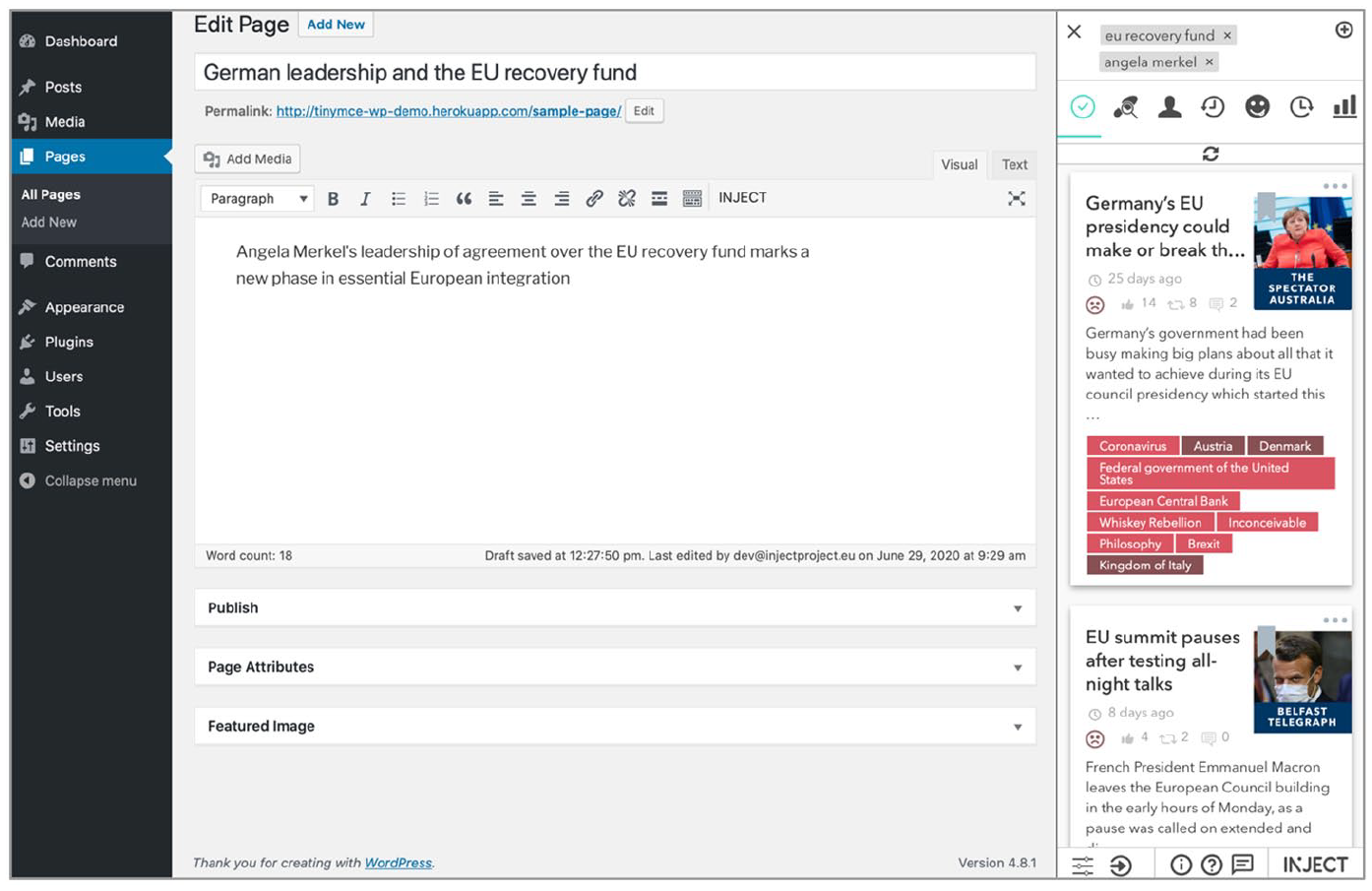
INJECT sidebar invoked in a Wordpress text editor, showing different discovered news article cards that the journalist is scrolling through.
Much of INJECT’s support for journalist creativity was delivered through three scrollable information cards – the landing, intelligence and article cards.
The first information card presented in the INJECT sidebar was the landing card. It provided a summary of the information discovered using the topic terms defined and creative strategy selected by the journalist. It reported the total number of discovered articles out of a sample total of 500, and how many of these that were rated to be positive articles based on an automated sentiment analysis. It then listed entities that were described in most discovered articles, entities described in some of the discovered articles and entities described in only a few of the articles, to encourage directed exploratory creativity. This last set of entities was the most likely source of new angles for the journalist so, using a pulldown feature on the card’s menu, the journalist could refresh these entities continuously to explore more novel angles on stories – more support for directed exploratory creativity, and for transformational creativity when new stories are discovered.
The design of the front of the landing card is shown on the left side of Figure 2. It reports that more than half of the discovered stories are ranked positive, many write about Germany, Brussels and the pandemic, but only a few write about Europe, parliament and snap elections. Novel angles on stories about the EU recovery fund that journalists might write about included the role of parliaments and effects of possible snap elections in different countries.
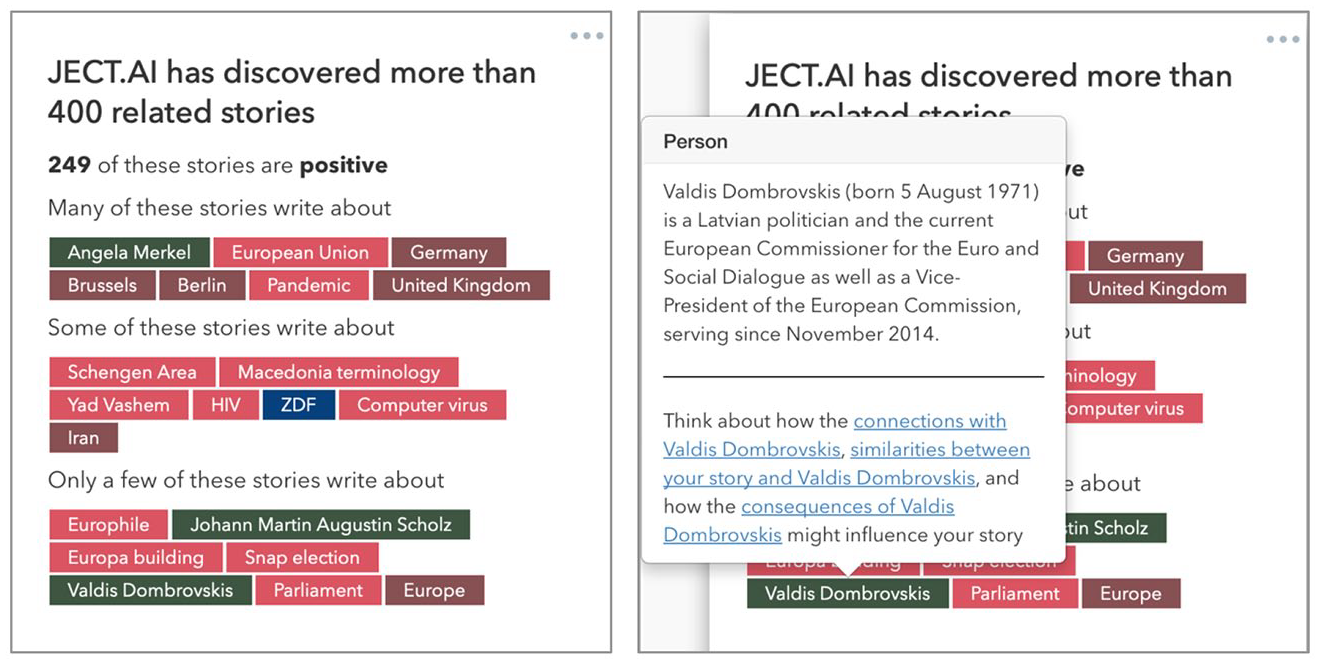
INJECT landing card, on the left, an overview of the discovered information and possible creative angles, background information on related themes, and on the right interactive guidance for more directed creative thinking.
The landing card was implemented with hover-over creativity sparks to encourage directed forms of exploratory creative thinking. When the journalist positioned the cursor over an entity, the sidebar presented not only a basic definition of the entity, based on its Wikipedia definition, but also three different interactive creativity sparks automatically generated for it, as shown on the right of Figure 2. Furthermore, if the journalist clicked on one of these sparks, INJECT launched a tailored Google search for information related to the spark. For example, by hovering the cursor over Valdis Dombrovskis, the journalist learns that he is a Latvian politician and European Commissioner, and is encouraged to explore his connections, consequences and similarities to Angela Merkel to discover possible angles. Then, by clicking on the first spark, the journalist can immediately explore connections with Valdis Dombrovskis through directed Google searches automatically generated by INJECT. As such, the journalist remained the creative agent, and the INJECT tool augmented rather than automated and replaced journalists’ existing creativity skills, consistent with the second value of their work.
Another type of card was the INJECT intelligence card. This was designed to provide relevant information about other journalists, scientists and experts already writing about the topics defined by the journalist. It provided creative intelligence about who to interview, or verify story elements with. It was implemented in response to an emerging need (identified during co-design work) to discover new contacts and experts to engage with. The intelligence card was intended to support both exploratory and transformational creativity, as talking with other knowledgeable sources could lead journalists to discover both new angles on existing stories and new stories.
The design of the intelligence card was similar to that of the landing card. It presented three sets of people that the journalist could follow-up with – people who had written the most articles and papers about the topic, people who has written the most relevant articles and papers about the topic and people who had written the most recent articles and papers about the topic. To provide more contextual information about each listed person, cursor hover-overs for each presented the title of one user or story that the person had written. And if the journalist clicked on the card, INJECT launched a specialised Google search using the person’s name that was designed to provide additional information about the person, for example, a journalist’s Muck Rack or a scientist’s Google Scholar profile.
The third type of information card was the article card. Up to 30 separate article cards were also presented at any time by the INJECT sidebar. Each presented content extracted from one discovered news article, scientific paper, science magazine article or science blog/fact sheet. Again, the journalist may read and manipulate this information to explore, discover and generate new angles and content for stories.
Each article card presented basic information about the article, the result of the sentiment analysis applied to it and 10 randomly selected entities extracted from it, see the left of Figure 3. Clicking on the title opened the original new article, at source, in a new browser tab. Positioning the cursor over an entity presented three interactive creativity sparks generated for the selected place, thing, person or organisation in a hover-over, to enable the journalist to explore multiple sparks and discover ideas for angles quickly, that is, to facilitate more effective exploratory creativity. The creativity sparks themselves were designed to direct the deliberate generation of ideas by journalists. These sparks were generated by automatically instantiating predefined spark types that direct journalist thinking about, for example, the norms and values of places, the essentials of people, the different roles of objects and the purposes of organisations. Moreover, if the journalist clicked on one of these interactive sparks, INJECT launched a tailored Google search for information related to the spark in a new tab, to continue the discovering process.

Left, the front of one example INJECT article card, and right, an example of the flipside of that card listing different creativity sparks automatically generated for three entities.
The article card’s pull-down menu offered access to other content associated with and generated for the topic. For example, the journalist could open the original new article, at source, in a new browser tab. To facilitate more productive referencing, the journalist could copy the article’s reference to the clipboard. To encourage more exploratory creative thinking, the journalist could also refresh the 10 entities presented on the card and creativity sparks generated for each, view all sparks as a simple list and automatically paste the list into the text document, see the right side of Figure 3.
INJECT was implemented to support users working in multiple European languages. It provides strong support for users working in English, French, German and Norwegian and content support for users in Dutch and Italian. An example of this multi-language support, in French, is shown in Figure 4.
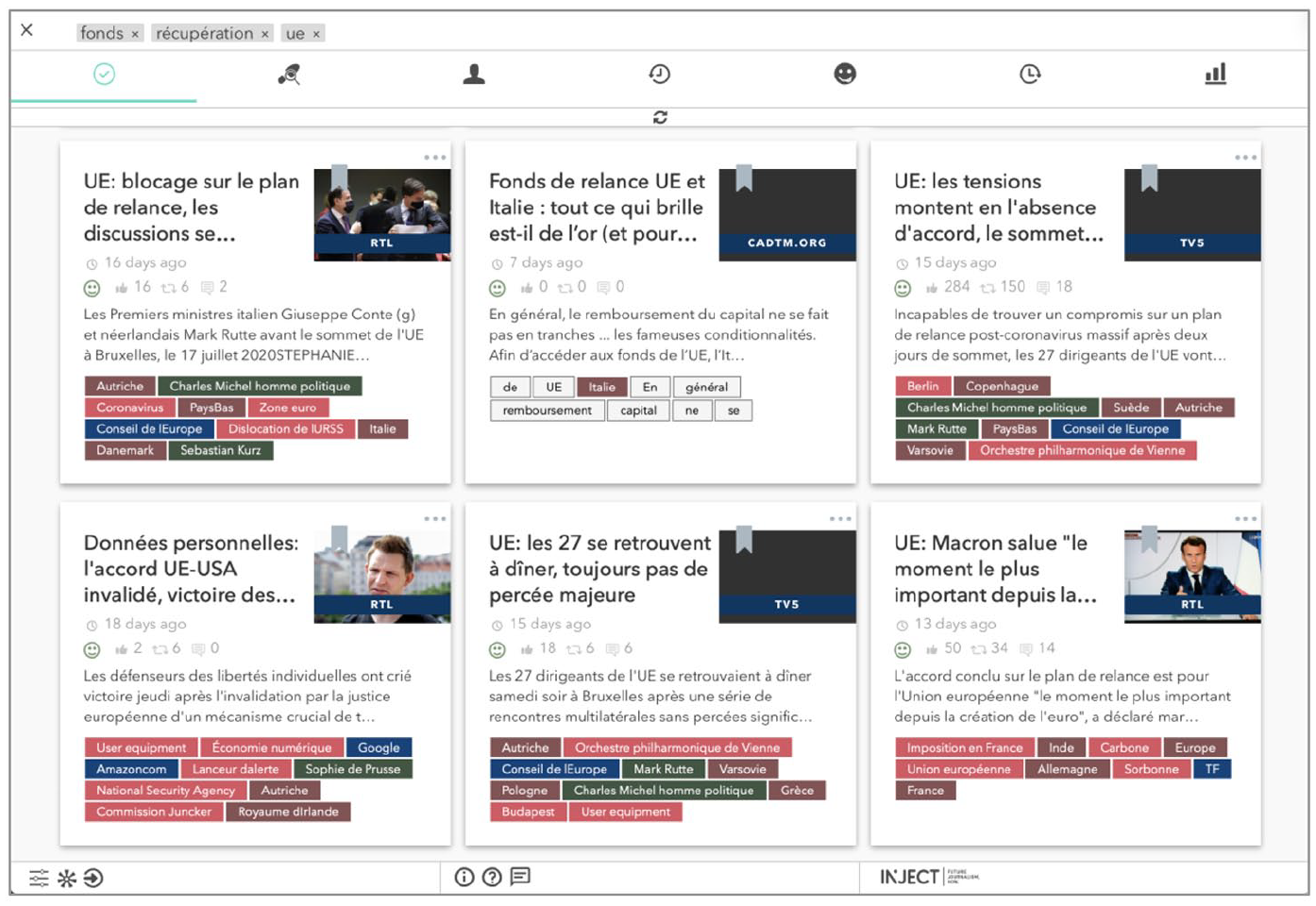
INJECT’s responsive web application discovering and presenting information content and guidance specific to the EU recovery fund in – French.
The next section reports one evaluation of the effectiveness of the INJECT tool in three newsrooms.
A first evaluation of INJECT
An evaluation of the effectiveness of an earlier version of INJECT was carried out in the newsrooms of three Norwegian newspapers. This version, which presented information about English and Norwegian language sources using the article cards, was installed into the daily work practices of four journalists at each newspaper for 2 months in 2018, for use in Norwegian and English. The research question explored in this evaluation was whether these 12 journalists would use INJECT to generate news stories that were more novel and valuable.
To investigate this, news stories produced by the journalists with and without the support of INJECT were rated by seven individuals with journalism expertise and/or knowledge of the regions of the three newspapers. Three were associate professors of journalism at local higher education institutions. The others had extensive local knowledge, as head of information at a regional institute in business and trade, two local business leaders in tourism and a retired legal stenographer. All seven judges were selected to make accurate value judgments about the relative novelty of the stories and the value to them as professionals and their work, based on their knowledge of the area. All lived in the localities covered by these newspapers, and were selected because of their extensive regional knowledge.
Each judge rated 20 news stories that journalists had written with support from INJECT and 20 written without it in the same earlier 12-month period. These 40 stories were selected randomly based on the proportions of the total number of stories written by each journalist with the support of INJECT. These stories were then randomly ordered in a questionnaire, anonymised and presented with two 1–7 scales to capture each judge’s novelty rating and value rating of each news story. Novelty was defined as how new the article was to the local population. Value was defined as the usefulness of the article to the local population. The remainder of this section summarises the key findings.
The evaluation showed that the journalists used already-published news stories as effective starting points for more original journalism. The average lowest and highest value ratings provided by the seven judges for articles written with INJECT’s support were 3.43 and 6.14, and for articles written without INJECT’s support were 3.50 and 5.86. The average lowest and highest novelty ratings provided by the seven judges for articles written with INJECT’s support were 1.33 and 6.14, and for articles written without INJECT’s support were 1.00 and 6.00. Statistical analysis of the values of the stories written with and without INJECT’s support revealed that the ratings of the novelty of news stories written with INJECT were significantly higher than the news stories written without it. A Wilcoxon Signed Rank Test indicated that novelty ratings for news stories written with the support of INJECT were statistically higher than for news stories without the support of INJECT, Z = −4.99, p < 0.00001. The median novelty rating was three for news stories written with the support of INJECT, and two without the support of INJECT. INJECT use was associated with an increase on the novelty of news stories, albeit from ratings that indicated low novelty of most of the non-INJECT news stories.
In contrast, there was no significant difference in the ratings of the value of news stories written with and without INJECT. A Wilcoxon Signed Rank Test indicated that the value ratings were not significantly different for the news stories written with the support of INJECT and without the support of INJECT, Z = −1.16, p > 0.05. Value was defined as the value of the article for the local public for whom it is written. The average value rating of all of the news was 4.7 out of 7, and the lowest and highest average value-rated articles were 3.71 and 5.86. This result was unsurprising, given that all of the news stories had passed through each newspaper’s editorial process.
The journalists used INJECT for certain types of article. Almost half were about social issues and a further quarter about cultural topics. In contrast, the journalists wrote few articles with INJECT’s support about politics, crime, sports and the economy. During interviews, the journalists reported that INJECT was more effective for writing research-based journalism such as features, investigations and other long form genres, based on forms of exploratory and transformational creativity. For example, one said: ‘For our everyday news we always have too many stories already. But during the magazine meetings we are required to come up with ideas from scratch, and ideally it should be something we haven’t written about before. So, there, we really need to be creative, and INJECT can be useful’. Another reported a need for INJECT four times a year, to write for each of the four magazines for the four seasons that required original long-form features. (INJECT, 2018).
To conclude, the evaluation revealed that the journalists produced research-based stories such as features and profiles with support from INJECT that were more novel than without the tool’s support, and still retaining their value to publish. There was preliminary evidence that journalists sought support for exploratory and transformational creativity. By contrast, there was little use of the tool to support the development of other forms of journalism. This outcome has implications for alternative emerging models of creativity, discussed in the remainder of the paper.
Discussion
This research reports the initial development and first newsroom evaluation of a version of bespoke digital creativity support for journalists. The design of the support was informed by existing information processing theories and types of creativity. The research enabled us to provide tentative answers to the two research questions: (RQ1) the co-design and first evaluation of INJECT revealed considerable potential for digital creativity support that was tailored to journalism work; and (RQ2) journalists verbalised and demonstrated some preferences for exploratory and, to a lesser extent transformational creativity in their work, but not for combinational creativity.
The answers to these questions can inform the scope and nature of new models with which to describe and support creative thinking in journalism. Digital technologies that process large volumes of information are now commonplace in newsrooms and media organisations. We argue that the use of theories of information processing that describe creative thinking was a good starting point for generating new and alternative models of creativity in journalism. These theories contrast with Markham’s (2012) view of creativity in journalism as expression, authenticity and de-authorisation, and Deuze (2019)’s argument that creativity in journalism can be associated with a more diverse and multi-perspective journalism. Instead, the theories describe a perspective on creative thinking as searches for information and the generation of new ideas and perspectives on story creation derived from information discovered from search (e.g. Kerne and Smith, 2004). This way is still consistent with Markham’s (2012) observation that creative expression is alternately structured practices, rather than less structured practices. The information processing theories of creativity used to design the INJECT tool define these altered but structured practices to have more creative potential.
The initial development and first evaluation of INJECT based on information processing theories of creativity provide both co-design insights and empirical data with which to develop a new model of creativity in journalism. The insights from the co-design process included journalist preferences for specific information search strategies (e.g. human angles or future ramifications in stories) over others and for using retrieved information to discover ideas with certain characteristics (e.g. types of new story angles to generate, and potential interviewees) (Maiden et al., 2020), and for some types of creativity (Boden, 1990) over others. Most journalists demonstrated exploratory and, to a lesser extent, transformational creativity.
Deuze (2019) argues that journalism creativity is curtailed by the rigid routines and current economic realities of newsmaking. A new model of exploratory creative thinking can offer new directions in which the inherent creativity of journalists and their work can be supported within the constraints of modern newsrooms. Moreover, framing creative journalism as exploratory and transformational provides informed means by which journalists can adopt, learn and use established techniques that support the forms of creative thinking – techniques such as constraint removal and hall of fame (Michalko, 2006).
Likewise, data from the tool’s newsroom evaluations can inform the new model of creativity in journalism. It revealed that journalists used INJECT to produce stories that were more novel than alternative stories produced without it, albeit still useful and publishable. Referring back to our baseline definition of creative work (Sternberg and Lubart, 1999), use of the INJECT tool led journalists to produce more creative outcomes. The data also provided evidence about the types of journalist work where the new models might have more relevance and impact. This was in the production of longer feature stories or investigations, rather than day-to-day news reports. Given the range of genres and subject areas, a general model with which to describe and support creative thinking in all forms of journalism might not be achievable.
Finally, a new information processing model of creativity in journalism based on information processing theories also facilitates the exploration of new research directions. If journalistic creativity can be described as searching for information to generate new ideas, then it poses interesting questions about what types of information to search. INJECT creative search algorithms can be modified to search alternative information spaces to discover, for example new writers, experts and influencers with diverse genders, ethnicities and areas of expertise to interview for stories. The algorithms can search more specialised information sources, such as scientific papers and trusted expert blogs, to support specialisms such as science journalism. 1 The algorithms can also be modified to search and combine information spaces of interview questions and writers, experts and influencers to interview.
And because creative search algorithms quantify measures of novelty, then the model could be developed to evaluate the relative novelty and hence creativity of different stories. Indeed, quantified measures of novelty are a focus of research in computational creativity (e.g. Maher and Fisher, 2011). It is therefore feasible that computational versions of a new information processing model could potentially be applied to measure and evaluate journalistic output in a range of ways and thereby inform editorial decision-making.
Footnotes
Funding
The author(s) disclosed receipt of the following financial support for the research, authorship, and/or publication of this article: The research reported in this paper was supported by the EU-funded H2020 723328 INJECT innovation action.