



Abstract
This project examines the way journalists establish narrative authority in online video news through their strategic uses of epistemological production elements. Journalists have historically constructed video news stories with a combination of linguistic and photographic epistemic components to assert their role as authoritative arbiters of factual reality. Online news makes extensive use of video, but production formats and their associated epistemic strategies vary, largely in accordance with the traditions and values of different organizations. This study represents one part of a larger content analysis of video news narrative. It examines the epistemological choices in online video news narratives as produced by legacy print organizations (LP), TV stations (TV), or digital natives (DN). The results show that legacy traditions still divide print and TV organizations, while authority in DN video is constructed in a more diffuse and participatory style reflective of online culture.
Online video has taken over social media, whether featuring talking cats on TikTok, propagandistic YouTube programs, or traditional news, where video has become a staple even for those organizations whose product was originally printed on paper. Video production styles vary widely, and for news, offer a variety of epistemic elements, including photographic indexicality, journalistic witnessing, or linguistic strategies that connote objective distance. Examining the epistemological choices made by journalists in news production can offer insight regarding practices and organizational norms.
This article uses content analysis to examine the form of online video news with a focus on epistemic strategies related to vocal narration, language, and story construction. It presents one part of a larger study investigating the form of online video news, here focusing on journalistic epistemology. This research sought to understand how online video news references time, presents human narrators, incorporates interviews and soundbites, and uses embodied representations of journalists.
Journalists have historically been strategic in their use of production elements, whether linguistic or photographic, to assert their role as authoritative arbiters of factual reality (Carlson, 2017; Zelizer, 1995a). While digital technologies offer myriad possibilities for video production, institutional traditions and values have been found to influence narrative choices. For instance, early in the convergence era, research found a patterned difference in narrative form between legacy newspapers and TV organizations (Bock, 2012a). The form of video news for digital native (DN) organizations, however, is less understood. This study examined the epistemic strategies of online news video, with a content analysis of stories produced by legacy print organizations (LP), TV stations (TV), or DNs, and found a connection between narrative form and institutional norms.
Literature review
Digitization’s impact on journalism has inspired a renewed interest in the epistemologies of news. Extending the long-standing interest of journalism scholars in the construction of authority (Carlson, 2017; Zelizer, 1990), Ekström has advanced an epistemological framework, grounded in critical realism, that has been especially fruitful (Ekström, 2002; Ekström et al., 2020; Ekström and Westlund, 2020). Ekström and Westlund (2020: 1) define epistemology as “the study of knowledge: what we know, how we know, and how knowledge is justified,” and as they argued, because journalism is a significant generator of knowledge, examining the way facts are generated, the way truth claims are justified, and the processes for producing knowledge offers insight into the complexities of the contemporary news environment. The epistemological lens is wide, and includes the sociology, discourse, and specific practices of journalists (Ekström, 2001, 2002; Ekström et al., 2021).
This study takes a discursive approach, focusing on the way truth claims are constructed in news texts, and examines a set of very tangible, practical video production choices by online news organizations to better understand organizational practices. We examine the epistemic dimensions of multimodal elements in online news videos. Video stories are complicated by their incorporation of multimodal elements, which offer epistemologies beyond words, including photographic indexicality, journalistic presence, and vocal narration. Institutional norms influence the way video creators choose to weave these elements into their stories.
Video narrative and epistemology
The primary unit of news is narrative, and stories are constructed using word and image in a style designed to communicate authority (Bell, 1991; Bird and Dardenne, 1988; White, 2005). Journalistic stories are expected to be truthful accounts of events, and as such offer a rich site for exploring their epistemological mechanics. Ekström’s (2002) study of TV news, for example, included video’s indexical visuality as part of a larger theorization of the genre’s production. In a subsequent study, Ekström et al. (2021) identified references to time, which rest upon temporal proximity to news, as an epistemic strategy used by TV journalists covering breaking news. Matheson and Wahl-Jorgenson (2020) studied live blogging from an epistemological perspective and found, among other observations, that such journalism often uses informal authorial voices. These studies build upon previous research on the role of news language in the construction of authority, identifying strategies such as the third-person declarative voice, use of attribution and quotations, and reportorial witnessing (Bell, 1991; Cotter, 2010; Zelizer, 1995a, 2007).
Journalism itself has traditionally invoked the camera as a source of unimpeachable authority, usually occluding the role of photo and video journalists in the construction of news (Zelizer, 1995b). While photographic images and video are indexical and therefore have an epistemological dimension, visual scholars have argued for a more careful understanding of images in news. Grabe and Bucy’s (2011) groundbreaking study of the way TV news visually framed politicians set the standard for research on visual content, particularly for the non-verbal information imparted by such coverage. Other visual researchers have examined iconic images and the way they circulate in media (Dahmen et al., 2018; Hariman and Lucaites, 2007). Visual theorists argue that images do not do their epistemic work alone in news but rely on linguistic contextualization, such as a caption for a still photo, or scripted narration for video (Barthes, 1977; Kobre, 2004). The way images are used in a news story offers insight into their epistemological significance.
Sound and the sources of narration present another epistemic element to news video. Early TV news used what is informally called the “voice of God” approach, with a highly authoritative third-person narrative style borrowed from newsreels and documentary filmmakers (Barnouw, 1974). Recorded voice tracks and other sounds guide a viewer through a story, and some production experts argue that sound is at least as important as images for comprehension, if not more so (Sidlow and Stephens, 2022). Other sound in TV news stories may include the recorded words of interviewees (soundbites), music, and natural sound (known as “NATS,” this is sound that is not speech, such as a babbling brook, the sounds of birds chirping, or city traffic) to report on events. Sound, in fact, is usually what organizes a news video story, and video journalists tend to start with a linguistic script to create the timeline for digital editing (Bock, 2012a).
Authority and narrators
The voice or voices attached to such a script present their own epistemological dimension. Authorship, or who tells a story, is a critical component to any narrative and its authority (Chatman, 1978, 1990; Herman and Vervaeck, 2005). As Foucault (1977) pointed out, authorship itself is a complex and constructed term, one with important epistemological consequences for journalism. In printed news, authorship can be identified with a byline or institutional marker (Reich, 2010), but because the story may be produced in concert with editors, sources, and visual journalists, authorship is not merely a matter of the writer’s name. In contrast with authorship, scholars have examined the way authority is established in language through the way a reporter describes their position relative to events and the audience (Good and Lowe, 2017; White, 2005). Journalistic authority may be derived from witnessing, or a reporter’s geographic proximity to events (Zelizer, 1990). The third-person declarative voice, another linguistic strategy, presents the journalist as a knowledgeable and uninvolved witness (Cotter, 2010).
Once again, video news adds another wrinkle, as its narrators are often presented in embodied ways. Here, “voice” is not only a linguistic style but an audible presence. This embodied voice may take any number of forms. A story might be told by someone who is seen or only heard, or a story might be created by a producer whose identity is never revealed (Diefenbach and Slatton, 2020; Genette, 1980). Campbell and Reeves (1989) observed that an unseen narrator constructs an illusion of journalistic distance. Narrators for TV news might also be seen, perhaps sitting at an anchor desk or on the scene, which conveys the authority of the eyewitness (Peters, 2001; Zelizer, 2007).
Soundbites are usually woven into conventional TV stories in ways that mimic quoting practices in print (Grabe and Bucy, 2011; Hallin, 1992). In his studies of broadcast interviews, Ekström (2001, 2002) noted the way TV news journalists question politicians, grant expert status to some guests, and let soundbites carry information in ways that let the journalists maintain objective distance. Yet some video news does not include a journalist’s voice at all and borrows from the verité, or “fly on the wall,” tradition of documentary film. This format is favored by many former print photojournalists who adopted video when newspapers shifted online (Bock, 2012a). Documentarians who adopted this style considered it to represent a more ethical, inclusive way of storytelling because it eschewed the “all-knowing” narrator in favor of letting the subjects of a film speak for themselves. As Ruby (1992) argued, however, the notion that verité is somehow more objective or ethical is illusory, as the talking heads of such documentary usually represent experts chosen by the filmmaker and merely constitute a different form of “all-knowing” authority.
Embodied reportorial presence, therefore, constitutes another epistemological dimension for video news. Video stories will vary according to how and whether a reporter shares narrative responsibilities with an interviewee, whether the journalist is heard or not heard, seen or not seen, near the story, or presenting the facts from a studio.
Newsroom culture and epistemology
Beyond the practical examination of story construction, the epistemological approach is also useful for studying newsroom practices more generally, especially in the fragmented, digital news ecosystem (Carlson, 2020; Ekström et al., 2020). Digital technology has ushered in new forms of storytelling, but other forces, such as institutional culture, economics, and regulations, affect the way any particular organization presents its news on the Internet (Gordon, 2003; Singer, 2006). As Boczkowski (2004) observed from his extensive ethnographic studies of multiple newsrooms, the adoption of new technologies and techniques of storytelling follows an uneven path. Legacy print organizations such as newspapers have historically struggled to incorporate visual practices (Lutz and Collins, 1993; Moeller, 1989; Zelizer, 1995b). The techniques of photojournalism and multimedia production are often neglected by an interest in the epistemology of photographic indexicality (Bock, 2012b; Zelizer, 1995c).
While legacy newspapers have come to embrace video as a means to survival in the digital age, its adoption has been convulsive (Assaf, 2021; Bock, 2012a). Indeed, early attempts to converge TV and print newsrooms struggled as their organizational practices were so different that Silcock and Keith (2006) found journalists could barely speak each other’s professional language. Photojournalists for legacy print newsrooms made a point of using a style to contrast with TV news, with less emphasis on reporter narration (Kalogeropoulos and Nielsen, 2018; Smith, 2011). This form favors the epistemology of the camera over the embodied presence of a journalist.
DNs do not carry the same kind of normative “baggage” as legacy print and TV news organizations. They are part of a culture marked by participation, remediation, and bricolage (Deuze, 2006). Digital news represents “an emerging value system and set of expectations as particularly expressed in the activities of news and information media makers and users online” (Deuze, 2006: 63). In contrast with news from an “autopoietic,” or discrete, closed organizational system, news on the Internet might be better conceived as “allopoietic,” with multiple sources and outputs, created in combination with external resources (Chadwick, 2017). How might this hybridity be reflected in the form of video production? Organizations that are “born digital”—to borrow a phrase from Hurcombe et al. (2019)—are more likely to incorporate social media elements such as tweets or Instagram posts, rely on curation from other organizations, and develop unique forms such as videos that use typed words instead of narrators attract an audience (Hurcombe et al., 2019; Tandoc and Foo, 2018; Tandoc and Jenkins, 2017). Studies of DN sites suggest that this emerging news form borrows from legacy media logic while also taking advantage of Internet affordances (Thomas and Cushion, 2019). Certain techniques, such as titling (typed words seen over video), quick edits, and the incorporation of still images, are much easier to deploy with digital editing.
Online video also has its own temporal characteristics. Ekström (2002) described the way broadcast news is tied tightly to the clock and uses time as an epistemological marker, but digital news is atemporal (Hampton and Wellman, 2003). TV news websites usually post clips from newscasts, stories that were originally played at a set time and then made available for people to go back and watch later. Newspaper videos—particularly those at daily print organizations—are supplementary to the printed articles, while DN videos are specific to their sites. Video may be streamed live and viewed in real time but once uploaded it remains in place, usually indefinitely.
Summary
The epistemological approach to news offers a useful foundation for studying the way authority in video news narrative is evolving in the new media environment. Yet while news epistemology studies have featured audio-visual news, they have tended to focus on image content, and not the specifics of video production as related to constructions of authority. Video production is more than camera work; it involves scripting and editing. References to temporality, the incorporation of interview soundbites, and a narrator’s aural and visual presence are just a few of the choices journalists make as they construct online video news stories. Organizational traditions seem to influence those choices, so even though the audience may see all news videos on the same screen, the form of those videos may not be similarly converging.
Research questions and hypotheses
To better understand how these organizations deploy the epistemological elements of news video, we designed a comprehensive content analysis, with a focus on (1) time references, (2) narrator construction, (3) subject and soundbite incorporation, and (4) narrator embodiment, comparing the three categories of news organizations. Our formal research questions are as follows:
RQ1. How do the three types of organizations include references to time? Based on the literature, we hypothesize that:
H1a. Digital Native (DN) organizations will post more timeless (“background” or “evergreen”) news than TV or LP organizations.
H1b. TV video stories will reference “live” moments more than LP and DN organizations.
Given that Legacy Print and Digital Native news organizations are not tied to the same filmic traditions as television and are able to experiment with narrative form, we ask,
RQ2. How do the three types of organizations compare in terms of the way they construct a video’s narrator?
Based on our review of previous studies, we submit the following hypotheses:
H2a. LP and DN stories will use titling or subject-driven narration more often than TV stories.
H2b. TV stories will be narrated by identifiable journalists more often than stories produced by LP and DN organizations.
H2c. DN and LP stories will use raw (unedited) tape more than TV stories.
Epistemology research has suggested that the way video journalists incorporate interviews or soundbites into news supports their knowledge claims, which we formally posit as:
RQ3. How do the three types differ in the presentation of interviewees and their soundbites?
H3a. More time in LP and DN stories will be devoted to an interview subject or subjects than TV stories.
H3b. Interview subjects will be heard more frequently in LP and DN stories than TV stories.
H3c. Interview subjects will be seen more frequently in LP and DN stories than TV stories.
Finally, given the different ways journalists might be seen or heard in video, we ask,
RQ4. How do the three types of organizations compare in terms of journalistic presence, whether vocal or physically visual?
H4a. More time in a TV story will be devoted to spoken words from a journalistic narrator than interview subjects, compared with LP and DN stories.
H4b. A journalistic narrator will appear more frequently in TV stories than in LP or DN stories.
H4c. TV journalists will appear on location more often than DN or LP journalists.
A detailed analysis of video production offers a way to explore these questions and test these hypotheses.
Method
This study uses data from an extensive content analysis designed to examine video news narrative from multiple perspectives. The data pulled from this larger study compares the epistemological strategies evident in online video news posted by Legacy Print (LP), Television (TV), and DN news organizations based in the United States. While this limits the present paper’s international generalizability, the focus here is on epistemic differences in storytelling, so choosing one national site and language allows for an appropriate comparison between organizational types. Our content analysis coded stories according to a set of dimensions that reflect visual storytelling decisions related to knowledge claims associated with narrative authority.
Sampling
The team collected stories from the first week of October 2020. Because this study is examining form, not content, the sample is not designed around a constructed week (Hester and Dougall, 2007; Riffe et al., 1993). Instead we collected a stratified sample from the three organizational types. We started by looking for populations lists, using a list of the top 100 TV markets for stations that produce news, the top 100 LP newspapers by circulation, and the Pew Research Center’s list of DN sites (Pew Research Center, 2019). Adequate statistical power of 0.70 could be achieved with a minimum sample of 129 stories gathered for three independent groups, but to bolster our case, we sampled 150 video stories (50 per category of LP, TV and DN).
Our sampling procedure was as follows:
Newspaper organizations
We randomly selected 25 LP websites from the top 100 publications by circulation as identified by the Alliance for Audited Media’s 2015 list of the 100 newspapers with the largest subscriptions, the most-recent available at the time (McIntyre, 2017). We looked for links or tabs on the newspaper home page for video or multimedia stories. Sometimes that failed, so we also searched homepages using the terms “video,” “multimedia,” “watch,” and “see,” using the site’s search engine. Occasionally, because newspaper websites do not have a uniform way of displaying their videos, that still did not yield local video stories. In these cases, we read the top story on the home page to see whether video was included, or we occasionally used YouTube to search for the website from the selected week. Two video stories from each LP were recorded for the sample.
TV news organizations
For the TV stories, we used the Nielsen Designated Market Area data as listed on Station Index, which is an online directory of all local broadcast channels (Station Index, n.d.), and randomly selected 25 stations from the top 100 TV markets. Once we chose the market, we selected the first station listed, which corresponds with the lowest channel number. The two most recent locally produced videos, as indicated by bylines or other identifying characteristics, were recorded for the sample.
DN organizations
We randomized the Pew Research Center (2019) list of 37 DN news organizations with high traffic to find DN video stories. This list included sites devoted to gaming and movies, which were eliminated from the sample to leave 10 DN websites devoted to news. The final sample contained five videos per news organization, ranging from hard news TV live shots to long-form mini-documentaries and entertainment features.
Codebook development
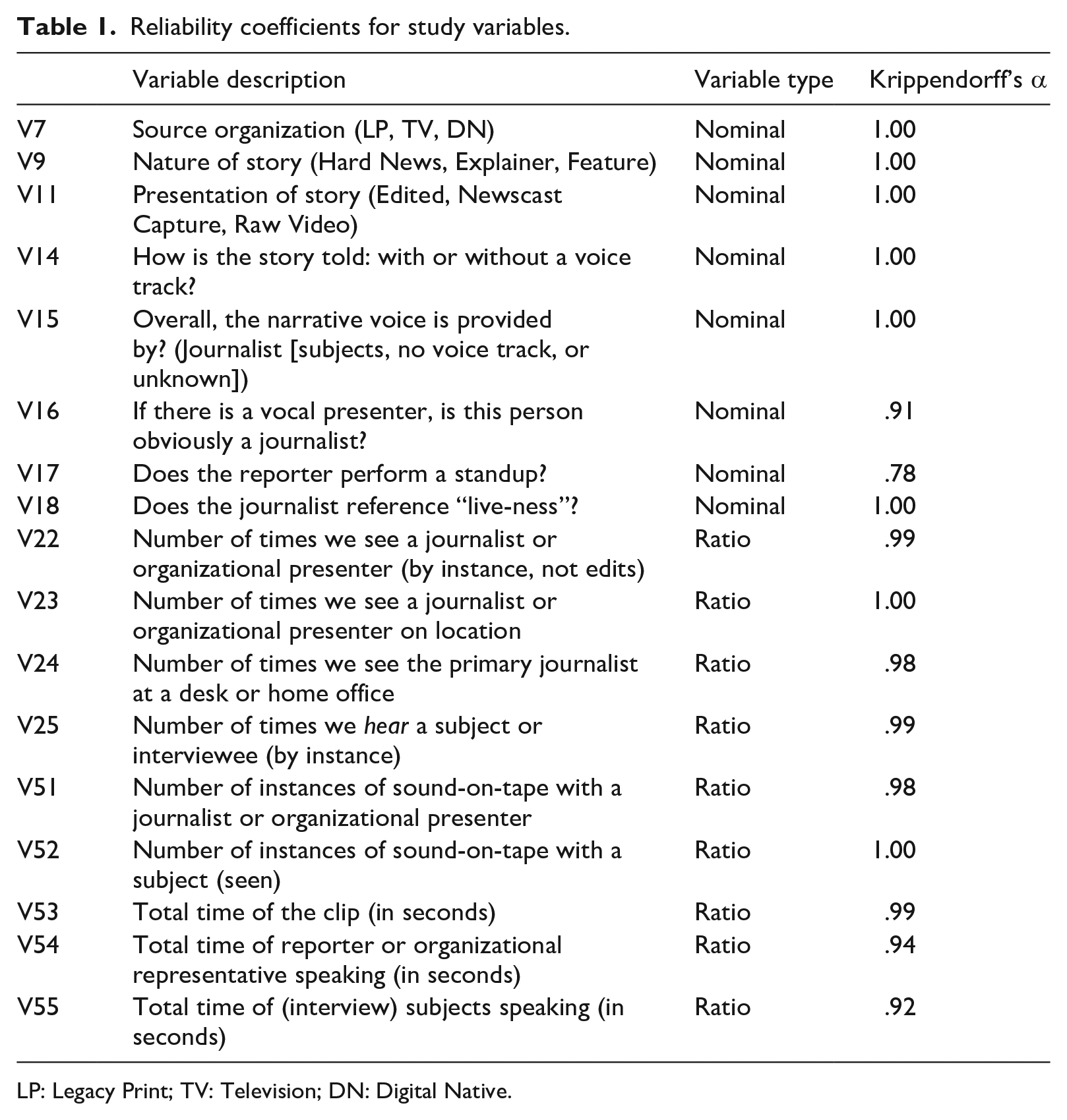
Three of the four authors worked as coders. The team worked together in the earliest iteration of the codebook and performed three more rounds of practice, refining the codebook until it achieved acceptable intercoder reliability, measured by Krippendorff’s alpha (K-alpha) on a scale from 0 to 1 (Krippendorff, 2004). The full data set includes 56 quantitative variables, but only some of them offer insight regarding epistemology, and these were chosen for this paper’s analysis. The relevant variables for this project are associated with temporality, narrative construction, subject interviews, and journalistic presence. For example, coders examined whether the source of a story’s narrative was provided by a scripted voice, soundbites from sources edited together, or simply through on-screen titling. The relevant coded variables and their K-alphas are provided in Table 1. Variables without acceptable intercoder reliability were eliminated from the study.
Reliability coefficients for study variables.
LP: Legacy Print; TV: Television; DN: Digital Native.
Even in the codebook development phase, it became clear that online video form is not converging but instead is developing in ways tied to organizational tradition. The team twice revised the definition of narrator, as many DN stories use presenters who seem to be hosts rather than journalists or field reporters. Even defining a “visible journalist” became problematic for the way some DN sites posted videos with hosts who were clearly tied to their organizations but did not use traditional news discourse, instead injecting humor, acting as entertainers, or endorsing products.
Results
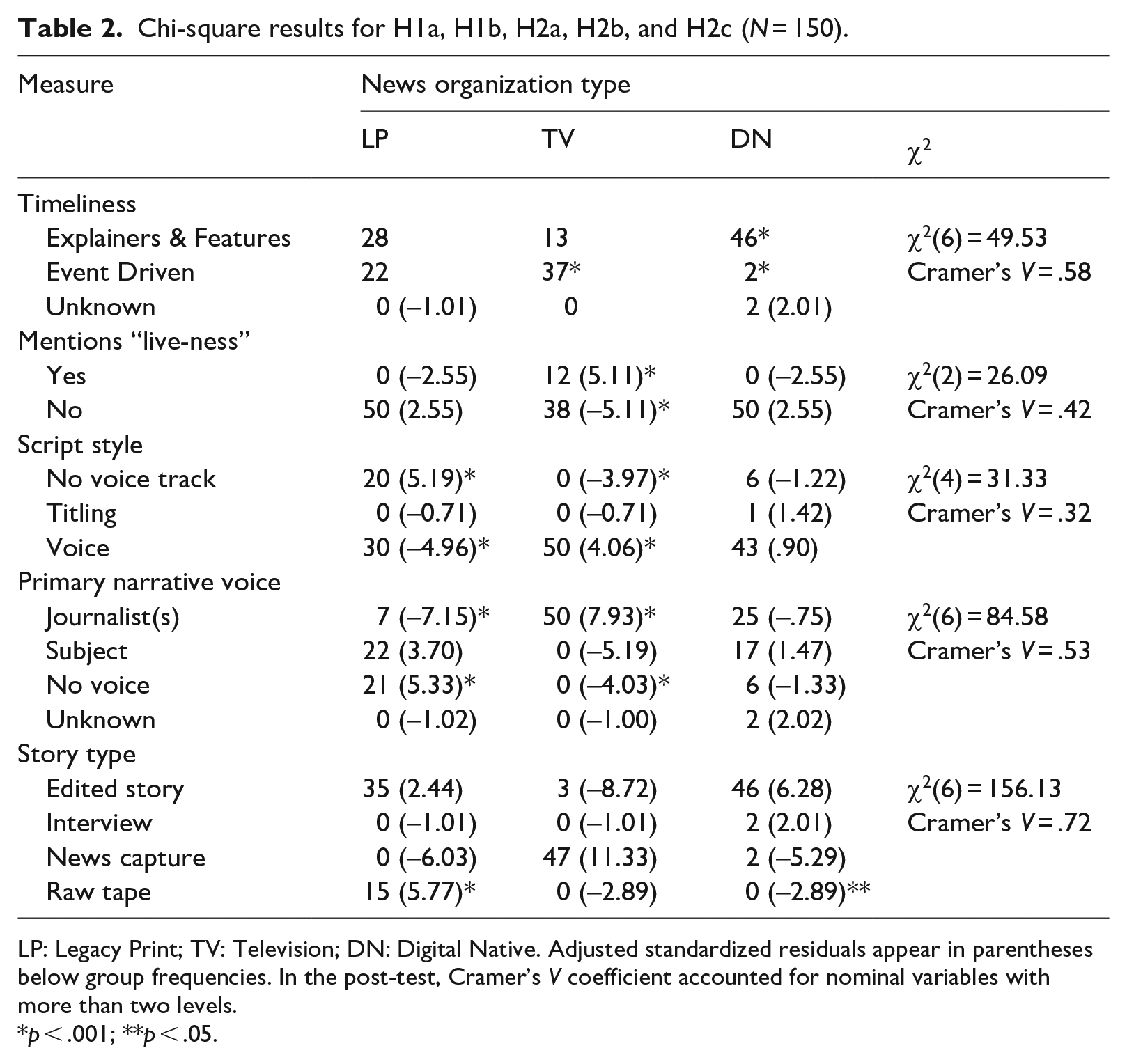
The analysis was conducted using two statistical methods. First, a chi-square test of independence (Table 2) compared how the three news organization types differ in their coverage of timeless or event-driven topics (H1a) and references to time (H1b). Narrative authority was measured by the frequency of using titling, narrative voice, or no voice (H2a), the identity of the primary narrative voice (H2b), and the use of raw tape (H2c). Second, the newsrooms’ treatment of interview subjects was tested using a multivariate analysis of variance (MANOVA) that employed news organization type (LP, TV, or DN) as an independent variable, and newsrooms’ scores for the total time devoted to interview subjects (H3a), how often they were heard on tape (H3b), and how often they were seen on screen (H3c) as dependent variables (Bray and Maxwell, 1985). Similarly, journalistic presence was also analyzed using a MANOVA with news organization type presented as an independent variable along with three dependent variables: the amount of time devoted to spoken words from a journalist versus an interviewee (H4a), how often we see a journalist on screen within a story (H4b), and how often a reporter appears on location (H4c).
Chi-square results for H1a, H1b, H2a, H2b, and H2c (N = 150).
LP: Legacy Print; TV: Television; DN: Digital Native. Adjusted standardized residuals appear in parentheses below group frequencies. In the post-test, Cramer’s V coefficient accounted for nominal variables with more than two levels.
p < .001; **p < .05.
Timeliness
A chi-square test of independence compared the frequency of news organizations’ coverage of evergreen versus event-driven news (H1a). A significant relationship was found across the three news organization types: χ2(6, N = 150) = 55.73, p < .001, 1 Cramer’s V = .43, showing that DN sites produced a disproportionately greater number of evergreen stories (42%) with very little timely news. Some of these evergreens bordered on product placement and included reviews and features about new businesses. One source, HuffPost, stood out for its daily coverage of political stories involving Donald Trump.
Timeliness was also examined by noting whether a journalist ever said “reporting live.” A significant relationship was found across the three news organization types: χ2(2, N = 150) = 26.09, p < .001, Cramer’s V = .42. TV referenced “live” moments more often than LP; thus, H1b is supported.
Scripted narrative authority
Narrative authority was tested by two sets of hypotheses. The first set examined the tactics of scripting, measured by three nominal variables: the presence of subject-driven narration (H2a), who serves as a narrator—whether journalist(s), subject(s), no voice or unknown (H2b), and the use of raw (unedited) tape (H2c). The second set of hypotheses dealt with handling interview subjects, tested through a set of continuous variables using a MANOVA. All three chi-square tests of independence showed significant differences across the three news organization types in handling subject-driven narration: χ2(4, N = 150) = 31.33, p < .001, Cramer’s V = .32; the narrative voice: χ2(6, N = 150) = 84.58, p < .001, Cramer’s V = .53; and the use of raw tape: χ2(6, N = 150) = 156.13, p < .001, Cramer’s V = .72.
In the post hoc analysis, we found H2a is partially supported since a disproportionately high number of LP stories did not have a voice track (p < .001); however, this is not true for DN (p > .001) in comparison to TV. This finding is in keeping with previous research that found that visual journalists for print organizations avoid scripted tracking. The Colorado Springs Gazette, for example, used natural sound, music, and titling to tell the story of a new bridge opening. Titling appeared to be a popular way to add linguistic context to stories, and there was no statistical difference in its use across the three news organization types (p > .001).
H2b was supported because all TV stories in the sample were narrated by a journalist or multiple journalists (p < .001), whereas LP stories were less likely to use a journalist track and more likely to either build a track from interview subject soundbites (p = .003) or let a story unfold with only natural sound or music (p < .001).
Print organizations were more likely to post raw video, sometimes simply sharing body-cam video released by local police departments. Compared to TV, LP used raw (unedited) tape more often than expected (p < .001). This was not true for DN (p > .001); thus, H2c was partially supported, though the relationship comparing DN’s greater use of raw tape compared TV was significant at a standard alpha level (p < .05).
Interview subjects and soundbites
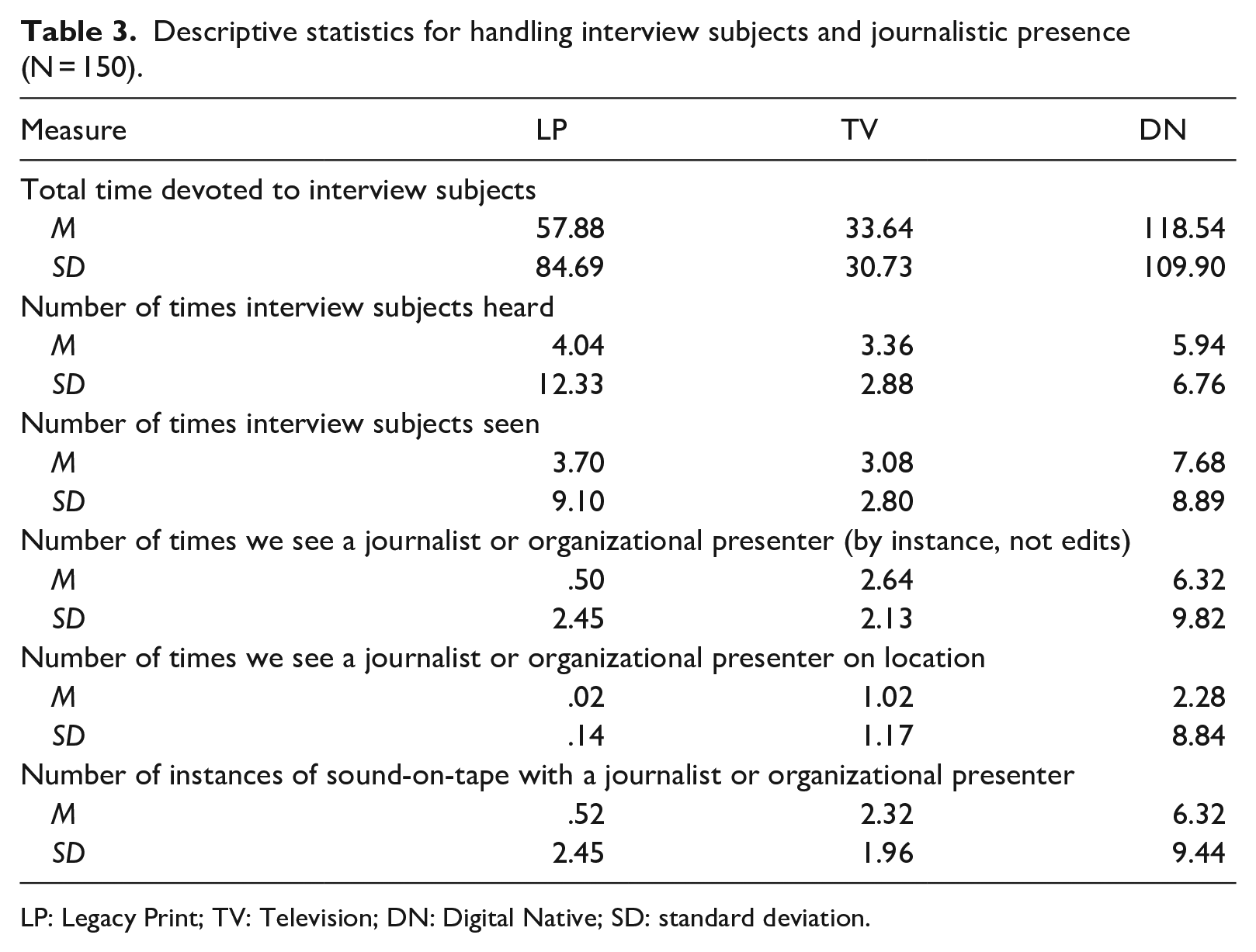
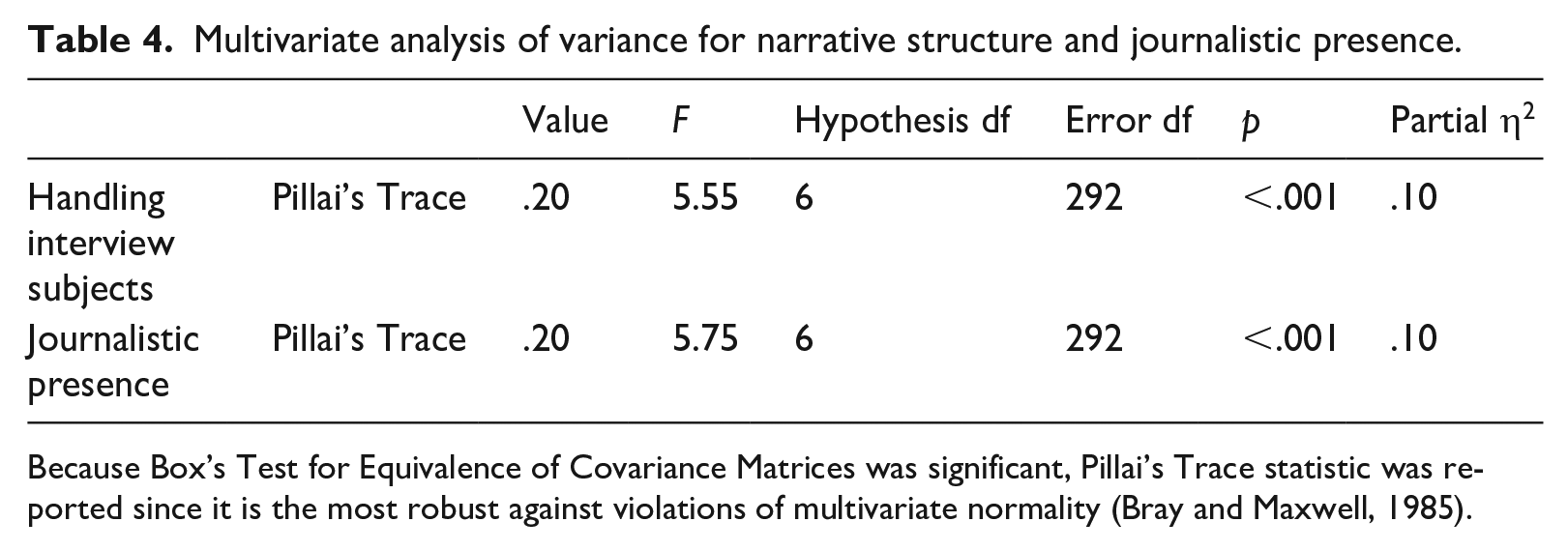
Measuring the time granted to sources in interviews provides insight into who tells a video story and how, and the control a journalist exerts in scripting the narrative. We used a one-way MANOVA to determine a significant relationship between news organization type (IV) and soundbite practices as measured by a set of three DVs: the total amount of time devoted to interview subjects (DV1) and the frequency of how often interview subjects are heard (DV2) versus seen (DV3) within a story. The results demonstrated a significant multivariate effect, Pillai’s Trace: (6, 292) = 5.55, p < .001, which is a medium effect (2pη = .10) (see Table 3 for descriptive statistics and Table 4 for MANOVA results). When those measures were subjected to separate one-way ANOVAs (Table 5), significant univariate effects were found on two out of three dependent variables: total amount of time devoted to interview subjects, F(2,147) = 5.51, p < .001, η2 = .16, and how often interview subjects are seen on screen, F(2,147) = 14.21, p < .001, η2 = .07, representing large and medium effect sizes, respectively. A univariate effect for how often interview subjects are heard was not significant (p = .28). Therefore, H3a (soundbite time) and H3c (interviewees seen) were supported, whereas H3b (interviewees heard) was not supported.
Descriptive statistics for handling interview subjects and journalistic presence (N = 150).
LP: Legacy Print; TV: Television; DN: Digital Native; SD: standard deviation.
Multivariate analysis of variance for narrative structure and journalistic presence.
Because Box’s Test for Equivalence of Covariance Matrices was significant, Pillai’s Trace statistic was reported since it is the most robust against violations of multivariate normality (Bray and Maxwell, 1985).
Univariate analysis of variance for handling interview subjects and journalistic presence.
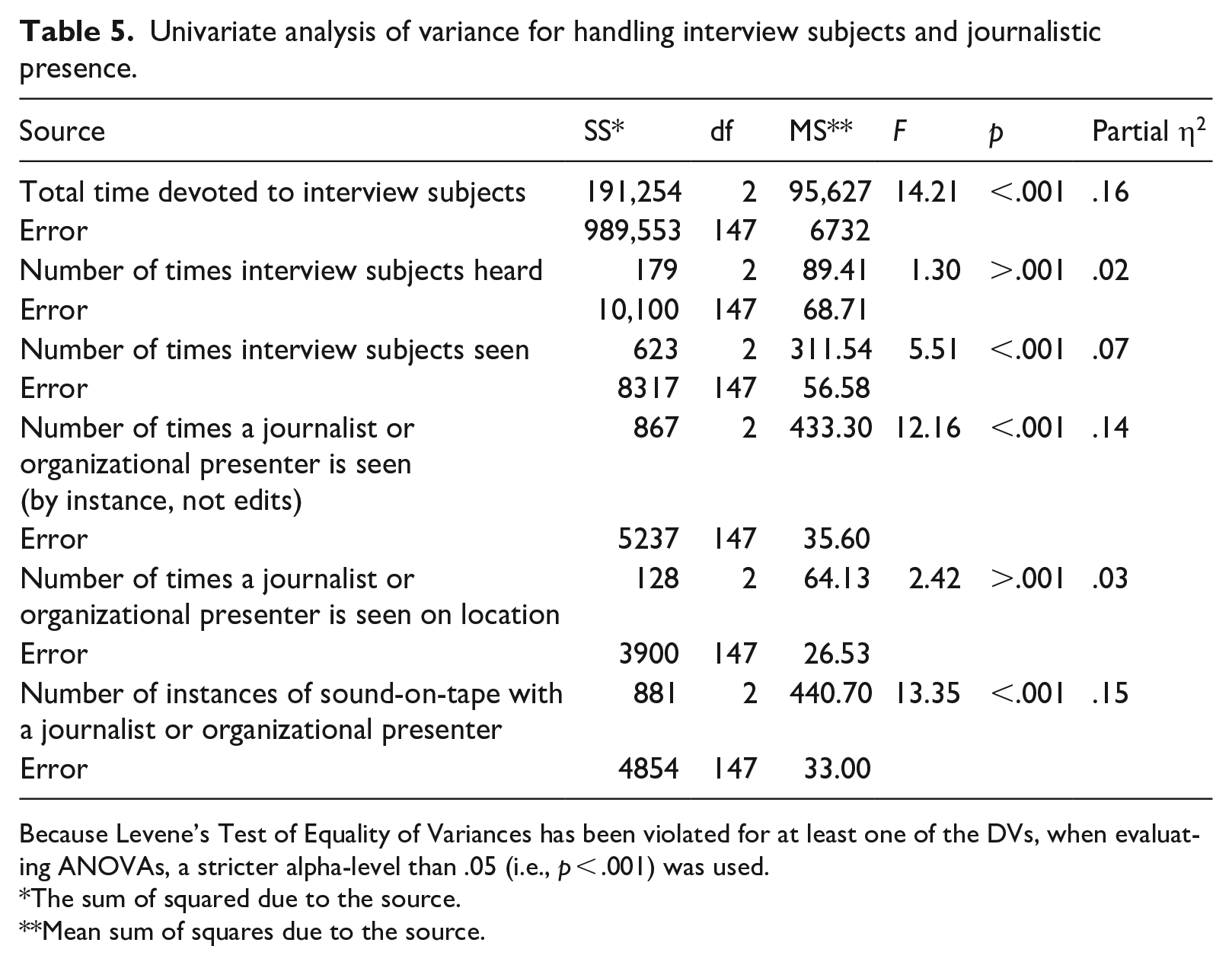
Because Levene’s Test of Equality of Variances has been violated for at least one of the DVs, when evaluating ANOVAs, a stricter alpha-level than .05 (i.e., p < .001) was used.
The sum of squared due to the source.
Mean sum of squares due to the source.
The Games-Howell post hoc procedure for pairwise comparisons (Table 6) showed that DN videos devoted significantly more time to interview subjects than LP and TV (p < .001). Furthermore, DN videos outnumbered LP and TV on the number of times interview subjects are seen on screen (p < .001) (Table 6). Put simply, DN stories allowed more time for interview subjects to speak, shifting epistemic responsibility from journalist to source. In some cases, a DN “story” was a recorded interview without additional narration.
Mean squares on dependent variables for news organization types.
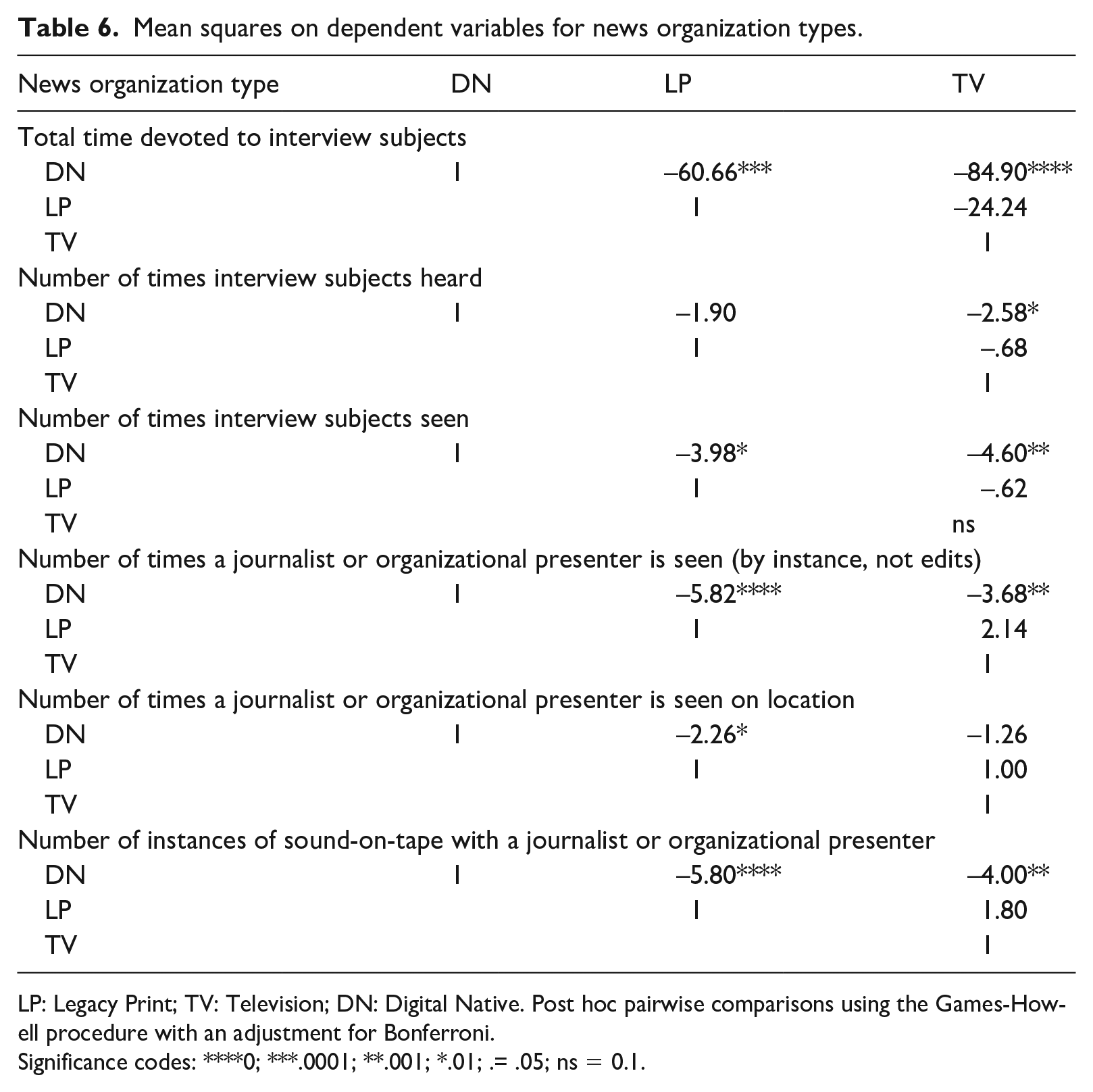
LP: Legacy Print; TV: Television; DN: Digital Native. Post hoc pairwise comparisons using the Games-Howell procedure with an adjustment for Bonferroni.
Significance codes: ****0; ***.0001; **.001; *.01; .= .05; ns = 0.1.
Embodied narrative authority
Another epistemological dimension of authorship in a video story is reflected by a journalist’s embodied presence and proximity to events. Again, we used a MANOVA and found a significant multivariate effect for a combined measure of journalistic presence (Pillai’s Trace: (6, 292) = 5.75, p < .001), which is a medium effect (2pη = .10), comprised of three DVs, measuring the frequency a journalist was seen within a story (DV1), the frequency a journalist was seen on location (DV2), and the number of instances a journalist was seen while speaking, a “sound-on-tape” (DV3). When the combined measure of journalistic presence was split onto separate univariate ANOVAs, main effects were found on two out of three dependent variables: how often a journalist is seen within a story (H4a): F(2,147) = 12.16, p < .001, η2 = .14, and the total number of instances a journalist appears with a sound-on-tape (H4c): F(2,147) = 13.35, p < .001, η2 = .15. The main effect of a journalist being seen on location was not significant (p = .09). Therefore, H4a (the journalist is seen) and H4c (the journalist appears while talking) are supported, and H4b (the journalist is merely heard) is not supported.
Additional statistical analysis (a post hoc Games-Howell analysis for pairwise comparisons) demonstrated a significant effect on how often a journalist appears while speaking when comparing the three groups. TV and LP stories gave more time to journalistic speech than interviewees, compared with DN. Many stories from the TV sample started with a journalist speaking from an anchor desk before the tape was rolled. Thus, H4a is partially supported. Similarly, there is a significant difference between TV and DN in the number of times we see a journalist appear within a story and an even stronger difference between DN and LP stories. Thus, H4b is partially supported.
Discussion
This project examined what Ekström and Westlund (2020) call the “processes for producing knowledge,” or epistemic strategies evident in online video news, to see whether organizational traditions might be associated with such practices. We found this to be the case. Legacy media organizations contrast with DNs in their choice of epistemological strategies for video production. This project contributes to a larger theoretical conversation about authority in the news by tending to the specifics of multimodal production. Four research questions with associated hypotheses guided our project, as we compared the three types of organizations according to the way they used production elements to establish authority: (1) time references, (2) narrator construction, (3) subject and soundbite incorporation, (and 4) narrator embodiment. Our findings offer something new, a description of an emerging DN style, and also reflect previous research in which legacy print organizations (LP) produced video news in a distinctive style that contrasts with TV.
Regarding temporality (RQ1), we observed that TV organizations continue to copy their edited reporter packages to the web straight from newscasts, keeping references to liveness even though the uploads exist online indefinitely and asynchronously. DN stories were less event-driven than LP or TV news. Only TV stories referenced “liveness,” tying a journalist to a real event. DN stories hardly ever posted event-driven news; 92% of their stories were classified as features or explainers. Such stories do not suffer the awkwardness of TV’s “live shots” suspended in digital amber, but they do not perform a traditional function of news, namely the chronicling of daily events.
The nature of narrator construction (RQ2) guided our examination of scripting styles and editing conventions that determine whose voice is used and when. The scripting styles of TV and LP organizations reflect previous research. TV stories continue to rely on voice tracks recorded by a journalistic narrator who speaks in the third-person declarative voice. RQ3 focused on how interview subjects and their soundbites are edited into video news. Reflecting previous research, LP stories were far more likely to use a mimetic approach, letting subjects tell their stories or letting a video unfold without any voice track at all. DN sites produced stories with a journalist’s voice track only half the time, mixing in many subject-driven or interview-based stories with a few stories that unfold without a scripted voice track. We hypothesized (H3b) that interview subjects would be heard more frequently in LP and DN stories than TV stories, but this was not supported. Nevertheless, the data found that DN stories let subjects speak longer. Our fourth guiding question, regarding narrator embodiment, produced unique insights. We hypothesized (H4b) that TV journalists would be seen on location more often, but this was only partially supported, as DN stories also displayed a significant embodied journalistic presence. Stories are more likely to show presenters, like TV, but unlike TV, those presenters did not always address the audience in ways traditionally associated with broadcast news. That is, they often appeared more like entertainment hosts with an informal speaking style—much as Matheson and Wahl-Jorgenson (2020) found with live bloggers.
Together, these four strands of findings suggest that DNs are developing a style of their own, with softer, more evergreen news presented by one or more representatives who share more time and presence with interview subjects.
This project contributes to theories of news epistemology for its attention to techniques of digital narrative production. Most epistemological studies have focused on language alone or discrete types of multi-modal information. This study found that strategies for establishing authority with filmic narrative techniques vary by institutional norms. It is not possible from this study to learn which of those norms is most beneficial for the online news audience. How well is the audience served by the diffuse, timeless, and multi-voiced form of DN video news? At best, the inclusion of multiple voices and materials may reflect more inclusivity in news, fulfilling a need long suggested by critics. On the other hand, this dilution might make it harder for the news audience to determine who to trust, when, and how. While this project focused on the mechanics of epistemology, not credibility or trust, these concepts are interrelated as they connect to journalistic purposes.
Conclusion
This study’s findings are significant for the way they point to three somewhat distinct video storytelling styles. The project extends news epistemology research for its attention to video production styles related to journalistic authority. LP organizations continue to rely on the camera’s recording perfection, hiding the subjectivities of visual production. TV journalists continue to script stories in ways that establish narrators as dispassionate, but well-positioned observers. DN news, on the other hand, reflects the hybridity and bricolage of Internet culture. Its stories reflect a wider range of styles and seem to make more expedient use of online resources, establishing authority by speaking the language of social media users and employing a bricolage construction style.
This project is limited by its sample size, sampling time frame, and geographic scope, as the organizations studied are all based in the United States. Most of the variables were nominal, which offers insight but lacks nuance. The project also does not measure change over time, which is significant for the fact that in 2023, more than one digital news organization suffered economic setbacks (Hirsch and Mullin, 2023). Nevertheless, this study highlights the way production elements are used to construct authority and the way organizational norms are related to epistemological production choices. The roots of an organization, whether it started as print, TV, or a DN, are significantly tied to the form of video news presented to the audience and the epistemological strategies employed by producers.
News consumers may be united in front of one screen, but the form of video news is not converging into one style. This project opens the door to effects studies to measure which forms the audience might consider most authoritative and useful. Video storytelling practices continue to evolve, and DNs are breaking trail, but the ultimate destination will be determined by the audience.
Footnotes
Data availability statement
Data for this project are in a shared repository.
Declaration of conflicting interests
The author(s) declared no potential conflicts of interest with respect to the research, authorship, and/or publication of this article.
Funding
The author(s) received no financial support for the research, authorship, and/or publication of this article.
