




Abstract
The paper attempts to describe, discuss and analyse the situation of rapid and spontaneous transfer to practical usage of a language which speakers know only passively in the situation of stable closely related bilingualism. Such a transfer – from native Russian to Belarusian – has been taking place in the Republic of Belarus due to various reasons. Partly, this process was connected to the political situation in the country and around it; at the same time, a part of Russian-speaking intelligentsia (mostly residing in the country capital, Minsk) was in the process of reshaping of their national identity. The paper discusses in details both those reasons, as well as the peculiarities of the language situation promoting this process, its linguistic features and their difference from those of an interlanguage which arises in the situation of a foreign language acquisition and from those of trasyanka, the code in-between Russian and Belarusian. The phenomenon in the focus is also compared with the newest tendency of Russian-speaking Ukrainians to transit to using Ukrainian instead of Russian in their everyday communication and in social media. The paper is based on the data obtained in the course of longitude field study conducted in Minsk in 1999–2022 and the data derived from media and internet sources.
Preface
In the focus of the current research are ‘individuals who have acquired an endangered or minoritized language not as a result of primary socialization in the family and community, but through immersion education and/or independent language study’ (Woolhiser 2013, 2). This endangered language, though it may seem unexpected, is one of the two official languages of an independent country – the Republic of Belarus. Being such, the Belarusian language (BL) was nevertheless listed in a recent classification of endangered languages by UNESCO as ‘vulnerable’ but, as K. Woolhiser rightfully put it, ‘would be more accurately classified as lying in a transitional phase between “vulnerable” and “definitely endangered” (meaning that children no longer learn the language as a mother tongue at home)’ (Woolhiser 2013, 7). 1
Following him, I will refer to these individuals as to newspeakers. I will compare their strategies, attitudes and challenges with those of the Ukrainian language (UL) newspeakers due to obvious closeness of the two situations (both countries were parts of the Russian Empire/the USSR, both were forcedly Russified, both titular languages of their countries are closely related to the Russian language (RL) and used to be regarded as a ‘peasant’s talk’ by the metropolis).
Background
The use of Belarusian and Russian most often has the form of non-parallel bilingualism, that is, ‘the non-parallel use of the two state languages and the assumption that all the inhabitants understand both of them’ (Giger, Sloboda 2008, 324). In a nutshell, Russian is dominating in all spheres, Belarusian being actually used in two entities – the first is to demonstrate independence (in documents, in urban topography, and in a limited number of official mass media), the second is to demonstrate identity (as the language of folklore events and as the language of choice for nationally oriented intelligentsia, who we have already termed as newspeakers).
A distinguishing feature of Belarusian-Russian bilingualism is the typological and genetic closeness of the two East Slavic languages. For instance, Bial’kovich (quoted by Giger, Sloboda, 2008) compared Belarusian and Russian versions of the text of the Universal Declaration of Human Rights and found that 27% of functionally and contextually equivalent (in the interlingual sense) morphemes had identical graphical forms, 37% were similar in form, and only 36% were completely different (on this topic see e.g. Brown, 2007; Hentschel et al., 2010; Liskovets, 2009: Woolhiser, 2014; Zaprudski, 2007).
Belarusian-Russian bilingualism gave birth to an interesting phenomenon of in-between speech variant called trasyanka 2 (see e.g. Liskovets, 2009; Hentschel, 2017; Fedorova, Liskovets 2022; Zaprudsky 2022). As C. Woolhiser stated, ‘In a sense, the sociolinguistic situation in Belarus is reminiscent of what is known in creole studies as a “post-creole continuum,” the socio-stylistic continuum of varieties that emerges when a creole (or basilect) comes into close and sustained contact with its primary lexifier language (or acrolect)’ (Woolhiser 2011, 26).
Ukrainian-Russian bilingualism share some of the above-mentioned (e.g. Kuzio, 1998; Bilaniuk, 2005, 2008, 2016; Kamusella, 2005; Bilaniuk, Melnyk 2008; Taranenko 2007; Del Gaudio, 2015; Sokolova 2021) but the linguistic situations in the two countries though having much in common are nevertheless strikingly different and the main point of difference is the position of the titular language.
In Soviet Ukraine (and earlier), the Ukrainian language though being suppressed in mostly the same way had never fallen to the level of vulnerability as there have always been a big community of its bearers. 3 Intergenerational transfer of the language has in fact been disrupted throughout much of the Belarusian speech territory while it has never been such in Western and some parts of central Ukraine (see e.g. Kuzio, 1998; Kamusella, 2005; Taranenko 2007; Bilaniuk and Melnyk 2008; Kulyk 2010; Kiss, 2022): ‘Belarusian national revival lacked an urban base and never reached the proportion of the Ukrainian revival’ (Pavlenko 2008, 290).
That is why it is not surprising that the two countries chose different language policies 4 since they gained independence in 1992: ‘In Ukraine the 1996 Constitution enshrined the position of Ukrainian as the official and national language in Ukraine. In 2003 Kyiv did not bow to Moscow’s pressure to make Russian a co-official language’ (Kamusella, 2005, 49) while in Belarus ‘the adoption of Russian as a second state language has effectively hampered Belarusian language revival. At present, Russian functions as the de facto main language, while Belarusian plays a symbolic function, indexing the nation in official documents and public spaces’ (Pavlenko 2008, 285). 5
So while language situations in modern Ukraine and Belarus differ significantly, newspeakers of the both languages have much in common (see also Zeller, Sitchinava 2019): • They share the same mother tongue which used to cover all their communication needs but has stopped covering at least some of them; • Their mother tongue used to receive higher social status and be of a great cultural value; • They mostly grew up in Belarus/Ukraine and studied the ‘titular’ language at school as a subject at a superficial level, which did not give them any command of using it in practice; • They have received their passive knowledge of the language (they all could read and understand BL/UL on an intermediate level) due to presence of titular language media and school curriculum in Belarusian/Ukrainian language and literature; • They have made their decision to start using the other language because of reshaping their system of values.
Methods and Data
The research is based on the data obtained in the course of longitude field study conducted in Minsk in 1999–2022. These field studies include field observations done annually, a number of language experiments and four sets of informal interviews, taken in Russian; respondents were free to choose the language to respond.
The first set was taken in 2000–2002. I interviewed 82 Minsk residents about their linguistic biographies, speech practices, and language attitudes with an attempt to include people belonging to different social strata. Interviews were taken in the farmer’s market, in two workshops of a big industrial enterprise, in three shops, in a private company, in different private settings. When recruiting respondents, several parameters were taken into account: age; educational level; the place of birth (Belarus city/town; Belarus village/small town; outside of Belarus); mother tongue; and the place of work. Two people answered in Belarusian, 18 – in trasyanka, 62 in Russian. I used mostly open-ended questions regarding the respondent’s language attitudes and practices. In 2006, I reinterviewed, less formally, six people (Russian-speakers) from the previous list to trace changes in their attitudes.
Three of them plus one more respondent, a Belarus refugee in Poland, were interviewed in 2022 as well as three Ukrainians (2 repatriates in Israel and a Kyiv resident). Interviews of this set contained questions only regarding their experience of transition to Belarusian or Ukrainian. All these seven people claimed Russian as their mother tongue, were born in Belarus/Ukraine and were college or University graduates.
Alongside with the data obtained by my own observation and interviews, I used the material of different media sources, mostly YouTube channels, which provide recorded speech in different settings, including speech in everyday interactions.
Theoretical Background and Main Notions
The current work is being performed in the frames of Language management theory developed by J. V. Neustupny and B. H. Jernudd (see short description of the theory in Nekvapil 2007). As Jiri Nekvapil postulates, ‘this theory could cover a large number of language phenomena and, therefore, could serve as a starting point for the description of a language situation. It follows from the structure of the language management theory that the resulting description of a language situation does not primarily draw on the linguist’s analytic perspective but is based rather on how the language situation is experienced and/or co-produced by the everyday language user’ (Nekvapil 2000, 176). This usage-based approach which ‘shifted the focus of theoretical thought concerning language planning towards the micro dimension’ (Nekvapil 2007, 95) suits the aims of the current analysis the best. Nadija Kiss applied this approach to contemporary sociolinguistic realities in Ukraine (see Kiss, 2022).
The main notion of the theory is language management – ‘a process which can occur on very different levels of society: in particular conversations of (everyday) language users, in families, in various social organisations such as companies, local authorities, schools, media, academies or ministries’ (Nekvapil 2000, 167).
Changes in the system of languages used in Belarus and Ukraine at the moment provide a definite and bright example of language management on different levels.
The key notion is that of an interlanguage, which is a linguistic system used by second language learners and affected by their native language (see Selinker 1972).
I will try to answer the questions about the newspeakers: who they are, when they made their transition and why and how it is happening in practice.
Who
In 2009, Curt Woolhiser defined the ‘three common stereotypes of new speakers that are frequently encountered in discussions of the public use of Belarusian: first, that they are just “showing off,” i.e., that their language use is essentially a performance (rather than “authentic,” unselfconscious “ordinary speech”); second, that they are necessarily “activists”; and third, that their language choice is motivated by an elitist desire to distinguish themselves from the Russian or trasyanka-speaking majority’ (Woolhiser 2013, 16). 6 However, in reality, as K. Woohiser puts it ‘I was surprised to discover that in the 2012 pilot survey of student-age Belarusian new speakers, only 2 out of 20 informants reported active participation in oppositional political organizations’ (Woolhiser 2013, 34).
The both of my Belarusian-speaking informants interviewed in 2000–2002 (see Ex 1 and 6 below) were in fact activists who didn’t hide their elitist ambitions and political preferences. But with the course of time and events the number of people who have reviewed their identity and made their decision to switch to Belarusian in their everyday speech practices, which, as K. Woolhizer stated, ‘is frequently represented as an overtly political statement, the choice of Belarusian being regarded as an index of opposition to the government’ (Woolhiser 2013, 13), has significantly grown (the reliable data of the their quantity is not available due to serious political repressions over any manifestation of opposition, including speaking Belarusian). 7
These people are mostly University graduates of different occupations but with the shared oppositional ‘myth of Belarusianness consisting of language, culture, and independence from Russia’ (Titarenko 2007, 83), or as it was formulated by J (female, University graduate, 40–50 y. o.) in the interview taken in 2000:
(1) The main question is where we are going – towards the West, towards freedom, towards Europe, or do we remain in kolkhoz (Soviet non-voluntary agricultural union, symbol of Soviet regime).
The group of newspeakers of Ukrainian is obviously much wider, especially since 2014, as L. Bilaniuk put it, ‘many people have felt that using Russian plays into the hands of the enemy, and so have switched from Russian into Ukrainian to demonstrate their support for Ukrainian sovereignty’ (Bilaniuk, 2022, 52). Exponential growth in the number of speakers of Ukrainian is shown by a research done in summer 2022 (see Kalitventseva, 2022).
In What Setting
‘Depending on the language situation, new speakers may adopt different strategies in their interactions with out-group interlocutors: in some cases, they will switch back to the majority language, maintaining a bilingual communicative repertoire, while in other cases they will continue to speak the non-dominant language with interlocutors speaking the dominant language’ (Woolhiser 2013, 3). My own experiments support the above-said but they also show another aspect of the reasons underlying the language choice in a particular situation.
When asked (interviewed in 2022) about the settings where she chooses Belarusian, one of my informants (N, female, college graduate, 50–60 y. o.) said: (2) “I speak Belarusian with those who prefer it. And in front of those who keep bullshitting about the united nation [of Russians and Belarusians]. In other situations I speak the way I am used to [i.e. Russian]”.
While working on the article already in Israel, I noticed the same pattern of behaviour from the side of a Ukrainian girl who spoke English with her colleagues and clients from Russia, explaining her behaviour by trying not to communicate in her native Russian with possible supporters of aggression against her motherland.
A lot of such examples can be quoted as well that highlight the main reason for switching from Russian – manifestation of independence and resistance.
When
The turning point of this movement in Belarus 8 was the year of 2014 due to two circumstances: the most significant – the revolution of dignity in neighbouring Ukraine and further Russian aggression against it and the less significant but still influential – World hockey championship held in Minsk required massive preparatory works which definitely increased the presence of Belarusian in street signs, public announcements, outdoor advertising, etc. These ‘changes of public space’, as Jiri Nekvapil put it speaking about changes in Czech cities in the after-Soviet epoch (see Nekvapil 2000) gave an obvious stimulus to changes in the system of values and to increased interest towards Belarusianness and Belarusian.
The next milestone was the revolution of dignity of 2020 after the disputed presidential election in August. Though failed, it showed unprecedented levels of mobilisation in Belarus and has led to actualization of Belarusian as of the language opposing the pro-Russian vector chosen by the authorities (see Petrova, Korosteleva 2021).
The third turning point was the start of the active phase of Russian aggression against Ukraine in February 2022. Belarus supported the aggressor and de facto lost much of its independence. The start of the war caused immediate shrinking of publically used Belarusian and thus made several people with democratic set of values to reconsider their language practices. 9
Why
Until 2022, the Belarusian language was the key to raising national consciousness even though the vast majority were (and have been) speaking Russian in everyday life. From the standpoint of Belarusian speakers, this language also links the nation to its European heritage unlike Russian which is regarded as a product of the colonial past. Since the de facto occupation of the country and Russian aggression against Ukraine Belarusian has gained other symbolical values of resistance against Russification, of support for Ukrainians in their fight and of a border between the two nations (see above, Ex. 2).
The reasons for Ukrainians’ refusal from Russian are highly unlikely need to be clarified. However, I would point here two main aspects.
The first is an emotional desire to distance from Russia and Russians as far as possible. Here is just one illustrative example. ‘Nastoyashchee vrem’a (Present Time)’ channel is interviewing, in Ukrainian, a refugee from Kharkiv. Hearing his ‘broken’ Ukrainian, the journalist offers to speak Russian. He refuses saying: (3) No, nevermore. I don’t want to speak Russian, the language of occupants and rascals. (https://t.me/c/1568777679/168630)
The second is more practical. The language serves as an in-group marker and not just a symbolic one. One of memes of this war is ‘say pal’anyc’a’ 10 : this word is extremely difficult to pronounce correctly for those who can’t speak a least some Ukrainian and, thus, is a perfect choice as a shibboleth. The meme was pushed by the viral video (https://youtu.be/Q5O2N2Ujaas) shot on Feb, 26, 2022 in Sumy region where a local man uses two language strategies in order to realise who are the military blocking his road: he says ‘Slava Ukraine’ (Glory to Ukraine, an official greeting) and when he doesn’t get the required answer ‘Heroyam slava’ (Glory to the heroes) he asks the military – ‘say pal’anyc’a’. The same strategy is widely used on different levels (see, e.g., Homenko, 2022) which can be easily explained: in this war between the two closely related and interrelated nations the not-shared language is definitely playing a demarcation role between ‘us’ and ‘they’.
How
Thus, a number of Russian-speakers have to shift – immediately and with little or no educational support 11 – to the language which they knew only passively. The newspeakers have to overcome the language barrier and start speaking the language they only used to perceive in oral or written form. This process of immediate immersion can be compared to the process of learning a second language by emigrants.
By a gradual process of trial and error and hypothesis testing, 12 learners manage to establish closer and closer approximations to the system used by native speakers of the language. The mistakes the newspeakers make during their spontaneous speech present much interest to a researcher. The material to be studied is easy to be found – the majority of Ukrainian public figures have been undergoing the process of mastering their Ukrainian language skills as well as a part of Belarusian opposition activists.
As it is well-known from the theory of second language acquisition (SLA), ‘learner’s errors are caused by several different processes: a. borrowing patterns from the mother tongue b. extending patterns from the target language. c. Expressing meanings using the words and grammar which are already known’ (Richards et al., 1992, 186).
The hypothesis of this research is as follows: using Belarusian or Ukrainian by not-native speakers in the process of learning though being different from typical SLA process due to closeness of languages, presence of a mixed code and long-term exposition to the second language will nevertheless contain the same types of irregularities.
Let us study speech examples. (4) Ukrainian, 2022. Olga Solodukha, former athlete, Rada Deputy https://www.facebook.com/watch/?v=5284762491602734 (with Ukrainian subtitles) (5) Belarusian, 2006, interview: S, female, university graduate, 20–30 y. o.
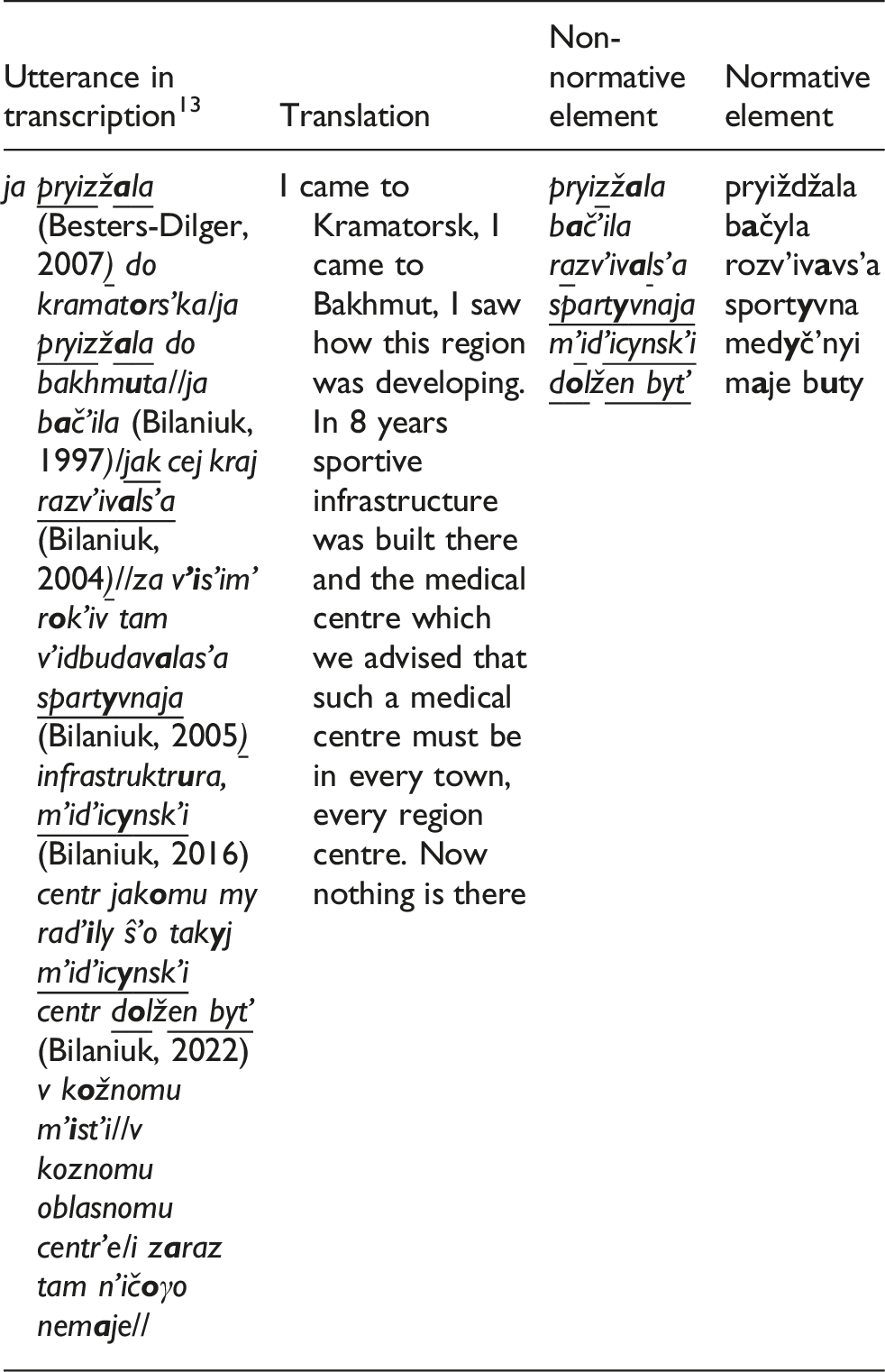
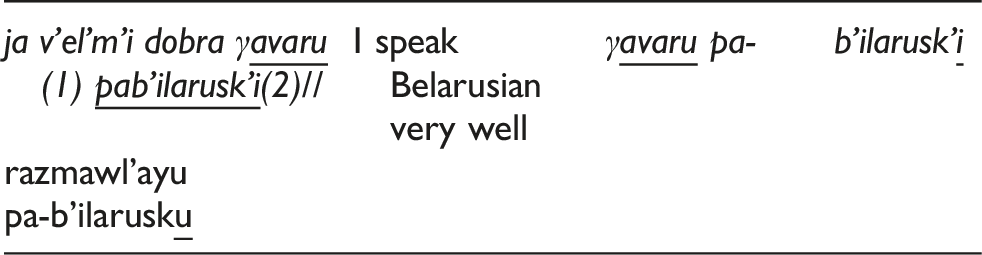
In these examples, we see overrepresentation of mistakes of the first listed type – borrowing patterns (and words) from the mother tongue.
In example 5, 14 we see two non-normative items. Let’s first focus on the second one, which is borrowing of either Russian morphological pattern (RL ending ‘–i’ instead of BL ‘-u’) or the word itself (‘pa-b’ilarusk’i’ is a normative Russian adverb meaning ‘in Belarusian’). Closeness of the languages makes it difficult to say whether it is a mistake in Belarusian or a Russian borrowing.
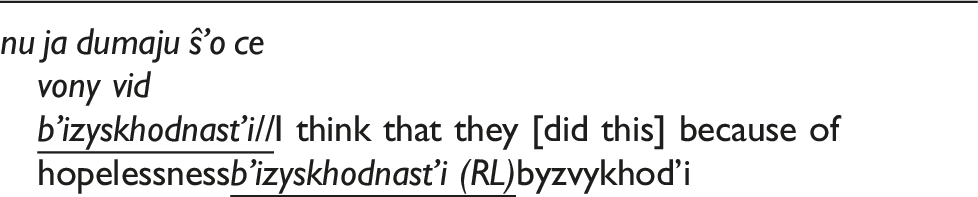
The material gathered so far shows that such borrowing or, as it can be called, backsliding to Russian due to language inertness, presents a very popular strategy, which is highly unlikely to occur in a distant language learning process. Backsliding can happen with literally any type of item at literally any place of an utterance. Most popular are the three following ones.
Backsliding at the most common words (presumably due to language inertness): (6) Belarusian, 2002, interview: J, female, university graduate, 40–50 y. o. (7) Ukrainian, 2022, general Serhii Kryvonos. https://youtu.be/kY-fRWFP0Eo.


Backsliding at rare words (presumably due to lack of vocabulary): (8) Belarusian, 2022, Andrej Pavuk, blogger. https://youtu.be/RRYex3u4cFg. (9) Ukrainian, 2022, Oleg Zhdanov, military analyst. https://youtu.be/OZoTjoN-Sn0.

Backsliding at discourse markers
15
(presumably due to language inertness): (10) Belarusian, 2022 (11)
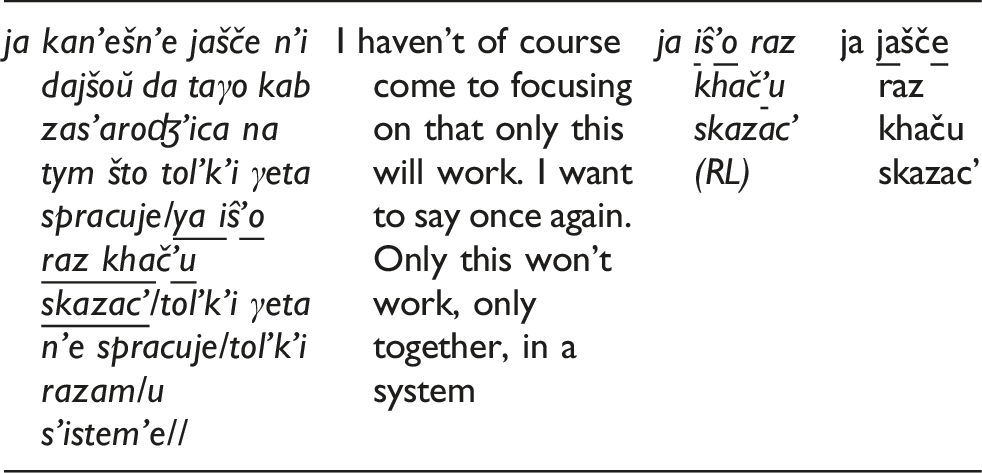
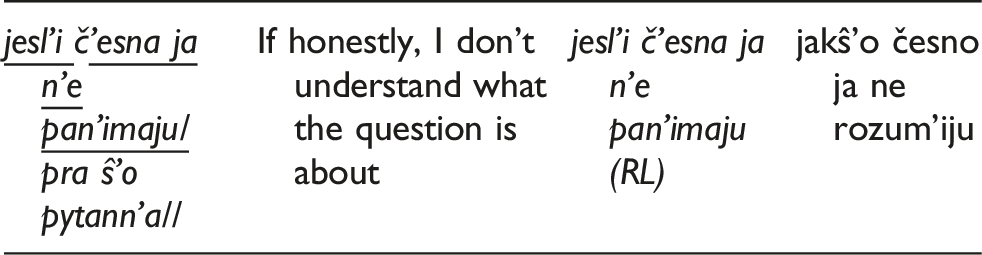
In these examples, speakers use Russian words in the flow of their Belarusian or Ukrainian speech
(12) (13)
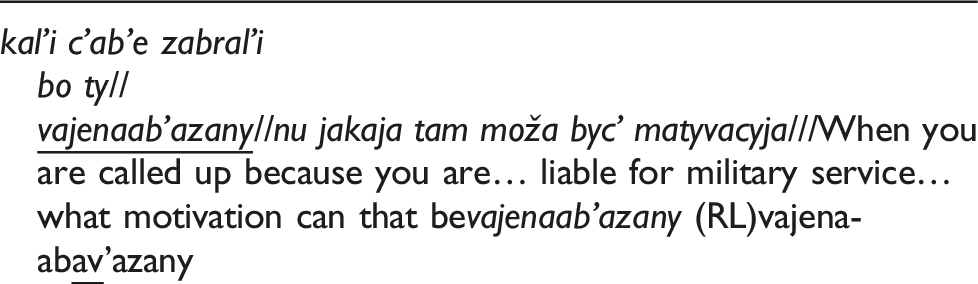
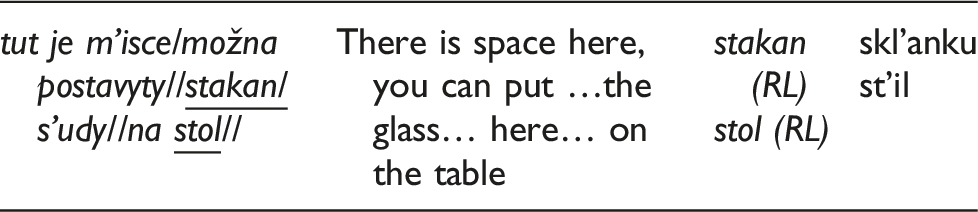
Such borrowings of full words are also highly unlikely to take place in the process of learning of a not closely related language.
Sometimes the speaker verbalises the process of searching for a correct word or construction, thus using code-switching: (14)
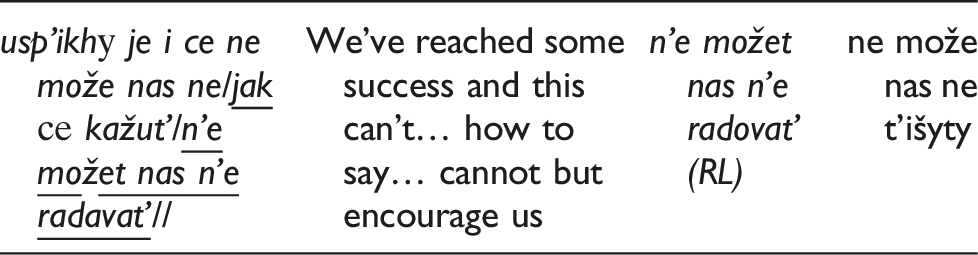
Marked by a pause of hesitation are also frequent cases of self-correction, typical for any SLA process: (15) (16)
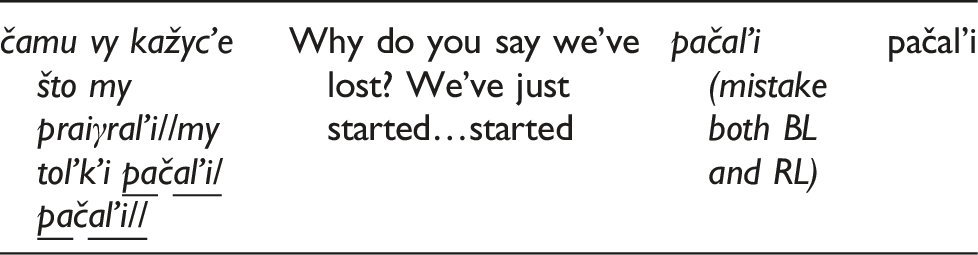

Another type of borrowing typical for newspeakers of Ukrainian and Belarusian is (17) Learn Belarusian, 2022, interview with D, male, 50–60 y. o., University graduate.
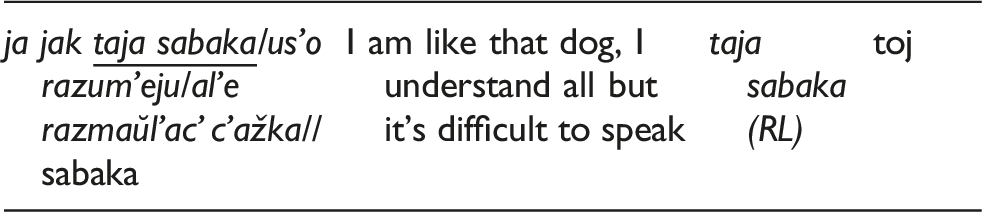
It is typical for close-related languages interlanguage paronymy with difference in usage, morphological or syntactical features (in this case, the difference is in gender).
(18) 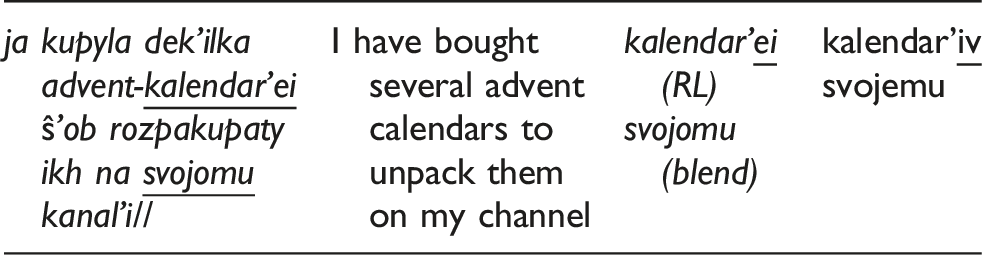
Here, the speaker uses Russian ending instead of Ukrainian.
Also multiple are borrowings of word-formation patterns for words with common roots (see as well the word ‘vajenaab’ (19)

Such speech mistakes are very frequent for the newspeakers of the both languages.
However, there are also some specifics for each of the languages. For example, the Ukrainian negative pronoun ‘žodny’ (=none, no) is to be used in a positive sentence. But since Russian has double negation with a phonetically-close pronoun, a newspeaker may use ‘žodny’ in a negative sentence: (20)
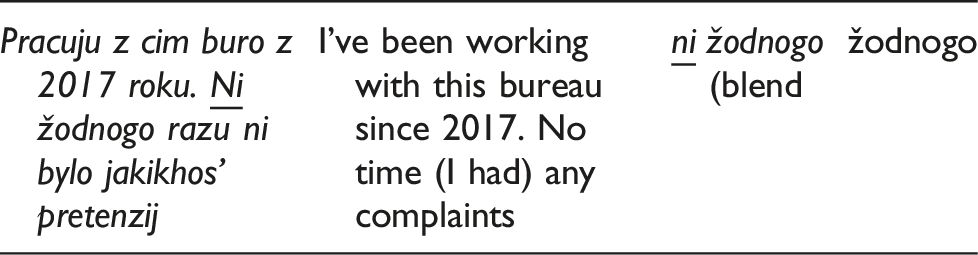
The last three examples showcase another popular type of newspeakers’ mistakes: blendings, which represent a combination of elements from two languages. Transfarm’ (21)
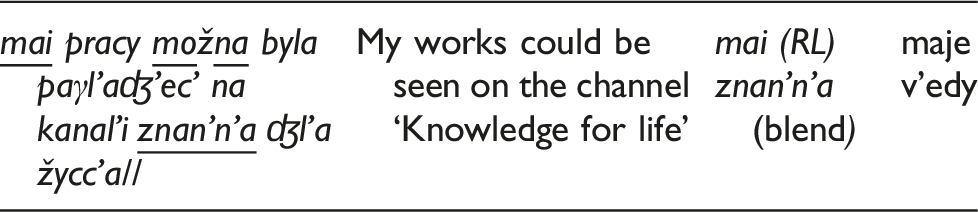
The speaker uses Russian pronoun ‘ma (22)
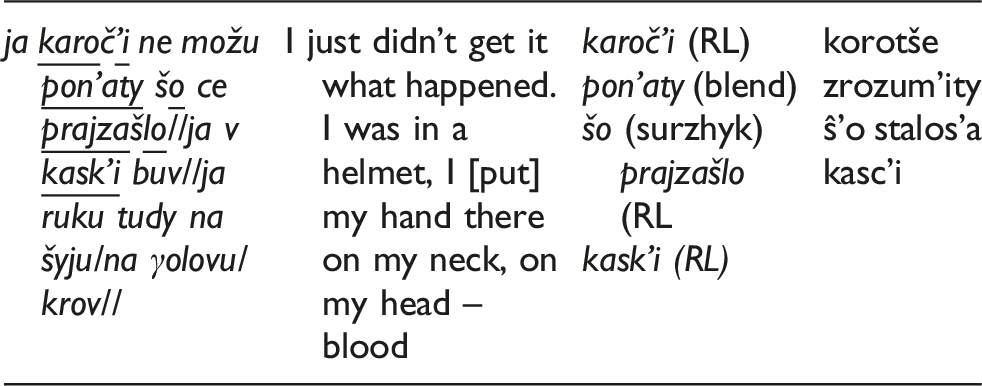
Here we see definite borrowings from Russian ‘projzašl
This pattern of borrowing different elements and blending them together was shown in Ex. Four and 5. The word
Ex. 4 contains all the described patterns: a borrowed word combination ‘d
Of course, no border can be drawn between backsliding, borrowing, and blending, they are different manifestations of the same process of mixing elements from the two languages.
Another expected interlanguage mistake, namely extending patterns of the target language (overgeneralisation in Selinker’s term), is much less typical, though existent: (23)

Here the speaker used a wrong model of conjugation like in ‘ab’ac (24)
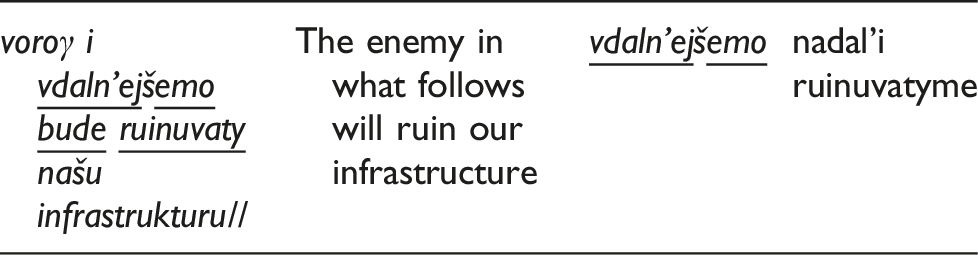
It is an interesting example of the speaker’s creativity in constructing this adverb to make (supposedly) Russian ‘v dal’n’
The third type of expected mistakes – usage of already known vocabulary or grammar, or, as other scholars call it paraphrasing – is extremely rare as a speaker has no need to use it: they always can use a Russian equivalent. for example, Ex. 21 can be treated as a paraphrase because BL would require the word ‘tvory’ (works) instead of ‘pracy’ (works) in the context of creative works which were meant by the speaker, while RL has only one word.
Is it Trasyanka/surzhyk?
As it can be seen from the above, the interlanguage of newspeakers has much in common with trasyanka or surzhyk and this fact is realised and even verbalised by informants. ‘In response to the question “Why don’t you speak Belarusian?” one of the most popular answers is “I don’t want to speak trasyanka.”’ (Woolhiser 2011: 35).
My Belarusian informants constantly marked the closeness of underlearned Belarusian to trasyanka, as proved by the following quote
(L, female, University graduate, 20–30 y. o., interviewed in 2001): (25) …you are just trying to say words in Belarusian but you don’t know the words and so you say Russian with Belarusian pronunciation. This is how they [trasyanka-speakers] do, but in the opposite direction – not to say it in Belarusian but in Russian. And with the same filthy result.
These newspeakers’ languages have their written form. Kapitolina Fedorova and me (see Fedorova, Liskovets 2022) quoted some examples: (Stamp on a passport) U vjezde adkazana (cf.: BL U vjezdze admowlena, RL: Vo vjezde otkazano) = Entry (to the country) is denied or (Official sign in the airport) Chrony karidor (cf.: BL chervony kalidor, RL krasnyi korior) = red corridor (at the customs). A Ukrainian example is given above, see Ex. 20.
The main difference of this new trasyanka or surzhyk from real trasyanka/surzhyk from the point of view of manifestation in language consists in the base language: real trasyanka is based on Belarusian, while inverted trasyanka is based on Russian, this being clear from phonetic features of the inserted parts (the same is true about surzhyk, see Sokolova, 2021).
Another point of difference, at least in case of trasyanka, is also connected with phonetics. It seems that newspeakers don’t have any difficulty with Belarusian pronunciation, while most trasyanka-speakers cannot reach the native-level competence in this domain of the Russian language.
As I have noticed and as my informants told me 21 , the situation with Ukrainian is not the same, as many newspeakers, even at advanced stages of mastering their Ukrainian, have an easily perceived accent (e.g. [a] instead of [o] in unstressed syllable, etc.), but this is to be analysed more precisely and deeply later on.
The main difficulties for Belarusian newspeakers, and seemingly for Ukrainian ones as well, are syntax and morphology since both Belarusian and Ukrainian have a lot in common with Russian but this commonness is much less than many newspeakers are aware of.
And of course, as in the case of learning any language, enrichment of vocabulary is the main and well-known challenge. And here lies the main difference of the process of learning Belarusian/Ukrainian from the process of learning of a more distant language.
Newspeaking as a SLA Process
From the analysis made above it is obvious that we are dealing with a very specific process of second-language acquisition. The main features of this process are borrowings (of words, of roots, of morphological and syntactical patterns) from the native language, backsliding, self-corrections, and blendings. And of these four phenomena, only self-correction has no specific features.
The specifics is based not only on closeness of the native and studied languages but mostly on the presupposition that the interlocutor would understand the utterance anyway, that is why borrowing of full words, of roots or of conjugation/declension patterns is the most popular strategy used to compensate for existing competency gaps, while such a strategy can hardly be expected to be used by a learner of any distant language.
Specialists in SLA also mark backsliding as a typical SLA feature. However, they mean not sliding back to one’s native language, but ‘variational reappearance over time of interlanguage features that appear to have been eradicated’ (Han, 2004, 102). It seems like we can consider that the newspeakers’ native Russian acts as an interlanguage in their process of learning Belarusian or Ukrainian.
Blending, that is using a Russian word with Belarusian or Ukrainian phonetical or morphological framing, definitely has its roots in trasyanka/surzhyk, where the same strategy is used, and has much in common with so-called immigrant languages, for example, the Russian of immigrants in the USA or Israel, that is, the Russian with frequent inclusions of English or Hebrew words in Russian morphological framing. However, such inclusions tend to retain Russian phonetics, while the newspeakers put a special effort at using the phonetics of the second language.
Phonetics thus seems to be the most perceivable feature, especially of Belarusian, and there lies the difference between newspeakers of the two languages: Ukrainian newspeakers find it harder to reach native-level phonetics than their Belarusian counterparts.
Summing up, it should be said that the newspeakers are experiencing the phenomenon known as an interlanguage fossilization, that is ‘the end-state of SLA, specifically […] an end-state that is not native-like. By end-state, we mean that point at which the learner’s mental representation of language, developing system, or interlanguage (all are related constructs) ceases to develop’ (Vanpatten, Benati 2015, 119). However, watching many of them in dynamics can prove that high value-based motivation, lots of self-control, and practice are the tools that help to overcome this barrier.
Additional Challenge
Thus, the newspeakers are pressured to switch to a language which they understand, which, though close to their native tongue, differs from it not only in vocabulary and phonetics, as they are aware of, but in morphology and syntax as well. Another challenge is provided by the mere state of the language they are switching to as of a language in the process of formation.
As Kurt Woolhizer noted, ‘in a situation where virtually all speakers of the language between the ages of 6 and 60 are bilingual, whom are we to regard as an authentic speaker of the sociolinguistically less dominant variety’? (Woolhiser 2011, 4). Heated discussions of which construction or word or form is correct and which is not have been taking place since early 1990-ies (see, e.g., Yavorska 2010; Kulyk 2010), and this provides another challenge for the newspeakers 22 .
Conclusion
The newspeakers’ Belarusian and Ukrainian present an interesting phenomenon, as it differs, on one side, from ‘classical’ trasyanka and surzhyk and, on the other side, from interlanguage which occurs in the process of learning of not a closely related language due to presumption of even greater closeness of languages.
Planned longitudinal studying speech practices and questioning are supposed to show how the process will develop and how the growing language learning awareness, value-based persistence and everyday practice will influence language competence and speech behaviour of Belarusian and Ukrainian newspeakers.
Footnotes
Declaration of Conflicting Interests
The author(s) declared no potential conflicts of interest with respect to the research, authorship, and/or publication of this article.
Funding
The author(s) received no financial support for the research, authorship, and/or publication of this article.