



Abstract
This study aims to specify the definitions of two terms, bigraphia and digraphia, and examine how these phenomena appear in post-socialist countries. It is currently a global phenomenon to use two or more writing systems in one country, due to the spread of English and the Internet. Bigraphia means when the function and prestige of two writing systems (or two varieties of one system) are equal. On the other hand, when there is a difference in the function and/or prestige between two writing systems, it is defined as digraphia. The paper examines the combination of writing systems in post-socialist countries such as Russia, Belarus, Serbia, and Uzbekistan. In-digraphia refers to a situation in which variations of one writing system coexist, and out-digraphia refers to a situation in which two different writing systems coexist. A narrower sense of digraphia is observed in Belarus today: Belarusian Cyrillic-Т(BC-T) is used to write Tarashkievitsa and Belarusian Cyrillic-N (BC-N) is used to write Narkamaŭka. Out-digraphia is observed in Serbia and Uzbekistan. In these countries, Cyrillic and Latin scripts are used to write Serbian and Uzbek. Out-digraphia is also confirmed in Russian texts: It is commonly thought that only Cyrillic letters are used to write Russian, but recently the use of the so-called “macaronic alphabet,” which is a mix of Cyrillic and Latin letters, has become common.
Introduction
The coexistence of multiple writing systems for a single language presents a complex and intriguing phenomenon. This is particularly evident in regions such as Moravia and Bulgaria, birthplaces of the Glagolitic and Cyrillic scripts, as well as in Russia and Eurasia, where the use of the Cyrillic alphabet has significantly expanded. This study aims to explore the instances in which two or more scripts are used to write a single language in post-socialist nations or language groups. It is important to note that the study excludes cases where multiple scripts are used to write several languages, since it is challenging to comprehend the intricacies of their coexistence based solely on the number of scripts without restricting the number of languages to one.
The problem becomes more complicated when there are multiple communities within a region or country, each of which uses a different script. For instance, let us consider the Belarusian Tatars who resided in the Polish−Lithuanian Commonwealth. Until the late 16th century, they spoke Turkic, later transitioning into Belarusian or Polish. During this time, these languages were written in Arabic script from the 15th to the 20th century (Мишкинене, 2015:61). Even though the Latin alphabet was used to write Polish, the Cyrillic alphabet was used to write Church Slavonic, and although the Cyrillic and Latin alphabets were used to write Belarusian, the Belarusian Tatars transformed Arabic script to form the Belarusian Arabic alphabet.
Meanwhile, there are cases where a community that previously used a single writing system may adopt multiple writing systems. In the case of Belarus, as mentioned earlier, it is a well-known fact that the Latin and Cyrillic alphabets were used together. However, within Belarus, three variants of the Cyrillic alphabet coexisted. The first variant is the script used by Nasha Niva (Наша нива), the first Belarusian weekly newspaper published between 1906 and 1917. The second variant is the writing system of Branislaw Tarashkyevich (Браніслаў Тарашкевіч), which laid the foundation for modern Belarusian orthography. This orthography, which was established in 1918, is known as the “classical” orthography or Tarashkievitsa (тарашкевіца). Further, its graphemes, which were used in Беларуская граматыка для школ (1918), became part of the second Belarusian Cyrillic writing system. The third variant is the writing system of Narkamaŭka (наркамаўка), which became the “official” orthography in 1933 following an orthographic reform. These three writing systems are variants of the Cyrillic writing system used in Belarus, with Tarashkievitsa and Narkamaŭka coexisting to this day.
Consequently, humans have historically utilized and continue to use two or more scripts to write a language for various reasons in diverse environments. In this study, we use the term “digraphia,” inspired by Ferguson’s term “diglossia,” to investigate cases where two or more scripts are employed to represent a single language. 1 In Chapter 2, we differentiate digraphia from other terms referring to script coexistence, while Chapter 3 classifies digraphia based on five criteria. Chapter 4 offers a detailed discussion on digraphia cases in post-socialist nations, including Russia, Belarus, Serbia, and Uzbekistan.
Digraphia: Terms and definitions
Several terms are employed to describe the use of two or more scripts: bigraphia, digraphia, biscriptality, and bialphabetism. However, it is important to note that the term “bialphabetism” should not be used to encompass all writing systems. The term “alphabet” typically refers specifically to consonant−vowel writing systems among phonetic writing systems, and not all writing systems (Gelb, 1963:14, Gaur, 1992:118, Daniels, 1996:4, Rogers, 2005:155–156). Moreover, the term “biscriptality” has multiple meanings, including those related to script and handwriting; thus, it is preferable to exclude the term to avoid ambiguity.
We now focus on digraphia, which extends C. A. Ferguson’s concept of diglossia to literacy. Ferguson’s influential work, “Diglossia,” published in 1959, prompted the active adoption and critical development of his terms and ideas within the linguistic community. Initially, Ferguson distinguished between two variants of a language: a high variety and a low variety. He observed that classical Arabic, used in the Quran, has a different function and status compared to modern Arabic, which serves as a daily spoken language. 2 He also provided examples of four language pairs: Classical Arabic and Egyptian Arabic, Standard German and Swiss German, French and Haitian Creole, and Katharevousa and Dimotiki, to illustrate high (H) and low (L) variety pairs, respectively.
However, Ferguson’s narrow application of diglossia to only variant forms of a language limits our understanding of language coexistence. By defining the coexistence of two languages solely as bilingualism, we fail to capture the distinctions in prestige and function that exist among language pairs. This limitation prompted later researchers such as Kloss (1966) and Fishman (1967) to observe that distinct functions and statuses can exist not only among language variants but also among unrelated individual languages. Schiffman (1997:205–206) further highlights that superordinate languages encompass not only those associated with “the dominant religious community or its priesthood,” but also languages with international prestige and those used by the local power elite. It is important to note that international prestige is not solely achieved through cultural factors but also through force, which underpins the international prestige of colonizing nations.
Spolsky (1998:64) highlights that the language of a colony’s ruling country can be an H language, whereas the language of a colony’s subject country can be an L language. Calvet (1998:28–29) further criticizes Ferguson’s theory, pointing out its failure to acknowledge the role of force. Calvet argues that the prestige and function of the H language are ultimately influenced by “the structure of power and the organization of society.” Consequently, the term “diglossia” has evolved to encompass language situations where prestige and functional differences exist, excluding considerations of kinship, in contrast to the more inclusive term “bilingualism.”
However, Ferguson argued that the presence of a significant and esteemed body of written literature, such as the Bible, contributes to the differentiation in prestige between language varieties (Ferguson, 1959:336). This approach raises concerns when applying Ferguson’s classification criteria. It becomes problematic to classify languages without “a substantial corpus of literature” (Ferguson, 1959:338) of the low variety type. For example, despite being the national language of Switzerland, Swiss German is still considered a low variety compared to Standard German. 3
How do the introduction of the Cyrillic alphabet in Kievan Rus in 988 and the development of the “Civil Script” during Peter the Great’s alphabet reform in 1708 align with Ferguson’s preconditions for writing systems? 4 Žagar (2021:167) notes that in 9th- and 10th-century Bulgaria, the Glagolitic script was used for religious purposes, while the Cyrillic alphabet was employed in governmental affairs, indicating a functional distinction between the two scripts. During Peter the Great’s reign, a series of directives were issued to produce “civil books” using the “new alphabet” from the late 1690s. The Moscow Printing House predominantly used the traditional Cyrillic script for printing religious materials, while the newspaper Vedomosti (Ведомости), founded in 1703, initially utilized the traditional Cyrillic script but gradually shifted to the Civil script for non-religious “civil” purposes, starting from 1710 (Cracraft, 2004:264–266).
It is worth noting that Russian Orthodox priests still read Church Slavonic Gospels printed in the Russian Church Cyrillic alphabet to this day. However, liturgical texts for common believers began to be printed in the Civil script in the 19th century, with limited instances of Civil script usage even in the 18th century (Кравецкий, 2021). In summary, the Cyrillic alphabet underwent a variant formation during Peter the Great’s reign, leading to a “specialization of function” (Ferguson, 1959:328) between the two varieties of the Cyrillic alphabet that persists to the present day.
When examining the construction of a new variety of the Cyrillic alphabet through Ferguson’s criteria for the H variety (literary heritage, stability, and acquisition), classifying the Civil script as an L variety becomes challenging. This is because the Civil script lacked literary heritage when Peter the Great came to power, and the imperial authority surpassed the religious authority. Grivelet (2001:5) provides an example of the difficulty in applying Ferguson’s concept of stability by citing the replacement of Chinese characters with Hanyu Pinyin. Examining the use of Church Cyrillic and Civil scripts for writing Church Slavonic reveals that stability is not necessarily a prerequisite for a high degree of diversity in writing systems. Moreover, unlike natural languages, the acquisition of writing systems typically requires formal schooling, which challenges the notion that acquisition is a determining factor for high diversity (Ferguson, 1959:331).
Given these considerations, this study excludes literary heritage, stability, acquisition, and other characteristics proposed by Ferguson from the concept of digraphia. Instead, digraphia refers to the coexistence of two or more writing systems, as well as the coexistence of two variants of one writing system with differing functions or prestige. Furthermore, it is crucial to distinguish between digraphia and bigraphia. Digraphia refers to the coexistence of writing systems or different variants of a single writing system with differing functions or prestige. In contrast, bigraphia involves the coexistence of two or more writing systems or variants of the same writing system that have identical functions and prestige. By making this distinction, we gain a better understanding of the complex dynamics of the coexistence of multiple writing systems. 5
Ferguson’s definition of diglossia has received significant criticism over the years and has been refined by numerous researchers to better explain various language phenomena. However, in discussions on digraphia, the focus on the two variants of a language, which Ferguson emphasized, has been largely overlooked. In the following paragraphs, as we classify the types of digraphia, we consider the two variants of a writing system, which are derived from the two variants of a language, as well as the criteria proposed by Ferguson, such as prestige, function, and others. Therefore, revisiting Ferguson’s definition holds some significance in our examination.
Classifying the types of digraphia
Classification according to the phylogenetic relationship of scripts: In-digraphia and out-digraphia
Despite the concept and nomenclature deriving from Ferguson, digraphia research nowadays focuses on the presence of two distinct writing systems (Grivelet, 2001:3). However, Ferguson’s focus on two varieties of one language when defining diglossia can equally be extended to digraphia. Above, we illustrated this using the Cyrillic script in 18th-century Russia as an example. Kloss’s (1966:138) distinction between the “connection within a family or between closely and recognizably related tongues” as in-diglossia and the “relationship between two unrelated tongues” as out-diglossia is relevant in this context. Accordingly, we propose classifying the link between varieties of a single writing system as in-digraphia and the interaction between two distinct writing systems as out-digraphia.
Croatia may serve as an illustration of out-digraphia. Croatians adopted the Latin alphabet after converting to Catholicism, while Croatian Cyrillic (Bosančica or Hrvatska Ćirilica) was frequently used from the 10th through the 19th century (Granić, 1989:113). In addition, the Glagolitic alphabet was utilized into the 20th century. Not only did Croats utilize Glagolitic “broadly and variably” in epigraphs, literary works, and religious texts, they also “exported” the Croatian Glagolitic script to Western Europe (Žagar, 2021:502–502). Croatian was written using three writing systems with differing evolutionary relationships (Latin, Glagolitic, and Cyrillic) that are geographically dispersed.
The two varieties of the Russian Cyrillic alphabet briefly outlined above are examples of in-digraphia. This is discussed in further depth in Section 4.1. By assuming that many varieties can exist within a single writing system, we can analyze the coexistence of Canadian French and Canadian English alphabets in greater detail, for instance, in cases where the Latin alphabet is used for French and a different Latin alphabet is used for English. 6 By distinguishing between in-digraphia and out-digraphia when conducting such investigations, it is easier to explain aspects regarding the “who, when, where, how, and why” of any given writing system that has been employed.
Classification according to period of coexistence: Synchronic digraphia and diachronic digraphia
Dale (1980:6) defines synchronic digraphia as the simultaneous existence of two writing systems, while diachronic digraphia refers to the replacement of one writing system by another. In the context of diachronic digraphia, Dale mentions a “diachronic switchover” that occurs during the transition from one writing system to another. According to Dale’s definition, only one writing system remains after the “diachronic switchover.” However, can we consider a situation where only one system is used once the shift in scripts is complete as digraphia? Just as the coexistence of two languages is a prerequisite for diglossia, the coexistence of two writing systems should be a prerequisite for digraphia. From Dale’s perspective, it is likely that all language communities on Earth with writing systems could be classified as digraphia societies if there were a transition of writing systems. In order to establish digraphia, the coexistence of two writing systems should be a prerequisite.
Diachronic digraphia is observed in societies where stability is maintained over several decades or even centuries. As briefly mentioned earlier, the Russian Orthodox Church provides an example of this. Since the early 18th century, the Russian Orthodox Church has used both the old Cyrillic script and the civil script to write Church Slavonic. Over time, these two scripts underwent reforms and evolved into their current forms. This is because the two variations of the Cyrillic script used by the Russian Orthodox Church serve different functions. We will examine this in more detail in section 4.1. Consequently, instances of diachronic digraphia can be identified in historical contexts where the coexistence of writing systems is observable. Conversely, synchronic digraphia is observed at a specific point in time, without considering its historical development.
Serbo-Croatian digraphia is another notable example to consider, which has been regarded as one of “two typical cases” with Hindi-Urdu digraphia (Grivelet, 2001:4). Since Serbo-Croatian linguists gathered in Vienna and agreed to utilize two writing systems as a single language in 1850 (Magner, 2001:18), Cyrillic and Latin scripts coexisted in Serbo-Croatia. However, since both Serbia and Croatia have their own distinct language policies in the 21st century, there is no longer a need to discuss the Serbo-Croatian language or Serbo-Croatian digraphia. In other words, Croatia is a monographic state that uses the Latin alphabet to write Croatian (Magner, 2001:21).
Classification according to replacement as a result of adoption: Transient digraphia and persistent digraphia
In the process of replacing a writing system, it is common and natural for two writing systems to temporarily coexist. After two script systems coexist during a transitional period, a script shift occurs. This corresponds to the cohabitation scenario in Uzbekistan during the transition from Cyrillic to Latin script.
Nevertheless, several languages regularly employ multiple writing systems. For approximately 100 years, the Korean language favored a dual writing system in which Chinese-origin words were written in Chinese characters and pure Korean phrases were written in Hangeul. During this time, Chinese letters held greater prestige than Hangeul, although this changed toward the end of the 20th century. Today, it is typical for Korean literature to be composed entirely in Korean. However, it is still common for newspaper headlines to use the respective Chinese characters to refer to a country or to the President of Korea. 7 By transcribing the surnames of presidents or significant politicians as well as the names of countries such as Korea (韓), China (中), Japan (日), the United States (美), and the United Kingdom (英) with single Chinese characters, paper is utilized economically. Additionally, to avoid confusion between homonyms, Chinese characters are frequently written after Hangeul words. The writing systems used in Korean texts are shifting from a persistent coexistence to a transient coexistence because Chinese characters are neither required nor recommended.
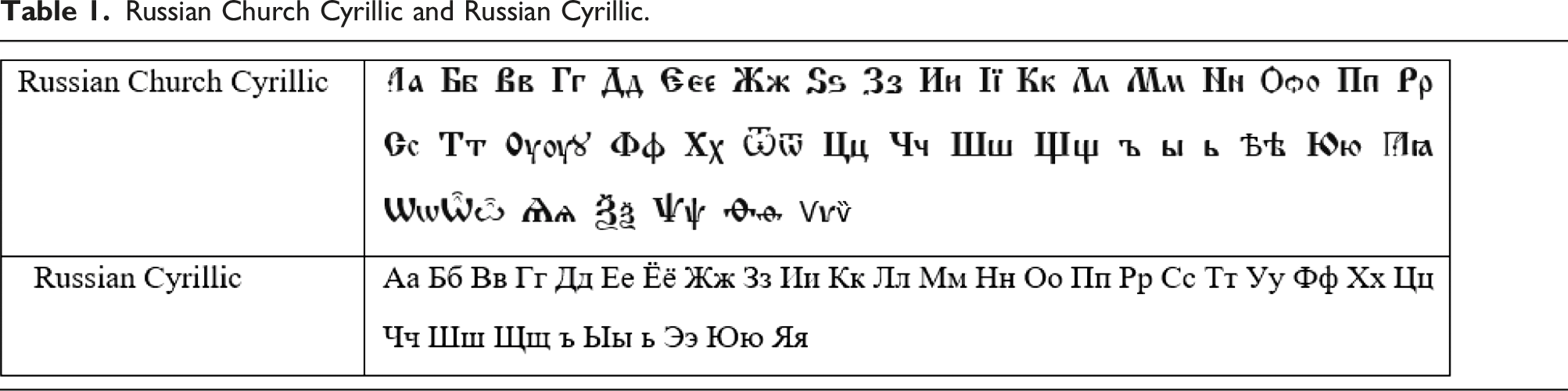
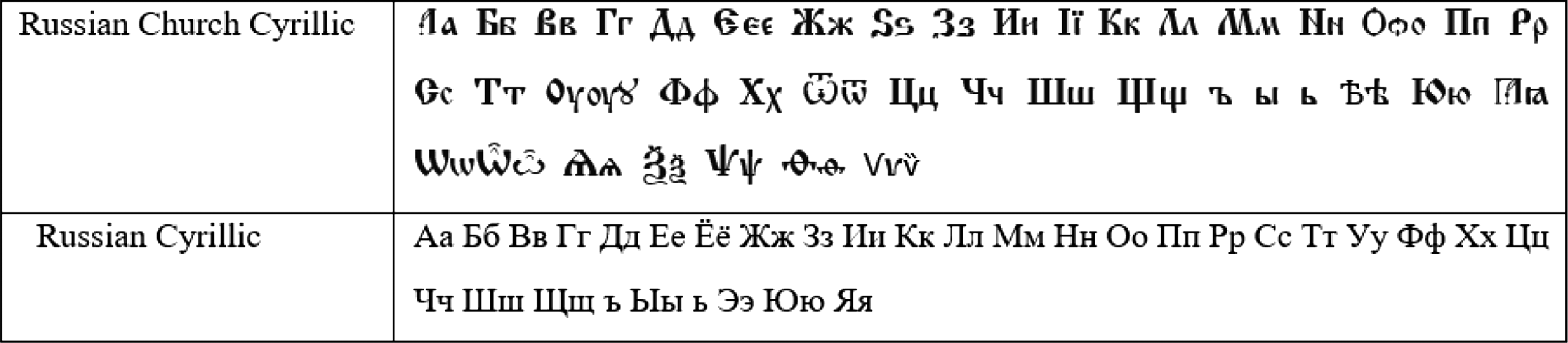
Russian Church Cyrillic and Russian Cyrillic.
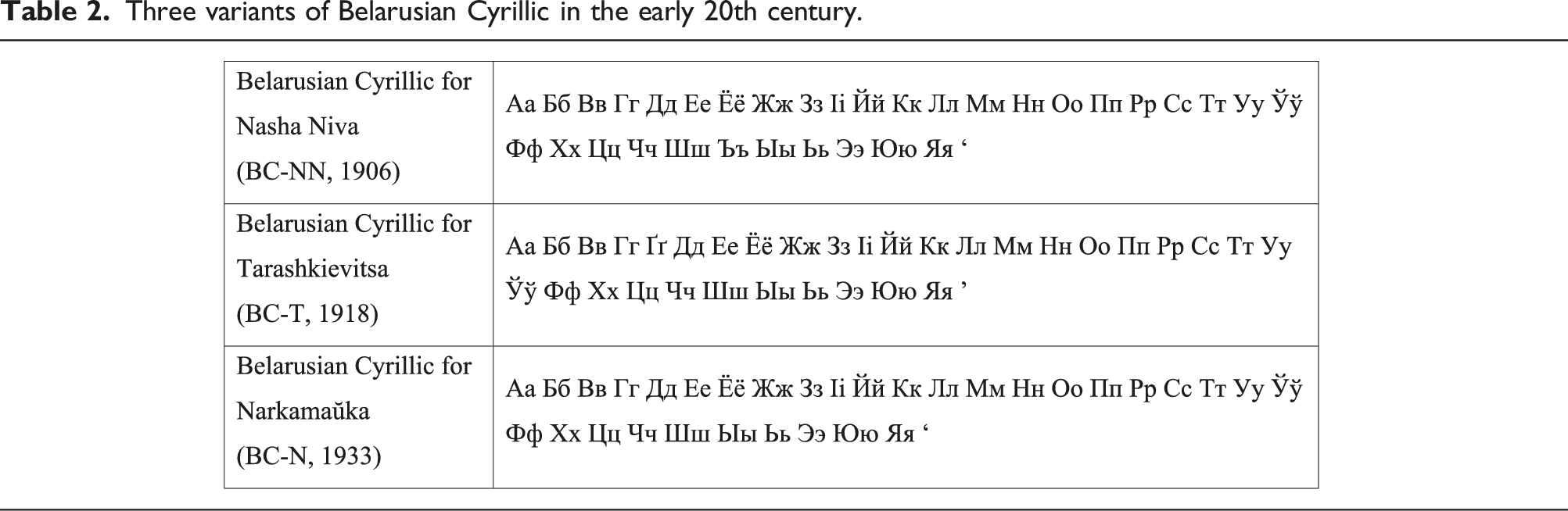
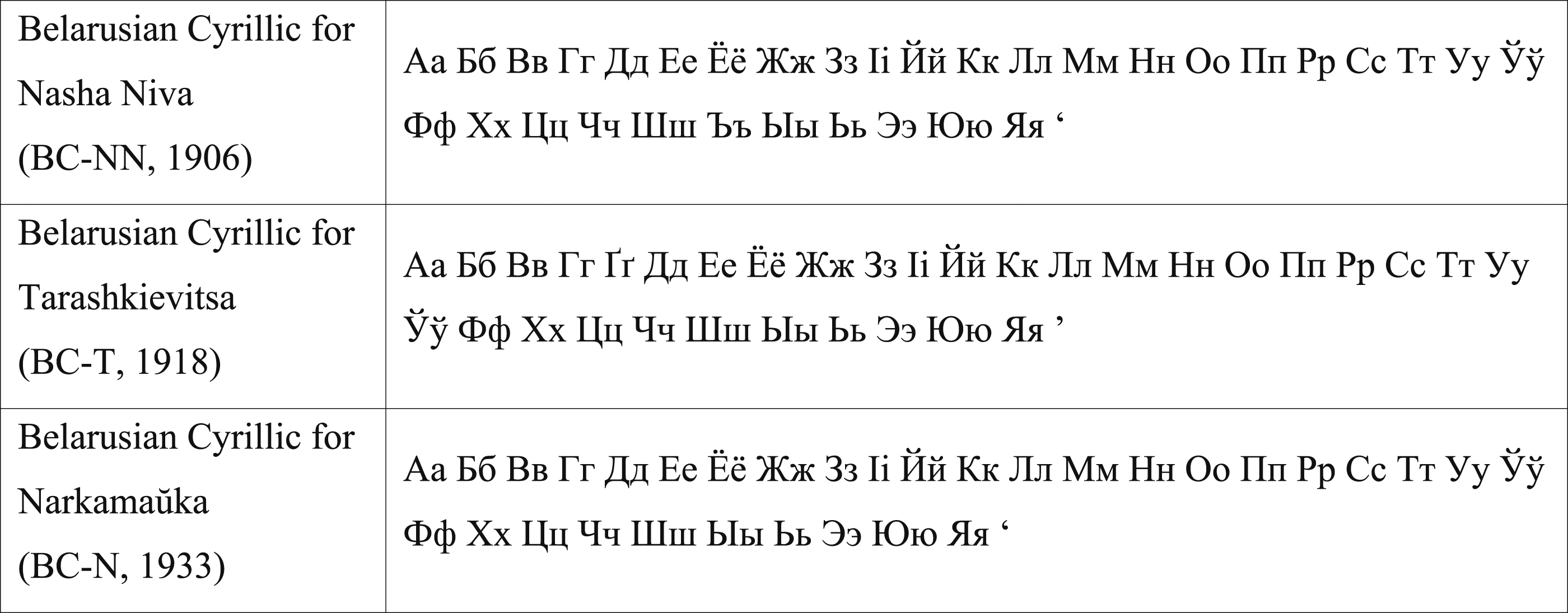
Three variants of Belarusian Cyrillic in the early 20th century.
Classification according to mixed use: Complementary digraphia and exclusive digraphia
Depending on whether they are mixed or not, coexisting scripts can be classified as either a complementary combination, in which only portions of vocabulary are written with two or more writing systems, or an exclusive combination, in which the full text is written with only one writing system. Japanese text is a typical example of complementary digraphia. Hiragana, Katakana, and Kanji all have their own functions and appear simultaneously in one text, and it is taboo for one writing system to invade the function and area of another writing system.
An exclusive example of digraphia occurred in Yugoslavia until the end of the 20th century. Serbs typically used the Cyrillic script and Croats the Latin alphabet to write the Serbo-Croatian language. Similarly, 21st-century Russia, covered in Section 4.1, is a region where exclusive digraphia is observed. Today, the Russian Orthodox Church utilizes Church Slavonic for the laypeople in the modern Russian Cyrillic script and for priests in the traditional Church Cyrillic alphabet. The same language, Church Slavonic, is written in two writing systems depending on the addressees. Except for educational purposes, there are no or extremely few instances in which two scripts are used together in a text.
Classification according to differences in function and/or prestige: Digraphia and bigraphia
According to Ferguson’s approach, when two writing systems coexist, the high variety and low variety should be separated. In the Russian Federation, for example, each republic’s national language is written exclusively in Cyrillic, but in Uzbekistan, the national language, Uzbek, must be written exclusively in Latin. Clearly, Cyrillic in Russia and Latin scripts in Uzbek are regarded as an H writing system.
However, there are some cases where no legal basis exists and distinguishing the difference in prestige is difficult. The same holds true for complimentary digraphia. In Korea, for instance, Chinese characters have historically been seen as a higher script than Hangeul. For nearly a century, Chinese characters were exclusively used for Chinese-origin words in official documents and academic papers, and Hangeul was used for only pure Korean words that could not be written in Chinese characters.
In modern times, however, only Hangeul is used for writing, and Chinese characters are enclosed in parentheses when serving to distinguish homonyms or when terminology needs to be clarified. There is no distinction in prestige between Hangeul and Chinese characters in Korean literature, although the functions ascribed to each script are distinct. The two writing systems complement one another. Therefore, it is not always possible to classify H and L scripts directly in digraphic circumstances. Nevertheless, the functional distinction can be explored even when the two writing systems are identically prestigious.
Circumstances in which there is no distinction between function and prestige in two or more writing systems are referred to as “bigraphia.” However, because maintaining both writing systems at the same time incurs significant social costs, it is unlikely that a society will maintain two writing systems with no difference in function and prestige. Therefore, bigraphia appears to only exist in theory.
Digraphia of the post-socialist countries
Russia
Currently, Russian is officially written only in Cyrillic script. In Russia, two varieties are used to write Russian Church Slavonic: Church Cyrillic and modern Russian Cyrillic. The presence of the two Cyrillic variants can be categorized as an in-digraphia phenomenon, given that the two scripts represent distinct Cyrillic variants. Since the establishment of the Cyrillic alphabet to write Church Slavonic in Kievan Rus around the end of the 10th century, the Cyrillic alphabet had remained relatively unchanged. Peter I instituted an alphabet reform to create the Civil Script at the beginning of the 18th century, and since then, the Russian Orthodox Church has written Church Slavonic in two variant scripts, employing both the old Church Cyrillic and the Civil Script. Since the 18th century, both the old Church Cyrillic and Civil Scripts have undergone reformation to reach their modern composition and form, reflecting the fact that the two varieties of the Cyrillic alphabet employed by the Russian Orthodox Church serve distinct purposes.
Russian Church Cyrillic, which is currently used by the Russian Orthodox Church, is used among the clergy, literary conservatives, and religious extremists. Advocates of the old script and spelling believe that the Slavic writing system was created by the Lord and is therefore sacrosanct (Bennett, 2012:60). Even though jat (Ѣ¸ ѣ) has disappeared from the contemporary Russian Cyrillic script, it is still used, along with ksi (Ѯ, ѯ), psi (Ѱ, ѱ), omega (Ѡ, ѡ), ot (Ѿ, ѿ), fita (Ѳ, ѳ), and izhitsa (Ѵ, ѵ). In other words, Russian Church Cyrillic is not a dead alphabet but a living alphabet with a religious purpose Table 1.
Thus, the coexistence of the aforementioned two Cyrillic writing systems can be referred to as in-digraphia, which is characterized by being continuous, exclusive, and showing differences in function and prestige. 8
Also prevalent in Russia is out-digraphia, the cohabitation of Cyrillic and Latin scripts. It is commonly believed that only the Cyrillic alphabet is used to write Russian; however, the so-called macaronic alphabet, a combination of Cyrillic and Latin scripts, has gained popularity in recent years. According to Мкртычова (2010:104), Latin script that is not transcribed from modern Russian to Cyrillic appears in CD-диск, CD-плейер, IBM-совместимость, PR-агенство, PR-компания, FTP-сервер, Web-сайт, Web-узел, and VIP-зал. This use of the “macaronic alphabet” is commonly observed in nations that do not primarily employ the Latin alphabet; however, in this study, we consider the post-socialist country Russia as an example. Importantly, the macaronic alphabet is one of the natural Russian writing systems, not a mixed script that incorporates Latin letters by writing foreign words in Latin letters. 9 In Russian, the VIP in VIP-зал is pronounced with the Russian sound [vip] rather than the English sound [viːai piː], and both вип-зал and VIP-зал are acceptable spellings. 10 It is currently difficult to establish if the coexistence of the Cyrillic and Latin scripts in modern Russian writing is transient or permanent. Currently, it is deemed to have some degree of stability, but it appears that more time must pass before a definitive conclusion can be reached. Since the macaronic alphabet notation is complimentary and appears when some English words are borrowed, and in many cases when it is a hyphenated word, functional difference has been achieved.
Thus, in-digraphia and out-digraphia phenomena occur in contemporary Russia, and these phenomena are not unique to Russia; they also occur in neighboring countries such as Ukraine and Belarus.
Belarus
In-digraphia, in which two varieties of Belarusian script are used to write the same language, was observed. At the beginning of the 20th century, the Belarusian Cyrillic alphabet existed in the following forms within one community.
The Declaration of Independence of the Soviet Socialist Belarus Republic on July 31, 1920, “provides perfect equality of the languages (Belarusian, Russian, Polish and Yiddish) in communication with government agencies and in institutions of national enlightenment and socialist culture” (Кожинова, 2017:133). Because Jews made up more than 13% of the population, the Jewish language was included (Кожинова, 2017:144). Thus, at the start of the 20th century, Belarus was a region where three major writing systems coexisted: Cyrillic, Latin, and Yiddish. Nevertheless, there were two varieties of the Cyrillic alphabet, the Belarusian Cyrillic alphabet and the Russian Cyrillic alphabet, and Belarusian Cyrillic for Nasha Niva (BC-NN) and Belarusian Cyrillic for Tarashkievitsa (BC-T) were the sub-systems of the Belarusian Cyrillic at the time Table 2.
Before the Belarusian orthography was established, various transcriptions were rampant. Those who introduced the orthography through newspapers, textbooks, and government directives had differing opinions on the necessary letters, resulting in the development of writing system variants. On August 28, 1933, the Belarusian Council of People’s Commissars promulgated the “Act on Change and Simplification of Orthographic Law” in Belarus to resolve the issue of Narkamaŭka. However, supporters of Tarashkievitsa did not accept Narkamaŭka (Кожиновa, 2017), and the two spelling systems remain in conflict to this day, resulting in their coexistence. Tarashkievitsa was mostly used by immigrants, but a small number of nationalists on the mainland continued to publish works using this variant in the 1980s (Bunčić, 2013:103–104). As individuals who support and employ the orthography of Narkamaŭka and Tarashkievitsa are distinct, so too are those who employ the writing systems BC-T and Belarusian Cyrillic for Narkamaŭka (BC-N). Currently, the sole difference between the two systems is that BC-T contains the grapheme Ґґ.
The presence of the varieties of the two Cyrillic scripts is in-digraphic, persistent, and exclusive, and the functions of the two writing systems are distinct. From school education through public affairs, BC-N is employed in Belarus. BC-T is used by individuals who oppose the orthography chosen by the Soviet People’s Council’s political body and believe in a return to the “traditional” Belarusian language. Prestige is difficult to define properly. BC-N has prestige because it is an official script; however, it is impossible to argue that BC-T has less prestige in terms of history, tradition, and national consciousness.
Serbia
Russia, Serbia, and Ukraine adopted the Cyrillic alphabet after accepting Eastern Orthodoxy, while the Poles, the Czech, and the Croatians adopted the Latin alphabet after accepting Catholicism. However, Cyrillic is the only writing system with legal status in Serbia today. Article 10 of the Serbian Constitution designates both Serbian and Cyrillic as official. This makes the Cyrillic alphabet an H writing system with prestige. Even in elementary school, students are forced to master the Cyrillic alphabet before the Latin alphabet, illustrating the hierarchical link between the two writing systems. Despite several attempts by the Serbian government to ban the use of the Latin alphabet, a significant portion of the population prefers to employ it for the following reasons: First, the past influence of one language with two writing systems continues in Serbia. Second, people are in contact with the West and exposed to the Western lifestyle. In other words, they are frequently exposed to Latin alphabets. Third, some people believe that knowing multiple languages and scripts is desirable. Fourth, it is more convenient to use Latin alphabets on mobile phones and laptops. 11 A preference for the Latin alphabet is more evident among the younger generation, raising concerns that the Cyrillic alphabet is in crisis (Vitas et al., 2012:55).
Given that the Cyrillic alphabet is the official alphabet and the Latin alphabet is an arbitrary script, it is difficult to state that the purposes of the two writing systems are clearly differentiated in Serbia today. However, only the Cyrillic alphabet is utilized for official use in government and public offices, and all elementary, middle, and high school textbooks are printed in the Cyrillic alphabet (Bugarski, 2021:185).
Although the Cyrillic alphabet is the high variety, the Latin alphabet is more widely used. At the beginning of the 21st century, Magner (2001:21) noted that “Cyrillic has greater usage.” However, the situation has drastically changed in just 20 years. Of the 12,574 monographs published in Serbia in 2010, 6,459 were written in Cyrillic and 6,000 in Latin (Vitas et al., 2012:53). Bugarski (2021:187) cited numerous statistical data and earlier studies on the usage of Cyrillic and Latin scripts and concluded that approximately two-thirds of texts “in public and private use” utilize Latin script and one-third utilize Cyrillic script. Even though the Latin alphabet is used twice as frequently as the Cyrillic alphabet in Serbia, as long as the constitution recognizes the Cyrillic alphabet as the official script and there are areas where the Cyrillic alphabet is used exclusively, Serbia can be classified as an out-digraphic society with distinctive prestige and function. Furthermore, this phenomenon, which has existed for over a century, is expected to continue in the future.
Orthographic sub-systems in Internet Serbian (derived from Ivković, 2015).

Ivković understands the aforementioned sub-systems at the orthographic level. However, the variation in orthography that he points to is due to the different scripts chosen by users. A Serbian Latin script was introduced during the period of “one language, two writing systems.” In this script, diacritical markings are verified. However, typing diacritical marks on digital devices such as computers, mobile phones, and tablets requires more time and effort. To save time when using the regular QWERTY keyboard layout, some Serbian speakers have opted for the Latin variant without diacritical marks. As Sebba (2007:43–44) notes, Internet and SMS texts frequently disregard spelling norms, expanding the “uncontrolled orthographic area.” 12 However, diacritical markings are displayed in Serbian Latin letters, and spelling norms in the digital space are destroyed by excluding diacritical markings. Consequently, a non-standard Latin variety (NSL) is used that is different from Serbia’s standard Latin variety (SL). The NSL will inevitably triumph over Serbia’s spelling standards. Non-standard orthography, in which spelling norms are neutralized in Serbian writing, is accomplished in two ways. Ivković identifies these as Non-standard Latinica simple (SL1) and Non-standard Latinica composite (SL2), derived from a Latin script variety known as Non-standard Latinica (NSL). However, Latinica is utilized for both SL1 and SL2. This Latinica is clearly distinct from the Latin script used to write English, as well as Standard Latinica. The composition of Latinica in SL1 and SL2 is the same, as is the number of graphemes employed. SL1 and SL2 demonstrate variations in the strategy for matching graphemes and phonemes, and thus constitute separate orthographic systems (see table above). We consider the coexistence of SL and NSL to be in-digraphic, as opposed to the orthographic coexistence of SL1 and SL2. NSL is a low variant of SL and has functional constraints in that it cannot be used with a QWERTY keyboard. Therefore, NSL is a low variety in terms of both status and utility. Moreover, while the QWERTY layout is used, NSL continues to be used and is deemed to coexist with SL. 13 Additionally, this writing system demonstrates an exclusive distribution.
Uzbekistan
The Cyrillic alphabet was approved at the national level, as mentioned in the previous section, but the users deliberately chose a different writing system, resulting in digraphia. In this section, we thus consider a country that chooses a different writing system than before, resulting in the coexistence of the old and new writing systems. It is commonly understood that various post-socialist nations have adopted or are attempting to adopt alternative writing systems to replace the Cyrillic alphabet introduced by the Soviet Union. Azerbaijan and Turkmenistan have already adopted the Latin alphabet, while Kazakhstan aims to do the same by 2025. The government of Tatarstan, a republic within the Russian Federation, enacted a bill in 1999 to replace the Cyrillic script with the Latin alphabet, which came into effect in 2001. 14 It is interesting to note that these are all Turkic countries. The transfer of these countries to the Latin script has a historical justification, but it may also be viewed as a gesture of cooperation among Turkic nations (Kadirova, 2018:2).
In Uzbekistan, the Cyrillic script was used to write Uzbek from 1940 until 1993, when it was replaced by the Latin script. 15 The Latin alphabet introduced in 1993 was reformed in 1995, and this reformed Latin alphabet is now the official script for Uzbek. 16 However, even to this day, Cyrillic and Latin scripts are used almost equally in all areas of written language (law, books, web, media, etc.). To promote the use of the Latin script, the government of Uzbekistan issued Cabinet Decree No. 61 of February 10, 2021, “Measures to Ensure Gradual and Complete Transition of Uzbek Language Based on Latin Alphabet.” Therefore, all district names, street names, terms, organization names, signs, advertisements, and notices in Uzbekistan were to be written in Latin script by August 1, 2021. 17 In addition, printed and electronic publications of central and local governments, Internet sites, and all other publications are being converted to Latin script, and starting from January 2023, all the office documents at each organization are also being written in Latin script. However, there are still options to choose between the Uzbek Latin alphabet (O’Z) and the Uzbek Cyrillic alphabet (ЎЗ) on official national websites, such as the website of the President of Uzbekistan (https://president.uz/uz) and the Constitution of Uzbekistan (https://constitution.uz/oz). This situation will persist until the Latin alphabet completely replaces Cyrillic.
Depending on the time period, the Latin alphabet used to write Uzbek displays three significant variations. First, from the 1920s, when the Latin alphabet was introduced to replace the Arabic alphabet, and until the Cyrillic alphabet was introduced to replace the Latin alphabet in the 1940s; second, when the Latin alphabet was reintroduced in 1993; and third, after the revision of the Latin script system in 1996. Let us designate the Uzbek Latin script in each period as Uzbek Latin-1920s (UL-1920s), Uzbek Latin-1993 (UL-1993), and Uzbek Latin-1996 (UL-1996), respectively. Among the three varieties, UL-1993 and UL-1996 coexisted briefly, but because this era was rather brief, it is pointless to identify or investigate them as in-digraphia. In contemporary Uzbekistan, the political, social, and cultural conditions in which each variety is adopted hold enormous relevance.
Latin alphabets for Uzbek language.
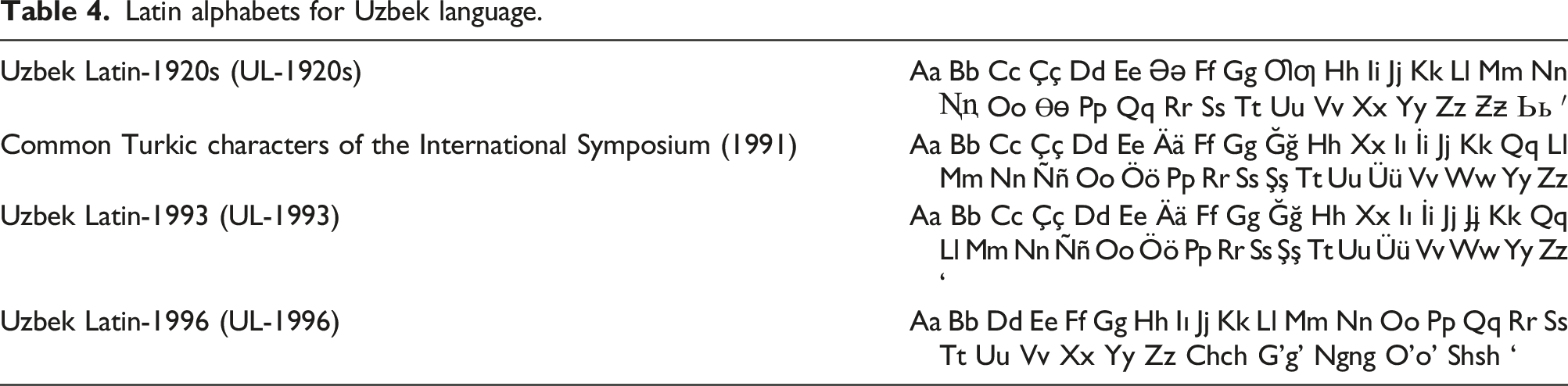
We classify the situation in which Latin and Cyrillic scripts are used to write Uzbek as transitional out-digraphia. 18 Since the Uzbek Latin script is an official writing system in the Uzbek constitution, it can be regarded as an H writing system in terms of status. Currently, there is no significant difference in the functions of the two writing systems, but according to the decree of the government, it is expected that texts written exclusively in Latin scripts will increase in the future.
Conclusion
In this study, we attempted to explain the situation in which two (or more) writing systems are used to write a language in post-socialist countries. Digraphia refers to the use of two or more writing systems to represent a single language. Historically, post-socialist countries have been digraphic societies. Furthermore, even in Russia, which has been traditionally considered a monographic space, partial instances of digraphia have been observed due to the increasing adoption and prevalence of Latin script. The manifestations of digraphia vary depending on the country and linguistic group. To describe the diverse coexistence patterns of multiple writing systems in post-socialist countries, we attempted to categorize digraphia into five types based on several criteria. First, based on the genealogical relationship between scripts, we distinguished in-digraphia and out-digraphia. Second, considering the period of coexistence, we identified synchronic digraphia and diachronic digraphia. Third, based on the replacement as a result of adoption, we classified digraphia into transient digraphia and persistent digraphia. Fourth, depending on the extent of script mixing, we differentiated complementary digraphia and exclusive digraphia. Lastly, considering the presence or absence of functional and prestige differences, we classified digraphia and bigraphia. We applied these categories to explain the various coexistence patterns of multiple writing systems in post-socialist countries. We provided evidence for the presence of all types of digraphia in the cases of Russia, Belarus, Serbia, and Uzbekistan.
In Russia, digraphia is observed in the representation of the Russian language and Church Slavonic. The Russian Orthodox Church adopted both Church Slavonic Cyrillic and Russian Cyrillic for writing Church Slavonic, resulting in the phenomenon of in-digraphia. These variants coexist persistently, exclusively, and diachronically, showing differences in function and prestige. Further, we note the “macaronic alphabet,” where Latin script is mixed within words. As Latin script and Cyrillic script do not belong to the same genealogical group, we classify this phenomenon as out-digraphia. At present, when both scripts appear within a single text, it is considered synchronic and complementary. These two scripts differ in terms of prestige and function. However, it is too early to determine whether this is a persistent or transient phenomenon. The latter case is commonly observed in other linguistic groups as well.
Belarus is a society of in-digraphia due to the adoption of different scripts in two orthographic systems: Tarashkievitsa and Narkamaŭka. The coexistence of two script variants within the Cyrillic script is persistent, exclusive, and characterized by differentiated functions. However, due to the tradition and justification associated with each orthographic system, it is difficult to make definitive statements about their respective prestige.
In Serbia, out-digraphia is observed because both Cyrillic and Latin scripts are used. Additionally, in-digraphia is observed due to the coexistence of non-standard spellings in Latin script, where diacritical markings are omitted. Cyrillic script holds a higher status as the official script in Serbia. Users autonomously choose to exclusively use one script in a text and freely switch over to the other script if desired. It is premature to determine if the selective usage of both scripts will be persistent or transient. The variants of the Latin script are classified as the standard Latin script (H variant) and non-standard Latin script (L variant). The exclusive use of each variant is observed in formal and informal contexts, and as long as mobile input methods persist, this functional differentiation is expected to continue.
After the dissolution of the Soviet Union, Uzbekistan officially transitioned to the Latin script, but the use of Russian and Cyrillic scripts continues. Uzbekistan represents an out-digraphia society where the Latin script is the H variant and the Cyrillic script is the L variant. The two scripts coexist exclusively and in a transient manner.
From the cases mentioned above, we have examined the utilization patterns of multiple writing systems in post-socialist countries based on the five classifications of digraphia. In reality, the coexistence of multiple writing systems is more commonly observed in situations of diglossia and bilingualism. However, in this paper, the terms “bigraphia” and “digraphia” are used solely to define situations where two writing systems are employed to represent a single language. We are not denying the possibility of digraphia arising from diglossia and bilingualism. Rather, digraphia resulting from bilingualism can be analyzed in greater detail only after examining monolingual digraphia.
For example, let us consider the use of Latin scripts in China. The composition of Latin scripts for English and Hanyu Pinyin for Chinese is different, in that there is no “v” in the latter. In addition, the appearance of the grapheme is the same, but the sound value represented by each grapheme is different. Most Chinese today know the Latin alphabet through Hanyu Pinyin, but when they learn English, they have to learn the Latin alphabet again. This is why the Latin alphabet should be analyzed as a Latin script for English (EL) and a distinct Latin script for Hanyu Pinyin (PL). While EL and PL are two varieties of the Latin alphabet, if they are not distinguished but instead viewed simply as Latin scripts, our discussion is limited to only Chinese characters and the Latin script (i.e., out-digraphia). Consequently, it is difficult to study the functional differentiation of EL and PL.
We expect that the typology of digraphia based on the five criteria presented in this paper will help to explain many instances of the coexistence of multiple writing systems prevalent worldwide. Furthermore, we believe that it can also contribute to explaining the coexistence of multiple writing systems in bilingualism or diglossia situations to some extent. The cases we presented in the conclusion will be the future research subjects.
Footnotes
Declaration of conflicting interests
The author(s) declared no potential conflicts of interest with respect to the research, authorship, and/or publication of this article.
Funding
The author(s) disclosed receipt of the following financial support for the research, authorship, and/or publication of this article: This work was supported by the Ministry of Education of the Republic of Korea and the National Research Foundation of Korea (NRF-2021S1A5B5A16076551).