



Abstract
The paper based on quantitative and qualitative analysis on data on language attitudes and geopolitical orientations obtained in Central and Southern Ukraine shows significant differences between two regions. The assessment of linguistic changes occurred after the collapse of the USSR in both regions is unequivocal: most participants in open interviews noted a positive trend for the Ukrainian language, including the expansion of functional spheres of its use (on television, in politics, in education) and its higher prestige in society. Post-Soviet changes toward the expansion of the use of the Ukrainian language were viewed positively even by predominantly Russian-speaking respondents, who opposed “Ukrainization” in other aspects. Based on the answers to the questions in the “Geopolitics” and “Identity” blocks of questionnaire, two types of respondents were identified using cluster analysis: (1) “pro-European” and (2) “pro-Russian.” The language preferences of respondents belonging to different clusters differed in the regions studied: while more Ukrainian speakers, both in the Center and in the South, mainly belonged to the first cluster, and more Russian speakers (to a somewhat lesser extent) to the second, speakers who used a mixed idiom known as Surzhik in the Center, were more “pro-Russian,” and in the South, more “pro-European” oriented. That can signal of differences in language attitudes and labeling regarding Surzhik in those regions of Ukraine.
Introduction
The ethnic and linguistic situation in Ukraine, which during the last several centuries was formed under the strong influence of other states, predominantly (given the volume of territories involved) the Russian Empire and the Soviet Union, still contains significant post-colonial features. In particular, attitudes toward the Soviet past influence the respondents’ current choice of geopolitical orientations, actualizing “a conflict of identities leading to the linguistic construction of social conflicts” (Danilenko, 2014, 25). According to the observations of the Ukrainian historian Y. Hrytsak, shortly after the collapse of the USSR, the Russian-speaking population of the former Soviet republics experienced a significant identity crisis: according to sociological studies made immediately after the collapse of the Soviet Union, 75% of the Russian-speaking population outside the Russian Federation identified themselves as “Soviet” and not “Russian”; similarly, the largest ethnic group in Donetsk was not the Russians (20%) nor the Ukrainians (25%), but actually the “Soviets” (45%) (Hrytsak, 1996).
According to the research results published in 2020 (KIIS, 2020), even after almost three decades after Ukraine gained independence, a third of citizens (33.5%) regret the collapse of the USSR, although, according to sociologists, the number of respondents who have a positive attitude toward the Soviet legacy is decreasing over time. But, as the same survey shows, among the supporters of the former USSR is a greater representative sample of the older generation, people with a lower level of education and income, as well as higher samples localized in the southeastern regions and those who consider themselves Russian and predominantly use the Russian language (some of these factors may complement each other).
The sociolinguistics situation in Ukraine can be roughly characterized as bilingual and diglossic, Ukrainian and Russian (see details: KIIS, 2019; Hentschel & Zeller 2017). Historically, in the west of Ukraine, the majority of the population speaks the Ukrainian language, often with noticeable dialect influences; in the east and south of the country (territories whose mass settlement began in the 18th century), the Russian language is widespread; but, in most of the territory of Ukraine, especially in the central regions, both the Ukrainian and the Russian languages are in wide use, as well as a mixed Ukrainian-Russian speech, called Surzhyk. (For details on the distribution of language codes in central and southern Ukraine, see Hentschel and Taranenko (2021)). Surzhyk arose as a result of long-term contact between Ukrainian as the language of the local population and Russian as the language of administration, education, the military, etc., so it does not act as a spontaneous mixture, but as a largely stabilized language code, with a predominance of Ukrainian elements in morphology and a significant influence of Russian in term of vocabulary. On the structural features of the Surzhyk, see, for example, Bilaniuk (2004), Del Gaudio (2010), Menzel & Hentschel (2017).
Such a constellation of language codes undoubtedly affects the identity of the inhabitants of the region, as well as their attitude to various social problems they encounter. Despite the fact that a large part of the population speaks Russian or Surzhyk, this does not automatically mean that these people identify themselves as Russians or are connected to Russia-on the contrary, many Russian-speaking Ukrainians are patriots of their country with a clear Ukrainian identity, cf. Zeller (2022). On the other hand, respondents’ opinions and attitudes about social issues also influence their language orientations, cf. Palinska (2022).
Here, one should separately note the peculiarities of the perception of ethnic identity in the post-Soviet countries: there is the concept of “nationality,” denoting ethnicity, which was as an item in Soviet passports. In modern Ukraine, this practice does not exist, and citizens can indicate their ethnicity (for example, during mass polls) at their own request. However, the terms “Ukrainian” and “Russian” can also refer to corresponding citizenship, which can cause miscomprehension in surveys. In this study all interviewees were citizens of Ukraine and the terms “Ukrainian”/“Russian” were used in the sense of ethnic identity, although in open interviews respondents could also use them in the sense of citizenship. (For a more detailed discussion about relations between mother language/first language and ethnicity/“nationality” in Ukraine, see Hentschel & Palinska, 2022).
In the current dramatic situation, as one of the justifications for military aggression on the territory of Ukraine, Russia calls on the imaginary unity of the Ukrainian and Russian peoples and the desire of Ukrainians, primarily in the south and east of Ukraine, to live in one country with the Russians. To what extent does this propaganda cliché correspond to the real situation in 2014–2021 and how the geopolitical attitudes of the population of the center and south of Ukraine correlate with their language practices is the subject of this paper.
Geopolitical Orientations of the Inhabitants of Central and Southern Ukraine and their Language Practices (According to the Results of a Sociological Survey)
Historical Background
The language situation in Ukraine was formed to a large extent as a result of the long stay of the territory of modern Ukraine as part of various historical states (in particular, Polish-Lithuanian Commonwealth, Austro-Hungarian empire, Russian empire, USSR (see review in Plokhy, 2016)). As a result, the Ukrainian language traditionally dominates in the West of Ukraine, and Russian dominates in the South and East. Since Ukraine gained independence in 1991, the language policy has been aimed at strengthening the role of the Ukrainian language in all spheres of social life, and massive changes are also taking place at the population level, cf. Verschik, 2010, Bilaniuk, 2020.
In addition, it is often assumed that there are two models of identity in Ukraine: one focuses on Ukrainian national identity and emphasizes differences from Russia, and the second consists in a sense of East Slavic unity, in particular unity with Russia, in opposition to the “West” (cf. Kulyk, 2014, 2018). While the former is considered dominant in the western parts, the latter is attributed to the south and east. The adherence to and use of the Ukrainian or Russian language was seen as an indicator of these global political orientations (cf. Zeller, 2022). It is believed that for Ukrainian-speaking Ukrainians, “Western” orientation and advocacy of national independence are more common than for Russian-speaking Ukrainians.
Research Methodology
As part the of research projects dedicated to the mixed language mentioned above (Surzhyk) sociolinguistic research was carried out on a large territory of Ukraine: in 2014–2019, in 11 central regions 1 of Ukraine (Khmelnytskyj, Vinnytsia, Cherkasy, Zhytomyr, Kyiv, Poltava, Sumy, Chernihiv, Kharkiv, Kropyvnytskyj, and Dnipro) hereinafter referred to as “Center,” and since 2019 in three southern regions (Odesa, Mykolaiv, Kherson), hereinafter referred to as “South.” The research methodology consisted of sociological questionnaires being filled out (1400 of them in the Center and 1200 in the South), as well recording in-depth semi-structured interviews with respondents who called Surzhyk their main language code (136 interviews in the Center and 102 in the South). In the South, villages were also included, because, unlike the Center, the influence of the old autochthonous dialects was not presupposed here. They were not taken into account in the quantitative analysis in order to be able to compare with the data of the Center, but the interviews of the respondents from the villages were also included in the qualitative analysis.
In the questionnaires, in particular, included was a block of questions related to the general geopolitical orientations of respondents in the opposition East versus West, that is, commitment to “Europe” (in the broadest sense) or to “Russia/USSR,” with the following responses: • I am positive about the collapse of the Soviet Union • I feel European • Russia poses a threat to the independence of Ukraine • The West (the EU and the USA) poses a threat to Ukraine’s independence • Ukraine should unite with Russia and Belarus into a single state • Ukraine should eventually become a member of the EU
Theoretically, respondents could support one of these directions, both, or neither. However, there are clear tendencies in the responses of respondents to be more inclined toward one of these two directions, that is, to be adherents of a “pro-European” or “pro-Russian” approach: in the first case, they support the collapse of the USSR, believe that Russia is a threat to the independence of Ukraine and that Ukraine should eventually join the EU; in the second, they are nostalgic for the Soviet Union, believe that Ukraine should unite with Russia (and Belarus), and also see the West as a threat to Ukraine. Responses are presented on a Likert scale with 4 grades ranging from “strongly agree” (1) to “strongly disagree” (4). It is indicative that about half of the respondents refused to answer this block of questions: 52% of respondents in the Center and 54% in the South did not answer one or several of them in various combinations. (Later, in open interviews, respondents often said that they were not interested in politics, and sometimes refused to answer questions that they saw as having political overtones).
Respondents’ Attitude Toward Uniting with Russia and Joining the EU
Respondents’ answers to questions about accession to Russia or joining the European Union.

Table 1 clearly shows that the “Westerners” are in the majority both in the Center and on the Black Sea coast-in the Center absolutely, in the South relatively. The second largest group are the (let us say) “neutralists” who want neither EU accession nor a union with Russia. In the South this group is larger. In the Center, however, less than one in thirteen people are in favor of a union with Russia, and on the Black Sea coast only one in seven.
A critical point is of course the interpretation of the “neutralists.” Together with the “Easterners” there would be a balance with the declared “Westerners.” Even if some of the professed “neutralists” were to hide supporters of a union with Russia, it would be inadmissible to assume that all “neutralists” were “Easterners.” There are certainly supporters of Ukraine’s neutral status. A majority for a union with Russia is nowhere to be seen-even before Russia invaded Ukraine in February 2022.
However, there are some regional differences, cf. Figure 1. Respondents’ answers to questions about accession to Russia or joining the European Union (by regions).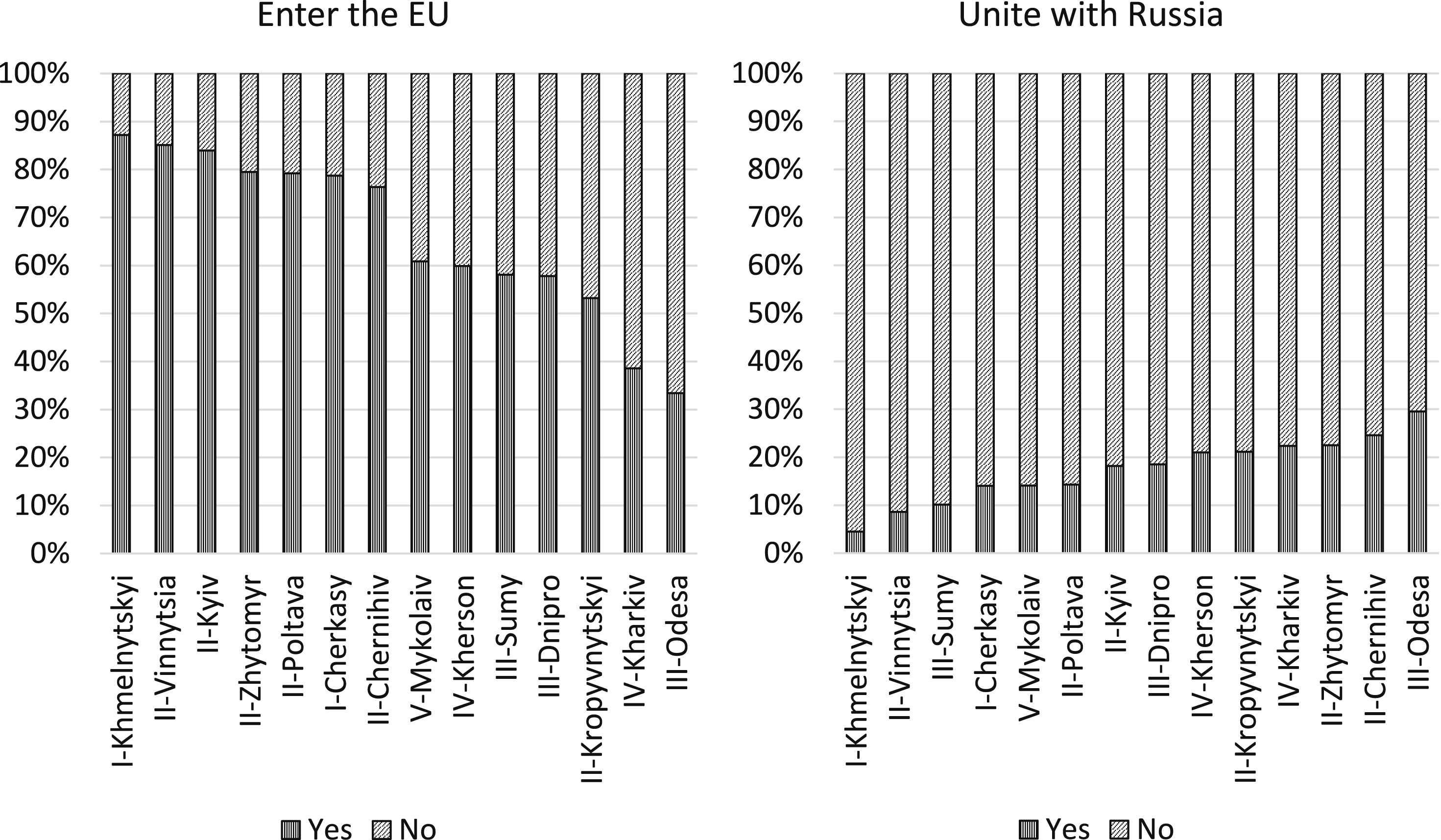
Expectedly, the most pro-Western and anti-Russian turned out to be Khmelnytskyi region, the westernmost in the study area. The Odesa region, located in the southwest, showed the least pro-Western and most pro-Russian sentiments (it should be mentioned that the city of Odesa, like other million-plus cities, was not included in the study). Interestingly, in the Kherson region, located in the south, 2/3 of the respondents were in favor of joining the EU and only 1/5 were in favor of union with Russia. There are similar trends in how respondents see threats from Europe and Russia: in the same Kherson region, which is now (partially) under Russian occupation, only half of the respondents considered the possibility of a threat from Russia, but more than 1/3 considered the West source of potential threat, cf. Figure 2. Respondents’ answers to questions “I feel like a European”: distribution by main language codes.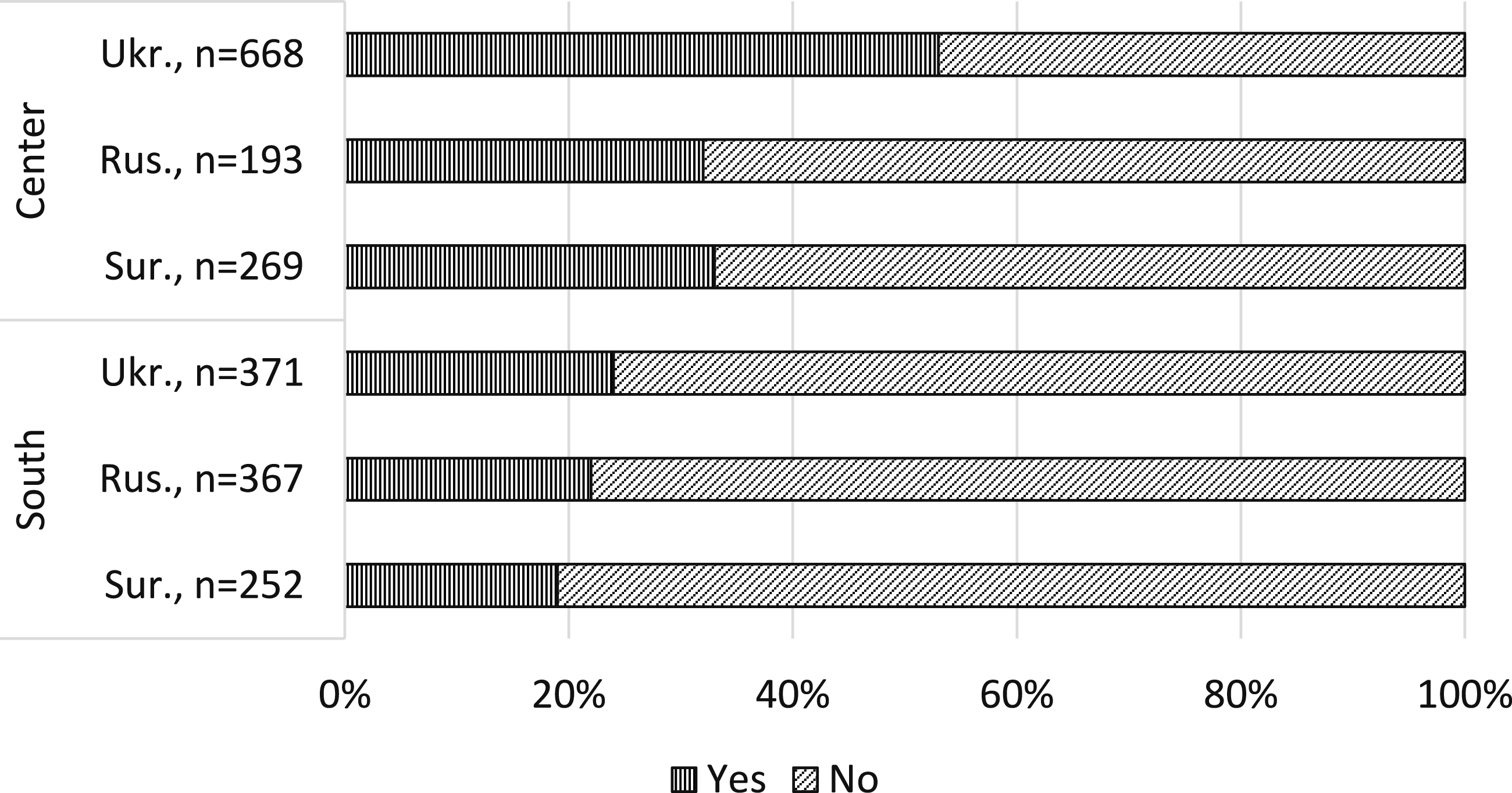
In a certain way, similar data were obtained as a result of a sociological survey by KIIS. According to a study (Detektor Media, 2021), of the three southern Ukrainian regions, Mykolaiv is the most “pro-Western”: in particular, 53.4% of those surveyed there consider Euromaidan to be a “popular protest in support of the European path of development” (38.2% in the Kherson region, in Odessa – 33.6%). But this does not mean that it is also the least “pro-Russian” in this macro-region: the opposite point of view (“Euromaidan was a power struggle of anti-Russian, nationalist forces with the support of Western intelligence agencies”) is equally supported by respondents from three regions-about a third of respondents in each.
The “geopolitical” block of questions was also considered in connection with the language practices of the respondents. It would be more accurate to call this not “language practices,” but “language orientations,” because the respondents themselves named the language or code they use most often. Clearly, these are just laymen’s estimates, and, moreover, some respondents tended to overestimate their level of use for Ukrainian or underestimate it for Surzhyk. It should be noted here that the definition of one main language is, of course, a significant simplification, as shown in the study by Hentschel and Taranenko (2021); nevertheless, we use such a simplified model here.
Language practices reveal a connection with self-identification as Europeans. It should be noted here that the respondents who communicate in Surzhyk define themselves in the same way as Russian speakers, although in relation to the collapse of the USSR, the distribution of answers was more like that of Ukrainian speakers; see below.
A tendency to feel European is not very pronounced. Most likely it is the respondents with Ukrainian as their main language who feel as such who are slightly in the majority. In the other two groups, with Russian or Surzhyk as the main code, it is clearly the other way around. On the Black Sea coast, more than two thirds of respondents do not feel European, regardless of their language orientation. But this is not only the case for Ukraine: even if one were to ask for a European feeling in Central and Western Europe, majorities for a perceived European identity in individual countries or in sub-regions of individual countries would not be a certainty.
Attitudes Toward the Collapse of the USSR and Language Orientations of Respondents
The main language of the respondents reveals a statistically significant weak positive correlation with the attitude toward the collapse of the Soviet Union: the more “Ukrainian” the main language is (scale: “pure Ukrainian” > “Ukrainian with some Russian elements” > “mixed language with approximately equal amount of Ukrainian and Russian elements” > “Russian with some Ukrainian elements” > “pure Russian”), the more positive the respondents are about the collapse of the USSR (scale: “strongly agree” > “rather agree” > “rather disagree” > “completely disagree”) (Center: rs = .15, p < .01; South: rs = .20, p < .01). In addition, those who speak Ukrainian more often view Russia as a threat to Ukraine’s independence: Center: rs = .20, p < .01; South: rs = .21, p < .01; only the answers of respondents who decided on the answer were taken into account.
An examination of the answers to these questions by macro-region reveals significant differences. In the subsequent analysis, we also include the option “difficult to answer,” since the respondents who gave such an answer turned out to be more than a quarter-27% in the Center and 28% in the South, which is also quite significant.
Answers to the question about the attitude of respondents to the collapse of the USSR are presented in the form of Figure 3 a/b. In the Center, all three main language groups view the collapse of the Soviet Union as a whole positively, although Russian-speaking respondents are more than twice as likely to answer this question in the negative than Ukrainian-speaking ones. The ratio in the South is somewhat different: on average, about a third of respondents are dissatisfied with the collapse of the USSR (also one-third of those who are satisfied and those who have not decided on the answer), and among Russian speakers there are almost twice as many as those who gave a positive answer. Those who use mostly mixed language show responses between the “Ukrainian” and “Russian” groups. Attitudes toward collapse of the USSR: distribution by main language codes of respondents.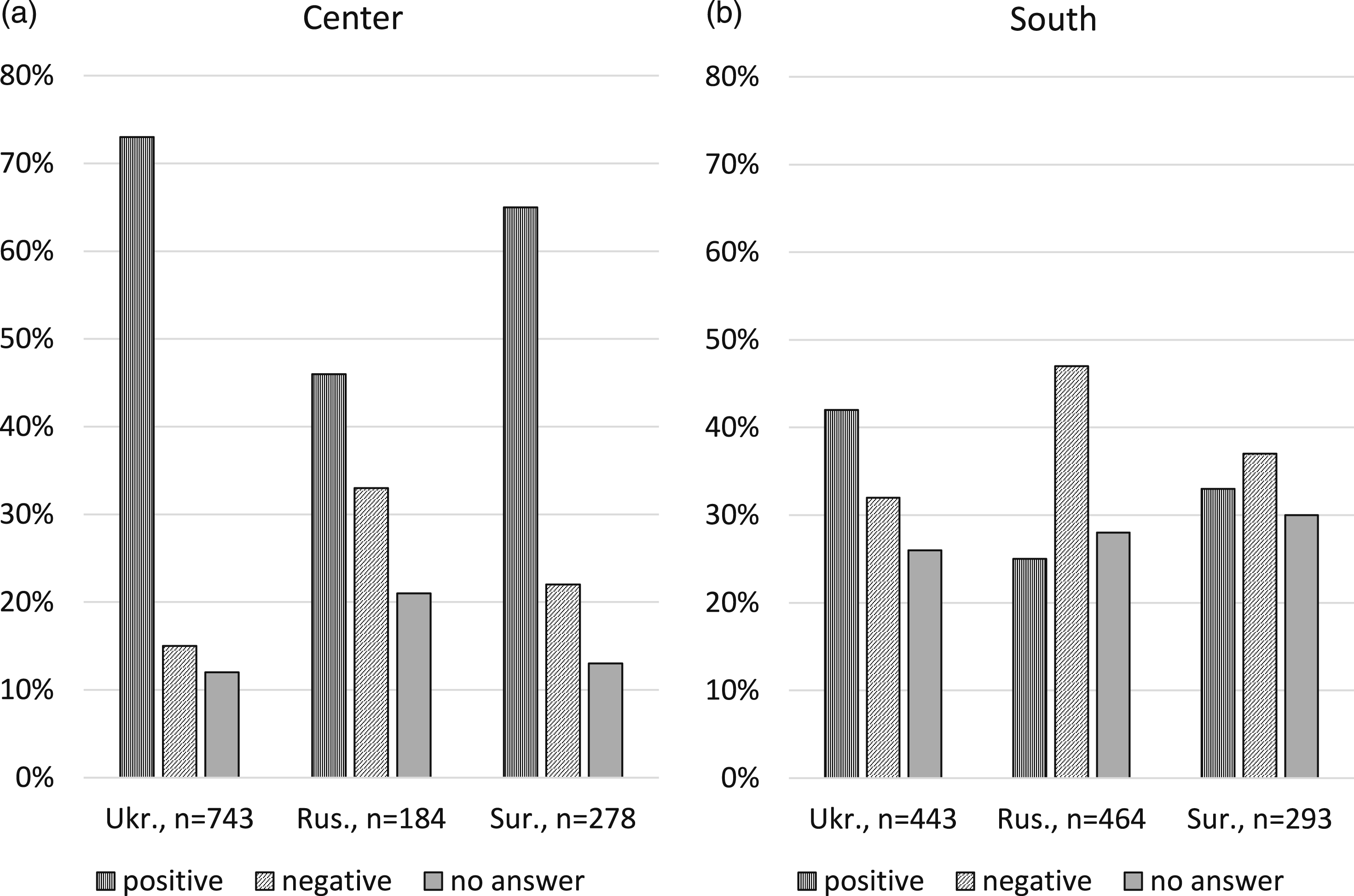
The explanation of the features of this ratio of answers cannot be unambiguous, thus here we should assume the influence of several diverse factors. On the one hand, respondents of the middle and older generations who grew up and lived under the USSR can retain good memories of it, connected, in particular, with the opportunities that the then dominant Russian language opened up: career growth, travel, etc. The same respondents often continue to speak it, despite the change in the language situation in the country. On the other hand, pro-Russian propaganda, which often includes pro-Soviet propaganda, is carried out primarily in Russian, and Russian-speaking respondents are more likely to be influenced by it when watching Russian films, political programs, etc. and thus shaping a more positive attitude toward the Soviet past. Age differences in attitudes toward the USSR are shown in Figure 4. Attitudes toward collapse of the USSR: Distribution by age of respondents.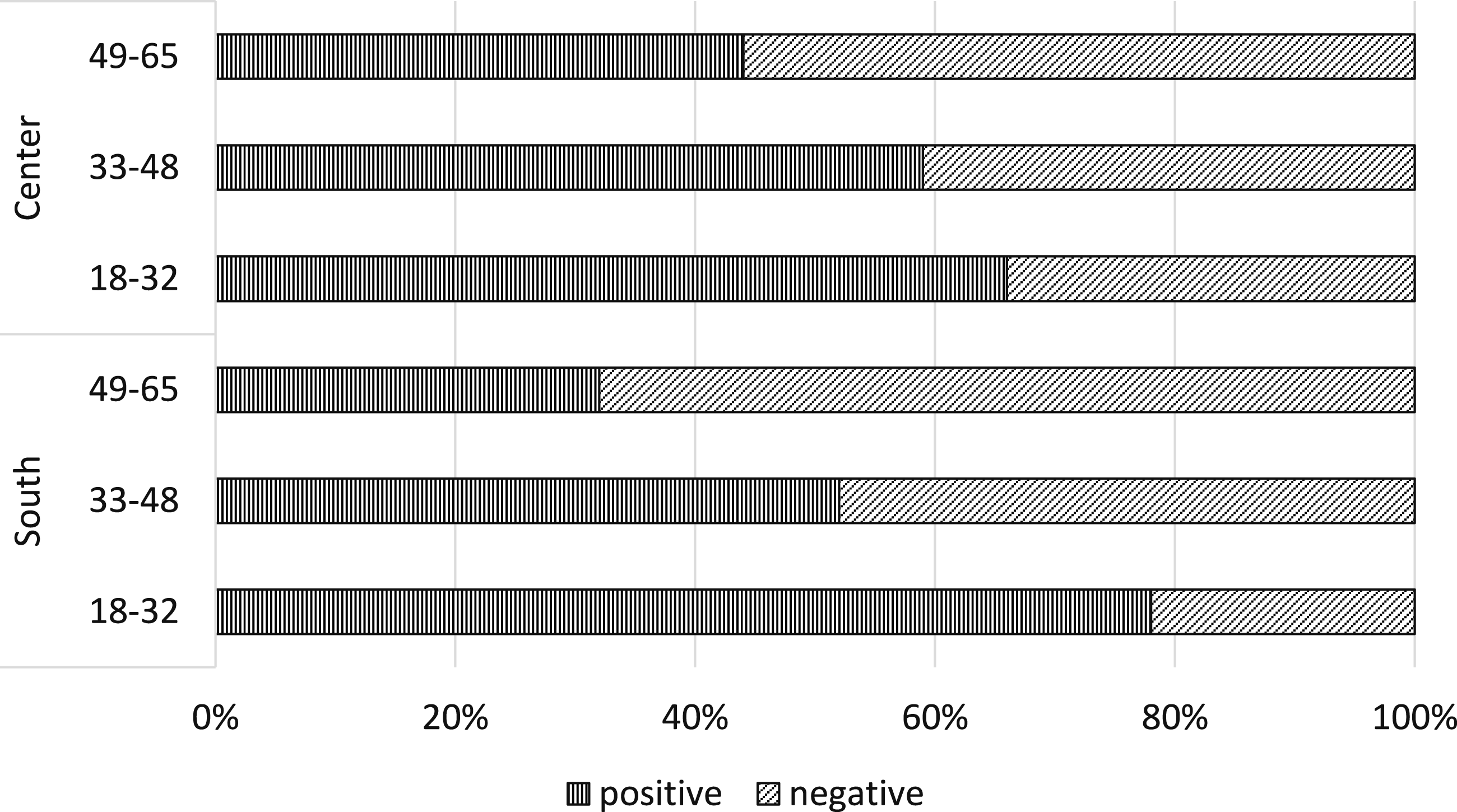
At the same time, attention should be paid to the dynamics of age-related changes: both in the Center and in the South, the older the respondents, the more they express loyalty to the Soviet Union (on average, 55.9% of respondents in the Center and 46.5% in the South demonstrate a positive attitude toward the collapse of the USSR), but the gaps between these groups in the South are much larger than in the Center, cf. 78% versus 32% of positive responses respectively in the younger and older groups in the South. These differences can be not only (or not as much) areal as temporal: the period after 2014, with the war, including the information war, on the one hand, and the building of civil society, with a visa-free regime and opportunities to travel and explore the world, on the other, strongly influenced the worldview of the respondents, especially young people.
If we simultaneously analyze the ratio of answers, taking into account both language and age groups, then the most polar answers, as one would expect, will be among the Ukrainian-speaking representatives of the younger group (70% (Center)/83% (South) of them support the collapse of the Soviet Union) and among Russian-speaking older respondents (65% (Center)/84% (South) express regret for the collapse of the USSR). The meaning of these statistics in the South is also much more stark than in the Center. It should be noted that the language of television viewing, contrary to assumptions, reveals only a small relationship with attitudes toward the collapse of the USSR: both in the Center and in the South, those who often watch television programs in Russian (here we are talking about the language of TV broadcasts, so it could be both Ukrainian and Russian channels) are, on average, 7 percentage points more likely to be dissatisfied with the collapse of the USSR than those who often watch Ukrainian language TV shows (see Figure 5). Correlation between the language of TV viewing and attitudes toward collapse of the USSR.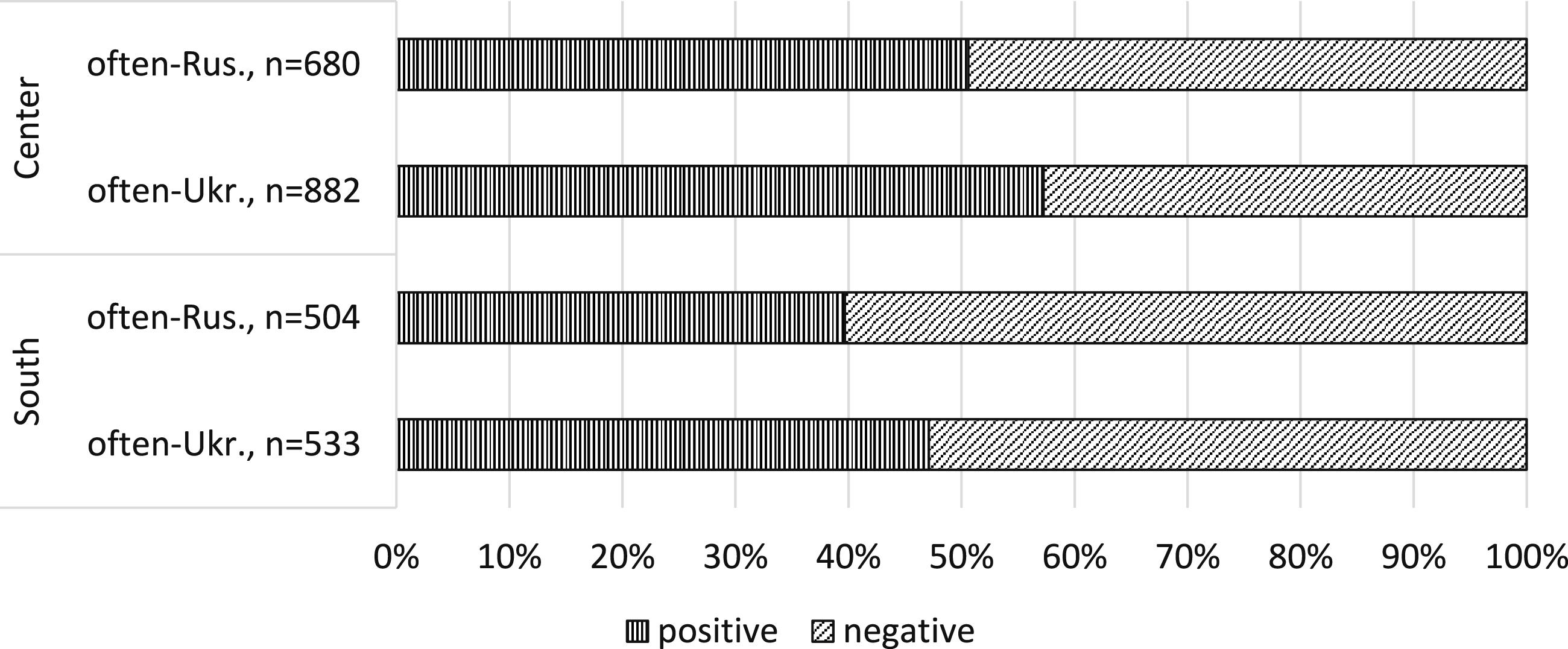
In general, there is a weak positive correlation between the frequency of television viewing in Ukrainian and a positive attitude toward the collapse of the Soviet Union, as well as a medium (weak in the South) negative correlation with the frequency of television viewing in Russian. The same correlation exists with the language of consumption of internet content.
Attitudes Toward East vs West and Toward the Soviet past: A qualitative analysis
The statistical data obtained as a result of the survey demonstrate general trends among the population of the studied areas. But we also need to look at how respondents talk about the relationship between languages and politics in a qualitative study to learn about their reasoning. In open interviews conducted in 2014 (Center) and 2020–2021 (South), respondents had the opportunity to speak on a variety of topics related to the language situation in Ukraine. In particular, there were also questions about the differences between Ukrainian and Russian culture (and more broadly between Russians and Ukrainians), attitudes toward the West, as well as potential threats from Russia and the West.
Two features of the survey should be noted. First, in contrast to the survey, for which a proportional sample was made from the general population, only those residents of the research area who, according to their own assertion, mainly or at least sometimes use mixed speech for communication took part in the interview. This group is characterized by certain features in their approaches, in particular, to the issues of “geopolitical” blocs, which differ from the Ukrainian and Russian-speaking groups, some of which were discussed above. And secondly, the age factor should also be taken into account, as mentioned earlier. Thus, we can neither extrapolate the results to the entire population of the studied regions, nor directly compare the findings in each individual region, or at least reduce the differences only to geographical ones. However, there are both general trends and some features that should be considered separately.
In both the Central and Southern macro-regions, despite the fact that respondents quite often expressed regret over the collapse of the USSR in questionnaires, explicit statements about this are extremely rare in open interviews; principally, these are regrets about the loss of unity and opportunities to travel and work throughout territories of the former Union: (1) There was the Soviet Union, and we were all together. And I went to Russia, as to my home (...). And this [all of us were in the same country-Int.], I liked it. (Po, vsto, 51, f, v)
2
In all likelihood, this terse commentary is partly due to the fact that the situation of the interview is more public than filling out the questionnaire: although the respondents were guaranteed anonymity, they nevertheless were in no hurry to be frank about a topic that was not very popular in public discourse, at least officially. Respondents who mentioned the negative aspects of Soviet rule most often talked about language infringement, forced Russification of all spheres of public life, the extermination of culture and science, and repressions: (2) In the USSR, the Ukrainian language was banned, Ukrainian [cultural] figures were exterminated, Ukrainian poets who wrote in Ukrainian were persecuted, Ukrainian was promoted, freedom was promoted in Ukraine (...) Many bans were imposed on the language, Russian was introduced as the main language, because of this, our language changed a lot... under the influence of Russian. (Od, vsto, 18, f, b)
Post-Soviet changes toward the increased use of the Ukrainian language are noted as positive even by those respondents who are predominantly Russian speakers and in other matters oppose “Ukrainization,” which, in their opinion, the state imposes on citizens without their consent. (3) The fact is that they began to obtrude into the Ukrainian language more. Maybe that’s right. I think that if they have already split up, then it is necessary only in Ukrainian. (Po, vsto, 51, f, v)
The rhetoric of example (3) is especially interesting: the respondent, who clearly regrets the collapse of the USSR (cf. her own statement in example (1)) and considers the spread of the Ukrainian language as an “obtrusion” (a word with an unambiguously negative connotation), nevertheless supports such state policy.
In general, it should be noted the clearly predominant positive attitude of the respondents to the language changes that occurred after the collapse of the USSR, namely the expansion of the spheres of the Ukrainian language and, in particular, its spread in education, science, culture, business, public administration. The vast majority of respondents expressed support for such changes, while noting the Ukrainian language as an integral attribute of an independent Ukrainian state.
The study shows that the vast majority of respondents, even those who generally support the pro-Russian position, emphasize that Ukraine is a separate independent state. Supporters of the union with Russia speak of a common language, traditions and history. “We saw the Russians as our brothers,” even young respondents having said so (4). (4) I think there is not much of a difference [between Ukrainians and Russians]. That is, most of us from Ukraine speak purely Russian, that is, this is our similarity. Well ... we have long considered, for example, Russians, well, Russian-speakers, as our brothers. That is, we spoke their language. We also honoured ourselves, some knew their traditions, that is, Russia’s. And we have some traditions with Russia which are similar. That is, the difference is only in the language barrier, that’s all. And, of course, Ukraine and Russia, they are different countries, that’s all. (Dn, vsto, 33, m, v)
Instead, Europe, an “uncertain object of desire” (Yavorska, 2010), appears in the respondents’ comments as the historical goal of Ukraine after leaving the USSR (5). Respondents who expressed their wish for Ukraine to be integrated into Europe justified this primarily with European values such as freedom and democracy (6). (5) Ukraine is the center of Europe, one might say, first of all. Ukraine is a state that currently wants to become one of the members of the European Union. That is, our future is only with Europe. And the fact that we were in the USSR before, let’s put it this way, it is necessary to break with that and, as they say in our country, strive for the best. (Po, vsto, 53, m, h) (6) We are a more European nation than, for example, the Russians. (…) Parliamentarianism is in our blood. We have no king. There are elected positions, and these are people who work for us, and we perceive them as such. Russia still believes in the tsar, the emperor. Russia is different, it’s just heaven and earth, it’s all different relationships, different worldviews. (Dn, mto, 54, m, v)
As has already been shown in a survey, many respondents see a threat from the West. But, for instance, in more than one interview we find mentioned the danger of a military threat posed by NATO—a cliché imposed by Russian propaganda. In fact, the respondents only worry about the challenges of migration (7) and the loss of identity, the “dissolving” in the European area (8). (7) I.: Well, the threat from the European Union is expected, right? R.: Many will still go there, all the youth will go there, well, they will go there. I.: To make a living, right? R.: Yes. (Dn, sto, 31, f, v) (8) If we enter Europe, it will begin... there are already international words in the Ukrainian language, plus Polish words, Hungarian, a lot of mixture just arrives into the Ukrainian language... And there are various such words... (Od, vi, 20, f, h)
Instead, when it comes to the Russian threat, respondents don’t mean cultural expansion, but genuine aggressive action (9). And although the interviews were conducted before the full-scale invasion, Russia’s aggression in Crimea and Donbas showed even residents of the most pro-Russian regions “what Russia really is.” (9) We have a lot of people, they understood what Russia is, because, knowing Nova Kakhovka, where everyone spoke Russian, when this war started, a lot of us hung Ukrainian flags on the balconies, and that was a lot. And I was very pleased that people understood what it was. They have already begun to understand what kind of trouble this is. (Xe, vi, 28, m, h)
In interviews, “2014” often sounds like a watershed. Many residents of Ukraine saw for the first time the real dangers and threats from Russia, and many of them began to switch to the Ukrainian language and think about patriotism; that is, because of the war, they recognized themselves as Ukrainians.
Conclusions
The issues of the threat from the West or Russia and future alliances, namely joining the EU or an alliance with Russia, are extremely relevant today, during the Russian-Ukrainian War. Research conducted in the period 2014–2021, that is, from the beginning of the military aggression in Donbas and the annexation of Crimea until the eve of the full-scale invasion, clearly demonstrates the opinions and attitudes of the population of different regions of Ukraine about their geopolitical orientations. It was also important to compare these attitudes with the language orientations of the respondents, since the language issue in Ukraine, not least under the influence of pro-Russian propaganda, acquired a political connotation, and language confrontations were cited as the cause of political, and later also military conflicts. The questions discussed here about agreement with or rejection of basic geopolitical attitudes by Ukrainians certainly depend also on other factors than the regional structure of Ukraine or the regional origin of the respondents or their language orientation.
Here other aspects need to be controlled, such as the age of the respondents, education and occupation, rural or urban background and much more. The constellations are different in the individual oblasts.
The following is clear—namely in times before Russia’s full-scale invasion Ukraine: not only in the center, but also on the Black Sea coast, Russia is seen as a greater threat, even if this is a little less pronounced in the south—namely in 2021.
The majority wish for union with the EU is clear, and even clearer is the rejection of a union with Russia and Belarus. This is characteristic of all the studied regions, even if it is a little less clear in the east and south.
Respondents in the South have mixed feelings about the collapse of the Soviet Union. Ukrainian speakers are quicker to welcome it, and Russian speakers are more likely to regret it. In the Center, on the contrary, there is universal agreement. Additional connections between the attitude to the Soviet past and the age of the respondents were revealed: more and more young people, thanks to access to objective historical information, manage to get rid of the influence of pro-Soviet propaganda.
A strong feeling of a European identity could not be identified. Somewhat clearer approaches to this were more in the West with a linguistic orientation toward Ukrainian.
Putin’s appeal to a majority wish of Ukrainians, especially in the east and south of Ukraine, is a myth. Those Ukrainians who were still committed to the idea of union with Russia until 2021, and there were certainly more of them in the east and south than elsewhere in the country, have certainly lost their illusions today.
Footnotes
Declaration of Conflicting Interests
The author(s) declared no potential conflicts of interest with respect to the research, authorship, and/or publication of this article.
Funding
The author(s) disclosed receipt of the following financial support for the research, authorship, and/or publication of this article: This work was supported by the paper is based on material from field work in two projects: (i) Variability and stability in a mixed substandard in extensive and time-stable language contact: The Ukrainian-Russian Surzhyk in the Ukraine, funded by the Fritz-Thyssen-Foundation (2014 – 2019, no. 10.14.1.066), headed by Gerd Hentschel; (ii) Hybridization from two sides? Ukrainian-Russian and Russian-Ukrainian code mixing in the context of the (socio-) linguistic situation in Southern Ukraine along the Black Sea coast (DFG no. 419468937, FWF no. I 4189-G30, an ongoing project (since 2019), headed by Gerd Hentschel and Tilmann Reuther).
